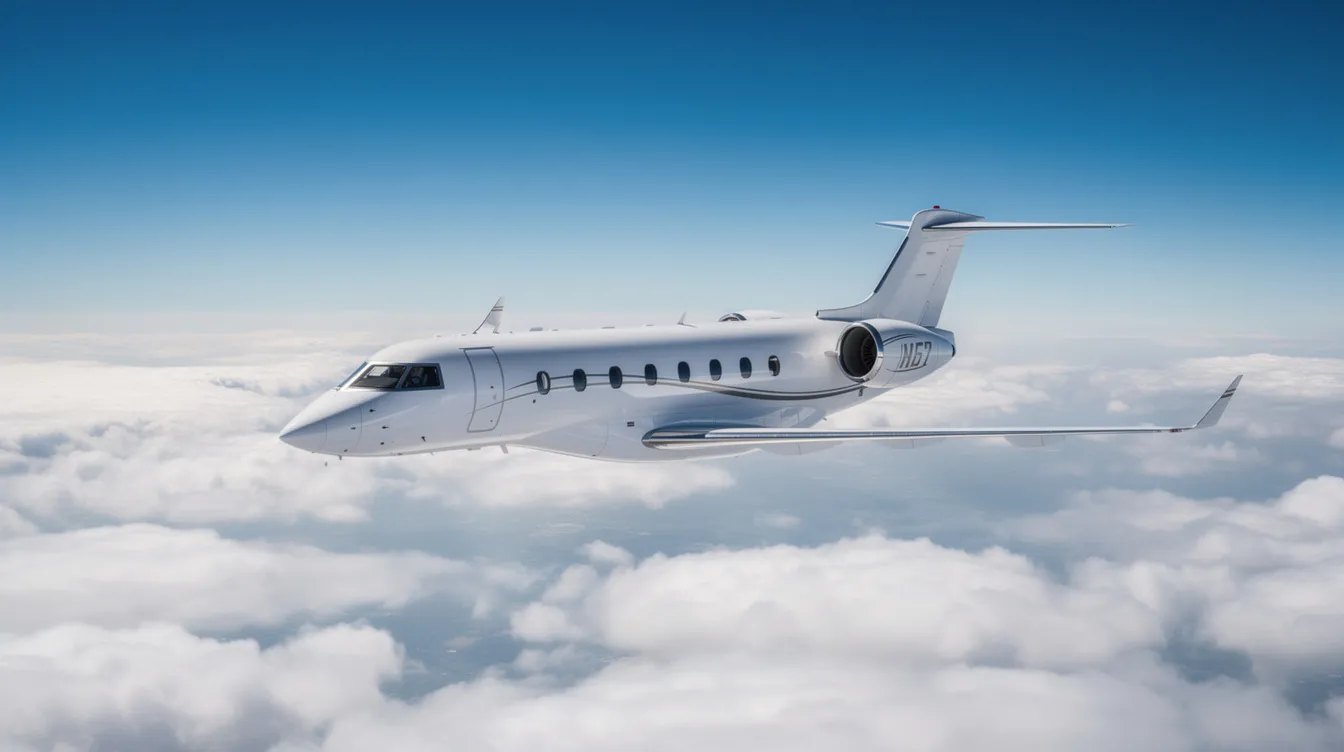
For the discerning traveler, understanding what separates a good flight from a great one often comes down to details invisible at 41,000 feet. Among the most consequential of those details is the wingspan of an aircraft—a single measurement that quietly governs range, ride quality, fuel economy, and even which airports you can access on any given mission.
Executive Overview: Why Wingspan Matters to Private Jet Travelers
Wingspan is the straight line distance measured from one wing tip to the other, across the airplane's centerline. It is independent of wing sweep, dihedral angle, or the presence of winglets. This measurement might seem like an engineering footnote, but it shapes virtually every aspect of your flight experience—from how far the plane can fly without stopping to how smoothly it cuts through turbulence at high altitude.
A longer wingspan improves aerodynamic efficiency and reduces fuel consumption, which translates into extended non-stop range and a quieter, more stable cruise. The Gulfstream G650, for example, spans 99 ft 7 in (approximately 30.4 m) and can connect New York to Dubai without a fuel stop. On the other end of the spectrum, a more compact wingspan-like the roughly 40-foot span of a very light jet—grants access to constrained airports, narrow hangars, and short alpine strips that larger aircraft simply cannot use.
At BlackJet, these aerodynamic trade-offs are translated into practical fleet selection for Jet Card members, supported by a broad portfolio of premium private jet card programs. Whether you need a nimble light jet for a weekend ski trip into a mountain airfield or an ultra-long-range aircraft for a transatlantic board meeting, the right wingspan is matched to your mission behind the scenes.
Fundamentals: How Wingspan Is Defined and Measured
The wingspan of an aircraft is one of the first numbers published on any specification sheet, and it tells you more than you might expect.
Wingspan is measured from wingtip to wingtip in a straight line across the aircraft centerline, ignoring any dihedral (the upward angle of the wings relative to horizontal).
Official values are published by manufacturers in both meters and feet. The Gulfstream G650's certified span, including winglets, is 99 ft 7 in / 30.4 m; the Bombardier Global 7500 comes in at approximately 104 ft / 31.7 m.
Wing shape, sweep angle, and winglets do not change the basic method of measurement, though regulations may specify whether winglets are included in the certified span figure.
The semi-span is one half of the total wingspan, measured from the aircraft centerline to a single wingtip. Engineers rely heavily on semi span models to analyze bending loads, deflection, and flutter behavior, assuming symmetry across the fuselage.
Key Wing Geometry: Span, Chord, Wing Area, and Aspect Ratio
Before exploring how wingspan shapes aircraft performance, it helps to understand the handful of geometric terms that govern wing design.
Wing span (b): the tip-to-tip distance, as defined above.
Wing chord: the distance from the leading edge to the trailing edge of the airplane wing at any given point along the span. The average chord (or mean chord) is this value averaged across the entire wing.
Chord length varies from root to tip on most tapered wings; for a simple rectangular wing, it is constant.
Wing area (S): the projected planform area of both wings. For a rectangular wing, wing area is calculated by multiplying wingspan and chord length: S ≈ b × c.
Aspect ratio (AR): defined as wingspan squared divided by wing area (AR = b² / S), or equivalently span divided by mean chord. Increasing wingspan while decreasing chord raises aspect ratio.
Consider a light jet with a 50-foot wingspan and 300 square feet of wing area. Its aspect ratio works out to (50²) / 300 ≈ 8.3—a moderate figure that balances efficiency with structural simplicity. Typical aspect ratios range from 5 to 30 for various aircraft, while sailplanes often have aspect ratios over 30, optimized purely for lift efficiency in still air.
For BlackJet clients, these parameters underpin what you actually experience: climb rate, cruise speed, fuel burn, runway requirements, and how the aircraft handles turbulence—and they also guide aircraft selection in resources like our guide to the best small private aircraft.
Wing Shapes and Planform: How Designers Use Span to Shape Performance
Aircraft designers do not choose wingspan in isolation-they pair it with a specific planform to balance aerodynamic forces, speed, and structural weight.
Straight wings appear on trainers, turboprops, and some propeller planes. They deliver very high aspect ratio at low cost and excel in slow-speed control, but they generate excessive drag at high speed.
Moderately swept wings are the standard for business jets and commercial airliners. Sweep delays compressibility drag at cruise Mach numbers of 0.80–0.90 while preserving a workable aspect ratio. Long, narrow wings maximize lift efficiency for gliders, but swept wings offer a better balance for jets that must also perform well at takeoff and landing.
Delta or highly swept wings feature on fighter jets and supersonic concepts. Short, broad wings enhance maneuverability in fighter jets, enabling faster roll rates—but they sacrifice cruise efficiency and require longer runways.
Wing shape affects aircraft stability and lift generation across all these categories. For a given wing area, increasing the wingspan and narrowing the chord lowers induced drag, but the added bending moment demands stronger—and heavier—structure.
Modern private jets use tapered, mildly swept wings with winglets to capture many benefits of a longer wing without exceeding airport gate and hangar limits. BlackJet's fleet partners rely on these design choices to deliver range and a smooth cruise while still fitting into major business airports like Teterboro or London Farnborough.
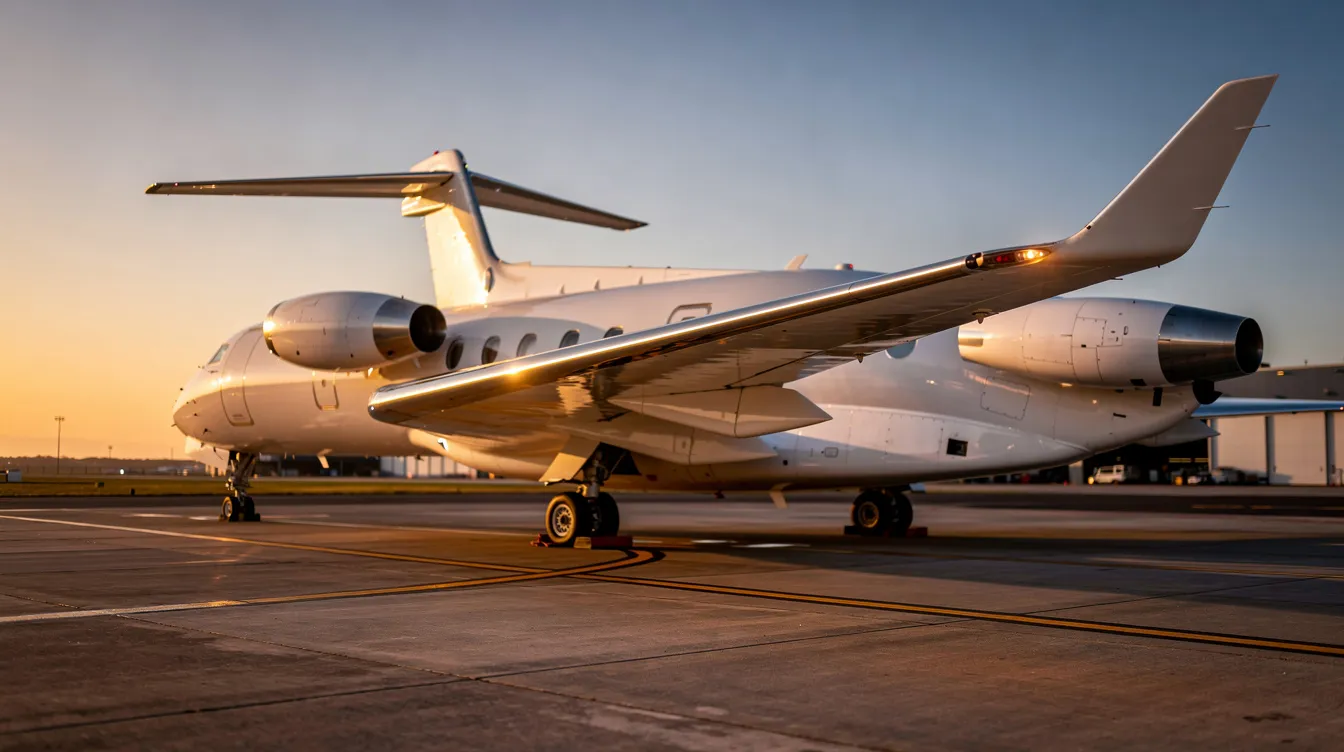
Aerodynamics: Wingspan, Lift, and Drag
The physics behind wingspan are intuitive once you strip away the jargon.
Lift is approximately proportional to wing area at a given speed and angle of attack. Larger wing areas generate more lift for takeoff and landing, which is why heavy, long-range aircraft have expansive wings.
Wing area also affects drag, impacting fuel efficiency and speed. Wing design affects both lift and drag characteristics significantly-every square foot of planform is a compromise between generating more lift and minimizing resistance.
Induced drag is the aerodynamic penalty you pay for producing lift. Higher aspect ratios reduce induced drag for a given lift coefficient, because longer wings spread wingtip vortices farther apart, weakening them. Conversely, induced drag increases with shorter wingspans due to closer wingtip vortices.
Longer wingspans generally increase lift generation and improve the lift-to-drag ratio, making them ideal for aircraft intended to fly long distances. This is why ultra-long-range jets like the Global 7500 carry high aspect ratio wings relative to their category.
Wingspan affects lift and stability in aircraft design simultaneously. Shorter wingspans can enhance aircraft stability in certain regimes but reduce overall lift, pushing designers toward swept wings and advanced flight controls.
The trade-off: a very long wingspan increases bending loads at the wing root, adds structural weight, and raises sensitivity to gusts. Designers counter these forces with composite materials, wing sweep, and careful aerodynamic tailoring.
For BlackJet travelers, these principles translate into longer practical range for a given fuel load, a quieter cruise, and fewer fuel stops on intercontinental missions.
Handling and Airport Constraints: When a Large Wingspan Becomes a Limitation
An aircraft's wingspan is not only an aerodynamic asset—but it is also the single dimension most likely to determine whether you can use a given airport, gate, or hangar.
Airport infrastructure imposes limits on maximum wingspan to ensure operational feasibility. Runway width, taxiway separation, gate clearance, and hangar door span all set hard ceilings on the aircraft that can operate safely.
Wingspan influences an aircraft's gate compatibility at airports. A plane with a 104-foot span simply cannot park at a stand designed for 70-foot aircraft without risking wingtip collisions.
Many corporate hangars are optimized around 60–90 ft wingspans for midsize and super-midsize jets. Ultra-long-range aircraft with spans approaching 100–105 ft require hangar doors of 100–120 ft or more, plus tail-height clearance.
Wider span also requires more careful taxiing, additional ground marshallers, and sometimes time-consuming repositioning at smaller airfields-all factors that can erode the time savings private aviation is intended to provide.
BlackJet's operations team confirms wingspan and aircraft category against every destination's infrastructure before finalizing a booking. Whether you are headed to a constrained city-center airport or an alpine strip, the airplane is pre-cleared for safe, seamless ground handling.
Wingspan Across Aircraft Categories: Light Jets to Ultra-Long-Range
Aircraft are categorized based on wingspan, which determines their operational capabilities—and the experience they deliver to passengers. Here is how span maps to the private jet sizes most relevant to BlackJet members:
Category | Typical Wingspan | Example Models | Mission Profile |
|---|
Very Light Jets | ~35–45 ft | HondaJet Elite II (~39.8 ft), Cirrus Vision Jet (~39 ft) | Regional hops, short runways, 2–4 passengers |
Light Jets | ~45–55 ft | Embraer Phenom 300 (~52 ft), Citation CJ3+ (~53 ft) | 3–5 hour legs, moderate baggage, flexible airport access |
Midsize | ~55–65 ft | Citation XLS+ (~56 ft), Hawker 800XP (~52 ft) | Transcontinental US, 6–8 passengers |
Super-Midsize | ~60–75 ft | Challenger 350 (~69 ft), Citation Latitude (~72 ft) | Coast-to-coast, stand-up cabin, greater wingspan for comfort |
Large Cabin / Ultra-Long-Range | ~80–105 ft | Gulfstream G650ER (~99.6 ft), Global 7500 (~104 ft), G700 (~103 ft) | Intercontinental non-stop, multi-zone cabin, full baggage |
Moving up in wingspan generally brings more cabin volume, range, and baggage capacity but may restrict which secondary airports can be used—a key consideration when evaluating the best private jet for 15 passengers and other large-group configurations. BlackJet's Jet Card structure, including the flexible BlackJet 25+ Hour Jet Card, lets members switch between shorter-span aircraft for regional flights and larger-span jets for intercontinental missions—without owning multiple airplanes.
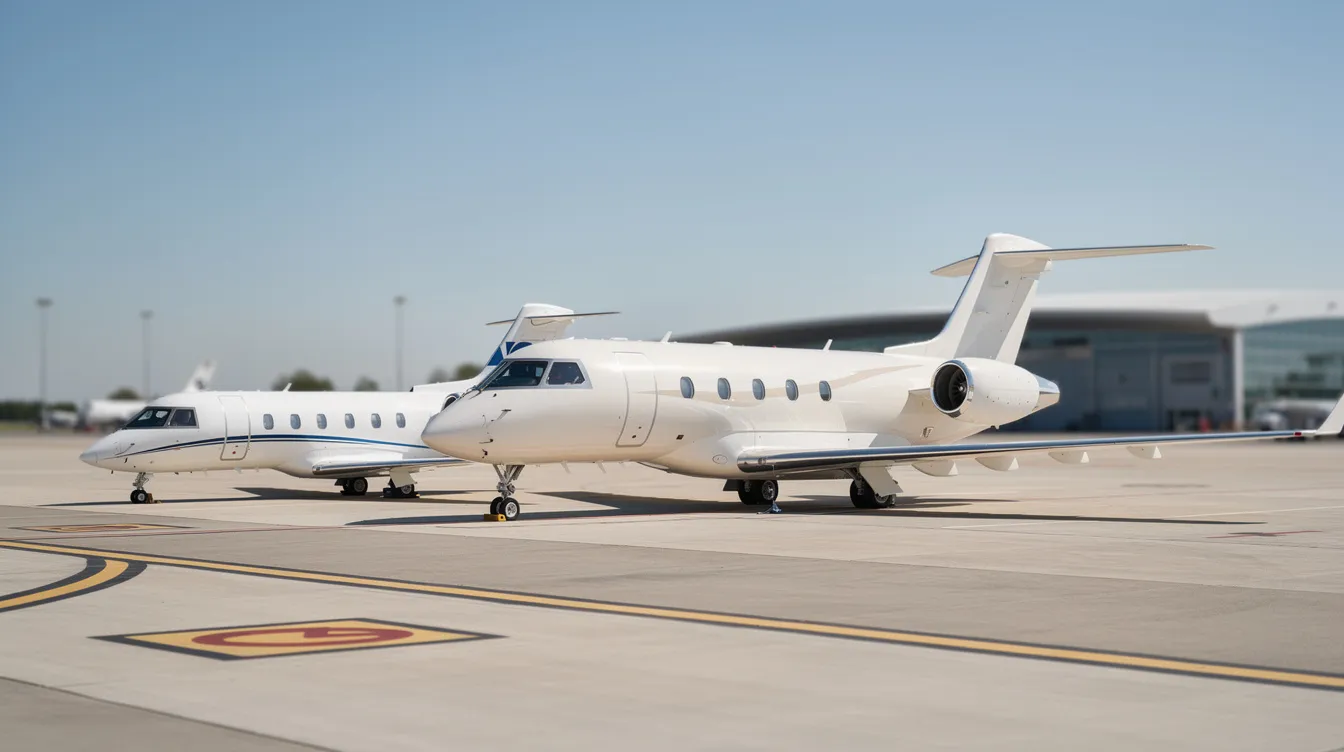
Record-Setting Wingspans: From Combat Aircraft to Giant Transports
Beyond the business jet world, wingspan has driven some of aviation's most remarkable machines, just as it differentiates small private jets for luxury travel from larger aircraft in private aviation. The typical wingspan of a commercial aircraft ranges from about 24 m to nearly 80 m, but several designs have pushed far beyond that.
The Convair B-36 Peacemaker has a wingspan of 230 feet (70.1 m), making it the largest combat aircraft ever built. Its enormous span was essential for the intercontinental range and heavy payload the Cold War mission demanded.
The Antonov An-124, a heavy-lift cargo plane, stretches 240 ft 6 in (73.3 m) from wingtip to wingtip. That greater wingspan supports a massive wing area, enabling the airplane to carry payloads exceeding 150 tons.
The Airbus A380 has a wingspan of 261 feet 8 inches (79.8 m). Its span was deliberately designed to stay within the upper boundary of ICAO Code F gate limits at major hubs, illustrating how airport infrastructure constrains even the most ambitious airliner design. Boeing, for its part, also had to balance fuselage lengths and span on the 747 and 777X families against the same code limits.
These extreme-span aircraft illustrate the constant tension between aerodynamic efficiency and airport compatibility-a tension that smaller business jets must also navigate every day.
The Largest Wingspan Ever: Spruce Goose, Stratolaunch, and Beyond
Two aircraft hold special places in the record books for sheer span, and both reveal how the same principles that shape private jets scale to extraordinary dimensions.
The Hughes H-4 "Spruce Goose" had a wingspan of 320 ft 11 in (97.5 m) and completed its first flight—and only flight—on November 2, 1947. This massive flying boat, a waterplane at heart, relied on an enormous wing area and modest wing loading to generate enough lift for heavy cargo over relatively short distances. It never entered regular service, but it proved that vast wingspan could, in principle, lift tremendous weight.
The Scaled Composites Model 351 Stratolaunch—known as "Roc" — now holds the record for the longest wingspan ever flown, at 385 feet (approximately 117 m). Its twin-fuselage design, which completed its first flight on April 13, 2019, was intended for air-launching hypersonic and orbital vehicles at high altitude.
While such spans are far beyond private jet needs, the same aerodynamic principles-span, aspect ratio, and wing loading—govern all aircraft, including those in the BlackJet partner fleet. Every foot of span is a deliberate choice between lift, drag, weight, and ground compatibility.
Wingspan, Winglets, and Modern Efficiency Tricks
One of the most visible innovations on modern business jets is the winglet—a curved or angled extension at each wingtip that alters effective wingspan without dramatically increasing physical span.
Winglets reduce wingtip vortices and induced drag, acting like a virtual increase in span. On many business jets, they improve fuel burn by three to five percent, compounding into significant savings over thousands of flight hours.
Winglets increase effective aspect ratio without adding span, which means designers can stay within airport and hangar clearance limits while capturing much of the performance benefit a longer wing would provide.
Compare older straight-tipped business jet wings to the blended winglets on the Gulfstream G650 or the raked tips on the Bombardier Global 7500 and the Dassault Falcon 8X: these modern devices improve aerodynamic characteristics at cruise while keeping the plane's wingspan within practical bounds.
Foldable wingtips are utilized on some new-generation commercial airliners, like the Boeing 777X, to fit large wings into standard airport gates—a concept that could eventually trickle down to business aviation.
Published wingspan figures often include winglets, which can affect airport code classification and hangar fit. BlackJet's operations team verifies actual certified span against each destination's infrastructure.
These efficiency gains directly support sustainability. Lower fuel consumption per hour means fewer emissions, which BlackJet complements with carbon-neutral flight commitments and offset programs included at no extra cost to members, alongside guidance on the most affordable private jet options for efficiency-minded travelers.
Wingspan and Flight Experience: Ride Quality, Noise, and Cabin Comfort
Passengers rarely think about wing geometry, yet it subtly shapes every moment of a flight.
Wings with high aspect ratios can reduce the severity of turbulence-induced vertical accelerations, contributing to a smoother ride. Lift changes occur more gradually across a longer wing, so passengers feel less abrupt jolting.
Wing placement and span influence cabin noise levels, engine mounting options, and fuel tank volume. Longer-span wings that position engines farther outboard or allow better vibration isolation create a quieter cabin environment.
Cabin volume and range often correlate with wingspan. A larger wing box holds more fuel, enabling non-stop range, while the structural depth of the wing can support a wider, taller fuselage cross-section.
Consider a BlackJet member flying New York to Los Angeles on a super-midsize jet with a 69-foot wingspan and a high aspect ratio wing design. That aircraft cruises at Mach 0.80, burns fuel efficiently enough to fly non-stop, and delivers cabin noise levels markedly lower than a smaller light jet covering the same distance with a fuel stop. The traveler experiences the outcome of wingspan without ever calculating it.
Engineering Trade-offs: Structure, Materials, and Semi Span Analysis
Every extra foot of span adds bending loads the structure must carry, creating a direct trade-off between aerodynamic ambition and structural cost—just as every extra hour of guaranteed access affects overall jet card cost and value.
Engineers analyze a semi-span to model one half of the wing, assuming symmetry, when calculating bending moment, deflection, and flutter risks. This approach simplifies an enormously complex problem while ensuring safety margins are met.
Bending moments scale roughly with the square of span; aircraft with larger wingspans generally require more structural reinforcement at the wing root, heavier spar caps, and wider wing boxes.
Trade-offs in wingspan design involve balancing aerodynamic efficiency and structural demands. Long, slender aspect ratio wings rely on advanced materials—carbon fiber composites, titanium fittings—to keep weight down while maintaining stiffness and meeting certification load factors (typically 1.5 times design loads).
Many new-generation business jets use composite wing components to safely extend aspect ratio and range without compromising maximum takeoff weight limits or certification standards.
BlackJet's safety-first approach includes partnering only with operators whose fleets meet or exceed rigorous structural inspection regimes tied to these engineering realities—fatigue monitoring, corrosion checks, and wing root inspections performed on schedule and without exception.
Regulation, Safety, and Certification Around Wingspan
Wingspan does not exist in a regulatory vacuum. It connects directly to how airports are designed, how aircraft are classified, and how safety is enforced.
Aviation authorities classify aircraft sizes using ICAO Aerodrome Reference Codes, which assign categories (A through F) based on wingspan and outer main landing gear span. Code F accommodates wingspans from 65 m up to 80 m; most business jets fall into Code C or D.
Every certified business jet has undergone structural and aerodynamic testing to validate wing strength, flutter margins, and stall behavior across its entire wingspan—from wing root to the tip of each winglet.
Maintenance inspections monitor for wing fatigue, corrosion, and damage, especially in high-cycle charter aircraft that accumulate many takeoff and landing cycles per year.
BlackJet works exclusively with audited, safety-rated operators—those certified by organizations such as ARGUS, Wyvern, and IS-BAO where applicable—to ensure that these wingspan-related structural standards are continuously upheld, similar to the rigor applied when evaluating providers in our Flexjet jet card cost guide. This is not optional; it is foundational to every flight.
Sustainability: Wingspan, Fuel Burn, and Carbon-Neutral Private Flights
Wingspan and aspect ratio are not just performance metrics-they are environmental levers.
For a given payload and range, aircraft with well-optimized wingspans and high aspect ratios generally burn less fuel per mile than shorter, low aspect ratio wing alternatives. A longer wingspan improves aerodynamic efficiency, which directly lowers CO₂ output per nautical mile—paralleling how smarter jet card pricing structures can improve the economic efficiency of frequent flying.
Incremental improvements-longer wings, smarter winglets, lighter composite materials—have cut fuel burn by double-digit percentages in modern fuel-efficient private jets compared with 1990s-era designs, enhancing the value proposition of the best jet cards for frequent flyers.
BlackJet layers carbon-neutral commitments on top of these efficiency gains by automatically offsetting the CO₂ footprint of each flight at no extra cost to members, which can complement strategies to maximize jet card tax deductions for qualifying business travelers.
Informed aircraft selection matters: choosing a right-sized, efficient type rather than an over-large jet for a short mission can materially reduce a traveler's environmental impact—saving fuel, reducing drag, and producing fewer emissions per passenger mile—just as informed provider selection matters when comparing NetJets jet card costs.
Choosing the Right Wingspan for Your Mission with a Jet Card
Wingspan considerations translate into real booking decisions, even if you never think about them directly.
Factors to consider: airport size and taxiway width, runway length, trip distance, passenger count, baggage volume, and ground transportation logistics. Each is indirectly tied to the wingspan of the aircraft best suited for the job, just as factors like projected usage and routing shape the true cost of a 100 hour Jet Card.
Scenario 1: A 4-passenger weekend flight from London City to Courchevel. This mission favors a compact-wingspan light jet with short-field performance and the maneuverability to handle narrow alpine taxiways—an airplane with a span under 55 feet, which aligns well with the use cases described in our complete guide to 25-hour jet cards.
Scenario 2: A 10-passenger business trip from New York to Geneva, non-stop, can be an ideal match for travelers evaluating 50 hour jet card programs that balance range, availability, and predictable cost. Here, a large-cabin jet with a wingspan near 100–104 feet is the right tool-delivering four-zone cabin comfort, full baggage capacity, and the range to cross the Atlantic without diversion—and similar design logic applies when selecting the best private jet for 20 passengers.
BlackJet's digital booking tools and real-time flight support team surface suitable aircraft categories without requiring you to understand every aerodynamic detail, while resources like our private jet price list guide help frame the cost implications of those choices. The platform matches aircraft performance to your itinerary, ensuring the right balance of wingspan, cabin class, and airport compatibility on every leg.
Ready to unlock flexible access to the right aircraft for every mission? Explore BlackJet's Jet Card options, including unlimited private jet flight memberships, and discover how a single membership connects you to the full spectrum of cabin classes, wingspans, and capabilities.

Frequently Asked Questions About Wingspan and Private Jets
How does wingspan differ from wing area, and why does it matter when comparing two jets? Wingspan is the tip-to-tip distance; wing area is the total planform surface of both wings. Two jets with similar cabin sizes can have different wing areas and aspect ratios, affecting range, fuel burn, and runway requirements. Wing area determines an aircraft's lift capacity, while wingspan governs how efficiently that lift is produced.
Does a larger wingspan always mean a smoother or safer flight? Not necessarily. While higher aspect ratios from a greater wingspan can dampen certain turbulence effects and reduce induced drag, safety is driven by certification standards, pilot training, and operator procedures—not by size alone. Shorter wings allow for faster roll rates and maneuverability, which can be advantageous in different flight regimes.
How does wingspan affect which airports BlackJet members can use? Wingspan directly determines whether an aircraft fits a given taxiway, gate, or hangar. Popular city-center airports and ski-destination strips often have tight span limits. BlackJet pre-clears every aircraft against destination infrastructure so members can land at airports where private jets are welcome.
Will future sustainable aircraft have different wingspans or wing shapes? Likely. Hybrid-electric and hydrogen concepts may feature even longer spans, morphing winglets, or foldable wingtips to optimize for both aerodynamic efficiency and airport compatibility. These innovations build on the same principles governing today's jets—higher aspect ratios to reduce induced drag and improve fuel economy, even for very large-group charters like private jets for 50 passengers.
How much does a typical traveler really need to know about wingspan? Very little in practical terms. Wingspan underpins range, comfort, and airport access, but BlackJet's experts handle the technical evaluation behind every aircraft recommendation, whether you're chartering a whole aircraft or simply buying a seat on a private jet. Your role is to define the mission; ours is to match the right airplane to it—seamlessly.
Conclusion: Wingspan as a Strategic Advantage in Private Jet Travel
Understanding the wingspan of an aircraft is far more than an academic exercise—it is a strategic consideration that shapes every facet of private jet travel. From extending your range and improving fuel efficiency to ensuring access at exclusive or constrained airports, wingspan influences the seamless luxury and operational flexibility you expect.
At BlackJet, we translate these aerodynamic and engineering principles into curated fleet options that align with your mission profile, whether that’s a nimble light jet for quick regional hops or an ultra-long-range aircraft for global business engagements. Our commitment to safety, sustainability, and cutting-edge technology ensures that every flight benefits from the latest advances in wing design and materials.
As you explore private jet membership and Jet Card programs, remember that wingspan is a key factor behind the scenes—one that delivers tangible benefits in performance, comfort, and environmental impact. Discover how BlackJet can elevate your travel experience by connecting you to the perfect aircraft, optimized for your itinerary and destination.
Elevate your journey with BlackJet—where every wingbeat counts.


 Sign up with google
 Sign up with Apple