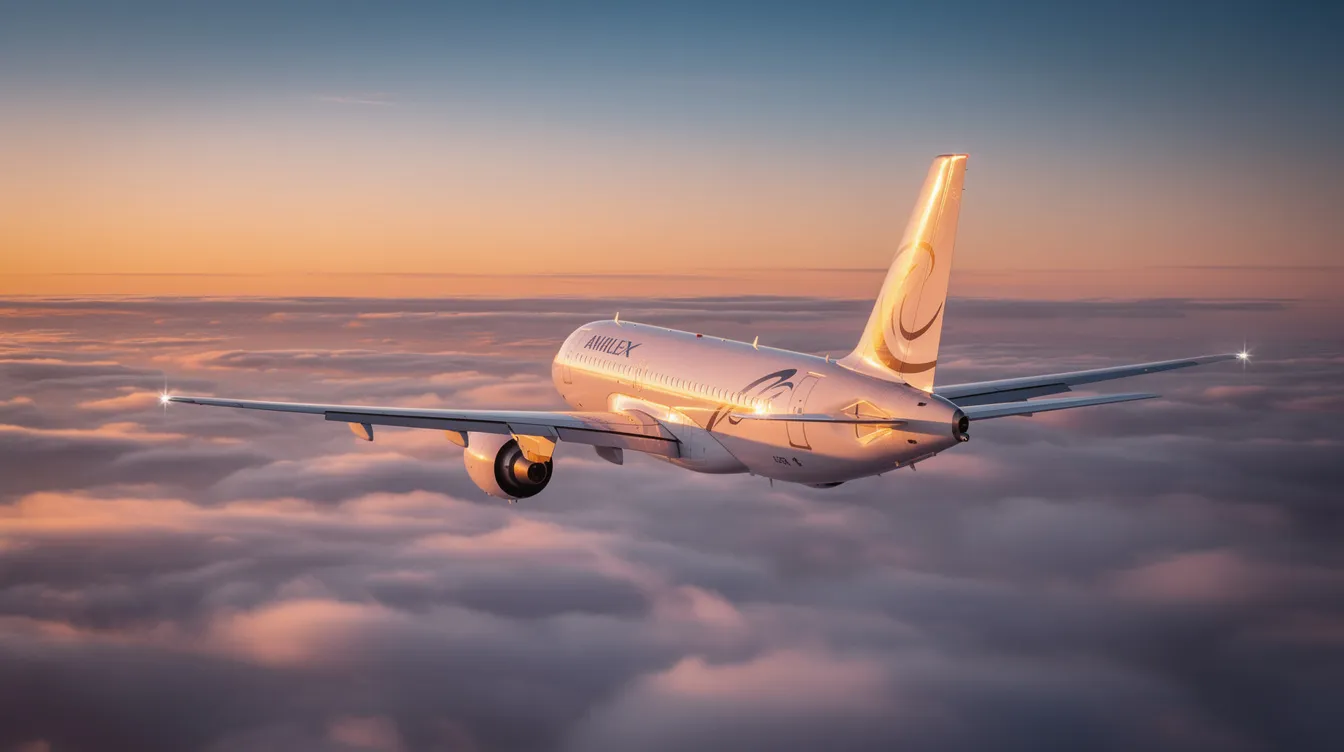
The aviation industry is entering its most transformative decade since the jet age. A wave of new passenger plane models - from the Airbus A321XLR to the Boeing 777X and radical blended wing body concepts - is reshaping what it means to fly, whether in a commercial cabin or aboard a private jet. For high-net-worth travelers and executives, understanding these shifts is no longer optional; it is a strategic imperative.
Why the new generation of passenger planes matters for high-end travelers
The late 2020s mark a turning point for passenger aircraft. Aircraft manufacturers are delivering airframes that fly farther on less fuel, reach city pairs that previously required connections, and offer cabin environments that rival what first class delivered just a decade ago. For discerning travelers, these gains translate into fewer stops, lower emissions, and meaningfully better comfort on long-haul routes aboard next-generation commercial aircraft.
Yet even the most advanced commercial airplane cannot eliminate the friction points that cost executives time: mandatory early arrivals, security queues, hub connections, and rigid schedules. Commercial carriers report an average on-time performance near 75%, while BlackJet Certified private jet operators routinely exceed 97%. Over the course of a year, a frequent traveler making 40 or more round-trip flights can recover hundreds of hours by avoiding connections alone - that compounds into a genuine competitive edge.
This is precisely why many BlackJet members adopt a blended approach. They fly premium commercial on fuel-efficient aircraft like the A350-1000 for intercontinental legs, then switch to a BlackJet Jet Card for regional and last-mile sectors where schedule control, privacy, and access to smaller airports matter most, leveraging BlackJet’s premium private jet card programs to integrate seamlessly with commercial itineraries. The result is a travel architecture that leverages the best of both worlds - the range and economics of new passenger planes plus the flexibility and discretion of private aviation.
The new era of fuel-efficient passenger aircraft
Airlines and aircraft manufacturers are racing to reduce fuel consumption and meet ambitious 2030–2050 climate targets. High fuel costs, regulatory pressure from CORSIA and the EU emissions framework, and growing passenger demand for sustainable travel are reshaping the aviation market for new aircraft technology, making fuel efficiency the single most important design criterion for every new aircraft program.
The results are tangible. The A320neo family offers 20% lower fuel burn than earlier models, while the Airbus A321XLR has over 20% lower fuel burn compared to previous-generation single-aisle aircraft. The Boeing 777-9 provides a 20% reduction in fuel use and emissions versus the 777-300ER it replaces, and the A350 uses 25% less fuel than previous generation aircraft in its widebody class. New engine options and aerodynamic modifications reduce fuel burn by up to 30% on certain variants when measured per seat. Major manufacturers are focusing on ultra-efficient aircraft with extended ranges, opening city pairs that were uneconomical just five years ago.
How is this achieved? Higher bypass ratio engines like the GE9X and LEAP family extract more thrust per unit of fuel. Modern aircraft prioritize lightweight materials to reduce structural fatigue and overall weight - the A350 family, for instance, incorporates roughly 70% advanced composites by structural weight. Improved winglets, optimized flap systems, and cleaner laminar-flow wing surfaces all contribute to reduced weight, less drag, and better overall fuel efficiency.
These trends extend to private aviation. BlackJet prioritizes access to newer, more fuel-efficient airplanes in its network - late-model airframes with modern engines and well-maintained interiors that mirror the commercial sector's commitment to lower emissions.
Single-aisle aircraft: the backbone of next-generation commercial travel
Single-aisle aircraft account for the vast majority of global departures. They power short-haul routes, domestic networks, and - increasingly - transatlantic and "long thin" markets where demand is strong enough for frequent service but insufficient for a widebody. For airlines like United Airlines and Delta Air Lines, next-generation narrowbodies are the key part of fleet renewal strategies through the 2030s.
Here are the models defining this category:
Airbus A220 family - The A220 has 25% lower fuel burn per seat than predecessors. The A220-300 carries up to 160 passengers, and the A220 has a maximum range of 3,600 nautical miles, powered by Pratt & Whitney GTF engines with exceptionally quiet cabin performance.
A320neo / A321neo / A321XLR - The XLR variant is the standout: the Airbus A321XLR can fly up to 4,700 nautical miles with an extra rear center fuel tank, enabling nonstop routes from the U.S. East Coast to Western Europe on a single aisle aircraft. Seat capacity in two-class layouts ranges from roughly 180 to 220 passengers.
Boeing 737 MAX 8 / MAX 9 - Equipped with LEAP-1B engines and advanced split-scimitar winglets, the MAX family delivers 15–20% lower fuel burn versus the 737 NG, with a range of around 3,500 nautical miles.
COMAC C919 - China's answer to the A320neo, seating 158–168 passengers with an extended range version capable of roughly 3,000 nautical miles. Its fuel consumption improvements over old-generation aircraft are estimated at 10–15%, though it trails the A320neo and MAX in overall efficiency.
Irkut MC-21 - A Russian-developed narrowbody with variants seating 163–211 passengers and a range of around 6,000 km. It features extensive composite wing construction and competitive seat-km fuel burn figures.
What makes these aircraft "next generation" extends beyond engines. Higher bypass ratio turbofans, advanced winglets, cabin-flex layouts, quieter cabins, and even lie-flat narrowbody business class on routes served by the A321XLR are changing the passenger experience. Still, for travelers who value absolute flexibility, the ability to choose aircraft by type through a private jet card remains unmatched - no fixed schedule, no shared cabin, no hub dependency, and the freedom to select among different types of private jets for every traveler.
Widebody and super jet developments: long-range comfort reimagined
Widebody passenger jets remain indispensable for ultra-long-haul routes across oceans and continents. The latest models from Airbus and Boeing combine efficiency gains with cabin innovations that substantially reduce traveler fatigue.
Key widebody developments include:
Airbus A330neo - Updated with Rolls-Royce Trent 7000 engines, offering range up to approximately 8,100 nautical miles and significant per-seat fuel reductions versus the A330ceo.
A350-900 / A350-1000 - The A350-1000 seats 350–410 passengers in a typical three-class configuration with a range up to roughly 9,000 nautical miles. The A350 uses 25% less fuel than previous generation aircraft, achieved through composite construction, advanced aerodynamics, and efficient Rolls-Royce XWB engines.
Boeing 777X - The 777-9 variant delivers 20% lower fuel use and emissions versus its predecessor, with approximately 10% lower operating costs. Its GE9X engines are the world's largest and most efficient commercial powerplants. Folding wingtips help large aircraft like the 777X fit into standard airport gates - a practical solution that preserves existing airport infrastructure while accommodating a wider fuselage and longer wingspan.
A380 - No longer in production but still operated by carriers, including Emirates. The A380 is the world's largest passenger aircraft, seating 853 in maximum-density configuration. Its economics, however, increasingly favor retirement in favor of more efficient twin-engine widebodies.
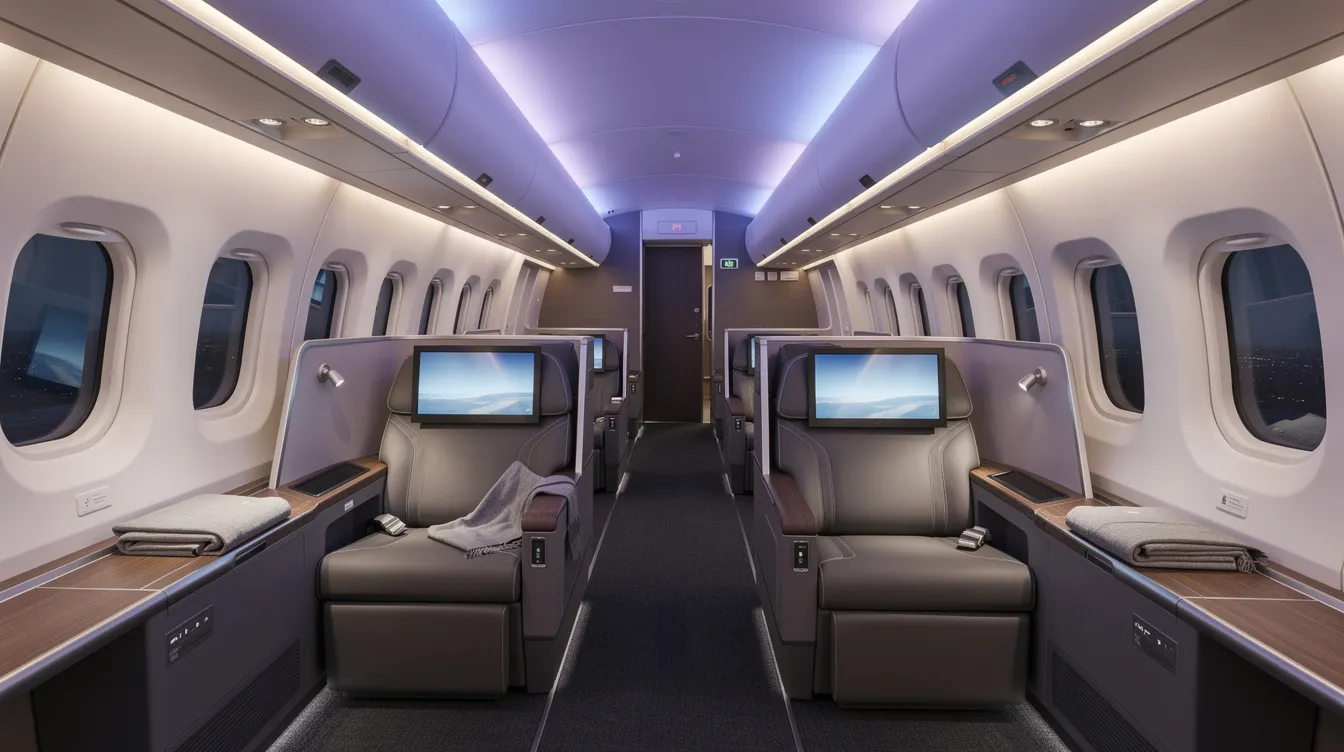
Comfort advances across these models include larger windows, LED mood lighting, advanced HEPA air filtration, lower cabin altitude, and higher humidity - features that composite materials allow by enabling better pressurization without the corrosion concerns of aluminum. For transatlantic private jet travelers, these commercial cabins are now closer in well-being to what the newest private jets combining innovation and luxury deliver, though privacy and schedule control remain exclusive to private flight.
Worth noting: emerging supersonic projects like Boom Overture aim to halve transoceanic travel times. While not expected in mainstream service until the 2030s, supersonic development could eventually complement private aviation for time-critical routes, a space BlackJet monitors closely.
Blended wing body and radical new designs
The most radical departure from conventional airplane design is the blended wing body - an aircraft architecture that merges fuselage and wing into a single lifting surface, eliminating the traditional tube-and-wing configuration. Blended wing body aircraft are being developed for better fuel efficiency, promising gains that incremental improvements to existing aircraft cannot match.
The most visible program is JetZero, a U.S. company whose blended wing design aims for 50% fuel efficiency improvement over conventional aircraft of equivalent size. JetZero received a $235 million grant from the U.S. Air Force to build and fly a full-scale demonstrator expected around 2027, with that milestone intended to lead to a first flight around the same timeframe. Its Pathfinder demonstrator - a 12.5% scale model with a 23-foot wingspan - already holds FAA Airworthiness certification and has completed flight tests, validating the core aerodynamic concept. JetZero's blended wing body can reduce fuel burn by 50%, an ambition that, if achieved at full scale, would represent the largest single efficiency leap in commercial aviation history.
Industry interest is growing. Delta Air Lines partners with JetZero to develop a blended wing aircraft, signaling that major airlines see this concept as viable for future fleet planning. The U.S. Air Force backing - via the same grant - also positions the design for potential military aircraft applications, where range, fuel efficiency, and payload are equally critical. Richard Aboulafia, a respected aviation analyst, has noted that blended wing designs represent a genuine generational shift, not merely an incremental evolution.
The practical implications are significant: a blended wing design produces less drag, less noise, and higher lift efficiency than tube-and-wing configurations. The wider fuselage and larger internal volume could transform cabin layouts, offering more space per passenger. However, key technical challenges persist - pressurizing a non-cylindrical fuselage section, certifying emergency egress pathways, and managing structural loads in a fundamentally different airframe shape. Past experimental aircraft, including NASA's X-48 series and insights drawn from the B-2 bomber lineage, inform current development, but full-scale civil certification remains years away.
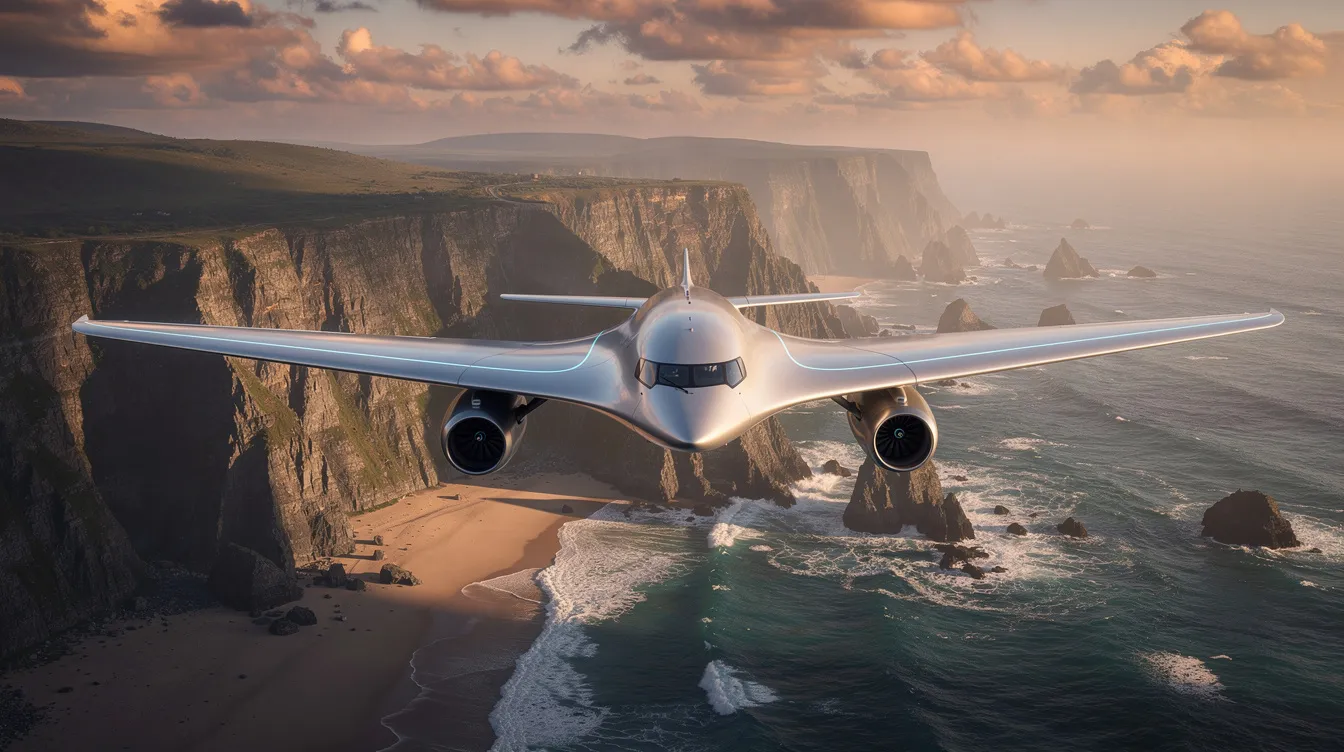
While blended wing aircraft will not be mainstream this decade, their development signals where next-generation commercial aircraft design is heading. BlackJet monitors these programs - and advances in related areas like hydrogen fuel propulsion - for future integration into its private aviation ecosystem, using tools such as an advanced private jet flight time calculator to plan routes that fully exploit future performance gains, ensuring members will always have access to the most advanced, efficient aircraft available in the near future.
Sustainable aviation fuel and decarbonising the passenger plane
The rise of sustainable aviation fuel is inseparable from the new passenger plane narrative. As commercial passenger planes focus on ultra-high fuel efficiency and sustainable aviation fuels simultaneously, the industry's path toward decarbonisation accelerates.
SAF is produced from waste oils, biomass, agricultural residues, or synthetic power-to-liquid pathways. Sustainable aviation fuel can lower CO2 emissions by as much as 80% compared to conventional Jet A-1 throughout its entire lifecycle. Today, new aircraft are certified to run on up to 50% sustainable aviation fuel - and all Airbus aircraft can fly using a 50% SAF blend. Flight tests are underway toward 100% SAF capability, with Airbus targeting full certification by 2030 and aiming for 30% SAF in its global fuel mix by that date. Japan Airlines and other major carriers have committed to increasing SAF procurement across their fleets through the decade.
Beyond SAF, airlines aim for a future with hydrogen-powered aircraft as part of the industry's longer-term goal of zero emissions in aviation. Airbus's ZEROe concepts explore hydrogen fuel turbofan and fuel-cell configurations for regional and short-haul aircraft, targeting entry in the 2035–2040 horizon. Hybrid-electric propulsion, while still constrained by battery energy density, is another avenue under active development for regional commuter models, just as innovative models like private plane rideshare options are reshaping how travelers access efficient, lower-impact private flights today.
BlackJet's stance is straightforward: every BlackJet flight is carbon neutral through verified offset projects at no extra cost to members. Looking ahead, BlackJet is expanding access to SAF from select hubs, aligning private jet travel with the broader aviation industry's sustainability trajectory. For members who care about emissions as much as efficiency, and who closely evaluate how safe private jets are relative to commercial options, this is a meaningful differentiator.
How new passenger planes compare to private jet access with BlackJet
Flying business class on a new fuel-efficient commercial aircraft like the A350-1000 or 777X is, by any measure, a superior experience to what airlines offered a decade ago. But the comparison with private jet access via a Jet Card reveals where commercial aviation, however advanced, still falls short.
Dimension | New Commercial Aircraft (Premium Cabin) | BlackJet Private Jet (Jet Card) |
|---|
Door-to-door time | 1.5–3 hr pre-departure + potential connections | 15–30 min pre-departure, direct routing |
Schedule control | Fixed timetables, rebooking fees | Depart when ready, dynamic adjustments |
Privacy | Shared cabin, 20–60 premium passengers | Exclusive cabin, full discretion |
Airport access | Major hubs only | 5,000+ airports, including regional fields |
Cabin personalization | Standard service tiers | Bespoke catering, pet-friendly, custom setup |
Consider a concrete scenario: a New York–based executive flies business class on an A350-1000 nonstop from JFK to London Heathrow. Upon arrival, she needs to reach Geneva for an afternoon meeting. Commercially, that means a connecting flight, additional security, and at least three hours of transit. With BlackJet, a pre-positioned light or midsize jet departs from a London-area private terminal within the hour, landing at Geneva's general aviation facility 90 minutes later - door to meeting in under two hours.
BlackJet curates aircraft across categories - light, midsize, super-midsize, and large-cabin - so members always operate on modern, efficient models suited to each leg. Understanding private jet sizes and how to find the right fit for your journey is central to this matching process. The co-founder's vision behind BlackJet's model is that private flight should complement the evolving commercial fleet: when travelers need absolute control, speed, and discretion, they choose BlackJet over even the world's most advanced passenger jets.
Safety, certification, and passenger well-being in modern aircraft
Safety is the foundation of every new passenger plane program. From the A220 through the 777X and new entrants like the C919 and MC-21, each type undergoes thousands of hours of flight tests, structural stress evaluations, and avionics verification before entering service. Airbus collaborates with industry partners on safety and innovation across its entire product line, and Boeing's certification process for the 777X includes the most advanced flight control system architecture in its commercial fleet history.
Modern planes feature lower cabin altitudes and improved air filtration systems - passengers on an A350 experience cabin pressure equivalent to roughly 6,000 feet rather than 8,000, reducing fatigue and dehydration on long flights. Composite materials allow for higher cabin humidity and better pressurization because they resist corrosion, enabling airline designers to maintain healthier cabin environments without compromising structural integrity.
BlackJet applies equally rigorous standards to private flights. Its safety framework requires every operator, aircraft, and pilot to meet criteria that exceed FAA Part 135 minimums - fewer than 30% of U.S. charter operators qualify. Dual-pilot crews, minimum captain hours on type, recurrent simulator training, and real-time operational oversight ensure that BlackJet members experience travel that is both cutting-edge and consistently protected, while transparent private jet price lists and cost structures help them align safety, comfort, and budget.
Technology, connectivity, and the digital passenger experience
Technology now defines the flying experience from cockpit to cabin. Advanced aircraft utilize AI for optimizing flight routing and efficiency, calculating fuel-optimal cruise profiles in real time, and adjusting for weather, wind, and air traffic constraints. More-electric architectures replace legacy hydraulic and pneumatic systems, improving dispatch reliability and reducing maintenance downtime.
In the cabin, high-speed broadband connectivity is being integrated into passenger planes across all major carriers, enabling streaming, real-time communications, and productive work sessions at 40,000 feet. Smart LED lighting systems, powered by new engine electrical generation capacity, help regulate circadian rhythms on long-haul routes. Predictive maintenance systems flag component issues before they cause delays, keeping aircraft in service and schedules intact.
BlackJet mirrors these advances on the private side. Members enjoy 24/7 access to mobile booking tools, receive real-time flight assistance, and benefit from clear, upfront pricing based on Jet Card hours, underpinned by a clear understanding of jet card pricing, costs, and benefits. Digital itineraries integrate with calendars and travel management systems. Behind the scenes, BlackJet's platform matches each trip with the optimal aircraft type - light jet for a two-hour hop, super midsize for a cross-country leg - keeping the process effortless while the technology works in the background.

Frequently asked questions about new passenger planes and private jet access.
These questions address what high-net-worth and executive travelers most commonly ask about next-generation passenger aircraft and how BlackJet fits into the picture.
What are the most important new passenger plane models I should know about?
The key models include the Airbus A220, A320neo/A321XLR, Boeing 737 MAX family, A330neo, A350-900/A350-1000, Boeing 777X, COMAC C919, and Irkut MC-21. On the horizon, blended wing body concepts from JetZero represent the next frontier in aircraft development.
How fuel-efficient are next-generation commercial aircraft compared to older jets?
Depending on the model, improvements in fuel burn per seat range from approximately 15% to 30% versus previous-generation equivalents. These gains lower airline operating costs and gradually reduce ticket pricing on competitive routes, while also cutting emissions per passenger.
Can these new passenger planes fly using sustainable aviation fuel?
Yes. Current Airbus and Boeing families are certified for up to 50% SAF blend, with flight tests progressing toward 100% SAF capability. SAF adoption is expected to accelerate through 2030 as production scales and regulatory frameworks mature.
Why would I still use a private jet if commercial aircraft are improving so quickly?
Commercial aircraft improvements enhance comfort and efficiency, but cannot replicate the schedule control, secondary airport access, privacy, and personalization that private jets deliver. A Jet Card membership makes private access prepaid and predictable - a strategic layer on top of commercial travel, not a replacement, and resources outlining the best jet cards for frequent flyers can help travelers choose the right structure.
How does BlackJet ensure safety and sustainability on private flights?
BlackJet vets every operator through independent safety audits, requires crew experience well above regulatory minimums, and maintains real-time operational oversight. Every flight is carbon neutral via verified offset programs, with SAF integration expanding at select hubs, and programs like the BlackJet 25+ Hour Jet Card are structured to keep this high standard consistent across frequent travel.
How BlackJet reshapes premium travel in the age of next-generation aircraft
The convergence of fuel-efficient passenger planes, sustainable aviation fuel, and forward-looking designs like the blended wing body is transforming global aviation at a pace not seen in decades. Every new aircraft entering service - from the A321XLR opening transatlantic narrowbody routes to the 777X setting new widebody efficiency benchmarks - raises the baseline for what passengers can expect in the sky.
For discerning travelers, the real advantage lies not in choosing between commercial and private, but in knowing when to deploy each. BlackJet's Jet Card programs give members prepaid, flexible access to modern, safe, and capable private jets that complement the best of commercial aviation - without the friction, without the compromises, and with carbon-neutral performance built in from the start, and an understanding of 50-hour Jet Card costs and value helps frame that access as a strategic investment.
Elevate your travel - effortlessly. Explore BlackJet's Jet Card programs and discover how seamless, carbon-neutral private flight becomes your new standard. As the industry evolves toward fully SAF-powered and potentially hydrogen or blended wing designs, BlackJet will continue to curate the most advanced, efficient aircraft for its members - ensuring you always fly at the leading edge of what aviation can offer.


 Sign up with google
 Sign up with Apple