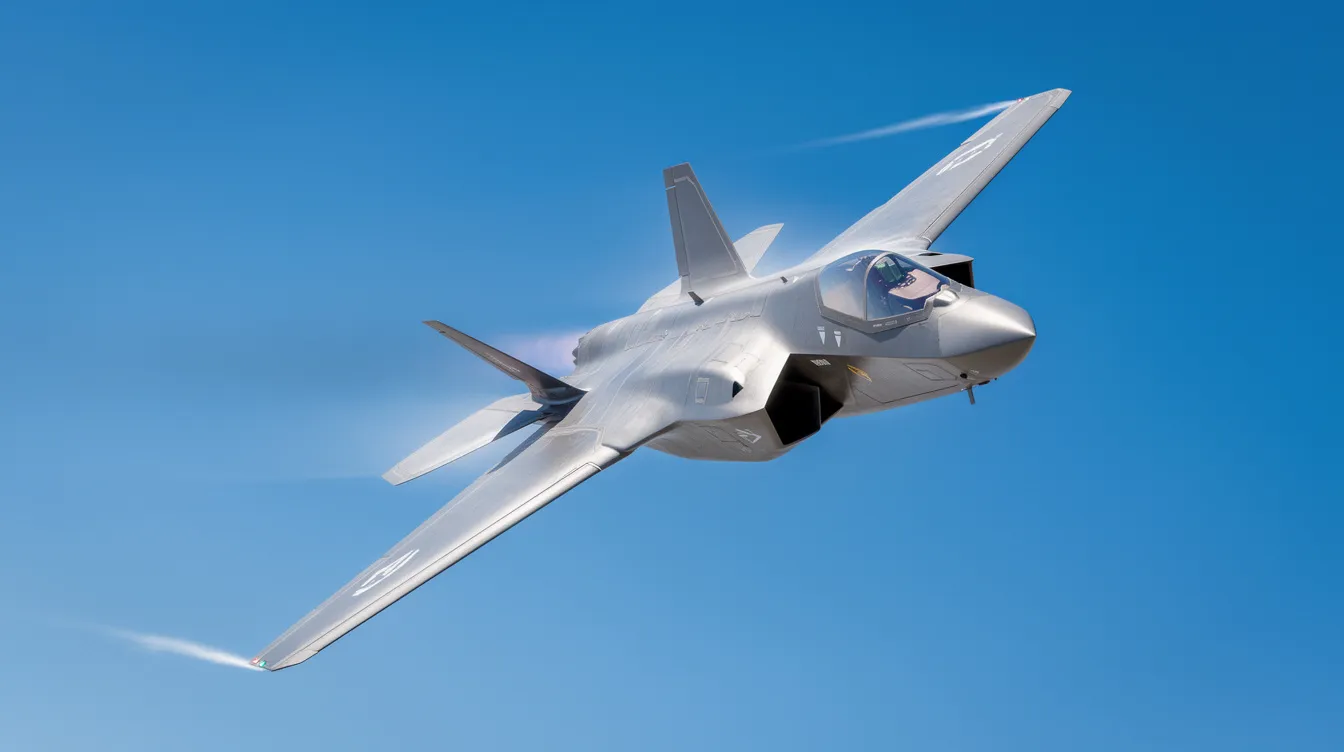
A military jet is a gas-turbine-powered aircraft built primarily for defense missions such as rapid response, deterrence, and securing air superiority, and for nearly a century it has helped define the balance of global power. From the earliest fabric-covered biplanes firing small bombs over enemy trenches to today's stealth platforms fusing data across entire battlefields, these machines represent the sharpest edge of aerospace engineering.
For frequent business flyers, high-net-worth leisure travelers, and anyone curious about how military aviation shaped modern private flight, understanding that evolution does more than satisfy historical interest—it reveals the engineering lineage behind the safety, efficiency, reliability, and comfort found in today's private aircraft. This guide traces the milestones and generations that shaped the military jet, examines where military and private jet technology and operations diverge, and shows how that crossover informs private aviation choices such as premium Jet Card access, private jet charter, and aviation sustainability.
Strategic importance of military jets in modern air power
Military Jet Capabilities
Military jets are specialized aircraft powered by gas turbine engines, and they sit at the core of 21st-century defense strategy. Their value is straightforward: they deliver rapid response, project deterrence, and secure air superiority—the ability to control the skies so that every other operation on land, sea, and in cyberspace can proceed. Without command of the air, modern combined-arms warfare stalls.
Key Roles of Military Jets
Military jets are categorized based on their primary design intent and mission profiles. A fighter aircraft optimized for dogfighting and interception differs sharply from an attack aircraft built for close air support, and both differ from the private jets that carry executives across continents. Yet the overlap in technology and safety standards is real. Fly-by-wire controls, composite airframes, redundant avionics—these originated in military programs and now underpin the aircraft that operators like BlackJet certify for private travel.
Why military jets shape global security:
Deterrence: a visible, capable air force dissuades adversaries before conflict begins.
Rapid reaction: crisis deployment, air policing, and humanitarian intervention measured in hours, not weeks.
Force multiplication: precision strike, deep penetration, and networked surveillance extend a nation's reach far beyond its borders.
Innovation pipeline: propulsion, materials science, and sensor development flow from military R&D into commercial and private aviation within a generation.
From balloons to battlefields: early history of military aircraft
Long before any airplane left the ground, militaries exploited lighter-than-air craft. The idea was simple: gain altitude, gain advantage. Observation from above changed the calculus of battles in ways that ground-based reconnaissance never could.
Key milestones in early military aviation:
1794: The French Aerostatic Corps deployed a tethered hydrogen balloon at the Battle of Fleurus, marking the first recognized use of aerial reconnaissance in combat.
1849: Austria launched roughly 200 incendiary balloons carrying small bombs over Venice during the First Italian War of Independence.
1861: The Union Army Balloon Corps was established during the American Civil War, using balloons to observe Confederate positions and direct artillery.
Late 1800s: Navigable airships and dirigibles emerged, with Germany investing heavily in Zeppelin technology for scouting and limited bombing—a capability that would be exploited heavily in World War I.
1909: The first military airplane was demonstrated when the U.S. Army purchased the Wright Military Flyer for its Signal Corps. Limited in power, range, and control, this aircraft nonetheless marked the formal adoption of heavier-than-air flight by the armed forces, and the Wright brothers believed aircraft would be useful for military reconnaissance.
World War I: the birth of the fighter aircraft
World War I transformed crude reconnaissance planes into purpose-built fighters in barely four years. Early in the war, pilots from opposing sides waved at each other from open cockpits. By 1915, they were trying to kill each other with synchronized machine guns.
The British coined the term "fighter" to describe aircraft specifically tasked with intercepting enemy aircraft conducting reconnaissance or bombardment. The introduction of synchronized, forward-firing machine guns—first deployed on the Fokker Eindecker around 1915—was revolutionary. It allowed a pilot to aim his entire airplane at a target and fire through the spinning propeller arc, turning the aircraft itself into a weapon.
Dogfighting tactics developed rapidly. Escort fighters began protecting bombers from enemy attacks during missions, and the concept of formation flying, wingman doctrine, and fighter patrols took root. Fighter-bombers that could combine air-to-air and ground-attack capabilities also began to emerge in rudimentary form, with pilots dropping small bombs or strafing ground targets between aerial engagements.
Definitive WWI aircraft and innovations:
Fokker Eindecker (1915): first fighter with synchronized forward-firing machine guns.
Sopwith Camel (1917): highly maneuverable British biplane with twin Vickers guns; credited with more aerial victories than any other Allied fighter of the war.
SPAD S.XIII (1917): French fighter prized for dive performance and structural strength, flown by many of the war's leading aces.
Albatros D.III: German fighter with improved aerodynamics and speed that dominated the skies during "Bloody April" of 1917.
Key innovations: synchronization gear, rotary and inline piston engines, aerial combat tactics, and the conceptual separation of fighters, bombers, and reconnaissance aircraft.
Between the wars: experimentation and the road to World War II
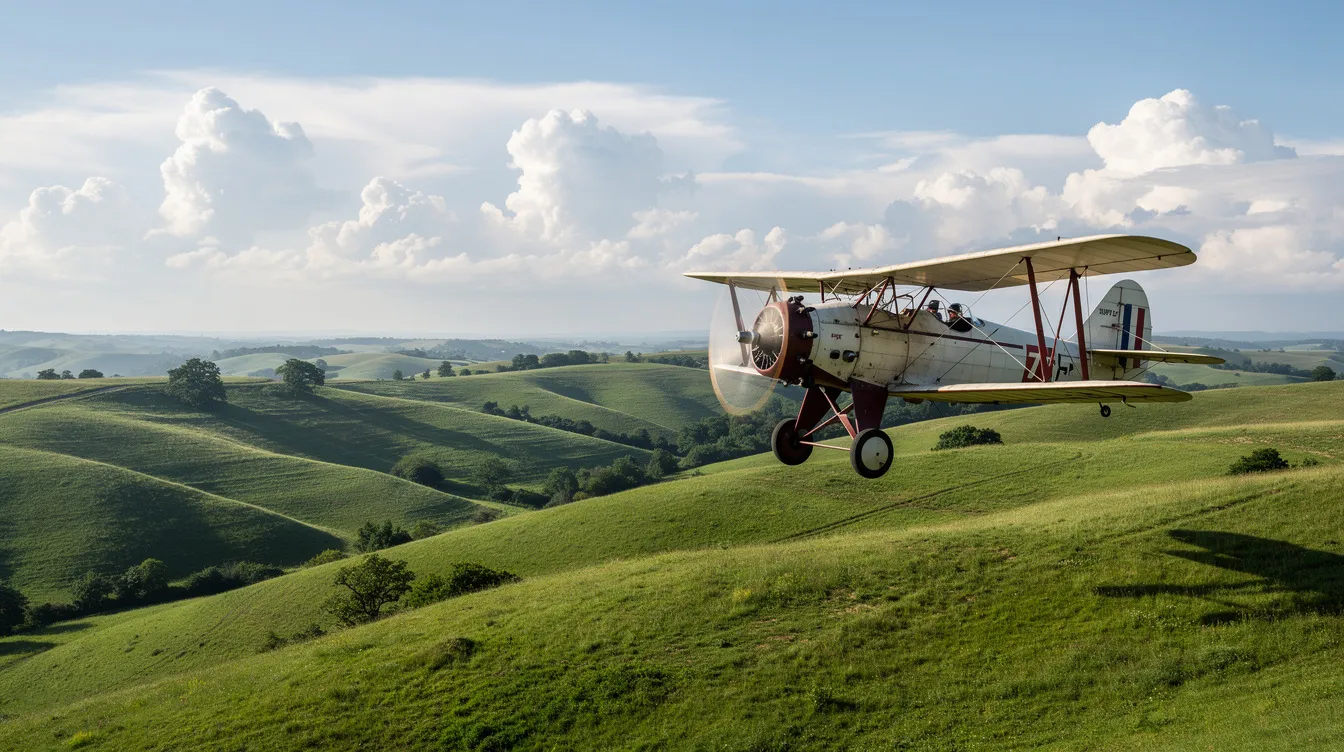
The interwar period (1919–1939) saw military aviation undergo a quiet revolution. Aircraft evolved from wood-and-fabric biplanes into sleek metal monoplanes, and the countries that invested most aggressively in this transition gained decisive advantages when the next world war arrived.
Key developments bridging WWI and WWII:
Metal monoplanes: France, Italy, and the Soviet Union developed all-metal airframes with enclosed cockpits, retractable landing gear, and variable-pitch propellers—features that dramatically improved speed and survivability.
Budget constraints: The U.S. and U.K. faced economic pressures that slowed fighter aircraft innovation through much of the 1920s and early 1930s, though civilian air racing (such as the Schneider Trophy) pushed aerodynamics and engine technology forward.
Spanish Civil War (1936–1939): This conflict served as a proving ground for next-generation fighters. The Messerschmitt Bf 109 and Polikarpov I-16 were both flown in combat, testing monoplane designs, more powerful engines, and retractable gear under real conditions, helping test monoplane fighter concepts in battle.
Bridging models: Hawker Hurricane, Mitsubishi Zero, and early variants of the Bf 109 all incorporated enclosed cockpits, hydraulic brakes, and improved power-to-weight ratios that would define WWII air combat.
World War II: air superiority, attack aircraft, and total war
World War II made control of the air the single most decisive factor in ground and naval campaigns. Fighters, attack aircraft, and bombers operated at a scale never before seen, with thousands of aircraft clashing in battles that stretched from the English Channel to the Pacific.
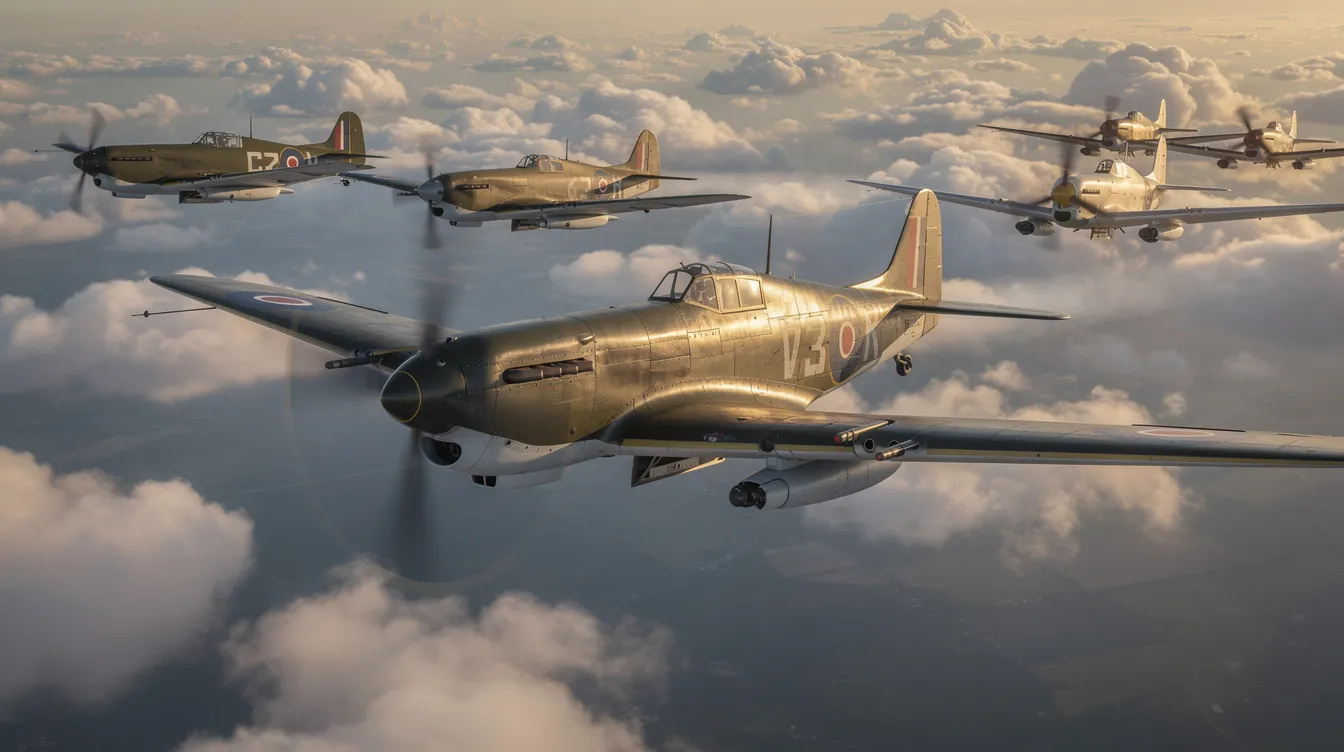
The Battle of Britain in 1940 demonstrated that air superiority could decide a nation's fate. The RAF's integration of radar, ground-controlled interception, and fighters like the Supermarine Spitfire and Hawker Hurricane held off the Luftwaffe's Bf 109s and bomber fleets. Night fighters evolved to operate in poor visibility conditions, and World War II saw the introduction of airborne radar on fighters, serving as an aid to pilots and giving them the ability to detect and engage enemy aircraft after dark.
By war's end, World War II fighters had engines producing over 2,000 hp, a staggering leap from the 100–200 hp powerplants of WWI. The P-51 Mustang, first flown on October 26, 1940, became the Allies' premier long-range escort fighter, enabling strategic bombing deep into German territory.
Roles and aircraft:
Air superiority fighters: Supermarine Spitfire (UK), Bf 109 (Germany)—designed to fight for control of the skies.
Escort fighters: P-51 Mustang, P-38 Lightning—protecting bombers over long range.
Attack aircraft: Il-2 Sturmovik (USSR), Ju 87 Stuka (Germany)—dedicated to destroying ground targets and providing close air support.
Bomber jets: heavy bombers like the B-17 and Lancaster delivered large weapon payloads over long distances, reshaping strategic warfare.
Strategic impact: WWII R&D produced jet propulsion, operational radar, and early guided weapons by 1944–1945, setting the stage for every generation of military jet that followed and contributing to Allied success.
Rocket and early jet experiments: the leap beyond piston power
Even before the war ended, engineers were pushing beyond the limits of piston engines. The first rocket-powered aircraft was the Lippisch Ente in 1928, a tailless glider fitted with solid-fuel rockets that proved the concept of rocket-assisted flight. By WWII, Germany had produced the Messerschmitt Me 163B Komet—the only mass-produced rocket fighter—which achieved extraordinary climb rates and speed but suffered from dangerously short endurance and volatile fuel.
The first operational jet fighter was the Messerschmitt Me 262, introduced in 1944. With swept wings and twin turbojets, the Me 262 was faster than any allied piston fighter and demonstrated the clear advantage of jet propulsion. The British Gloster Meteor entered service around the same time, though it saw more limited combat use.
Key constraints and transitions:
Rocket fighters: extreme speed but flight durations measured in minutes; hazardous landing procedures; not viable for sustained combat.
Early jets (Me 262, Gloster Meteor): superior speed and climb, but limited by engine reliability, fuel consumption, and materials that couldn't withstand sustained high temperatures.
Mixed-power types: experimental jet-plus-rocket and turboprop hybrids appeared in the late 1940s but were quickly superseded by pure turbojet designs as engine technology matured.
Legacy: these experiments proved that the future of air combat belonged to jet propulsion, not pistons.
Generations of jet-powered fighters: framework and controversy
The "generation" system for classifying jet fighters is informal—there is no universal standard ratified by any governing body. The framework emerged in the 1990s through historians like Richard P. Hallion and has since been adopted by militaries, analysts, and media to describe leap-frogging capabilities across decades of development.
Air superiority fighters dominate air combat with speed and maneuverability, but how that dominance is achieved has changed radically from one generation to the next.
What each generation typically adds:
1st Generation (1940s–1950s): early turbojets, subsonic or transonic, guns only, minimal avionics.
2nd Generation (1950s–1960s): supersonic speed, afterburners, early radar, first guided missiles.
3rd Generation (1960s–1970s): multirole capability, improved radar, beyond-visual-range missiles, better aerodynamics.
4th Generation (1970s–2000s): fly-by-wire, digital avionics, composite materials, all-aspect infrared missiles, pulse-Doppler radar.
5th Generation (2000s–2020s): stealth shaping, internal weapons bays, sensor fusion, supercruise, network-centric operations.
6th Generation (emerging): optionally manned, AI-assisted, loyal wingman drones, adaptive engines, full-spectrum stealth, cross-domain networking.
Classification is sometimes debated—manufacturers occasionally inflate generation labels for marketing purposes, and upgrades to older platforms can blur boundaries between one generation and the next.
First and second generation jets: 1940s–1960s
First-generation jet fighters defined the late 1940s and early 1950s. Aircraft like the F-80 Shooting Star and MiG-15 featured unswept or modestly swept wings, gun-based armament, and limited radar. Interceptors like these were designed to engage enemy aircraft quickly, climbing fast to meet incoming bombers.
The Korean War (1950–1953) cemented the jet age. The first jet-versus-jet dogfight occurred on November 8, 1950, when a USAF F-80 engaged a MiG-15 over North Korea. The subsequent duels between MiG-15s and F-86 Sabres proved that swept-wing jets were the backbone of any modern air force.
First-generation vs second-generation:
First gen: subsonic to transonic; guns only; analog instruments; straight or mildly swept wings. Examples: F-80, MiG-15, Gloster Meteor.
Second gen: supersonic in level flight; afterburning turbojets; swept or delta wings; early radar sets; first air-to-air missiles (though often unreliable). Examples: F-100 Super Sabre, MiG-21, Dassault Mirage III.
Key shift: second-generation jets introduced missiles alongside guns, though early infrared seekers were not all-aspect and pilots still relied heavily on visual identification and maneuvering to fight.
Third and fourth generation: multirole dominance and advanced avionics
Third-generation fighters (1960s–1970s) prioritized multirole capability. The F-4 Phantom II, produced by McDonnell Douglas and operated by the Navy, Air Force, and multiple allied nations, could serve as both an air-superiority fighter and a ground-attack platform. The Saab 37 Viggen introduced canard aerodynamics for short-takeoff performance. Radar improved markedly, and missiles became more reliable, though aerial combat increasingly utilizes beyond-visual-range engagements—a trend that began here and accelerated with weapons like the AIM-120D missile, which has a range over 160 km.
Fourth-generation jets (1970s–2000s) represented a quantum leap. Fly-by-wire flight control systems replaced mechanical linkages, composite materials cut weight and radar signature, and pulse-Doppler radar gave pilots "look-down/shoot-down" capability against low-flying targets. Energy-maneuverability theory—managing kinetic and potential energy to sustain high performance through a fight—became central to both aircraft design and training.
Third vs fourth generation:
Third gen: analog systems, improved radar, stronger ground-attack capabilities. Aircraft: F-4 Phantom II, Saab 37 Viggen.
Fourth gen: digital avionics, fly-by-wire, composite airframes, all-aspect infrared missiles, dramatically improved situational awareness. Aircraft: F-16 Fighting Falcon, F/A-18 Hornet; Boeing later carried the line forward with the F/A-18E/F Super Hornet as a 4.5-generation evolution; Su-27 Flanker.
Training evolution: programs like Red Flag and aggressor squadrons became essential for preparing pilots to operate these capable but complex systems.
Fifth and emerging sixth generation fighters
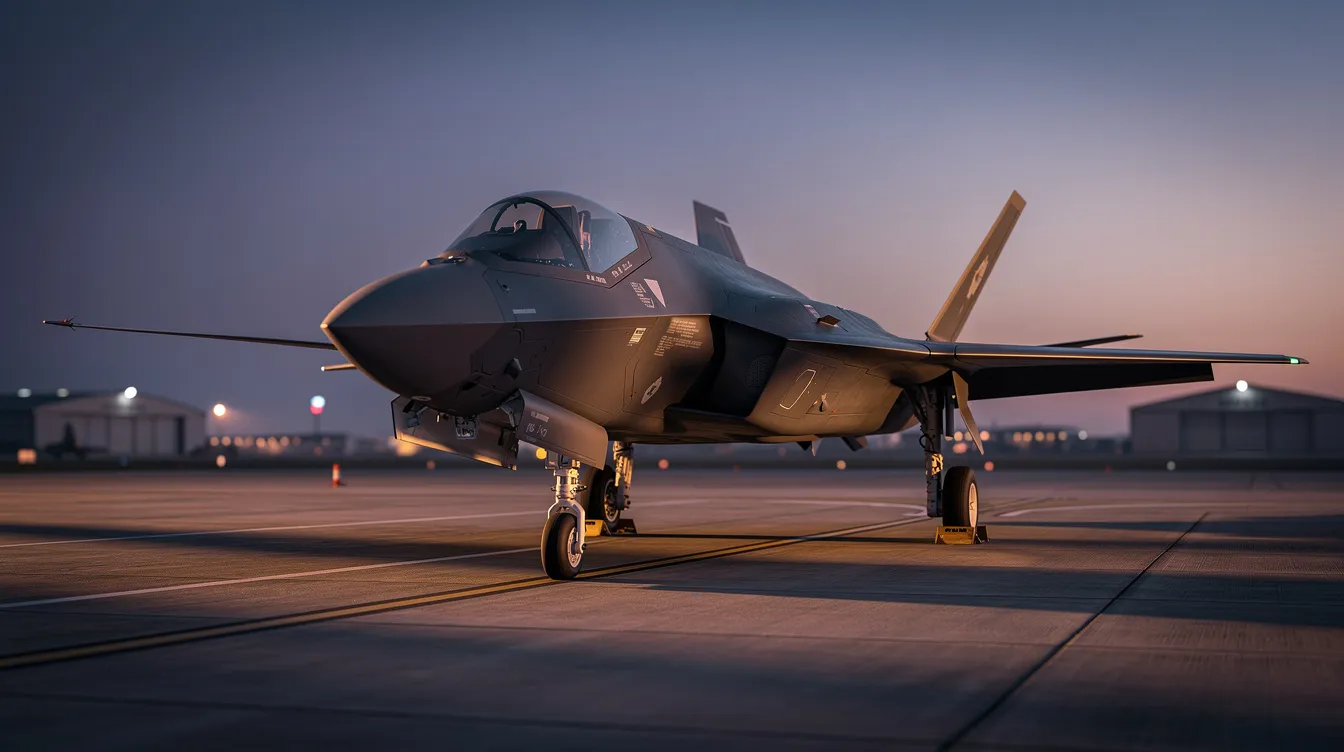
The F-22 Raptor was introduced in 2005 as a fifth-generation fighter, and it remains the world's premier air-superiority platform. Fifth-generation fighters feature low-observable multi-spectral signatures, meaning stealth technology reduces aircraft radar cross-section significantly across multiple sensor bands—not just traditional radar. Internal weapon bays maintain a clean aerodynamic and stealth profile. AESA radars provide simultaneous air-to-air and air-to-ground tracking. Advanced sensor fusion integrates data from various sources into a cohesive picture, giving the pilot unprecedented situational awareness.
The F-35 Lightning II extended these capabilities into a multirole, internationally fielded platform. China's J-20 represents a parallel fifth-generation development. Cognitive electronic warfare allows these jets to actively manipulate enemy radar networks, while software-defined aircraft prioritize rapid updates to mission capabilities through software rather than hardware modification. The role of stealth aircraft is evolving to include networking with other systems, making these platforms nodes in a larger combat ecosystem rather than isolated weapons.
Emerging sixth-generation programs and expected features:
U.S. NGAD / F/A-XX: next-generation air dominance concepts targeting the 2030s, emphasizing optionally manned operation and adaptive engines.
UK–Japan–Italy "Tempest" / Global Combat Air Programme: multinational effort with projected service entry in the late 2030s to 2040s.
Collaborative Combat Aircraft: these platforms integrate AI to support crewed fighters in missions, functioning as "loyal wingmen" that extend sensor coverage and weapons capacity.
Key trends: military aviation is shifting toward networked combat ecosystems rather than isolated aircraft; directed energy weapons, cross-domain connectivity (space, cyber, electronic), and full-spectrum stealth are all anticipated.
Fighter, attack, and multirole aircraft: how missions shape design
Military aircraft fall into distinct categories, and the airframe of each type reflects its intended mission with precision.
Fighter aircraft: optimized for air-to-air combat and air superiority. The F-15C Eagle, with its powerful engines and high thrust-to-weight ratio, is a pure air-superiority platform capable of dominating the skies. The best U.S. fighter jets represent decades of refinement in this role.
Attack aircraft: designed for close air support and strike against ground targets. The A-10 Thunderbolt II, with its straight high-lift wings and titanium armor bathtub protecting the pilot, can loiter at low altitude and absorb ground fire. Attack jets provide close air support for ground troops and destroy tactical targets.
Multirole fighters: platforms like the F-16 and Dassault Rafale can switch between air-to-air combat and ground-attack missions using modular weapon pylons and advanced avionics. Fighter-bombers can deliver ordnance and engage enemy fighters in the same sortie, making them the most cost-effective choice for most modern air forces.
Modern trend: the economics of defense procurement push strongly toward multirole designs, equipped with precision weapons and advanced systems that allow a single airframe to serve across multiple mission sets.
Lockheed Martin and the evolution of U.S. air power
Lockheed Martin stands as one of the world's leading defense contractors in military aircraft, and its program history mirrors the evolution of American air power itself. Technological advancements in fighter jets include improvements in stealth and avionics, and Lockheed Martin has driven many of them.
Key programs and milestones:
P-38 Lightning (service entry ~1941): twin-boom WWII long-range fighter that served across every theater.
P-80 Shooting Star (late 1940s): among the first USAF jet fighters, bridging the piston-to-jet transition.
F-117 Nighthawk (first operational mid-1980s): the world's first operational stealth attack aircraft, proving that low-observable design could penetrate heavily defended airspace.
F-22 Raptor (IOC 2005): fifth-generation air-superiority fighter with supercruise, stealth, and sensor fusion.
F-35 Lightning II (IOC 2015–2020 across variants): multirole stealth platform with the largest international customer base of any modern fighter, produced in partnership with allied nations.
These platforms interact with broader air force structures—AWACS surveillance, tanker fleets, ISR assets—to achieve and maintain air superiority as part of integrated force packages.
Air superiority, deterrence, and global air forces today
Modern air forces structure their fleets around layered capabilities. The U.S. Air Force, RAF, and Japan Air Self-Defense Force all maintain mixed inventories: older fourth and 4.5-generation fighters handle day-to-day missions while fifth-generation platforms are reserved for contested airspace and high-value operations.
Reconnaissance jets gather intelligence through imagery and electronic surveillance. Electronic warfare jets disrupt enemy radar and communications. Refueling tankers extend the range of fighters and bombers through in-flight refueling. Cargo and airlift jets transport troops and equipment over long distances. Together, these support elements amplify the effectiveness of frontline combat aircraft.
Real-world mission scenarios illustrating modern jet employment:
NATO air policing: member nations scramble fighters to intercept unidentified aircraft approaching allied airspace—a routine that has operated continuously for decades.
Freedom of navigation patrols: fighters accompany naval vessels and patrol aircraft over disputed waters, signaling resolve without escalation.
Quick-reaction alert (QRA): military jets sit on standby to respond within minutes to threats ranging from an airliner off course to strategic bomber probes near national borders.
Precision strike: stealth aircraft penetrate defended airspace to disable critical targets using air-to-ground missiles, often supported by drone ISR and electronic warfare platforms.
Technology crossover: what military jets taught private and business aviation
Technology Transfer to Private Aviation
The aircraft that carry BlackJet members today owe a significant debt to military R&D. Innovations born in military programs have filtered into business aviation over decades, producing measurable benefits for private travelers.
Military-derived technologies and their private aviation benefits:
Fly-by-wire controls: originally developed for high-performance fighters, these systems now deliver smoother rides and reduced pilot workload in business jets.
Composite materials: carbon-fiber and advanced alloy structures pioneered for military airframes reduce weight and fuel burn in private jets, lowering emissions per flight hour.
Advanced avionics: GPS, inertial navigation, heads-up displays, and triple-redundant systems all trace their lineage to military cockpits. BlackJet partners with operators meeting rigorous safety and certification standards rooted in these same principles.
Efficient turbofan engines: military research into high-bypass turbofans has directly improved the fuel efficiency of modern business jets, cutting noise and emissions simultaneously.
Safety culture: the maintenance rigor, crew resource management, and systems redundancy developed for combat aircraft now form the backbone of civilian Part 135 certification and ARGUS safety ratings.
Private Jet Safety Standards
Private jets benefit from a safety culture that mirrors military aviation in many respects:
Rigorous maintenance schedules
Redundant systems for critical flight operations
Highly trained pilots and crew
Strict adherence to certification standards (e.g., FAA Part 135, ARGUS ratings)
Military versus private jet operations: missions, safety, and access
The mission profile of a military jet—high-G maneuvers, combat survivability, weapons integration—stands in stark contrast to a private jet's priorities: comfort, range, reliability, and privacy. Yet both domains share an uncompromising commitment to safety, detailed maintenance regimes, and intensive pilot training.
Consider a scenario: a business executive needs to fly New York to London. Commercial first class means fixed schedules, crowded terminals, and security lines. Outright jet ownership means millions in capital, crew management, and hangar fees. Ad-hoc charter introduces price variability and aircraft uncertainty. A BlackJet Jet Card delivers the flight on a guaranteed schedule, at a fixed hourly rate, aboard a certified aircraft with 24/7 support—no ownership burden, no surprises.
Key differences and advantages:
Military: mission-driven, high performance, equipped for combat in contested airspace, operate from austere fields.
Private: comfort-driven, reliable, luxurious, designed for point-to-point efficiency with minimal ground time.
Shared DNA: strict safety culture, redundant systems, rigorous maintenance schedules, highly trained pilots.
Customer advantage: frequent travelers value flexibility, privacy, safety, and luxury in private aviation—exactly what a Jet Card program for frequent flyers model provides without the complexity of ownership.
For travelers comparing ownership, charter, and membership, understanding the broader private jet price list and access models helps frame how military-derived technology translates into different cost structures.
Jet cards and modern access to advanced aircraft
Private aviation companies offer Jet Card programs for prepaid access to private jets, and a clear understanding of Jet Card cost and membership pricing shows why BlackJet's model represents the most streamlined path from intent to wheels-up. Think of it as your personal flight squadron—guaranteed hours, multiple aircraft categories, and none of the operational overhead.
BlackJet's Jet Card options include 25-hour and 50-hour programs, such as the dedicated BlackJet 25+ Hour Jet Card, providing access to light, midsize, and heavy cabin jets depending on your route and preferences.
What sets BlackJet's approach apart:
Flexibility: choose the aircraft type that fits each trip, from a light jet for a regional hop to a heavy cabin for transcontinental travel.
Predictable pricing: prepaid, fixed hourly rates eliminate the variability of ad-hoc charter and the capital exposure of ownership, and understanding Jet Card cost per hour helps you benchmark those rates against other options.
Digital efficiency: mobile booking platforms streamline private jet chartering for users, mirroring the mission-planning precision of a modern air force but tailored for private travelers, whether you’re exploring a 100-hour Jet Card cost structure or flying less frequently.
Real-time support: real-time flight support is available to enhance the travel experience in private aviation—24/7, from booking through landing, which also simplifies record-keeping for those optimizing Jet Card tax deductions.
Sustainability and the future: from military research to carbon-neutral private flights
Military research into efficient engines, advanced aerodynamics, and alternative fuels is accelerating civil aviation's push toward lower emissions. Each generation of military jet engine delivers 10–20% greater fuel efficiency than the last, and those gains eventually reach the private aviation fleet.
Sustainable aviation initiatives include carbon offset measures for flights, and BlackJet's commitment to carbon-neutral operations reflects this trajectory directly. By combining verified carbon offsets with emerging sustainable aviation fuel (SAF) options, BlackJet ensures every journey is carbon neutral—at no extra cost to members.
Technology, responsibility, and traveler expectations:
SAF blends: current sustainable aviation fuels can reduce lifecycle CO₂ emissions by 50–80% compared with conventional jet fuel, depending on blend ratio and feedstock.
Military R&D pipeline: propulsion materials, thermal coatings, and adaptive engine cycles developed for sixth-generation fighters will further improve commercial engine efficiency within the next decade.
Offset quantification: a typical transcontinental midsize private jet flight (e.g., New York to Los Angeles) emits roughly 10–15 tonnes of CO₂; BlackJet's offset and SAF program neutralizes this impact entirely.
Discerning travelers expect it: today's high-net-worth flyers increasingly view environmental responsibility as a baseline requirement, not a luxury add-on.
FAQ: military jets, air superiority, and private jet access
What is the difference between a fighter aircraft and an attack aircraft? A fighter aircraft is optimized for air-to-air combat—speed, agility, and missile capability are paramount. An attack aircraft is built for close air support and striking ground targets, often featuring heavier armor and specialized ordnance. Multirole fighters blend both capabilities in a single airframe.
What is air superiority? Air superiority is the degree of control one force holds over the airspace in a given area, preventing the adversary from conducting effective air operations. Achieving it is typically the first objective of any modern military campaign, because it enables freedom of action for all other forces.
How are military jets categorized? Military jets are categorized based on their primary design intent and mission profiles: fighters, attack aircraft, bombers, interceptors, reconnaissance platforms, electronic warfare jets, cargo and airlift aircraft, and training aircraft. Many modern platforms are multirole, blurring these lines.
What was the first operational jet fighter? The first operational jet fighter was the Me 262, introduced in 1944 by Germany. It was faster than any Allied piston fighter and demonstrated the decisive advantage of jet propulsion.
Can civilians fly in ex-military jets? Some demilitarized aircraft are available for civilian ownership and operation, though they require specialized maintenance, insurance, and often restricted airspace permissions. They are not part of standard private jet charter or Jet Card fleets.
How do military safety standards compare to private aviation? Both domains demand rigorous maintenance, redundant systems, and highly trained crews. Military certification focuses on combat survivability and airframe fatigue under extreme loads; civilian private aviation certification (e.g., FAA Part 135, ARGUS ratings) focuses on passenger safety, operational reliability, and scheduled inspection compliance. The underlying safety culture is remarkably similar.
How does a Jet Card work? A Jet Card is a prepaid membership that secures a set number of flight hours across a provider's fleet. You book when you need to fly, choose the aircraft category that fits your trip, and pay a fixed hourly rate with no hidden fees. It delivers the convenience of private aviation without the capital commitment of ownership.
Is private jet travel becoming more sustainable? Yes. Operators like BlackJet now offer carbon-neutral flights through verified offset programs and sustainable aviation fuel options. Military-driven advances in engine efficiency and lightweight materials continue to reduce the environmental footprint of private aviation with each new aircraft generation.
Conclusion: The Enduring Impact of Military Jets on Modern Aviation
Military jets have not only shaped the course of global security but have also driven the technological advances that underpin today’s private and business aviation sectors. From pioneering fly-by-wire controls and composite materials to advancing safety protocols and sustainable fuel technologies, the military jet’s legacy is deeply embedded in every aspect of modern air travel.
For the discerning traveler, understanding this heritage provides confidence in the safety, performance, and innovation that BlackJet’s Jet Card programs offer. These programs leverage the best of military-derived technology and operational excellence to deliver flexible, reliable, and environmentally responsible private jet access.
As the industry looks ahead to sixth-generation military jets and beyond, the cross-pollination between defense and private aviation will continue to accelerate. BlackJet invites you to experience this evolution firsthand—explore premium jet access, enjoy seamless digital booking, and travel with the assurance of carbon-neutral flights. Discover how BlackJet can elevate your journey with the precision and prestige born from a century of aerospace mastery.


 Sign up with google
 Sign up with Apple