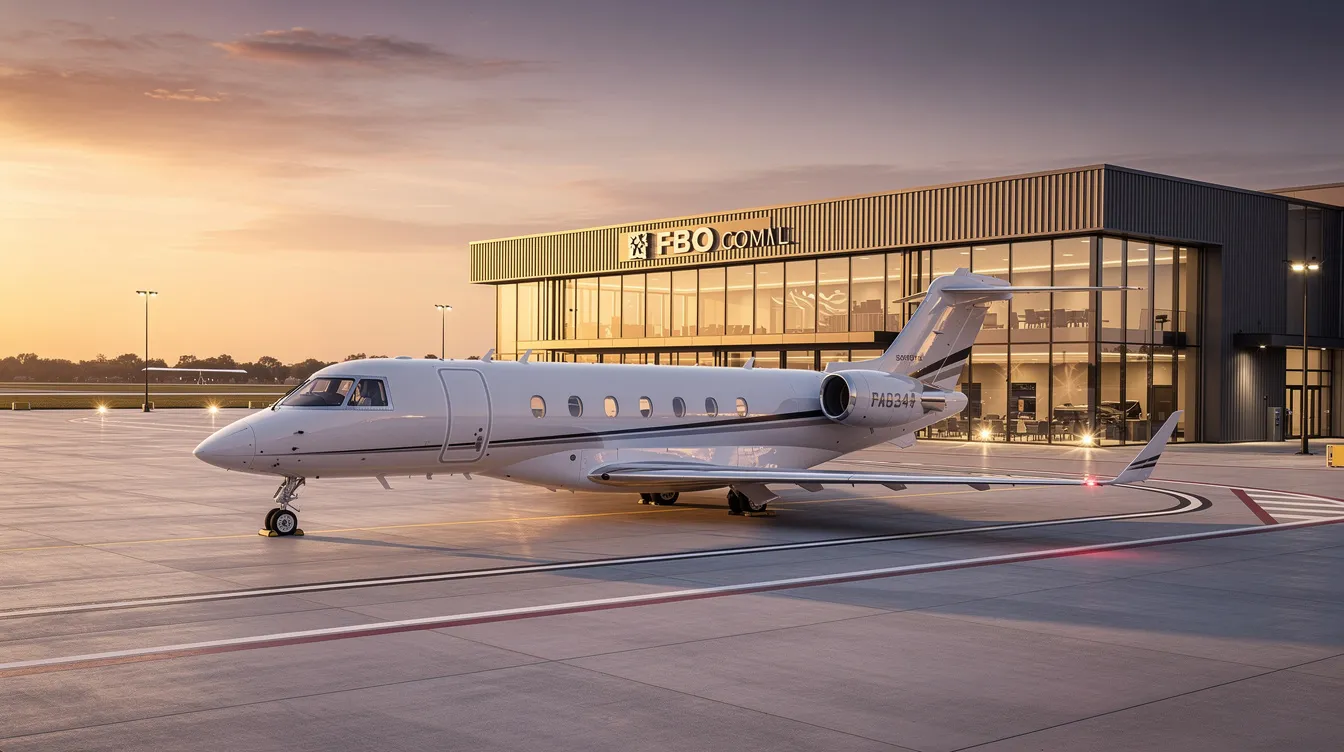
The first-class seat in plane cabins has been a symbol of prestige since commercial aviation's earliest days. From Pan Am's ocean-liner-in-the-sky aesthetics to the fully enclosed suites that airlines like Emirates and Singapore Airlines operate today, the first-class experience has always represented the pinnacle of air travel on long-haul routes between cities like New York–London, Paris–Singapore, and Los Angeles–Tokyo. First class offers the most luxurious seating options in commercial aviation, and in 2025–2026, the best products continue to push boundaries.
Yet choosing the right premium cabin is no longer straightforward. Business class now rivals what first class delivered a decade ago. Private jet cabins offer an entirely different value proposition. When you compare commercial first class to a private jet solution in terms of door-to-door time saved, privacy, and control over schedule, the calculus gets interesting fast, especially for executives and high-net-worth travelers who measure travel in productivity, not just comfort.
Consider a concrete scenario: a CFO who flies LAX–JFK once per month. In domestic first class on a major carrier, that's roughly six hours in the air plus three or more hours of ground time (airport arrival, check-in, boarding, taxiing, baggage claim). Alternatively, using a BlackJet 25-hour Jet Card on a super-midsize jet, that same CFO departs from a private terminal 20 minutes before wheels-up, flies direct, and reclaims hours each trip for deal-making or rest.
This article is a guide for discerning travelers evaluating whether ultra-premium commercial first class or a private jet solution like BlackJet Jet Cards creates more strategic value, and how BlackJet's broader premium private jet card programs can fit into a long-term travel strategy. We'll cover specific first-class cabins from Air France, Cathay Pacific, American Airlines, Japan Airlines, and others, then show how private aviation changes the equation entirely.
What Is a First Class Seat? (And How It Differs from Other Class Seats)
A first-class seat is the top tier of seating on a commercial airline. It typically occupies a small first-class cabin at the front of the aircraft, separated from other classes by curtains or bulkheads. But the term "first class" is not created equal across carriers; domestic first-class recliners and long-haul suites with closing doors are vastly different products sharing the same name.
The hierarchy of cabin classes breaks down roughly like this. Economy class seats offer approximately 30–32 inches of seat pitch and 17–18 inches of width; economy class has narrower seats with limited legroom. Premium economy offers slightly wider seats and improved legroom, typically around 38–40 inches of pitch, with a separate cabin and enhanced meal service. Business class seats on international flights provide lie-flat beds, direct aisle access, and strong privacy, usually in a 1-2-1 configuration with seat widths around 20–22 inches. International first-class seat pitch can stretch from 58 to 94 inches, with widths up to 35 inches in rare class suites, along with personal wardrobes, full-height doors, and bespoke service. First class offers more legroom and larger seats than economy class by a dramatic margin.
It's worth noting that many airlines have removed international first class in favor of high-end business class products. China Southern retired its first-class product entirely in recent years, and other carriers have followed. Still, a handful-Air France, Singapore Airlines, Emirates, Cathay Pacific, and several Asian carriers-continue to operate flagship first-class cabins on select routes.
Cabin Class | Seat Pitch (inches) | Seat Width (inches) | Typical Features | Privacy Level |
|---|
Economy | 30–32 | 17–18 | Basic seating, limited legroom | Low |
Premium Economy | 38–40 | 18–19 | Wider seats, better legroom, meals | Moderate |
Business Class | 58–80 (lie-flat) | 20–22 | Lie-flat beds, aisle access | High |
International First Class | 58–94 | Up to 35 | Fully enclosed suites, wardrobes | Very High |
Domestic First Class vs International First Class: Two Very Different Experiences
When most travelers in the U.S. or Canada hear "first class," they picture the front rows of a Boeing 737 or Airbus A320. In reality, domestic first class is closer to a regional business class product than to the international first class suites that define true long-haul luxury.
On domestic flights, first class means wider recliners arranged in a 2–2 layout. Seat pitch typically runs 37–40 inches with a width of around 19–21 inches; a large recliner seat offers more space, better beverage service, and free drinks, but rarely a lie-flat bed. Domestic first class focuses on comfort with extra legroom and free drinks rather than the full suite experience. On American Airlines' A321 flying LAX–ORD, you'll find a recliner with roughly a 37-inch pitch and 21-inch width. Delta First on ATL–JFK and United First on DEN–SFO deliver a similar class product: comfortable, but not transformative.
Contrast that with international first class on routes like JFK–LHR, LAX–HND, or CDG–JFK. Here, first-class passengers settle into enclosed suites with lie-flat seats, turn-down bedding, vintage champagnes, and crew attention that borders on personal concierge. On Cathay Pacific's 777-300ER, the first class section holds just six suites in a 1-1-1 layout, each 36 inches wide with a dedicated lie-flat bed. The gap between domestic first class and international first class is not incremental-it's a different category of travel altogether. Domestic first class often lacks the bespoke first-class service, privacy, and dine-on-demand menu options that define the long-haul first-class experience.
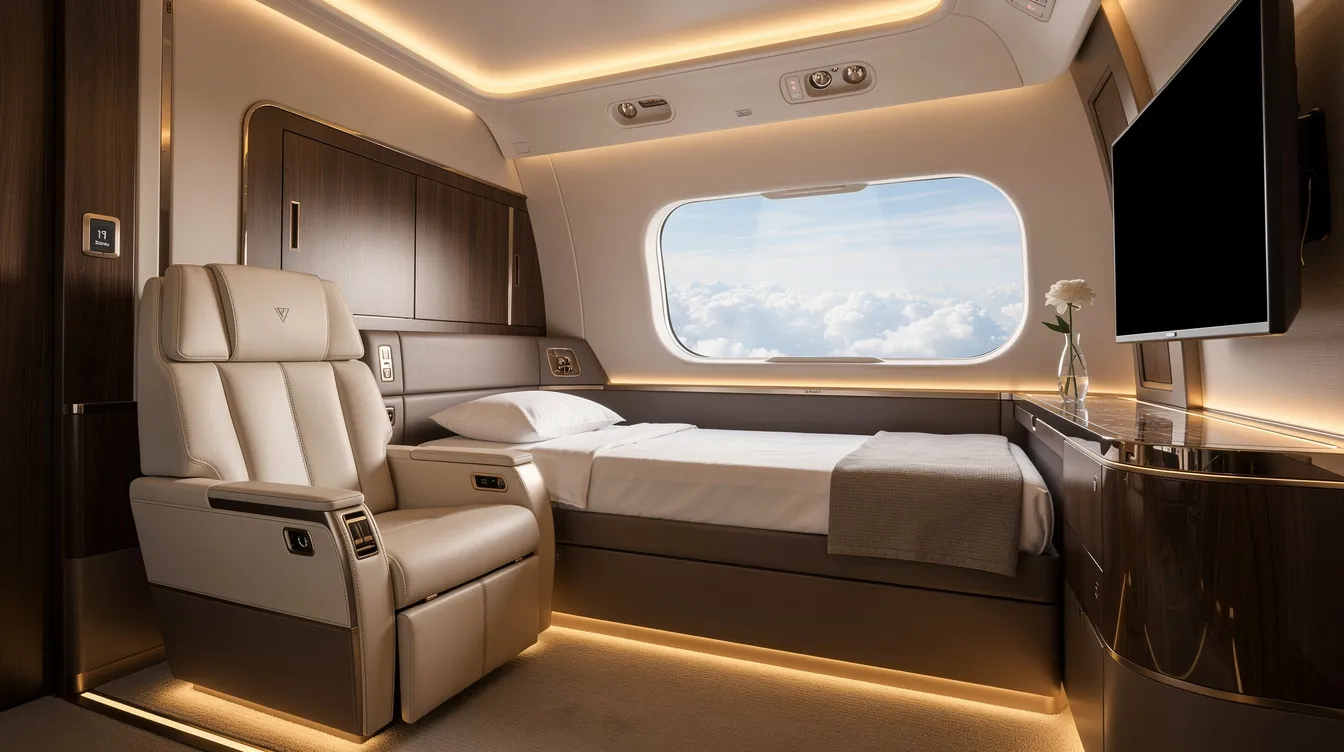
The Anatomy of a Modern First Class Seat
When you sit in a modern first-class seat on a leading international carrier, the hard product alone signals a different world from other classes.
Key hard-product elements include seat widths exceeding 30 inches (and reaching 36 inches on Cathay Pacific's 777-300ER), fully flat bed configurations that extend over two meters, and partial or full-height doors for enclosure. First-class seats are typically larger than business-class seats, and first-class offers smaller and quieter cabins with enhanced privacy. Private suites include personal closets and mood lighting, while entertainment options in first class feature large personal screens and Wi-Fi. Cathay's first-class screen, for example, measures 18.5 inches in HD. Many top cabins include individual wardrobes, personal lighting controls, and ottomans that double as companion dining seats, borrowing from private plane layout conventions.
Soft-product elements are equally important. First class typically includes complimentary gourmet meals and drinks, and first class passengers often enjoy gourmet meals and premium drinks curated by renowned chefs. Amenity kits in first class often contain high-end skincare products-Cathay Pacific provides Bamford facial care and PYE sleepwear, while high-end amenities include designer bedding and luxury brand toiletries across most flagship carriers. Turn-down service with 600-thread-count sheets and plush duvets transforms these seats into proper beds.
For a specific 2025–2026 benchmark: Japan Airlines' first class has just six seats in a 1-1-1 configuration on select A350-1000 aircraft, with expansive suite widths, lie-flat beds, and large personal screens. First-class seats often recline further than those in business class, and JAL's product exemplifies the trend of seat design increasingly borrowing from private jets, side tables, configurable seating positions, and ottomans for companion dining.
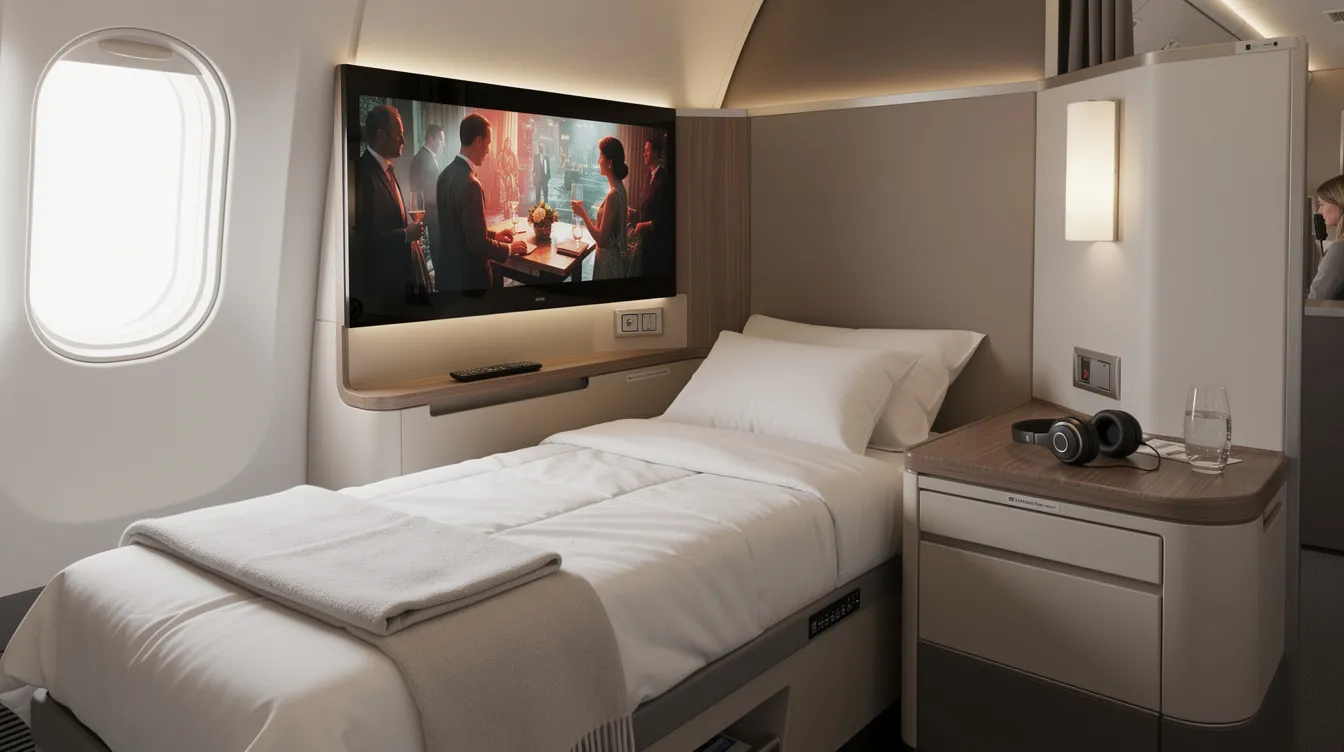
Spotlight on Iconic First Class Cabin Experiences Worldwide
Not all first-class cabins are created equal. A few stand out as destination products in their own right—experiences that travelers book specifically for the cabin, not just the route. First class usually has fewer seats than other classes for privacy, and these flagships take that principle to the extreme.
Air France La Première: The Gold Standard of French Luxury
Air France La Première on the Boeing 777-300ER is one of the most refined first-class experiences in the sky. Air France's first class has a single row of seats in a 1-2-1 layout, with just four seats in the class cabin. Each seat converts into a two-meter bed with a chaise longue configuration, merino-wool blankets, and turndown service by dedicated flight attendants. The dining, designed by Chef Guy Martin, delivers excellent food with a distinctly French sensibility. Ground services include a private first-class lounge at Paris-CDG and chauffeured transfers. International first class includes chauffeured airport transfers with select airlines, and Air France is the gold standard.
Cathay Pacific: Privacy and Comfort in the Sky
Cathay Pacific first class on the 777-300ER offers six extra-wide, spacious seats (36 inches) without doors but with exceptional privacy, top-tier Bamford bedding, and access to The Pier First class lounge in Hong Kong, one of the most celebrated first-class lounges in the world. Cathay's class experience is available on flagship routes, including HKG–LHR and HKG–LAX.
Emirates and Etihad: Suites and Apartments Above the Clouds
Emirates first class on the 777-300ER features fully enclosed first class suites with sliding doors and virtual windows. Emirates offers fully enclosed first-class suites on select 777s that blur the line between airline cabin and private room. On the A380 upper deck, Etihad's A380 features first-class "Apartments" with high square footage—a separate bed, separate living space, and an onboard shower. Singapore Airlines A380 Suites have only six first-class seats, each with a separate bed and enclosed suite on the upper deck, though availability is shrinking as A380 fleets reduce.
Japanese Excellence: All Nippon Airways and Japan Airlines
When aviation enthusiasts name their favorite first-class cabin, All Nippon Airways first class and Japan Airlines frequently top the list for sleep comfort, meticulous service, and outstanding cuisine, even rivaling the experience of a private jet Airbus A380 in terms of onboard space and refinement for individual travelers. These products run on select international flights to and from Tokyo, typically on 777 and A350 frames.
How Major U.S. Airlines Design Their First Class Seats
The way US airlines approach first class differs significantly from Asian and European carriers. On most flights within the U.S., "first class" means a domestic recliner, not a suite.
American Airlines First Class
American Airlines offers domestic first class on narrowbodies (737, A321) with recliner-style class seats at roughly 37–40 inches of pitch and 21 inches of width. On select long-haul and transcontinental flight routes (like JFK–LAX), American operates its three-cabin Flagship First on the 777-300, featuring fully lie-flat Flagship Suite seats with direct aisle access. The gap between American's domestic First and its Flagship First international product is enormous-one is a recliner with full meal service, the other is a lie flat suite with luxurious amenities and a dedicated first class section.
Delta Air Lines First Class
Delta's product split works differently. Delta One suites (their premium long-haul cabin with closing doors) function as the top-class product on international and select transcon routes, though Delta brands this as business class, not first. On most domestic flights, Delta First is a large recliner seat with better service, meal service on longer segments, and Delta Sky Club lounge access, comfortable but closer to enhanced premium economy than international first.
United Airlines First Class
United Airlines markets United First on domestic narrowbodies with similar recliners (around 38-inch pitch). On international routes, United's highest cabin is Polaris Business, which functions as the first-class equivalent with lie-flat seats and dedicated Polaris lounges. United does not operate a traditional international first-class cabin.
Booking Expectations for US First Class
In practical terms, when booking "first" across these three carriers in 2025–2026, expect a domestic recliner on most routes and a lie-flat bed only on select transcontinental or international services. On many US routes, business class may be the highest cabin marketed, even if historically it would have been called first.
First Class Seat vs Business Class: When Is the Upgrade Worth It?
On many international flights, the real decision sits between a high-end business class seat and a smaller first class cabin. Business class seats are generally less private than first-class suites, but the hard-product gap has narrowed considerably.
Modern business class on carriers like Qatar Airways, ANA, and Emirates now includes lie-flat seats and direct aisle access, features that were exclusively first-class territory a decade ago. Flying business class on a top carrier today gets you a lie-flat bed, solid dining, and reasonable privacy. The question is, what first class still does better?.
The answer: smaller cabins with more personalized attention. First class provides a higher flight-attendant-to-passenger ratio, meaning more attentive, better service throughout the flight. Vintage champagne, caviar courses, and bespoke dining (rather than a fixed menu) remain first-class territory. Some airlines offer lie-flat seats in business class, but the first-class seat still reclines further and converts into a more generous flat bed with a premium mattress and bedding.
A concrete comparison: on an Air France 777-300ER flying Paris–New York, business class offers a lie-flat seat, direct aisle access, and strong French-inspired dining. La Première adds a chaise longue that converts to a full two-meter lie-flat bed, a four-seat class cabin with an extraordinary crew-to-passenger ratio, personalized coat service, and a special service dimension that business simply doesn't match. Pricing dynamics reflect this: first-class tickets can exceed $10,000 for long-haul flights, often running 2–3 times the cost of a business-class ticket on the same route. Frequent-flyer miles can shift the value calculation; upgrading from business to first on select routes can offer exceptional per-mile value when cash fares are steep.
On-the-Ground Perks That Come with a First Class Seat
A first-class ticket is not just a seat. It's a suite of ground privileges that starts long before boarding. Flying first class enhances the overall travel experience with priority services that eliminate many of the friction points of commercial travel.
First-class passengers enjoy priority check-in and boarding at dedicated desks, bypassing the main terminal queues. Priority boarding and early boarding privileges put you on the aircraft first, with time to settle in before other class passengers file past. Most carriers also provide priority check lanes and baggage handling, so luggage arrives first at the carousel. At select airports, a security service escort through immigration and customs further reduces transit time.
First-class passengers have access to exclusive airport lounges that function as destinations in their own right. Air France operates the La Première lounge at CDG with private dining and spa treatments. Lufthansa's First Class Terminal in Frankfurt is a standalone building with a private ramp transfer to the aircraft. Cathay Pacific's The Pier First Class lounge in Hong Kong features private cabanas, a bathhouse, and à la carte dining. Lounge access at this level is dramatically different from a standard business class lounge.
The private jet ground experience offers a different model entirely. Instead of navigating large terminals, BlackJet members use private terminals (FBOs) with direct ramp access. There's no performing security verification in long queues, no waiting at crowded gates. You arrive 20–30 minutes before departure, walk to the aircraft, and go.
First Class Seat vs Private Jet Cabin: Where BlackJet Changes the Equation
BlackJet offers Jet Card access to private aircraft that often exceed even the best commercial first-class seats in privacy, time savings, and customization, with specific options like the BlackJet 25+ Hour Jet Card designed for frequent travelers who want predictable pricing and flexible cabin choices. The positioning is clear: when your travel demands flexibility that no airline schedule can match, a private jet cabin becomes the ultimate first class.
The private jet class cabin experience means the entire aircraft is dedicated to your party, whether you're accessing it through a Jet Card or evaluating 10-million-dollar private jet options for eventual ownership. Fully reclining leather seats or divans, a full galley with personalized catering, and the ability to configure the cabin layout for work sessions, family travel, or rest. There are no strangers, no announcements, no compromises—exactly the attributes that define the most expensive private jet experiences at the very top of the market. You set the departure time, choose the origin airport, and travel with pets or special equipment without restriction.
Consider a BlackJet member using a 25-hour Jet Card to fly New York–Miami on a midsize jet versus booking domestic first class on American Airlines or Delta. On the commercial side: arrive at JFK two hours early, navigate the terminal, board a narrow-body with a large recliner seat, share the first-class section with a dozen other passengers, and deal with fixed schedules. On a BlackJet midsize jet: depart from Teterboro 20 minutes after arrival, fly in a quiet cabin where you can hold confidential calls, enjoy customized catering, and land at a private terminal in Opa-locka or Fort Lauderdale Executive, closer to your destination, with no baggage wait.
BlackJet's approach rests on three pillars, and comparing it with established providers via resources like a NetJets Jet Card cost guide can clarify where different membership models fit on the spectrum of flexibility and price. Safety: Every operator in BlackJet's network meets or exceeds leading audit standards and certifications. Sustainability: flights are carbon-neutral by default, with emissions measured and offset at no additional cost to the member. Technology: 24/7 digital booking tools and real-time flight support replace airline call centers and generic apps.
Jet Cards and Cabin Classes: Choosing the Right Private Jet "Seat" with BlackJet
A Jet Card works differently from buying an airline class ticket, and the best Jet Cards for frequent flyers emphasize guaranteed access, transparent pricing, and flexibility over fixed airline schedules. You pre-purchase flight hours in a specific aircraft category-light, midsize, super-midsize, or large-cabin-and use those hours whenever and wherever you need them, choosing among the types of private jets that best match your trip profile.
BlackJet's cabin categories map to commercial cabin classes in revealing ways:
Light jets seat up to 7–8 passengers with ranges around 1,150 statute miles, ideal for short hops like Boston–Toronto. Even a light jet cabin exceeds domestic first-class comfort in per-passenger space and privacy, and some of the cheapest private jet options fall into this category for cost-conscious travelers entering private aviation.
Midsize jets (Hawker 800XP, Lear 60XR) extend range to roughly 3,950 statute miles with stand-up cabins and more spacious seating.
Super-midsize jets accommodate up to 12 passengers with ranges around 5,500 statute miles, rivaling flagship international first-class cabins in space and comfort and overlapping with many of the top 16-seat private jet options used for larger groups.
Large-cabin jets (Challenger 600, Global 7500, Gulfstream 500/600, Legacy 650) handle transcontinental and transatlantic routes, with cabin widths over eight feet, multiple zones, and bedroom configurations that surpass any commercial first-class suite, and they form the backbone of private jets for 20 passengers and other large-group missions.
Scheduling flexibility is where Jet Cards create the most tangible advantage. Depart from smaller airports closer to home or office, avoid connections, and adjust departure times around meetings or events-no fixed schedules, no rebooking fees. A corporate traveler might optimize an annual travel plan by using commercial first class for a few fixed-date long-haul trips on carriers like Air France or Cathay Pacific, while reserving BlackJet Jet Card hours for short-notice domestic trips, multi-city days, and confidential itineraries where schedule control matters most.
Cost, Value, and When to Choose First Class vs Private Jet
Both international first-class and private jets sit at the top of the travel cost spectrum, but they deliver different types of value, and understanding the broader private jet price list helps frame where Jet Cards, charter, and ownership fit relative to premium airline tickets.
A New York–London round-trip first-class fare in peak season can range from $12,000 to $25,000 or more, depending on the airline and booking class, a budget that can also be compared with a 100-hour Jet Card cost if you're flying privately at scale. The equivalent hours on a large-cabin private jet will cost significantly more in absolute terms-heavy jet transatlantic rates often run $10,000–$15,000 per flight hour. But cost-per-hour is only one lens.
Commercial first-class seats still make sense for solo leisure trips on fixed dates, especially on routes where the class product is exceptional (Air France CDG–JFK, Cathay Pacific HKG–LHR, Singapore Airlines SIN–LHR), though some travelers at this level also look at the top private jets in the world as alternative benchmarks for comfort and performance. If schedule flexibility isn't critical and the route features an outstanding first-class cabin, the value is strong.
BlackJet becomes the smarter choice for multi-city itineraries in a single day, short-notice trips, confidential deal-making flights, or family travel requiring flexible departure times, especially if you understand Jet Card membership pricing and structure your hours around those patterns. The hidden costs of commercial travel-arriving 2–3 hours early, overnight layovers when schedules don't align, lost productivity in crowded terminals, reduced privacy for calls-add up. For an executive whose time bills at four figures per hour, the total cost of a Jet Card and understanding the Jet Card cost per hour can represent a net savings when opportunity cost is factored in.
Safety, Sustainability, and Technology: Beyond the First Class Seat
High-end travelers in 2025–2026 evaluate more than seat comfort. Safety protocols, environmental impact, and digital convenience now shape decisions, especially as the best aircraft of 2026 push advances in efficiency and onboard technology that filter into both commercial and private fleets.
Commercial first class operates under rigorous international aviation regulations, but passengers have limited control over equipment selection, schedule disruptions, or carbon footprint. Various airlines offer offset programs, but transparency varies.
BlackJet's safety approach is built on partnering only with operators that meet or exceed leading audit standards-ARG/US, Wyvern, and IS-BAO-with regular operational vetting and oversight, while also leveraging the fact that private jets often fly higher than commercial flights to avoid congestion and turbulence. This is non-negotiable.
On sustainability, private aviation faces scrutiny-private jets emitted approximately 19.5 million metric tons of greenhouse gases globally in 2023. BlackJet addresses this directly: flights are carbon-neutral by default, with all emissions measured and offset at no extra cost. For corporate ESG reporting and environmentally conscious travelers, this commitment is built into every Jet Card hour, covering CO₂, water vapor, and other flight-related emissions. For a deeper look at green private jet initiatives, the standards are evolving rapidly, even on the largest private jets for sale and charter, where fuel burn and carbon strategies are central considerations.
On the technology front, BlackJet's mobile and web tools let members view aircraft options, confirm flights, and receive real-time support. Most airlines require navigating complex booking systems where security verification steps and website protections against malicious bots can slow the process-sometimes you'll encounter a response-ray process. Sometimes, re the system confirms your session. With BlackJet, dedicated support replaces the friction of airline call centers.
Practical Tips for Booking the Best First Class Seat on a Plane
If you're choosing commercial first class on select routes, a few strategies can make the difference between a good flight and an exceptional one.
Research the specific aircraft and configuration assigned to your route. A "777-300ER" on Air France versus an older frame may carry a completely different first-class product. Check whether your route uses First Class 777 or A350, and verify which version features the best first-class cabin. Seat maps and expert reviews of first-class and aviation sites help identify the best rows in each class section-especially critical in small cabins like section, especially six-seat first class, where 1A versus 2K can mean very different window views and noise levels.
Compare domestic first class versus transcontinental premium products carefully. American Airlines' three-cabin Flagship First between JFK and LAX is a lie-flat suite; the same carrier's domestic first lie-flat on a 737 is a recliner. Paying premium prices for a transcontinental flight, expecting an international product, only to get a domestic recliner, is a cost product only. Most airlines publish fleet assignments weeks ahead; use that information.
On miles and points: upgrading from business class to first class on Supergroups can deliver exceptional value when cash fares are high. Routes like LHR–DXB or CDG–JFK often show first-class award availability even when business-first-class, making the incremental mileage spend highly worthwhile.
FAQs About First Class Seats and Private Jet Alternatives
Below are answers to the questions travelers most frequently ask when evaluating commercial first class and private jet alternatives.
Is first class worth it on short flights?
On domestic flights under 2–3 hours, first class provides more space, a better meal service, complimentary beverage service, and early boarding-but not a lie-flat bed or suite. The upgboarding, but while for comfort, the class experience won't be transformative compared to a longer route.
What is the difference between business class and first class seats?
First class generally offers more space, more privacy, and elevated service: fewer class passengers per cabin, sometimes enclosed class suites, and higher-end dining. Business class has closed the gap in hardware- lie-flat seats, direct aisle access-but the soft product in first remains distinct and exclusive.
Which airlines still offer true international first class in 2025–2026?
Air France (La Première), Cathay Pacific, Singapore Airlines (limited, being phased), Emirates, Etihad, Japan Airlines, and ANA all operate first-class cabins on select flagship aircraft. First-class China Southern and other airline products have been retired, and most airlines are trending toward enhanced business class as the top cabin.
What is a domestic first-class cabin?
In the U.S. and short-haul markets, the domestic first class cabin is the top tier but features recliners rather than lie-flat beds, wider economy seats with greater pitch, and better meal service-not a true suite or full privacy product. Service,
not BlackJet Jet Car, compared to buying individual first-class tickets?
A Jet Card gives you fixed hours, access to multiple aircraft types, full schedule control, and a private cabin for your party. The cost per hour is higher than a commercial first-class seat, but the value often comes in the form of first-class flexibility, privacy, and customized service. For complex or time-sensitive travel, it can be more strategic than any airline class ticket.
What aircraft cabins are available through BlackJet?
Light, midsize, super-midsize, and large-cabin categories-ranging from efficient jets for short categories, like the Global 7500 and Gulfstream 600 with stand-up cabins, multiple zones, and bedroom configurations.
Can I offset the carbon from my private jet flights?
Yes. BlackJet commits to carbon-neutral flights by measuring emissions fully and purchasing verified offsets at no additional cost to members, critical for corporate ESG commitments, and members are critically conscious travelers.
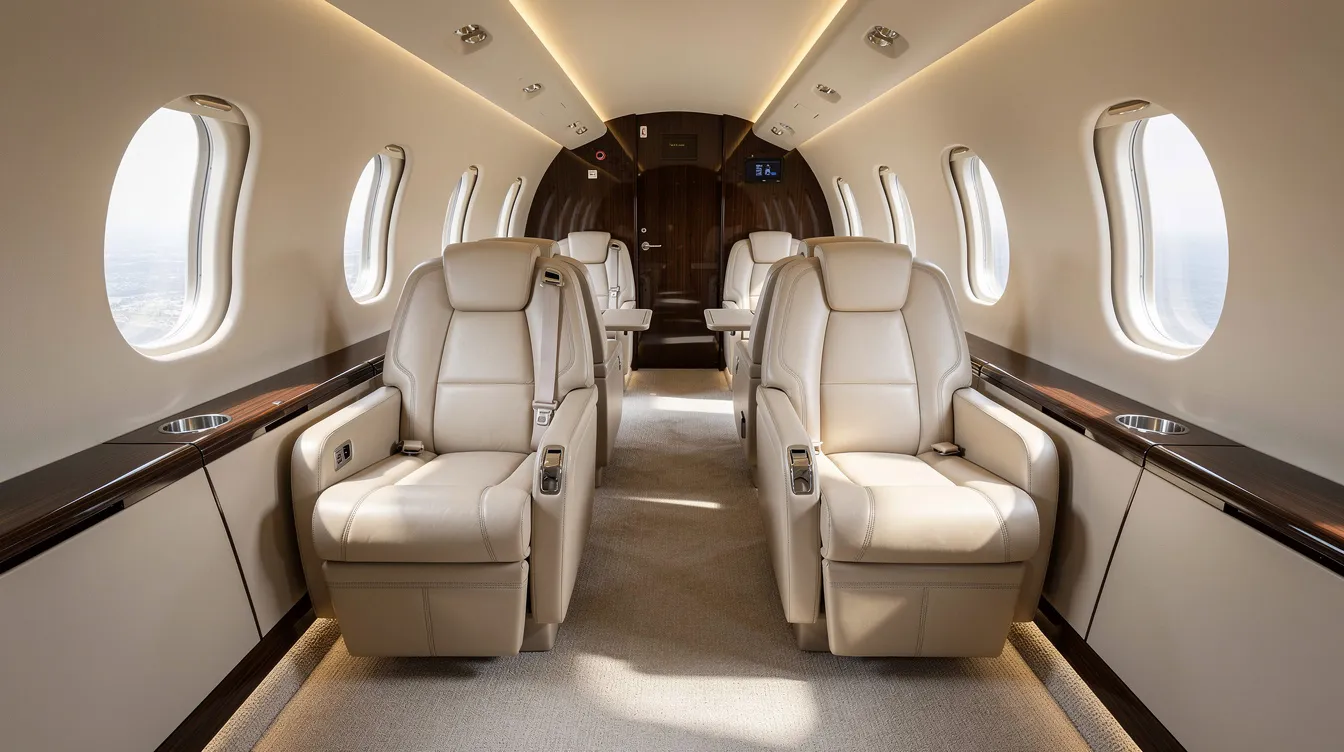
Conclusion: Redefining "First Class" with BlackJet
Commercial first-class cabins can be extraordinary. Air Frafirst-classière, Cathay Pacific's six-seat suite, and the enclosed-class suites on Emirates represent some of the finest experiences in commercial aviation. For fixed-schedule leisure trips on flagship routes, they remain compelling.
But the ultimate first-class cabin in 2025–2026 is increasingly a first-class tailored around the traveler's schedule, privacy needs, and standards. BlackJet brings this within reach through safety-certified operators, carbon-neutral flights, multiple cabin types via Jet Cards, and 24/7 digital booking and support-without the commitment or complexity of a subscription. You're ready to move beyond what even the best airline can offer. Explore the BlackJet experience and discover how a Jet Card can reshape the way you travel.


 Sign up with google
 Sign up with Apple