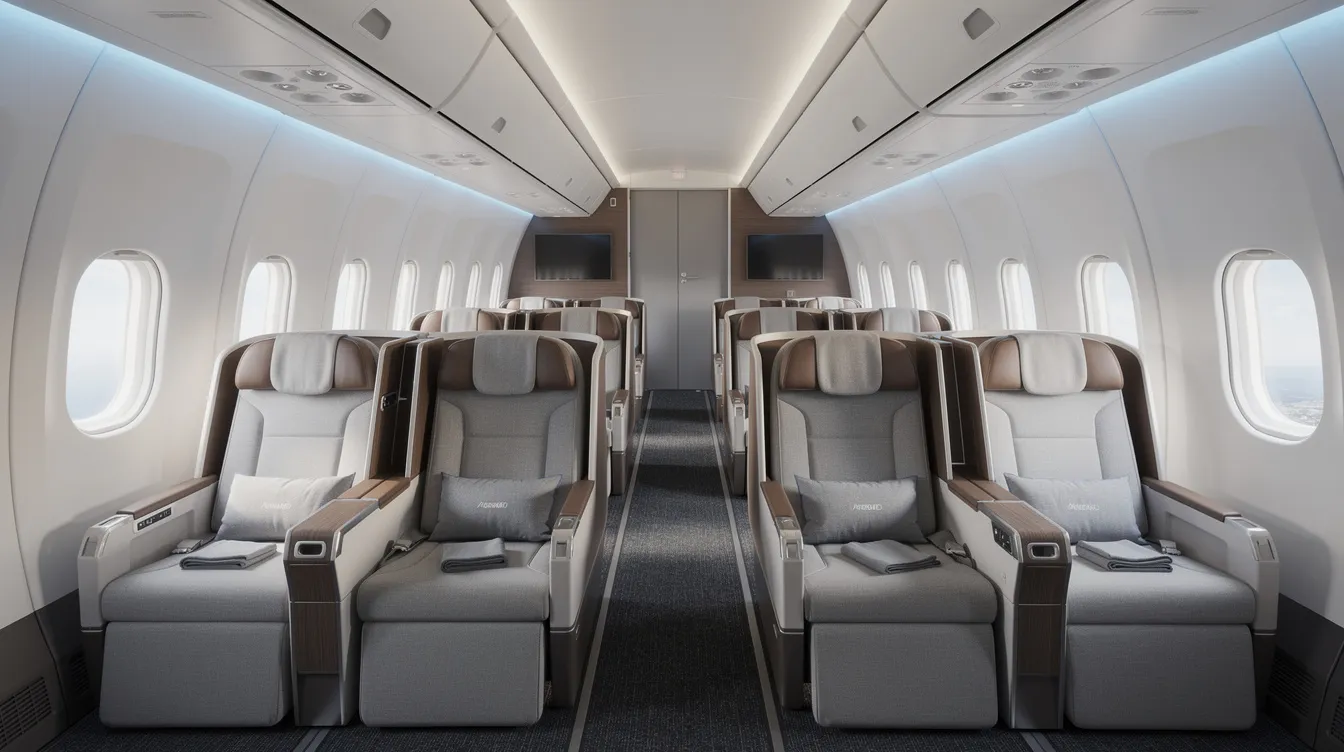
First class is usually located at the very front of the plane, ahead of business class and economy, often just behind the cockpit on widebody aircraft and, on some jets like the Airbus A380, on the upper deck. For frequent business travelers and high-net-worth leisure flyers, comparing premium commercial cabins with private aviation, that location shapes more than prestige: it affects noise, boarding speed, privacy, and the overall travel experience.
This guide explains where first-class cabins sit on different aircraft, how domestic first class differs from international first class, what first class offers compared with business and economy, and when skipping the airline cabin entirely for private travel or a BlackJet Jet Card is the better fit for flexibility, space, and control.
Quick Answer: Where First Class Is on the Plane
First class is usually located at the front of the aircraft, ahead of business class and economy class. On most widebody jets like the Boeing 777-300ER, the first class section occupies the nose of the main deck, directly behind the cockpit. On some A380 aircraft, first class sits on the upper deck instead.
If you board through a door and walk into the business class cabin without seeing first class, the airline may position first class further forward behind a galley, on a different deck, or may not offer first class at all on that route. Air France La Première on the 777-300ER provides a clear example: four private suites arranged in a single row at the very front of the plane, ahead of the business class cabin, with a galley separating the two sections.
Why First Class Is Usually at the Front of the Aircraft
Commercial aircraft organize cabin classes in a front-to-back hierarchy. Economy class fills the largest rear section, business class occupies the middle or forward-middle area, and first class (when offered) takes the nose. This layout exists for three concrete reasons.
Operational Efficiency
First-class passengers enjoy priority check-in and boarding, and front placement means they can board and deplane through the forward door with minimal corridor traffic. Ground crews can connect jet bridges or private vehicles directly to the forward exit, cutting transfer time.
Noise Reduction
Noise levels are lower at the front. On wing-mounted engine aircraft (the majority of widebodies), the forward fuselage sits ahead of the engine pylons, reducing cabin noise by several decibels compared to seats over or behind the wing. This quiet space is a core part of the first class experience.
Marketing Visibility
Airlines use the walk-through effect as a marketing tool. When economy class and business class passengers board through the second door, they pass through (or glimpse) the first class section. That visibility drives upgrade purchases and loyalty program engagement.
Typical First Class Layouts on Common Long-Haul Aircraft
First-class layouts vary by aircraft type and airline, but several patterns repeat across fleets.
Boeing 777-300ER. Airlines that still offer first class on this aircraft typically place 4 to 8 first-class seats in a 1-2-1 or 1-1-1 configuration at the nose. Business class follows immediately behind, and economy class fills the rear two-thirds of the cabin. Air France and ANA are among the carriers maintaining first-class suites on this type.
Airbus A380-800. The A380 has unique opportunities for premium cabins, which can include first class on the upper deck. Emirates, for instance, places its first-class suites at the front of the upper deck, followed by business class on the same deck, while economy class occupies most of the main deck. Lufthansa's A380 configuration puts eight first-class seats at the front of the upper deck as well.
Boeing 747-8I. Lufthansa positions eight first-class seats in rows 1 through 3 at the nose of the main deck. The upper deck is reserved for business class, and economy class fills the rear main deck.
Airbus A350 and Boeing 787. On these newer widebodies, many airlines have eliminated international first class in favor of enhanced business class offerings, and China Southern retired its international first class product as part of that broader shift. The front-most cabin on an A350-900 or 787-9 is typically business class, not first class.
Domestic First Class vs International First Class Cabin Placement
First class means very different things depending on the airline, route, and aircraft. The gap between domestic first class and international first class is one of the starkest examples.
On U.S. narrow-body aircraft (Boeing 737, Airbus A321), domestic first class occupies the very front of the plane in a 2-2 layout. Narrowbody airplanes use a 2-2 layout with larger reclining armchairs in first class, but these seats are not lie-flat and do not include enclosed partitions. Domestic first class often resembles regional business class seating; it offers extra legroom, early boarding, and a full meal service, but not the private suites of a long-haul product, so occasional private flyers may instead prefer the flexibility of a 25-hour jet card.
On international widebody flights, the first class cabin (when offered) sits at the nose, followed by one or more business class cabins, then premium economy and economy class seats in the rear. International first class can feature fully enclosed suites with lie-flat beds, separate bed configurations, onboard shower facilities (on certain Emirates A380 routes), and dedicated flight attendants.
By 2025-2026, many airlines will sell only business class as their highest cabin on long-haul flights. Delta Air Lines, for example, offers "Delta First" on domestic narrowbodies but uses Delta One (a business class product) as its top international cabin. The class section at the nose of the widebody looks like it sits where first class would be, but it is technically business class, a contrast to premium access models like NetJets jet cards and their costs.
How to Tell If Your Plane Actually Has a First Class Cabin
Not every aircraft has first class. On most flights, especially on newer widebodies, airlines offer only business class and economy class, sometimes with premium economy between them.
Steps to Identify First Class Cabins
Look at your booking confirmation for the aircraft type (e.g., 777-300ER, A350-900, 787-9).
Visit the airline's seat map for that specific route. Look for labels like "First," "La Première," or "First Class" as a separate cabin ahead of business class.
If the front cabin is labeled business class and no class section sits ahead of it, the airline does not offer first class on that route.
Cross-reference with third-party tools like SeatGuru for that airline and aircraft combination.
Some airlines, such as several U.S. majors, have domestic first class but no international first class. On their long-haul international flights, business class is the most premium cabin available, which leads some frequent flyers to compare that spend with alternatives like a 100-hour jet card cost guide.
First Class Cabin Size, Privacy, and Class Seats vs Other Cabins
First-class cabins are intentionally small. Airlines typically install only 4 to 12 first-class seats on a widebody aircraft that may carry 300+ passengers total. First-class cabins typically have fewer seats for privacy, and first class typically has fewer seats than business class on the same aircraft. Lufthansa's 747-8 has 8 first-class seats versus 80 business-class seats and 244 economy seats, a ratio that contrasts sharply with 16-seat private jet cabins designed for groups that want full-jet privacy.
Cabin Size
First class offers vastly more space, gourmet dining, and personalized service than other classes. Typical class seats measure over 30 inches wide. First-class seats can recline into fully flat beds stretching over two meters long, and first-class seats can recline further than business-class seats.
Privacy
Many first class seats include individual suite doors, high partitions, and large personal screens for entertainment. The spacious seating and personal space in first class are designed to replicate a private cabin feeling, echoing some of the layouts found on the best private jets in the world. First class offers more privacy than business class because of lower density and physical barriers between seats.
Seat Comparison
Business class seats now often include lie-flat seats with direct aisle access, but they sit in larger cabins with more class passengers and slightly less floor area per person. Economy class seats, by contrast, run 30 to 32 inches of pitch and 17 to 18 inches of width, arranged in blocks of 3-3-3 or 3-4-3 with minimal privacy.
Seat Feature Comparison Table
Feature | First Class | Business Class | Economy Class |
|---|
Seat Width | 30+ inches | 20-24 inches | 17-18 inches |
Seat Pitch | 78-90 inches (lie-flat) | 55-78 inches (lie-flat) | 30-32 inches |
Privacy | Suite doors, partitions | Partial partitions | Minimal |
Cabin Size | 4-12 seats | 20-80 seats | 150-300+ seats |
Meal Service | Gourmet, à la carte | Premium, multi-course | Standard |
Entertainment Screen | 18-32 inches | 15-18 inches | 8-12 inches |
Dedicated Attendant | Yes | Sometimes | No |
Iconic First Class Cabins and Where They Sit on the Plane
Only a handful of airlines still maintain flagship international first class, and each positions it at premium real estate on the aircraft.
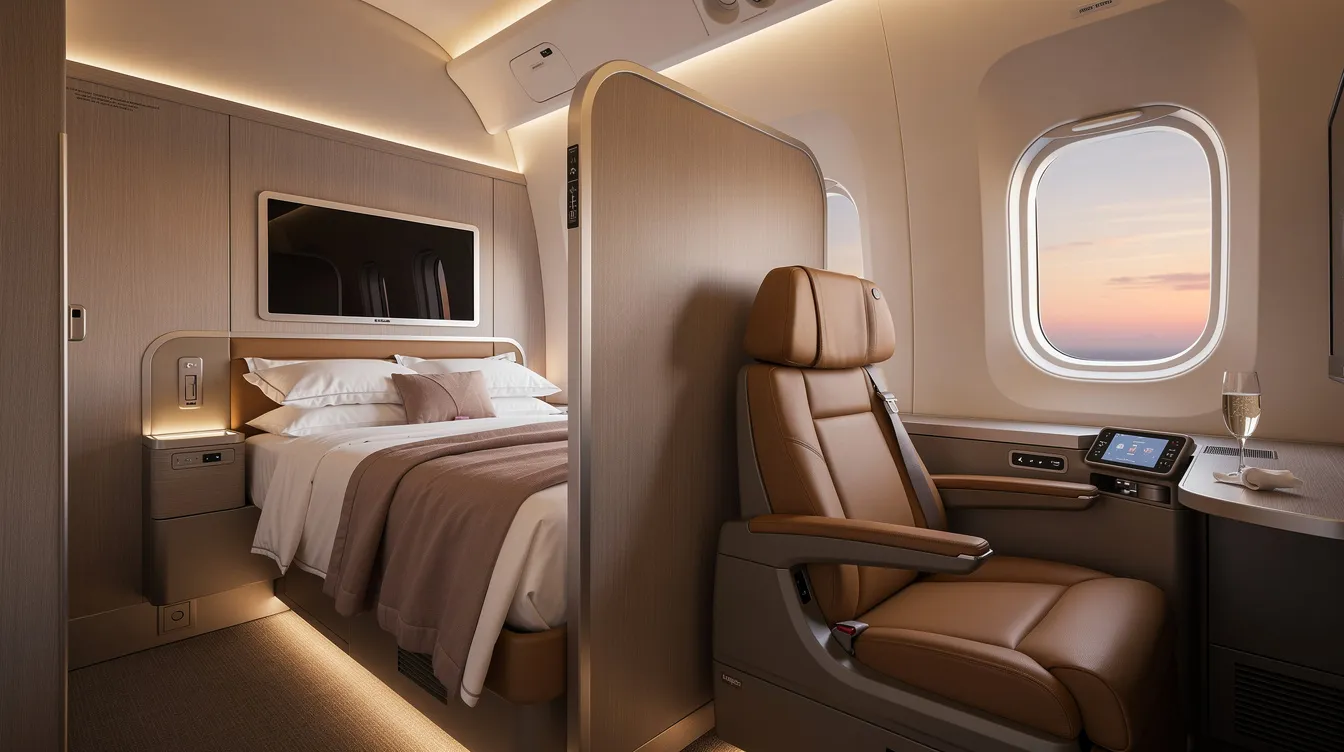
Air France La Première on the Boeing 777-300ER places four-class suites in a single row at the very front, behind the cockpit. The separate cabin holds just four travelers, each with a private suite that converts into a lie-flat bed and includes a separate bed mattress. First class meals are often designed by renowned chefs; Air France rotates Michelin-starred chefs through its La Première galley.
Emirates' A380 first class occupies the nose of the upper deck. Each of the 14 suites has floor-to-ceiling doors and access to an onboard shower and spa treatments. Other passengers in business class and economy class board through different doors and never pass through the first class section.
Nippon Airways first class and Japan Airlines both position their first class cabins at the nose of their widebodies. Japan Airlines' A350-1000 first class features six enclosed suites at the forward-most section, reinforcing how location on the aircraft supports the quiet space and seclusion these products promise.
These first-class cabins function as destination products; travelers choose specific routes and airlines to experience them, much like enthusiasts seek out the most expensive private jet experiences purely for the onboard luxury.
Major U.S. Airlines: How They Position First Class and Business Class
Most U.S. carriers split their branding: "first class" for domestic, "business class" (or a branded suite product) for long haul.
American Airlines offers domestic first class at the front of 737 and A321 aircraft with a large recliner seat in each row. On long-haul 777-300ER routes, American's Flagship First cabin sits at the nose with 8 seats, then Flagship Business behind it, then economy cabins. American is one of the few U.S. airlines still operating a separate international first-class product.
Delta Air Lines brands its domestic premium cabin as "First" or "Delta First" at the front of narrowbodies, offering priority boarding and better meal service. On international widebodies, Delta One suites (business class) occupy the forward section. There is no separate first-class cabin; Delta One is the highest class section available.
United Airlines follows a similar pattern. United First sits at the front of domestic narrowbodies. Polaris Business Class is the top cabin on long-haul flights, located at the nose of 777 and 787 aircraft, with no international first-class option.
Across all three carriers, the forward-most premium cabin section is reserved for their most valuable class passengers on that aircraft, regardless of whether the label says "first" or "business."
Is First Class Worth It Compared to Business Class and Economy Class?
The gap between modern business class and traditional first class has narrowed in hardware. Business class offers lie-flat seats with direct aisle access on most long-haul flights. The remaining differentiator is soft product: fewer other passengers per cabin, more personalized service from dedicated flight attendants, gourmet meals often prepared by renowned chefs, and first-class lounges with features like spa treatments and a dedicated class terminal or class lounge, all of which come at a price that many travelers now benchmark against a comprehensive private jet price list and access options.
First-class tickets can exceed $10,000 for long-haul flights. Round-trip fares on routes like New York to London range from $12,000 to $25,000 or higher in first class, versus $4,000 to $8,000 for business class and under $1,000 for economy class—numbers that naturally invite comparison with a 50 hour jet card cost breakdown. First-class passengers typically have access to exclusive airport lounges, priority services including baggage handling and a private check-in experience, and better service overall.
Flying business class delivers roughly 80% of the hardware experience at 40-60% of the first-class ticket price. Whether the remaining 20% of exclusivity and premium service justifies the gap depends on the traveler, the route, and the specific airline product.
For travelers running the numbers on repeated long-haul flights, the cumulative cost of first-class tickets starts to approach the economics of private aviation, the hourly structure of renting a private jet, and structured jet card membership pricing.
From First Class Seat to Private Jet Cabin: When Location Stops Mattering
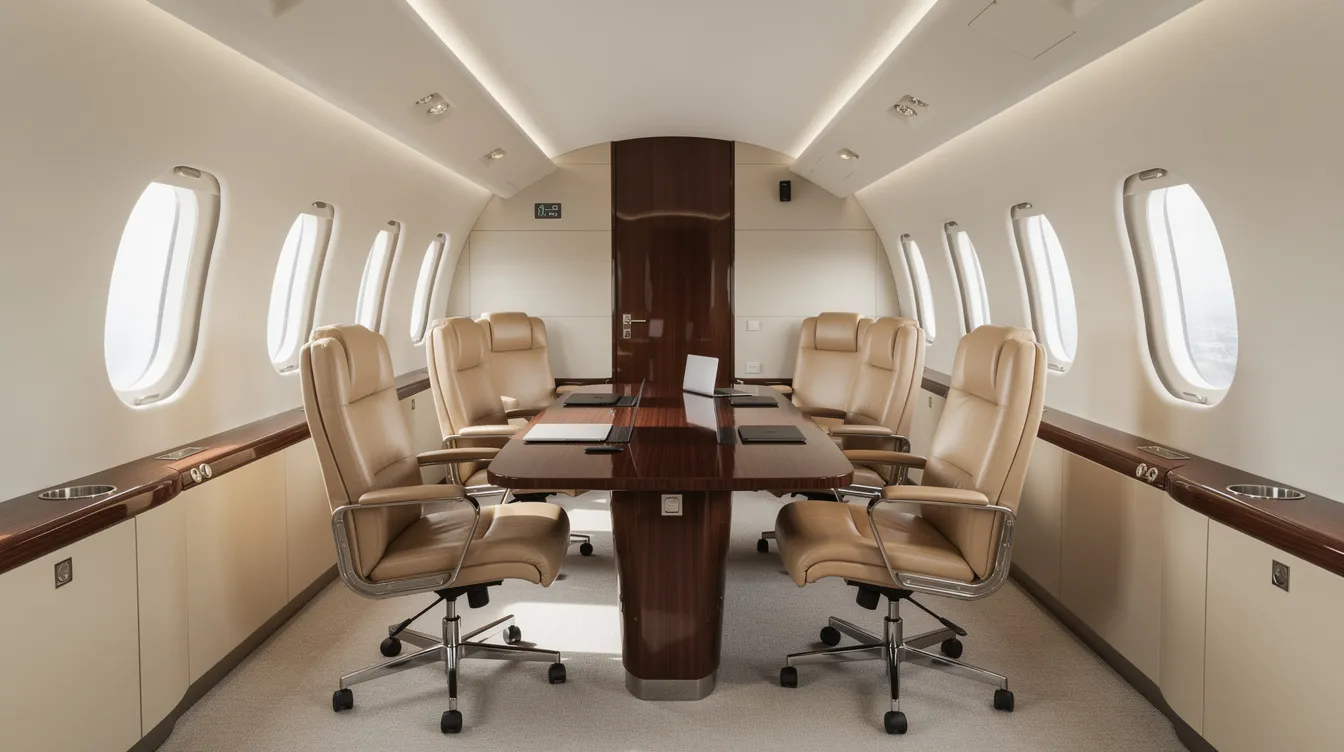
While first-class location on a plane affects noise, speed of exit, and privacy, a private jet changes the equation. There is no first-class section, business-class cabin, or economy class because the entire cabin is reserved for one party, and different types of private jets and private jet sizes allow you to match cabin size and range to each trip.
On a private jet, whether light, midsize, super-midsize, or large-cabin, every seat belongs to the traveler, and the experience varies significantly between small private aircraft options and long-range jets. BlackJet Jet Card members bypass the airline cabin classes system entirely, boarding via private terminals and walking directly onto the aircraft without passing other passengers or navigating class sections.
Compare a flagship product like Air France La Première (four suites at the nose of a 777-300ER, sharing the aircraft with 300+ people) with a large-cabin private jet: the private aircraft offers full control over schedule, more space per person, a private cabin with no strangers, and the ability to land at airports commercial airlines do not serve, which becomes especially compelling when moving groups on the best private jets for 20 passengers or evaluating private jet options suitable for 15 passengers.
The distinction is not just seat width or meal options. It is control over time, route, and who shares the space.
Choosing Between First Class, Business Class, and BlackJet Jet Cards
The decision is strategic for frequent travelers balancing time, comfort, and cost.
Commercial first class makes sense on fixed city-pair routes where the airline product is part of the draw. Flying first class on Emirates' A380 from Dubai to London or on Air France La Première from Paris to New York is an experience worth having at least once, even though these flights cruise at altitudes that private jets can sometimes surpass for smoother air, as explained in our guide on how high private jets fly compared to commercial flights. It also works well when redeeming airline miles for premium redemptions.
Business class is usually sufficient on long-haul flights where the airline has eliminated first class but offers a strong lie-flat product. Flying business class on Delta One or United Polaris delivers a flat bed, direct aisle access, and priority boarding at a lower price point, though some travelers now also look at private plane rideshare options as a flexible alternative on select routes.
A BlackJet Jet Card becomes compelling for multi-city trips, last-minute schedule changes, or regional travel to airports not well served by airlines, especially when you want the fixed-rate flexibility of the BlackJet 25+ Hour Jet Card. Consider an executive flying from New York to Boston to Toronto and back to New York in one day. That itinerary requires three commercial segments, three rounds of check-in, security, and boarding, and likely involves domestic first class on narrowbodies at best. A single private jet covers all three legs on the traveler's schedule, with no connections and no cabin class compromises, especially when using flexible programs like the Flexjet jet card to guarantee aircraft access.
For travelers weighing these options regularly, a Jet Card vs. charter comparison helps clarify which model fits, and understanding the meaning of charter flights makes it easier to evaluate on-demand options against fixed-hour programs.
Safety, Sustainability, and Technology: Beyond Where First Class Is Located
Whether a passenger sits in economy class, business class, or first class, all commercial cabins operate under the same FAA or EASA safety regulations. The aircraft, crew certifications, and maintenance standards do not change by cabin.
BlackJet layers additional standards by partnering only with operators that meet top third-party safety audits, including ARG/US and Wyvern certifications, and maintains rigorous pilot and maintenance criteria beyond regulatory minimums.
On sustainability, BlackJet flights are carbon-neutral by default, with emissions measured and offset at no extra cost. This supports personal ESG goals more directly than purchasing a first-class ticket on a commercial airline, where per-passenger carbon accounting is opaque, and compares favorably with many of the top private jet companies competing for high-end travelers, especially when you factor in the rigorous standards highlighted in our overview of private jet safety realities.
Technology plays a role too: 24/7 digital booking, real-time flight support, and transparent aircraft selection across cabin types give BlackJet members control that airline passengers, regardless of their class ticket, do not have, especially when leveraging the best jet cards for frequent flyers or exploring unlimited private jet flight memberships to lock in availability and pricing. The conversation shifts from "Where is first class located on this plane?" to "What aircraft and schedule best serve this trip?"
Practical FAQs: First Class Location, Cabins, and Private Alternatives
Why do I only see business class when I board? Where is first class? Some aircraft have no first-class cabin. On others, first class sits ahead of the boarding door behind a galley or on a different deck (as on some A380 configurations). Check the airline's seat map for that specific aircraft to confirm.
Are first-class cabins always quieter? Front placement generally reduces engine noise, but cabin design, insulation quality, and class seat density also matter. A first-class cabin with four suites will be quieter than a business class cabin with 48 seats, even at the same position on the fuselage.
What is domestic first class? On many U.S. and Canadian flights, domestic first class is a front cabin of recliner seats offering early boarding, more space, and better meal service. It functions closer to regional business class than to the first-class suites found on long-haul international flights, and its value is often compared against the jet card cost per hour of moving some trips to private aviation or even budget-friendly private aircraft options.
How does a BlackJet Jet Card compare to repeatedly buying first-class tickets? Jet Cards provide prepaid flight hours on private aircraft, delivering a private cabin, schedule control, and access to thousands of airports. For frequent, time-sensitive, or multi-city travel, a Jet Card can outperform commercial first class on both convenience and total cost per trip, particularly when you understand Jet Card pricing structures, how they translate into hourly value, and what they mean relative to the cost of a 12-seater private jet.
Is the first-class equivalent available on every airline? No. Many airlines operate only two cabin classes on long-haul flights: business class and economy class. The first-class equivalent on those carriers is their top business-class product, which occupies the forward section where first class would otherwise sit, though some travelers instead opt to buy a seat on a private jet or even charter one of the largest private jets available to bypass cabin hierarchies entirely.
If the question of where you sit on someone else's aircraft matters less than having the whole aircraft to yourself, explore how BlackJet can reshape your travel around your schedule.
Conclusion: The Strategic Advantage of First-Class Location and Private Jet Travel
The location of first class at the very front of the aircraft is more than tradition; it is a strategic choice that enhances the travel experience through reduced noise, faster boarding, and greater privacy. Whether on a Boeing 777, Airbus A380, or domestic narrowbody, first-class cabins occupy prime real estate that supports the premium service and exclusivity passengers expect.
However, the evolving landscape of premium air travel means that for many frequent and discerning travelers, the ultimate first-class experience extends beyond the commercial cabin. Private jets, accessed through programs like BlackJet's Jet Card, offer unparalleled control over schedule, space, and privacy, effectively redefining what it means to fly first class.
Choosing between commercial first class and private jet travel depends on your specific needs—whether you prioritize the iconic luxury of international first class suites or the flexibility and exclusivity of a private jet cabin. BlackJet's safety-certified, carbon-neutral private jet network and 24/7 digital booking tools provide a compelling alternative that elevates the concept of first class to a new level.
Explore how BlackJet can transform your travel experience, offering premier access that goes beyond the front of the plane to place you in command of your journey. Learn more about our private jet safety standards, discover the carbon-neutral flights we provide, and understand the benefits of our large-cabin private jets for ultimate comfort. For frequent flyers, our jet card cost breakdown offers insight into the value of private jet travel compared to commercial first class.


 Sign up with google
 Sign up with Apple