One of the most common questions in aviation circles-and one that reveals a widespread misconception-is "what is the octane rating of jet fuel?" The short answer may surprise you: jet fuel has no octane rating at all.
Executive Overview: Does Jet Fuel Have an Octane Rating?
Jet fuel does not have a defined octane rating because it is designed for turbine engines, not spark ignition engines. The grades you encounter in business and commercial aviation-Jet A, Jet A-1, and Jet B-are aviation turbine fuels governed by entirely different performance criteria than gasoline. Jet fuel is a highly refined kerosene and chemically closer to diesel fuel than gasoline, which means the octane scale simply does not apply.
Instead of octane, jet fuel is characterized by properties like flash point, freezing point, and energy content. These specifications determine whether a fuel can safely power jet engines at high altitudes, in extreme cold, and across thousands of nautical miles without interruption. For private jets and commercial airliners alike, these properties matter far more than any octane number ever could.
Aviation gasoline, or avgas, is a different story. Avgas powers piston engines in small aircraft and carries a high octane rating-typically 100LL-to prevent engine knock. But for every aircraft in BlackJet's jet card and on-demand charter programs, the fuel is certified Jet A or Jet A-1, meeting international aviation safety standards, not automotive gasoline or high-octane gasoline.
Understanding the distinction between fuel types is not merely academic. For business and high-net-worth travelers, it connects directly to the strategic advantages of private aviation: range, reliability, safety, and the confidence that every detail-right down to the fuel-has been rigorously vetted.
Foundations: What Octane Rating Actually Measures
Octane rating measures a fuel's resistance to premature detonation, which is crucial for piston engines. In spark ignition engines, whether in car engines or piston aircraft, fuel and air are compressed in a combustion chamber and ignited by spark plugs. If the mixture ignites before the spark fires, the result is "knock," a destructive phenomenon that can damage pistons, valves, and bearings.
Octane does not indicate the energy content of fuel or the power production ability. A higher octane fuel simply tolerates greater compression before uncontrolled ignition. An engine designed for regular gasoline gains nothing from higher octane fuel unless its compression ratio demands it.
Typical octane values provide useful context:
Fuel Type | Octane Rating (AKI) | Primary Use |
|---|
Regular automotive gasoline | 87 | Car gas, auto gas |
Premium automotive gasoline | 91–93 | High-compression car engines |
Avgas 100LL | 100/130 (lean/rich) | General aviation piston aircraft |
Avgas UL94 | 94 | Select general aviation aircraft |
Historical Avgas 115/145 | 115/145 (lean/rich) | WWII-era military aircraft |
The lean/rich octane scale used for aviation gas is not directly comparable to the pump numbers you see at a gas station. Avgas grades like 100/130 describe knock resistance under both lean and rich mixture conditions, a dual-rating system unique to aviation gasoline that general consumers rarely encounter.
Why Jet Fuel Has No Octane Rating
The jet fuel octane rating question stems from a fundamental misunderstanding of how turbine engines work. Unlike gasoline engines and diesel engines that rely on discrete combustion cycles, jet engines operate on continuous combustion rather than explosive compression in piston engines.
Here is how a turbofan or turbojet engine actually functions—a subset of the broader types of jet engines that power modern aviation:
Compression - Incoming air is compressed through multiple stages of rotating blades.
Fuel injection - Kerosene-based fuel is sprayed into the combustion chamber as a fine mist.
Continuous burn - The fuel-air mixture ignites and burns steadily, not in isolated detonation events.
Exhaust and thrust - Hot gases expand through a turbine and exit as thrust.
Because there is no spark ignition cycle and no compression of a pre-mixed fuel charge, knock-and therefore the fuel's resistance to knock-is irrelevant. Jet fuel is kerosene-based and used in turbine engines where the critical specs are flash point, freezing point, thermal stability, smoke point, energy density, and cleanliness.
For jet aircraft, performance depends more on fuel's physical and chemical properties than on octane. Comparing a jet fuel octane rating to a high octane rating on avgas is a category error, much like asking for the thread count of a carbon fiber wing panel. The fuel's ability to resist knock has no bearing on how turbine engine aircraft operate. Even the cetane number used for compression ignition engines in diesel applications is not formally assigned to civil jet fuel.
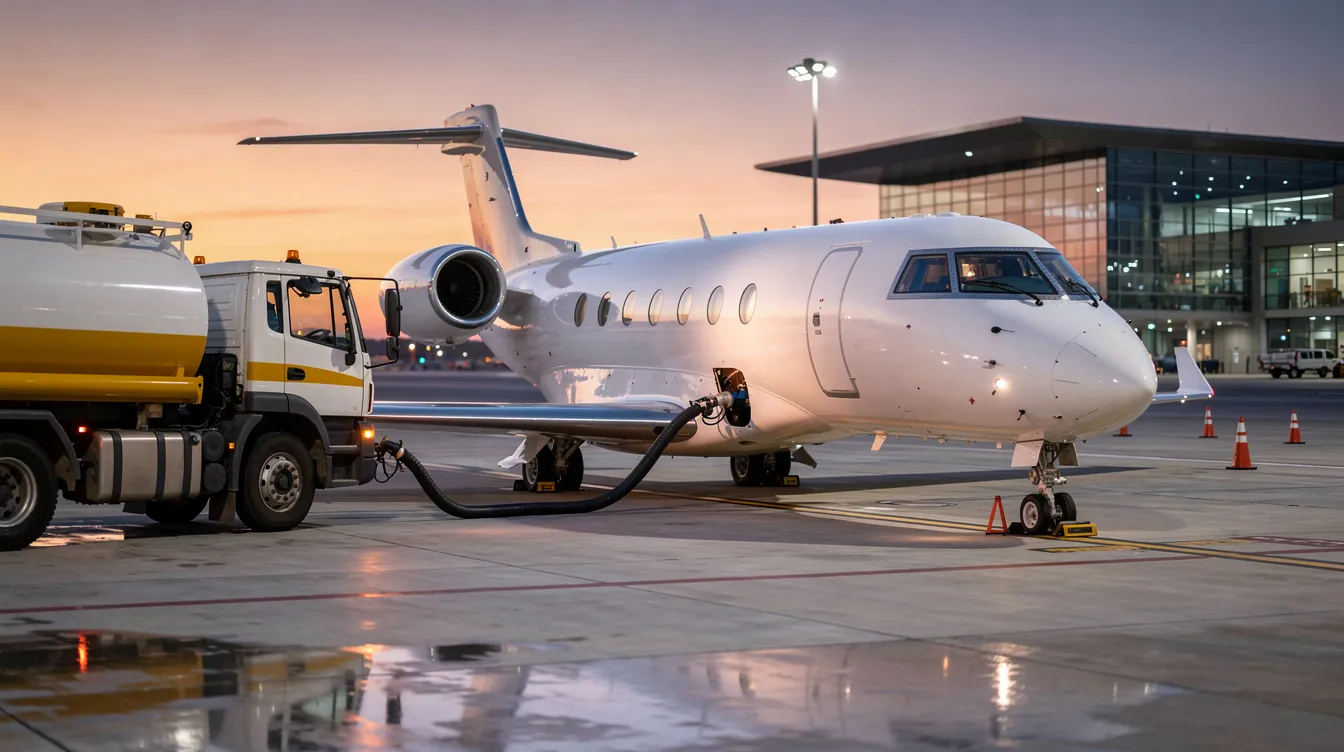
Aviation Gasoline (Avgas) vs Jet Fuel: Where Octane Still Matters
Aviation fuel divides cleanly into two families, and octane rating applies to only one of them.
AvGas is used in piston-engine aircraft trainers like the Cessna 172, touring planes like the Piper PA-28, and vintage aircraft with radial engines. Piston aircraft engines require a fuel with a specific octane rating to prevent knock, particularly under the high power demands of takeoff and climb. AvGas typically has an octane rating of 100 or higher, with 100LL (low lead) being the dominant grade worldwide.
Avgas grades and their identifying dye colors serve as practical safety measures:
These color codes help ground crews at FBOs immediately distinguish between fuel types during preflight checks-a critical detail given that using the wrong type of fuel in aircraft can have severe impacts on performance.
Jet fuel is used in turbine-engine aircraft. Jet A and Jet A-1 are kerosene-based, straw to clear in color, and graded by specification rather than by octane number. There is no lean/rich rating, no required octane rating, and no lead additives. The chemical composition and ignition characteristics of jet fuel are fundamentally different from av gas.
For BlackJet clients, this distinction is largely academic but worth understanding. Most piston engine aircraft serve general aviation operations-flight training, recreational flying, and agricultural spraying. Business jets, from light jets to ultra-long-range cabins, are exclusively turbine-powered and run on jet fuel. If you hold a BlackJet jet card, your aircraft will never require avgas.
Inside Jet Fuels: Jet A, Jet A-1, and Jet B Explained
Not all jet fuel is identical. The aviation industry relies on three main civil grades, each optimized for specific operating conditions. For a deeper breakdown, see our guide to types of jet fuel and how those grades factor into private jet pricing and access models.
Jet A is the standard turbine fuel across the United States. Jet A fuel must meet ASTM specification D1655, which governs everything from chemical composition to thermal stability. Its maximum freezing point is −40°C (−40°F).
Jet A-1 is the global standard, used across Europe, Asia, the Middle East, and most international airports. Jet A-1 is primarily used in turbine engine aircraft and differs from Jet A mainly by its lower freezing point: Jet A-1 has a maximum freezing point of −47°C (−53°F). Jet A-1 has a flash point of approximately 38°C (100°F) and is composed mainly of hydrocarbons with 8 to 16 carbon atoms. Internationally, it also conforms to DEF STAN 91-91.
Jet B is a wide-cut fuel with an even lower freezing point-approximately −60°C-designed for extreme cold environments like northern Canada, Alaska, and certain military aircraft operations. Its higher volatility and lower flash point make it more hazardous to handle, limiting its use to specialized contexts.
Key properties at a glance:
Property | Jet A | Jet A-1 | Jet B |
|---|
Freezing point (max) | −40°C | −47°C | ~−60°C |
Flash point (min) | ~38°C | ~38°C | Lower |
Primary region | United States | Global | Arctic/military |
Standard | ASTM D1655 | ASTM D1655 / DEF STAN 91-91 | ASTM D6615 |
Mandatory additives in Jet A-1 include antistatic agents that reduce the risk of static discharge during fueling. Optional additives-corrosion inhibitors, antioxidants, fuel system icing inhibitors-further protect fuel systems and aircraft safety at altitude.
In BlackJet's operations, dispatch teams verify fuel type and source as part of every flight's safety checks. The aircraft in our network are certified for specific fuel grades, and only on-spec fuel is accepted as part of our broader premium private jet service.

Key Performance Metrics for Jet Fuel (Instead of Octane)
If octane is irrelevant, what does matter? The answer lies in a set of precisely defined physical and chemical properties.
Energy density is arguably the most consequential metric for travelers. Jet A-1 has an energy content of about 43 MJ/kg, and jet fuel has a higher energy density than AvGas. More energy per kilogram means longer non-stop range-the difference between a direct New York-to-London crossing and a refueling stop in Newfoundland. Jet A-1's flash point is approximately 38°C (100°F), providing a practical safety margin during ground handling.
The freezing point directly affects route planning. At cruise altitudes of FL400 and above, outside air temperatures can plunge below −56°C. Jet A-1 fuel has a maximum freezing point of −47°C, giving operators confidence on polar and high-latitude routes. For extreme cold-weather operations, Jet B's even lower freezing point becomes necessary.
Viscosity must remain within limits at low temperatures to ensure the fuel flows freely through pumps and injectors. ASTM D1655 sets a maximum kinematic viscosity of 8 mm²/s at −20°C.
Thermal stability prevents deposit formation inside hot fuel lines and injector nozzles, critical for engine technology reliability in turbine engines that cycle fuel through high-temperature zones before combustion.
Fuel quality and cleanliness-absence of water, particulates, and excess sulfur (capped at 0.30% by mass) and aromatics (max 25% by volume)-round out the specification. These metrics protect engine life, prevent flameouts, and underpin the schedule reliability that BlackJet members depend on across recurring routes.
Jet Fuel, Diesel, and Gasoline: Clearing Up Common Confusion
The question "What octane is jet fuel?" often arises because people mentally group all liquid fuels together. In reality, the three main fuel types occupy distinct roles:
Gasoline - Light, volatile, octane-rated for spark ignition engines
Diesel - Heavier middle distillate, cetane-rated for compression ignition engines
Jet fuel - Kerosene-type middle distillate, optimized for continuous combustion in turbine engines
Jet fuel is often described as similar to diesel, and the comparison is fair in some respects. Both are middle distillates derived from crude oil refining. But jet fuel meets far stricter standards for freezing point, thermal stability, and cleanliness than road diesel. For a detailed comparison, see our article on jet fuel vs diesel.
AvGas is more volatile and flammable than Jet A-1, which is precisely why misfueling-putting jet fuel into a piston engine aircraft or avgas into a jet aircraft-is treated as a critical safety event. Misfueling a piston aircraft with kerosene-based fuel can cause immediate engine failure due to ignition failure and pre-ignition issues. Natural gas, rocket fuel, and automotive gasoline each serve their own domains and are equally inappropriate substitutes.
For BlackJet travelers, all contracted operators follow rigorous fuel handling and labeling procedures. Aircraft type, fuel grade, and fueling records are cross-checked before every departure—controls that matter whether you’re on a smaller introductory program or a higher-commitment 50-hour jet card.
How Fuel Type Influences Private Jet Performance and Range
The high energy density and cold-flow performance of Jet A and Jet A-1 enable the long non-stop missions that define modern business aviation. Large-cabin business jets like the Gulfstream G550 or Bombardier Global 6000 can cross oceans precisely because their fuel systems carry enough energy-dense kerosene to sustain hours of continuous thrust.
Consider a practical scenario: a BlackJet member flying from Los Angeles to New York non-stop on a super-midsize jet. Fueled with Jet A-1, the aircraft climbs to FL450, cruises above commercial traffic, and arrives without a refueling stop-saving roughly two hours compared to a multi-leg commercial itinerary with connections, while the member benefits from a predictable jet card cost per hour.
At those high altitudes, gasoline engines would be entirely impractical. Spark ignition piston engines lose power density as air thins, and avgas-powered piston aircraft typically have service ceilings well below FL300. Turbine engines thrive in thin air, and jet fuel's properties-stable combustion, resistance to freezing, predictable viscosity-support that advantage.
Some travelers ask whether higher octane fuel could boost their jet's speed or range. The answer is no. Turbine performance is governed by engine design and certified thrust settings, not by fuel octane. On-spec Jet A or Jet A-1, meeting every parameter of ASTM D1655, is exactly what delivers optimal performance. There is no "premium upgrade" equivalent for jet aircraft fuel.

Safety, Standards, and Quality Control in Jet Fuel Handling
Jet fuel passes through a multi-stage quality process before it ever reaches an aircraft wing, and for business users, this dovetails with broader planning around jet card tax deductions and overall operating economics:
Refining - Crude oil is distilled, and the kerosene fraction is isolated and treated.
Transport - Fuel moves via pipeline, barge, or tanker truck under chain-of-custody protocols.
Airport storage - Fuel farms receive, test, and filter fuel before distribution.
Final delivery - Fuel trucks or hydrant systems deliver fuel directly to the aircraft, passing through final filtration stages.
Key organizations and standards governing this chain include ASTM D1655 for Jet A and Jet A-1, DEF STAN 91-91 for certain international and military grades, IATA guidance material, and JIG (Joint Inspection Group) quality checklists for global fuel operations. The Federal Aviation Administration oversees operational compliance within the United States.
Practical safety checks at the point of delivery include fuel sampling for water and particulates, density verification, and clear-and-bright visual inspection. Labeling of aviation fuel prevents confusion with automotive gasoline or diesel fuel at shared-use facilities.
BlackJet only partners with operators and FBOs that meet or exceed these standards. Audited fuel suppliers, documented fuel quality logs, and trained ground crews following standard operating procedures are non-negotiable. Reliable, on-spec jet fuel reduces risks of flameouts, filter blockages, and icing issues-reinforcing the trust that families and corporate travelers place in private jet travel.
Sustainable Aviation Fuels (SAF) and the Future of Jet Fuel
Aviation contributes 2–3% of global CO₂ emissions, and the aviation industry is under increasing pressure to reduce carbon emissions. Sustainable aviation fuels represent the most promising near-term pathway.
SAF is produced from waste oils, biomass, municipal solid waste, or synthetic Power-to-Liquid processes and serves as a drop-in alternative to conventional Jet A-1. Under current ASTM standards, SAF can be blended at ratios up to approximately 50% with conventional jet fuel. Biofuels could reduce flight-related greenhouse gas emissions by 60–80% on a lifecycle basis, depending on feedstock and production pathway. Synthetic jet fuels can reduce pollutants like NOx and SOx as well, helping even more cost-conscious private jet travelers access sustainable options over time.
Jet fuel contains up to 1,000 ppm of sulfur, affecting emissions, while jet fuel can produce higher emissions than AvGas in certain categories. SAF addresses both concerns by offering a cleaner-burning alternative that still meets every performance and safety requirement of ASTM D1655.
Major airlines and fuel-efficient business jet operators have been flying on SAF blends at hubs across the U.S. and Europe since the late 2010s, including some that offer unlimited private jet membership models. BlackJet delivers carbon-neutral flights by default through high-quality carbon offsets and partnerships with operators progressively incorporating SAF where supply allows. There is still no octane metric involved; SAF is rated and certified by the same turbine fuel standards as conventional Jet A-1.
Fuel Choices, Jet Cards, and Operational Flexibility with BlackJet
Fuel availability-whether Jet A versus Jet A-1, SAF blends, or local infrastructure constraints-can influence routing, refueling stops, and private jet fuel costs. BlackJet's 24/7 flight support team evaluates departure and destination airports for fuel grade, fuel quality reputation, and operational constraints, then matches the optimal aircraft category to each mission, all within a transparent jet card pricing structure.
Consider a same-day round trip from Chicago to Aspen. Field elevation, temperature, and required fuel reserves all factor into aircraft selection and fueling strategy-details that BlackJet's platform handles seamlessly so members never need to think in terms of octane or fuel specs, whether they hold a 100-hour jet card or fly less frequently.
This is also where a jet card program provides a strategic advantage over owning a single aircraft. Members access jets optimized for each mission profile, with fuel type, range, and runway performance already accounted for. Whether the mission calls for a light jet on a 90-minute hop or a large-cabin aircraft on a transatlantic crossing, the right fuel and the right aircraft are matched automatically, especially with flexible options like the BlackJet 25+ Hour Jet Card.
Frequently Asked Questions About Jet Fuel and Octane
What octane rating is Jet A or Jet A-1? Neither Jet A nor Jet A-1 has an octane rating. These are kerosene-based aviation turbine fuels rated by flash point, freezing point, energy density, and other physical properties under ASTM D1655-not by octane number. The concept of a required octane rating applies only to spark ignition engines.
Is jet fuel the same as high-octane aviation gasoline? No. Aviation gas (avgas) and jet fuel are entirely different fuel types. Avgas is high-octane gasoline formulated for spark-ignition piston engines in general aviation aircraft. Jet fuel is a kerosene-type fuel for turbine engines. Confusing them is not just inaccurate-it can be dangerous.
Can diesel engines run on jet fuel? Some diesel engines can technically operate on Jet A in emergency situations because both are middle distillates. However, jet fuel lacks certain lubricity additives that diesel engines need for long-term operation, and using it voids most automotive warranties.
Can a car run on jet fuel? Standard car gas is gasoline, and car engines use spark ignition. Jet fuel behaves more like diesel and would not combust properly in a gasoline engine. Attempting to use jet fuel, let alone rocket fuel or natural gas, in a vehicle designed for auto gas or automotive gasoline would cause immediate engine failure.
Does using "better" jet fuel make a private jet faster? No. Turbine performance is determined by engine design and certified power settings, not by fuel grade variations. As long as the fuel meets specification, commercial jets and private jets perform identically whether fueled from a refinery in Houston or Rotterdam. There is no very low octane or low octane concern; octane is simply not part of the equation.
Is sustainable aviation fuel different from regular jet fuel in performance? From the passenger's perspective, SAF performs identically to conventional jet fuel. It meets the same ASTM certification standards and can be used in existing aircraft and fuel systems without modification.
How does fuel choice affect aviation safety? Fuel quality is foundational to aircraft safety. Every stage-from refining to delivery-is governed by international standards. BlackJet's member advisors and operations team can address any fuel-related questions when planning complex or international missions.
Conclusion: What Jet Fuel Octane Myths Mean for the Private Jet Traveler
The central takeaway is straightforward: jet fuels like Jet A, Jet A-1, and Jet B do not have octane ratings. Octane belongs to the world of gasoline and avgas-fuels designed for spark ignition engines in small aircraft and automobiles. Turbine fuels follow different performance metrics, governed by stringent aviation standards that prioritize energy density, thermal stability, freezing point, and cleanliness over knock resistance.
Understanding this distinction matters in practice. It helps discerning travelers evaluate safety claims, sustainability initiatives, and the operational capabilities of private jet providers with a more critical eye. When a provider talks about "premium fuel," you now know to ask about ASTM certification, SAF availability, and fuel quality protocols-not octane.
BlackJet's approach reflects this reality. Every flight in our network is backed by safety-first operator selection, certified fuel standards enforced at every stage of the supply chain, technology-enabled flight planning, and carbon-neutral travel delivered through our flexible jet card model. No complex aircraft ownership required. No fuel logistics to manage. Just seamless, informed, and elevated private aviation, supported by some of the best jet card options for frequent flyers.
Discover how BlackJet's jet card memberships can reshape the way you travel-where every detail, from the fuel in the tanks to the cabin waiting for you, meets the highest standard in business aviation—whether you’re buying a seat on a private jet, comparing 10 million dollar private jet options, exploring 20 million dollar aircraft features, evaluating Flexjet jet card pricing, benchmarking NetJets jet card costs, or planning large-group trips on the best private jet for 50 passengers.


 Sign up with google
 Sign up with Apple