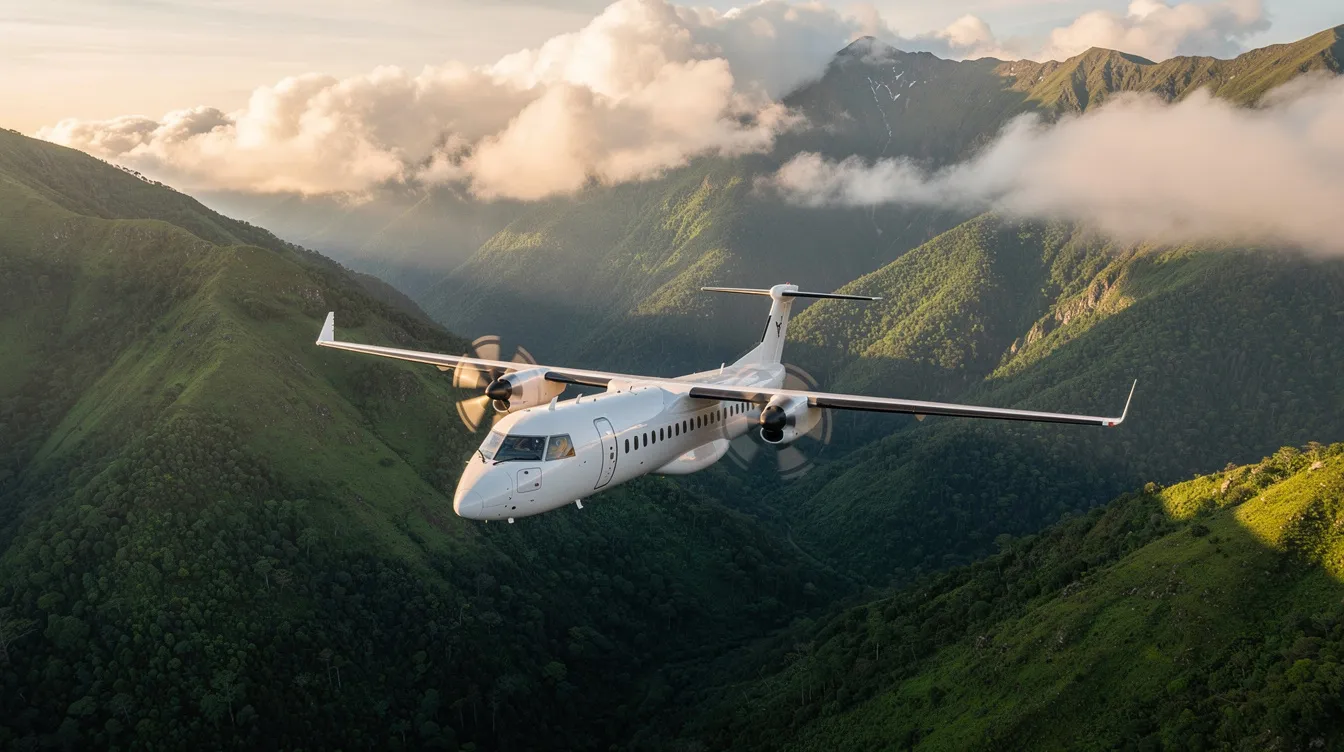
For discerning private travelers, choosing a modern propeller plane is never just about speed. Whether you are a private traveler, charter client, or aviation enthusiast, understanding the capabilities and advantages of modern propeller planes is essential for optimizing regional and remote travel. A modern propeller plane almost exclusively uses a turboprop engine—a gas turbine engine that turns multi-blade propellers—combining the efficiency of propellers with jet engine technology. This unique combination allows these aircraft to deliver unmatched access, efficiency, and operational flexibility, especially on routes where jets may not be practical.
This article will cover the strategic advantages of modern propeller planes, the technology behind their performance, the different types available, their economic and environmental benefits, safety and cabin experience, and how BlackJet integrates these aircraft into its Jet Card and charter programs. By the end, you’ll understand why modern propeller planes matter for regional and remote travel, and how they can transform your private aviation experience.
Strategic Advantage of Modern Propeller Aircraft for Private Flyers
The assumption that a jet is always faster than a turboprop aircraft falls apart when you measure what actually matters: door-to-door travel time. On routes between 400 and 800 nautical miles, the speed gap narrows dramatically once you account for ground transfers, taxi times, and airport proximity.
Consider a trip from New York to Martha's Vineyard, roughly 300 to 350 nm. A turboprop departing from a small airport close to Manhattan lands directly at the Vineyard. A light jet may require departure from a larger field farther from the city, and the in-air time difference is roughly 15 minutes. Factor in the drive and boarding, and the total trip time gap compresses to as little as 15–25 minutes. On a route like Zurich to Milan, the math is similar: a turboprop private jet reaches closer airfields, reducing ground transfer by enough to offset its lower cruise speed.
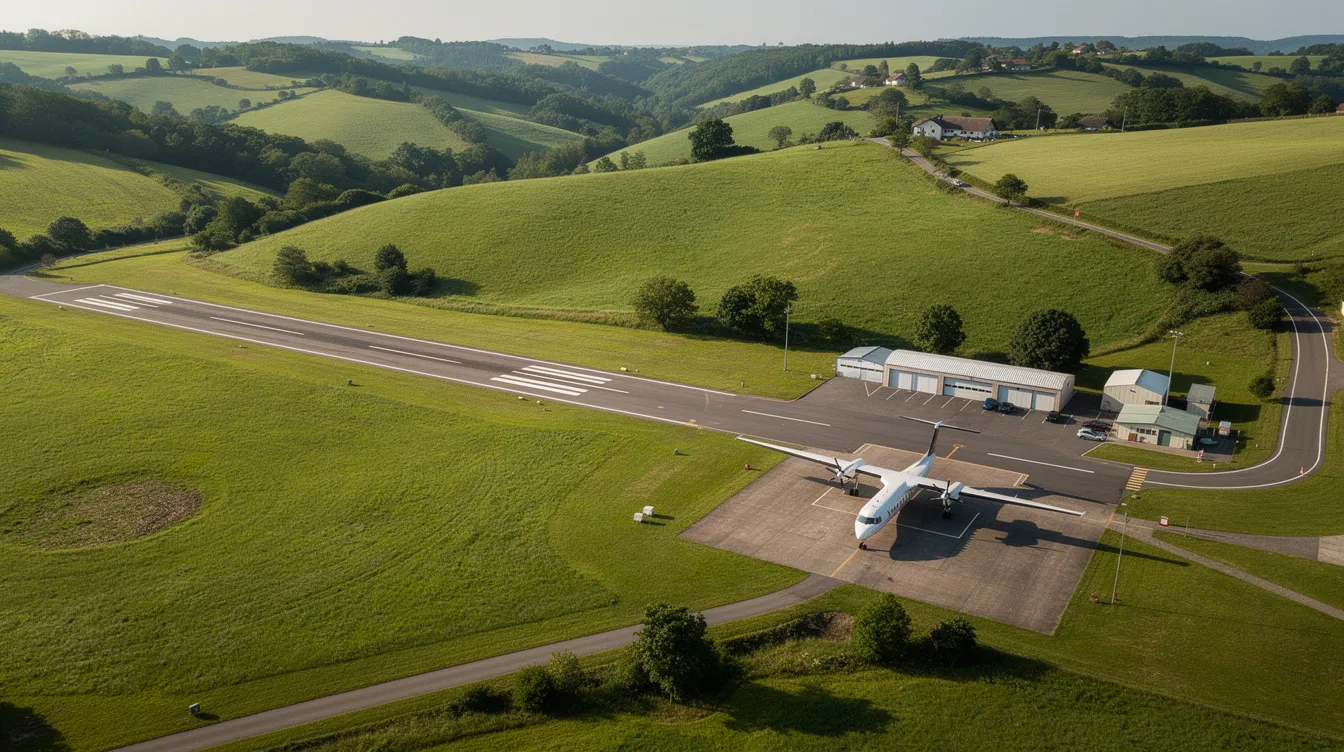
Approximately 34% of airports globally rely on turboprop aircraft for service; many of these are smaller airports and remote airports where jet operations are restricted or impossible. Modern turboprops can land on much shorter or less-developed runways, often requiring as little as 2,500 to 3,500 feet, while light jets typically need 4,000 feet or more. This access advantage expands the network of reachable destinations by hundreds, covering island strips, alpine airfields, and coastal retreats.
The economic case reinforces the strategic one. Executive turboprops in charter typically range from $2,000 to $3,500 per flight hour, whereas light jets generally cost between $4,000 and $6,000 per hour. Turboprop engines can use up to 50% less fuel than jets, burning roughly 55–110 gallons per hour versus 180–250 for comparable light jets. These are not budget savings; they are intelligent allocations of resources for a mission that does not require a jet.
BlackJet integrates modern turboprop aircraft into Jet Card itineraries for regional hops, maintaining the same carbon-neutral commitment and safety standards that apply to every flight. Its premium private jet card programs give members predictable access to aircraft while optimizing for each mission profile. When a turboprop is the right aircraft for the mission, members benefit from lower cost, broader access, and reduced environmental impact-without compromising on service.
How Modern Propeller Planes Work: From Piston to Turboprop
Modern propeller planes combine the efficiency of propellers with jet engine technology. Understanding the mechanics clarifies why these aircraft perform so well on regional missions.
Each propeller blade functions like a rotating wing, generating thrust by creating pressure differences that push the aircraft forward. This form of propeller propulsion is inherently fuel efficient at low speeds and moderate altitudes because it accelerates a large mass of ambient air at relatively low velocity-the opposite approach from jet engines, which accelerate a smaller mass of air at high velocity.
Key mechanical distinctions:
Piston-driven prop planes (e.g., Cirrus SR22T, Diamond DA50 RG) use reciprocating piston engines driving propellers directly. These single-engine piston aircraft have limited altitude capability, lower power-to-weight ratios, and rely on precise fuel-air mixtures for combustion. They work well for owner-pilots but are constrained for serious private charter.
Turboprop aircraft use a gas turbine engine with an air intake drawing in ambient air, a compressor creating compressed air, a combustion chamber, and turbine stages extracting energy to drive a propeller system through a reduction gearbox. The power turbine in a free-turbine design (like the PT6 family) delivers full torque at low forward airspeed, enabling short-field performance.
Modern propeller planes almost exclusively use turboprop engines. Most thrust comes from the propeller blade rotation, not exhaust. Turboprop engines are more reliable and quieter than piston engines, with cruise speeds typically around 250–330 knots.
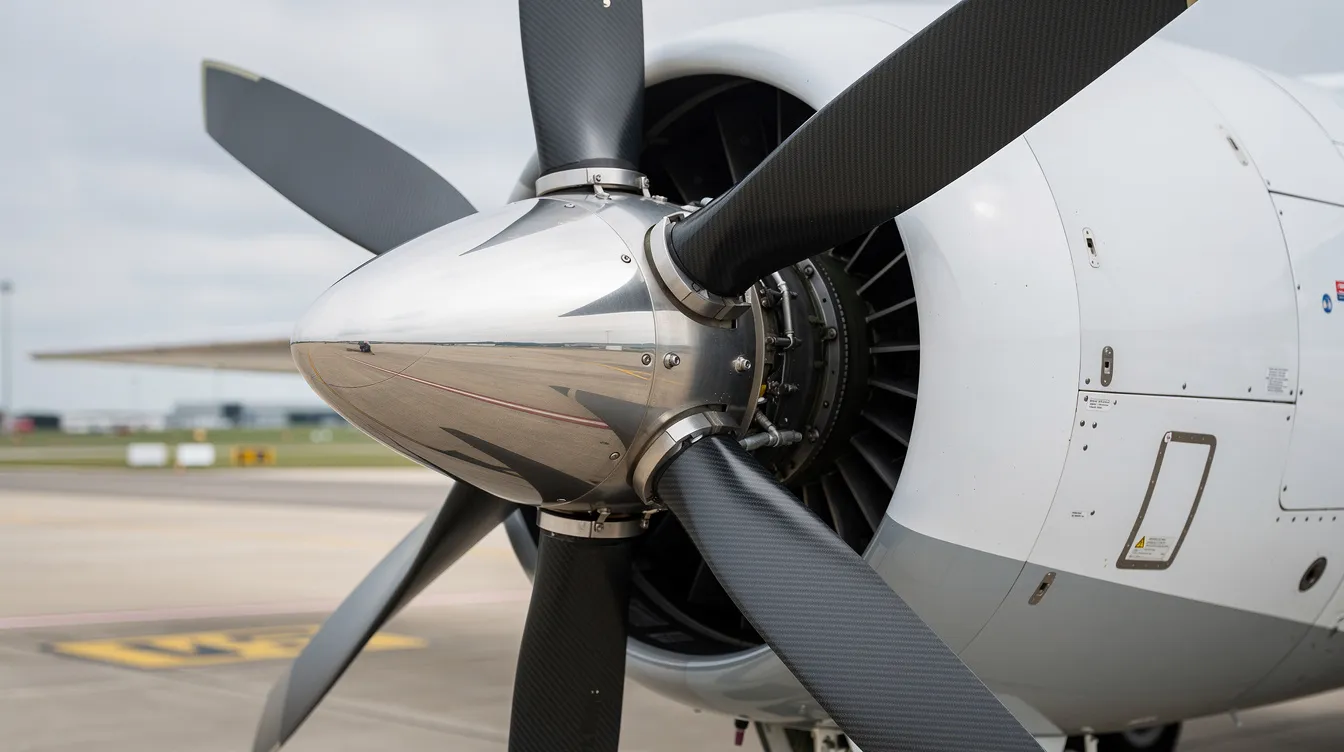
Modern propeller planes utilize constant-speed propellers to maintain optimal performance. These variable pitch propellers automatically adjust blade angle for climb, cruise, and descent, optimizing power generated across flight phases. Current designs use composite, scimitar-shaped blades-often five to seven per hub-to manage blade tips approaching transonic speeds while reducing noise.
Evolution of Turboprop Engines and Modern Prop Planes
The journey from concept to modern turboprop spans nearly a century of engineering refinement.
The world's first turboprop engine was patented in 1929 by Hungarian engineer György Jendrassik, who built and ran an early prototype by 1940. During World War II, Rolls-Royce experimented with converted jet cores driving propellers. But the real breakthrough came with the Rolls-Royce Dart, one of the first practical turbopropengines, which first ran in 1946. ThosDartrt engines powered the Vickers Viscount, the first successful turboprop airliner, entering service in the 1950s and marking the first flight of a turbine-propeller airliner in regular scheduled operations.
From that foundation, turboprop technology has evolved significantly across several dimensions:
Digital engine control systems (FADEC) replaced analog governors, enabling precise torque limiting, automatic feathering in engine failure scenarios, and improved hot-and-high performance. These systems extend engine life and reduce maintenance costs.
Advanced materials-composite propeller blades, 3D-printed turbine components, cooled turbine blades-have cut weight and improved durability. Modern models utilize advanced composite materials to reduce weight and increase fuel efficiency. The GE Catalyst engine, certified in February 2025, uses additive manufacturing and a 16:1 pressure ratio, representing a generational leap over previous generation engines.
Modern turboprop engines improve fuel efficiency by 3% over previous models while delivering longer time-between-overhaul intervals and more durable components.
Innovation continues. Hybrid-electric assistance for takeoff and climb phases is under active development-ATR's Evo program targets 20% lower fuel burn through mild hybridization and synthetic aviation fuels. Many practical turboprop engines are now certified for high blends of Sustainable Aviation Fuel, and ATR flew a 100% SAF-powered regional aircraft in 2022. The trajectory points toward even greater environmental sustainability.
Types of Modern Propeller Planes: Single-Engine vs Twin Turboprop
The term "modern propeller plane" covers a spectrum, from high-performance piston aircraft to purpose-built turboprops. For serious private and regional missions, turbine-powered prop planes dominate, and many travelers evaluate them alongside other options covered in the best small private aircraft guide.
Single-Engine Turboprops
Aircraft like the Pilatus PC-12 NGX and Daher TBM 960 represent the pinnacle of single-engine turboprop design. Modern turboprop aircraft typically cruise at around 300 knots, with cabin widths around five feet, seating for six to nine passengers, and a maximum range of 1,200–1,800 nm. These aircraft deliver exceptional runway performance-often departing in under 2,700 feet-and are popular for executive travel, air ambulance, and private charter. Modern propeller aircraft are designed to be faster and quieter than their predecessors, making them viable alternatives to entry-level jets on regional routes.
Twin-Engine Turboprops
The Beechcraft King Air 260 and King Air 360 offer engine redundancy, larger cabins, and higher payload. Twin-engine passenger turboprops like these serve executive shuttles, cargo operations, and regional airlines. The Cessna SkyCourier fills a similar niche for cargo and small passenger missions. For larger movements, chartering aircraft for around 100 passengers becomes more relevant, but twins generally provide greater operational flexibility in marginal weather and over-water operations.
Practical Differences for Travelers
Feature | Single-Engine Turboprop | Twin-Engine Turboprop |
|---|
Hourly charter cost | ~$2,000–$2,800 | ~$2,800–$3,500 |
Typical pax capacity | 6–9 | 8–13 |
Engine redundancy | No | Yes |
Runway requirement | ~2,500–2,700 ft | ~3,000–3,500 ft |
Best for | Short hops, remote strips | Longer regional, higher payload |
Modern high-performance pistons like the Diamond DA50 RG and Piper M350 remain entry points for owner-pilots. But turboprop aircraft are ideal for regional routes under 1,500 km where mission requirements demand reliability, altitude performance, and cabin comfort that pistons cannot match.
Modern Turboprop Aircraft in Real-World Operations
Modern turboprops are widely used for short-haul regional flights and cargo transport across every continent. Their operational versatility is unmatched, and they often appear among the most affordable private aircraft options for cost-conscious travelers seeking efficiency.
Regional airline service: ATR turboprop aircraft (ATR 42/72) and De Havilland Dash 8/Q400 dominate short-haul routes under 1,500 km, connecting secondary cities, island chains, and areas with lower passenger demand. These modern turboprop models thrive where regional jets are uneconomical or runway-limited.
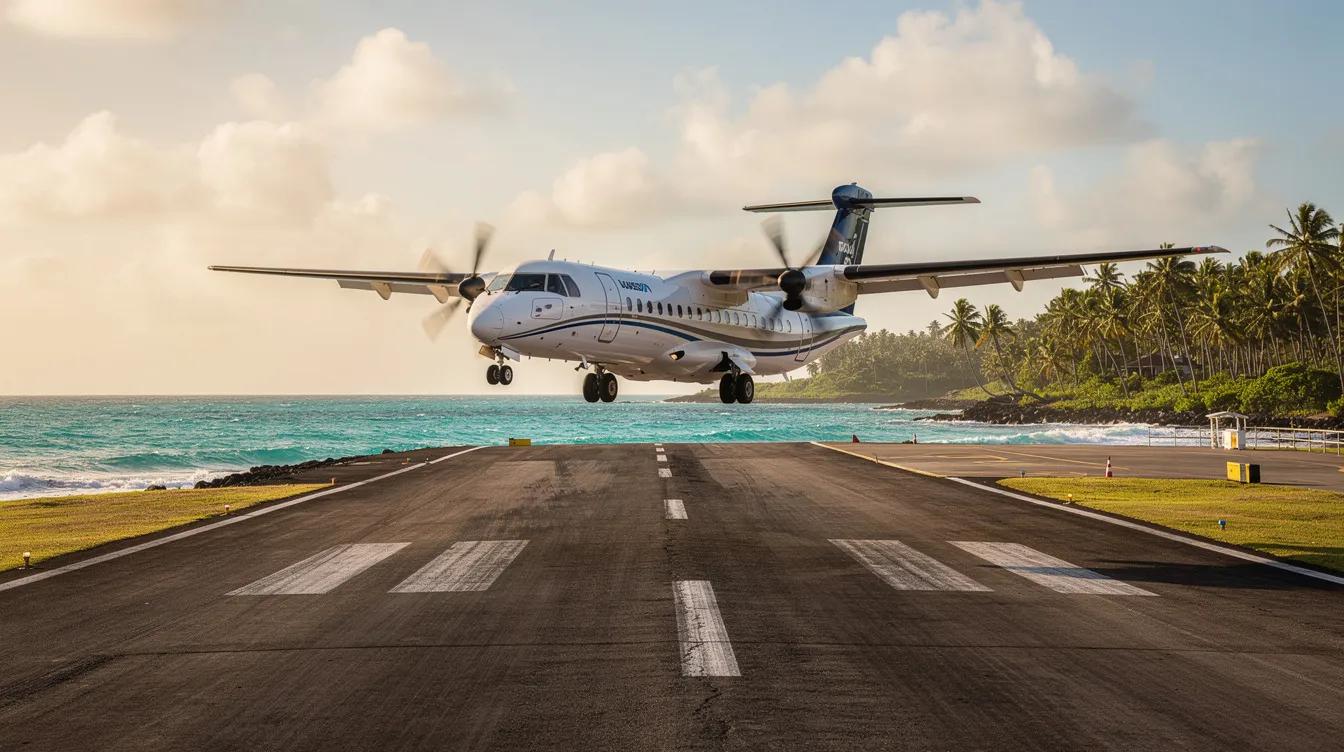
Short and unpaved runways: Turboprop aircraft can operate from runways as short as 1,100 meters. Aircraft like the Cessna Caravan and Quest Kodiak, equipped with gravel kits and robust landing gear, handle grass, gravel, and compacted earth-serving mining sites, island resorts, and humanitarian missions on unpaved runways and short runways alike. Turboprops resist water ingestion issues on wet runways better than jet engines and can operate in diverse conditions with better loiter time than jets.
VIP and corporate configurations: PC-12s and King Airs configured with club seating, lavatories, and premium interiors serve as executive shuttles in vip configurations. Combi configurations mix passengers and cargo on a single frame, supporting remote locations where separate freight flights are impractical.
Regional connectivity: Modern turboprops provide STOL capabilities for landing on unpaved runways, enabling regional connectivity that would otherwise require ground transport or helicopter transfers.
Economics, Efficiency, and Sustainability of Modern Turboprops
Modern turboprops deliver cost efficiency and environmental performance that align with both financial discipline and corporate ESG commitments.
Turboprops exhibit superior fuel efficiency at lower altitudes and slower speeds. On regional routes below 1,500 km, they can consume significantly less fuel, up to 30–50% less-than comparable regional jets. A PC-12 burns roughly 55–70 gallons per hour; a King Air 350burns around 90–120. Light jets burn 180–250. Turboprops are most efficient below 725 km/h (450 mph), which is precisely where regional missions live. This reduced fuel consumption translates directly into lower operating costs.
The environmental advantages are equally concrete:
Turboprop aircraft emit fewer CO₂ emissions than regional jets on equivalent routes, roughly proportional to their fuel burn advantage.
Turboprops reduce contrail formation compared to jets because they cruise at lower altitudes, where contrail-forming conditions are less common, thus reducing emissions' impact on the climate.
Modern turboprops are designed to operate on alternative fuels. Most new turboprop engines accept high blends of aviation fuel derived from sustainable sources, and operators increasingly use these synthetic aviation fuels on busy regional corridors.
BlackJet's carbon-neutral model layers on top of these inherent advantages. Every flight-whether jet or turboprop-includes offsets for residual emissions and preferential SAF use where available, ensuring that even mixed jet–turboprop itineraries meet the company's environmental sustainability commitment at no additional cost to members.
Safety, Technology, and Cabin Experience in Modern Prop Planes
Modern turboprop aircraft meet the same FAA and EASA certification standards as jets. Their safety records in commercial and charter operations are strong, and technological advancements have closed the cabin-comfort gap substantially.
Safety and redundancy:
Twin turboprops provide full engine redundancy. Single-engine turboprops like the Pilatus PC-12 have accumulated over 10 million fleet flight hours with an exceptionally low fatal accident rate. Rigorous Part 135 certification requirements, recurrent pilot training, and mandatory safety equipment govern their use in charter operations.
Cockpit technology:
Modern turboprops utilize digital glass cockpits with integrated GPS and automated systems, including synthetic vision, weather radar, TAWS (Terrain Awareness and Warning Systems), and real-time engine monitoring. These tools give pilots the same situational awareness found in modern jet flight decks.
Cabin experience:
Modern propeller planes provide a quiet and comfortable environment, similar to jets. Advances in propeller blade design-scimitar shapes, composite materials, six- or seven-blade configurations-combined with improved cabin insulation have reduced internal noise to the high-70s to mid-80s dB range. On flights under 90 minutes, the cabin experience in a current-generation PC-12 or King Air rivals that of an entry-level light jet, with pressurized cabins, flat floors, and quality materials.
BlackJet vets every turboprop operator in its network against the same standards applied to jet partners-auditing maintenance programs, verifying pilot experience on specific types, and confirming adherence to third-party safety ratings.
Modern Propeller Planes vs Jets: Choosing the Right Aircraft with BlackJet
The smartest aircraft choice depends on route length, passenger count, runway constraints, and mission requirements, not a blanket preference for jets or props.
Short regional legs (under ~600 nm): Routes like Los Angeles to Napa or Geneva to St. Moritz favor turboprops. They can fly faster into closer airports, often matching total travel time while delivering lower hourly rates and access to airfields where jets cannot operate. Turboprops excel on regional routes under 1,500 km where the top speed of a jet adds minimal time advantage.
Longer nonstop missions (600+ nm): New York to Miami, London to Athens-these routes belong to jets. Higher cruise speeds, the ability to fly faster at higher altitudes above weather, and greater range without payload penalty make midsize or super-midsize jets the clear choice.
Multi-leg itineraries: A BlackJet member might use a midsize jet from New York to Charleston, then connect to a PC-12 for final access to a private island strip in the Bahamas, a runway too short for any jet. This mixed approach optimizes every segment.
BlackJet's Jet Card programs and digital booking tools recommend the optimal mix of jets and modern turboprops based on each mission profile, ensuring safety, comfort, and carbon-neutral operations across every leg, while resources like its guide to jet card cost and pricing help members understand the economics behind these choices.
FAQs About Modern Turboprops and BlackJet Access
Are modern turboprop aircraft really slower than jets in practice?
Modern turboprop aircraft cruise around 280–320 knots versus 430–470 knots for light jets. But on sub-800-nm routes, total trip-time differences are often modest. On a 500 nm route, a turboprop might spend roughly 1 hour 45 minutes in the air versus 1 hour 10 minutes for a jet, but taxi, boarding, and ground transfer times dominate short trips, compressing the real gap to approximately 15–25 minutes. When tight same-day multi-city schedules demand speed, light or midsize jets remain preferable. For most regional missions, the difference is negligible.
How noisy and comfortable are modern prop planes?
Older prop planes earned a reputation for vibration and cabin noise. Today's designs tell a different story. Six- or seven-blade composite propellers combined with advanced insulation produce cabin environments comparable to entry-level jets on flights under 90 minutes. Current-generation executive turboprops feature pressurization, club seating, and in-flight connectivity. BlackJet's advisors can recommend specific aircraft models if a member is particularly sensitive to noise.
Can modern turboprop aircraft use unpaved runways and remote airports safely?
Yes. Many turboprops are certified to operate on grass, gravel, or compacted earth with appropriate performance margins. Protective features include gravel kits, robust landing gear, and high-wing configurations. Performance considerations-payload limits, field length, and elevation-are evaluated before every mission. All remote-airport operations arranged for BlackJet members meet conservative safety and weather criteria. Modern turboprops offer better performance on shorter runways compared to small jets, making them the preferred choice for remote access.
How safe are single-engine turboprop aircraft for private charter?
The Pilatus PC-12 and TBM series maintain strong safety records across commercial and air-taxi operations. Certification standards mandate specific equipment, recurrent pilot training, and operational procedures. BlackJet applies additional safety filters-operator history, pilot experience minimums, and stricter weather policies-positioning single-engine turboprops as a safe, efficient choice for short- to mid-range routes into smaller airfields.
Does BlackJet include modern propeller planes in its Jet Card program?
BlackJet's core Jet Card categories prioritize jets, but the company regularly integrates turboprop aircraft when missions demand short-field or remote access, applying the same principles outlined in its best jet cards for frequent flyers analysis. Members can request turboprop options through the booking platform or concierge, particularly in regions where they are commonly operated. All turboprop operators meet or exceed the same safety, maintenance, and service standards as BlackJet's jet partners, and every turboprop segment falls under the company's carbon-neutral commitment with offsets and SAF use where available.
Elevate Regional and Remote Travel with BlackJet
Modern turboprops transform access to the places that matter most-regional cities, island resorts, ski destinations, and remote business hubs that jets alone cannot reach efficiently. With runway flexibility, consuming significantly less fuel than comparable jets, fewer emissions, and safety backed by modern avionics and rigorous training, these aircraft have earned their place in any serious private travel strategy.
BlackJet serves as your strategic partner in curating the right mix of jets and modern propeller planes. Through Jet Card programs and on-demand charter, every itinerary is tailored to optimize time, cost, and environmental impact-whether you need a midsize jet for a transcontinental leg or a turboprop for the final hop to a remote airstrip.
Explore BlackJet Jet Cards or speak with an advisor about integrating modern turboprops into your regional travel strategy. The smartest journey is the one designed around your destination, not limited by the aircraft.


 Sign up with google
 Sign up with Apple