Mach 1 at Sea Level: What It Means for High-Performance and Private Jet Flight
Mach 1 is the speed of sound in air, and at sea level it is about 761 mph, 661 knots, or 1,225 km/h under standard conditions of 15 °C and 1013.25 hPa. That figure changes with local temperature and pressure, so it is not a universal constant. For frequent business flyers and high-net-worth leisure travelers—especially private jet customers comparing aircraft performance—understanding Mach 1 at sea level gives useful context for cruise speeds, safety margins, flight regimes, and how speed affects travel time, comfort, efficiency, and sustainability.
Swift answer: How fast is Mach 1 at sea level?
Mach 1 is the local speed of sound in air at a given air temperature and altitude. It is not a fixed number. The speed of sound varies with atmospheric conditions, so Mach 1 at sea level on a cold January morning in Oslo differs from Mach 1 on a hot August afternoon in Dubai.
Under International Standard Atmosphere (ISA) conditions at sea level (15 °C / 59 °F, air pressure of 1013.25 hPa, dry air), Mach 1 is approximately 761 mph, 661 knots, or 1,225 kilometers per hour. These values apply specifically to standard sea level pressure and temperature. At real-world airports, warmer coastal locations push sound speed slightly higher, while cold northern airports pull it lower.
An aircraft's Mach number represents its speed relative to the local speed of sound. It is a dimensionless ratio: true airspeed divided by the local speed of sound at the aircraft's position. Mach number matters in aviation because aircraft performance limits, the formation of shock waves, and the so-called sound barrier are all defined relative to Mach 1. Every jet's structural and aerodynamic safety margins reference this threshold.
Why Mach speed matters to discerning travelers
Understanding Mach 1 at sea level helps high-net-worth and executive travelers appreciate the performance envelope of modern jets. Private aviation is a strategic advantage when you grasp why operators choose specific cruise speeds and what those choices mean for your schedule, comfort, and safety, especially when comparing premium private jet card programs that bundle aircraft access with optimized performance.
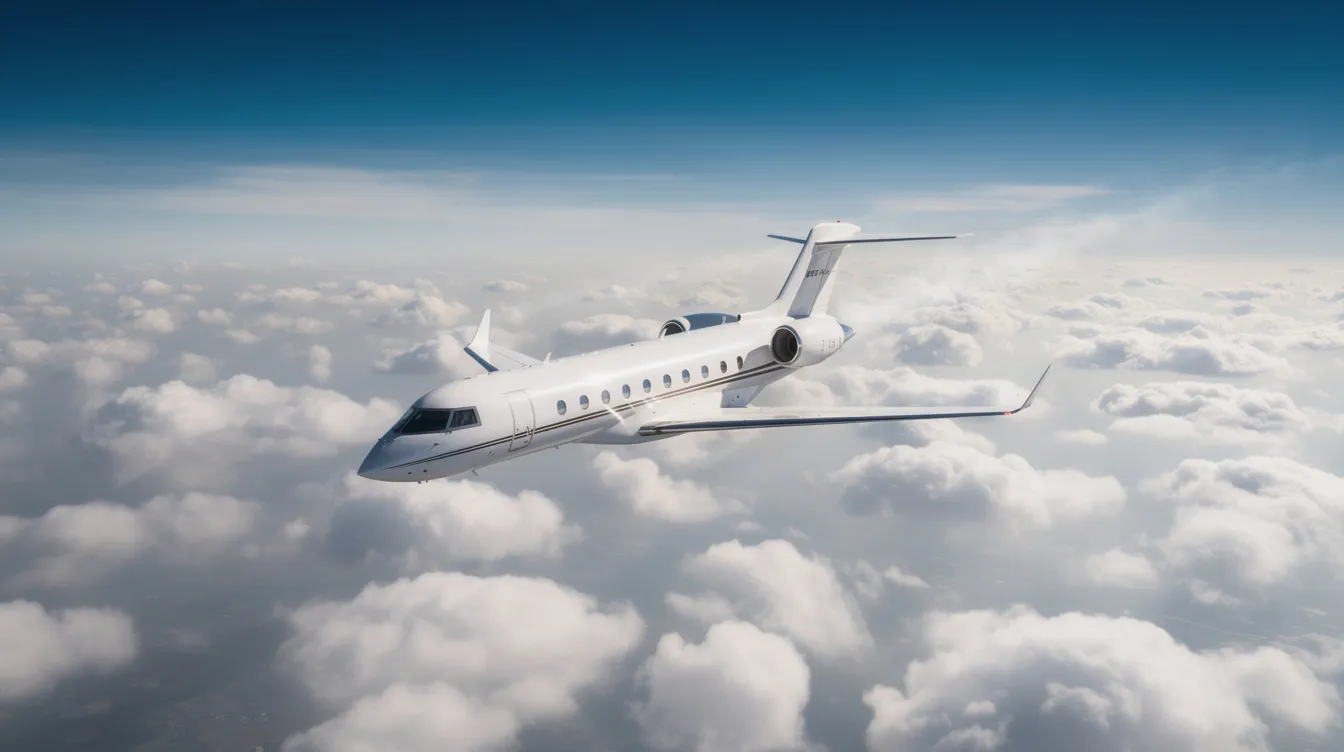
Commercial airliners typically cruise between Mach 0.78 and Mach 0.85 at high altitudes. High-performance business jets push higher: a Gulfstream G650ER cruises near Mach 0.90 with a maximum operating Mach of about 0.925, while the Citation X+ reaches Mach 0.935. Both commercial and private jets operate close to, but below, the sound barrier. BlackJet's aircraft providers cruise below Mach 1 to avoid transonic shock waves, excessive drag, and cabin noise, prioritizing safety, comfort, and fuel efficiency.
Consider a New York to London flight (roughly 3,000 nautical miles). A commercial widebody cruises near Mach 0.85, yielding a true airspeed around 560 mph. An ultra-long-range business jet through a BlackJet Jet Card or other 25+ Hour Jet Card programs cruises at Mach 0.90, around 590-600 mph true airspeed. The airspeed difference saves 20-30 minutes in flight. Add flexible departure times, private terminals, and faster customs processing, and total time savings reach 2-3 hours. BlackJet's operations team monitors precise Mach speed and aircraft performance data in real time so that every flight plan balances speed, safety, and schedule reliability.
Foundations: Mach number, speed of sound, and sea level conditions
Standard Sea Level Conditions
Mach number is defined as Ma = V / a, where V is true airspeed and a is the local speed of sound. Named after the Austrian physicist Ernst Mach, who studied supersonic compressible flow and subsonic compressible flow in the 19th century, it is a dimensionless ratio used throughout high-speed flow aerodynamics. To compute mach number, you need both the object's actual speed through the air and the sound speed at that location.
Standard sea level conditions under ISA set air pressure at 1013.25 hPa, temperature at 15 °C, and air density at approximately 1.225 kg/m³. At sea level, air is at its maximum density and pressure under standard conditions. These values produce the commonly quoted speed of sound of about 343 m/s (1,235 km/h, 761 mph, 661 knots).
Temperature Effects on Mach 1
The speed of sound depends directly on air temperature: higher absolute temperature means gas molecules vibrate faster, propagating pressure disturbances more quickly. Sound travels faster in warmer air due to these more active molecules.
Air density and air pressure changes tend to cancel in the ideal gas relation for sound speed (a ∝ √T), making air temperature the primary driver at a given composition. The speed of sound is directly related to air temperature only in this idealized framework. Humidity slightly increases the speed of sound in air because water vapor is lighter than nitrogen and oxygen, but the effect is small at sea level.
Mach Number in Aviation
For pilots and performance engineers, Mach number is more meaningful than raw mph or knots when dealing with compressibility, shock waves, and structural loads. Static pressure and dynamic pressure measurements feed Air Data Computers that track the speed of an object relative to the surrounding air mass.
Mach 1 at sea level vs high altitudes
Altitude and Mach Number
Mach 1 is lower at high altitudes because the speed of sound decreases with altitude as air temperature drops. From sea level up to the tropopause (around 36,000 ft under ISA), temperature falls roughly 2 °C per 1,000 ft. In thinner air at those heights, sound drops to values well below the sea level reference. Above the tropopause, temperature stabilizes, and the speed of sound levels off.
Mach 1 Speed Comparison Table
Altitude | Speed of Sound (mph) | Speed of Sound (km/h) | Speed of Sound (knots) |
|---|
Sea Level | 761 | 1,225 | 661 |
30,000 ft | 678 | 1,091 | 589 |
36,000 ft | 661 | 1,066 | 573 |
These two speeds at sea level and cruise altitude show why the same Mach number corresponds to different ground speed values. A given true airspeed of 700 mph is subsonic at sea level (about Mach 0.92) but becomes supersonic at 43,000 ft (approximately Mach 1.06), where sound decreases due to colder air. That exact scenario played out on October 14, 1947, when Chuck Yeager broke the sound barrier. Yeager flew the Bell X-1 at Mach 1.06, about 700 mph, at an altitude where the actual speed of Mach 1 was far lower than 761 mph, foreshadowing the performance of today’s top luxury private jets that routinely operate near the high-subsonic edge.
At high altitudes, indicated airspeed becomes less representative as air density drops. Pilots and flight computers control speed by Mach number rather than indicated airspeed above roughly FL280. As Mach number increases toward the aircraft's certified limit, the flight management system alerts the crew. BlackJet's flight planning tools track both Mach number and altitude to keep every leg within safe, certified performance envelopes.
Critical Mach number, the sound barrier, and shock waves
The overall aircraft Mach number tells only part of the story. Faster airflow over curved surfaces, particularly the upper wing, can locally exceed Mach 1 before the aircraft's free-stream Mach reaches 1.0. Airflow over an aircraft can exceed Mach 1 before the aircraft reaches Mach 1 overall.
Critical Mach Number (Mcrit)
The critical Mach number (Mcrit) is the lowest free-stream Mach at which airflow over any part of the aircraft locally reaches Mach 1. This is often at the object's leading edge or the upper wing surface, where a flow channel forms between the curved airfoil and the oncoming air, creating a slightly concave plane of accelerated fluid flow. When fluid flow crosses this local sonic threshold, the transonic period begins: localized supersonic pockets appear, and the shock wave formation process occurs on the wing. The critical Mach number is the lowest Mach number at which shock waves form on the aircraft structure.
Shock Waves and the Sound Barrier
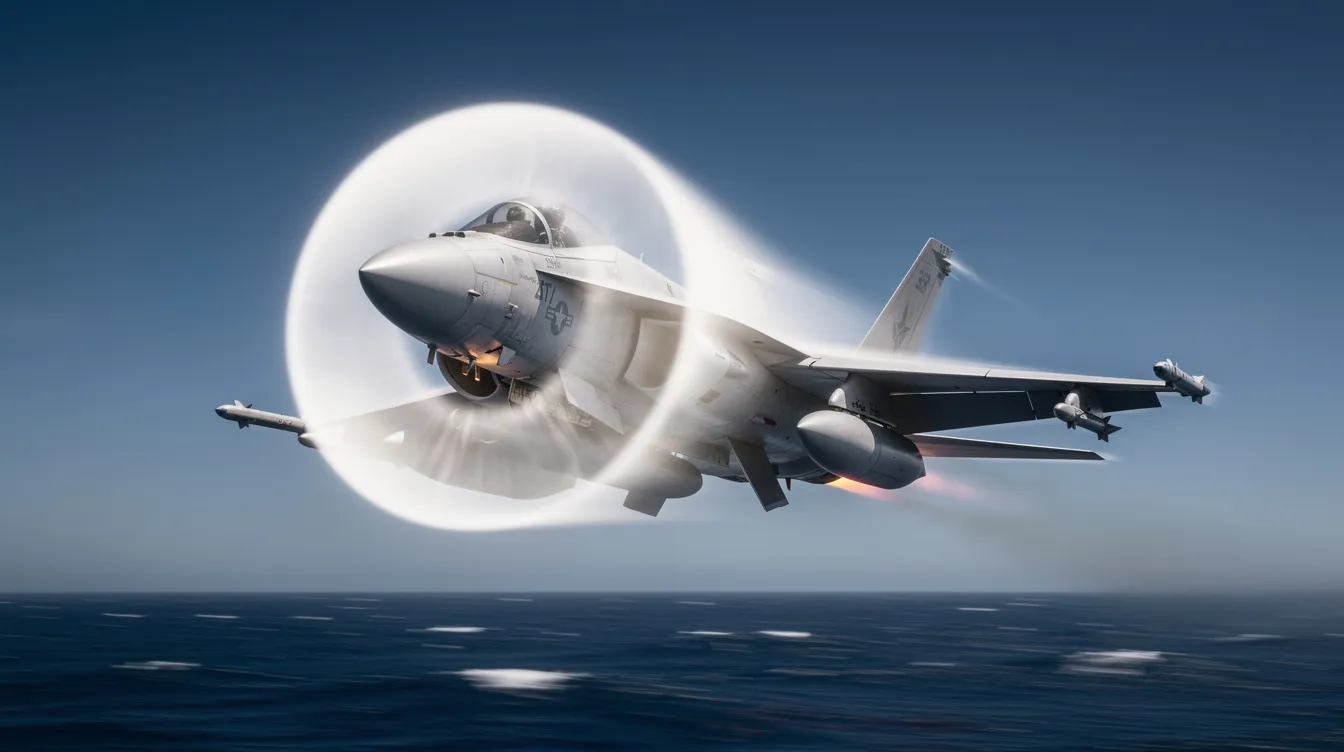
As transonic airflow develops, flow speed behind the shock wave decelerates abruptly, creating an abrupt pressure difference and a large pressure difference across the shock boundary. At Mach 1, aerodynamic drag increases on the aircraft due to wave drag from these normal shock structures. A weak oblique shock may also form at other surface angles. When the normal shock reaches sufficient strength, the flow ahead remains supersonic while the region behind it is the only subsonic zone. Breaking Mach 1 creates a shock wave known as a sonic boom, heard on the ground as an explosive pressure pulse. Crossing Mach 1 creates a shock wave in front of the aircraft as a sharp pressure difference develops ahead of it, and the shock wave begins to intensify, generating this sonic boom.
Historically, the "sound barrier" referred to the cluster of aerodynamic problems (buffeting, loss of control effectiveness, structural overloading) that pilots encountered near Mach 1 in the 1940s. It was never a literal barrier. Modern business jets use swept and supercritical wings to raise their critical Mach number, allowing efficient cruise around Mach 0.80-0.90 without encountering severe shock waves. Where flow decelerates behind a shock, these wing designs minimize boundary layer separation. Even when a normal shock is present at about Mach 0.85-0.90, a completely supersonic pocket may exist briefly on the upper wing while the aircraft cruises comfortably in the high-subsonic band, even for travelers who simply buy a seat on a private jet via shared or semi-private services. The Mach cone that would form at fully supersonic speeds does not develop at these cruise conditions.
Air density, temperature, and sea level effects on Mach 1
Air density at sea level interacts with temperature to influence both lift and the speed of sound. Sound increases in warmer conditions and sound speed rises accordingly, but the operational picture is more complex than that single variable.
Temperature and Density Effects Table
Condition | Effect on Mach 1 Speed | Effect on Aircraft Performance |
|---|
Warmer air (e.g., Dubai) | Increases | Decreases density, reduces thrust/lift |
Colder air (e.g., Oslo) | Decreases | Increases density, enhances performance |
At 0 °C at sea level, Mach 1 drops to approximately 741 mph.
At 30 °C, it rises to about 781 mph.
In extreme environments like Death Valley (up to 50 °C) or Antarctic coastal stations (−30 °C or colder), Mach 1 shifts across a range of roughly 700-810 mph.
While BlackJet clients rarely operate anywhere near Mach 1 at sea level, these density and temperature effects shape runway length requirements, climb performance, and payload planning at sea-level airports across different types of private jets. Most aircraft do not operate safely at Mach 1 near sea level due to the extremely high dynamic pressure at those speeds and densities. Turbojet and turbofan engines partially mitigate low density by compressing intake air, but overall aircraft performance still depends on sea level conditions during departure and arrival.
Indicated airspeed, true airspeed, and Mach number in real operations
Three speed concepts govern aviation operations:
Indicated airspeed (IAS): Derived from pitot-static pressure measurements. Most accurate near sea level but increasingly misleading at high altitudes as air density falls.
True airspeed (TAS): The actual speed of the aircraft through the surrounding air mass, corrected for temperature and pressure. TAS increases with altitude even at the same IAS.
Mach number: TAS divided by local speed of sound. The reference that matters for structural limits and aerodynamic behavior.
At constant IAS, an aircraft reaches higher Mach numbers as it climbs because the air speed indicated on instruments understates the true velocity in thinner air. Machmeters and Air Data Computers compute Mach number from total and static pressure ratios. In the supersonic equation regime (above Mach 1), the Rayleigh supersonic pitot equation governs this calculation because shock waves form ahead of the pitot probe. In the subsonic equation regime (below Mach 1), simpler isentropic relations apply.
In BlackJet operations, pilots typically climb using a constant IAS, then transition to a constant cruise Mach number (often Mach 0.80-0.84 depending on aircraft class) at high altitudes. For members using jet card membership pricing models, this Mach limit balances comfort, fuel efficiency, and schedule reliability within predictable hourly costs.
From transonic to hypersonic: Mach regimes that shape aircraft performance
Aircraft performance is organized around four regimes:
Mach Regime | Mach Number Range | Description |
|---|
Subsonic | Below 0.8 | No shock waves form. Standard for regional and light jets. |
Transonic | 0.8 - 1.2 | Mixed subsonic and supersonic flow, strong compressibility effects. |
Supersonic | 1.2 - 5.0 | Continuous shock waves and a sonic boom accompany supersonic flight. |
Hypersonic | Above 5.0 | Extreme heating, ionization, and specialized materials required. |
Commercial airliners and most business jets cruise in the high-subsonic range, near but below Mach 1, for optimal fuel efficiency. The transonic regime between Mach 0.8 and 1.2 is deliberately avoided in sustained cruise. Subsonic flight occurs below Mach 0.8, and supersonic flight is defined as speeds above Mach 1.2, with each regime implying different positions on a comprehensive private jet price list as size, speed, and range increase.
Historic and military aircraft illustrate higher regimes. Concorde cruised at about Mach 2.0 over the North Atlantic, reaching twice the speed of sound. The SR-71 Blackbird, operated by the United States Air Force, set a speed record of 2,193.167 mph. Military aircraft like these were designed for high-speed flight in fully supersonic and near-hypersonic conditions. Experimental hypersonic platforms target Mach 5+ for research, whereas today’s large-cabin jets capable of carrying around 20 passengers focus on efficient high-subsonic cruise, as outlined in guides to the best private jet for 20 passengers.
For BlackJet members, the core value is consistently optimized high-subsonic operations: reduced block times, smooth ride profiles, and predictable fuel and emissions performance delivered within transparent jet card pricing structures.
Mach number, aircraft design, and private jet categories
Aircraft are engineered around specific design Mach numbers that dictate wing sweep angle, airfoil thickness, and structural reinforcement. These choices differ across aircraft categories:
Light jets: Cruise near Mach 0.72-0.80
Midsize jets: Cruise near Mach 0.75-0.82
Super-midsize and heavy jets: Mach 0.80-0.90
Ultra-long-range jets: MMO up to Mach 0.925-0.935
Swept wings and supercritical airfoils delay the onset of critical Mach number by reducing the effective flow speed perpendicular to the wing. The flow channel between upper and lower wing surfaces is optimized so that even at high subsonic Mach, the subsonic zone remains dominant and wave drag stays manageable.
For a BlackJet member flying Miami to São Paulo (about 3,000 nautical miles) in a large-cabin jet cruising near Mach 0.85 at FL450, the air speed translates to roughly 560-580 mph TAS. A midsize jet on the same route at Mach 0.80 would cruise at about 530-540 mph, adding 30-45 minutes of flight time. Combined with Jet Card flexibility and direct airport pairs, choosing among the best jet cards for frequent flyers and the right aircraft category can save 1-2 hours per trip.
Safety, high-speed flow, and BlackJet's operational standards
Mach 1 and high-speed flow concepts connect directly to safety and certification. Every aircraft has a maximum operating Mach number (MMO), set below the onset of dangerous transonic effects, and premium providers such as those explained in NetJets jet card cost guides price their programs around aircraft that can cruise efficiently near, but below, MMO.
Key Compressibility Hazards
Mach tuck: Shock waves shift the lift distribution aft, generating a nose-down pitch tendency that can overpower control inputs.
Buffeting: Turbulent separated flow behind shocks mimics stall-like vibrations.
Coffin corner: At very high altitudes, stall speed and Mach limit converge. The safe operating window narrows, requiring precise handling.
Modern flight management systems continuously track indicated airspeed, true airspeed, and Mach number to keep the aircraft inside its safe flight envelope.
BlackJet partners with rigorously vetted operators running up-to-date avionics and standardized high-speed procedures, comparable to the top private jet companies in the market, so members fly at near-optimal Mach speeds without concern for the underlying complexity.
Sustainability, carbon-neutral performance, and efficient Mach cruise
Flying too close to Mach 1 increases drag and fuel use steeply. The fuel burn curve near MMO is non-linear: pushing from Mach 0.85 to Mach 0.90 might save 30 minutes on a long leg but burn a large additional fraction of fuel and increase emissions proportionally.
BlackJet's preferred cruise profiles operate at efficient high-altitude Mach numbers where air is thinner, and drag is lower, avoiding excessive high-speed flow drag penalties. This maximizes miles flown per kilogram of fuel burned and complements more economical access paths such as the cheapest private jet options for travelers focused on cost as well as speed.
BlackJet commits to carbon-neutral private flights by monitoring actual fuel burn on each leg, calculating CO₂ emissions with recognized methodologies, and funding certified carbon offset projects to neutralize the footprint at no additional cost to members. Optimized Mach speed and altitude selection also reduce the noise footprint on climb and descent near dense coastal cities at or near sea level. This data-driven approach to aircraft performance balances time savings, comfort, and environmental responsibility.
Practical FAQs: Mach 1 at sea level and private jet travel
Is Mach 1 always 761 mph?
No. Mach 1 is approximately 761 mph at sea level under standard conditions (15 °C, dry air). On a 30 °C day, it rises to about 781 mph. On a 0 °C day, it drops to roughly 741 mph. Mach 1 varies with temperature and altitude conditions.
Do BlackJet flights ever go supersonic?
No. All business jets in current service are certified for subsonic cruise, with MMOs well below Mach 1 (typically Mach 0.92-0.935). Supersonic flight over land is restricted by regulation because the shock wave from Mach 1 causes a sonic boom heard on the ground. No current private jet operations exceed Mach 1.
Why do pilots talk about Mach instead of mph on my flight?
Above roughly FL280, indicated airspeed becomes less informative because air density is much lower. Mach number reflects the true aerodynamic loads on the aircraft and defines regulatory safety limits. It is how structural and performance boundaries are measured and enforced.
Does flying closer to Mach 1 make my trip much faster?
Returns diminish quickly. Cruising at Mach 0.90 instead of Mach 0.85 on a 3,000-nautical-mile leg saves roughly 30-45 minutes but increases fuel consumption and emissions disproportionately.
How does Mach speed affect comfort?
Staying below the aircraft's critical Mach number and MMO prevents transonic shock formation on the wings, which causes cabin noise and turbulence-like buffeting. Modern aircraft designs keep cruise Mach in a range where the ride remains smooth and quiet.
Conclusion
Mach 1 at sea level—approximately 761 mph under standard conditions—is a fundamental benchmark in aviation that shapes aircraft design, flight operations, and traveler expectations. For private jet travelers and business executives, understanding this speed in context highlights why modern jets cruise just below the sound barrier, balancing efficiency, safety, and comfort. The interplay of temperature, altitude, and air density influences the true speed of sound, making Mach 1 a dynamic threshold rather than a fixed number.
BlackJet’s commitment to optimized high-subsonic cruise profiles ensures members enjoy swift, smooth, and sustainable travel with rigorous safety standards. By flying at carefully managed Mach numbers, BlackJet jets maximize time savings while minimizing fuel burn and environmental impact. Whether crossing oceans or regional hops, appreciating the nuances of Mach 1 empowers discerning travelers to make informed choices about private jet categories, jet card programs, and flight planning.
Ultimately, Mach 1 is more than a speed—it's a gateway to elevated travel experiences where technology, performance, and luxury converge seamlessly. Explore BlackJet’s Jet Card offerings to discover how mastering the science of speed can reshape your private aviation journey with unmatched precision and prestige. Learn more about our safety and certification standards that underpin every flight experience.


 Sign up with google
 Sign up with Apple