The gap between a seven-hour commercial crossing and a sub-four-hour supersonic sprint across the Atlantic is not merely an aviation statistic. It is, for the executive closing a deal in London or the entrepreneur splitting a week between New York and Dubai, the difference between a productive day and a wasted one. Faster planes are reshaping what is possible in both commercial aviation and private air travel, and the travelers who understand this shift stand to gain the most.
This article examines exactly how fast today's commercial airplanes and private jets fly, what limits their speed, and what technologies are poised to push those limits further. It also explores how BlackJet's Jet Card programs translate raw aircraft performance into real-world time savings for members who refuse to let transit eat into their lives.
Why Faster Planes Matter for Business and Luxury Travel
Consider two versions of the same Tuesday. In the first, you leave Manhattan at 6 a.m., endure check-in queues, board a commercial flight to London, and land roughly seven hours later. By the time you clear customs and reach Mayfair, the business day is over. In the second, you arrive at a private terminal 30 minutes before departure, climb aboard a high-speed aircraft, and touch down in under four hours, ready for an afternoon meeting.
Time is the one asset no amount of capital can manufacture. For executives and high-net-worth travelers, every hour lost in transit carries tangible costs:
Missed board meetings, investor calls, or deal closings that cannot be rescheduled.
Extra hotel nights and the compounding fatigue of jet lag on multi-leg itineraries.
Opportunity cost: the strategic thinking, family time, or rest that evaporates inside an airport lounge.
Today, commercial planes typically cruise at 500 to 600 mph, while the fastest private jets push well beyond that range. Emerging supersonic concepts promise to cut long distances to a fraction of current flight times. BlackJet positions itself at this intersection, offering Jet Card programs in 25- and 50-hour blocks that let members "buy back" time without the burden of aircraft ownership, all while ensuring every flight is carbon neutral. Its broader premium private jet card and membership offering also emphasizes comfort, safety, and sustainability for frequent flyers.
Route | Commercial First Class | BlackJet Private Jet | Future Supersonic (Mach 1.7) |
|---|
New York–London | ~7–7.5 hours | ~6.5 hours (door-to-door) | ~3.5–4 hours |
New York–Los Angeles | ~6–6.5 hours | ~5 hours (door-to-door) | ~2.5 hours |
Los Angeles–Tokyo | ~11–12 hours | ~10.5 hours (door-to-door) | ~6 hours |
Door-to-door estimates include ground time, security, and boarding differences.
How Fast Do Commercial Planes Fly Today?
Commercial airplanes, the scheduled passenger and cargo aircraft that carry the vast majority of travelers, include workhorses like the Boeing 737, 787, Airbus A320, A350, and A380. Their cruising speeds cluster within a narrow band dictated by aerodynamics and economics.
Commercial jets typically cruise at speeds between 500 and 550 mph on most domestic routes, with long-haul widebodies pushing toward the upper end of that range.
The Boeing 787 has a cruising speed of 650 mph in optimal conditions, making it one of the faster airliners in daily service at around Mach 0.85.
The Airbus A380 can exceed 700 mph at top speed, though airlines rarely operate it anywhere near that limit on scheduled flights.
Narrow-body aircraft like the Boeing 737-800 and Airbus A320neo cruise between Mach 0.78 and 0.80, translating to roughly 515–560 mph depending on altitude and conditions.
Most commercial aircraft cruise between Mach 0.78 and 0.86, a range carefully calibrated to balance fuel efficiency, engine longevity, and schedule reliability.
Aircraft | Typical Cruise Mach | Approx. Cruise Speed (mph) | Max Operating Mach |
|---|
Boeing 737-800 | 0.78–0.80 | 530–560 | ~0.82 |
Airbus A320neo | 0.78 | 515–520 | ~0.82 |
Boeing 787-9 | 0.85 | 560–590 | ~0.90 |
Airbus A350 | 0.85 | 560–590 | ~0.90 |
Boeing 747-8i | 0.855 | 560–570 | ~0.90 |
On a New York–London route, these typical speeds translate to roughly seven hours of block time gate-to-gate, with the return leg often longer due to headwinds. A Los Angeles–Tokyo commercial flight runs 11 to 12 hours. Schedule padding for taxi, departure sequencing, and air traffic routing makes these trips feel even slower than the raw numbers suggest.
Key Factors That Limit Commercial Airplane Speed
Why haven't commercial planes fly much faster in the past few decades? The answer involves physics, money, regulation, and passenger comfort working in concert.
Aerodynamic limits near the speed of sound. As an aircraft approaches Mach 0.9 to 1.0, it enters the transonic regime where shockwaves form on wing surfaces, causing a sharp increase in wave drag. Supercritical wing designs delay this drag rise, but standard commercial widebody airliners preserve fuel efficiency by cruising below Mach 0.90 to avoid it altogether.
Economic constraints. Fuel burn rises steeply with speed beyond the optimal cruise Mach. Turbofan engines operate most efficiently at 400 to 620 mph; pushing beyond that range means exponentially higher fuel consumption per seat-mile. With fuel prices volatile and passengers sensitive to ticket cost, airlines have little incentive to fly faster. Aircraft speed is affected by engine power and thrust, but the economics of thrust at higher speeds make the math unfavorable for mass-market carriers.
Regulatory and environmental pressure. Noise regulations, carbon pricing through ICAO and EU frameworks, and growing ESG scrutiny push airlines toward fuel economy rather than speed. Modern aircraft are ten times more fuel-efficient than 1950s models, but that progress came from efficiency-first design, not faster speeds.
Passenger comfort. Routinely cruising near an aircraft's maximum operating Mach number increases structural loads, cabin noise, and turbulence exposure. It also shortens the fatigue life of wings, engines, and airframe components, raising long-term maintenance costs.
Commercial airliners like the Boeing 747 or Airbus A380 are certificated for maximum speeds well above their daily cruise settings, but airlines almost never use those reserves on scheduled routes because operating costs outweigh the marginal time savings.
Different Speeds in Flight: Takeoff, Climb, Cruise, and Landing
An airplane's speed changes dramatically across each phase of flight. Understanding these different speeds reveals where private jets gain their time advantage.
Takeoff: After rotation, commercial jets accelerate through V1 (decision speed), VR (rotation speed), and V2 (takeoff safety speed). For a typical widebody, takeoff speeds sit around 150–160 mph. Pilots treat these V-speeds as inviolable safety boundaries.
Climb: Speed increases gradually through an optimized climb schedule. Commercial jets fly at altitudes around 35,000 feet, and reaching that altitude can take 20 to 40 minutes. Higher altitudes reduce drag, allowing faster flight once cruise is established.
Cruise: The longest and fastest phase. Commercial airliners maintain a steady speed of Mach 0.78–0.86 at cruise altitude. Private jets often cruise higher, at 45,000–51,000 feet, where thinner air means less resistance.
Approach and landing: Speeds drop to around 140–150 mph as the aircraft configures for landing with flaps and gear deployed.
Flight Phase | Commercial Airliner | Large-Cabin Private Jet |
|---|
Takeoff | ~150–160 mph | Similar, often slightly faster |
Climb to Cruise | 20–40 min to ~35,000–43,000 ft | Faster climb to ~45,000–51,000 ft |
Cruise | Mach 0.78–0.86 | Mach 0.85–0.935 |
Approach/Landing | ~140–150 mph | ~130–145 mph |
Private jets, being lighter and more powerful per passenger, can climb faster to optimal cruising altitude, spending less time in the inefficient lower atmosphere. The aircraft's speed also varies by phase of flight and by whether it is measured as indicated, true, or ground speed. That climb advantage alone can shave meaningful minutes off every leg.
How Airplane Speed Is Measured: Knots, Mach, IAS, TAS, and Ground Speed
Aviation uses several distinct speed measurements, each serving a different purpose. Knowing the difference clarifies why two aircraft at the "same speed" can arrive at very different times.
Indicated airspeed (IAS): What the pilot reads on cockpit instruments, based on air pressure differential. Critical during takeoff and approach for maintaining safe margins above stall speed.
Calibrated airspeed: IAS corrected for instrument and position errors, giving a more precise pressure-based reading.
True airspeed (TAS): IAS corrected for altitude and temperature. This reflects actual speed through the surrounding air mass.
Ground speed: TAS adjusted for wind. Tailwinds can increase ground speed, shortening travel time significantly, while headwinds do the opposite. Ground speed is what ultimately determines arrival time.
Mach number: The ratio of TAS to the local speed of sound. At 35,000 feet, the speed of sound is approximately 660 mph, so Mach 0.85 equals roughly 560 mph TAS. Mach is the primary reference for flight speed at higher altitudes because it governs aerodynamic behavior near the transonic regime.
Speed Type | What It Means for the Traveler |
|---|
Indicated Airspeed (IAS) | Safety reference for takeoff, climb, and approach |
Calibrated Airspeed | Refined IAS for precision flight planning |
True Airspeed (TAS) | Actual speed through the air, used in performance calculations |
Ground Speed | Determines real arrival time; affected by wind |
Mach Number | Governs aerodynamic limits and high-altitude cruise planning |
For BlackJet Jet Card members, none of these numbers appear in the booking app. What they see is estimated block time and arrival time, both calculated from ground speed projections that account for real-time wind and routing data, similar to the advanced private jet flight time calculators used for precise planning.
How Fast Do Private Jets Fly Compared to Commercial Aircraft?
The real story of private jet speed is not just about cruise Mach numbers, though those numbers are impressive. It is about the compounding effect of faster climbs, higher cruise altitudes, and radically shorter ground times.
Private jets typically cruise at 600–700 mph, and several flagship models push even further:
The Gulfstream G700 cruises at Mach 0.90 with a maximum operating Mach of 0.935, making it one of the fastest non military aircraft in civilian service.
The Bombardier Global 7500 matches at Mach 0.90 long-range cruise, with a top speed near Mach 0.925 and over 30 speed records to its name.
The Cessna Citation X+ holds a maximum cruise speed of Mach 0.935, and the current fastest civil aircraft operates just under the speed of sound at Mach 0.95 when factoring in experimental and test configurations.
Private jets can fly higher than commercial aircraft, often reaching 45,000 to 51,000 feet where thinner air reduces drag. They also offer more direct flight routes than commercial planes, bypassing congested hubs and taking advantage of great-circle routing.
Aircraft | Cruise Mach | Approx. Speed (mph) | NY–LA Door-to-Door |
|---|
Commercial Widebody (A350/787) | 0.85 | ~560–575 | ~7–8 hours |
Gulfstream G700 | 0.90 | ~600–620 | ~5–6 hours |
Citation X+ | 0.935 | ~700+ | ~5 hours or less |
A BlackJet member flying a New York–Los Angeles roundtrip on a large-cabin jet experiences roughly two fewer hours of total transit each way compared to commercial first class, even on routes where cruise Mach numbers are similar.
Aircraft Categories and Speed: Light, Midsize, and Long-Range Private Jets
Not every trip demands the fastest aircraft in the fleet. BlackJet's Jet Card programs offer access across multiple cabin categories, each optimized for different mission profiles.
Light and super-light jets cruise around Mach 0.70–0.78 (roughly 450–500 mph). They excel on short hops under 1,500 miles, accessing smaller aircraft-friendly airports that larger jets cannot reach. A Paris-to-Berlin business shuttle is a natural fit, and many of the best small private aircraft are optimized specifically for these mission profiles.
Midsize and super-midsize jets operate between Mach 0.78–0.85 with ranges of 3,000–4,500 nautical miles. They balance speed, cabin space, and runway flexibility for transcontinental routes.
Large-cabin and ultralong-range jets like the G700 and Global 7500 cruise at Mach 0.85–0.90 with top speeds approaching Mach 0.935. These are the aircraft of choice for transatlantic flights, transpacific legs, and multi-city roadshows where nonstop capability and cabin comfort are non-negotiable, especially on itineraries that call for the best private jets for groups of around 15 passengers.
The trade-offs are real. Faster, heavier jets may require longer runways and carry higher operating costs, but Jet Card members benefit from the flexibility to match the right type of aircraft to each trip rather than being locked into a single airframe. A quick intra-European hop might call for a midsize jet, while a New York-to-Tokyo board meeting demands an ultralong-range platform that can fly the distance nonstop at higher speeds—choices that mirror the full spectrum of types of private jets available to travelers.
Fastest Planes in Aviation History: From X-1 to SR-71 and X-43
The pursuit of the fastest plane has driven some of the most dramatic chapters in aviation history. While none of these record-setters carry passengers commercially, their technologies ripple through every modern aircraft flying today.
Bell X-1 (1947): The Bell X-1 first broke the sound barrier in 1947, piloted by Chuck Yeager. It was the moment that proved supersonic flight was possible and opened the door to an era of high speed military aircraft development.
North American X-15 (1960s): A rocket-powered research aircraft that pushed into hypersonic territory. The X-15 set a record of Mach 6.72 (4,520 mph), exploring the boundary between atmospheric flight and spaceflight. Its turbine-based combined cycle engines transition from turbojet to scramjet configurations at hypersonic speeds, a concept that informed later research programs.
SR-71 Blackbird (1960s–1990s): The most iconic aircraft in reconnaissance history. The SR-71 Blackbird reached speeds of Mach 3.3 (2,193 mph) at altitudes above 80,000 feet, and its speed records still stand. Powerful military turbofan engines utilize afterburners for extra thrust, and the SR-71's Pratt & Whitney J58 engines were among the most remarkable ever built.
MiG-25 Foxbat: Among the fastest military jets produced in quantity, the MiG-25 could reach speeds of Mach 3.2 (2,190 mph). Developed in the post-World War II jet age, it reflected the broader wave of military aviation innovation that defined the Cold War. The fastest military aircraft can exceed Mach 2 with examples like the MiG-31 and F-15, but the MiG-25 pushed well beyond that—much as today’s 16-seat large-cabin private jets push the envelope for high-speed, high-comfort civilian travel.
NASA X-43 (2004): The fastest aircraft ever, the X-43, achieved Mach 9.6 (7,366 mph), showcasing hypersonic potential for future propulsion research. It remains unmanned and experimental.
Modern military aircraft accept higher fuel consumption for maximum speed and mission performance, and modern military and commercial flight priorities emphasize stealth, fuel efficiency, and sensor integration. Experimental hypersonic systems also differ from conventional jet engines, relying on very different propulsion principles than standard military and civilian aircraft. Supercruise allows aircraft to sustain supersonic speeds without afterburners, a capability found in fighter jets like the F-22 Raptor. These technologies, from advanced materials to digital flight controls, have trickled down into the business jets and commercial airliners that fly today.
The Concorde Era: When Commercial Planes Flew at Mach 2
No discussion of faster planes is complete without Concorde, the delta-winged icon that made supersonic travel a reality for paying passengers.
The Concorde achieved speeds of Mach 2.04 (1,354 mph), cruising at approximately 60,000 feet, far above conventional jet traffic. On its signature route, New York to London, Concorde delivered block times under 3.5 hours, cutting transatlantic flights to less than half the time of subsonic alternatives. It flew at twice the speed of the commercial airliners sharing the same corridor.
Concorde was a symbol of prestige. Its clientele included heads of state, celebrities, and executives who valued reaching speeds no commercial airplane could match. Air France and British Airways operated the only commercial Concorde services, primarily on transatlantic routes where overwater supersonic flight avoided the sonic boom restrictions that banned it over land.
But the aircraft's economics were brutal:
Fuel burn ran roughly three times higher per passenger-mile than subsonic jets of the era.
The sonic boom limited Concorde to oceanic routes, constraining its commercial viability.
High operating costs, an aging fleet, post-9/11 demand decline, and mounting environmental scrutiny led to retirement in 2003.
Today's leading business jets offer superior cabin comfort, lower cabin altitude pressure, satellite connectivity, and lie-flat seating that Concorde never provided, even at lower speeds, and many travelers ultimately preferred the comfort and value of business class on subsonic aircraft over Concorde's speed-focused cabin experience. The Concorde experience was about raw speed; the modern private jet experience is about total journey quality.
Future Supersonic Commercial Aircraft: Boom Supersonic and Beyond
Supersonic commercial travel is still under development, but it is closer to reality than at any point since Concorde's retirement. The most prominent effort is Boom Supersonic and its Overture aircraft, which will likely sit above today’s budget-friendly private aircraft options on both speed and price, carving out a distinct tier of ultra-fast premium travel.
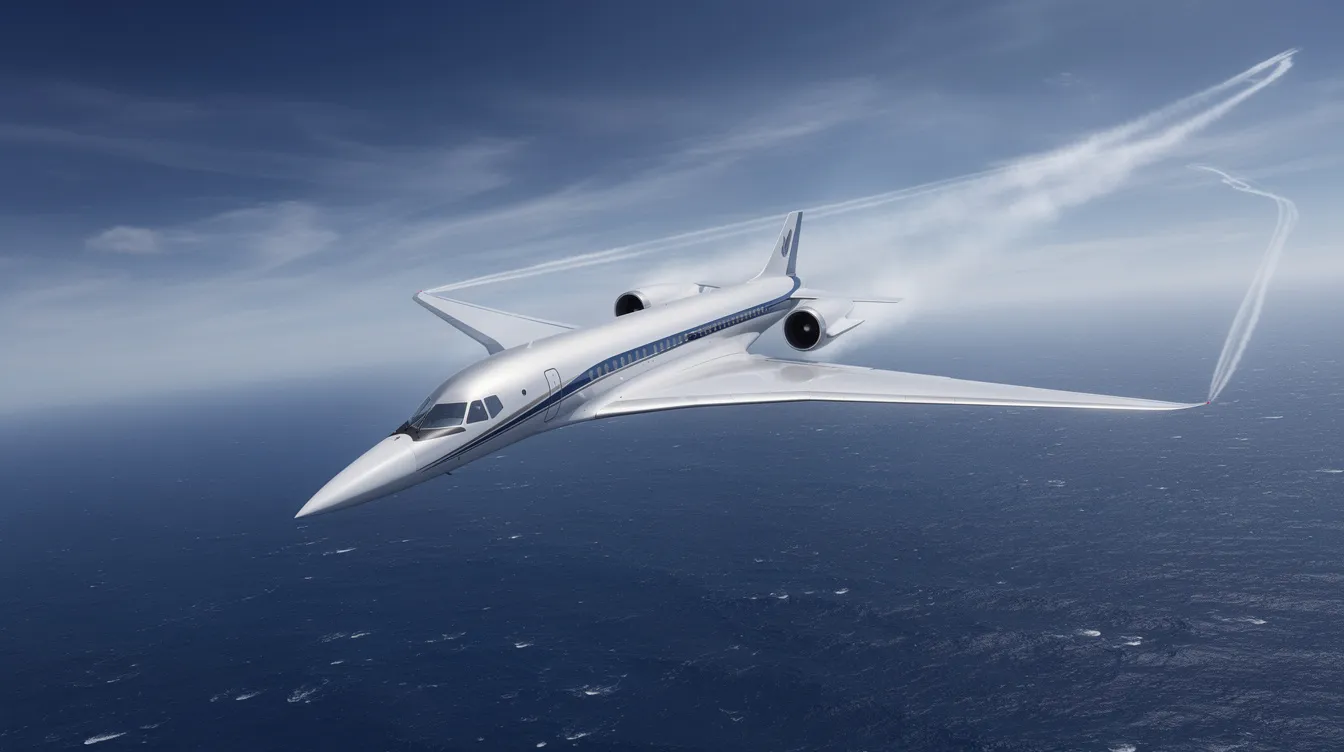
The Boom Overture aims for Mach 1.7 speeds, with a cruise altitude near 60,000 feet and a range of approximately 4,250 nautical miles.
Firm orders and pre-orders have come from United Airlines, Japan Airlines, and American Airlines, totaling roughly 130 aircraft. Supersonic travel could return by 2029 with the Overture, with commercial service expected around 2030.
Boom's Symphony engine, a next-generation medium-bypass turbofan, is designed to achieve efficient dry supersonic cruise without afterburners, a fundamental departure from Concorde's Olympus powerplants in terms of fuel efficiency and noise profile.
Sonic boom mitigation technologies aim to reduce disruptive noise from overland supersonic flights, potentially opening routes that Concorde could never serve. Computational fluid dynamics are used to optimize aircraft designs and reduce drag, shaping Overture's airframe for minimal wave drag at supersonic speeds.
The aircraft is being designed for compatibility with 100% sustainable aviation fuel (SAF), targeting net zero carbon emissions.
Lightweight composite materials help aircraft withstand extreme conditions at high speeds, and carbon-fiber composites are used to reduce weight and improve performance across the Overture's structure. Adaptive-cycle engines optimize airflow for different flight conditions to enhance efficiency and speed, a technology path that both military and commercial programs are exploring.
Projected route times are compelling: Miami to London in under five hours, Los Angeles to Honolulu in about three. For BlackJet members, the eventual integration of supersonic legs into Jet Card itineraries could redefine what a "day trip" means on transatlantic flights.
Why Most Commercial Aircraft Won't Go Much Faster Anytime Soon
Despite these supersonic ambitions, the mainstream commercial fleet will remain firmly subsonic for the foreseeable future.
The speed plateau in commercial aviation has held since the 1970s. Cruise Mach numbers have inched from about 0.78 to 0.85 over the past few decades, but further gains offer diminishing returns for airlines flying hundreds of passengers per trip.
Fuel price volatility and carbon regulations push airlines toward designs like the Boeing 787 and Airbus A350, which prioritize less fuel per mile over faster speeds. Fuel economy, not flight speed, drives procurement decisions.
Routinely flying close to maximum operating Mach stresses airframes, shortens engine life, and inflates maintenance budgets. Airlines prefer conservative cruise margins that extend fleet longevity.
For mass-market air travel, schedule reliability, airport slot constraints, and turnaround efficiency matter far more than shaving 15 minutes off a five-hour flight.
The conclusion is clear: true speed advantages are increasingly concentrated in private aviation and niche supersonic services. For travelers who value reaching speeds that commercial aviation cannot justify, private jets and future supersonic aircraft represent the only realistic paths forward.
How BlackJet Uses Aircraft Speed to Redefine Travel Time
Raw cruise speed is only one component of a fast journey. BlackJet's Jet Card model is designed to compress every other variable that adds time to travel.
Prepaid simplicity: With 25- or 50-hour Jet Card blocks, members book flights without negotiating rates leg by leg. The focus shifts entirely to scheduling outcomes: when you need to arrive, and which aircraft gets you there fastest, while resources like a dedicated 50 hour Jet Card cost guide help benchmark pricing and value.
Eliminated ground delays: Private terminals mean no security queues, no boarding groups, no connection layovers. A BlackJet member typically arrives 30 to 45 minutes before departure.
Direct routing and airport access: Commercial flights route through congested hubs. BlackJet aircraft operate from secondary airports closer to final destinations, with more direct flight paths.
Real-time optimization: BlackJet's digital booking tools factor in wind forecasts, runway availability, and slot times to minimize total trip duration.
Example scenario: A New York–Miami business day trip via commercial first class might consume 5–6 hours door-to-door each way (arrive two hours early, taxi delays, cruise ~3 hours, baggage, ground transfer). A BlackJet midsize jet compresses that to roughly 3–4 hours each way, enabling a same-day roundtrip that a commercial itinerary would stretch across two days.
Jet Cards vs On-Demand Charter vs Ownership: Speed, Access, and Control
How you access a private jet fundamentally affects how quickly you can get airborne, and many travelers compare programs like NetJets using dedicated NetJets jet card cost breakdowns before deciding which model best fits their speed and access requirements.
Jet Card members benefit from guaranteed response times, standardized hourly rates, and priority access to multiple aircraft categories. A BlackJet Jet Card holder can request a flight with as little as 24–48 hours' notice and expect confirmed availability, avoiding the positioning delays common in ad hoc charter—advantages shared by many of the best jet card programs for frequent flyers.
On-demand charter requires sourcing an available aircraft, negotiating price, and coordinating logistics from scratch each time. This process can add hours or days to the timeline, particularly during peak travel periods.
Ownership guarantees access to one specific aircraft, but locks the owner into a single performance profile. If that aircraft is in maintenance or positioned across the country, the owner waits. Ownership also carries fixed costs regardless of utilization, which is why many travelers analyze overall jet card cost and membership pricing before committing capital to a single airframe.
Consider a scenario: a client needs to fly New York to Chicago in the morning and Chicago to Dallas the same afternoon. A Jet Card's fleet flexibility allows selecting the optimal aircraft for each leg, departing from the nearest available airport, and compressing what would be a two-day commercial itinerary into a single, productive day—exactly the sort of pattern where a detailed 100 hour Jet Card cost guide helps determine whether a larger block of hours makes financial sense.
Safety at High Speeds: Certification, Training, and Operational Standards
Flying faster does not mean compromising safety. In fact, higher speeds demand more rigorous protocols, and BlackJet's certification standards reflect that reality.
BlackJet partners exclusively with operators that maintain ARGUS, Wyvern, or IS-BAO ratings, or equivalent proprietary safety audits. These programs assess maintenance practices, pilot qualifications, and operational discipline—standards that also extend to large-group charters on the best private jets for 20 passengers.
Pilots operating high-speed, high-altitude business jets undergo recurrent training in areas specific to transonic flight: critical Mach awareness, high-altitude decompression procedures, and crew resource management at reaching speeds near maximum operating limits.
Operational standards include conservative dispatch criteria for weather, performance margins at shorter runways, and contingency planning for diversions. Operators adhering to Part 135 or equivalent regulatory frameworks ensure that safety always takes precedence over schedule pressure.
Despite operating faster planes at high speeds, the safety record among premium business aviation providers is strong when these protocols are maintained without exception.
Sustainability and Faster Aircraft: Can Speed Be Climate-Responsible?
The perception that flying faster automatically means a larger carbon footprint is understandable but incomplete.
Yes, higher speeds generally increase fuel burn per mile. But newer engine technologies, lighter airframe materials, and optimized aerodynamics can moderate the difference. A carbon-neutral private jet program accounts for the full environmental picture, even when clients choose the cheapest private jet options to keep budgets in check.
BlackJet commits to carbon-neutral flights across all Jet Card hours flown, using verified offset and insetting strategies at no additional cost to the member, while travelers compare jet card cost per hour to understand how sustainability features factor into overall pricing.
Sustainable aviation fuel is the most promising path to decarbonizing both subsonic and supersonic flight. Current SAF blends are approved at up to 50% in most engines, with 100% SAF certification progressing. Industry targets aim for net-zero emissions by 2050, and evolving jet card pricing structures increasingly reflect the cost of integrating SAF and other green initiatives.
Speed is only one variable in an aircraft's environmental profile. Routing efficiency (fewer connections, more direct paths), load factors, and fleet modernity all influence emissions per passenger-kilometer. A fuel efficient modern business jet flying direct may produce fewer total emissions than a half-empty commercial flight with a connection.
Technology Enabling Faster, Smarter Flights: Avionics, Data, and Digital Tools
Speed is not just about engines and airframes. The digital systems surrounding a flight can be equally decisive.
Modern flight management systems optimize cruise speed versus fuel burn in real time, calculating step-climb profiles and adjusting altitude to maximize average ground speed across changing wind conditions. As Flying Magazine often notes when explaining performance and routing, these tradeoffs shape real-world trip times as much as headline speed figures. Advanced digital flight control systems enhance aircraft stability and performance, especially at high Mach numbers, whether on owner-operated fleets or structured programs like Flexjet jet cards with defined pricing and options.
BlackJet's mobile booking platform offers instant aircraft category selection, live availability views, and routing suggestions that minimize connections and total ground time. Members see estimated arrival times, not raw Mach numbers.
Weather and air traffic data allow operators to select alternative routes that may shorten flight times even when cruise speeds remain constant. Private jets have far more routing flexibility than commercial aircraft, which must follow ATC corridors and rigid slot windows.
Mini case study: A BlackJet client scheduled for a New York–London departure faces a major storm system over the mid-Atlantic. Commercial flights divert south, adding 45 minutes. BlackJet's operations team reroutes north, departs 30 minutes earlier from a less-congested airport, and the client arrives in London before the commercial option despite flying at a similar cruise Mach.
How Different Aircraft Types Compare on Speed: Turboprops, Jets, and Supersonic Concepts
The spectrum of aircraft speed is broader than most travelers realize. Here is how each category stacks up:
Aircraft Type | Speed Range | Typical Use Case |
|---|
Turboprop | ~250–350 mph | Short regional hops, remote airfields, island transfers |
Regional Jet | ~450–500 mph | Domestic routes, short international legs |
Commercial Widebody/Narrowbody | ~500–600 mph | Intercontinental and domestic long-haul |
Large-Cabin Private Jet | Mach 0.85–0.935 (~600–700 mph) | Long-range international, transcontinental |
Future Supersonic (Boom Overture) | Mach 1.4–1.7 | Ultra-fast transoceanic, premium time-critical routes |
A few things worth noting: | | |
Turboprop private jets can be time-competitive on short routes (under 300 miles) because they access smaller airports closer to final destinations, even though their airplane's speed is lower than any jet, and they often feature among the cheapest private aircraft options for cost-conscious travelers.
BlackJet typically offers access across light, midsize, and large-cabin categories, matching each trip profile to the right balance of speed, range, and cabin size, and can also coordinate larger-group solutions on private jets for around 30 passengers when itineraries demand it.
When Boom Overture and similar supersonic commercial aircraft enter service, they will sit at the top of this spectrum, primarily serving transoceanic segments where the time savings justify the premium. For now, large-cabin private jets remain the fastest civilian option for covering long distances quickly, with even bigger groups turning to private jets that accommodate up to 50 passengers when they need speed and capacity together.
FAQ: Fastest Planes, Commercial Speeds, and Private Jet Travel
What is the fastest plane ever built and how fast did it fly? The NASA X-43, an unmanned hypersonic research vehicle, achieved Mach 9.6 (7,366 mph) in 2004. Among piloted aircraft, the X-15 reached Mach 6.72 (4,520 mph). Many record-setting aircraft were developed for national air force or research missions rather than civilian transport. These were experimental programs, not designed for passenger service.
What is currently the fastest operational jet you can fly on as a civilian? The Gulfstream G700 and Cessna Citation X+ lead the field with maximum cruise speeds near Mach 0.935. The current fastest civil aircraft operates just under the speed of sound. These are the fastest aircraft available through Jet Card programs and charter.
How fast do most commercial airplanes fly on international routes? Most commercial airliners cruise between Mach 0.80 and 0.86, which translates to roughly 500–600 mph. Commercial jets usually fly at 500–600 mph depending on the aircraft type and route.
Can private jets fly faster than commercial aircraft on the same route? Yes, in practice. Private jets can reach speeds between 600 and 700 mph in cruise, and they save additional time through faster climbs, higher cruising altitude, private terminal access, and more direct routing. The total time advantage on a New York–Los Angeles trip can exceed two hours.
Will I be able to book supersonic flights through programs like BlackJet in the future? It is increasingly likely. With Boom Supersonic's Overture targeting commercial service around 2029–2030 and major airlines placing orders, supersonic commercial flight could become a bookable option within Jet Card frameworks as the fleet enters service.
Does flying faster affect safety or turbulence? Pilots maintain strict safety margins regardless of cruise Mach. Modern aircraft are certificated and tested at their maximum operating speeds. Higher cruising altitude (where many private jets operate) often means smoother air and less turbulence, not more.
What happened to the Concorde and why did it stop flying? Concorde retired in 2003 due to high operating costs, environmental noise regulations (particularly sonic booms over land), post-9/11 demand reduction, and the expense of maintaining an aging fleet. Air France and British Airways operated the final services.
How do supersonic planes avoid the sonic boom problem? Next-generation designs use shaped fuselages, advanced aerodynamics, and boom mitigation technologies to reduce the intensity of sonic booms to acceptable levels. Regulatory changes in the U.S. are also reopening the door for overland supersonic commercial flight under new noise standards.
From Faster Planes to Smarter Itineraries: Choosing the Right Speed with BlackJet
The fastest plane in the sky means nothing if you are still standing in a terminal queue when it takes off. The central insight of this article is simple: raw top speed matters far less than total journey time and control. And that is precisely where private jet access excels.
BlackJet's Jet Card programs transform aircraft performance into outcomes that matter:
Same-day transatlantic turnarounds that would be impossible on commercial schedules.
Multi-city business trips compressed from three days into one.
Departure times optimized around your calendar, not an airline's hub schedule, reducing jet lag and maximizing productive hours.
Access to the right speed for each mission, from a light jet for a 400-mile hop to an ultralong-range aircraft for a nonstop crossing.
Think less in terms of Mach numbers and more in terms of time windows. Dinner in London after a full New York workday. A board meeting in São Paulo and breakfast at home the next morning. These are the outcomes that faster, smarter air travel makes possible.
Explore BlackJet's Jet Card membership and discover how to convert speed into your most valuable strategic advantage. Speak with an aviation advisor to calculate the time savings on your most frequent routes, or request a tailored consultation to see what your travel calendar looks like when every hour is yours.


 Sign up with google
 Sign up with Apple