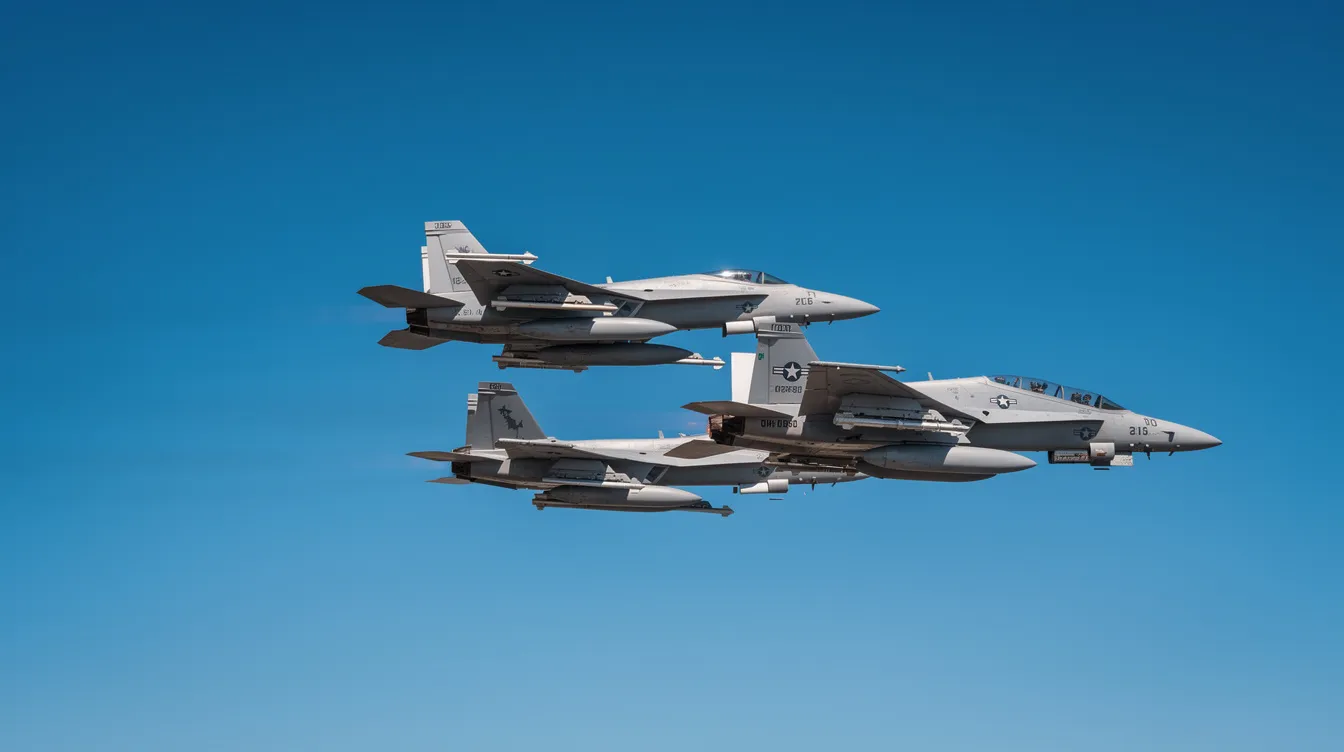
The United States military operates the largest and most technologically advanced fleet of fighter jets on the planet. From stealth-dominant fifth-generation platforms to battle-proven fourth-generation workhorses, American fighter aircraft define what air superiority looks like in the 21st century. This guide breaks down every major fighter type in active US service, explains the designation systems behind them, and covers what comes next for the armed forces.
Whether you follow aerospace development closely or simply appreciate the engineering that shapes modern aviation, this US fighter planes list delivers the numbers, capabilities, and context you need.
Overview: How Many US Fighter Jets There Are Today
As of late 2025, the US Air Force alone maintains approximately 1,978 fighter and attack aircraft across active duty, Air National Guard, and Reserve components. Combined with US Navy and Marine Corps tactical aviation, the country fields well over 2,000 fighter and strike fighter aircraft. The United States military operates fifth-generation stealth fighters and legacy aircraft simultaneously, making this inventory one of the most diverse on Earth.
The US operates 47 major types of fighter jets when accounting for all variants, sub-blocks, and specialized configurations across branches. Fighter jets are categorized as air superiority or multirole, depending on their primary mission sets.
Here is a summary of the major current types in US service:
F-22A Raptor - Air superiority fighter, USAF (~184 airframes)
F-35A Lightning II - Multirole stealth fighter, USAF (~500 in service)
F-35B Lightning II - STOVL variant, Marine Corps (~280+)
F-35C Lightning II - Carrier variant, Navy and Marine Corps (~90–100)
F-15EX Eagle II - Heavy multirole fighter, USAF (~13–27 delivered)
F-15E Strike Eagle - Dual-role strike/air superiority, USAF (~217)
F-15C/D Eagle - Air superiority, USAF Air National Guard (~42–75 remaining)
F-16C/D Fighting Falcon - Multirole fighter, USAF (~826)
F/A-18E/F Super Hornet - Carrier-based multirole, Navy (~549)
EA-18G Growler - Electronic warfare, Navy (~160)
F/A-18C/D Hornet - Legacy multirole, Marine Corps (phasing out by 2030)
This list focuses on post–Cold War and in-service aircraft. Notable retired types like the F-14 Tomcat and the F-4 Phantom II receive brief treatment later for historical context. The article also covers how these fighters support air superiority, attack aircraft roles, electronic warfare, and the broader armed forces missions.
Understanding fighter aircraft gives private jet travelers a deeper appreciation for modern aviation technology, the safety disciplines that originated in military cockpits, and the performance standards that flow into every corner of the aerospace industry, whether they are chartering light jets or evaluating large-cabin 16-seat private jet options.
US Fighter Aircraft Designation System (F-, A-, and Beyond)
The US uses a unified designation system adopted in 1962 known as the Mission Design Series (MDS). Before this standardization, each branch maintained its own naming conventions, which created confusion across the armed forces. The USAF was established as an independent service on September 18, 1947, evolving from the Army Air Corps, which had used "P" for Pursuit to classify its fighter aircraft. After 1948, "P" became "F" - the P-51 Mustang was redesignated the F-51.
Here is how the modern system works:
"F" - Fighter: Designates aircraft whose primary mission is air-to-air combat or multirole fighter operations (e.g., the F-16 Fighting Falcon, F-22, F-35)
"A" - Attack: Ground attack or close air support aircraft (e.g., A-10 Thunderbolt II)
"B" - Bomber: Strategic or tactical bombing platforms (e.g., B-2 Spirit)
"E" - Electronic Warfare / Special Mission: Variants modified for electronic warfare (e.g., EA-18G Growler)
"F/A" - Fighter/Attack: Naval fighters that carry dual designations reflecting both air-to-air and ground attack roles (e.g., F/A-18 Super Hornet)
This structured system contrasts with purely civilian aircraft naming. Business aviation - including BlackJet's fleet access across aircraft categories - uses manufacturer and cabin category names rather than combat mission codes. The logic, however, shares a common thread: matching the right airplane to the right mission.
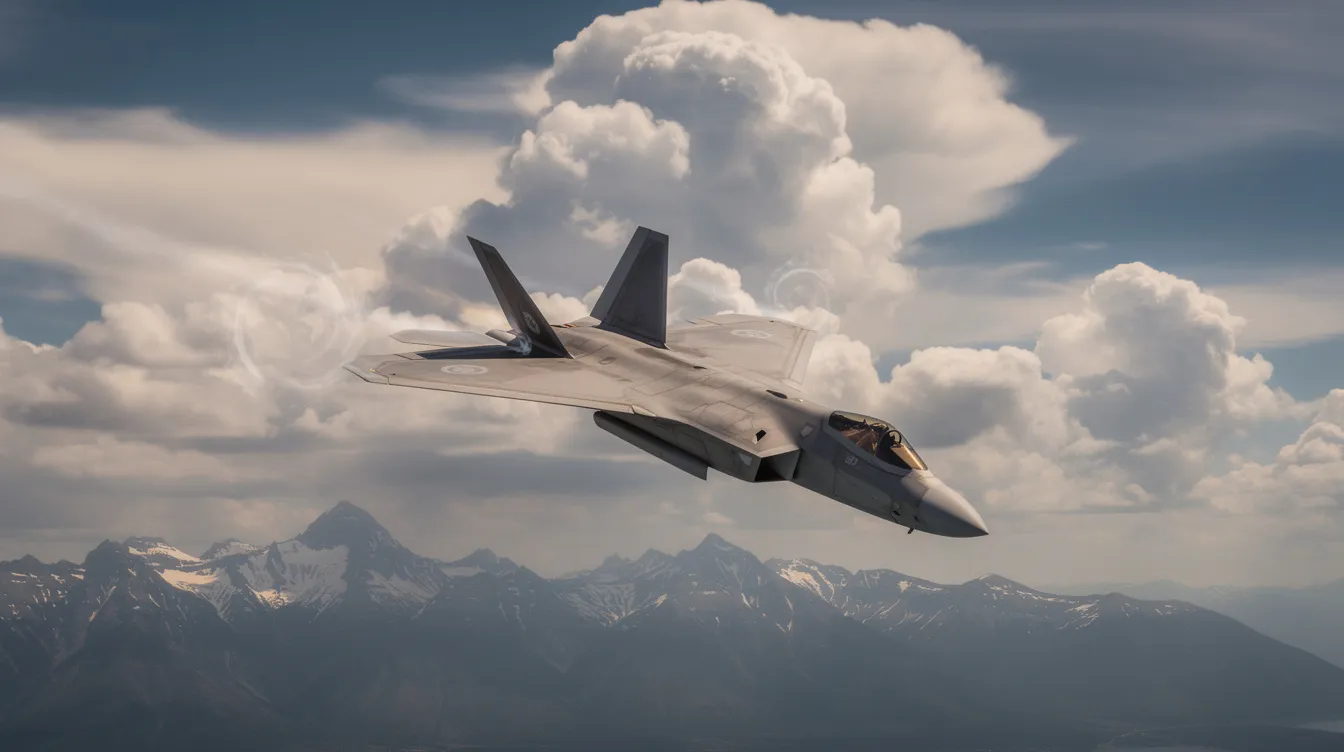
F-22A Raptor: The Air Superiority Benchmark
The Lockheed Martin F-22A Raptor is the world's first operational fifth-generation air superiority fighter. It entered service with the USAF in 2005 and achieved initial operational capability in December 2005. The F-22 Raptor is unmatched in air-to-air combat, combining stealth technology, super-maneuverability, and integrated avionics that no other aircraft in the world can fully replicate.
Stealth technology helps fighters like the F-22 and F-35 evade enemy radar detection, but the Raptor was initially designed with radar signature reduction as a foundational requirement rather than an add-on.
Key performance data and status:
Engines: Twin Pratt & Whitney F119-PW-100 turbofans with thrust vectoring
Speed: Supercruise above Mach 1.5 without afterburner; maximum speed approximately Mach 2.0
Service ceiling: Above 50,000 ft
Primary roles: Air superiority, limited ground attack, intelligence/surveillance; emphasis on beyond-visual-range combat and sensor fusion
Production: Ended in 2012 at 187 airframes built; the F-22 Raptor had 183 operational aircraft as of August 2022, with approximately 184 in inventory and around 140–150 combat-coded as of the mid-2020s
Export: No export version exists, reinforcing its status as a uniquely American fighter aircraft
The F-22 remains the benchmark for what a penetration fighter can achieve in contested airspace. Congressional law prohibits retiring below 184 Raptors through September 30, 2027, keeping this single-seat platform at the tip of America's air dominance posture.
F-35A Lightning II: Backbone of the US Air Force Fighter Fleet
The F-35A is the conventional takeoff and landing variant of the Lightning II, developed by Lockheed Martin for the US Air Force. With roughly 500 aircraft delivered to the USAF by late 2025, the F-35A is the most numerous fighter jet in the US and central to the service's future force structure. Fifth-generation fighters incorporate stealth technology and advanced sensor fusion, and the F-35A represents the most ambitious effort to bring these capabilities to scale.
Technical performance:
Engine: Single Pratt & Whitney F135 afterburning turbofan
Top speed: Approximately Mach 1.6
Combat radius: Around 670 nautical miles
Range: The F-35A has a range of over 1,350 miles
Service ceiling: Above 50,000 ft
Roles: Air-to-air, air-to-ground, electronic attack, ISR
Sensor fusion provides pilots with a unified battlefield view from multiple sources - the Distributed Aperture System, Electro-Optical Targeting System, and APG-81 AESA radar feed a 360-degree situational picture directly into the pilot's helmet-mounted display. This multi-role fighter aircraft concept makes the F-35A effective across a wider mission set than any single-role predecessor.
The F-35 Lightning II program aims for 100 annual deliveries by 2030. Over 1,149 production F-35s of all variants had been delivered worldwide by early 2025, including roughly 831 A-variants.
Challenges remain real. Full-mission capable rates have hovered around 25% fleet-wide in certain assessments, driven by software bugs, spare parts scarcity, and Block 4 upgrade delays. Sustainment costs exceeded $5 billion in 2023.
The advanced avionics, data-linking, and real-time information systems in the F-35A parallel - at a simpler level - the integrated technology and real-time support that BlackJet Certified private jet clients benefit from in modern business aviation.
F-35B Lightning II: STOVL Power for the Marine Corps
The F-35B is the short takeoff and vertical landing variant used primarily by the Marine Corps for expeditionary operations. Its Rolls-Royce LiftFan and swiveling rear nozzle allow it to operate from amphibious assault ships, short or damaged runways, and austere forward bases - a capability no other stealth fighter can match.
The STOVL system adds weight and reduces internal fuel capacity, which shortens the F-35B's combat radius compared to the F-35A and F-35C. Despite this tradeoff, the airplane delivers transformative flexibility for the armed forces.
Program of record: The Marine Corps plans for more than 350 F-35Bs and Cs combined; the B-variant fleet approaches 280+ delivered aircraft as of 2026
Replaces: Legacy AV-8B Harrier II (already phased out) and F/A-18C/D Hornets (retiring through 2030)
Operational concept: Operates from LHD/LHA amphibious assault ships and expeditionary airfields, supporting Marine Air-Ground Task Forces
Roles: Both fighter and attack aircraft for close air support, precision strike, and air defense within the Marine air-ground task force construct
The F-35B's ability to fly from a wider range of platforms than any other aircraft in the inventory makes it the cornerstone of Marine Corps tactical aviation for decades ahead.
F-35C Lightning II: The Navy's Carrier-Based Stealth Fighter
The F-35C variant is designed for carrier operations, featuring larger wings for lower approach speeds, strengthened landing gear, and folding wingtips compatible with US Navy aircraft carrier operations. The United States Navy declared initial operational capability for the F-35C in 2019, and integration into carrier air wings alongside the F/A-18 Super Hornet is accelerating.
Carrier-capable jets include the F-35C and F/A-18E/F, but only the F-35C brings full fifth-generation stealth and sensor fusion to the flight deck.
Projected force: Roughly 273 F-35Cs for the Navy, plus approximately 67–140 for the Marine Corps depending on evolving aviation plans
Current deliveries: The Navy had accepted nearly 90 F-35Cs by late 2025
Primary roles: Penetrating advanced air defenses along contested coastlines, long-range precision strike, air superiority within the carrier air wing
Significance: The first truly stealth carrier-capable fighter, reshaping naval aviation doctrine
Naval aviation's rigor and safety culture - from carrier qualification standards to maintenance protocols - set benchmarks that influence civilian and business aviation practices, including the safety certifications that define premium private jet programs.
F-15EX Eagle II: Modernized Heavy Fighter for Air Dominance
The Boeing F-15EX Eagle II is the latest evolution of the classic F-15 design, optimized as a heavy payload carrier for the US Air Force. While 4.5-generation fighters like the F-15EX and F/A-18E/F lack full-spectrum stealth capabilities, the Eagle II compensates with raw payload capacity, speed, and a digital backbone designed for integration with fifth-generation networks.
Engines: Twin GE F110-GE-129 or -132 turbofans
Top speed: Approximately Mach 2.5
Payload: Up to roughly 29,500 lb across numerous external hardpoints; the F-15EX Eagle II can carry up to 12 AIM-120 AMRAAMs - or 12 air-to-air missiles simultaneously - earning its "missile truck" reputation
Cockpit: Advanced digital fly-by-wire system, large-area display, open mission systems architecture
Deliveries: Initial batches delivered to Air National Guard and active-duty squadrons in the mid-2020s, replacing aging F-15C/D airframes
Roles: Air superiority, homeland defense, and complement to stealth fighters like the F-35A
Boeing Defense continues to deliver the F-15EX under a multi-year contract, bringing modern capabilities to a proven twin-engine airframe that first entered service nearly five decades ago.
F-15E Strike Eagle and F-15 Variants Still in Service
The F-15E Strike Eagle is a dual-role, long-range strike and air superiority platform that entered squadron service with the USAF in the late 1980s. The F-15 Eagle entered service in 1976 and remains operational in multiple variants - a remarkable testament to the McDonnell Douglas design that McDonnell Aircraft originally developed in the early 1970s (now produced by Boeing).
Crew: Two-seat configuration (pilot and weapons systems officer)
Radar: APG-82(V)1 AESA radar in upgraded aircraft; terrain-following capability for low-altitude penetration
Speed: Near Mach 2.5
Range: Ferry range over 3,000 miles with external tanks, supporting long-range power projection
USAF inventory: Approximately 217 F-15Es in service as of late 2025
Remaining F-15C/D Eagles serve primarily in Air National Guard units. Many active-duty C/D squadrons have already transitioned or are transitioning to the F-15EX or F-35A. A small residual fleet is projected to fly into the late 2020s before full retirement.
Export derivatives - the F-15K (South Korea), F-15SA (Saudi Arabia), and F-15QA (Qatar) - demonstrate the global appeal of the Strike Eagle lineage, though these foreign types fall outside this article's scope.
The Strike Eagle's combination of deep strike capability, air superiority performance, and two-seat crew coordination makes it one of the most effective heavy fighters ever developed for the USAF.
F-16 Fighting Falcon: America's Workhorse Fighter
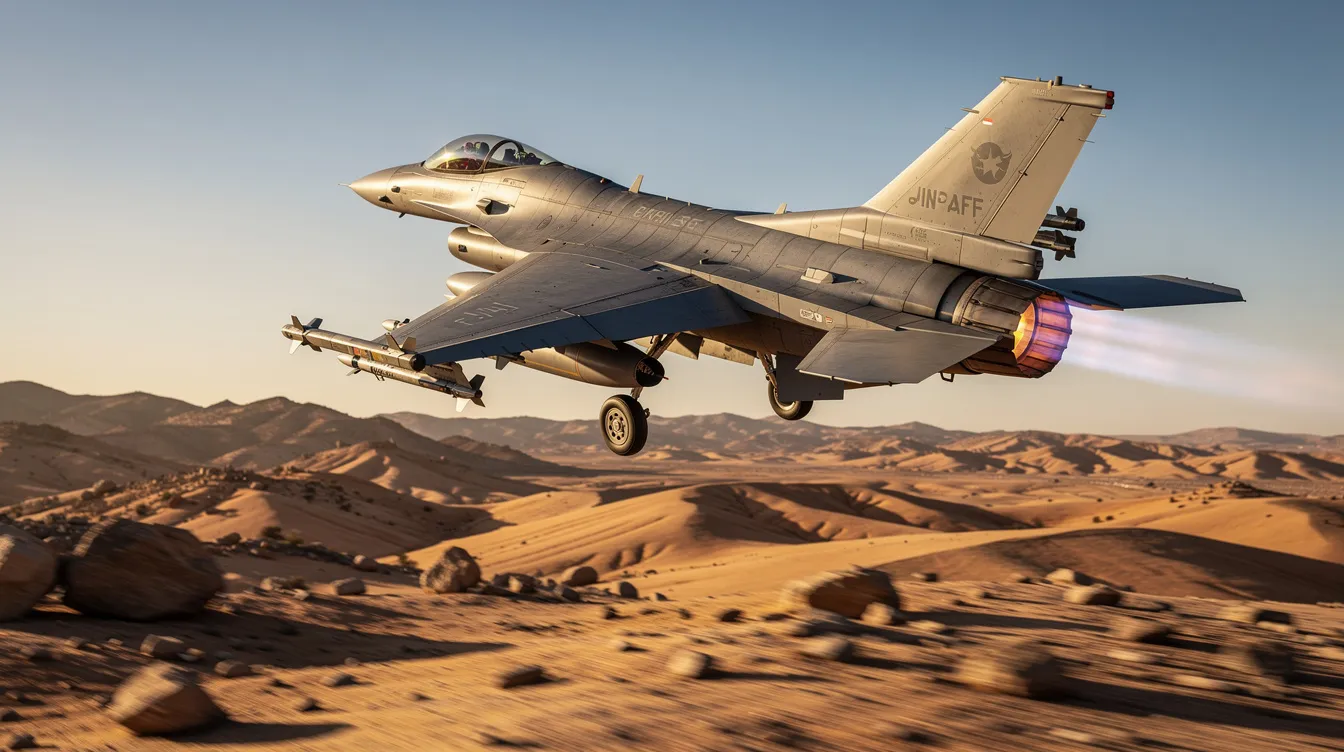
The F-16 Fighting Falcon - nicknamed "Viper" by its pilots - is the most numerous US fighter jet and has served as the backbone of American tactical airpower since the 1980s. Originally developed by General Dynamics and now produced by Lockheed Martin, the F-16 has become the single-engine multirole fighter aircraft that defines what a workhorse combat plane looks like.
The F-16C/D Fighting Falcon fleet includes 1,017 aircraft when counting all USAF components (active duty, Guard, and Reserve), with approximately 826 in the Air Force's total aircraft inventory as of late 2025. Over 4,500 F-16s have been built globally for more than 25 countries.
Engine: Single Pratt & Whitney F100 or GE F110 turbofan producing approximately 27,000–29,000 lb of thrust
Top speed: Mach 2.0+
Service ceiling: Above 50,000 ft
Maneuverability: Fly-by-wire flight controls, frameless bubble canopy, reclined pilot seat for high-G tolerance
Evolution: From early F-16A/B models through modern F-16C/D Block 50/52 and the latest Block 70/72 F-16V with AESA radar
Service life extension programs aim to keep hundreds of F-16s flying into the 2030s for air policing, close air support, precision strike, and adversary training. Many of these planes are 30+ years old, yet upgrades keep them tactically relevant.
The agility and responsiveness of the F-16 - a single-seat fighter equipped with one of the most intuitive cockpits ever designed - represent a different mission than private aviation, but the aerodynamic sophistication is comparable to what modern high-end business jets deliver for BlackJet members in terms of performance engineering.
F/A-18E/F Super Hornet: The Navy's Multirole Carrier Fighter
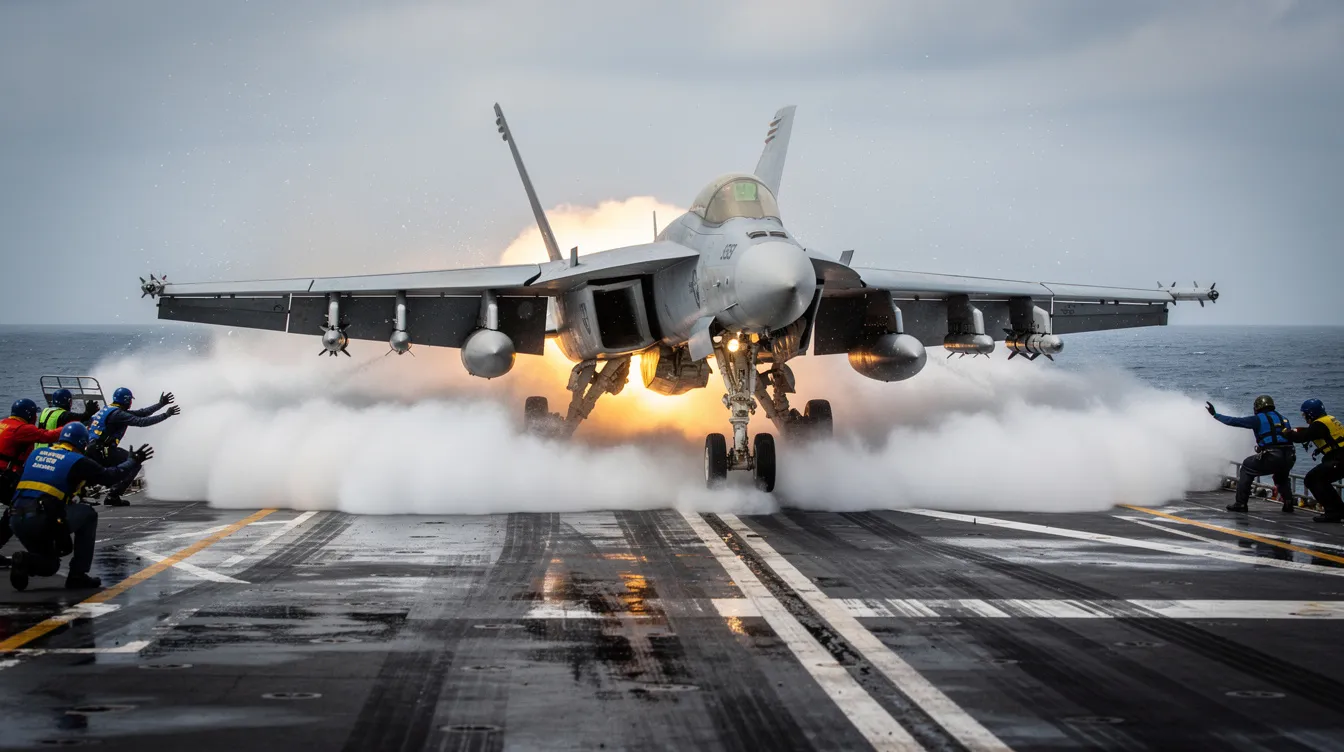
The Boeing F/A-18E (single seat) and F/A-18F (two seat) Super Hornet has served as the primary US Navy carrier-based fighter and attack aircraft since the early 2000s. The F/A-18E/F Super Hornet serves as a carrier-based strike fighter with versatile mission roles spanning fleet defense, maritime strike, close air support, and long-range interdiction.
Engines: Twin GE F414-GE-400 turbofans
Top speed: Approximately Mach 1.8
Combat radius: Roughly 500–600 nautical miles depending on weapons load
Crew: E-model is single-seat; F-model is two-seat
Roles: Air superiority, precision strike, fleet defense, ground attack, and buddy refueling
The Super Hornet replaced both the Grumman F-14 Tomcat and older F/A-18C/D Hornets in frontline carrier air wings. Production is projected to end around 2027, though tooling and industrial base preservation will allow a potential restart if needed. Block III upgrades - conformal fuel tanks, redesigned cockpit, reduced radar cross-section, and advanced tactical networking - will extend the fleet's operational life into the 2040s.
The Super Hornet remains the backbone of Navy service carrier aviation and will continue to fly alongside the F-35C for at least two more decades.
EA-18G Growler: Electronic Warfare Specialist
The Boeing EA-18G Growler is a dedicated electronic warfare and electronic attack aircraft derived from the F/A-18F Super Hornet airframe. It is the only tactical airborne electronic attack platform in the U.S. military inventory, making it indispensable for modern combat operations.
Primary capabilities: Jamming hostile radars and communications, escorting strike packages, conducting suppression of enemy air defenses (SEAD), and delivering kinetic weapons when needed
IOC: Approximately 2009; first combat deployment in 2010
Inventory: Approximately 160 aircraft in US Navy service, primarily based at NAS Whidbey Island with forward-deployed squadrons in Japan
Upgrade path: Transitioning from legacy ALQ-99 jamming pods to the Next Generation Jammer Mid-Band (NGJ-MB) system in the mid-2020s, dramatically improving effectiveness across the electromagnetic spectrum
Electronic warfare is increasingly central to modern air superiority, blending kinetic and non-kinetic effects. Secure, resilient communications are equally central to civilian operations - including BlackJet's real-time flight support, where robust digital connectivity ensures seamless coordination from booking through landing.
Legacy and Transitioning Fighters: F/A-18C/D Hornet and AV-8B Harrier II
The original F/A-18C/D Hornet was the Navy's and Marine Corps' first aircraft to serve as a true multirole fighter and attack platform, entering service in the 1980s. Its operational history spans nearly four decades of combat deployments worldwide.
The US Navy retired its last F/A-18C from frontline combat in 2018
Remaining Marine Corps Hornets serve as a bridge to the F-35B and F-35C, with complete phase-out planned by approximately 2030 (Beaufort by 2028, Miramar by 2029, Fort Worth by 2030)
The AV-8B Harrier II - a Marine Corps vertical/short takeoff and landing attack aircraft - has been phased out in favor of the F-35B's superior STOVL capability
These platforms are no longer front-line fighters in most services, but they remain essential to understanding the transition to the F-35 family
The Marines' shift from legacy Hornets and Harriers to an all-F-35 tactical fleet represents one of the most significant force structure changes in Marine Corps aviation history.
Retired Icons: F-14, F-4, F-117, and A-10 (Why They're Not on the Current List)
Several iconic military aircraft no longer appear on the active US fighter planes list, but their contributions shaped today's fleet:
F-14 Tomcat: Grumman's twin-engine, variable-sweep-wing naval air superiority fighter, retired from US Navy service in 2006. Famous for its long-range Phoenix missile capability and Pacific theater deployments, but no longer in American inventory.
F-4 Phantom II: The McDonnell Douglas F-4 served as a versatile Cold War air superiority and attack aircraft across the US Air Force, Navy, and Marine Corps. It saw extensive action in the Vietnam War and was retired from front-line US service in the 1990s, with some airframes later used as QF-4 target drones. The national museum of the United States Air Force preserves several examples.
F-86 Sabre: This North American Aviation fighter was pivotal in the Korean War, establishing American jet-age air superiority against Soviet-built MiG-15s. It is long retired but remains foundational to understanding how the country developed its modern fighter doctrine.
F-117 Nighthawk: Despite its "F" designation, the Lockheed F-117 was primarily a stealth attack aircraft. It was officially retired in 2008 but continues to fly in limited test and training roles - among the more unusual X-planes-adjacent programs in the USAF.
A-10 Thunderbolt II: While iconic for close air support and ground attack, the A-10 is categorized as an attack aircraft rather than a fighter. It remains in limited USAF service with ongoing retirement debates, but its mission profile falls outside the fighter category this article covers.
These aircraft shaped the operational history and development of every fighter that followed them.
Future US Fighter Aircraft: NGAD, F-47 Concepts, and F/A-XX
The Next Generation Air Dominance (NGAD) program represents the US Air Force's effort to field a sixth-generation air superiority system in the 2030s. NGAD is not a single airplane but a "system of systems" that may include crewed fighters, uncrewed Collaborative Combat Aircraft (CCA) wingmen, advanced propulsion, and next-generation stealth.
Notional designs like a Boeing "F-47" sixth-generation fighter have appeared in open sources, though official designations and details remain limited and mostly classified. Boeing received conceptual design contracts for this development effort.
The US Navy's F/A-XX program is a planned sixth-generation carrier-based fighter to replace or augment the F/A-18E/F and operate alongside the F-35C in future carrier air wings. Northrop Grumman and Boeing are among the competitors.
Key technology themes include manned-unmanned teaming, advanced thermal management, long-range weapons integration, and space technology-derived sensor architectures.
Emerging technologies in these fighters often trickle down into civilian and business aviation - from composite materials and additive manufacturing to avionics architectures. BlackJet's interest in the future of aerospace innovation and the many types of private jets available to travelers reflects how military advances shape what commercial aviation and private travel look like within a decade.
US Air Force Fighter Fleet: Roles, Commands, and Global Presence
The U.S. Air Force operates the F-22 Raptor and F-35 Lightning II alongside legacy platforms like the F-16 and F-15 variants, organized across major commands to maintain global air superiority:
Air Combat Command (ACC): Primary provider of combat-ready fighter forces for unified combatant commands
Pacific Air Forces (PACAF): Forward-positioned fighters supporting Indo-Pacific deterrence
US Air Forces in Europe – Air Forces Africa (USAFE-AFAFRICA): NATO-aligned fighter operations across European and African theaters
The USAF maintains approximately 1,271 combat-coded fighters, though the exact figure fluctuates with deliveries and retirements. A CRS report found that by mid-2026, the Air Force had 1,098 primary mission aircraft inventory fighters - below the 1,145 minimum mandated by law. The average age of the Air Force fighter fleet approaches 25.4 years.
Primary USAF fighter roles include:
Air superiority and defensive counter-air
Offensive counter-air and interdiction
Close air support for joint ground forces
Nuclear strike capability in select dual-capable aircraft types
Training programs like Red Flag and dedicated aggressor squadrons sustain pilot proficiency across these mission sets. The USAF's demand for experienced pilots and maintainers overlaps with the civilian aviation labor market, influencing availability and standards in high-end private aviation that travelers rely on daily.
Navy and Marine Corps Fighters: Carrier Air Wings and Expeditionary Power
Different military branches operate distinct aircraft based on their missions and needs. The United States Navy structures carrier air wings around a mix of F/A-18E/F Super Hornets, EA-18G Growlers, and an increasing number of F-35C squadrons. Each carrier air wing typically embarks four strike fighter squadrons, one electronic warfare squadron, and supporting assets.
Marine Corps fighter aviation centers on F-35B and F-35C squadrons supporting Marine Air-Ground Task Forces from land bases, amphibious assault ships, and carriers. As the United States entered the era of expeditionary warfare, the Marines prioritized aircraft that can operate from austere and sea-based platforms.
Navy roles: Fleet defense, maritime strike, long-range precision strike, and power projection in littoral and blue-water environments
Marine Corps roles: Close air support for ground forces, air defense of the amphibious objective area, deep strike, and shaping operations
Key difference: Sea-based fighters must withstand carrier landings, salt-water corrosion, and compressed maintenance cycles - operational demands that land-based Air Force fighter aircraft do not face
This dual naval fighter force ensures the armed forces can project combat airpower anywhere a carrier or amphibious ship can sail.
Electronic Warfare, ISR, and the Expanding Definition of "Fighter"
Modern fighter aircraft frequently integrate electronic warfare, intelligence, surveillance, and reconnaissance, and networked command-and-control roles. The traditional boundary between a "fighter" and other aircraft types has blurred considerably, as platforms like the EA-18G Growler, the F-35 family, and upgraded F-16s with electronic attack pods deliver effects across the electromagnetic spectrum alongside kinetic weapons.
Control of the electromagnetic spectrum is now as important to air superiority as speed or stealth, with guided missile ability enhanced by networked targeting data shared in real time.e
Aviation Week and other defense publications increasingly describe fighters as "sensor-shooter nodes" rather than standalone combat platforms.
The F-35's ability to serve simultaneously as a fighter, electronic warfare platform, and ISR collector exemplifies how a single airplane can fill roles that once required multiple dedicated aircraft types.
This evolution means that the definition of a "fighter equipped" for modern combat extends far beyond guns and missiles into the digital domain.
Modern private aviation, including BlackJet's operations, relies on a parallel principle: robust digital connectivity, secure communications, and real-time data integration ensure safe, seamless flight experiences for every passenger.
From Military Fighters to Private Jets: What This Means for BlackJet Travelers
Decades of innovation in US fighter aircraft - aerodynamics, avionics, composite materials, safety systems - directly influence modern business and private aviation standards, even for travelers focused on the cheapest private aircraft and budget-friendly options. The connection is not abstract; it is structural.
Many pilots and maintenance professionals transition from military aviation to corporate and charter operations, bringing rigorous safety discipline, checklist culture, and mission planning expertise to services like BlackJe.t.
Air superiority demands situational awareness; private jet charter demands operational awareness and risk management - the underlying discipline is the same.
Technologies developed for fighters, from fly-by-wire controls to advanced weather radar and terrain avoidance systems, now appear in the business jets BlackJet members fly on every week.
BlackJet's emphasis on safety certification, carbon-neutral flights, and advanced booking technology represents civilian counterparts to the high-performance, high-reliability ethos seen in military aviation, similar to how the best private jets in the world blend cutting-edge performance with passenger comfort
For travelers who appreciate what elite aviation capabilities represent, BlackJet translates that same commitment to precision and safety into efficient, comfortable private travel, whether a client charters an entire aircraft or simply buys a seat on a private jet through shared or semi-private options.
How BlackJet's Jet Card Model Compares to Owning a Fighter-Style Fleet
Fielding a single fighter aircraft costs billions in research and development, requires massive support infrastructure, and demands thousands of maintenance hours per year. The US military solves this through scale, organization, and mission-tailored force allocation. BlackJet applies a similar logic to private aviation - without the complexity- offering structured premium private jet card programs instead of owning and operating an entire fleet yourself.
Jet Cards (25-hour, 50-hour, and other tiers) provide predictable pricing, guaranteed availability across aircraft categories, and flexibility that mirrors how the armed forces allocate different fighters to different mission profiles; readers can also review a broader guide to jet card cost and membership pricing to understand typical market structures.
Compared to aircraft ownership, a Jet Card eliminates hangar fees, crew salaries, insurance, and depreciation - the private aviation equivalent of the military's logistical tail.
Compared to ad-hoc charter, a Jet Card locks in rates and availability, removing the uncertainty of spot-market pricing; understanding how jet card pricing is structured helps frequent flyers budget more accurately.
Compared to commercial first class, a Jet Card delivers direct routing, terminal bypass, and schedule control that save hours per trip, and frequent travelers evaluate the best jet cards for regular private flyers to maximize those benefits.
Consider a scenario: a business executive follows the development of the F-35 from Edwards AFB testing to operational deployment with genuine interest, then books a super-midsize jet through BlackJet's 50-hour Jet Card for a New York–Dallas round-trip in a single day, having first compared detailed insights on 50-hour jet card cost and value. Different missions. Same appreciation for precision, performance, and doing things right.
Frequently Asked Questions About US Fighter Planes
What is the difference between air superiority fighters and multirole fighters?
An air superiority fighter like the F-22 Raptor is optimized primarily for air-to-air combat - controlling the skies. A multirole fighter aircraft like the F-35A or F-16 is designed to perform both air-to-air and air-to-ground missions effectively. Most modern fighters lean toward multirole capability because of budget and operational flexibility.
How many US fighter jets are in active service?
The US Air Force alone fields approximately 1,978 fighter and attack aircraft. Combined with the Navy's roughly 549 Super Hornets, 160 Growlers, and approximately 90–100 F-35Cs, plus Marine Corps F-35Bs and remaining legacy Hornets, the total US fighter inventory exceeds 2,500 aircraft across all branches.
What are the main differences between the F-35A, F-35B, and F-35C?
The F-35A is the conventional takeoff variant for the USAF. The F-35B is the short takeoff and vertical landing variant for the Marine Corps, able to operate from amphibious ships. The F-35C is the carrier variant for the US Navy with larger wings and reinforced landing gear. All three share a common stealth design and sensor suite but differ in range, weight, and launch/recovery capability.
Why is the F-16 Fighting Falcon still in service?
The F-16 remains in service because of its proven reliability, low operating cost relative to fifth-generation platforms, and ongoing upgrades (like the Block 70/72 F-16V with AESA radar) that keep it tactically relevant. Service life extension programs will sustain hundreds of F-16s into the 2030s for air policing, training, and combat roles.
What role does electronic warfare play in modern fighter operations?
Electronic warfare - jamming enemy radars, disrupting communications, and protecting friendly forces from guided weapons - is now central to air superiority. The EA-18G Growler is the US military's primary tactical electronic attack platform, while the F-35 family integrates electronic warfare sensors and capabilities into every sortie.
How do military safety standards relate to private jet safety?
Military aviation pioneered crew resource management, structured maintenance protocols, and rigorous preflight checklists that are now standard across civilian aviation. Many private jet pilots are former military aviators. Programs like BlackJet's ARGUS Platinum-level safety certification reflect the same zero-compromise safety culture that fighter pilots train under.
What is the next generation of US fighters?
The NGAD program and the Navy's F/A-XX initiative are developing sixth-generation fighter concepts for the 2030s, incorporating advanced stealth, manned-unmanned teaming, and next-generation propulsion. These programs remain largely classified but will define American air dominance for decades.
External Links and Further Reading
Elevate your travel - effortlessly. With BlackJet, private flight is accessible on your terms through our Jet Card programs, complete with rigorous safety, carbon-neutral performance, and unmatched flexibility, and frequent flyers can even analyze 100-hour jet card costs in detail to decide what commitment level fits their travel profile. Explore our offerings and discover how refined, meaningful travel becomes your new standard.
Join BlackJet's Jet Card program for seamless, premium private travel - safety, sustainability, and flexibility built in, whether you need a light jet for a short hop or a private jet for 20 passengers, a 30-passenger private charter, or even large-group jets for up to 50 passengers.


 Sign up with google
 Sign up with Apple