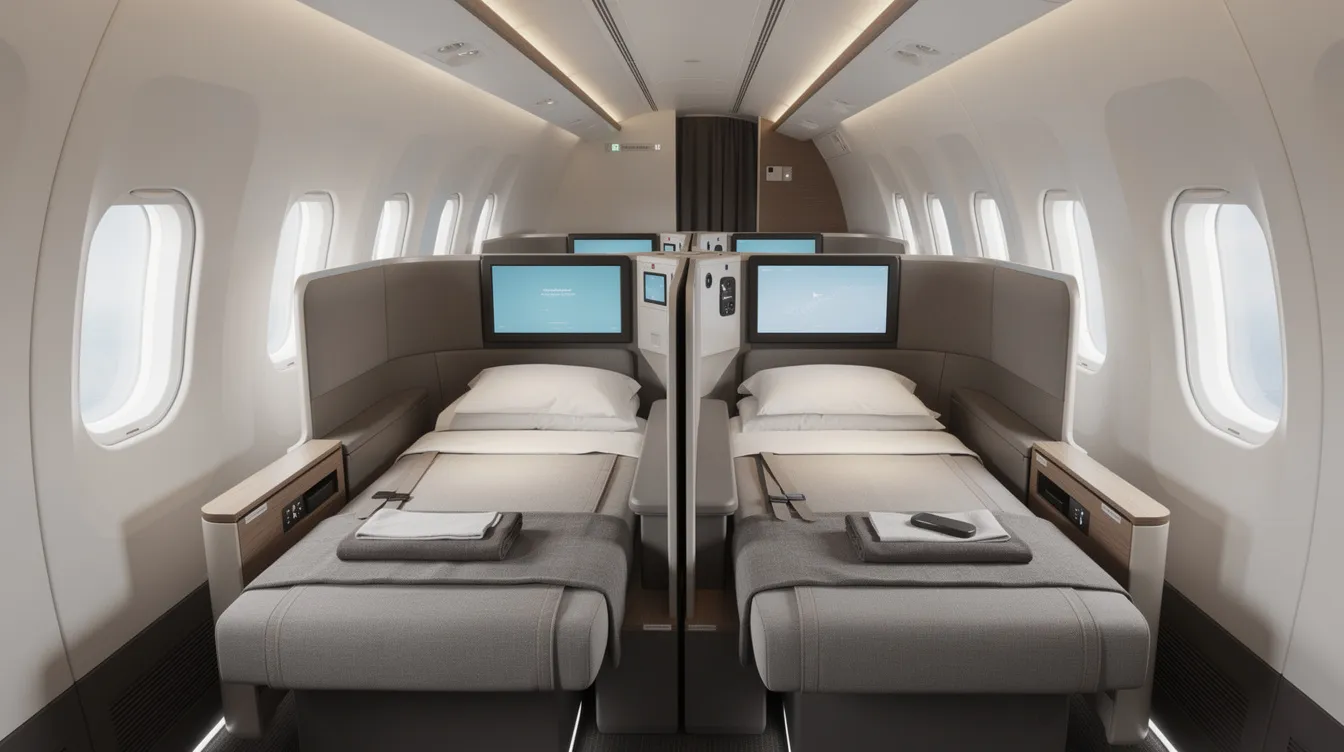
Airline suites are the highest tier of premium air travel, designed to mimic private hotel rooms in the sky. For executives and high‑net‑worth travelers seeking rest, privacy, and productivity at 40,000 feet, these ultra-premium class cabins represent commercial aviation's boldest answer to private jet travel. The question is whether that answer is enough.
Consider a New York–London journey. A first-class suite on a flagship carrier means roughly 11–13 hours door-to-door: transit to JFK, check-in and security, boarding, seven hours in the air, customs at Heathrow, and ground transport into the city. A private jet via a BlackJet Jet Card cuts that to under eight hours, departing from a quiet FBO, clearing customs privately, and landing closer to your final destination. The privacy gap is just as wide: one offers a room shared with a handful of strangers; the other, an entire aircraft reserved for you and your party.
This article decodes what suites on airplanes actually deliver in commercial first class and business class cabins, covering iconic products from Etihad Airways, Singapore Airlines, Air France, and Emirates, then contrasts them with the private experience that a BlackJet Jet Card provides.
How Airlines Rebranded Premium Seats as "Suites"
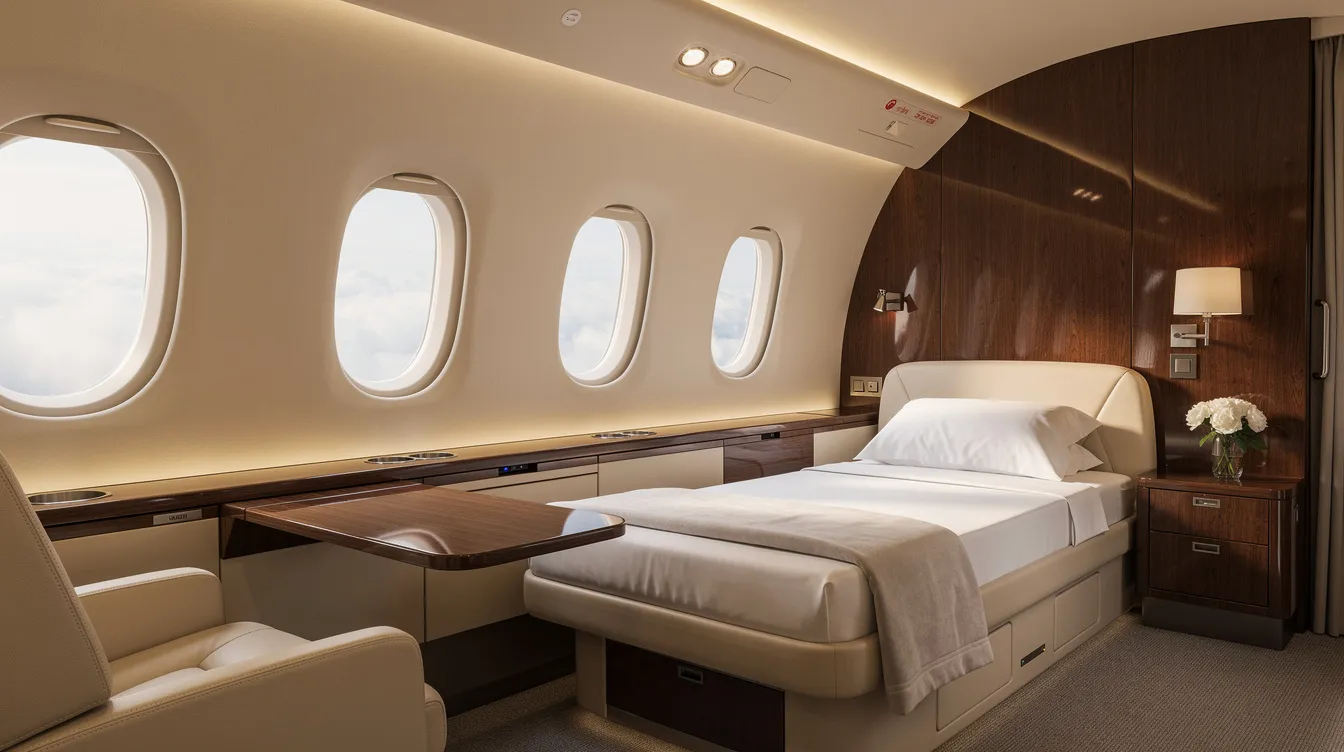
The word "suite" entered the airline vocabulary in the early 2000s as carriers sought language that elevated first-class seats beyond reclining chairs with extra legroom. Suites are found on select international carriers that compete fiercely for premium-fare travelers, and the branding shift was deliberate: it promised something closer to a room than a seat.
Emirates was among the first, around 2004, to label its first class product "suites," adding sliding doors, personal minibars, and massive entertainment screens to justify the term. Singapore Airlines followed in 2007 with its dedicated Suites Class on the Airbus A380, popularizing fully enclosed suites with separate beds and closing doors that made the cabin feel genuinely residential.
Today, several airlines stretch "suite" across both first class and business class seats:
First class suites: Emirates, Etihad Airways, Singapore Airlines, Air France La Première
Business class suites: Qatar Airways Qsuite, ANA The Room, Etihad Business Studio, Cathay Pacific Aria Suite
Much like hotels that apply "suite" to everything from a junior room to a presidential penthouse, airlines use the label to signal top-tier luxury-even when the product is simply an upgraded pod with a door.
Defining a True Airplane Suite: Space, Doors, and Layout
Airplane suites are ultra-premium cabin classes beyond traditional seating. A true suite transforms a single-class seat into a private room with dedicated zones for relaxing, dining, and sleeping. Here are the hard criteria that separate suites from standard business class seats, which are typically open or offer limited privacy:
Physical enclosure: Sliding doors or high walls that screen the passenger from foot traffic and aisle activity. Suites ensure passengers cannot see other travelers, creating genuine seclusion.
Space: Suites are larger than standard business class seats-often 30–50 square feet per passenger. Singapore Airlines' Suites offer 50 square feet of space; Etihad's The Residence spans approximately 125 square feet.
Bed: Suites provide fully lie-flat beds with premium pillows and a separate bed or convertible chaise, not just a reclined seat.
Storage and amenities: Suites include dedicated storage areas for personal items, personal wardrobes, and often a minibar.
Privacy features: Suites feature sliding doors or high walls for privacy, ranging from full floor-to-ceiling doors (Emirates) to floor-to-ceiling curtains (Air France).
Suites offer maximum privacy, space, and personalized service qualities that distinguish first-class suites (fewer seats, separate bed and seat, more space) from high-end business-class suites (denser layout, single multi-function seat). The gap between these tiers is significant, even when both use the word "suite."
Flagship First Class Suites: The Pinnacle of Commercial Luxury
These first-class products represent what commercial aviation can achieve at its absolute peak-and they still operate within airline schedules, shared terminals, and airport constraints.
Etihad Airways: The Residence and The Apartment on the Airbus A380
Etihad's The Residence is the most ambitious first-class suite ever built for a commercial aircraft. It is a three-room suite consisting of a separate living room, a separate bedroom with a double bed, and a private shower room spanning approximately 125 square feet. It functions as a micro private jet cabin within the A380, complete with a butler, ESPA toiletries, and an ensuite shower.
First-class suites include onboard shower spas on select airlines, and Etihad's A380 is among the most notable. Current routes serve Abu Dhabi to London Heathrow, Paris CDG, Singapore, and Toronto, with The Residence priced at $20,000+ one-way.
The Apartment, Etihad's nine-suite first class cabin, offers fully enclosed suites with a large armchair plus a separate sofa that converts into a bed, access to in-flight showers, and companion dining. Etihad's branding-"The Residence," "The Apartment"-sidesteps the generic "suite" label while delivering one of the most exclusive cabin experiences in the world.
On the ground, Abu Dhabi offers private check-in, dedicated lounges, and chauffeur service, impressive yet still fundamentally different from the discrete FBO access available in private aviation.
Emirates First Class Suites: 777 "Game Changer" vs A380
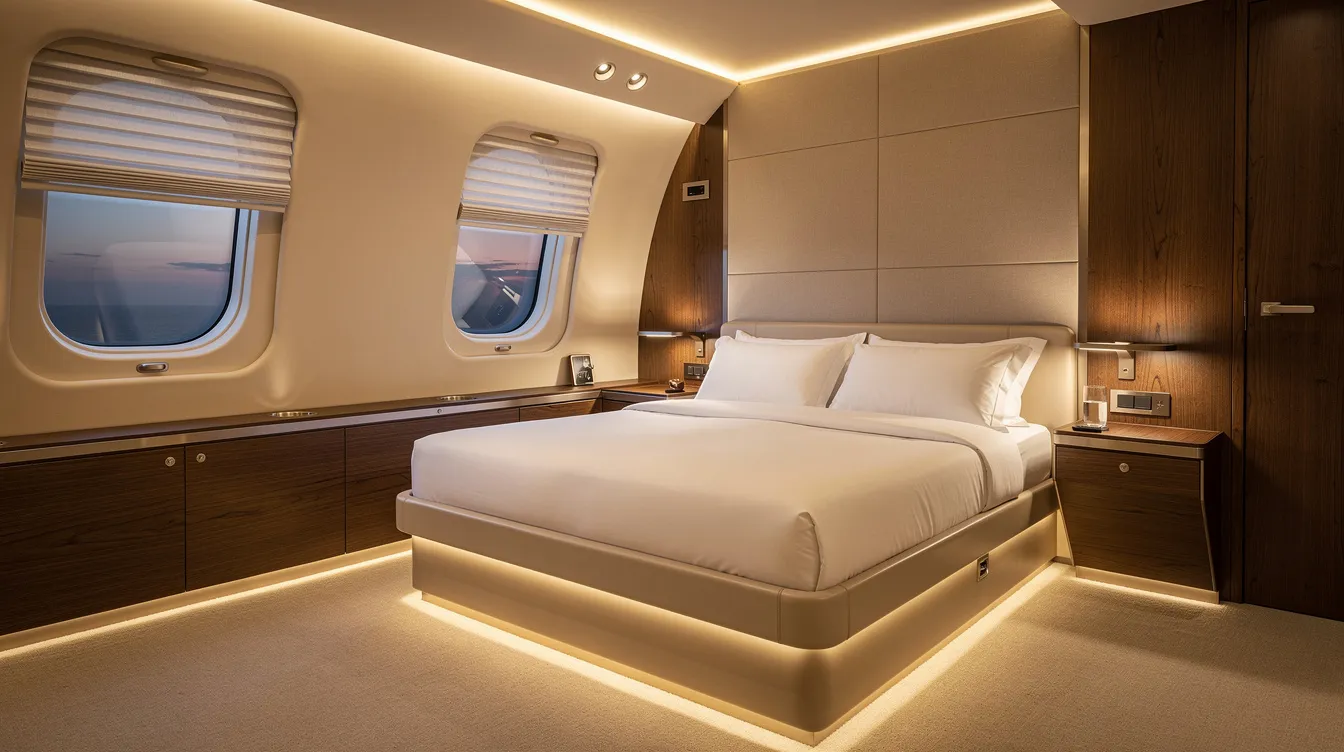
The game-changer first-class suite on select Boeing 777 300ER aircraft is exactly what the name implies. Emirates' Game Changer suites feature floor-to-ceiling privacy doors roughly 6.5 feet high, creating genuine private rooms in the sky. Each suite operates as a self-contained environment with customizable lighting, personal climate controls, and a zero-gravity seat mode inspired by NASA research.
Middle suites include virtual windows, real-time camera feeds displayed on screens that replicate the view outside, allowing passengers in windowless positions to still see the sky. The cabin holds just six suites in a 1-1-1 layout, deployed across only nine 777-300ERs. Key routes run from Dubai to European hubs like Geneva and Brussels, with occasional U.S. deployments, though aircraft substitutions make them a "catch it if you can" class product.
Emirates' A380 first class adds in-flight showers and the iconic onboard bar but uses slightly less radical suite hardware. On pricing, short-haul 777 Game Changer fares start from low four-figures one-way, while long-haul routes climb into the mid- to high-five-figure range round-trip. Emirates' Game Changer suites also feature floor-to-ceiling privacy walls that block all visual contact with neighboring passengers.
Singapore Airlines Suites on the Airbus A380
Singapore Airlines' current A380 Suites offer approximately 50 square feet of personal space per passenger, featuring a swiveling leather recliner and a separate full-size bed, a separate seat and sleeping surface, not a single convertible unit. Certain pairs of suites (1A/2A and 1F/2F on the upper deck) can be combined into a roughly 100-square-foot apartment with a double bed, making them ideal for two passengers traveling together.
Amenities include a 32-inch HD screen, premium headphones, Lalique skincare products, and the "Book the Cook" pre-order meal service. Singapore Airlines offers a Book the Cook meal selection service featuring dishes like lobster Thermidor. Routes from Singapore to London, Sydney, and select seasonal cities carry the A380 Suites, though U.S. nonstops rarely see this configuration.
Access is tightly controlled. With just six suites per aircraft, KrisFlyer Saver awards are extremely limited, and cash fares reflect the scarcity.
Air France La Première: French Elegance Without Doors
Air France La Première on the Boeing 777 300ER is a four-seat first class section that achieves privacy through floor-to-ceiling curtains rather than doors. Air France's La Première uses floor-to-ceiling curtains for privacy, creating an exclusive cabin that is open in character yet deeply secluded from the rest of the aircraft.
Each suite features an extra-wide seat plus a chaise longue converting into a bed spanning up to five windows, over two metres long. The hallmark is the soft product: Air France's menu includes dishes by Michelin-starred chefs (collaborators have included Glenn Viel and Daniel Boulud), complemented by onboard sommeliers and Paris Charles de Gaulle ground services, including chauffeur transfers and a dedicated La Première lounge.
Availability is restricted to a small sub-fleet of 777-300ERs on routes from Paris to New York, Los Angeles, São Paulo, and select Middle Eastern destinations. Pricing often reaches $10,000–$20,000+ round-trip, and Flying Blue mileage redemptions are reserved for top-tier elites-underlining air france la première's intentionally limited access.
Sophisticated Asian First Class Suites: ANA, JAL, and Cathay Pacific
All Nippon Airways (ANA) "The Suite" on refreshed Boeing 777 300ER aircraft features fully enclosed suites with sliding doors. ANA's The Suite features sliding doors approximately 5 feet high, paired with ANA's first-class suites featuring 42-inch entertainment screens, understated Japanese design, and routes including Tokyo Haneda–New York JFK and London Heathrow.
Japan Airlines' A350-1000 first class presents just six suites with sofa-like seats, ottomans for companion dining, and Japan Airlines' first class includes a 43-inch TV screen, one of the largest in commercial aviation. Japan Airlines features dine-on-demand service for meals, offering premium beverages including Salon champagne alongside refined Japanese and Western cuisine.
Cathay Pacific first class on the Boeing 777 takes an open, non-door approach: ultra-wide first class seats converting into long beds, luxurious bedding, and highly personalized attentive service, paired with The Pier First lounge in Hong Kong. These carriers emphasize soft product-quiet hospitality, meticulous food presentation, as much as hardware, making them favorites for transpacific business travelers seeking long-haul comfort.
While these rank among the world's finest first-class cabins, every passenger still shares an exclusive cabin with several other first-class passengers and operates within scheduled airline constraints.
Business Class Suites: When "Business Class Seats" Become Private Rooms
The line between business class and first class has blurred dramatically. Many airlines have eliminated first class cabins, redirecting investment into new business class suites with direct aisle access, sliding doors, and lie-flat seats that approach first class territory.
Today's leading business class suites include Qatar Airways Qsuite, ANA The Room, Etihad Business Studio, Air France business class suites, and Cathay Pacific's Aria Suite. Suites provide personalized lighting and entertainment systems across these products, and all offer lie-flat beds with more space than previous-generation class cabins.
The trade-off is density. Business class suites typically hold 30–60 seats per cabin versus 4–9 in first class, with one multi-purpose seat/bed per suite and less floor space. This is now the "new normal" for long-haul routes between major business hubs, with premium economy stepping up in quality below, and first-class products becoming rarer above.
Qatar Airways Qsuite: Business Class That Feels Like First
Qatar Airways Qsuite, launched in 2017, redefined expectations for business class. Fully closing doors, staggered layouts, and high walls create real separation from aisle foot traffic. In select center positions, two adjacent Qsuites convert into a double bed configuration, unprecedented in business class.
Popular U.S. routes from Doha include New York JFK, Chicago, Los Angeles, San Francisco, and Houston, with Qsuite frequently scheduled on Boeing 777 and Airbus A350 fleets. Award redemptions remain attractive: roughly 70,000 miles through the American Airlines AAdvantage program for U.S.–Doha in business class, or Avios through Qatar Privilege Club.
Qsuite often outshines legacy first class products in hardware, but passengers still travel with dozens of others and navigate standard airport processing-a distinction worth noting for travelers seeking a truly private experience.
ANA The Room and Other High‑Concept Business Suites
ANA's "The Room," introduced in 2019, is one of the widest new business class seats in the sky. Tall sliding doors, sofa-style seating, and the ability to sit side-facing for meetings or work make it feel like a first-class product at business-class lower fares. Deployed on roughly 10 of ANA's 13 Boeing 777-300ERs, it serves routes like Tokyo Haneda–New York, Seattle, and London.
Dining includes premium Japanese cuisine and extensive sake selections, allowing passengers to experience a refined mid-flight meal program that rivals some first-class products. Compare this with Etihad's Business Studio (staggered seats with high partitions on A380 and 787) and Air France's Collins Aerospace Elements suite (sliding doors, fully flat beds), and a pattern emerges: business class is absorbing what first class used to own.
Use-case: transpacific night flights where door-equipped business class can help a traveler fall asleep with near-first-class privacy at substantially lower cost.
From Business Studio to Aria Suite: Regional Highlights
Etihad Business Studio (A380/787): Staggered forward/rear-facing seats, refined Abu Dhabi lounge access with showers and à la carte dining.
New Etihad A350 business class suites: Reverse-herringbone layout with doors, updated aesthetics for premium routes to Europe and Asia on new aircraft.
Cathay Pacific Aria Suite: Forthcoming on refitted Boeing 777s, with sliding doors, improved storage, 4K entertainment, designed for long-haul flights between Hong Kong, North America, and Europe.
Air France business class cabins: 1-2-1 layouts with doors and French-inspired materials on newer 777 and new Airbus A350 aircraft.
A critical note: "business class" alone does not guarantee a suite-style seat. Always check specific aircraft configurations, as older planes on the same route may offer two rows of standard open pods instead of new cabins with doors.
The Ground and Inflight Experience: Lounges, Dining, and Service
The suite experience extends far beyond the seat. Airlines offer private check-in and security zones for first class, and passenger lounges offer dining, showers, and quiet areas designed to begin the journey before boarding.
Signature lounges:
Air France La Première lounge at Paris CDG
Emirates first class lounge and spa in Dubai
Qatar Al Mourjan Business Lounge in Doha
Cathay Pacific's The Pier First in Hong Kong
Onboard dining and service: First-class passengers often enjoy a one-to-one crew ratio, and first-class suites feature a very low passenger-to-crew ratio that enables deeply personalized attention. Flight attendants deliver suites' extensive personalized service throughout the flight, from pre-departure champagne to turndown service.
First class service includes gourmet meals designed by top chefs, and suite passengers experience on-demand dining with premium ingredients. Airline suites offer multi-course culinary experiences-Emirates serves wines from a $500-million wine cellar, while first-class meals often feature gourmet dishes by top chefs across carriers. Suites often have premium bedding and mattress pads, first-class cabins feature high-quality bedding for comfort, and suites offer luxurious amenity kits with high-end skincare products.
Yet even with chauffeur services and private escorts, first-class passengers still pass through crowded hubs at scheduled boarding times. Contrast this with private jet FBOs: discrete entrances, minimal dwell time, car-to-aircraft proximity, and the ability to depart when the passenger arrives, not when a schedule dictates.
Cost, Flexibility, and Availability: Suites vs Private Jet Access
First class tickets can exceed $10,000 for long-haul flights, with top products like Etihad's Residence and Air France La Première reaching $20,000+ round-trip. The question is what that spend actually buys compared with private jet access, whether through a bespoke program like Flexjet's jet card offering or BlackJet's own solutions.
Seat scarcity is real:
Air France La Première: 4 seats per eligible 777
Singapore Airlines A380 Suites: 6 seats per aircraft
Emirates Game Changer: 6 suites across only 9 aircraft globally
Holidays and business travel peaks can wipe out availability months in advance. Aircraft swaps can downgrade your expected first-class suite to a regular business-class seat with no recourse, a risk that leads some travelers to evaluate alternatives such as NetJets jet card programs.
BlackJet Jet Card economics: BlackJet's model is straightforward: prepaid blocks of flight hours (25-hour or 50-hour cards) with fixed hourly jet card pricing across aircraft categories. No fare searches, no award space lotteries, no schedule rigidity.
Sample scenario: A New York–Paris business traveler flying 8–10 times per year might spend $80,000–$150,000 annually on La Première or business class suites, including last-minute premiums, change fees, and hotel layovers from rigid schedules. A 100-hour private jet card or super-midsize Jet Card with BlackJet, covering the same missions with door-to-door time savings of 3–5 hours per trip, can deliver comparable or better value per productive hour gained, especially when traveling with colleagues and splitting the cost across two passengers or more.
Why Private Jet Suites Are Different: The BlackJet Perspective
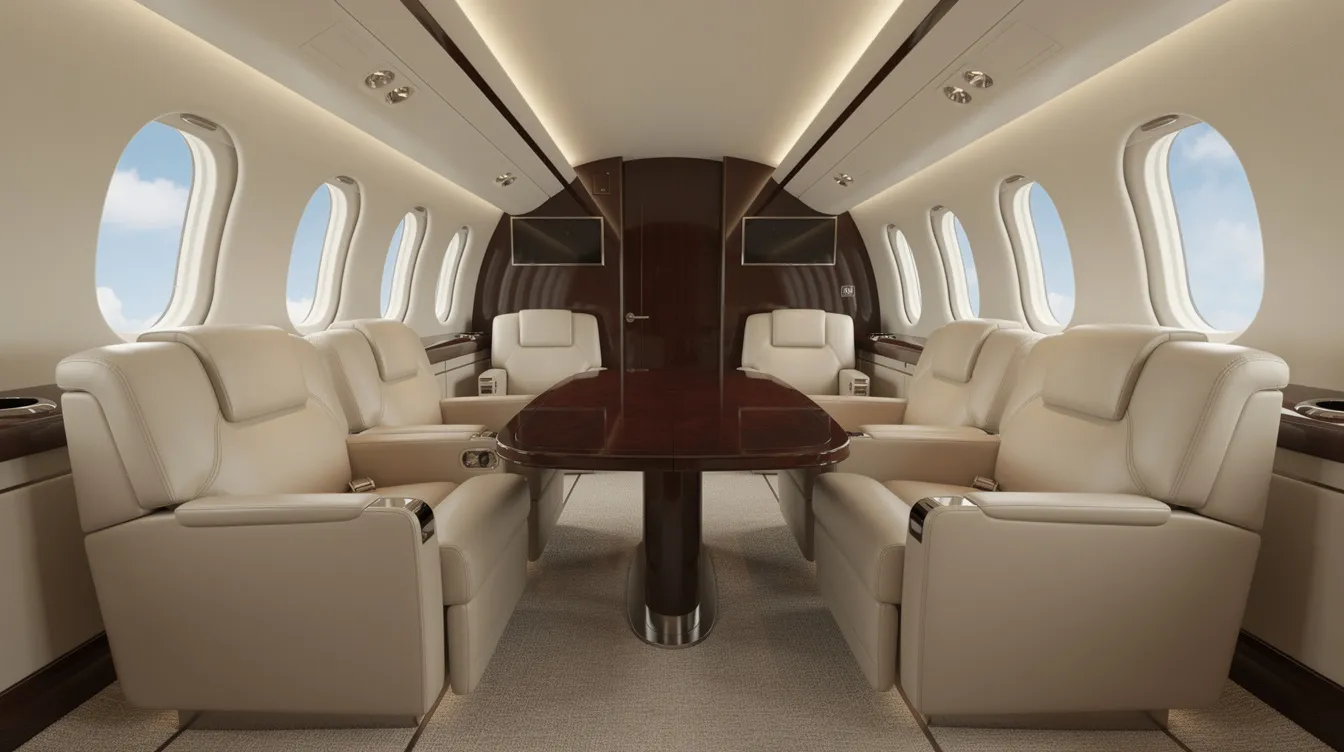
Commercial airline suites simulate a room. A private jet provides one for the entire aircraft. Club-four seating converts to meeting layouts, divans become beds, and in large cabin jets, separate lounge zones and enclosed lavatories create a genuinely private environment. No strangers occupy adjacent suites. No shared air system with hundreds of class passengers. The cabin configuration adapts to each mission, making it essential to understand private jet size categories when aligning aircraft choice with the trip profile.
Safety, Certification, and Control Over Your Cabin
BlackJet partners exclusively with operators meeting stringent safety standards-ARG/US or Wyvern-equivalent certifications-and requires experienced two-pilot crews across all jet categories. Every operator undergoes ongoing audits, not just initial checks.
In commercial first class suites, passengers share the cabin with dozens or hundreds of others, follow airline-wide policies, and have no control over who sits nearby. With BlackJet, clients select the aircraft category (light, midsize, super-mid, large cabin) to match mission length, passenger count, and desired amenities, with large-group solutions such as the best private jet for 15 passengers available when needed. For families and senior executives, controlling who is onboard, whether for confidential board discussions or simply peace of mind, can be more valuable than any airline suite's hardware.
The ultimate suite on an airplane is effectively an entire jet cabin reserved for one client, which is what BlackJet provides as standard, though ultra-frequent travelers may also explore unlimited private jet membership models when comparing access options.
Sustainable Luxury: Carbon‑Neutral Private Flights vs Commercial Premium Cabins
BlackJet ensures every journey is carbon neutral at no extra cost. Each mission's emissions are calculated and offset via verified carbon projects, including reforestation and renewable energy installations, which is especially relevant for travelers comparing the most economical private jet options with premium commercial cabins.
Premium cabins on commercial airlines, including first class and business class suites, carry a higher per-passenger footprint due to more space allocation, even on newer aircraft like A350s or 787s. BlackJet balances demand for high-comfort travel with responsibility by encouraging optimal aircraft selection-right-sized jets rather than overspec aircraft-and providing automatic carbon-neutral coverage, while value-focused flyers can apply similar thinking using strategies to fly private more affordably.
For many clients, the choice isn't simply "suite vs private jet" but "how to fly premium most responsibly." BlackJet's carbon-neutral guarantee addresses that concern directly.
When to Choose Commercial Suites vs BlackJet
Commercial suites make sense when:
Traveling solo for leisure to destinations well-served by flagship carriers (Paris, London, Tokyo, Sydney)
Schedule rigidity is acceptable, and a first-class ticket is booked well in advance or redeemed with miles
The ground experience-iconic lounges, onboard showers-is part of the trip's appeal
BlackJet delivers superior ROI when:
Multi-city business trips require same-day connections, especially for larger delegations who may benefit from 30-passenger private jet solutions
Last-minute meetings demand flexible departure times
Privacy is non-negotiable in investor discussions, legal strategy sessions, or family travel
The destination is best reached via secondary airports with limited commercial service, or you are evaluating buying a single seat on a private jet instead of chartering the whole aircraft.
Door-to-door time savings of 3–5 hours per trip compound across 8–12 annual missions, and can be even more dramatic when using 20-passenger private jets for group travel.
Many BlackJet clients still enjoy airline suites occasionally-a Singapore Airlines A380 Suites experience or an Air France La Première flight can be a memorable event, much like sampling one of the top private jets in the world for a special charter. But they reserve Jet Card hours for missions where time, privacy, and control deliver the highest return on travel spend, often after comparing overall jet card program costs with premium commercial fares.
FAQs About Airplane Suites and Private Jet Alternatives
What's the difference between first class suites and business class suites? First class suites offer more space (often 30–50+ sq ft), separate sleeping and seating areas, smaller cabins (4–9 seats), and richer ground experiences. Business class suites use a single multi-function seat/bed in larger cabins (30–60 seats), with less floor space but increasingly competitive privacy features like fully closing doors.
How do Air France La Première and other exclusive first-class products compare to private jets? La Première and similar products deliver outstanding in-seat luxury but remain scheduled, shared experiences. A private jet offers complete schedule control, cabin exclusivity, and faster door-to-door times-advantages that compound for frequent travelers.
Are business class seats with doors really as private as they look? Doors help significantly, but business class suites still share open cabin space with 30–60 other passengers. Sound, ambient light, and galley activity are present. True isolation requires a private cabin.
Which airlines currently offer true first-class suites on the Airbus A380? As of 2026, Emirates, Etihad Airways, Singapore Airlines, and Qantas operate A380 first-class cabins. Each varies in hardware: Etihad offers The Residence and The Apartment; Emirates provides suites with doors and showers; Singapore Airlines features separate bed-and-chair suites.
How does a BlackJet Jet Card compare cost-wise to flying first class several times a year? A traveler spending $15,000–$25,000 per round-trip on first class suites across 6–10 annual trips may find that a BlackJet Jet Card, with transparent hourly pricing and no fare volatility, delivers comparable or better value, particularly when factoring in time savings, flexibility, and the ability to share costs across multiple passengers, as outlined in our guide to the best jet cards for frequent flyers.
Is private jet travel always less sustainable than commercial first class? Not necessarily. While private jets consume more fuel per passenger than a full economy cabin, BlackJet offsets 100% of emissions through verified carbon projects at no additional cost. Commercial first class suites, with their large per-seat footprint, are also significantly less efficient than economy, narrowing the gap more than most travelers realize, especially when compared with innovations like private jet rideshare options that increase load factors.
Conclusion: Beyond Suites – Redefining Premium Travel with BlackJet
First class and business class suites from Etihad, Emirates, Singapore Airlines, Air France, Cathay Pacific, and their peers represent a genuine golden age of commercial luxury. The hardware is remarkable. The soft product, gourmet meals, premium bedding, and personalized service are world-class. For travelers seeking the finest scheduled flight experience, these products deliver.
But they remain shared, scheduled experiences. Aircraft swaps, terminal congestion, rigid timetables, and the simple reality of traveling alongside strangers impose limits that no amount of suite engineering can eliminate. For travelers who measure value in time saved, privacy guaranteed, and complete control over their journey, a private jet via BlackJet Jet Cards is often the more strategic upgrade, even beyond the finest class suites in commercial aviation, particularly once you've compared offerings from leading private jet companies across the market.
BlackJet's pillars-rigorous safety certification, carbon-neutral flights, 24/7 digital booking with real-time support, and the ability to choose the exact aircraft category for each mission through products like the BlackJet 25+ Hour Jet Card-make that upgrade seamless.
Explore premium jet access with BlackJet and discover how Jet Cards can complement or replace commercial first class travel for the journeys that matter most.


 Sign up with google
 Sign up with Apple