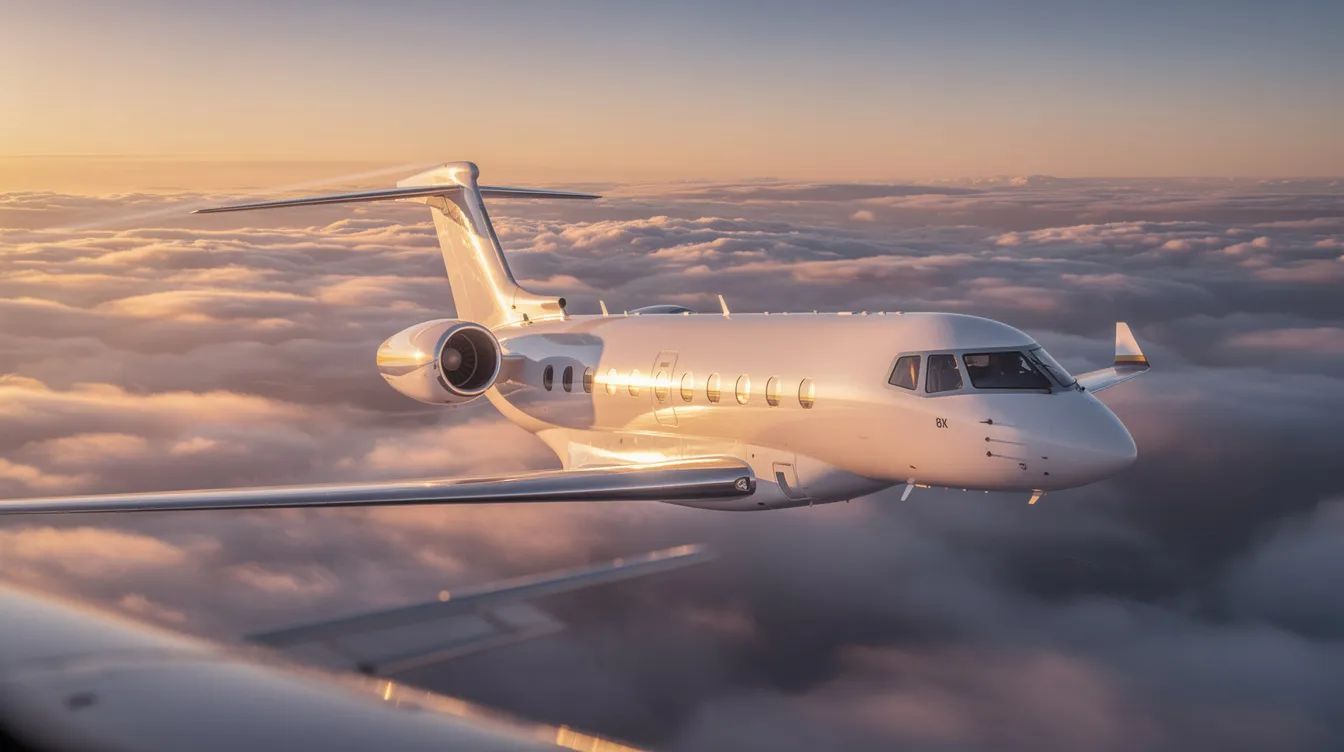
For travelers who treat time as their most valuable asset, private aviation is not merely a luxury—it is a strategic advantage. This guide is for executives, frequent flyers, and anyone considering private jet travel who prioritizes safety above all else. Understanding which private jets are safest—and why—can help travelers make informed, confident decisions. But that advantage only holds if every flight meets the highest possible safety threshold. Here is where the industry's top aircraft stand, what makes them safe, and how to access them intelligently.
Immediate Answer: What Is the Safest Private Jet in the World?
The Dassault Falcon 8X is widely regarded as the safest private jet in the world today. Its triple-engine redundancy, advanced Digital Flight Control System (A Digital Flight Control System replaces mechanical linkages with electronic signals, providing enhanced safety through flight envelope protection and stability optimization. [1, 2]), and FalconEye Combined Vision System place it in a category of its own. As of 2024, the Falcon 8X has recorded only one non-fatal incident and zero hull loss accidents—an outstanding safety record for any private aircraft in any class.
Other contenders among the safest private jets include:
Each brings innovative safety features to different cabin classes, but the Falcon 8X remains the benchmark.
Modern private jets, when operated by reputable private jet operators under strict safety standards, deliver aviation safety comparable to—and in many cases surpassing—that of commercial airlines on a per-flight basis. Business jets had a fatal accident rate of approximately 0.04 per 100 aircraft in 2024, reinforcing that private jets are exceptionally safe due to rigorous regulations and advanced technology.
At BlackJet, clients do not gamble on a single aircraft. Through our Jet Card programs, members access a curated pool of top-rated private jet models—including the Falcon 8X where available—all vetted to the highest third-party safety standards.
Comparison Table: Key Safety Features of Top Private Jets
Aircraft Model | Engine Configuration | Safety Highlights | Notable Technologies | Safety Record (2024) |
|---|
Dassault Falcon 8X | Tri-engine | Triple-engine redundancy, Digital Flight Control System | FalconEye Combined Vision, Fly-by-Wire, Envelope Protection | 1 non-fatal incident, 0 hull loss |
Embraer Phenom 300E | Twin-engine | Runway Overrun Awareness and Alerting System (ROAAS) | Prodigy Touch Avionics, Synthetic Vision | Strong safety record |
Cessna Citation Longitude | Twin-engine | Garmin G5000 avionics, Synthetic Vision | Autothrottle, Touchscreen Flight Deck | Perfect safety record |
Embraer Legacy 500 | Twin-engine | Fly-by-wire control, Flight envelope protection | Advanced Avionics, Synthetic Vision | Zero hull loss accidents |
Bombardier Global 7500 | Twin-engine | Advanced wing design, Predictive maintenance | Head-Up Display, Enhanced Vision System | Strong safety record |
Gulfstream G650/G650ER | Twin-engine | Enhanced Flight Vision System, Steep approach certified | Symmetry Flight Deck, Predictive Landing Performance | Among the safest business jets |
Cirrus Vision Jet | Single-engine | Whole-airframe parachute system (CAPS) | Cirrus Airframe Parachute System | Innovative safety features |
Why Safety in Private Aviation Matters More Than Ever
Private aviation gives travelers control over schedule, route, and exposure—advantages that compound for executives and high-net-worth individuals flying 30 to 50 times per year. But those advantages only deliver value when flight safety is uncompromising.
Recent data confirms the trajectory is positive:
Business jet fatalities dropped nearly 35% worldwide from 2023 to 2024, with only 21 fatalities recorded across eight fatal accidents.
2024 will mark the lowest fatal accident rate since 2009 in general aviation, and turbine engines typically have lower failure rates than piston engines, further reducing risk in the business jet segment.
For frequent flyers who fly private, marginal improvements in advanced avionics, maintenance practices, and pilot training compound across dozens of annual trips. The safest private jets combine advanced avionics with automated protections to reduce errors—and the private aviation industry continues investing heavily in these systems.
Safety is not solely about aircraft features. It extends to operator culture, regulatory compliance, crew qualifications, and how you access jets in the world—whether through on-demand charter, Jet Card membership, or ownership. BlackJet prioritizes safety, sustainability, and technology as foundational pillars, not optional add-ons.
Dassault Falcon 8X: The Safest Private Jet in the World
The Dassault Falcon 8X is Dassault's flagship ultra-long-range tri-jet, entering service in 2016 with a range of approximately 6,450 nautical miles. It draws directly from Dassault's military and fighter-jet heritage—flight control logic, structural design margins, and redundant systems all trace back to combat aircraft engineering.
As of 2024, the Falcon 8X maintains a remarkable safety record: only one non-fatal incident, zero hull loss accidents. No other ultra-long-range business jet matches this combination of advanced technology and clean safety records.
Triple-Engine Redundancy and Performance
The Falcon 8X is powered by three Pratt & Whitney Canada PW307D turbofan engines—a configuration that provides critical redundancy. Modern jets can feature multi-engine redundancy for enhanced safety, and the tri-jet layout means that if one engine fails during takeoff or cruise, two remain to allow continued safe flight and landing. This configuration also shortens required takeoff distances and enhances performance from hot-and-high runways, opening more diversion options than twin-engine alternatives. Among private jet models competing for global missions, this design philosophy sets the 8X apart.
Digital Flight Control System and Fly-By-Wire
The Dassault Falcon 8X features a Digital Flight Control System for enhanced safety (A Digital Flight Control System replaces mechanical linkages with electronic signals, providing enhanced safety through flight envelope protection and stability optimization. [1, 2]), replacing traditional mechanical linkages with electronic signals in a full fly-by-wire system. Fly-by-Wire Technology (Fly-by-Wire Technology prevents pilots from exceeding aircraft structural limitations. [2]) prevents pilots from exceeding aircraft structural limitations. This architecture includes flight envelope protection, automatically preventing pilots from exceeding critical limits—stall, overspeed, overbank—which directly addresses loss-of-control scenarios, the leading cause of fatal accidents.
The DFCS continuously optimizes flight control surfaces for stability and efficiency, reducing pilot workload during all phases of flight. Automatic Emergency Descent Mode (Automatic Emergency Descent Mode takes control if cabin pressure is lost. [3]) takes control if cabin pressure is lost. Dassault's EASy IV flight deck centers on an intuitive, pilot-friendly design engineered to minimize human error—a factor that contributes to the majority of incidents across both private and commercial aviation.
FalconEye Combined Vision and Predictive Safety Systems
FalconEye merges an enhanced vision system (Enhanced Flight Vision Systems allow pilots to see better in poor visibility conditions. [4]) (infrared camera) with a synthetic vision system (Synthetic Vision Systems provide a 3D digital rendering of terrain and obstacles. [5]) (database-generated terrain and obstacles) projected directly on the head-up display. Enhanced Flight Vision Systems allow pilots to see better in poor visibility conditions, while Synthetic Vision Systems provide a 3D digital rendering of terrain and obstacles—together improving pilot situational awareness during the most critical phases of flight.
The avionics suite integrates predictive alerting including terrain awareness, runway performance cues, wind shear warnings, and Collision Avoidance Systems (Collision Avoidance Systems detect nearby aircraft to avoid midair incidents. [6]) that detect nearby aircraft to avoid midair incidents. Advanced Weather Radar (Advanced Weather Radar helps pilots navigate around severe weather. [7]) helps pilots navigate around severe weather. This combination of systems makes the 8X one of the least turbulent private jets in perceived ride quality and among the safest in approach-and-landing scenarios.
Cabin Safety, Structure, and Passenger Protection
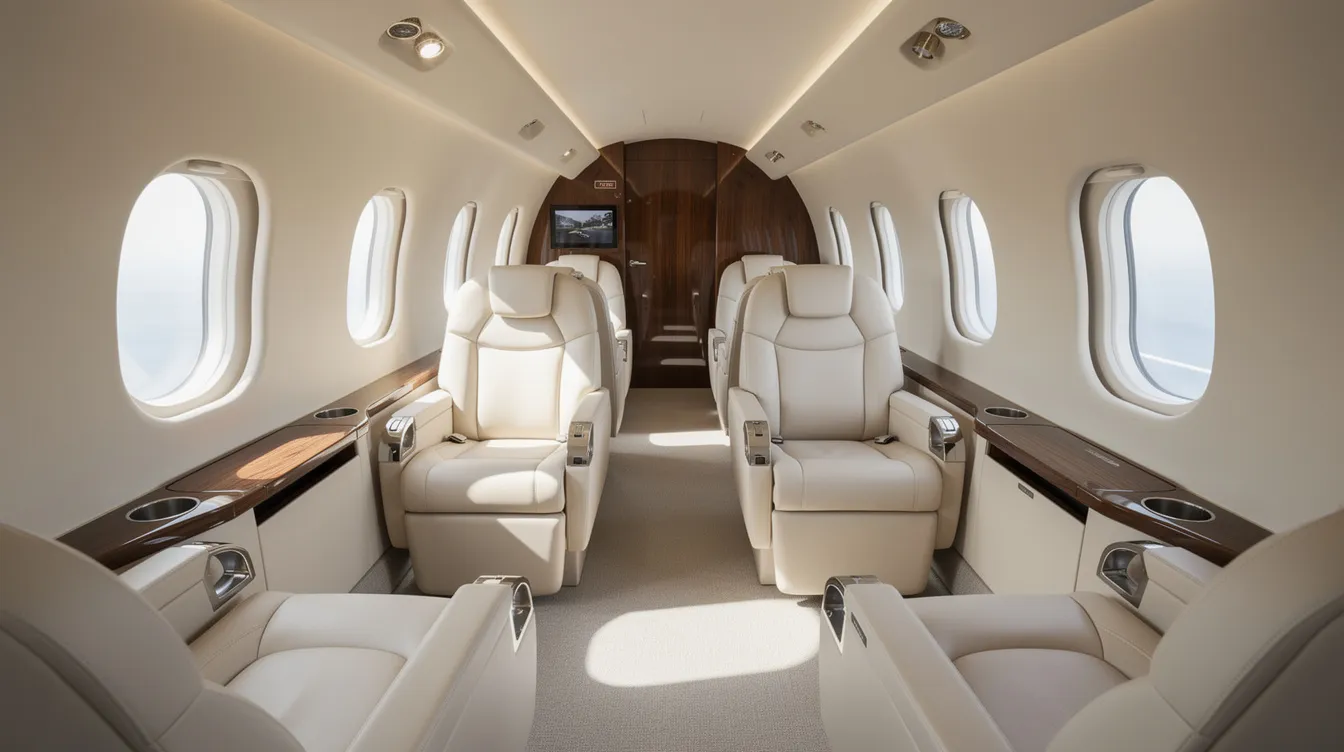
The Falcon 8X maintains a cabin altitude of approximately 3,900 feet at FL410—significantly lower than many competitors—reducing fatigue, hypoxia risk, and sleep disturbance on ultra-long flights. Composite materials in aircraft improve resilience to stress and turbulence, and redundant systems across electrical and hydraulic architectures allow multiple failures without compromising passenger safety.
Cabin layout flexibility, wide aisles, and secure stowage reduce injury risk during turbulence or sudden maneuvers. Consider a BlackJet member flying Paris to São Paulo overnight: they arrive rested and alert, benefiting from quiet cabin noise levels (2 dB lower than the predecessor 7X), continuously refreshed cabin air, and the peace of mind that comes from flying on one of the safest private jets available.
Other Contenders: Safest Private Jets and Their Standout Safety Features
While the Falcon 8X often takes the top position, several other aircraft rank among the safest private jets due to impeccable safety records and the best safety features. BlackJet's vetted network incorporates many of these types, giving members access to modern safety features across multiple cabin classes.
Embraer Phenom 300E and Cirrus Vision Jet: Safety in Smaller Cabins
The Embraer Phenom 300E has been the world's best-selling light jet for over a decade, with advanced Prodigy Touch avionics based on Garmin G3000 and a strong safety record. The Embraer Phenom 300E has a runway overrun awareness and alerting system (ROAAS)—the industry's first system to proactively warn pilots if landing conditions might exceed available runway length.
The Cirrus Vision Jet takes a different approach entirely. It features the Cirrus Airframe Parachute System (CAPS)—whole-airframe parachutes provide a safety measure for small personal jets, enabling the entire aircraft to descend under canopy in extreme emergencies. While the Cirrus Vision Jet serves a different market segment, it remains a reference point for innovative safety features in personal aviation.
Embraer Legacy 500 and Praetor 600: Fly-By-Wire Midsize Safety Leaders
The Embraer Legacy 500 has zero hull loss accidents as of May 2024, and its successor, the Praetor 600, continues that trajectory. Both feature full fly-by-wire control uncommon in their size class, providing flight envelope protection and turbulence-smoothing control laws. Advanced avionics systems with synthetic vision and auto-throttle significantly reduce pilot workload and human error, making them top selections for safety-conscious corporate travelers. A recent airworthiness directive regarding pitch trim actuators underscores that even aircraft with a proven track record require constant vigilance and responsive maintenance—a principle BlackJet enforces across its operator network.
Gulfstream G500/G600 and G650/G650ER: Symmetry Flight Deck and Vision Systems
The Gulfstream G500 and G600 underwent rigorous testing—thousands of flight hours before certification—resulting in high safety ratings from their first year of service. The Symmetry Flight Deck features touchscreen controllers and active control sidesticks designed to improve crew coordination and pilot awareness.
The Gulfstream G650 and G650ER are among the safest business jets today. The Gulfstream G650 features an Enhanced Flight Vision System for improved navigation, and both models hold certification for steep approaches at airports like London City. These top private jets combine rigorous safety testing with conservative operating margins, unlike some models, such as certain Airbus corporate jet variants that may lack equivalent vision system integration in their base configurations.
Bombardier Global 7500: Ultra-Long-Range With Advanced Flight Controls
The Bombardier Global 7500 has advanced safety features and a strong safety record since entering service in 2018, offering approximately 7,700 nm of range. The Bombardier Global 7500 includes a Head-Up Display for pilot awareness alongside integrated enhanced vision and synthetic vision systems. Its cutting-edge wing design, optimized for turbulence reduction, and predictive maintenance capabilities together contribute to smooth rides and reduced risk of in-flight anomalies—positioning it among the paramount business jets in the ultra-long-range segment. Even turbulent private jet scenarios are mitigated by its advanced flight controls and wing optimization.
Cessna Citation Longitude and Citation Latitude: Clean Safety Records and Garmin Avionics
The Cessna Citation Longitude has a perfect safety record with no reported incidents in major databases as of 2024. Its Garmin G5000 avionics suite provides synthetic vision, intuitive touchscreens, and optional autothrottle—all reducing pilot workload during high-workload phases. Advanced avionics enhance navigation and pilot awareness in modern aircraft like these. The Citation Latitude adds diagnostic systems like LinxUs and CDMS for real-time fault monitoring. Both models demonstrate that straightforward design paired with advanced avionics systems can deliver an outstanding safety record for midsize missions.
Private Jet Safety vs Commercial Airline Safety: How Do They Compare?

Both private jets and commercial airlines operate under stringent Federal Aviation Administration and EASA rules. When reputable operators and modern aircraft are used, private jet safety is comparable to major commercial airlines—and in specific scenarios, superior. Private jets often fly above typical airline altitudes (up to FL510), avoiding congestion that affects larger commercial aircraft. Passengers who fly private also control who boards, reducing risks from illness exposure common in crowded commercial flight environments.
A BlackJet member flying New York to Los Angeles on a carbon-neutral charter flight avoids hub connections, delays, and security queues—arriving faster, fresher, and without the compromises of even first-class commercial travel.
Standards, Certifications, and Oversight
Commercial airlines operate under Part 121 regulations; on-demand private charter generally falls under Part 135, with different duty limits and operating requirements. Third-party audits by organizations like ARGUS ensure compliance with FAA standards, while operators audited by ARGUS and WYVERN exceed FAA requirements across training, maintenance, and operational protocols. Independent certifications demonstrate a commitment to safety in aviation, and Safety Management Systems ensure comprehensive safety practices beyond minimum safety standards.
The highest ARGUS and WYVERN ratings indicate exceptional safety records. Private jet operators must meet FAA safety standards as a baseline, but certifications and consistent external audits are better predictors of real-world overall flight safety than any single aircraft model alone. BlackJet only partners with operators holding top ratings—ensuring members access the safest private aircraft and crews in the industry.
Beyond the Aircraft: What Actually Makes a Private Jet Flight Safe?
The safest private jet in the world still requires the right operator, experienced pilots, and disciplined maintenance practices. Accidents predominantly stem from human factors and operational lapses rather than design failures. For safety-focused travelers, evaluating both the aircraft and the ecosystem around it is essential before they fly private.
Advanced Aircraft Features That Improve Safety
Key technologies that enhance safety outcomes include fly-by-wire control, flight envelope protection, enhanced flight vision system and synthetic vision system integration, head-up display projections, auto-throttle, and autobrake systems. The Phenom 300E's ROAAS, Global 7500's advanced wing and vision suite, Falcon 8X's FalconEye, and Cirrus Vision Jet's CAPS each represent different approaches to reducing risk and improving overall flight safety. Charter companies and private jet companies should specify which avionics packages are installed—not just the base model name—when presenting options, as aircraft features vary significantly within the same type depending on configuration. These systems collectively help pilots land safely in conditions that would otherwise require diversions.
Maintenance, Inspections, and Predictive Monitoring
Private jets undergo mandatory 100-hour inspections, and leading operators exceed these baselines substantially. Private jet operators follow manufacturer-prescribed maintenance schedules using OEM-certified replacement parts. Real-time monitoring allows for predictive maintenance in aircraft, and maintenance teams use real-time health monitoring for safety, detecting anomalies long before they become threats. Operators audited by ARGUS exceed FAA safety standards, and BlackJet's partner operators maintain detailed logbooks subject to regular third-party review. Discerning travelers should ask about average fleet age, maintenance intervals, and whether the operator uses predictive diagnostics—hallmarks of strict safety standards in the private aviation industry.
Pilot Qualifications, Training, and Crew Culture
Private jet pilots undergo extensive model-specific training, and the Advanced Qualification Program training enhances pilot preparedness beyond standard requirements. Pilots receive initial and recurrent simulator training sessions—typically every six to twelve months—covering emergency and weather-specific drills. Training includes work on advanced avionics like head-up displays, reducing pilot workload through familiarity and procedural confidence.
Two pilots are encouraged on all private jet flights, and BlackJet requires two pilots with ATP ratings on every jet operation. Crew Resource Management and human-factors training are critical: IATA data consistently identifies situational awareness lapses and SOP non-compliance among leading contributing factors in accidents—issues that affect both airline pilots and private crews alike. Experienced pilots with substantial flight hours in type, combined with company policies on fatigue and duty time, form the backbone of flight safety for every charter flight.
How BlackJet Delivers Access to the Safest Private Jets
BlackJet is a private aviation company offering Jet Card programs that combine safety, technology, and sustainability for frequent flyers. Instead of owning a single private aircraft, members access a curated fleet across cabin classes—light, midsize, super-midsize, large-cabin, ultra-long-range—including many of the safest private jet types profiled here. Every mission is matched to aircraft and crew based on route, runway, passenger count, and safety requirements. All flights are carbon-neutral by default through verified offset programs.
Jet Cards vs On-Demand Charter and Ownership: Safety and Control
BlackJet's Jet Card model locks in access to vetted operators with consistent safety standards, whereas ad-hoc charter bookings from unvetted charter companies may vary widely in quality. Ownership gives maximum control over a single aircraft but places maintenance oversight, crew management, and safety investment squarely on the owner. Jet Cards offer a middle path: safety, scheduling flexibility, and predictable pricing managed by a team with established protocols and data-driven vendor selection.
Consider a CEO flying 30–40 times per year on a 50-hour Jet Card—always accessing ARGUS/WYVERN-rated operators and modern jets like the Falcon 8X, Praetor 600, or Global 7500 when mission-appropriate. That level of consistency is difficult to replicate through ad-hoc booking.
Technology, Booking Experience, and Real-Time Flight Support
BlackJet's 24/7 digital booking platform allows members to request, confirm, and manage flights with transparent aircraft type and safety information visible before committing. Real-time flight support teams monitor weather, NOTAMs, and operational factors, proactively suggesting adjustments to avoid storms or congested airspace—reducing the "get-there-itis" pressure that compromises decision-making in both private and commercial aviation. For each trip, members receive clear briefings on aircraft features, safety certifications, and crew credentials, reinforcing trust at every stage.
FAQs: Safest Private Jets, Jet Cards, and Choosing a Safe Operator
Is the Dassault Falcon 8X really the safest private jet in the world?
Yes—its tri-engine redundancy, fly-by-wire DFCS, FalconEye vision system, and zero hull loss record make it the benchmark. However, safety also depends on operator quality, crew training, and maintenance, not the airframe alone.
Which other private jets are considered among the safest?
The Embraer Phenom 300E, Legacy 500/Praetor 600, Cessna Citation Longitude, Bombardier Global 7500, Gulfstream G650/G500/G600, and Cirrus Vision Jet all have strong safety records and advanced avionics.
Are private jets safer than commercial airlines?
With reputable operators and modern aircraft, private jet safety is comparable to that of major commercial airlines. Differences in oversight and operating profiles mean the comparison depends on operator standards and aircraft condition.
How do I know if my charter flight is safe?
Look for ARGUS Platinum or WYVERN Wingman ratings, ask about crew experience and flight hours, verify aircraft age, and confirm maintenance programs meet or exceed manufacturer specifications.
What role do advanced safety features like HUD and autoland play?
They improve pilot awareness in low visibility, reduce workload during critical phases, and provide automated protections—collectively reducing pilot workload and enhancing overall safety.
How does BlackJet ensure every flight is safe?
Through operator vetting at the highest audit levels, the Jet Card structure ensures consistency, real-time monitoring, and ongoing third-party audits of every partner operator.
Can I request specific aircraft models like the Falcon 8X or Global 7500 with BlackJet?
Members can express preferences, and BlackJet matches availability based on route, mission profile, and safety requirements. Specific models are subject to availability.
Is flying private with BlackJet carbon-neutral?
Yes. All flights include verified carbon offsets at no additional cost, with Sustainable Aviation Fuel used where available.
Conclusion: Flying on the Safest Private Jets with BlackJet
The Dassault Falcon 8X stands at the pinnacle of private jet safety—but true protection comes from aligning the right aircraft with audited operators, top-tier crews, and disciplined maintenance. BlackJet gives members structured access to many of the safest business jets globally, from the Falcon 8X and Global 7500 to the Phenom 300E and Praetor 600, under a consistent safety framework with high safety ratings across the board.
Safety, sustainability through carbon-neutral flights, and technology-driven booking are built into every Jet Card—making rigorous protection effortless for the traveler.
Elevate your travel—on your terms. Explore BlackJet's Jet Card programs and discover how secure, carbon-neutral private aviation becomes a strategic asset for both your business and personal travel.


 Sign up with google
 Sign up with Apple