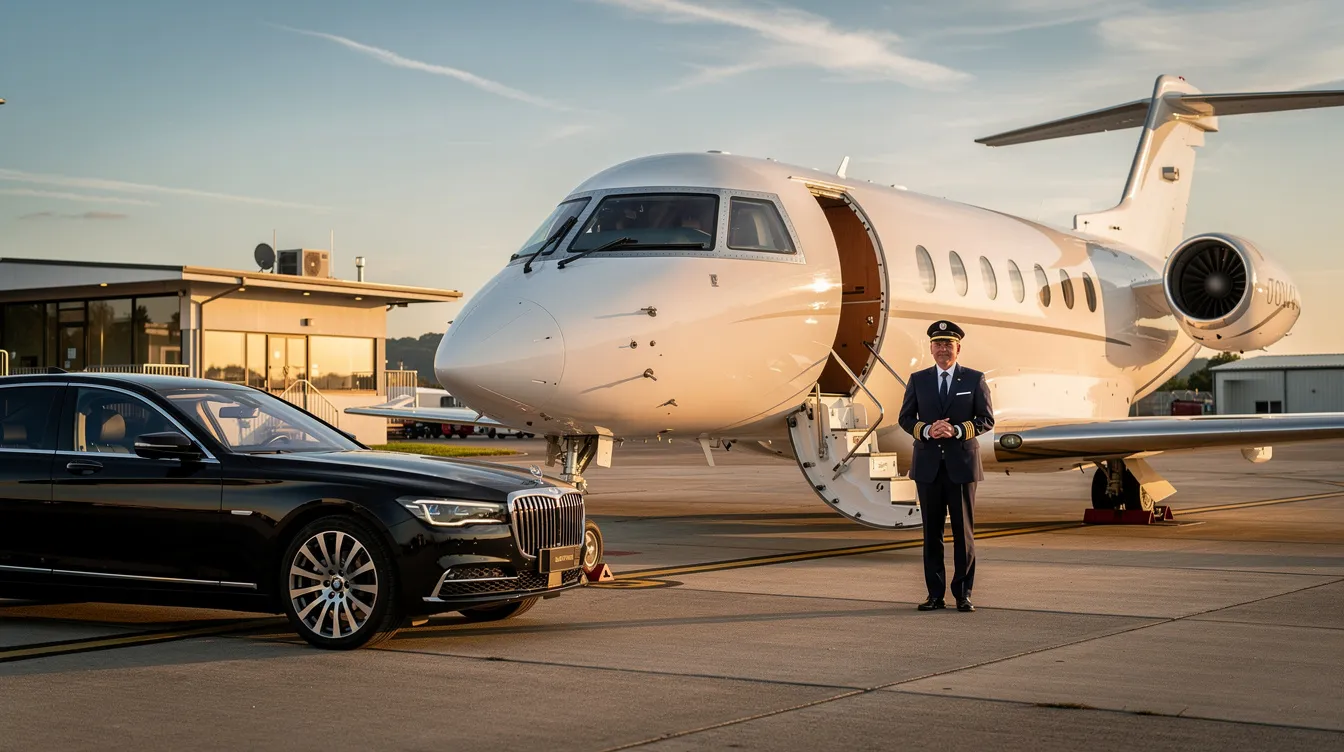
A private plane ride is no longer a rare indulgence reserved for billionaires. It's an increasingly practical decision for executives, entrepreneurs, and families who have calculated the real cost of wasted time. This guide covers all the details - from what a private flight actually looks like minute by minute, to how much it costs, which aircraft type fits your needs, and how BlackJet's Jet Card programs turn unpredictable charter pricing into a streamlined, membership-based experience.
Why a Private Plane Ride Is a Strategic Advantage
Consider a New York–Miami trip. On a commercial airline, even in first class, the door-to-door journey typically runs four to six hours: rideshare to JFK, arriving 90 minutes early, security, boarding, the flight itself, taxiing to a gate, baggage claim, and another ground transfer downtown. On a private jet, the same trip shrinks to roughly two and a half hours. You drive to Teterboro, walk onto the plane, fly direct, and step into a waiting car at Opa-locka Executive Airport.
That difference adds up quickly. A study by the NBAA found that business aviation trips save an average of 127 minutes compared to commercial alternatives. Private jet charters can save up to 75 percent on travel time when you factor in ground transfers, security, and connections. Private flights minimize airport wait times and allow non-stop routing to destinations that commercial carriers often can't reach directly.
But time savings is only part of the equation. Here's what flying private actually delivers:
Privacy for deal-making. Close a negotiation, hold a board prep session, or simply decompress - all in a cabin where every seat belongs to you.
Access to 5,000+ airports. Private jets offer direct access to over 5,000 airports across the U.S., including smaller airports and regional airports that commercial carriers bypass entirely.
Schedule control. Depart when you're ready, not when the airline decides. Adjust your departure date or routing with hours of notice instead of days.
Membership-based access. BlackJet offers Jet Card programs - prepaid flight hours with fixed rates - so frequent travelers get predictable pricing without owning an aircraft.
What a Private Plane Ride Actually Looks Like (Step-by-Step Journey)
Imagine you're a BlackJet member based in Manhattan with a 10:00 a.m. meeting in Chicago. Here's how the morning unfolds.
You leave your apartment at 7:00 a.m. A chauffeured car or rideshare takes roughly 30 minutes to reach Teterboro Airport in New Jersey. At 7:30 a.m., you pull up directly to the fixed base operator - a private terminal where there are no ticket counters, no overhead announcements, no lines. You show your ID, the FBO staff confirms your manifest, and you walk through a lounge to the ramp. By 7:45 a.m., you're seated in a midsize jet. Your crew members greet you by name and confirm your preferences: still water, cabin at 68 degrees, Wi-Fi on. Wheels up at 8:00 a.m.
The flight time to Chicago Midway is approximately two and a half hours. You land around 10:30 a.m. Central, step off the aircraft, and a car is already waiting on the ramp - not at a curb four terminals away. You're at your meeting by 11:00 a.m. Private travel eliminates common airport inconveniences like long security checks, boarding groups, and gate changes.
Here's the timeline in brief:
7:00 a.m. - Depart Manhattan by car
7:30 a.m. - Arrive at Teterboro FBO, 5-minute check-in
7:45 a.m. - Board aircraft, settle in
8:00 a.m. - Wheels up
10:30 a.m. - Wheels down at Chicago Midway
10:40 a.m. - In car, en route to meeting
11:00 a.m. - At destination
Total door-to-door: four hours,s including a two-and-a-half-hour flight across two time zones.
Private Jets vs Commercial First Class: Time, Privacy, and Control
Take a specific route: Los Angeles to Dallas in 2026. A commercial first-class ticket gets you a comfortable seat, lounge access, and a roughly three-hour flight. But the total door-to-door experience - driving to LAX, navigating security and check-in, boarding, deplaning, ground transfer - pushes total time to five or six hours. On a private charter from Van Nuys to Dallas Love Field, the same trip compresses to about two and a half hours.
Private aviation allows schedule control and flexibility that no airline can match. You pick your airport, your departure time, and your passenger list. Private flights allow for flexible scheduling and last-minute bookings - adjust plans a few hours before departure rather than paying change fees. And for companies sending multiple executives, flying private is often more cost-effective than buying four or five first-class tickets.
Here's a direct comparison:
Time. Commercial first class: 5–6 hours door-to-door. Private jet: ~2.5 hours.
Privacy. Commercial: shared cabin with 20+ passengers. Private: your cabin, your rules - ideal for confidential conversations.
Flexibility. Commercial: fixed schedule, change fees. Private: adjust departure by hours, not days.
Airport access. Commercial: major hubs only. Private: executive and regional airports closer to your destination.
Baggage. Commercial: weight limits, checked bag fees. Private: load directly onto aircraft, no carousel.
Post-flight. Commercial: taxi, baggage claim, ground transfer. Private: car waiting planeside.
Key Airports for Flying Private in Major U.S. Markets
Private travelers rarely use the main commercial hubs. Instead, they fly through executive airports that offer faster ground handling, shorter taxi times, and far less congestion. The surface travel to a private aviation airport averages about 15 minutes, versus 45–60 minutes to a major international terminal.
Here are the airports BlackJet members and private flyers most frequently use on popular routes:
Teterboro (TEB), New Jersey - The primary private jet airport for New York. Among the busiest in the country for general aviation movements.
Van Nuys (VNY), Los Angeles - The go-to executive airport for the Los Angeles market, avoiding LAX entirely.
Dallas Love Field (DAL) - Closer to downtown Dallas than DFW, with efficient FBO operations for shorter flights.
Chicago Midway (MDW) - A faster alternative to O'Hare for private charter arrivals.
Miami Opa-locka Executive (OPF) - The preferred private arrival point for Miami, well north of MIA's congestion.
Aspen (ASE) - Seasonal favorite for ski and summer leisure; accessible only by smaller aircraft due to runway constraints.
San Francisco (SFO/SQL) - San Carlos Airport (SQL) serves as a quieter option for Bay Area departures; San Francisco International also has FBO facilities.
Frequently flown routes include TEB–OPF for New York–Miami weekends and VNY–ASE for Los Angeles–Aspen ski trips.
How Much Does It Cost to Take a Private Plane Ride?
This is the question everyone asks: how much does a private jet cost? The answer depends on aircraft size, flight distance, and market conditions - but here are the 2026 ballpark figures.
Private jet charter rates range from $1,800 to $18,000 per hour depending on the aircraft, so the overall private jet charter cost rises or falls with the cabin category and trip profile. Private jets range from turboprops to heavy jets, and pricing scales accordingly. Critically, these rates are per aircraft, not per passenger. Because private jet rental prices vary by route and aircraft type, a six-passenger light jet making a two-hour round trip at $5,000 per hour costs roughly $20,000 total. Split among six travelers, that's approximately $3,300 per person before fees - comparable to multiple first-class tickets on some routes.
BlackJet Jet Card members lock in predictable hourly rates, avoiding the spot-market swings that can inflate on-demand charter pricing during peak seasons and aligning closely with the main drivers of private jet charter pricing.
Here are the ranges by aircraft category:
Turboprops (King Air 350, Pilatus PC-12): Turboprop charters start at around $2,000 per hour, typically ranging $2,500–$3,500 per hour.
Light jets (Citation CJ3, Phenom 300): $4,000–$7,000 per hour. Best for domestic flights under three hours.
Midsize jets (Citation Latitude, Hawker 800XP): $5,500–$8,500 per hour with an average range of 2,500–3,200 nautical miles.
Large-cabin / heavy jets (Gulfstream G550, Falcon 7X): Heavy jet charters can cost between $5,400 and $11,000 per hour - and up to $10,000 per hour or more for premium configurations.
Ultra-long-range aircraft (Global 7500, Gulfstream G700): $15,000–$25,000 per hour for transcontinental or transatlantic missions.
Private Jet Cost Drivers: What's Behind the Number?
Understanding what drives private jet pricing helps you evaluate any quote you receive. Charter costs fluctuate based on aircraft type and distance, but several other key factors shape the total cost of a specific trip.
Aircraft category. Larger cabins, longer range, and higher cruise speeds all increase the hourly rate. A light jet and an ultra long range jet serve fundamentally different missions at different price points.
Billable flight hour vs. block time. A quoted two-hour flight may actually be billed as 2.4–2.6 hours once taxi time, minimum leg charges, and engine-start protocols are included. Costs beyond the hourly rate can significantly increase private jet expenses.
Aircraft positioning. If the specific aircraft isn't already at your departure airport, the operator must reposition it - and that repositioning leg is billed. Aircraft positioning can add meaningfully to the total charter cost.
Flight distance. Distance flown is one of the strongest determinants of flight cost. Longer routes burn more fuel and accumulate more billable hours.
Crew and overnight expenses. For multi-day trips, crew hotel stays, per diems, and duty-time limits add to the quote. Hidden expenses can include catering and crew overnight fees.
Additional services. Catering, ground transport, deicing, and special requests increase private jet charter costs. Even modest catering adds $500–$2,000 per leg.
Airport and FBO fees. Landing fees, ramp handling, and parking charges vary by airport. Airport landing fees range from $100 to $1,500 per flight.
Fuel prices. Jet-A fuel fluctuates by region and season. Operators may apply a fuel surcharge when prices exceed a baseline threshold.
Example: A round-trip New York–Miami long weekend might cost 20–40 percent less than two same-day out-and-back business trips on the same route, because overnight stays reduce repositioning and the aircraft remains on location.
Understanding Hourly Rates and Billable Flight Time
The hourly rate is the core building block of any charter quote. It covers fuel, maintenance reserves, crew salaries, insurance, and operator margin. But the advertised hourly rate isn't always what you pay - the effective cost depends on minimums and repositioning.
Billable flight time typically runs from engine start through taxi, wheels-up, the actual flight, wheels-down, and taxi-in. Most operators add 0.1–0.3 hours per leg for taxi adjustments. Many also enforce a minimum billable flight hour per leg - often two hours for light jets and midsize jets.
Here's a concrete example:
Route: Los Angeles to Las Vegas on a light jet
Actual block time: approximately 1.7 hours in the air
Minimum per leg: 2.0 hours
Taxi adjustments: ~0.2 hours each side, bringing billable to ~2.4 hours
Hourly rate: $5,000 per hour
Base cost for one leg: $12,000
For the return leg, the same minimum applies. So even a short round trip generates roughly $24,000 in base charter rates before various fees and surcharges. This is why understanding the distinction between advertised and effective cost matters - and why many frequent travelers prefer Jet Card programs with transparent, all-in pricing.
Taxes and Fees: Federal Excise Tax and Other Line Items
Beyond the base charter rate, several taxes and additional fees appear on every private jet invoice. A 7.5 percent federal excise tax applies to all domestic flights under Part 135 charter, calculated on the base fare. This is the single largest line item after the charter fee itself.
BlackJet presents all of these elements transparently in pre-trip confirmations so members see the full cost before they fly. Here's what to expect:
Federal excise tax (FET). 7.5% on the base charter fee for all U.S. domestic private charter flights.
Segment fees. A per-passenger fee for each takeoff and landing segment on domestic flights, mandated by the U.S. government.
Landing fees. Charged by airports based on aircraft weight. These range from $100 to $1,500 per flight, depending on the airport.
Ramp and handling fees. Charged by fixed base operators for ground services - marshalling, baggage, fueling coordination.
Fuel surcharge. Applied when fuel prices exceed an operator's baseline; varies by quarter and region.
Deicing fees. Common in winter at northern airports; can add $1,000–$5,000 depending on aircraft size and conditions.
International fees. For border crossings: customs, immigration, head taxes, overflight permits, and additional handling charges.
Private Jet Rental Options: Charter, Jet Cards, and Ownership
There are three primary ways to access a private plane on-demand: charter, Jet Card membership, and aircraft ownership (whole or fractional). Each model suits a different travel profile.
On-demand private jet charter is pay-as-you-go. You contact charter companies, get a quote for your specific trip, and pay per flight. It's flexible - no long-term commitment - but pricing is volatile. During peak demand (holidays, ski season, major events), charter rates spike, and availability tightens. For infrequent flyers, this is often the most practical entry point. For anyone booking regularly, the unpredictability becomes a problem.
BlackJet's Jet Card model sits between on-demand charter and ownership. You prepay for a block of flight hours - typically 25 or 50 hours - at a fixed hourly rate across your chosen cabin class, a structure that mirrors broader jet card cost and membership pricing. You get guaranteed availability, priority access during peak periods, and a single contract covering all flights. No negotiation on every trip, no surprise additional costs. For travelers logging 25–150 hours per year, this is where the economics and convenience intersect.
Full or fractional ownership makes financial sense only at very high utilization - typically 150–300+ flight hours per year. For ultra-frequent flyers, exploring unlimited private jet membership programs can also clarify whether fixed-fee models beat ownership economics. The capital outlay, hangaring, maintenance, crew staffing, and depreciation are significant.
Here's a summary:
On-demand charter: No commitment, volatile pricing, limited availability at peak. Best for fewer than 15 hours per year.
Jet Card membership: Fixed rates, guaranteed access, simplified booking. Ideal for 25–150 hours per year.
Fractional ownership: Partial aircraft stake, more control, high fixed costs. Suits 150–300+ hours per year.
Whole ownership: Maximum control, highest cost, and complexity. For 300+ hours with dedicated crews and management.
BlackJet Jet Cards: How Prepaid Hours Transform Your Experience
BlackJet's Jet Card programs are designed for travelers who want the benefits of private jet travel without the overhead of ownership. Cards are typically offered in 25-hour and 50-hour increments across light, midsize, and large-cabin categories, with fixed per-hour rates that don't fluctuate with fuel prices or seasonal demand, especially within the BlackJet 25+ Hour Jet Card structure.
Here's what a typical quarter might look like for a Jet Card member: a New York–based executive uses 10 hours for round-trip New York–Chicago business trips, 5 hours for New York–Toronto meetings, and reserves the remaining hours for weekend personal flights to Miami or Nantucket. Because rates are locked and hours prepaid, there's no scrambling for availability during Thanksgiving week or Presidents' Day weekend when spot charter rates surge.
Key benefits of BlackJet Jet Cards:
Predictable pricing. A fixed hourly rate eliminates market volatility and negotiation.
Guaranteed availability. Secured access even during peak travel periods.
Simplified booking. One contract, one relationship, one app - no shopping across charter companies for each trip.
Multi-cabin flexibility. Choose the right aircraft category for each mission, from a light jet shuttle to a heavy jet charter for international flights.
Ideal profiles. Executives with multi-city schedules, families with seasonal travel patterns, and high-net-worth individuals who value consistency and safety.
Choosing the Right Aircraft Category for Your Private Plane Ride
Matching the right aircraft to your trip is one of the most important decisions in private aviation. The wrong choice means paying for a range you don't need - or cramming into a cabin that's too small. Here's a breakdown of the main categories in 2026, with typical aircraft types and use cases, complementing a broader overview of the types of private jets for every traveler:
Turboprops (King Air 350, Pilatus PC-12): 4–8 passengers, ~1,000 nm range. Best for shorter flights under two hours, regional hops, and accessing smaller airports with shorter runways.
Very light jets (Cirrus Vision Jet): 4–5 seats, ~1,100–1,400 nm. Entry-level jet performance for quick point-to-point missions.
Light jets (Embraer Phenom 300, Citation CJ3): Light jets typically seat 6–8 passengers for short flights, with an average range of 1,500–2,200 nm. Ideal for two-to-three-hour domestic flights and often featured among the best small private aircraft for varied missions.
Midsize jets (Citation Latitude, Hawker 800XP, Challenger 350): 7–9 seats, 2,500–3,200 nm. Midsize jets offer larger cabins and longer flight distances - coast-to-coast capability with stand-up headroom.
Super-midsize (Gulfstream G280, Challenger 350): 8–10 seats, 3,000–4,500 nm. Transcontinental range with full-size cabin comfort.
Large cabin / heavy jet (Gulfstream G550, Dassault Falcon 7X): 10–16 seats, 4,000–6,500 nm. Built for long-haul international flights and groups of eight or more.
Ultra long range (Bombardier Global 7500, Gulfstream G700): 14–19 seats, 6,000+ nm. Non-stop New York–London, Los Angeles–Tokyo. The ultimate in range and cabin space, and a key segment in any guide to understanding private jet sizes.
Cabin Experience: What It Feels Like to Fly Private
The experience begins before you board. You arrive at a private lounge - not a gate in a crowded terminal - and crew members who have already been briefed on your preferences are waiting. Your sparkling water brand, cabin temperature, and reading material are ready. There are no announcements, no crowds, no overhead bins.
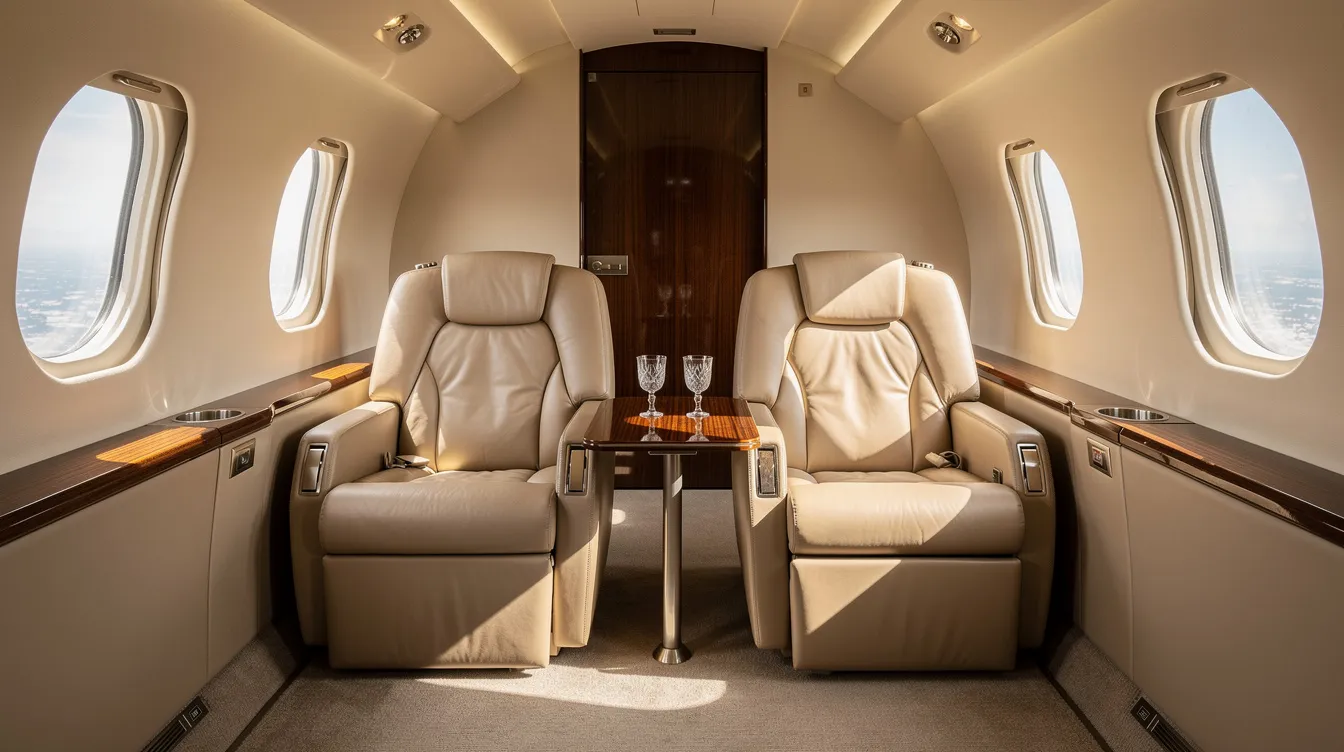
Once on board, the cabin is yours. Private aircraft provide a quiet environment for work and meetings - significantly quieter than any commercial cabin. On midsize jets and above, you have standing headroom, enclosed lavatories, and layouts that include club seating and aft divans. For longer flights on heavy jets, lie-flat seating and sleeping couches are standard.
Here's what defines the private cabin experience:
Privacy. No shared cabin. Conduct calls, hold meetings, or simply rest without interruption.
Noise. Substantially quieter than commercial aircraft, especially in newer models with advanced insulation.
Connectivity. High-speed Wi-Fi is standard on most jets in 2026, supporting video calls and streaming. Larger jets offer broadband satellite, and higher cruising altitudes help private jets fly above commercial traffic for smoother, faster routes.
Workspace. Tables, power outlets, and quiet allow productive work - turning flight time into office time.
Personalization. From cabin interiors to lighting to temperature, the environment is tailored to you, reflecting the broader premium private jet experience BlackJet offers.
In-Flight Dining and Onboard Services
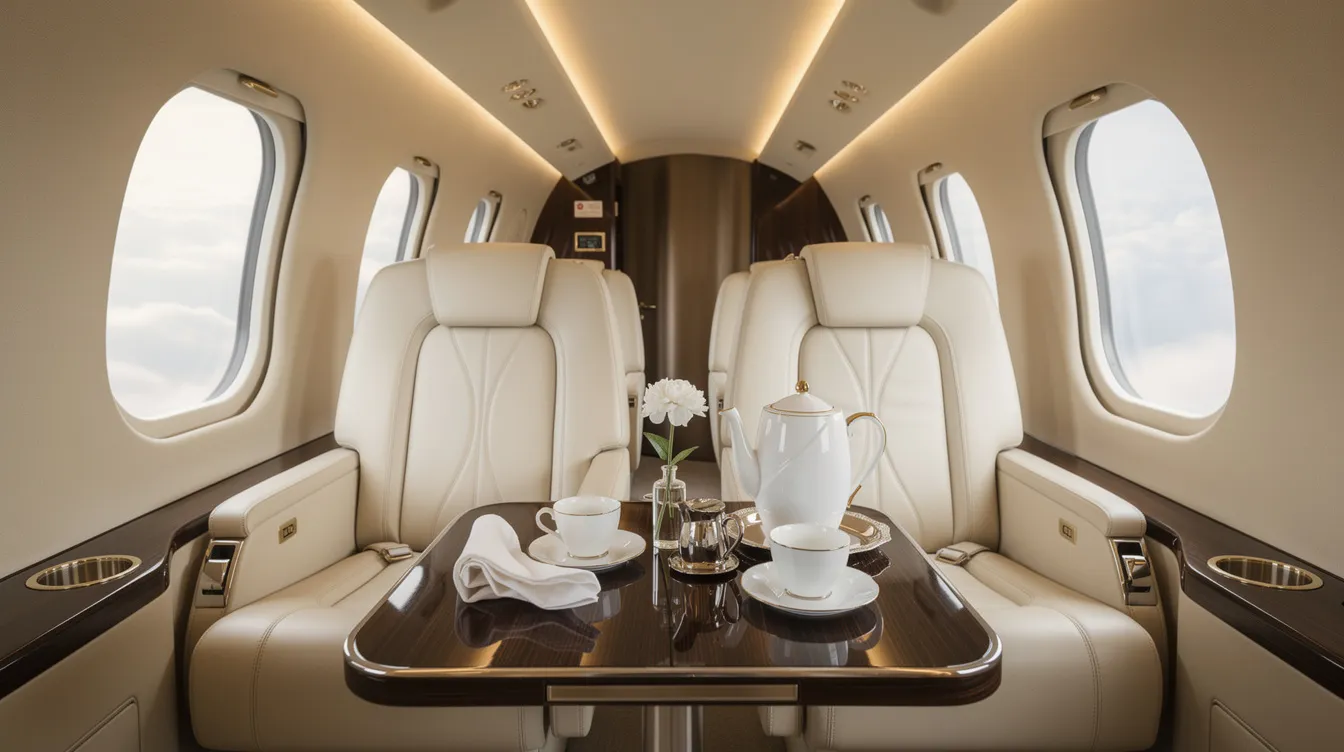
Private jets provide personalized in-flight services and catering options that commercial airlines simply cannot match. On shorter flights, standard offerings include premium beverages - spirits, wine, still and sparkling water - along with curated snack selections. On longer flights or for special occasions, bespoke catering is where private aviation truly differentiates.
Customizing the private flight experience can include catering preferences and amenities tailored to each passenger. BlackJet's concierge collects preferences 24–48 hours before departure - dietary restrictions, wine brands, specific cuisines. For milestone events, custom cakes, floral arrangements, or particular Champagnes are coordinated with local providers.
Standard tier. Premium snacks, beverages, fresh fruit. Included or minimally priced on most charter flights.
Elevated tier. Multi-course meals from local restaurants or specialty caterers - lobster salad, sushi platters, artisan cheese boards. Typically $200–$800 per person depending on complexity.
Special occasion tier. Custom menus, celebration cakes, rare wines. Requires 48–72 hours' notice for sourcing.
How to request. Via BlackJet's app or concierge. Confirm dietary needs, headcount, and budget guidelines at least 24 hours before departure.
Safety and Certification: Why Standards Matter When Flying Private
Safety verification is essential when choosing a charter operator. Not all private jet providers operate under the same standards, and understanding the regulatory framework protects you.
Legitimate private jet charter flights in the U.S. operate under FAA Part 135, which mandates strict oversight of maintenance programs, crew licensing, duty-time limitations, and operational control. Independent safety audits help ensure operator compliance with high safety standards - organizations like ARG/US and Wyvern conduct third-party evaluations that go beyond baseline FAA requirements.
BlackJet partners exclusively with operators who meet or exceed these benchmarks, including when arranging large-cabin aircraft like the best private jets for 20 passengers. Here's what that means in practice:
FAA Part 135 certification. Every operator in the BlackJet network holds a valid Part 135 certificate, verified annually.
Third-party audits. Operators undergo ARG/US, Wyvern, or equivalent proprietary safety assessments.
Pilot experience. Minimum hour thresholds for pilot-in-command andco-pilott; type ratings on every aircraft flown; recurrent simulator training and emergency drills.
Real-time trip monitoring. BlackJet's operations team monitors every flight for weather, routing, and ATC changes.
Safety-first decisions. During a winter 2025–2026 New York–Aspen trip, deteriorating weather at Aspen required a last-minute diversion to Eagle-Vail. The decision prioritized passenger safety over convenience - a ground transfer completed the final leg. Flexibility is necessary for private jet travel due to potential weather issues.
Maintenance standards. Aircraft in the network follow manufacturer-recommended maintenance intervals or stricter operator schedules.
Sustainable Private Aviation: Carbon-Neutral Private Plane Rides
Private aviation produces higher carbon emissions per passenger than scheduled commercial flights - that's a fact the industry cannot ignore. BlackJet addresses this directly: every Jet Card trip is carbon neutral at no extra cost to the member.
Here's how it works. BlackJet offsets the full carbon footprint of each flight through verified carbon offset projects that account for CO₂ and non-CO₂ climate forcers - including water vapor, aerosols, and contrail effects. Some operators in the market offset at 300 percent of emissions to account for measurement uncertainty.
On the fuel side, Sustainable Aviation Fuel is growing but still limited. SAF represented approximately two percent of total U.S. jet fuel consumption in 2026, and supply remains concentrated at major airports. BlackJet members can request aircraft or routing that favors SAF-enabled airports - particularly on routes like Los Angeles–San Francisco and select transatlantic sectors - when available.
Carbon offset process. Emissions per flight hour are calculated based on aircraft type, distance flown, and fuel burn. Offsets are purchased through verified third-party providers.
SAF availability. Growing but not yet universal. Book-and-claim programs allow operators to match fuel volumes even when SAF isn't physically loaded on your specific aircraft.
Tracking. BlackJet's platform provides per-flight emissions data so members can track their environmental impact.
Member options. Request SAF-capable airports when planning routes; opt into enhanced offset programs for additional impact, or consider more efficient aircraft classes highlighted in resources on the cheapest private jet options.
Technology: Booking and Managing Your Private Flights With BlackJet
BlackJet's 24/7 digital platform is designed to make private jet rental as frictionless as possible - from first quote to post-flight feedback, including emerging private plane rideshare options on select routes. In early 2026, a member booked a same-day flight from San Francisco to Los Angeles in under five minutes via the mobile app.
Here's what the technology delivers:
Instant quoting. Enter route, departure date, passenger count, and cabin preference. An instant quote requires specific travel details for accuracy - and the system returns options within seconds.
Real-time status. Push notifications on weather, crew and tail assignments, slot changes, and gate-ready alerts.
Preference storage. Dietary needs, beverage brands, cabin temperature, entertainment - stored once, applied to every trip.
Digital manifest. Passenger details, IDs, and customs documentation are uploaded and stored securely for repeat use.
Live support. 24/7 access to BlackJet's operations team via app, phone, or message for schedule adjustments, additional services, or urgent changes.
Typical Use Cases: Business, Family, and Lifestyle Travel
Private jet travel isn't one-size-fits-all. Here are three scenarios that illustrate where it delivers the most strategic value.
Multi-city executive week. A CEO flies New York–London on a Sunday evening via a heavy jet, holds Monday–Tuesday meetings, then continues to Zurich on Wednesday morning. The ability to depart on her schedule - not a fixed airline timetable - saves an entire day over the course of the week, underscoring why chartering a private jet can be worth it in demanding business scenarios. For high-profile travelers carrying sensitive materials, the privacy and security of a private cabin are non-negotiable.
Family ski trip. A family of five flies Dallas–Vail during Presidents' Day weekend 2026 on a midsize jet. Commercial options require connections through Denver, add hours of ground transfer, and risk weather delays. A private charter flight gets them slope-side by early afternoon - with all ski gear loaded planeside. Jet Card members who secured hours before the season avoid the peak-demand pricing surge that hits spot charter markets every February.
Friends' weekend getaway. A small group of six books a light jet from Los Angeles to Las Vegas for a Saturday–Sunday celebration. Total cost split six ways comes close to what each person would pay for a premium commercial ticket - but with zero time wasted at LAX and a car waiting at Henderson Executive Airport. Shared flights like these are where per-person economics start to favor private over commercial, especially when you apply strategies to fly private more cheaply.
International Private Plane Rides: Crossing Borders Smoothly
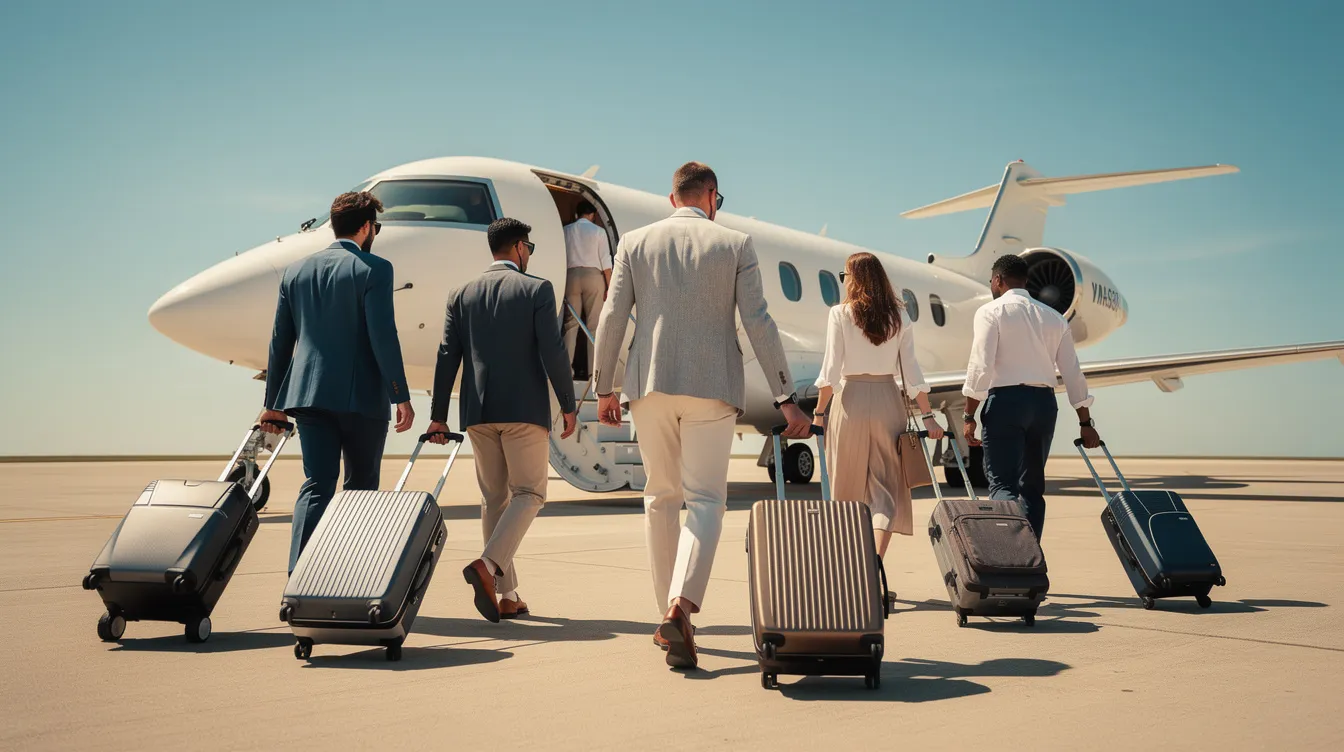
International flights on private jets follow a different logistical path than domestic trips. Routes like Teterboro–London Farnborough or Miami–Nassau require advance coordination of overflight permits, landing permissions, and customs documentation, whether you’re booking the whole aircraft or simply buying a seat on a private jet.
The good news: private customs facilities at executive airports make the process far smoother than clearing immigration at a major international terminal. Many U.S. airports offer pre-clearance for returning flights, and handlers abroad manage documentation so passengers simply walk off the aircraft and into a waiting car.
Here's what to expect for international private flights:
Permits. Overflight and landing permits are filed by the operator 24–72 hours before departure, depending on the destination country.
Customs and immigration. Private arrivals facilities at airports like Farnborough, Le Bourget, and Nassau Executive handle clearance on the ramp - no terminal queues.
International fees. Head taxes, customs fees, navigation charges, and handling fees abroad are additional costs factored into BlackJet's pre-flight quotes, which can become substantial on very large aircraft such as private jets for 50 passengers.
Documentation. Passports, visas, and any import/export paperwork uploaded via the digital platform in advance.
Lead time. International charters typically require more planning than domestic flights - 48–72 hours minimum for permits and fueling coordination.
SAF on international routes. Limited but expanding, especially at select European airports.
How to Book Your First Private Charter or Jet Card with BlackJet
Whether you want to charter a private jet for one trip or commit to a Jet Card for the year, the process is straightforward. Here's how to get started:
Initial inquiry. Contact BlackJet with your route, dates, passenger count, and cabin preference. Providing passenger details expedites the booking process.
Consultation. A BlackJet advisor reviews your travel patterns and recommends whether an on-demand charter or a Jet Card better fits your needs.
Quoting. You receive a detailed quote clarifying the overall private jet charter cost, including base rate, taxes, additional fees, and total cost - no hidden line items.
Aircraft selection. Choose from available options by aircraft type, cabin layout, and amenities. Need help? See BlackJet's guide to finding flights by aircraft type.
Contract and payment. A signed charter agreement and payment are needed for confirmation. Payment options include credit card, wire transfer, or Jet Card prepayment.
Pre-flight briefing. Final schedule confirmation, FBO location, ground transport details, and crew contact info are sent 24 hours before departure.
Day of. Arrive at the FBO 15–30 minutes before departure. Board, fly, arrive.
Booking a private jet typically requires 3–6 hours' notice for on-demand flights, though booking 24 to 72 hours in advance offers the best selection of aircraft and crew. During holidays and peak seasons, lead times increase - another reason Jet Card members benefit from guaranteed access and should compare the best jet cards for frequent flyers before committing.
Frequently Asked Questions About Private Plane Rides
What should I wear on a private flight?
There's no dress code. Smart casual is common; business attire is typical for corporate trips. The cabin is yours - wear what suits your day.
How much luggage can I bring?
Baggage limits depend on aircraft size. Light jets have compact luggage compartments; midsize and heavy jets accommodate more. Overweight or oversized items (golf clubs, ski equipment) may influence which aircraft category is selected for your trip.
Can I bring my pet?
Yes, pets are generally allowed in the cabin on private flights. Size restrictions and health documentation requirements vary by operator. Crates may be required for larger animals.
What does security look like?
Private terminals handle identity verification through fixed base operators - no TSA-style lines. The process takes 5–10 minutes. Your ID is checked, the manifest is confirmed, and you proceed directly to the aircraft.
How early should I arrive?
BlackJet members typically arrive 20–30 minutes before departure. For international flights, allow additional time for customs documentation - usually 45–60 minutes.
Is Wi-Fi available on board?
High-speed Wi-Fi is standard on most private jets in 2026. Satellite connectivity supports email, video calls, and streaming on midsize and larger aircraft. Speeds vary by system and route.
Can I split the cost with friends or colleagues?
The air charter fee covers the entire aircraft, not individual seats. You're welcome to divide the total cost among your passengers informally. Some operators also offer shared flights on high-demand routes, though this is less common.
How do I get an accurate quote?
An instant quote requires specific travel details - route, date, passenger count, and cabin preference. Use BlackJet's digital platform or speak with an advisor for a personalized breakdown.
Is Flying Private Worth It? When the Numbers (and Lifestyle) Add Up
Private jet travel is generally much more expensive than commercial flights. That's the honest starting point. But for certain travelers, the math works differently.
For executives who fly 25–100+ hours per year, each hour lost to commercial travel inefficiency carries a real opportunity cost. If that executive's time is valued at $1,000 per hour, saving even 127 minutes per trip - the NBAA average - represents meaningful ROI across dozens of annual flights. Private jet travel can be more cost-effective for groups compared to first-class tickets when aircraft are well utilized - a full light jet with six passengers on a two-hour flight can approach first-class per-person pricing while delivering an incomparably better experience.
The cost to charter a private jet will always exceed a single economy ticket. But for multi-city days, tightly scheduled board meetings, family travel with young children or elderly parents, and teams carrying confidential materials, the strategic value of a private plane ride is clear. For travelers logging 25–100+ hours annually, structured access through BlackJet's Jet Cards provides the strongest balance of cost, control, and comfort - with unlimited flight hours available through higher-tier programs and a clear understanding of jet card pricing structures and benefits.
Next Steps: Explore Private Jet Access with BlackJet
Your next trip doesn't have to involve terminal queues, connection anxiety, or lost luggage. Whether you're planning fall 2026 business travel, a holiday family vacation, or simply want to understand how private aviation fits your life, BlackJet is ready to help.
Safety-first operations. Every flight is backed by FAA Part 135 oversight and third-party audited operators.
Technology-driven convenience. Book, manage, and track flights from your phone - anytime, anywhere.
Carbon-neutral flights. Every Jet Card trip is offset at no additional cost to you.
Expert support, 24/7. Speak with a BlackJet advisor to compare private jet charters vs Jet Card options based on your anticipated flight hours and routes.
Discover how BlackJet can reshape your travel. Explore Jet Card membership or request a quote for your next trip, and if you expect heavy annual usage, review how 100-hour jet card costs are structured alongside guides to the cheapest private aircraft and budget-friendly options.


 Sign up with google
 Sign up with Apple