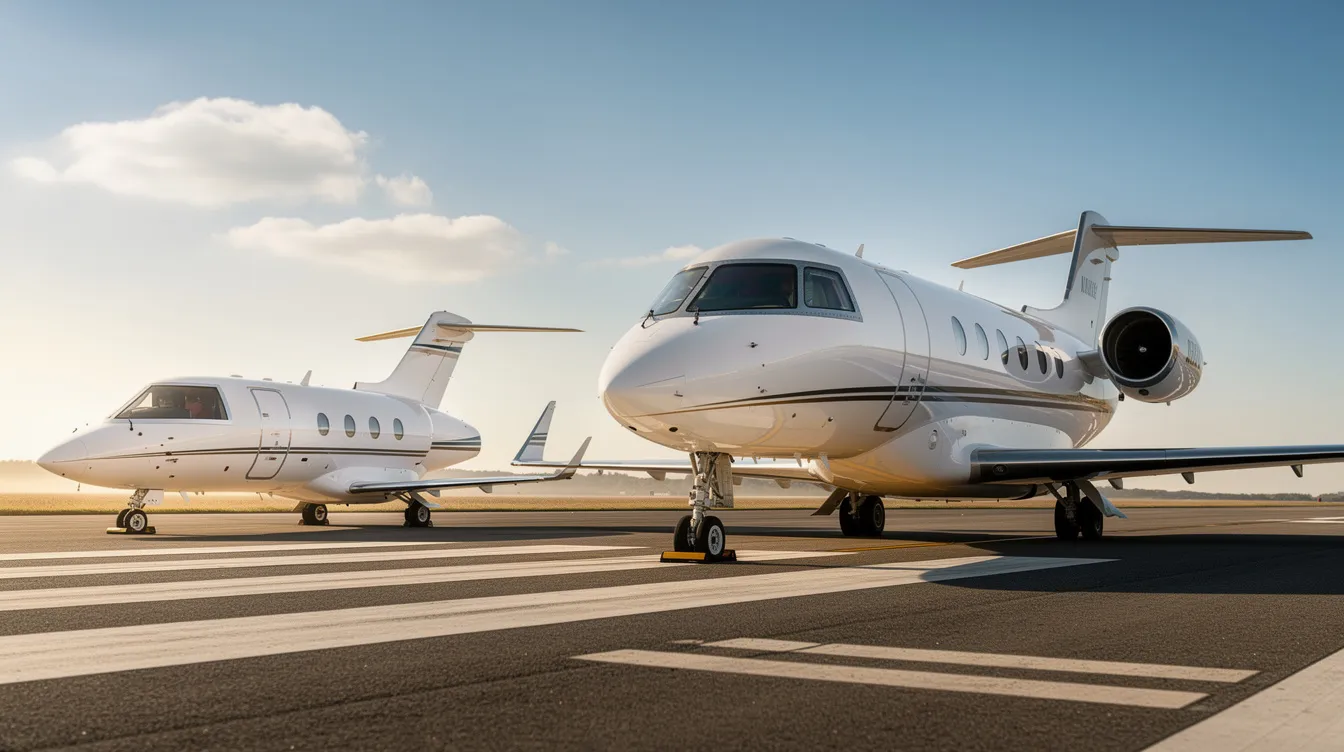
Private aviation is more than a luxury — it is a strategic advantage, and in 2025 the largest private jet company is NetJets, with a fleet of more than 800 aircraft, over 719,086 annual flight hours, and a global operating reach that exceeds other providers. For executives, entrepreneurs, and high-net-worth leisure travelers who fly regionally or internationally multiple times a year, those scale advantages can translate into faster booking, broader aircraft availability, and more consistent service without the commitment of owning an aircraft.
With more than a thousand operators in the market, knowing who is largest — and how companies differ by fleet size, aircraft categories, business model, safety standards, and sustainability efforts - is the first step toward choosing the right kind of private access. This guide compares the largest private jet companies across those metrics, explains options such as fractional ownership and jet cards, and shows how membership platforms like BlackJet connect travelers to large operator fleets when flexibility, privacy, safety, and convenience matter most.
Fast answer: Who is the largest private jet company today?
NetJets is the largest private jet operator in 2025 by virtually every measure that matters: fleet size, annual flight hours, and global reach. The company operates a massive global fleet exceeding 800 aircraft and logged 719,086 flight hours in 2025 — more than double its nearest competitor.
Flexjet ranks second among private jet companies in 2025 with 284,533 hours flown across a fleet of over 340 aircraft globally.
Vista Global is the fourth-largest private jet operator in 2025 with 117,423 hours, trailing Wheels Up (82,318 hours) in some rankings but leading in intercontinental scope.
Wheels Up and FlyExclusive round out the top five, though Wheels Up has seen significant contraction in recent years.
The term "largest" typically refers to a combination of fleet size, total flight hours, and global footprint — not just revenue or brand awareness.
BlackJet operates as a premium jet card and membership access provider, leveraging the capacity of multiple certified operators rather than owning the world's largest single fleet. This model gives members access to the scale of these giants while delivering personalized service, transparent pricing, and rigorous safety standards.
What does "largest private jet company" actually mean?
Defining the largest private jet company requires looking beyond a single number. Several metrics determine scale, and a company can lead in one while lagging in another.
Number of aircraft: owned, managed, and deployed under fractional shares. NetJets leads with 800+ private aircraft; Flexjet follows with 340+.
Total annual flight hours: the most commonly cited benchmark, tracked by ARGUS TRAQPak across Part 135 and Part 91K operations. This captures charter flights, fractional operations, and executive jet management missions.
Global footprint: bases, countries served, airports accessible. One operator may dominate domestic routes while another leads in international flights across Central America, South America, and the Middle East.
Number of customers: fractional owners, jet card holders, or membership clients served annually.
Operators vs. brokers: companies like NetJets and Flexjet hold the Part 135 or Part 91K certificate and directly fly the aircraft. Membership platforms like BlackJet aggregate capacity across multiple fleets and offer broader private aviation solutions, providing flexibility without the constraints of a single operator's network.
Snapshot of the top 5 largest private jet operators (2021–2025)
The rankings among the biggest private jet operators have shifted meaningfully over the past five years, driven by fleet investments, financial pressures, and evolving demand for business jets.
NetJets has held the top position every year, growing from approximately 542,831 hours flown in 2021 to 719,086 in 2025 — a 32% increase over the period.
Flexjet has maintained a firm second place, rising from 178,327 hours in 2021 to 284,533 in 2025, fueled by aggressive fleet expansion including a $7-billion order with Embraer for 182 new aircraft.
Vista Global moved into third place around 2023, though its 2025 hours (117,423) dipped approximately 7.8% from 2024, reflecting some softening in its subscription model.
Wheels Up experienced the most dramatic decline: its flight hours dropped 50.7% from a 2022 peak of 167,641 to just 82,318 in 2025, driven by fleet rationalization and financial restructuring.
FlyExclusive has been the quiet climber, growing steadily from 45,618 hours in 2021 to 73,080 in 2025 — a 60% increase.
The top 30 private jet companies flew 1,725,728 hours in 2025, up 8% (127,771 additional hours) year-over-year. Those top 30 companies captured 30.84% of all flight hours across Part 91, 91K, and 135 operations — underscoring significant market concentration among the largest operators. Some notable operators, such as Nicholas Air, are not always reflected in ranking datasets because of data limitations.
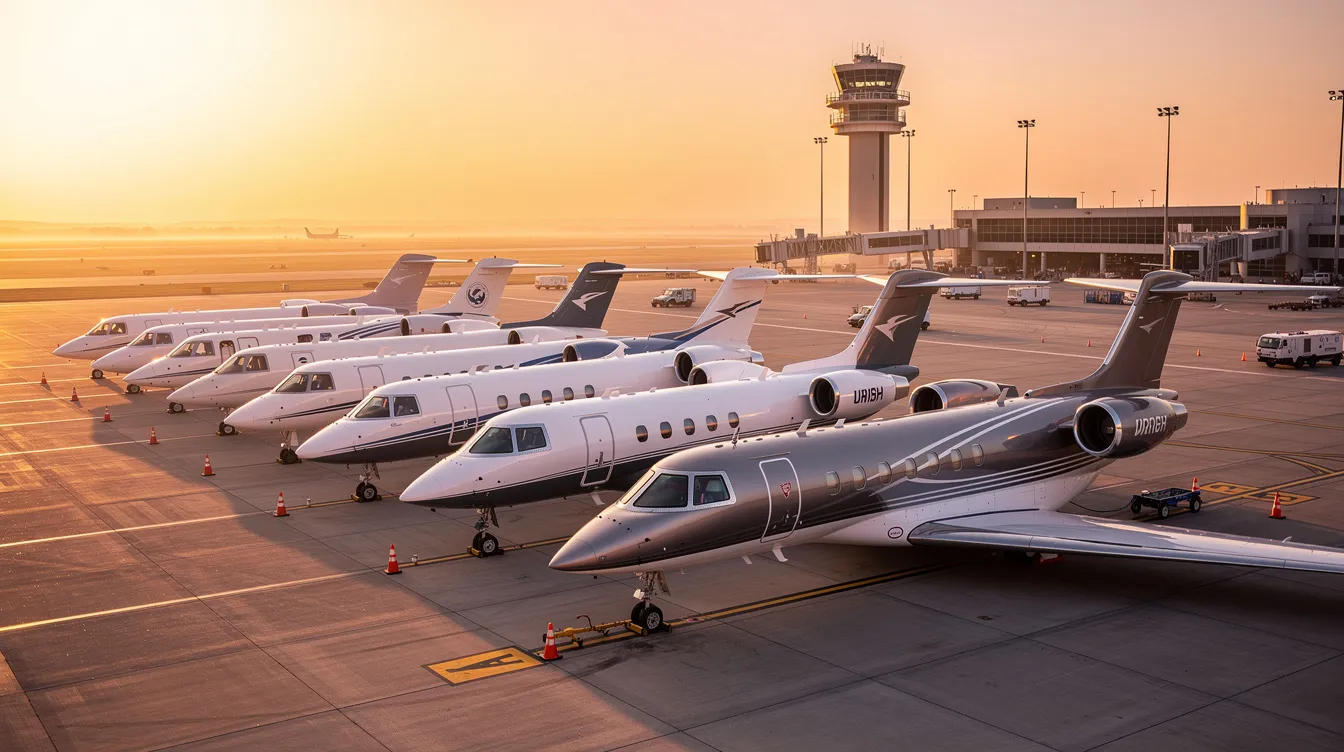
NetJets: the benchmark for "largest private jet company"
Founded in 1964 in Columbus, Ohio, NetJets pioneered the concept of fractional aircraft ownership in the 1980s and has since become the yardstick against which every other private jet operator is measured. As a subsidiary of Berkshire Hathaway, NetJets offers financial stability that few competitors can match.
Programs: NetJets provides fractional ownership, leasing options, jet card programs, and aircraft management through Executive Jet Management — serving aircraft owners who want professional oversight of their private aircraft.
Fleet breadth: The fleet spans light jets (Embraer Phenom 300), midsize (Citation Latitude), super midsize jets (Bombardier Challenger 350/3500), and large cabin long-range jets (Global 5500, Global 7500). Roughly ten main aircraft types are in active service.
Scale: NetJets accounts for roughly 15% of all private jet movements in North America. It provides access to more than 5,000 airports globally and serves approximately 40% of Fortune 500 companies.
Availability: NetJets offers guaranteed aircraft availability even during peak travel periods — a critical differentiator when demand surges around holidays or major events.
Data context: Some "largest operator" datasets include Executive Jet Management flights alongside NetJets' fractional hours, which slightly inflates total hour counts but reflects the full scope of the company's operations.
Other major players: Flexjet, Vista Global, Wheels Up, FlyExclusive
While NetJets is the undisputed largest, several other charter companies dominate specific niches across private aviation, a field that includes both fleet operators and brokerage-led air charter service models, from ultra-long-range intercontinental missions to regional on-demand charter services.
Flexjet: founded in 1995, originally backed by Bombardier (now Textron Aviation manages some of the legacy types). Flexjet offers fractional ownership, jet cards, and leasing. Its fleet emphasizes super midsize jets and long-range jets, including the Gulfstream G650ER and the new G700. Flexjet ranks second in 2025 with strong year-over-year growth of nearly 20%.
Vista Global: headquartered in Dubai since 2018, Vista Global is the umbrella for VistaJet, XO, and acquisitions including Jet Edge, Air Hamburg, and Talon Air. Its subscription model offers guaranteed availability across a 300+ aircraft fleet, with 18 Bombardier Global 7500s being upgraded to Global 8000s. Vista America operations contribute meaningfully to its North America hours.
Wheels Up: a membership-based U.S. operator that went through significant fleet rationalization in 2024–2025, retiring older King Air 350 turboprop aircraft and Citations to focus on the Embraer Phenom 300 and Challenger 300. Its reduced fleet size reflects a strategic pivot toward profitability over growth, as outlined in many rankings of the top 5 private jet companies.
FlyExclusive: founded in 2015, FlyExclusive focuses on North America, the Caribbean, and select international routes. It offers on-demand charter services, jet card programs, fractional ownership, and empty-leg private flights with a diverse fleet of small jets through large-cabin aircraft suitable even for private jets for 50 passengers on certain missions. Some industry lists also omit notable providers such as Paramount Business Jets when comparable operator data is unavailable.
How these giants structure their fleets: from light jets to long-range aircraft
The largest private jet companies operate across multiple cabin classes to match missions from a 90-minute hop to a 14-hour intercontinental crossing. The fleet includes light jets, midsize jets, and large and long-range jets — each serving distinct travel profiles.
Light jets: designed for regional trips under three hours with small teams. Very light jets have a maximum takeoff weight under 10,010 lbs, while light jets typically accommodate 6–8 passengers over a 1,953 nautical mile range. Popular models include the Embraer Phenom 300 and Cessna Citation CJ series. Large fractional operators keep substantial light jet segments because these aircraft handle the highest volume of domestic routes.
Midsize and super midsize jets: the workhorses for cross-country U.S. and transcontinental missions. Aircraft like the Citation XLS, Bombardier Challenger 350, and Praetor 500 fill this category. Super mid-size jets can carry 10–11 passengers over a 3,420 nautical mile range, making occasional transatlantic legs feasible with a fuel stop.
Long-range and ultra-long-range jets: aircraft families like the Gulfstream G650ER and Bombardier Global 7500 enable nonstop flights between continents. Heavy jets can accommodate 12–19 passengers over a 6,500 nautical mile range. Boeing Business Jets serve as business airliners, often used for large groups of up to 50 passengers or VIPs who need airliner-class cabin space with engines mounted for long-range endurance.
Specialization patterns: companies like PlaneSense focus on turboprop aircraft and light jets, while Vista Global and Flexjet invest heavily in long-range private jets to capture high-yield intercontinental demand. At the other end of the spectrum, travelers can also consider the cheapest private jet options when shorter missions or lower budgets are the priority. Dassault Aviation's Falcon family also appears across several operators' fleets for its efficiency on missions to Latin America and Europe.
Fractional ownership, jet cards, and membership models explained
The largest private jet operators rely on three core business models to serve clients — each with distinct trade-offs in cost, commitment, and flexibility.
Fractional ownership: clients buy fractional shares — an equity stake that translates into a set number of flight hours per year on a specific aircraft type. Fractional ownership allows sharing costs among multiple owners for crew, hangar, maintenance, and insurance while navigating fractional jet ownership depreciation and related tax benefits of fractional jet ownership. However, fractional ownership requires an upfront equity share for aircraft costs, often with five-year minimum commitments. NetJets and Flexjet are the dominant fractional operators.
Jet cards: jet card programs offer prepaid access to private jets in blocks of flight time — commonly 25 hours or 50 hours. Clients lock in fixed hourly rates, simplifying budgeting versus ad hoc private jet charter. Jet card memberships often include zero blackout dates, a significant advantage over some fractional programs.
Pay-as-you-fly and membership models: pay-as-you-fly models charge clients only for used flight hours, appealing to less frequent travelers. Deposit-based memberships provide guaranteed access to fleets with minimum annual usage. Unlimited private jet flight memberships have been largely discontinued due to misuse — the economics simply didn't work at scale.
BlackJet's position: BlackJet specializes in jet card and membership-style access across multiple fleet partners, offering predictable hourly rates, safety-certified operators, 24/7 digital booking tools, and carbon-neutral private flights backed by transparent jet card pricing. Rather than tying clients to a single operator's fleet, this model provides access across types of private jets from light to long range.
Why "largest" doesn't always mean "best" for frequent flyers
Scale brings undeniable advantages — broader availability, more aircraft categories, and a wider global network. But savvy travelers know that the biggest fleet doesn't automatically deliver the best experience.
Availability gaps persist: even the largest operators can experience peak-day surcharges or limited positioning in certain regions. Smaller, agile providers may offer more creative routing or faster turnaround for a specific trip.
Pricing transparency matters: some large fractional operators layer fixed costs, variable hourly fees, fuel surcharges, and repositioning charges into complex structures. Jet card programs with wholesale pricing and fixed hourly rates — like those offered by BlackJet — eliminate surprise line items.
Safety is non-negotiable: third-party ratings from ARGUS and WYVERN apply equally to both large and boutique operators. The question is whether your provider vets every flight against these standards, not whether it owns the most aircraft.
Technology as a differentiator: large incumbents may rely on legacy booking systems, while modern providers like BlackJet emphasize mobile booking, instant quotes, and proactive flight monitoring — delivering personalized experiences that scale doesn't always provide.
Personalized service: with over a thousand operators in the market, a curated approach that matches the right aircraft and operator to each mission often outperforms a one-size-fits-all relationship with a single large company.
How BlackJet leverages the largest operators to maximize your options
BlackJet does not own aircraft. Instead, it provides curated access to a global network of leading operators — including many of the biggest private jet companies and certified regional specialists — through a single, streamlined membership.
Jet card model: BlackJet's 25-hour and 50-hour programs allow members to pre-purchase flight time fulfilled using a mix of light jets, midsize, and long-range jets from multiple Part 135-certified operators.
Indirect fleet benefits: aircraft management and fleet optimization by large operators mean more availability, better positioning flights, and consistent cabin standards for BlackJet members — without requiring a direct relationship with each operator.
Expert filter: BlackJet vets aircraft, pilots, and safety records so clients don't have to parse flight hour data or audit reports themselves. Every trip is checked against current operator and crew data, giving clients big-fleet access with boutique-level verification.
Real-world example: a BlackJet member books a midsize business jet from New York to Miami on Monday for an investor meeting, then a long-range jet from Los Angeles to London the following week for a board session. Both flights are sourced from different operators, coordinated through one jet card, with consistent service standards, carbon-neutral commitments, and a single point of contact.
Use cases: matching aircraft size and operator scale to your mission
The "right" largest private jet company — or access model — depends entirely on how and where you fly.
Regional executive travel: a client flying monthly between Chicago and Toronto needs efficiency, not prestige. A light jet or midsize jet via a jet card delivers the right cabin for the flight time, at a fraction of the cost of owning a share in a long-range business jet. Ground transportation coordination and rapid turnaround matter more than intercontinental range.
Transatlantic board meetings: a European HQ executive flying New York to London multiple times per year benefits from long-range jets sourced from operators running Gulfstream and Global fleets. BlackJet's fixed hourly pricing and guaranteed availability remove the complexity of negotiating each crossing individually.
Multi-city roadshows: an investor roadshow hitting four or five U.S. cities in 72 hours demands scheduling precision. Large operators' fleet depth reduces deadhead positioning, while BlackJet's trip planning and real-time support minimize downtime between legs.
Family leisure and ski trips: holiday travel to Aspen or the Caribbean often involves short hops into challenging airports. Mixing aircraft types — a light jet for the mountain approach, a midsize for the Caribbean leg - through one BlackJet jet card beats committing to a single aircraft via fractional ownership.
Sustainability and the environmental impact of large private jet fleets
The largest private jet companies, due to their enormous total flight hours, face growing scrutiny for their environmental impact. The aviation industry is rapidly changing towards sustainability, and private travel is no exception.
Scale of the challenge: private jets generate thousands of tons of CO2 emissions annually. Traveling in private jets leaves a disproportionate carbon footprint compared with commercial alternatives — a reality the industry must address head-on rather than minimize.
Operator responses: sustainable aviation practices aim to reduce greenhouse gas emissions through three primary channels — carbon offset programs, investment in sustainable aviation fuel (SAF), and fleet modernization. NetJets has committed to long-term SAF procurement. Vista is upgrading to more fuel-efficient aircraft. Flexjet's new Embraer orders replace older, less efficient models.
Carbon offset options: Carbon offset options are available for private aviation flights, and BlackJet ensures every journey is carbon-neutral through verified offset programs — at no extra cost to members. This gives environmentally conscious flyers responsible access to business jets without compromising convenience.
Practical comparisons: flying a modern, fuel-efficient light jet for a two-hour regional hop produces significantly fewer emissions per passenger than using an older, heavier large cabin aircraft for the same mission. Fleet renewal strategies at the operator level directly influence the environmental profile of every flight booked through providers like BlackJet.
Safety, regulation, and data: what underpins the rankings
The same systems used to determine which operators are the largest also serve as the backbone of safety and regulatory compliance in private aviation. Safety is the foundation of private aviation services—full stop.
Regulatory categories: Part 91 covers private, owner-operated flying. Part 91K governs fractional operators like NetJets and Flexjet. Part 135 covers charter and jet card flights. Hours flown under each are counted differently in industry rankings, which is why some operators appear larger or smaller depending on the dataset.
Safety audits: agencies like ARGUS, WYVERN, and IS-BAO audit operators' flight hours, pilot experience, maintenance records, and safety management systems. ARGUS Gold is the minimum safety benchmark for operators in this space. Every flight must be operated by FAA Part 135-certified providers.
Pre-flight verification: ARGUS TripCHEQ reports are run before every flight to confirm operator status, crew qualifications, and aircraft airworthiness. BlackJet runs these checks on every trip, ensuring big-fleet access with boutique-level verification.
Market fragmentation: over 1,000 Part 91, 135, and 91K operators exist in the industry, yet the top 30 captured 30.84% of all flight hours — meaning the vast majority of operators are small. This fragmentation is precisely why an expert intermediary that vets each operator adds tangible value.
Empty legs: repositioning flights - flown without paying passengers to position aircraft - inflate flight hour totals for large operators but also create opportunities for discounted private travel for flexible travelers.
Choosing your ideal access model: ownership vs charter vs jet card
Even with the largest private jet companies in the picture, the optimal strategy for a traveler is choosing the right access model — not simply the biggest brand.
| Fractional ownership | Committed flyers wanting equity and prestige | Long contracts (5+ years), residual value risk, limited flexibility across aircraft classes. | | On-demand charter | Infrequent or unpredictable schedules | Maximum flexibility but variable pricing. Requires careful vetting of charter services for safety and reliability. | | Jet card and membership | Clients flying 25–100+ hours/year | Fixed hourly rates, guaranteed availability on multiple aircraft categories, carbon-neutral flights, and app-based booking — without owning or managing an aircraft. | For most frequent flyers who don't need 400+ hours annually, a jet card program delivers the scale advantages of the world's largest fleets — availability, aircraft variety, global network reach — without the capital commitment or operational complexity of ownership.
BlackJet's jet card programs are built on this principle: connect clients to the capacity of the largest operators and vetted regional specialists through a single membership, with transparent pricing, uncompromising safety standards, and carbon-neutral flights on every mission.
The next decade in private aviation will be defined not by who owns the most aircraft, but by who delivers the most intelligent access to them. Whether your next flight is a two-hour regional hop or a nonstop transatlantic crossing, the right jet card puts the world's largest fleets at your disposal — on your terms.
Discover how BlackJet can reshape your travel.


 Sign up with google
 Sign up with Apple