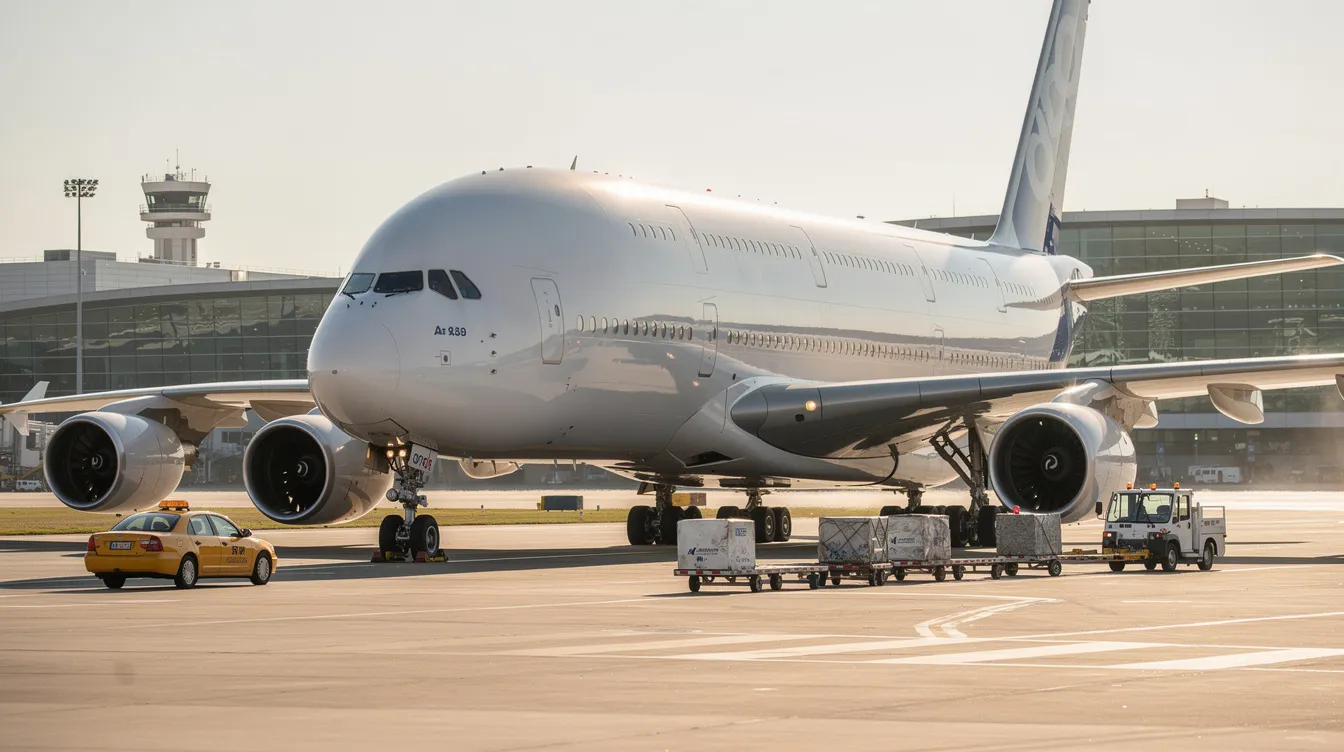
The Airbus A380 has held the title of the world's largest passenger aircraft for nearly two decades. This guide is for travelers, aviation enthusiasts, and private jet clients interested in the world's largest passenger aircraft and its impact on luxury travel. We cover the A380's engineering, industry impact, and what its size means for both commercial and private aviation. Explicitly, the Airbus A380 is the largest passenger aircraft ever built.<sup>1</sup>
Immediate answer: what is the largest passenger aircraft in the world?
The Airbus A380 is the largest passenger aircraft ever built.<sup>1</sup> The largest passenger plane in active service is the Airbus A380-800. The Airbus A380 features two full-length passenger decks extending the entire length of the fuselage.<sup>1</sup> It is the only aircraft ever built as a full-length double-deck wide-body airliner designed to carry passengers on both complete decks from nose to tail. No other commercial aircraft matches its total passenger capacity or cabin volume.
Here are the headline numbers:
Overall length: approximately 72.7 m
Height: 24.1 m
Wing span: 79.8 m - nearly the maximum allowed by airport taxiway infrastructure
Cabin floor area: roughly 550 m² across two full-length passenger decks (comparable to three tennis courts)
Maximum capacity: 853 passengers in an all-economy configuration
Typical seating: 500–545 in a three-class layout
Maximum takeoff weight: 560–575 metric tonnes
Range: approximately 8,000 nautical miles (14,800 km)
How does it compare? The Boeing 747-8 is slightly longer at 76.3 m, but it lacks a full-length upper deck and carries fewer passengers. The upcoming Boeing 777-9 will be one of the longest commercial aircraft ever built, yet its single-deck design means it cannot approach the A380's total cabin volume or maximum seating capacity. The Airbus A380 remains the undisputed world's largest passenger plane.
Now that we've established the A380's status, let's explore how its size impacts both commercial and private travel.
Why size still matters: hub mega‑liners vs private jet strategy
Hub-to-Hub Efficiency
Very large aircraft like the A380 reshaped long-haul flights between the world's busiest hubs. Routes like London Heathrow to Dubai, Singapore to Sydney, and Frankfurt to New York became showcase corridors where airlines could move 500-plus passengers in a single departure, maximizing revenue on slot-constrained runways. For decades, this hub-to-hub model was the pinnacle of efficient mass travel.
But efficiency at scale is not the same as efficiency for the individual traveler. When you fly business class on the largest passenger aircraft, you still face 90–120 minutes of pre-departure airport time, security screening, terminal transit, boarding queues, and post-arrival immigration lines. On a peak day at Heathrow or JFK, door-to-door time for a transatlantic flight can stretch well beyond 12 hours.
Private Jet Advantages
Consider a concrete example: a New York–London executive itinerary.
A380 business class: arrive at JFK 2+ hours early, clear security, board with 400+ other passengers, fly 7–8 hours, queue for immigration at Heathrow, collect luggage, transfer to central London. Total door-to-door: roughly 12–14 hours.
BlackJet long-range private jet: depart from a nearby private terminal, arrive 20–30 minutes before departure, fly non-stop with full privacy, clear streamlined customs on arrival, transfer directly. Total door-to-door: approximately 8–9 hours.
Strategic pros and cons at a glance:
Mega-liners excel on high-demand trunk routes with competitive per-seat pricing
Private jets win on schedule flexibility, airport access (thousands of airfields vs. a few hundred major hubs), and elimination of ground-side delays
For executives whose time carries a cost of $500–$1,000+ per hour, saving 3–5 hours per segment shifts the value equation decisively toward private aviation.
With these differences in mind, let's look at how the A380 came to be and the milestones that shaped its legacy.
The A380 story: from concept to maiden flight and beyond
A380 Program Launch
Airbus began studying ultra-large aircraft concepts in the late 1980s, driven by a straightforward ambition: break the Boeing 747's three-decade monopoly on the high-capacity, long-haul market. Internal studies evolved through the 1990s under the project designation A3XX, envisioning a double-deck aircraft that could seat 500 or more passengers and operate profitably between the world's busiest airport pairs.
Airbus launched the program officially in December 2000, committing to build the first Airbus aircraft designed from the ground up as a full-length double-deck passenger aircraft. The focus was long-haul flights between slot-constrained hubs - airports like London Heathrow, Hong Kong, and Dubai where adding more daily departures was physically impossible, but adding more seats per departure was not.
Maiden Flight and Entry into Service
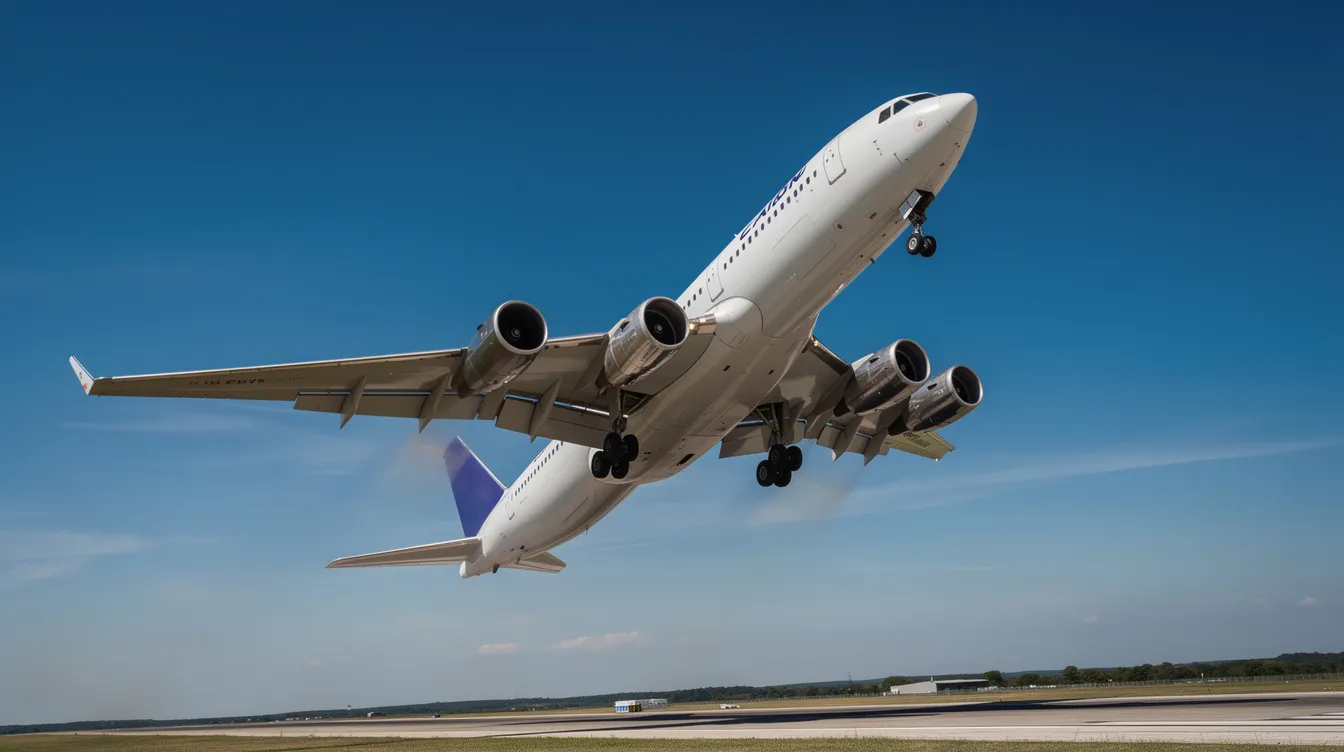
The A380's first flight took place on 27 April 2005 from Toulouse, France. Extensive flight tests and test flights followed over the next two years, validating the aircraft's performance across every operational envelope. The first aircraft entered service with Singapore Airlines on 25 October 2007, operating the Singapore–Sydney route to considerable fanfare.
Key milestones:
December 2000: Program officially launched by Airbus
April 2005: Maiden flight from Toulouse
October 2007: Entered service with Singapore Airlines
2012–2014: Peak production years, approximately 30 aircraft delivered annually
February 2019: Airbus announced end of production due to declining orders
December 2021: Final aircraft delivered to Emirates, the A380's largest customer and largest operator
Having reviewed the A380's development, let's examine the facts and figures that make it the largest passenger plane.
Facts, figures and dimensions: what makes the A380 the largest passenger plane
The specifications that earn the A380 its title are not just about length or wingspan - they reflect total usable volume, which no other passenger aircraft approaches.
The Airbus A380 has a length of 72.7 meters (238 feet).<sup>1</sup>
The Airbus A380 has a height of 24.1 meters (79.1 feet).<sup>1</sup>
Wing span: 79.8 m (wing area approximately 845 m²)
Maximum takeoff weight: 560–575 tonnes
Fuel capacity: approximately 320,000 litres
Range: ~8,000 nautical miles / 14,800 km (flights up to 17 hours)
Passenger capacity: 853 maximum (all economy); typical seating of 500–545 in a three-class layout
Cabin volume: over 1,570 m³ including lower deck cargo holds
Doors: 16 passenger doors
Windows: approximately 220 across both decks
Decks: two full-length passenger decks; main deck width ~6.5 m, upper deck width ~5.8 m
For context, Singapore Airlines configures its A380 with 379 seats in a generous four-class layout with premium cabins, while Emirates operates some aircraft with approximately 615 economy seats in a two-class configuration. The significant difference in these numbers illustrates how airlines tailor the same airframe to vastly different strategies.
With the numbers in mind, let's see how the A380's technology and design innovations changed commercial aviation.
Technology and innovation: what the A380 changed in commercial aircraft design
Digital Design and Materials
The A380 was the first aircraft of its size to be designed entirely using a full digital mock-up. This advanced technology allowed Airbus engineers to detect component clashes and integration issues virtually, reducing costly physical prototyping and accelerating design cycles. The approach became standard practice for later Airbus aircraft, including the A350.
Materials and weight reduction:
Carbon-fibre reinforced plastic (CFRP) used extensively in wing components, central wing box, and tail sections
GLARE laminates - a hybrid glass-fibre/aluminium material - applied to fuselage panels, improving fatigue resistance while cutting weight
Aluminium-lithium alloys in structural elements for further mass savings
Aerodynamic Innovations
High-aspect-ratio wings designed to operate near the 80 m airport infrastructure limit
Aerodynamic improvements including wingtip devices and optimized high-lift systems enabling slower, quieter approaches
These innovations allowed the A380 to achieve landing speeds and noise levels comparable to much smaller widebody aircraft.
Avionics and Systems
Integrated modular avionics architecture
Advanced fly-by-wire flight controls
Full-duplex Ethernet data networks - among the first in commercial aviation
New technologies in cockpit design that influenced the next-generation A350 program
These engineering achievements pushed the boundaries of what commercial aircraft could do. They also set a benchmark that resonates across all of aviation - including the aircraft categories used in private jet programs, where materials science and avionics continue to evolve.
Next, let's consider the A380's environmental impact and efficiency.
Responsibility and efficiency: fuel burn, emissions and noise
Environmental Impact
One of the A380's strongest arguments was fuel efficiency at scale. At high load factors, Airbus cites consumption of approximately 3.1 litres per 100 passenger-kilometre - a figure that compares favorably with driving a modern compact car, but delivered at 900 km/h across continents. The low fuel consumption per seat made the A380 a surprisingly fuel-efficient option on routes where airlines could consistently fill 450-plus seats.
The aircraft's noise footprint was also a notable improvement over previous generation quadjets. Modern high-bypass Trent 900 and GP7000 engines, combined with aerodynamic improvements, produced significantly lower community noise levels - an important factor for operations into noise-sensitive airports.
However, the landscape shifted:
Newer twin-engine long-range jets like the Airbus A350 and Boeing 787 achieve similar or better per-seat efficiency with 300–400 seats, and far better economics when load factors dip below 80%
The Boeing 777X promises further gains, though it cannot match the A380's sheer capacity
Airlines increasingly favored two-engine aircraft for their lower maintenance costs, greater route flexibility, and reduced infrastructure demands.
For private aviation, the efficiency conversation takes a different form. BlackJet builds carbon-neutral flights into every Jet Card program through verified carbon offsets at no additional cost to the traveler. While a private jet will never match the per-seat fuel burn of a fully loaded A380, the ability to offset the environmental footprint - combined with selecting efficient aircraft types, exploring more affordable private jet options, and sustainable aviation fuel where available - ensures that private travel can be pursued responsibly.
With efficiency and responsibility addressed, let's move inside the A380 to see what the cabin experience offers.
The A380 cabin experience: from economy to business class and beyond
First Class Features
The A380 earned a devoted following among passengers long before its production ended. Its twin-aisle, double-deck design creates a cabin environment that is quieter, more spacious, and less pressured than almost any other aircraft in the sky. Wider seats, generous overhead bins, higher ceilings, and a fuselage designed to reduce vibration make long-haul flights noticeably more comfortable.
Typical cabin configurations across operators:
First class: private suites with closing doors, lie-flat beds, personal minibars (Emirates, Singapore Airlines, Etihad Airways)
Several airlines introduced features unique to the A380. Emirates installed onboard bars and showers in first class. Singapore Airlines debuted its flagship Suites product. Qantas created a dedicated upper deck lounge. These innovations raised the bar for what passengers expect from premium cabins on any aircraft.
Business Class Experience
Business class: lie-flat seats with direct aisle access, premium dining, and onboard lounges
Premium economy: wider seats with extra legroom and upgraded service
Economy seats: 18-inch-wide seats in a 3-4-3 configuration on the main deck - more generous than many other aircraft
Yet even the most lavish A380 first class suite shares the aircraft with hundreds of other passengers. The cabin is not yours. The schedule is not yours. The routing is fixed. For travelers who define luxury as full control, a private jet cabin - where the entire aircraft is effectively first class for your group and can be tailored across multiple private jet types - represents a fundamentally different proposition.
Having explored the cabin experience, let's see where the A380 flies today and what the future holds for these giants.
A380s in the air today: operators, routes and future life
Airbus ended the A380 production line in 2021 after delivering 251 aircraft. As of mid-2026, approximately 189 remain in active service. Many airlines retired theirs during the pandemic, but several operators have recommitted to the type, investing in cabin refurbishments and route expansion.
Major operators still flying the A380:
Emirates - 116+ aircraft, by far the largest operator; recently completed fleet-wide cabin refit
Singapore Airlines - flagship routes to London, Sydney, and other key cities
Qantas - premium trans-Pacific and Kangaroo Route services
British Airways - London Heathrow hub operations
Lufthansa - select European hub departures
Qatar Airways - Doha hub long-haul services
Korean Air - transpacific and Asian trunk routes
All Nippon Airways (ANA / Nippon Airways) - Honolulu and other leisure routes
Etihad Airways - select routes from Abu Dhabi
Air France - returned select A380s to service on Paris CDG routes
Asiana Airlines - regional deployments
Flagship routes include Dubai–London Heathrow, Dubai–Sydney, London–Los Angeles, Singapore–London, and major Europe–Asia corridors. The A380 may remain in service into the 2030s and possibly early 2040s on select routes, though its numbers will gradually thin as airlines transition to newer fleet types with lower operating costs.
Next, let's compare the A380 to other giants of the sky.
Other giants: how rivals compare to the largest passenger plane
The A380 exists in a category of very large aircraft where only a handful of designs have ever competed.
Boeing 747-400/747-8: The original "Queen of the Skies." The 747-8 is slightly longer than the A380 but features only a partial upper deck (the distinctive hump), resulting in lower total passenger capacity (approximately 410 in a three-class layout). Boeing launched the 747-8 as both a passenger and freighter variant, but passenger production ended in 2017.
Boeing 777-300ER: A high-capacity twinjet seating up to 396 in two classes, offering similar range to the A380 but with significantly lower operating costs. It became many airlines' workhorse for long-haul routes.
Boeing 777-9: The next-generation 777X variant will be among the longest aircraft in commercial service, seating approximately 400–425 passengers with exceptional range. It does not replicate the A380's double-deck volume.
Airbus A350-1000: A fuel-efficient twin-engine widebody aircraft seating 350–410, optimized for ultra-long-haul point-to-point routes with a similar range to the A380.
While some of these aircraft match or exceed the A380 in length, none approach its total cabin volume or maximum capacity. The largest passenger aircraft title remains firmly with the A380 - the only aircraft that is truly a double-deck aircraft across its full length.
With the competition in mind, let's look at the complexity and logistics behind building the A380.
Inside the numbers: development cost, complexity and logistics
Building the world's largest passenger plane required an industrial effort without precedent in commercial aviation.
Development cost: initial estimates around €9.5 billion escalated to approximately €18 billion, with total program costs often cited near $25 billion
Production system: major fuselage and wing sections manufactured across four countries - France, Germany, Spain, and the United Kingdom - then transported to final assembly in Toulouse
Transport logistics: oversized components moved by Airbus Beluga transport aircraft, river barges, and specialized road convoys
The Itinéraire à Grand Gabarit: a dedicated route through southwest France, including widened roads and modified bridges, built specifically to carry A380 tail sections and fuselage panels at night
Cabin wiring complexity: early aircraft required over 500 km of wiring per airframe; inconsistencies between manufacturing sites contributed to significant delivery delays and cost overruns
These logistical and financial challenges ultimately shaped the program's commercial outcome. The scale required to build the largest passenger aircraft in history was itself a vulnerability - one that became apparent as market conditions shifted.
Now, let's examine the engines and systems that power the A380.
Engines and systems: Trent 900 and GP7000 powering the giant
The A380 is powered by four high-bypass turbofan engines, with airlines choosing between two options:
Rolls-Royce Trent 900: delivering approximately 70,000 lbs of thrust per engine, drawing on experience from engines used on the A340 and Boeing 777 programs
Engine Alliance GP7200: a joint venture between GE Aviation and Pratt & Whitney, blending technologies from the GE90 and PW4000 engine families to achieve similar thrust and efficiency levels
Both powerplants represent the state of the art for their era, optimized for low fuel consumption and reduced noise on long-range operations.
Beyond the engines, the A380 introduced systems innovations that influenced the broader aviation industry:
350-bar hydraulic systems - higher pressure than any previous commercial aircraft, allowing smaller, lighter actuators
Power-by-wire actuators for backup flight controls
Advanced electrical generation producing 600+ kVA to support two full decks of cabin systems, galleys, lighting, and entertainment.t
With the technical details covered, let's turn to the A380's safety record.
Passenger safety record and incidents
As of mid-2026, the A380 has recorded no hull-loss accidents across more than 800,000 commercial flights carrying over 300 million passengers. It is statistically among the safest large aircraft types ever built.
The most notable incident occurred on 4 November 2010 when Qantas Flight 32, an A380 departing Singapore, suffered an uncontained failure of its number-two Trent 900 engine. Shrapnel damaged flight controls, fuel systems, and hydraulics. The flight crew - aided by the aircraft's multiple redundant systems - safely returned to Singapore and landed without injuries. The event demonstrated precisely the kind of fail-safe engineering that makes modern commercial aircraft remarkably resilient.
This safety culture extends beyond commercial aviation. At BlackJet, every partner operator undergoes rigorous safety certification and auditing, including standards like ARGUS and IS-BAO, comparable to the benchmarks used to evaluate top private jet companies. Whether a traveler flies on the world's largest passenger aircraft or a light jet, safety and redundancy must be the foundation - never a luxury add-on.
With safety assured, let's discuss why the A380 struggled commercially despite its size.
Why the A380 struggled commercially despite its size
The A380's commercial challenges were strategic, not technical. The aircraft was engineered for a market model - hub-and-spoke networks connecting mega-airports - that began evolving even before the first aircraft entered service.
Key factors:
Market shift: airlines increasingly favored point-to-point service with efficient twin-engine jets, bypassing congested hubs entirely. ETOPS regulations made ultra-long twin-engine routes viable, eliminating the need for four-engine aircraft on most corridors.
Infrastructure demands: only a handful of airports could accommodate A380 operations without significant investment in wider taxiways, reinforced pavement, multi-level boarding gates, and expanded terminal capacity
Fill rate pressure: consistently selling 500+ seats at profitable yields proved challenging for many airlines, especially outside peak seasons.ns
Cargo variant failure: the A380F freighter version attracted initial freight orders from operators like FedEx Express and UPS, but both cancelled. The cargo variant was never built, removing a potential revenue stream. The freighter version's cancellation reflected broader doubts about the airframe's commercial versatility.
Residual value weakness: a thin secondary market and high maintenance costs meant retired A380s had limited resale options
Ultimately, only a small number of carriers could deploy the A380 profitably at scale. Emirates, with its Dubai hub strategy and massive connecting traffic flows, accounted for nearly half of all orders. For most airlines, efficient twins offered better economics.
Next, let's look at the variants and concepts that never made it to production.
Variants, stretch concepts and "what might have been"
The A380-800 passenger model was the only variant to reach production. Several other configurations were studied but never launched:
A380F (freighter): designed to carry approximately 150 tonnes of payload over 5,600 nautical miles; initial freight orders were placed but cancelled before delivery
A380-900 (stretch): a proposed variant family that would have extended the fuselage to accommodate 50–100 additional passengers
A380neo: envisioned with new-generation engines for improved fuel efficiency
A380plus: a package of winglets, cabin optimization, and aerodynamic improvements aimed at reducing cost per seat by 13%
None of these proposed variants advanced beyond concept studies. Market demand had shifted decisively toward smaller, more flexible widebody aircraft, and Airbus chose to focus its engineering and capital resources on the A350 - a decision that proved commercially sound.
Now, let's consider when a mega-liner like the A380 makes sense in an airline fleet.
Role in airline fleets: when a mega‑liner makes sense
The A380 works best on a specific type of route: high-density corridors between slot-constrained airports with strong premium and leisure demand, where some groups instead evaluate private jets for around 20 passengers to keep similar capacity but gain full control.
Where it excels:
Dubai–London Heathrow: Emirates operates multiple daily A380 services on this route, filling aircraft consistently with connecting traffic from across its network
Singapore–Sydney: one of the first A380 routes, leveraging strong business and tourism demand between Southeast Asia and Oceania
London–Los Angeles and London–Hong Kong: British Airways deploys A380s where gate slots are scarce and premium demand is high
Airlines like Emirates, British Airways, Singapore Airlines, and Qantas deploy their A380 fleet on carefully selected trunk routes to maximise load factors and per-seat revenue. On secondary or seasonal routes, the economics collapse - which is why many airlines with smaller A380 fleets have already retired or stored their aircraft, while some large groups instead consider private jets for 50 passengers or fewer for flexible premium travel.
With the A380's operational sweet spot defined, let's see how the industry has shifted toward smaller, long-range twins.
From mega‑liners to point‑to‑point: the rise of long‑range twins
The most consequential shift in commercial aviation over the past two decades has been the migration from very large aircraft to smaller, long-range twins.
Aircraft like the Airbus A350, Boeing 787, and Boeing 777-300ER offer similar range to the A380 with 300–400 seats instead of 500+. Advances in engine reliability - particularly the maturation of ETOPS regulations allowing twin-engine aircraft to fly routes previously reserved for four-engine types - made this transition inevitable.
The advantages are clear:
Greater frequency: airlines can offer three daily flights with 350-seat aircraft instead of two with 550-seat aircraft, giving passengers more scheduling options
Route diversity: smaller aircraft open profitable service to city pairs that could never support A380-level capacity
Lower operating costs: two engines instead of four, simpler ground handling, compatible with more airports
Low-cost carriers entering long-haul markets have overwhelmingly chosen twin-engine widebody aircraft for their economics.
This trend toward right-sized, flexible aircraft mirrors the logic of private aviation. Where commercial airlines moved from mega-liners to efficient twins, private travelers have always had the ultimate point-to-point solution: a Jet Card program that puts the right aircraft on the right route at the right time.
Next, let's compare the A380's business class to the private jet experience.
Comparing travel classes: A380 business class vs private jet cabins
On the best A380 operators, business class is genuinely impressive. Lie-flat seats with direct aisle access, noise-cancelling headphones, curated multi-course dining, and dedicated cabin crew create an experience that far surpasses economy. On Emirates and Singapore Airlines, upper deck business class cabins include onboard bars and lounge areas.
Now consider the alternative.
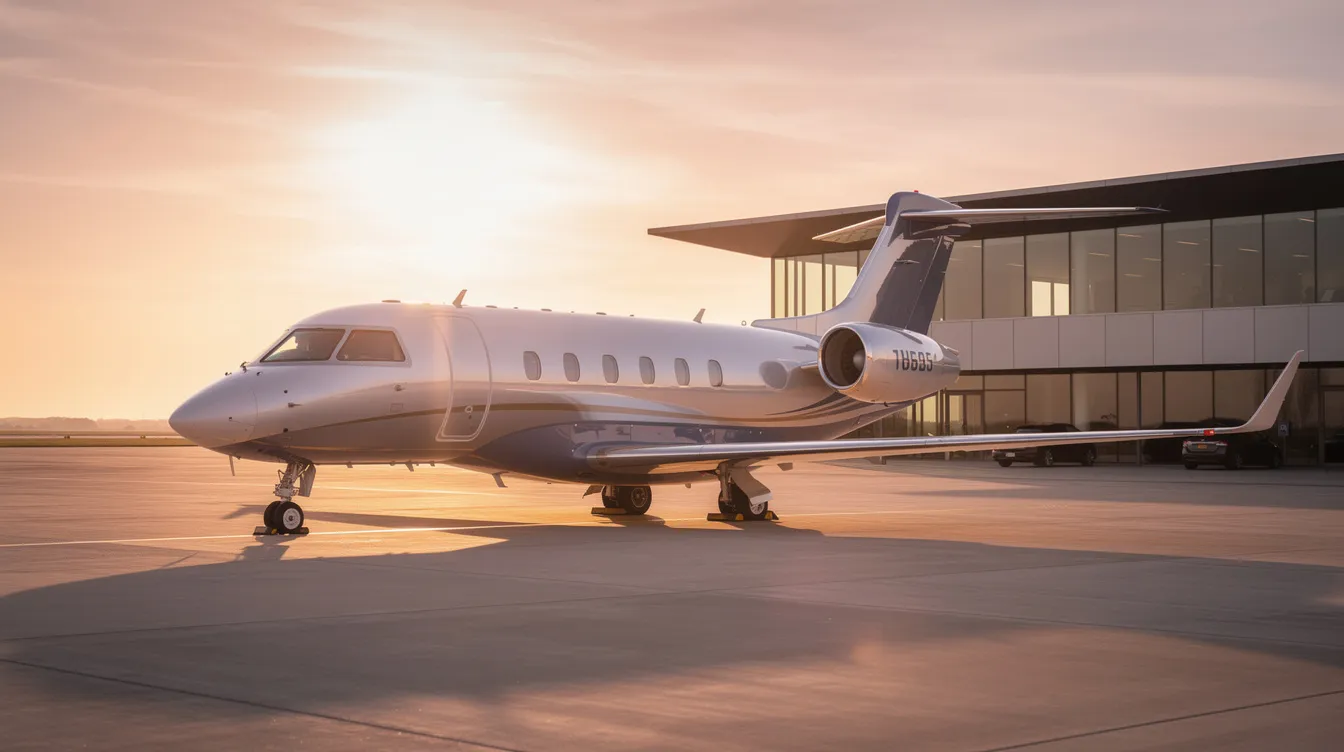
A modern super-midsize or large-cabin private jet - the kind accessible through a BlackJet 25-hour Jet Card or the expanded BlackJet 25+ Hour Jet Card - offers a fundamentally different experience:
Privacy: the cabin is yours alone. No strangers, no cabin announcements, no overhead lighting conflicts
Catering: bespoke menus tailored to your preferences, not a choice between two pre-set options
Productivity: hold confidential meetings, make calls, spread documents across a conference table
Sleep: quiet cabin configured for rest, not a lie-flat seat surrounded by 40 other passengers
Scenario: London–Dubai (or even niche markets like private jet charters in Karachi for regional hubs off the A380 map)
Factor | A380 Business Class | BlackJet Jet Card |
|---|
Pre-departure time | 90–120 minutes | 15–30 minutes |
Boarding process | Shared with 400+ passengers | Walk directly to aircraft |
Flight time | ~7 hours | ~6.5 hours (direct) |
Immigration/customs | Standard queue | Streamlined private terminal |
Post-arrival transfer | Public terminal to ground transport | Direct tarmac-to-car |
Total door-to-door | ~11–13 hours | ~7.5–9 hours |
Even though the A380 is the largest passenger aircraft in the world, genuine privacy is only achieved when the entire aircraft belongs to you—whether through a VIP-configured private jet Airbus A380 or a more right-sized business jet. That is the core of private aviation's value.
With these comparisons in mind, let's look at the broader advantages of private jets over large commercial aircraft.
Large aircraft vs private jets: time, convenience and access
The time savings of private aviation compound across every segment of a journey:
Airport access: private jets operate from thousands of airports globally, including regional and private airfields that reduce ground travel time. Commercial A380 flights are restricted to perhaps 60–80 airports worldwide with adequate infrastructure.
Security and boarding: arrive 15–30 minutes before departure at a private FBO versus 90–120 minutes at a commercial terminal
Connections eliminated: no layovers, no missed connections, no rebooking queues
Baggage: walk from aircraft to car with your luggage; no carousel, no wait
Immigration: many private terminals offer expedited customs and passport control
BlackJet's digital booking platform and 24/7 real-time support mean travelers schedule flights around their agenda - not around an airline's timetable, whether chartering whole aircraft or simply buying a seat on a private jet. For multi-city itineraries (three European capitals in four days, for example), private aviation is not merely convenient. It is the only practical option, especially for teams that fit naturally into 15 passenger private jets with long-range capability.
With convenience and access covered, let's revisit the topic of safety and certification.
Safety, certification and reliability in large and private aircraft
The A380's certification process was among the most rigorous in aviation history: full-scale structural fatigue tests, emergency evacuation drills with 853 passengers and 20 crew exiting in under 80 seconds, and engine-out performance validation under extreme conditions. These standards are set by EASA and FAA and represent the gold standard of commercial aircraft safety.
Private aviation safety, when managed correctly, mirrors these principles. BlackJet's safety and certification framework requires every partner operator to meet or exceed industry-leading standards:
ARGUS-rated and Wyvern-certified operators
Experienced two-pilot crews meeting stringent duty-time and training requirements
Audited fleets across light, midsize, super-midsize, and large cabin categories
Real-time operational monitoring and flight tracking
Whether flying on the world's largest passenger aircraft or a light jet for a regional hop drawn from the best small private aircraft, safety is the only aircraft characteristic that should never be compromised.
With safety and reliability addressed, let's look at sustainability and the future of large commercial aircraft.
Sustainability and the future of large commercial aircraft
The aviation industry faces mounting pressure to reduce its environmental footprint. Large commercial aircraft like the A380 contribute to efficiency per passenger when fully loaded, but the trend is toward newer aircraft with 20–25% better fuel burn per seat.
Current and emerging sustainability initiatives:
Sustainable aviation fuel (SAF) is being tested and deployed on A380 routes, with Airbus pursuing certification for 100% SAF operation across its fleet
Airbus's ZEROe program is exploring hydrogen-powered aircraft concepts for entry into service by the mid-2030s
Hybrid-electric propulsion research continues for shorter-range applications
In private aviation, BlackJet takes a direct approach: every Jet Card flight is carbon neutral through verified offsets at no additional cost to the member. Where available, BlackJet also facilitates access to SAF and prioritizes more fuel-efficient aircraft types within its partner fleet.
Both large aircraft operators and private jet providers must address climate challenges transparently. The distinction is not whether to act, but how quickly and credibly each segment can deliver measurable reductions.
With sustainability in mind, let's answer some of the most common questions about the A380.
Frequently asked questions about the largest passenger plane
What is the largest passenger plane? The Airbus A380-800 is the world's largest passenger aircraft. It is the only full-length double-deck airliner, with a certified maximum seating capacity of 853 passengers in an all-economy configuration and typical seating of 500–545 in a three-class layout.
How many passengers can an Airbus A380 carry? The A380 can carry a maximum of 853 passengers.<sup>1</sup> Most airlines configure it for 500–615 passengers depending on the number of premium cabins. Singapore Airlines seats 379 in four classes; Emirates seats approximately 615 in two classes.
Is the Airbus A380 still flying? Yes. Although Airbus ended production in 2021, approximately 189 A380s remain in active service as of 2026. Emirates alone operates 116+ aircraft. The type is expected to remain in service on select routes into the 2030s and potentially the 2040s.
Which airlines use the A380? Major operators include Emirates, Singapore Airlines, Qantas, British Airways, Lufthansa, Qatar Airways, Korean Air, All Nippon Airways, Etihad Airways, Air France, and Asiana Airlines, among several airlines worldwide.
What will replace the A380? There is no direct replacement. Airlines are transitioning to efficient twin-engine widebody aircraft like the Airbus A350 and Boeing 777X, which offer similar range with lower operating costs and greater route flexibility.
How does flying private with BlackJet compare to flying business class on the A380? An A380 business class seat offers a premium experience within a shared cabin. A BlackJet Jet Card flight offers full cabin privacy, bespoke service, drastically reduced airport time, access to thousands of additional airports, and schedule flexibility - the entire aircraft is your first-class cabin. Explore how Jet Cards work to understand the practical differences.
Now that we've answered the most common questions, let's see how the A380 influenced private and business aviation.
How the largest passenger aircraft influenced private and business aviation
The A380's first class suites, onboard showers, and dedicated bars raised the standard of what air travel could feel like. That benchmark did not stay confined to commercial aviation. Corporate travelers and high-net-worth individuals who experienced A380 premium cabins came to expect similar - and eventually superior - levels of comfort, service, and privacy from every flight.
This expectation migration has been a tailwind for private aviation. Executives who once defaulted to A380 or 777 business class on long-haul flights are increasingly moving to Jet Card solutions that offer flexibility and control without the constraints of airline schedules. BlackJet's aircraft categories - from small private aircraft for short hops to ultra-long-range cabins for intercontinental missions - cover mission profiles that overlap with many A380 routes, but with bespoke routing and timing.
Mega-liners shaped the benchmark. Private jets now define the pinnacle.
With this context, let's help you decide when to fly the A380 and when to fly private.
Choosing your next long‑haul: when to fly the A380, when to fly private
There are scenarios where an A380 flight makes practical sense: a solo leisure traveler on a major route like London–Sydney, where premium cabin pricing is competitive and the aircraft's comfort advantages over other commercial options are tangible. For larger parties, understanding the cost of a 12-seater private jet can shift the equation toward chartering instead.
But for many frequent travelers, the calculus favors private aviation:
Multi-city executive trip: a team of four visiting London, Munich, and Milan in three days. No commercial routing can match the efficiency of point-to-point private flights between these cities.
Family with children and pets: boarding a private aircraft eliminates the stress of commercial terminals, pet cargo holds, and the logistics of managing a family through a mega-airport built for 500-seat aircraft.
Last-minute board meeting: a CEO summoned to Dubai for an urgent meeting tomorrow. No A380 schedule offers the flexibility of a same-day private departure.
The per-seat cost of an A380 business class ticket is lower than chartering a whole aircraft. But cost and value are not the same measure. When you factor in time saved, productivity gained, and the ability to control every element of the journey, the "right-sized, right-timed" aircraft wins for serious travelers - and that is precisely what a Jet Card delivers, whether structured as a 50-hour Jet Card program or a larger commitment.

With your options clear, let's see how BlackJet can help you take the next step.
BlackJet perspective and next steps
The Airbus A380 remains a marvel of engineering - the largest passenger plane ever built, a testament to what the aviation industry can achieve when ambition meets technical mastery. But the future of premium travel is not about sheer scale. It is about personalized access, time efficiency, and the freedom to fly on your own terms.
BlackJet's Jet Card programs are built around the principles that matter most to frequent, high-net-worth travelers:
Safety first: every flight operated by top-tier certified partners, continuously audited and monitored
Carbon-neutral commitment: verified offsets included in every Jet Card flight at no extra cost
Technology-enabled booking: 24/7 digital platform with real-time support, designed for the pace of modern business
Fleet breadth: light, midsize, super-midsize, large cabin, and ultra-long-range aircraft - the right aircraft for every mission
The largest passenger aircraft in history showed the world what air travel could be. BlackJet shows what it should be - effortless, private, and precisely tailored to you, whether you commit to a flexible 25-hour membership or evaluate the economics of a larger 100-hour Jet Card cost structure.
Explore BlackJet Jet Card membership and discover how private aviation can reshape the way you travel. Speak with a BlackJet travel advisor, explore premium UK private jets for sale if ownership is on your horizon, or visit the mobile platform to compare your next journey against commercial alternatives.


 Sign up with google
 Sign up with Apple