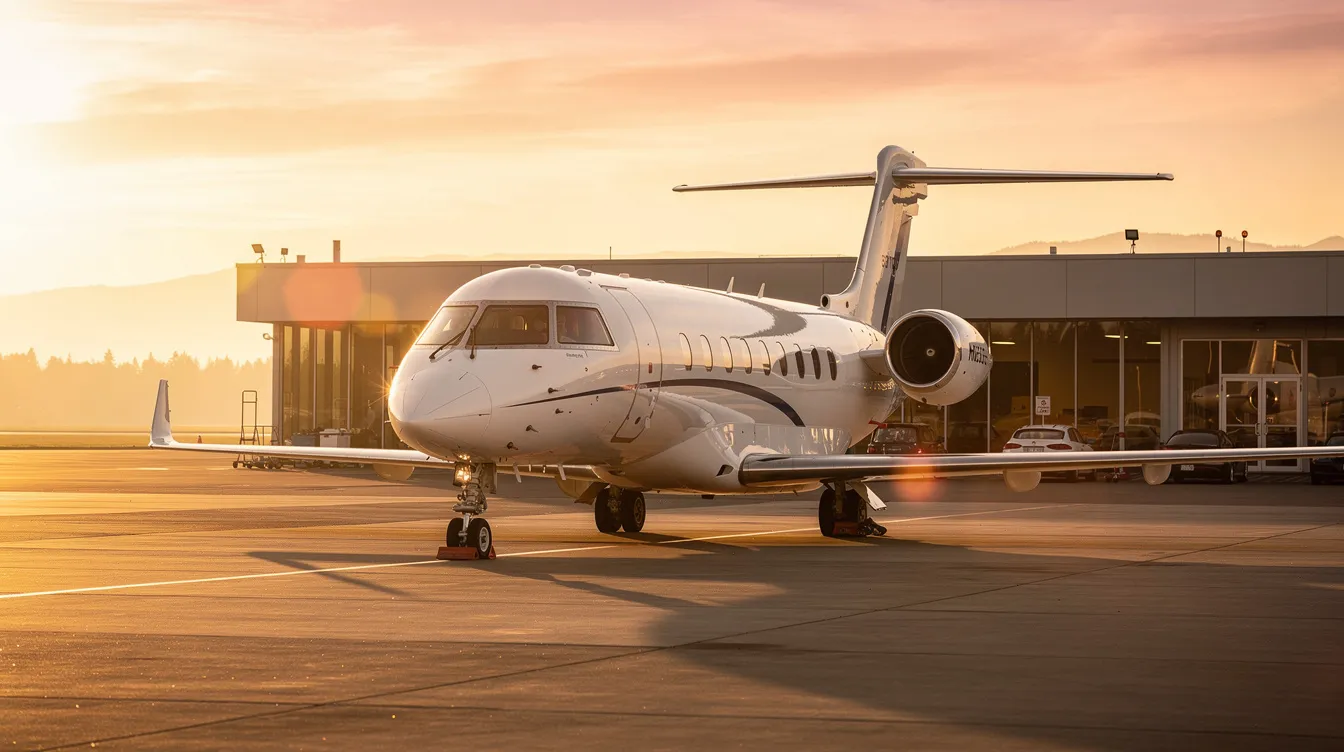
For travelers who have outgrown the inefficiencies of commercial airlines but aren't yet committed to chartering an entire aircraft, JSX occupies an intriguing middle ground. This guide breaks down exactly what the JSX airline experience delivers—routes, cabin comfort, fares, and logistics—and where a BlackJet Jet Card picks up where semi-private flying leaves off.
Overview: What Is JSX and Why High-End Travelers Compare It to Private Jets?
JSX is a semi-private public charter airline founded in 2016 under the name JetSuiteX (formerly Jet Suite), rebranding to JSX in August 2019. Rather than operating like other commercial airlines with crowded terminals and lengthy security queues, JSX flights depart from private terminals and FBOs, giving passengers a streamlined ground experience that feels closer to flying private than riding a standard air carrier.
Here is what defines JSX at a glance:
JSX operates three aircraft types—the Embraer 145, Embraer 135, and ATR 42—each retrofitted to carry just 30 passengers in a single business-class-style cabin
JSX passengers board from private terminals, bypassing traditional TSA lines entirely
Check-in occurs just 20–30 minutes before departure, a fraction of what most passenger flights require
Fares often start around $119 per seat on short-haul flights, positioning JSX between economy and full first-class pricing
The carrier serves destinations primarily across the southwestern and southern United States in this part of the country, plus select routes into Mexico
By contrast, BlackJet provides whole-aircraft charter through prepaid Jet Card programs. Every flight is fully private—custom schedules, bespoke catering, and access to thousands of airports rather than a fixed route network. For the frequent executive traveler, this distinction matters: JSX offers a taste of premium aviation, while BlackJet delivers complete control.
Where JSX Flies Today: Key Routes and How They Fit Executive Travel
JSX's route network includes locations in California, Nevada, Texas, and Florida, connecting regional and major hubs primarily in the southwestern and southern U.S. The airline also flies domestically in California, Washington, Nevada, and Arizona, with recent expansion to Miami and Westchester County on the East Coast.
Notable JSX flight examples include:
Burbank to Concord - JSX's first flight, operating since April 2016
Burbank to Las Vegas - one of the most popular leisure and business corridors
Oakland to Orange County - Bay Area executives avoiding LAX entirely
Dallas to Houston and Austin - high-frequency Texas business shuttles
Las Vegas to Dallas, Austin, and Houston - connecting entertainment and corporate hubs
Westchester County to Miami/Palm Beach - East Coast executive links
JSX flies from convenient smaller regional airports like Burbank instead of LAX, Concord instead of SFO, and Orange County (John Wayne) instead of LAX. This approach saves significant ground time—often 30–60 minutes each way-for travelers who value efficiency.
The fleet includes Embraer ERJ-135 and ERJ-145 jets for longer routes, plus ATR 42 turboprops for stages under roughly 350 miles. Seasonal destinations like Reno-Tahoe and leisure markets round out the schedule.
BlackJet's on-demand model extends far beyond these fixed city pairs. With access to private plane charter across the continental U.S., Caribbean, and Europe via partner operators and a broad range of types of private jets, a BlackJet Jet Card removes the constraint of flying only where JSX goes.
JSX Travel Experience: From Check-In to Arrival
The first time you fly JSX, the experience feels strikingly different from anything at a major airport. Here is the end-to-end flow:
Arrival and check-in: JSX check-in requires showing ID and tagging luggage at the JSX terminal—a private FBO or dedicated hangar, not a main commercial terminal. You arrive as little as 20 minutes before departure for domestic flights
Security: Passengers bypass traditional TSA lines. JSX uses Secure Flight vetting and weapons/explosives screening, but there are no long queues or shoe-removal rituals
Lounge and wait time: The lounge is a functional, comfortable space with complimentary coffee, drinks, and light snacks. It is not a full-scale international business lounge, but you rarely wait more than 10–15 minutes
Boarding: Boarding begins 15 minutes before departure. On many JSX flights, passengers walk across the tarmac or ride a short shuttle directly to the plane-no jet bridges, no crowded gates
Arrival: On landing, bags are delivered on carts to a small claim area or directly to the lounge. Exit is quick; coordinate a rideshare to the specific JSX airport FBO address for seamless pickup
JSX provides a faster and more convenient travel experience than traditional airlines. But BlackJet's ground experience goes further: dedicated FBO handling, car-to-aircraft transfers, coordinated chauffeur service, and fully private spaces with essentially no queuing at any point of the journey.
Onboard: Seating, Cabin Layout, and Semi-Private Comfort
JSX retrofitted its ERJ-135 and ERJ-145 to carry 30 passengers in a single, uniform cabin. There are no separate cabin classes-everyone receives the same seats and service.
The Embraer 145 has a 1x1 seating configuration-single seats on each side of the aisle, meaning no middle seat and no seatmate
The Embraer 135 and ATR 42 have a 2x1 seating configuration, with two seats on one side and a single seat on the other
Seat pitch ranges from 35 to 37 inches of extra legroom, compared to roughly 28–32 inches on standard economy
Seats are leather, reclining, with tray tables and power/USB outlets at every row
The ATR 42 features a larger cabin with more overhead bin space, while many Embraer aircraft have overhead bins removed entirely, creating an open feel but requiring most luggage to be checked
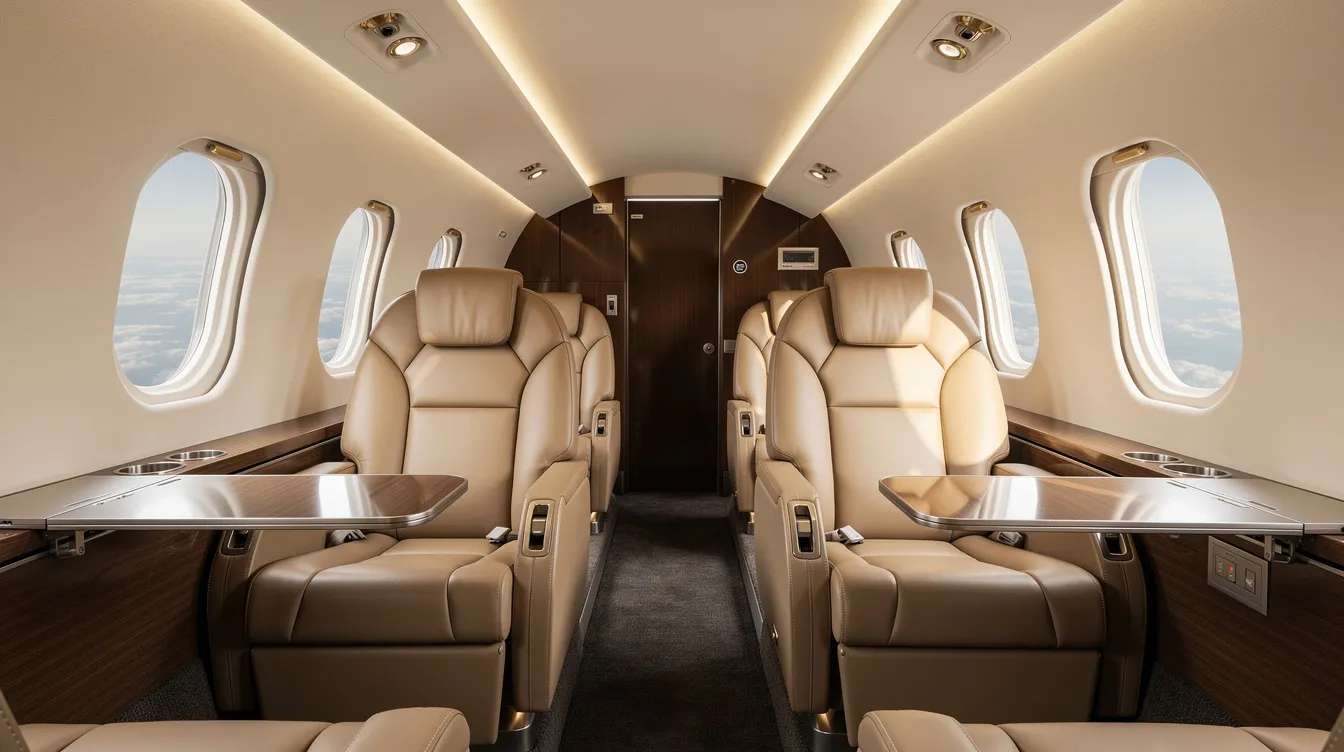
BlackJet's aircraft categories—light, midsize, super-midsize, and large-cabin jets, including 16-seat private jet options — offer a different proposition entirely. Travelers select the cabin class that fits their needs, from six-passenger light jets to long-range heavy aircraft with boardroom-style seating, sleeping divans, and fully private cabins. The privacy, noise isolation, and finish are a category above what any 30-seat regional plane can deliver.
Service, Food, and In-Flight Amenities on JSX Flights
JSX keeps its service model simple but effective. One flight attendant serves up to 30passengers—aa ratio that allows noticeably more attention than a typical commercial carrier with 150+ customers onboard, yet it still operates as a semi-private carrier where you buy a seat on a private jet rather than chartering the whole aircraft.
JSX offers unlimited snacks and beverages on flights, including soft drinks, coffee, beer, wine, and simple cocktails. Passengers can enjoy craft beer and cocktails onboard at no extra cost
JSX provides complimentary drinks, including free alcohol, across both fare classes
JSX serves sophisticated snacks like grass-fed venison sticks and charcuterie-style boxes on select routes—free snacks are standard on every departure
High-speed Wi-Fi is available for streaming on JSX flights, with Starlink rolling out across the fleet. Passengers rely on personal devices for entertainment; there are no seatback screens
JSX allows small pets to travel in the cabin for an additional fee
BlackJet leverages full private jet flexibility: custom catering with specific champagne labels or dietary menus, quiet cabins configured for productivity, and guaranteed connectivity options depending on aircraft class. For travelers who need to conduct a meeting at 40,000 feet, that distinction is significant.
JSX Fares, Fees, and How Pricing Compares to Private Jet Options
Buying a JSX ticket means choosing between two fare classes: "Hop On" and "All In." Tickets for JSX typically include checked baggage allowances, which distinguishes the airline from many other airlines that charge separately.
Hop On fares include two free checked bags (up to 50 lb each), seat selection as part of the ticket options at an additional cost ($10–$30), and a $50 change/cancellation fee after the 24-hour grace period
All In fares allow three free checked bags, include free seat selection, and have no change or cancellation fees-with refunds returned to the original payment method
Base fares start around $119 on short routes, scaling with demand and season. JSX often undercuts full-fare business class on similar routes while delivering a semi-private terminal experience
Both fare types include complimentary drinks and snacks—no paying extra for in-flight service
How does this compare to private jet access? BlackJet's Jet Card model operates on a fundamentally different structure: prepaid hourly rates for the entire aircraft, not per-seat pricing, and travelers often evaluate these options by analyzing the jet card cost per hour across aircraft classes and providers. Rates range from approximately $6,500/hour for light jets to around $20,000/hour for large-cabin, long-range aircraft. There are no surprise baggage or seat-selection fees. For a solo traveler on the same routes JSX covers, per-seat pricing wins on cost. For groups, families, or custom itineraries, the Jet Card cost structure often delivers more value per person than it initially appears, especially once you understand overall Jet Card cost and membership pricing.
Operational Model and Safety: Public Charter vs Private Jet Charter
JSX operates as a Part 135/380 public charter carrier in the U.S. Its flights are sold per seat through Delux Public Charter, LLC, and are subject to FAA oversight—though under different regulatory frameworks than scheduled Part 121 airlines, and sit alongside offerings from leading private jet companies that focus on fully private charters.
JSX terminals use Secure Flight vetting, weapons detection, and visual/thermal screening, but avoid full TSA checkpoints, resulting in faster processing with less invasive screening
The public charter model means JSX flies fixed schedules on fixed routes, similar to airlines but using smaller aircraft and private terminals
JSX's regulatory status has faced scrutiny, with some tension from unions and scheduled carriers over how public charters are regulated relative to traditional airlines
BlackJet's safety positioning is distinct. Every flight is BlackJetCertified—a proprietary standard that fewer than 30% of U.S. charter operators meet. This includes third-party audits (ARGUS, Wyvern), strict pilot-hour requirements, maintenance oversight, and consistent crew evaluation. For sophisticated travelers, the layered safety certification of a vetted private charter operator offers a measurable step above what a public charter framework provides.
JSX Baggage, Check-In Rules, and Practical Travel Tips
Here is a practical checklist for anyone planning to fly JSX:
Carry-on: One small personal item that fits under the seat (approximately 13" × 11" × 17"). Limited cabin storage and the absence of overhead bins on most Embraer aircraft mean larger items must be checked
Checked bags: Hop On includes two bags up to 50 lb each; All In includes three. Extra or overweight bags incur roughly $50 per item
Check-in timing: Arrive 20–30 minutes before departure. JSX check-in occurs at the private FBO-not the main terminal. A boarding pass and bag tags are finalized at the terminal counter
Boarding cutoff: Boarding closes approximately 15 minutes before takeoff
Ground transport: Direct your rideshare or car service to the specific FBO address, not the main airport terminal. First-time travelers frequently make this mistake
Documents: Have government-issued ID ready; no passport needed for domestic flights. For Mexico routes, standard international documentation applies
BlackJet simplifies these logistics further. Car-to-jet transfers, flexible departure times, and FBO staff handling luggage directly mean there is no sign-in queue, no bag-size anxiety, and no risk of missing a cutoff window when you use BlackJet’s premium private jet card programs.
When JSX Makes Sense vs When to Choose BlackJet Private Jet Access
This comes down to use case. Here is how to think about it:
JSX is best when:
You are a solo traveler or a pair flying fixed city pairs like Burbank–Las Vegas or Dallas–Houston
Your travel aligns with JSX's published schedule and destinations
You want semi-private speed and convenience at near-business-class cost
Discounts or base fares make JSX meaningfully cheaper than alternatives
BlackJet is best when:
You need last-minute departures outside JSX timetables or off-network airports
You are traveling with a family or larger group requiring cabin privacy
Your itinerary involves multi-city roadshows, international legs, or destinations JSX does not serve
You require full control over the passenger list, schedule, and service level, including access to private jets suitable for 20 passengers when you are moving larger groups
Corporate ESG goals demand carbon-neutral flights as standard—which every BlackJet flight delivers
JSX flies with up to 30 strangers in a shared cabin. BlackJet offers a fully private aircraft where you decide who boards. For travelers weighing whether flying private is worth it, that privacy gap is often the deciding factor.

BlackJet Jet Cards and Technology: A Step Beyond Semi-Private JSX Fly Options
BlackJet's Jet Card programs-available in 25-hour and 50-hour blocks—provide prepaid access to private jets across multiple cabin sizes and can be compared directly with 225-hourjet card options and 50-hour jet card pricing available in the wider market. Unlike buying individual JSX tickets, a Jet Card offers:
Fixed hourly rates by aircraft class (light, midsize, super-midsize, large cabin) with no hidden fees, following transparent jet card pricing structures
Real-time booking via BlackJet's digital platform—web or mobile-with concierge-level support available 24/7
Carbon-neutral flights as standard, with offsets calculated and included at no extra cost, which is a key benefit highlighted in many best jet cards for frequent flyers comparisons
BlackJet Certified safety on every flight, with fewer than 30% of U.S. charter operators qualifying
Sample scenario: A New York–based executive uses JSX for regular Westchester-to-Miami shuttles. But when a client meeting in Aspen comes up on 12 hours' notice—or a family trip to the Caribbean requires flexibility-she draws on her 25-hour BlackJet Jet Card, booking a midsize jet to an airport JSX simply does not serve.
If you are already considering semi-private JSX air travel, explore how BlackJet can extend that convenience into full private jet access with predictable costs and elevated privacy. Discover what a Jet Card can do for your travel.
FAQs: JSX Flights vs Private Jet Charter with BlackJet
Is JSX considered flying private? No. JSX is a public charter service where you purchase a seat on a shared 30-passenger aircraft with a fixed schedule. Flying private through BlackJet means chartering the entire plane—you control who is onboard, when you depart, and where you go.
How does JSX pricing compare to chartering a private jet? JSX fares start around $119 per seat. Private jet charter via Jet Cards runs $6,500–$20,000 per flight hour depending on aircraft class, within the broader range of typical private jet rental costs. For solo travelers on JSX's same routes, per-seat pricing is significantly cheaper. For groups or off-network trips, private charter cost per person narrows considerably.
Can I earn miles or loyalty benefits on JSX flights? JSX has its own Club JSX loyalty program, but it does not integrate with major airline frequent flyer programs like Delta or United.
What kind of business class experience does JSX offer? JSX provides a single-cabin experience with leather seats, 35–37 inches of legroom, complimentary drinks and snacks, and boarding from private terminals. It mirrors domestic business class comfort without a separate premium cabin tier.
Does JSX fly internationally? Only to limited Mexico destinations such as Cabo San Lucas. BlackJet's Jet Card model enables international travel-Caribbean, Latin America, and Europe—through its certified operator network.
How do BlackJet Jet Cards work compared to buying JSX tickets? Jet Cards are prepaid blocks of flight hours at fixed rates, granting access to entire private aircraft with full scheduling flexibility, whether you opt for a 100 hour jet card program or evaluate options across the broader private jet price list. JSX tickets are per-seat purchases on fixed-schedule flights in a shared cabin.
JSX provides a strong introduction to premium air travel—a genuine step above what commercial airlines deliver on the same routes. For travelers who have experienced that upgrade and now seek full privacy, schedule control, and carbon-neutral private aviation, BlackJet represents the natural evolution, whether you are comparing NetJets jet card costs, exploring large private jets for 50 passengers, evaluating private jet leasing options, or even looking for the cheapest private jet solutions. Explore what premium jet access looks like-on your terms.
Conclusion: Choosing Between JSX and BlackJet for Your Next Flight
JSX offers a compelling semi-private flying experience that bridges the gap between commercial airlines and private jet travel. Its streamlined check-in, comfortable seating, and competitive pricing on fixed routes make it an attractive option for solo travelers or pairs seeking convenience without the full cost of private jet ownership.
However, for discerning travelers who demand complete control, privacy, and customization, BlackJet’s Jet Card programs provide unparalleled access to a broad range of private jets with bespoke service, flexible scheduling, and certified safety standards. BlackJet also leads in sustainability with carbon-neutral flights included at no extra cost.
Ultimately, the choice depends on your travel needs: JSX excels for predictable, regional routes with semi-private comfort, while BlackJet elevates your journey with full private jet access tailored to your schedule, group size, and destination.
Explore how BlackJet can redefine your travel experience with exclusive Jet Card options designed for the modern executive and luxury traveler. Discover the freedom of private aviation on your terms with our private plane charter.


 Sign up with google
 Sign up with Apple