By the BlackJet Editorial Team. Reviewed by private aviation operations and safety specialists. Last updated June 28, 2026.
Choosing how to fly private comes down to one practical question: which model can you repeat reliably without straining your budget or your patience? Four options dominate the private jet market, and they are a jet card, on-demand charter, fractional ownership, and whole aircraft ownership. Each one solves a different problem, and the option that sounds most impressive is rarely the one that fits how you actually travel. This guide turns the comparison into a scored decision matrix, hands finance teams a checklist for multi-user jet card programs, and explains the last-minute booking realities most brochures skip.
The One-Screen Decision Matrix
The best model is the one you can repeat reliably across budget, availability, and governance, not the one that photographs well on a tarmac. Buyers who pick on prestige tend to overpay or get stuck in contracts they cannot exit. Start with how you fly, then match the structure to it.
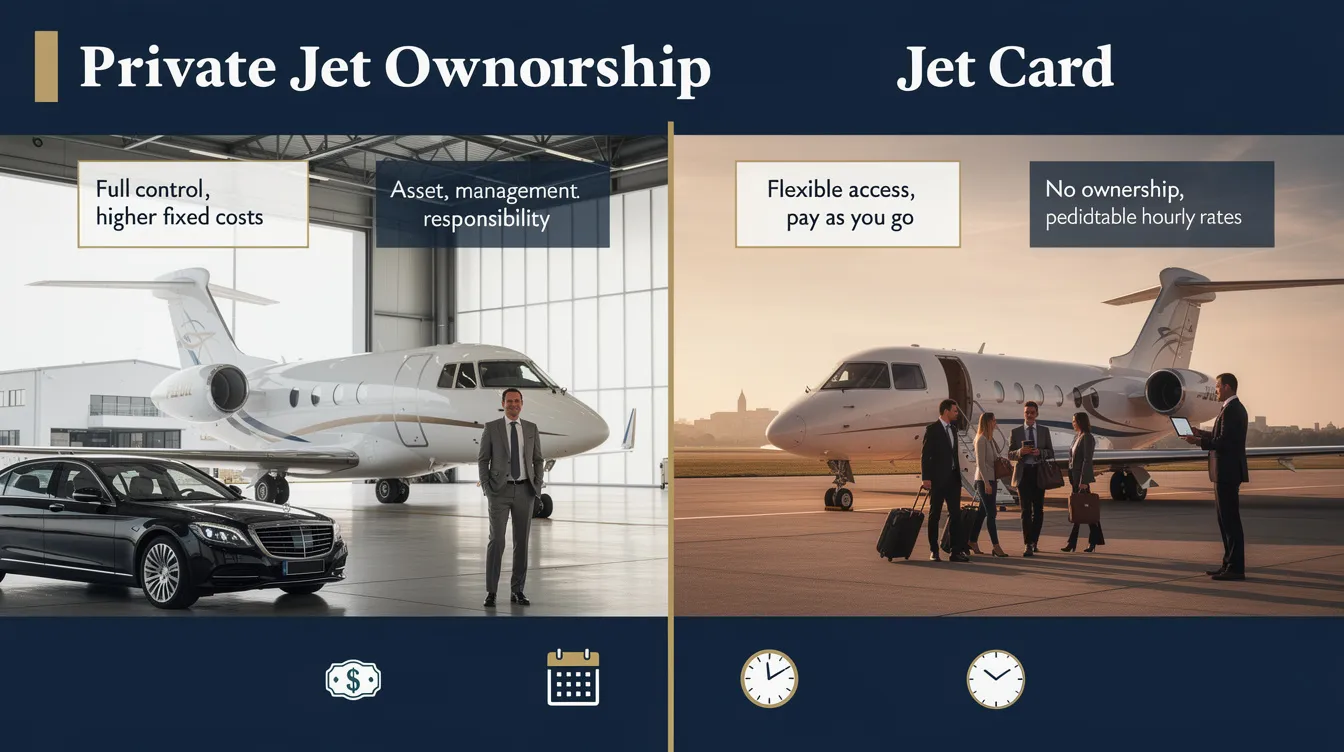
Private jet "membership" pricing usually falls into four buckets: jet cards (prepaid hours), on-demand charter (pay per trip), fractional ownership (a multi-year share plus monthly fees), and whole aircraft ownership (buying the aircraft plus ongoing fixed costs). The right choice depends mainly on hours per year, schedule variability, and how much capital risk you are willing to take.
A decision matrix is a simple scoring table that ranks options against the factors that matter most to you, so the "best" choice is evidence-based instead of emotional. Score each model from 0 to 5, where 5 favors the buyer.
| | | | Table 1: Decision Matrix |
Factor (0 to 5) | Jet Card | Charter | Fractional | Ownership |
|---|
Low up-front cash | 4 | 5 | 2 | 1 |
Price predictability | 5 | 2 | 4 | 3 |
Last-minute reliability | 4 | 3 | 5 | 5 |
Aircraft consistency | 3 | 2 | 4 | 5 |
Accounting simplicity | 5 | 2 | 3 | 2 |
Safety governance leverage | 4 | 3 | 4 | 3 |
Exit flexibility | 4 | 5 | 2 | 1 |
Who it's for | 15 to 75 hrs/yr, wants predictability | 0 to 15 hrs/yr, occasional | 75 to 150+ hrs/yr, wants consistency | 150+ hrs/yr, wants control |
Typical commitment | Prepaid block, 12-month rate window | Per trip | Multi-year share (3 to 5 yrs) | Indefinite asset ownership |
"Private aviation isn't a one-size-fits-all decision. Charter, jet cards, fractional ownership, and whole aircraft ownership each serve different travel patterns, and selecting the right model starts with understanding how you actually fly."
- Justin Crabbe, CEO
One caution before you compare quotes. A program advertising stable rates can still add peak surcharges of 20% to 40% on declared high-demand days, as AvSky Charters describes in its membership overview. Most people don't need to own a jet to get ownership-level reliability. They need a pricing model with clear rules, fast access, and dependable safety standards. For a wider look at the formats covered here, see our jet card options explained guide.
What You Actually Buy With Each Model
Terms get used loosely in private aviation marketing, so here is the clean taxonomy. Picture four boxes: pay per trip (charter), prepay hours (jet card), buy a share (fractional), and buy the aircraft (ownership). Knowing what you are not buying matters as much as the headline.
Jet Card
A jet card is prepaid private jet access where you buy a defined block of flight time (often 25 or 50 hours) and then draw down hours as you fly under published program rules. Rates come in three flavors: fixed hourly rates that hold for a set period, capped rates that limit increases, and dynamic pricing that moves with the market. Initial payments span a wide band, from around $25,000 to $500,000 and up depending on hours and cabin class, per general membership framing from Stratos Jets. You are buying access, not an asset. For a plain-English primer on what a jet card is, start there.
On-Demand Charter
On-demand charter means you pay per trip at market rates. You request a quote for a specific route and date, and the price reflects aircraft availability, positioning, and how busy the week is. Quoting feels variable because the same trip can be served by different aircraft at different costs, and a one-way booking may carry repositioning charges the operator has to recover. No commitment, no prepay, no guaranteed availability.
Fractional Ownership
Fractional ownership is a share purchase. You buy a fraction of a specific aircraft, sign a multi-year management agreement, pay a monthly management fee, and pay an occupied hourly fee when you fly. Large operators such as NetJets and Flexjet built this category at scale. The structure can lower per-hour cost at high use, but the exit is the hard part, since selling a share back can take time and carry remarketing terms. Our fractional ownership explained guide covers the mechanics.
Whole Aircraft Ownership
Whole aircraft ownership means you buy the airplane and take on its operations. Management companies can run the aircraft for you, handle crewing, and even charter it out to offset costs, but they do not erase the fixed costs of crew, hangar, insurance, and maintenance reserves. You carry those whether you fly two hours or two hundred.
The biggest difference between a jet card and fractional ownership is whether you're buying access (jet card) or buying a share of an aircraft asset with a long-term contract (fractional). That single distinction explains most of the cost and flexibility gaps that follow.
What Is Included, What Costs Extra, and Where People Get Surprised
The cheapest quote is rarely the cheapest program. Fees and rules drive total cost, and two offers with the same headline hourly rate can land thousands apart once you add taxes, minimums, and peak surcharges.
How Jet Card Pricing Works
A jet card charges a published rate against prepaid hours or prepaid funds. Watch four mechanics. Deposit versus fully funded (some programs bill a deposit, others take the full block up front). The rate-lock period (how long your fixed hourly rates hold before they reset). Taxi-time and daily minimums (you may be billed for ground time or a one to two hour daily floor). The federal excise tax, commonly 7.5% on domestic U.S. flights, which belongs in any honest comparison. A membership comparison from AvSky Charters puts jet card hourly pricing in the $4,000 to $12,000 range depending on cabin class, against on-demand charter at roughly $2,000 to $10,000 per hour. Our jet card pricing breakdown walks through each line item.
How Charter Pricing Works
Charter pricing is a spot market. Operators quote based on where the aircraft sits, where it needs to go next, and demand that week. Repositioning the empty aircraft to your departure airport can be billed, one-way trips often cost more per leg than round trips, and peak days carry premiums. Availability itself becomes a premium when demand spikes around holidays and major events.
Fractional and Ownership Cost Layers
Fractional and full ownership stack costs in layers: acquisition (share price or purchase price), monthly management, occupied hourly fees, maintenance reserves, crew, hangar, and insurance. Whole aircraft purchase prices run roughly $3 million to $90 million depending on the model, according to pricing examples from Stratos Jets. Our ownership cost breakdown covers the recurring side that buyers underestimate most.
A formula you can reuse for any model: Total annual cost = fixed costs + (occupied hourly rate × hours flown) + predictable fees + likely surcharges. Fill it in for each option with honest hour estimates, and the "expensive" choice often flips.
| | | | Table 2: Fee and Rule Checklist |
Fee or rule | Jet Card | Charter | Fractional | Ownership |
|---|
Fuel surcharge | Often included | Common | Common | Direct cost |
Peak-day surcharge | Common | Common | Common | N/A |
Repositioning fee | Sometimes | Common | Rare | You absorb |
Daily or segment minimum | Common | Common | Sometimes | N/A |
De-icing | Sometimes | Common | Sometimes | Direct cost |
International fees | Sometimes | Common | Common | Direct cost |
Cancellation penalty | Common | Common | Common | N/A |
Expiration of value | Varies | N/A | Term-based | N/A |
"The best way to compare private aviation options is to evaluate total cost, operational flexibility, safety standards, and long-term commitment together rather than focusing on any single metric."
- Justin Crabbe, CEO
Where do buyers get surprised most? Peak-day surcharges and daily minimums. A program built on fixed hourly rates can still add 20% to 40% on declared peak days, and a one-hour flight can bill as two or more once a daily minimum and taxi time apply. When you compare programs, insist on an "all-in" view: hourly rate plus taxes, fuel policy, minimums, peak rules, and cancellation terms.
Last-Minute Booking and Empty Leg Flights
Last-minute private jet booking is a spectrum, and the cheaper it gets, the less controllable it becomes. Last-minute private jet availability is real, but "best price" and "best reliability" are usually opposites: empty leg flights can be 30% to 75% cheaper than standard charter, while jet cards and premium charter relationships generally win on speed and certainty.
An empty leg flight is a discounted, typically one-way repositioning flight a private jet must fly anyway, so the operator may sell it at a reduced rate if your timing and route match. Because these legs exist to move an aircraft back into position, the route and timing stay fixed, and the deal can vanish if the originating trip changes. Marketplaces such as Jettly advertise empty leg flights at up to 75% off, and Vaunt describes a common 30% to 75% discount band.
Many domestic last-minute charter flights can be arranged in about 2 to 4 hours, depending on aircraft positioning and routing, according to evoJets. International trips can take longer once permits and customs enter the picture. Charter quotes vary trip to trip, so to compare options fast you can get a private jet quote and see live pricing.
The Last-Minute Ladder runs from cheapest to most certain:
Empty leg flights — lowest price, lowest control.
On-demand charter with flexible aircraft — moderate price, moderate certainty.
Jet card — fast booking with published rules and guaranteed availability windows.
Fractional or owned fleet — highest certainty, highest fixed commitment.
How to Book a Last-Minute Private Jet in 5 Steps
Estimated time for domestic trips: about 2 to 4 hours from request to confirmation.
Set your route flexibility. Confirm departure and arrival airports, acceptable alternates, and how much your dates and times can flex.
Lock passenger count and luggage. Final headcount, bag volume, and any pets or oversized items decide which aircraft qualify.
Gather ID and documents. Government IDs for everyone, plus valid passports for international segments.
Ready your payment. Pre-authorize a card or stage a wire so approval does not stall the booking.
Request quotes and decide quickly. The faster you confirm, the larger the available aircraft pool and the better your pricing.
Empty leg flights can be a great deal, but they're not a dependable transportation plan unless your schedule and destination are highly flexible.
Safety and Operator Vetting Checklist
Safety is table stakes. What matters is how it is documented, repeated, and audited on every single flight.
Three third-party frameworks show up across the industry. ARGUS rates operators and aircraft, with ARGUS Platinum as its highest audited tier and the rating buyers ask about most. Wyvern runs the Wyvern Wingman standard, built on registered safety data and audits. IS-BAO is an industry code of best practice from the International Business Aviation Council. No single badge guarantees an outcome, so treat them as inputs, not a finish line. Jet Linx leans on this audit-based positioning, referencing ARGUS, Wyvern, and IS-BAO in its safety messaging.
Most U.S. private charter operates under FAA Part 135 rules, and the certificated operator, not the broker or card provider, holds operational responsibility for the flight. That is why your first question should always be who is operating this trip. A credible private aviation provider should be able to tell you, before you fly, who the operating carrier is, what safety standards they require, and what documentation they can share for that specific trip.
BlackJet built its diligence into a proprietary process called BlackJet Certified, a four-part standard that certifies the operator, the aircraft, the pilot, and the individual flight. The company states that fewer than 30% of the more than 575 U.S. charter operators pass the certification required to serve its clients, and its app surfaces a pre-flight BlackJet Certified Safety Report so you can see checks before you board. A Safety Advisory Board of former FAA and NTSB leaders works alongside the company's Chief Safety Officer. Pre-flight reporting like this mirrors what Paramount Business Jets markets around safety-vetted networks. Organizations vetting vendors can use our team travel jet cards checklist as a deeper dive.
Three Real Scenarios and the Model That Usually Wins
Use cases beat theory, so here are three common patterns and the model that usually fits.
Scenario A, the 25-Hour Buyer
You fly 6 to 10 domestic trips a year with variable timing. If you expect to fly about 15 to 40 hours over the next 12 to 24 months and you value predictable budgeting and streamlined booking, a 25-hour jet card is often the simplest "middle ground" between ad hoc charter and fractional ownership. At this volume, fractional's multi-year share and monthly fees rarely pay off, and pure charter makes budgeting messy. A 25-hour card locks rates, simplifies billing, and keeps commitment light. Check current 25-hour jet card costs to benchmark your number.
Scenario B, the Multi-User Organization
Three to eight travelers, overlapping trips, and a finance team that needs clean books. A jet card membership with multi-user controls beats ad hoc charter here, because procurement gets one vendor, one set of rules, and consolidated statements instead of a stack of one-off invoices. If multiple employees need to fly under one program, prioritize multi-user permissions, consolidated statements, transparent fee rules, and documented safety standards before you negotiate headline hourly rates. Confirm cost-center tagging, traveler profiles, and an audit trail your auditors will accept.
Scenario C, the Last-Minute Traveler
Board meetings and deals move without notice. Empty leg flights can be opportunistic savings when your dates happen to line up, but they are not a plan when timing is non-negotiable. A jet card or an established charter relationship wins when the meeting cannot move, because guaranteed availability windows and published call-out times beat hunting for a discount leg. Fractional structures, often sold as shares mapping to 50, 100, 200, or 400 annual hours per AvSky Charters, add the most certainty and the most commitment.
"Most travelers don't need to own an aircraft to achieve reliable private aviation. For many organizations and individuals, structured access through the right program delivers the consistency they need without the capital commitment of ownership."
- Justin Crabbe, CEO
Contract Landmines and the Questions to Ask
Your contract matters more than your brochure. Glossy photos do not bill you; terms do.
Six clauses cause most disputes. Expiration (do hours or funds expire, and under what conditions). Peak and blackout rules (which days count, what surcharge applies, how much notice you get). Minimums (daily minimums, segment minimums, taxi-time billing, ramp and handling fees). Cancellations (sliding-scale penalties, weather and force majeure, passenger changes). Recovery (what happens if your aircraft goes AOG, short for aircraft on ground, and whether a recovery aircraft is promised). Accounting (consolidated monthly statements, multiple cost centers, and traveler profiles).
Terms vary widely between providers. Some market no-expiration hours and refundable deposits as differentiators, which tells you those features are not universal, so read every clause. Paramount Business Jets frames its deposit-style card around exactly that kind of transparency claim. To keep usage visible across a team, our guide on how to track jet card hours shows what good reporting looks like.
A good provider will answer contract questions in writing and show you a sample invoice. If they won't, assume the terms will change after you commit.
The 20-Question Vendor Bank
Pricing
What exactly is included in the hourly rate (taxes, fuel surcharge, federal excise tax)?
Are rates fixed for a defined period, and when can they reset?
What are the peak-day surcharges, and how many peak days fall in a year?
What daily minimums, segment minimums, and taxi-time billing apply?
Availability
Do you offer guaranteed availability with set call-out times?
What notice do you require on peak days?
What happens if my preferred cabin class is unavailable?
Can I switch cabin sizes per trip, and at what rate?
Safety
Who is the operating carrier for my specific flight?
Which third-party ratings do you require (ARGUS, Wyvern, IS-BAO)?
Can you provide a pre-flight safety report for each trip?
What pilot experience minimums apply to my flights?
Accounting and Controls
Do you provide consolidated monthly statements?
Can you tag flights to cost centers and traveler profiles?
Can multiple travelers book under one account with permission levels?
How do I track remaining hours and spending in real time?
Service Recovery
What happens if the assigned aircraft goes AOG?
Is there a documented recovery aircraft policy?
What are the cancellation and weather policies?
Do unused hours or funds expire, and are deposits refundable?
Where BlackJet Fits in the Decision
If your decision matrix points to a jet card, here is what to look for, and how BlackJet is built around those requirements. BlackJet offers 25-hour and 50-hour jet cards with access across four cabin categories: Light, Midsize, Super-Midsize, and Large Cabin. The company pioneered the jet card model more than a decade ago, letting travelers buy flight time in hourly increments and pay for the hours they fly.
Two funding approaches fit different priorities. Pay-As-You-Fly (the 25-hour card starts at $50,000, the 50-hour at $95,000) keeps cash flexible for buyers who want to commit gradually. Fully-Funded (the 25-hour card at $225,000, the 50-hour at $450,000) secures the full block for those who want maximum rate certainty and the simplest accounting. The 50-hour jet card suits higher-volume flyers chasing the lowest effective rate per hour.
BlackJet 50 hourly rates are guaranteed fixed for 12 months, and jet card hours never expire. For long planning cycles and clean year-end books, non-expiring hours remove the use-it-or-lose-it pressure that complicates budgeting. Published base hourly rates run from $5,484 for Light jets to $8,038 Midsize, $10,384 Super-Midsize, and $13,131 Large Cabin, each inclusive of fuel surcharge and federal excise tax. You can sanity-check those against market prices per hour across cabin classes and models.
BlackJet Certified handles the safety side: a four-part vetting of operator, aircraft, pilot, and flight, with a pre-flight safety report available in the app before you board. The program draws on more than 10 years of proprietary data. Booking runs through a mobile app with real-time status updates and 24/7 support, plus a text-to-book option when speed matters. Cardholders switch cabin sizes up or down at stable fixed hourly rates and get complimentary Wi-Fi on board. On sustainability, BlackJet states that since the beginning of 2021 every flight flown by card owners is offset to be carbon and emissions neutral at no cost to the client, using a 300% offsetting approach that reaches beyond CO2 alone.
A Private Jet Card for Startups With Multiple Users
For a finance lead standing up a program, the requirements are concrete: traveler permissions so several employees can book, consolidated monthly statements for clean reconciliation, transparent fee rules, and a safety-vetting standard you can document for auditors. Jet card programs commonly start at a 25-hour minimum, which Magellan Jets frames as the typical entry point, giving a new program a contained way in before scaling to 50 hours. Pair that with cost-center tagging and an audit trail, and procurement gets a vendor it can actually approve.
Choose Your Cabin Class
Light — up to 7 seats, about 1,149-mile range (think New York to Atlanta).
Midsize — up to 8 seats, about 1,790-mile range (Austin to New York).
Super-Midsize — up to 8 seats, about 3,950-mile range (Los Angeles to Boston).
Large Cabin — up to 12 seats, about 5,100-mile range (New York to London).
BlackJet is designed for travelers and organizations that want jet card predictability (non-expiring hours, a defined fixed-rate period, and documented pre-flight safety reporting) without the capital and contract complexity of fractional or whole-aircraft ownership.
"Whether you're flying for business or personal travel, the strongest private aviation programs combine transparent pricing, dependable access, documented safety standards, and the flexibility to adapt as your travel requirements evolve."
- Justin Crabbe, CEO
Frequently Asked Questions
What is a jet card and how does it work?
A jet card is prepaid private jet access where you buy a set amount of flight time (often 25 or 50 hours) and then use those hours as you fly under published program rules. Rates may be fixed for a set window, capped to limit increases, or set by dynamic pricing. Before you buy, confirm the minimums, peak-day rules, and whether hours expire.
Is a jet card cheaper than charter?
A jet card isn't always cheaper per trip than charter, but it's often easier to budget because the rules and pricing are more predictable. Charter can win on a one-off market opportunity, especially when you are flexible on aircraft and timing. A jet card trades some spot-market upside for stable rates and consolidated billing.
What are empty leg flights and how much can I save?
Empty leg flights are discounted one-way repositioning flights, and in some examples they're marketed as 30% to 75% less than standard charter pricing. The catch is control: routes and timing stay fixed, and a booking can fall through if the originating trip changes. Treat them as opportunistic savings, not a dependable plan.
How fast can I book a last-minute private jet?
Many domestic last-minute charter flights can be arranged in about 2 to 4 hours, but timing depends on aircraft positioning, routing, and how quickly you can approve and pay. International trips can run longer once permits and customs apply. Flexibility on airport, timing, and aircraft improves both speed and price.
What's the difference between fractional ownership and whole aircraft ownership?
Fractional ownership means you buy a share of an aircraft program under a multi-year agreement, while whole aircraft ownership means you buy the aircraft outright and take on (or outsource) ongoing operations. Fractional adds monthly management fees and an occupied hourly rate; full ownership adds crew, hangar, insurance, and maintenance reserves. Both carry exit and liquidity questions that a jet card does not.
What safety certifications should I look for?
Look for a provider that can clearly explain its safety standards and show documentation for the operating carrier and aircraft used for your trip, often referencing frameworks like ARGUS, Wyvern, and IS-BAO. The point is documentation per flight, not collecting logos. Ask who operates the trip and request the records before you board.
Can a jet card be used by multiple employees?
Many jet card programs can support multiple authorized travelers, but the details vary, so confirm permissions, booking approval flow, and consolidated monthly statements before you commit. Ask about cost-center tagging, traveler profiles, and a usable audit trail. Those controls decide whether finance can reconcile spending cleanly across a team.
When does buying a jet actually make sense?
Buying a jet tends to make sense only when you fly very high annual hours, want maximum control, and are comfortable tying up capital and paying fixed costs even when you don't fly. Purchase prices run roughly $3 million to $90 million depending on the aircraft, and fixed costs continue whether you fly or not. Run the numbers with a tax and finance advisor before committing.
Conclusion
The right model is the one your real flying pattern can support without surprises. Light annual hours favor charter and empty leg flights, mid-range hours favor a jet card, and only the highest utilization makes fractional or ownership pay off. Score your options against the matrix, run the all-in cost formula, and ask the vendor questions in writing. For most travelers and organizations that want predictability, documented safety vetting, and simpler accounting without tying up capital, a jet card carries the decision.
Use BlackJet's jet card team to sanity-check your decision matrix results. Request a walkthrough of the 25-hour and 50-hour options and see how BlackJet Certified safety reporting and non-expiring hours work in practice. Reach the team in the BlackJet app, by phone at 1-866-321-JETS (1-866-321-5387), or by email at info@blackjet.com.
References
Empty Leg Flights, Jettly - empty leg definition and the up to 75% savings claim.


 Sign up with google
 Sign up with Apple