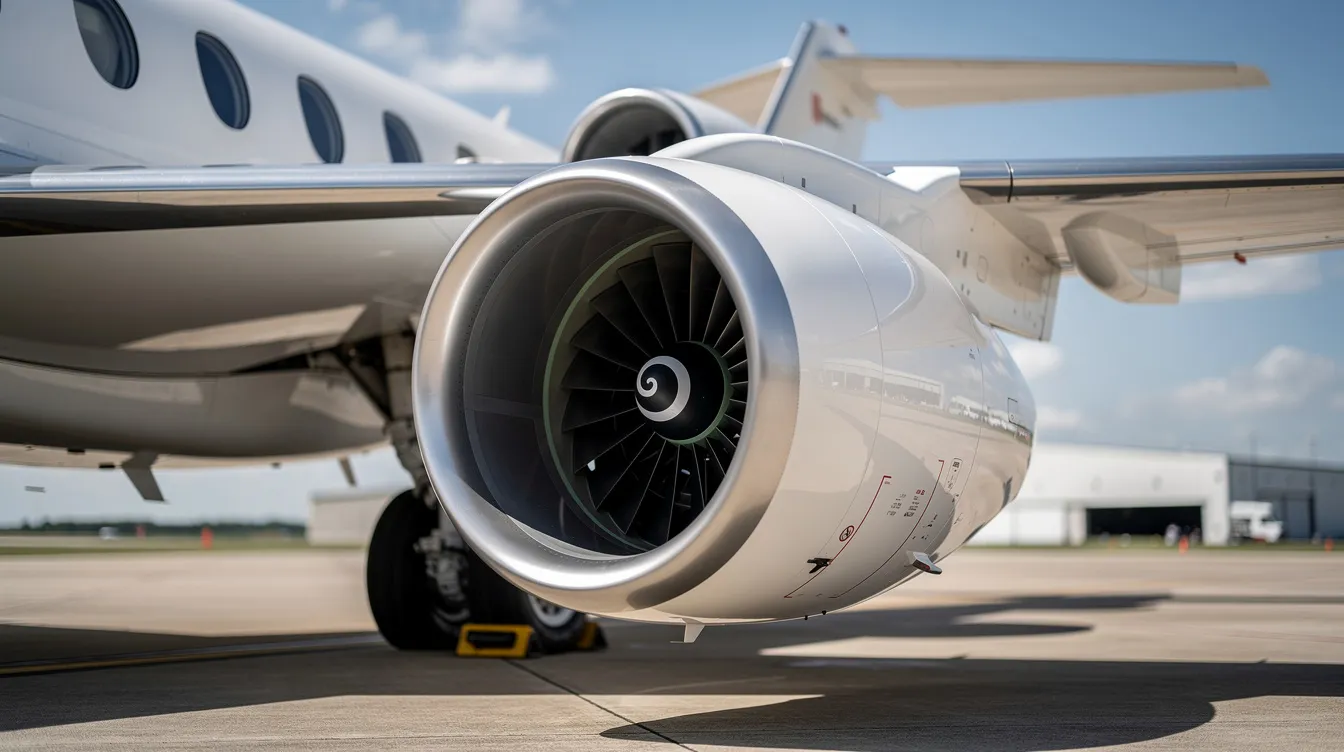
Jet engines are gas-turbine powerplants (a type of engine that operates on the Brayton cycle, using a continuous process of intake, compression, combustion, and exhaust to produce thrust) that create thrust by drawing in air, compressing it, mixing it with fuel for combustion, and accelerating the exhaust; in private aviation, modern turbofan engines dominate because they deliver the speed, range, efficiency, and lower noise travelers expect. The technology hidden inside a jet engine nacelle shapes every minute of your flight - from the moment thrust pushes you back into your seat to the quiet cruise at 45,000 feet.
For frequent business flyers, high-net-worth leisure travelers, and anyone comparing private aircraft or a Jet Card program, understanding how aircraft jet engines work gives useful context for decisions about performance, comfort, safety, and operating flexibility, and complements broader guidance on the best jet cards for frequent flyers. This guide breaks down how jet engines work, traces their evolution from wartime prototypes to the refined turbofans powering today's private aviation fleet, compares major engine types, and looks at the safety standards, noise and environmental impact, digital engine monitoring, sustainable aviation, and future trends that influence aircraft selection for everything from a light jet weekend hop to an ultra-long-range transatlantic crossing.
Why Jet Engines Matter To Private Jet Travelers Today
Consider the contrast. A commercial New York–London journey typically consumes seven to eight hours once you factor in security queues, boarding, taxiing, and arrival processing. A private flight on a high-bypass turbofan-powered business jet covers the same distance in roughly five hours, departing from a private terminal and arriving at a less congested airport closer to your final destination.
That speed advantage comes directly from the jet engine. Modern business jets cruise between 450 and 530 knots (roughly 515–610 mph), altitudes well above commercial traffic and weather, delivering non-stop ranges that piston engines or turboprop aircraft engines simply cannot match. Jet engines maintain high efficiency at high altitudes and speeds, which is precisely why they dominate both commercial and private aviation.
BlackJet's fleet access emphasizes modern, fuel-efficient turbofan-powered jets maintained by ARGUS- or Wyvern-rated operators. The main types of jet engines encountered across aviation are turbofans, turbojets, turboprops, and turboshafts. Each serves a distinct purpose, and each influences the cost, comfort, and capability of your flight. The main types of jet engines are turbofans, turbojets, turboprops, and turboshafts. Throughout this article, we connect those technologies to real-world private aviation use cases and BlackJet Jet Card programs, as well as broader premium private jet card solutions from BlackJet.

Jet Propulsion Basics: How A Jet Engine Produces Thrust
Jet propulsion rests on a straightforward principle. Jet engines operate on the principle of Newton's Third Law of Motion: accelerate a mass of air backward through a propelling nozzle, and the reaction force pushes the aircraft forward. Jet engines create thrust by accelerating a large amount of air backward, and they do so through a remarkably elegant cycle.
Jet engines perform a continuous four-step cycle - intake, compression, combustion, and exhaust:
Intake. The engine sucks air in through a carefully shaped inlet. Intake involves a large fan drawing in atmospheric air and directing it into the engine core.
Compression. Multiple compressor stages with spinning blades squeeze the incoming air to extreme density. Compression involves spinning blades that raise the intake air well above atmospheric pressure and to high temperature - modern engines achieve overall pressure ratio values of 30:1 to 45:1, heating the compressed air significantly before it even reaches the burners.
Combustion. Compressed air is mixed with jet fuel and ignited inside the combustion chamber. Combustion occurs when air mixes with fuel and is ignited, creating hot gas that can exceed 1,600°C in advanced engines. Jet engines run in a continuous stream of intake and burning, unlike reciprocating piston engines that fire in discrete strokes. Jet engines differ significantly from reciprocating engines in combustion processes.
Exhaust. Hot gases expand and exit through the exhaust nozzle at high velocity. Expanding gas is expelled through a nozzle, generating thrust. The turbine powers the compressor in a jet engine, extracting just enough energy from the hot gases leaving the core to keep the cycle running.
Most jet engines are a type of gas turbine that operates on the Brayton cycle. Thrust is produced by the high-speed exhaust jet, and in turbofan engines, also by cooler bypass air moved by the large fan - improving fuel efficiency and making the engine quieter for passengers. Jet engines are designed for thrust rather than torque, and they use oxygen from the atmosphere, which is why they cannot operate in space.
For context, typical midsize and large-cabin business jets generate roughly 7,000–15,000 lbf of engine thrust per powerplant, illustrating how different types of jet engines scale power output to match aircraft size and mission.
The First Jet Engines: From Whittle And von Ohain To Early Jet Aircraft
Before jet propulsion, aviation depended on piston engines turning propellers. By the late 1930s, those powerplants were hitting a performance wall: propeller tips approached supersonic speeds at high forward speed, drag climbed steeply, and very high altitudes remained difficult to reach. A new kind of engine was needed.
Frank Whittle patented the turbojet engine in 1930 in Britain, envisioning a centrifugal compressor gas turbine - the Whittle engine - that would bypass the propeller entirely. His W.1 engine eventually powered the Gloster E.28/39 on its first flight in May 1941, as early British and German work accelerated under World War II pressures. Independently, Hans von Ohain developed a turbojet engine around 1935 in Germany, and his HeS 3b powered the Heinkel He 178, which became the first turbojet-powered aircraft, flying on 27 August 1939 - the world's first jet aircraft flight.
The United States followed quickly. General Electric built the I-A engine, derived from the British Power Jets W.2B design. The first American jet engine flew in the Bell P-59A in October 1942, proving that jet propulsion could be industrialized at scale. By 1952, the De Havilland Comet I was the first passenger jet, flying commercially and ushering jet travel into the civilian world.
Those early turbojets were loud, thirsty, and short-lived. But the core principle - a gas generator compressing air, burning fuel, and expelling hot gases - would evolve over decades into the quiet, efficient turbofan engines now powering private jets in BlackJet's network.
Core Components Of A Modern Aircraft Jet Engine: The Combustion Chamber
Regardless of whether you are looking at a turbojet, turbofan engine, turboprop engine, or turboshaft engine, every gas turbine engine shares a common architecture: intake, compressor, combustion chamber, turbine, and exhaust system.
Intake. The intake system slows and straightens air flowing into the compressor. Business jets use carefully contoured inlets that reduce noise and prevent flow separation during steep climbs or high angles of attack - situations common at smaller airports.
Compressor. Early engines like the Whittle engine relied on centrifugal compressors that fling air outward. Modern aircraft engine designs almost universally use axial-flow compressors - rows of spinning blades alternating with stationary stator vanes - found in engines like the Pratt & Whitney PW300 series delivering 4,700–8,000 lbf thrust for midsize business jets. Each stage raises air pressure incrementally; combined compressor stages can push overall pressure ratio above 40:1.
Combustion chamber. Here, high-pressure air meets atomized fuel and ignites. Temperatures inside can approach 2,000°C, but "dilution air" mixed downstream keeps metal temperatures manageable for the turbine blades ahead.
Turbine. High-pressure and low-pressure turbine stages extract energy from hot gases to drive the compressor (and in turbofans, the fan). Turbine blades endure extreme conditions through nickel superalloys, advanced cooling via internal air passages, and thermal barrier coatings.
Exhaust and nozzle. The propelling nozzle accelerates remaining hot air and combustion products to produce additional thrust. On many business jets, thrust reversers redirect exhaust or fan nozzle flow after landing, shortening stopping distances on the smaller runways common in private aviation.
Turbojet Engines: The Original Pure Jet Powerplants
A turbojet engine is the simplest form of jet engine. All the air entering the intake passes through the engine core - compressed, burned, and expelled as a high-velocity jet exhaust stream. There is no bypass duct, no large fan pushing cold air around the core.
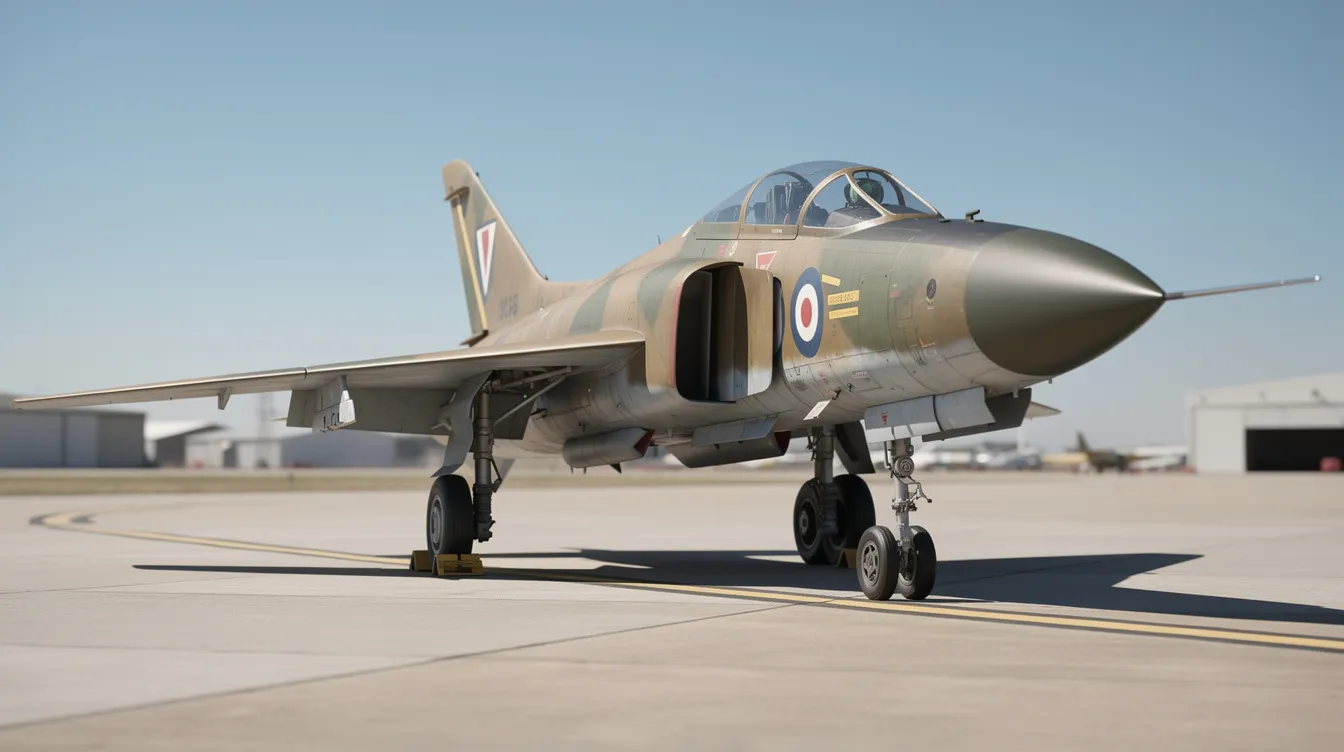
Turbojets are older designs that push all air through the engine core. Military aircraft like the Lockheed F-104 Starfighter and early commercial aircraft such as the de Havilland Comet used such engines because they excelled at high speed and very high altitudes, even though many modern missions can now be served more efficiently by small private aircraft options and other small private jets luxury travel choices. Turbojet engines compress air 3 to 12 times its original pressure, with mid-20th-century engines achieving pressure ratios of 8:1 to 12:1, producing very high exhaust velocities that delivered impressive jet propulsion at supersonic speeds.
However, cycle efficiency in turbojets is around 30%, and propulsion efficiency at subsonic speeds is poor because accelerating a small mass of air to very high speeds wastes more energy than moving a larger mass at moderate velocity. Some military aircraft used afterburners - injecting additional fuel into the jet exhaust downstream of the turbine - for momentary thrust boosts, but the enormous fuel consumption and noise make such engines impractical for civil aviation.
Pure turbojet engines have largely disappeared from private and commercial fleets. They are not used in the business jets served by BlackJet, having been superseded by far more efficient turbofan designs.
Turbofan Engines: The Workhorses Of Business And Commercial Aviation
Turbofan engines are the most common type in commercial aviation and power nearly every medium and large business jet flying today. A turbofan engine combines a gas turbine core with a large fan at the front, enclosed in a nacelle. The intake fan accelerates a substantial volume of bypass air through a bypass duct around the engine core, while a smaller portion of air entering the core goes through the traditional compress-burn-exhaust cycle.
The key metric is bypass ratio - the mass of bypass air to core airflow. Turbofan engines have bypass ratios from 5 to 8 on many business and regional jet powerplants, and modern large commercial engines push beyond 10:1. Concrete examples include the CFM56 family powering narrow-body airliners, the Pratt & Whitney PW1000G geared turbofan on newer regional jets, and the Rolls-Royce BR700 family found on aircraft such as the Gulfstream G550.
Most of the engine's thrust in a high-bypass turbofan comes from that large fan accelerating a huge mass of air at relatively low velocity rather than relying solely on hot gases from the core. This makes the engine quieter and dramatically improves fuel efficiency compared to turbojets, while enhancing short-field performance - critical for business jets accessing compact airports.
New high-bypass turbofan engines pollute less than older engines, partly because geared turbofan architectures allow the fan to spin at its optimal low speed while the turbine spins faster, and advanced composite fan blades with chevron-shaped nacelle trailing edges further suppress noise. These innovations directly support BlackJet's value proposition: longer non-stop ranges on routes like Los Angeles–New York or London–Dubai, lower fuel burn per passenger mile, and smoother, quieter cabins where executives can work or rest productively in flight.
Turboprop Engines: Bridging Jet Technology And Short-Range Efficiency
A turboprop engine pairs a gas turbine core - the same gas generator principle found in any jet engine - with a reduction gearbox that drives a propeller. The propeller, not jet exhaust, produces the vast majority of thrust.
Aircraft like the Beechcraft King Air 350, Pilatus PC-12 NGX, and ATR 72 rely on turboprops, cruising at around 250–330 knots. Turboprop engines are efficient below 500 miles per hour, making them ideal for short regional hops between smaller airports where BlackJet clients might choose a turboprop private plane for access and cost efficiency, especially when evaluating the cheapest private aircraft options and broader guides to affordable aircraft choices or the best cheapest planes that still meet safety and comfort expectations.
Modern "scimitar" propeller blade tips and noise-reduction features address older perceptions that turboprops are loud or less comfortable. Today's turboprop cabins are pressurized, vibration-damped, and capable of reaching altitudes above most weather.
While turboprops share core gas turbine engine principles with turbojet and turbofan engines, their propeller-driven thrust profile makes them distinct from typical jet aircraft in private aviation. They burn less fuel on short legs and can operate from runways that would challenge heavier jets - a practical advantage when your destination is a mountain resort or island runway.
Turboshaft Engines: Jet Technology Beyond Fixed-Wing Aircraft
A turboshaft engine is a gas turbine optimized to produce shaft horsepower rather than direct jet thrust. Turboshaft engines power helicopter rotors instead of producing thrust through a nozzle, converting nearly all the engine's energy into mechanical energy delivered through a transmission.
Examples include the Pratt & Whitney PT6T powering Bell 212 helicopters and the Safran Arriel series used in modern corporate helicopters like the Airbus H160. The gas generator section spins independently of the power turbine connected to the rotor, allowing pilots to maintain a nearly constant rotor RPM for stable lift at different speeds and altitudes.
For BlackJet travelers, turboshaft-powered helicopters serve a specific purpose: first- and last-mile transfers. Think Manhattan heliports to Teterboro, Monaco to Nice, or São Paulo Congonhas to Guarulhos, as well as busy urban hubs like private jet charters in Karachi. These high-frequency operations demand exceptional reliability from their powerplants.
While BlackJet's core Jet Card solutions revolve around fixed-wing jets, partner-operated helicopters with turboshaft engines can be integrated for seamless luxury access on either end of your journey.
Other Jet Propulsion Concepts: Ramjets, Rockets, And Propfans
Beyond the four primary gas turbine types, several specialized propulsion concepts round out the broader family of reaction engines.
A ramjet engine has no moving parts and relies on forward speed alone for compression. Incoming air is rammed into a duct, mixed with fuel, burned, and expelled. Ramjets have no moving parts and rely on forward speed for compression, which means they cannot produce thrust at rest - they need a booster to reach operating speed, typically above Mach 1. They are used mainly in missiles and experimental high-speed vehicles. Current research into ramjets and related propulsion also appears in academic work tied to unmanned systems. Scramjets are advanced ramjets designed for hypersonic flight, compressing atmospheric air at very high speeds without slowing it to subsonic levels before combustion occurs.
Rocket engines carry both fuel and oxidizer, making them self-contained. Unlike air-breathing jet engines, they can operate in space, but their fuel consumption is extreme and impractical for passenger aviation, underscoring why safety and practicality keep mainstream private aviation focused on turbine-powered aircraft that meet stringent standards similar to those discussed in analyses of how safe private jets are.
Propfan or open-rotor concepts combine features of turboprops and turbofans - contra-rotating propellers driven by a gas turbine achieve high propulsion efficiency, but cabin noise and certification challenges have slowed adoption.
None of these technologies are part of BlackJet's current service offering, but ongoing research into high-speed and ultra-efficient propulsion may influence future business jet propulsion designs and sustainable aviation initiatives, including the largest private jets for 20 passengers that rely on powerful, efficient engines to balance range, payload, and cabin comfort.
Physical Principles: Thrust, Nozzles, And Efficiency
The thrust equation at the heart of every jet engine is elegantly simple: thrust (F) approximately equals mass flow rate (ṁ) multiplied by the difference between exhaust velocity and flight velocity (Vexit − Vflight). Increase the mass of air flowing through the engine or the speed at which it exits, and you increase thrust.
The propelling nozzle converts thermal and air pressure energy into kinetic energy. A simple convergent nozzle accelerates subsonic exhaust to sonic velocity; a convergent-divergent (de Laval) nozzle pushes exhaust past Mach 1, used on military turbojets designed for supersonic speeds. Business jets operating at subsonic speeds use convergent or lightly convergent nozzles from the fan nozzle and core.
Specific fuel consumption measures fuel needed for thrust - expressed as pounds of fuel burned per hour per pound of thrust. Modern high-bypass turbofans achieve SFC values roughly 40–50% lower than mid-century turbojets, a difference that translates directly into range and cost. Combustion efficiency is nearly 100% at sea level takeoff in modern engines, meaning virtually all fuel energy is converted to heat - the remaining challenge is converting that heat efficiently into propulsive work.
Propulsive efficiency explains why turbofans and turboprops dominate subsonic flight: accelerating a large mass of air slightly is inherently more efficient at low speeds than accelerating a small mass dramatically. At subsonic speeds, a high-bypass turbofan wastes far less energy in its exhaust wake than a turbojet would, which is why many of the cheapest private jet options focus on efficient light jets and turboprops that can maximize range per gallon, matched carefully to mission profiles using frameworks similar to those in guides on understanding private jet sizes.
For private jet operations, higher efficiency means longer range, fewer fuel stops on transcontinental routes, lower fuel consumption, and reduced carbon emissions - supporting BlackJet's carbon-neutral flight commitments through high-efficiency engines and certified offset programs.
Four Main Types Of Aircraft Jet Engines Compared
All four major gas turbine aircraft engine types - turbojet, turbofan, turboprop, and turboshaft - share the same fundamental cycle of intake, compression, combustion, and exhaust. They diverge in how they harness output power.
Turbojets channel all the air through the core and produce thrust entirely from the high-velocity exhaust jet. They excel at very high speeds and very high altitudes but burn more fuel at subsonic cruise. The F-104 Starfighter remains the iconic example. Turbofans add a large fan that moves bypass air around the core, producing the majority of thrust at lower noise and lower temperature air exhaust - the Gulfstream G650 and its Rolls-Royce BR725 engines exemplify this category. Turboprops extract shaft power to spin a propeller, offering the best fuel efficiency at different speeds below about 350 knots - the King Air 350 is a staple of regional private aviation. Turboshaft engines similarly extract shaft power, but route it to a helicopter rotor or industrial load - the Airbus H160 with Safran Arrano engines shows how turboshaft technology serves corporate helicopter operations.
BlackJet clients encounter turbofan-powered jets most frequently, with occasional turbops for short legs and turboshaft helicopters for ground transfers, drawing from a broad spectrum of types of private jets matched to different mission profiles, including the latest flagship models covered in reviews of the newest private jets. Understanding these broad distinctions helps travelers select the correct value for each mission through BlackJet's Jet Card and on-demand charter options.
Jet Engines In Private Aviation: From Light Jets To Long-Range Flagships
Nearly all private jets in BlackJet's accessible fleet use turbofan engines, but performance and cabin experience vary by aircraft class.
Light jets such as the Embraer Phenom 300 and Cessna Citation CJ4 use compact, efficient turbofans optimized for regional hops. They climb quickly to FL410, access shorter runways, and burn roughly 150–200 gallons per hour - keeping hourly costs manageable for trips like New York–Miami or Chicago–Aspen, especially when you understand how much it costs to charter a small plane.
Midsize and super-midsize jets like the Citation XLS+ and Bombardier Challenger 3500 carry more powerful engines with higher bypass ratios. These aircraft cover coast-to-coast U.S. missions nonstop, carry more payload, and offer stand-up cabins. Fuel burn runs approximately 200–350 GPH, and many of the top private jets for sale under 10 million sit in this midsize and super-midsize performance bracket, alongside popular 12-seater private jet options that balance capacity, range, and operating cost.
Ultra-long-range jets - the Gulfstream G650ER, Bombardier Global 7500 - mount advanced Rolls-Royce or GE turbofans delivering over 15,000 lbf of thrust per engine. They fly nonstop missions such as New York–Tokyo or London–Buenos Aires, burning 400–500+ GPH but distributing that cost across larger passenger loads and eliminating fuel stops that add hours to a journey, and many of the best 16-seat private jet options and private jets for 15 passengers fall into this large-cabin, ultra-long-range category.
Different Jet Card tiers map to these categories. A 25-hour light-jet card suits frequent regional travelers; a 50-hour premium card targeting large-cabin access serves executives with intercontinental schedules, and understanding 50-hour Jet Card cost and value helps align engine performance with budget expectations. Engine performance - range, climb rate, airport compatibility - is the variable that connects cabin class to mission capability.
Safety, Reliability, And Certification Of Aircraft Jet Engines
Modern jet engines are among the most reliable machines ever built. The Honeywell HTF7000 business jet engine family accumulated over 325,000 in-service hours with zero recorded in-flight shutdowns and dispatch reliability of 99.97%. GE's CF34-8C1, a regional turbofan producing 13,790 lbf, recorded an in-flight shutdown rate of approximately 0.004 per 1,000 flight hours - roughly one event per 250,000 engine hours.
These numbers reflect the rigor of certification standards. FAA Part 33 prescribes design, endurance testing, blade containment, bird-strike resistance, and high-temperature strength requirements that every aircraft engine must satisfy before entering service. EASA mirrors these standards in Europe.
Modern business jet engines incorporate redundant systems - dual or triple-channel FADEC controls, multiple igniters, independent lubrication circuits - ensuring safe operation across a wide flight envelope, from sea level to FL510 and from arctic cold air conditions to desert hot air.
BlackJet partners exclusively with operators that maintain engines under Part 135 or equivalent maintenance regimes, including on-condition monitoring, trend analysis, and strict adherence to manufacturer service bulletins. Real-time engine data and diagnostics can prompt proactive maintenance before a minor trend becomes an operational issue, ensuring that Jet Card members experience minimal disruption to their travel plans.
Jet Engine Noise, Airport Access, And Passenger Comfort
Jet engine noise from takeoff can reach about 110 decibels - comparable to standing next to a rock concert speaker. The dominant sources are high-velocity exhaust jets and, in turbofans, the blade tips of the intake fan approaching transonic speeds, producing the "buzz saw" tone historically associated with older low-bypass engines.
Technology has driven dramatic improvements. High-bypass ratios push more air at lower temperature air velocities, inherently reducing noise. Chevron nozzles on nacelle trailing edges break up exhaust shear layers. Acoustic liners inside nacelles absorb broadband noise. In 2023, Rolls-Royce tested an engine reducing noise pollution by 35%, demonstrating how aggressively manufacturers are attacking the problem. Modern engines now meet Stage 4 and Stage 5 noise standards set by ICAO.
Quieter engines open access to noise-sensitive airports favored in private aviation - London City, certain Alpine strips, and Mediterranean coastal airfields with strict noise abatement procedures. For BlackJet clients, this translates directly into landing closer to the destination rather than diverting to a more distant, less restricted airport.
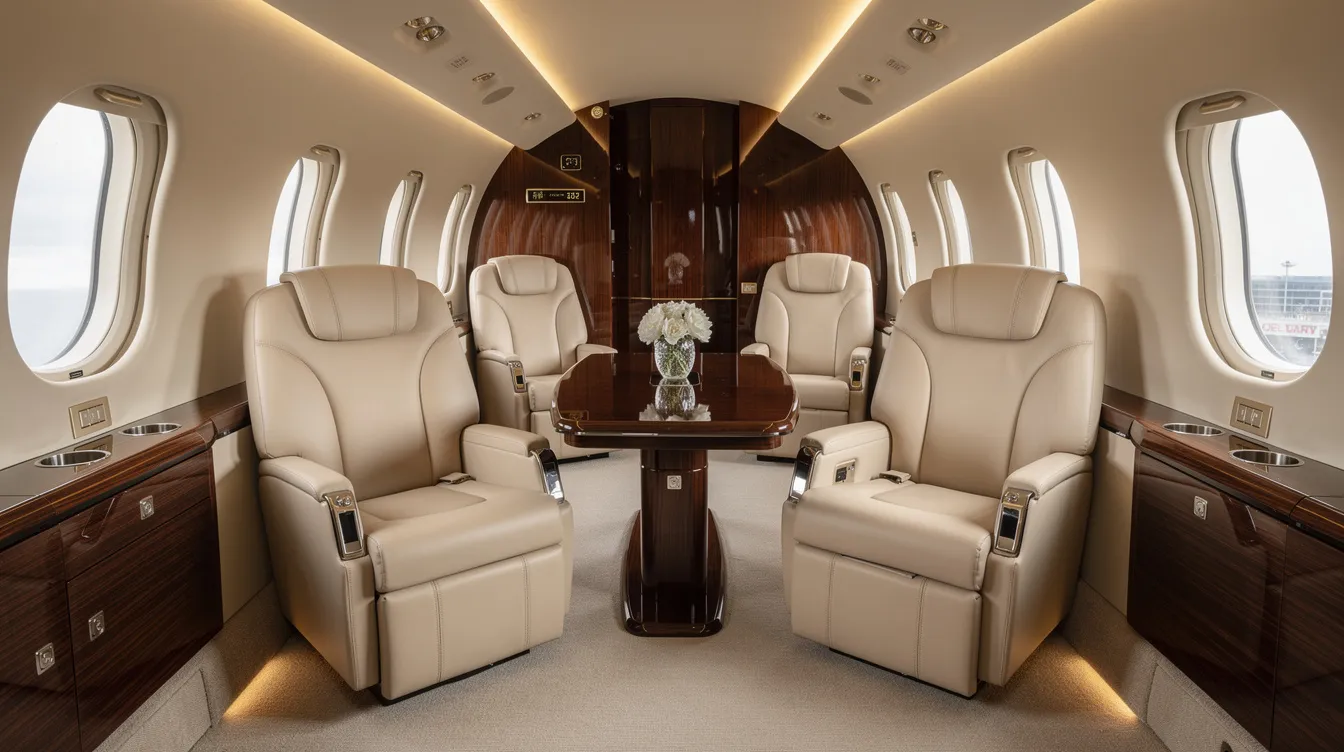
Inside the cabin, newer engines mean reduced vibration and lower ambient noise, supporting on-board productivity for executives reviewing presentations or restful sleep on overnight transatlantic flights. BlackJet emphasizes newer, quieter engine generations across its accessible fleet, recognizing that discretion and a low noise footprint are intrinsic to the private aviation experience.
Fuel Burn, Emissions, And Carbon-Neutral Private Jet Flights
Jet engines emit carbon dioxide and nitrogen oxides as unavoidable byproducts of burning hydrocarbon fuel. A midsize business jet burning 200–250 GPH emits roughly 2–2.5 metric tonnes of CO₂ per flight hour; large-cabin jets consuming 400–500+ GPH produce 3–4.5 tonnes per hour. Airplanes pollute hundreds of times more when idling than flying, which is one reason private aviation's fast taxi-and-go operations at FBOs present an efficiency advantage over congested commercial terminals.
Modern high-bypass turbofan engines have reduced specific fuel consumption by roughly 40–50% compared with the turbojets of the 1960s. Each generation of engine refinement - better materials for turbine blades, higher overall pressure ratio, improved cooling - pushes the efficiency frontier further, meaning aircraft burn less fuel per nautical mile than their predecessors.
The primary pollutants - CO₂, NOₓ, unburned hydrocarbons, and particulates - carry acknowledged climate impact. Private aviation bears responsibility for addressing these emissions transparently, including recognizing how engine efficiency and aircraft size influence jet card cost per hour, broader private jet price lists, and the true environmental cost of each trip.
Sustainable aviation fuel (SAF) offers a practical near-term solution. Certified under ASTM D7566 pathways, SAF is a drop-in replacement for conventional Jet-A, compatible with existing engines at blends up to 50% without modification, and its use is increasingly factored into modern jet card pricing structures. Depending on feedstock, SAF can reduce lifecycle greenhouse gas emissions by up to 80% compared with petroleum-derived jet fuel.
BlackJet's carbon-neutral commitment combines fuel-efficient engines, route optimization, and certified carbon offset programs so that every flight booked through a Jet Card or charter is offset - without additional cost or complexity for the member, aligning sustainability with predictable jet card cost structures.
Digital Engine Monitoring, FADEC, And Real-Time Flight Support
FADEC - Full Authority Digital Engine Control - is standard on virtually every modern aircraft jet engine. It manages fuel flow, variable stator vanes, bleed valves, and engine limits automatically, ensuring optimal efficiency and safety across all phases of flight. The system protects against exceeding temperature limits, over-speed conditions, and compressor stalls, while delivering smoother engine starts and thrust transitions that passengers notice as refined cabin comfort.
Digital engine monitoring systems continuously capture parameters including N1 and N2 spool speeds, exhaust gas temperature (EGT), fuel flow, oil pressure, and vibration signatures. This data streams to maintenance teams for trend analysis, enabling predictive rather than reactive maintenance scheduling.
For BlackJet members, this technology integrates with the operations and booking platform. If trend data flags a parameter drifting outside the correct value envelope on a scheduled aircraft, the operations team can proactively swap to a replacement jet before departure, preserving schedule integrity and eliminating unscheduled downtime while still aligning the trip with optimized private jet charter pricing for the mission profile.
The benefits extend beyond reliability. FADEC-managed engines perform consistently across varied conditions - hot-and-high airports, short runways, de-icing operations - giving Jet Card members confidence that their aircraft will depart on time regardless of environment. BlackJet's 24/7 support team leverages engine health information alongside flight planning tools to advise members on optimal departure windows and routing for each mission.
Selecting The Right Jet Engine–Powered Aircraft For Your Mission
For most travelers, "engine choice" translates into selecting the right aircraft category. The jet engine defines what an aircraft can do - how far, how fast, from which runways, carrying how much payload.
Consider typical mission profiles, which also shape whether chartering a private jet is worth it compared with scheduled airline service:
New York–Miami weekend, 4 passengers: A light jet with efficient turbofans handles the 1,000 nm leg easily, accessing smaller South Florida airports and keeping costs proportional to the trip.
London–Dubai business trip, 8 executives: A super-midsize or large-cabin jet with engines producing 10,000+ lbf thrust covers the 3,000 nm nonstop with a full-service cabin, with pricing broadly in line with frameworks for how much it costs to rent a private jet.
Intra-Europe hops - Paris, Geneva, Milan: Midsize jets or even turboprops offer flexibility and access to compact Alpine and urban airports, and similar logic applies when comparing regional missions and pricing in markets like India, where guides to private jet prices in rupees help contextualize cost, alongside earlier discussions of how much it costs to charter a small plane.
Field length, runway surface, and altitude affect engine performance directly. Hot-and-high conditions in Aspen or Toluca thin the intake air, reducing engine output. BlackJet advisors factor these variables when recommending aircraft for each mission.
BlackJet's Jet Card model lets members specify cabin class and typical mission distances up front, ensuring consistent access to aircraft whose engines deliver the necessary range, climb rate, and payload. Consider noise restrictions at your most frequent destinations, sustainability preferences such as SAF-enabled operators, and onboard productivity needs when evaluating which engines and aircraft classes align with your travel style, especially if you are comparing a 100-hour Jet Card cost guide to other membership options or weighing them against the allure of the most expensive private jets.

Future Trends In Jet Engines And What They Mean For Private Flyers
The next decade will bring meaningful advances to the powerplants behind private aviation. Ultra-high-bypass turbofans, hybrid-electric assist systems, and advanced materials like ceramic matrix composites (CMCs) for hotter, more efficient engine cores are all progressing from laboratory to flight test.
Rolls-Royce's UltraFan demonstrator targets fuel-burn reductions of 25% compared with the first Trent generation. Pratt & Whitney and GE are pursuing next-generation business jet engines with similar ambitions - 20%+ improvements that compound the gains already achieved over prior decades. These gains come from higher high-temperature tolerance in turbine materials, more efficient compressor stages, and lower-drag nacelle designs, all of which influence hourly rates across leading providers such as those covered in our NetJets jet card cost overview and comparative analyses like the Flexjet jet card cost guide.
Sustainable aviation fuel will play an expanding role. Engine manufacturers are designing combustion systems and fuel systems compatible with higher SAF blend ratios, and multiple feedstock pathways (HEFA, Fischer-Tropsch, Alcohol-to-Jet) are scaling to improve supply and reduce cost. The long-term trajectory includes synthetic e-fuels produced with renewable electricity, potentially approaching net-zero lifecycle emissions.
Digital twins - virtual replicas of individual engines fed by real-time sensor data - will enable prescriptive maintenance that anticipates component wear weeks before it affects dispatch. For providers like BlackJet, this translates to even higher dispatch reliability and the flexibility to accommodate last-minute trip changes without compromising safety or schedule, factors that can also shape jet card tax deduction strategies tied to business travel reliability.
While the core physics of jet engines hasn't changed since the first jet engine flights of 1939–1941, the coming years will deliver meaningful gains in sustainability, noise reduction, and range. For private flyers, this means quieter arrivals, longer non-stop routes, and a credible path toward genuinely low-carbon air travel - enhancements that elevate every element of the experience, whether you are moving a handful of executives or chartering private jets for 50 passengers, arranging charter planes for 100 passengers, or selecting top private jets for 30 passengers for major events.
Frequently Asked Questions About Jet Engines And BlackJet Travel
What type of jet engines power most BlackJet flights?
The vast majority of flights use turbofan engines - specifically medium- and high-bypass turbofans mounted on light, midsize, and large-cabin business jets. These engines offer the best balance of speed, range, fuel efficiency, and low cabin noise for private aviation.
Are private jet engines less safe than commercial airline engines?
No. Business jet turbofans undergo the same FAA Part 33 and EASA certification processes as commercial airline engines. Families like the Honeywell HTF7000 have logged hundreds of thousands of hours with zero in-flight shutdowns. BlackJet partners only with operators meeting rigorous maintenance standards.
Do private jets use more fuel per passenger than commercial flights?
On a per-passenger basis, private jets typically consume more fuel because they carry fewer people. However, direct routing, minimal ground idle time, and access to closer airports can offset some of that difference, and BlackJet's carbon-neutral program ensures every flight is offset regardless.
How does BlackJet keep flights carbon neutral if jet engines burn fossil fuels?
BlackJet combines fuel-efficient engine selection, route optimization, and certified carbon offset programs to neutralize the emissions of every Jet Card and charter flight. Where available, operators in the network also use SAF blends to reduce lifecycle emissions at the source.
Can I request aircraft approved for sustainable aviation fuel?
Yes. Many modern turbofan engines are certified to run on SAF blends up to 50%. BlackJet advisors can match your preferences with SAF-capable operators as supply expands across major FBO networks.
What is the difference between a turbojet engine and a turbofan engine?
A turbojet pushes all the air through the engine core. A turbofan adds a large fan that moves a significant volume of cooler bypass air around the core, producing thrust more efficiently and with far less noise - which is why turbofans dominate modern private and commercial aviation.
How can I match the right jet and engine performance to my travel profile?
Start by considering your typical mission distance, passenger count, and preferred airports. BlackJet advisors use these inputs to recommend the ideal aircraft class - and the engine performance behind it - through the Jet Card program that fits your schedule. Explore membership options or speak with an advisor to get started.
Conclusion: Jet Engines as the Heart of Private Aviation Excellence
Jet engines are far more than mechanical components; they are the strategic enablers of private aviation’s unmatched speed, efficiency, and flexibility. From the pioneering turbojets of the 1930s to today’s advanced high-bypass turbofans, continuous innovation has transformed jet propulsion into a technology that balances performance with sustainability, safety, and passenger comfort.
For the discerning traveler, understanding the nuances of jet engine types and their operational benefits clarifies why modern business jets powered by turbofan engines remain the preferred choice. These engines deliver the thrust necessary for rapid climbs, long-range nonstop flights, and access to noise-sensitive airports, all while supporting carbon-neutral commitments through fuel efficiency and sustainable aviation fuel compatibility.
As private aviation evolves, emerging technologies like hybrid-electric propulsion and digital twin monitoring promise even greater reliability and environmental responsibility. BlackJet’s commitment to integrating these advances ensures that every journey is not only effortless and exclusive but also aligned with the future of sustainable luxury travel.
Discover how BlackJet’s Jet Card programs leverage the best in jet engine technology to offer you premier access to the skies—where every flight is an elevated experience defined by precision, discretion, and innovation, whether you’re booking charters, exploring ownership, or even evaluating private jet purchases with cryptocurrency.


 Sign up with google
 Sign up with Apple