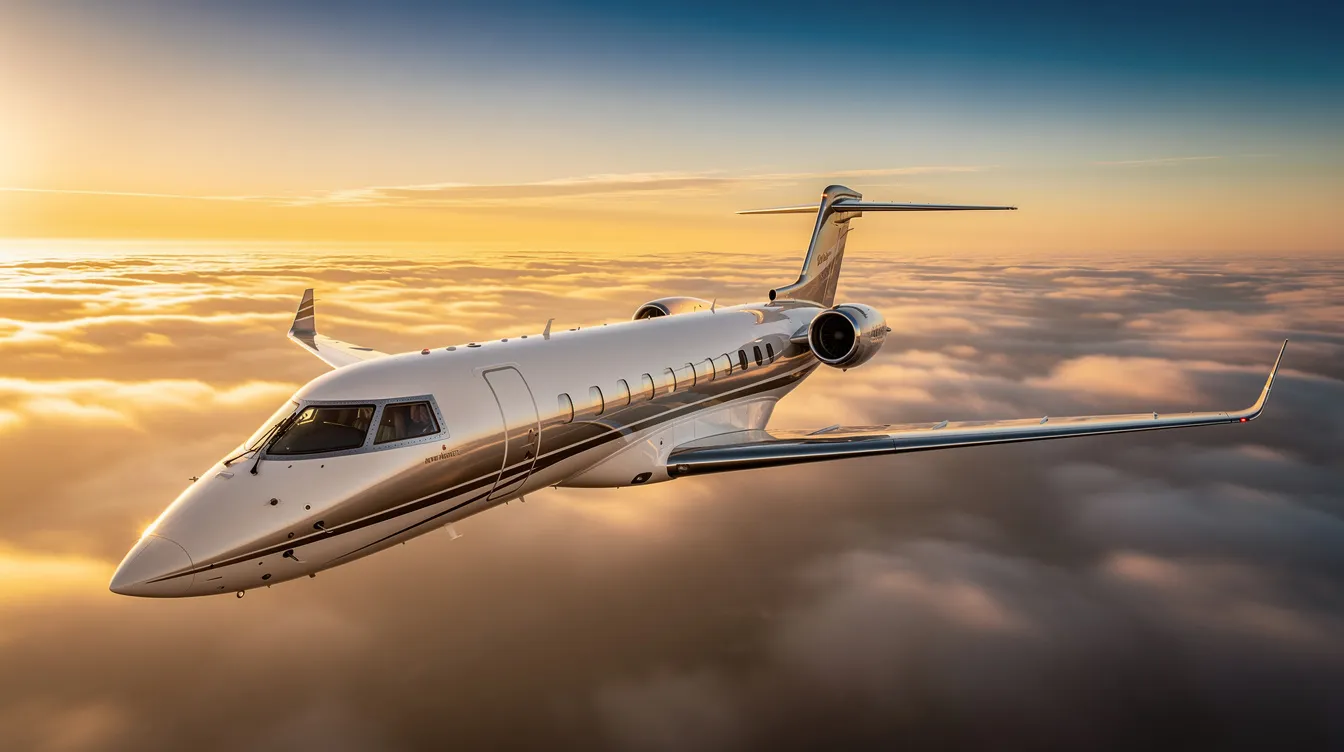
Choosing the right aircraft for family travel is not a luxury decision; it is a logistics decision. The difference between a well-matched family jet and a poor one shows up in hours lost, stress accumulated, and vacation days wasted before anyone reaches the resort. This guide covers aircraft categories, safety standards, costs, and planning steps to help families fly private with precision.
Why High-Net-Worth Families Are Redefining Family Vacations in the Sky
Consider a Christmas trip from Manhattan to Aspen. On commercial airlines, the itinerary typically requires leaving home 4 to 5 hours before the first flight: driving to a major hub, clearing TSA security, checking bags (including ski gear), and boarding a flight to Denver. From Denver, families either connect on a regional carrier or drive 4 hours through mountain passes. Total door-to-door: 6 to 8 hours, assuming no weather delays, cancellations, or de-icing holds. With young children, each of those steps compounds the stress.
Flying private from a nearby FBO like Teterboro or Westchester County Airport changes the math. The family arrives 20 to 30 minutes before departure, boards directly, and flies a direct route to Aspen Pitkin County Airport. Total door-to-door: roughly 3 hours. That is 3 to 5 hours recovered per direction, which for a holiday trip means an extra half-day with family at the destination instead of standing in an airport terminal.
BlackJet's Jet Card model gives families access to this experience through 25-hour and 50-hour blocks of prepaid flight time. Unlike ad-hoc charter services, which can spike in price or become unavailable during peak school holidays, a jet card provides guaranteed availability and fixed hourly rates. Unlike aircraft ownership, which ties a family to one aircraft type and a long list of management responsibilities, a jet card allows switching between cabin sizes trip by trip.
This article is a practical reference: how to choose the best private planes for family vacations, what safety certifications to verify, how costs break down by aircraft type, and how to plan a trip from first call to wheels-down. Everything is written from BlackJet's operational perspective.
What Makes a "Family Jet" Different from a Typical Private Jet?
A family jet is not a specific aircraft model. It is a configuration: the right cabin layout, storage capacity, noise profile, and service setup to handle children, grandparents, pets, and oversized luggage on the same flight.
Compare two scenarios:
Business trip: Two executives on a light jet, each with an overnight bag, flying 2 hours from Chicago to New York. They need Wi-Fi, a quiet cabin, and coffee. The aircraft barely needs to flex.
Family trip: A family of 5 heading to Vail in February with skis, snowboards, a stroller, a car seat, and a nanny. They need enough external baggage hold for bulky gear, cabin space to install a child restraint, room for an infant to be changed, and meals that satisfy a picky 4-year-old. The aircraft needs to flex considerably.
The practical dimensions that define a family jet:
Cabin layout: Club seating paired with divans (convertible couches) so adults and children can spread out. Aisle width matters for moving between seats with a toddler on your hip.
Baggage volume: External hold capacity for ski bags, golf clubs, or multiple full-size suitcases. A very light jet holds 50 to 70 cubic feet; a super midsize jet may hold 120 or more.
Noise and pressurization: Lower cabin altitude reduces ear discomfort for infants. Newer aircraft pressurize to 5,000 to 6,000 feet even at cruising altitude, which is gentler than older jets at 8,000 feet.
Range vs. payload: Carrying a full family with luggage reduces usable range. A midsize jet rated for 3,000 nautical miles at light load may only cover 2,400 nautical miles fully loaded.
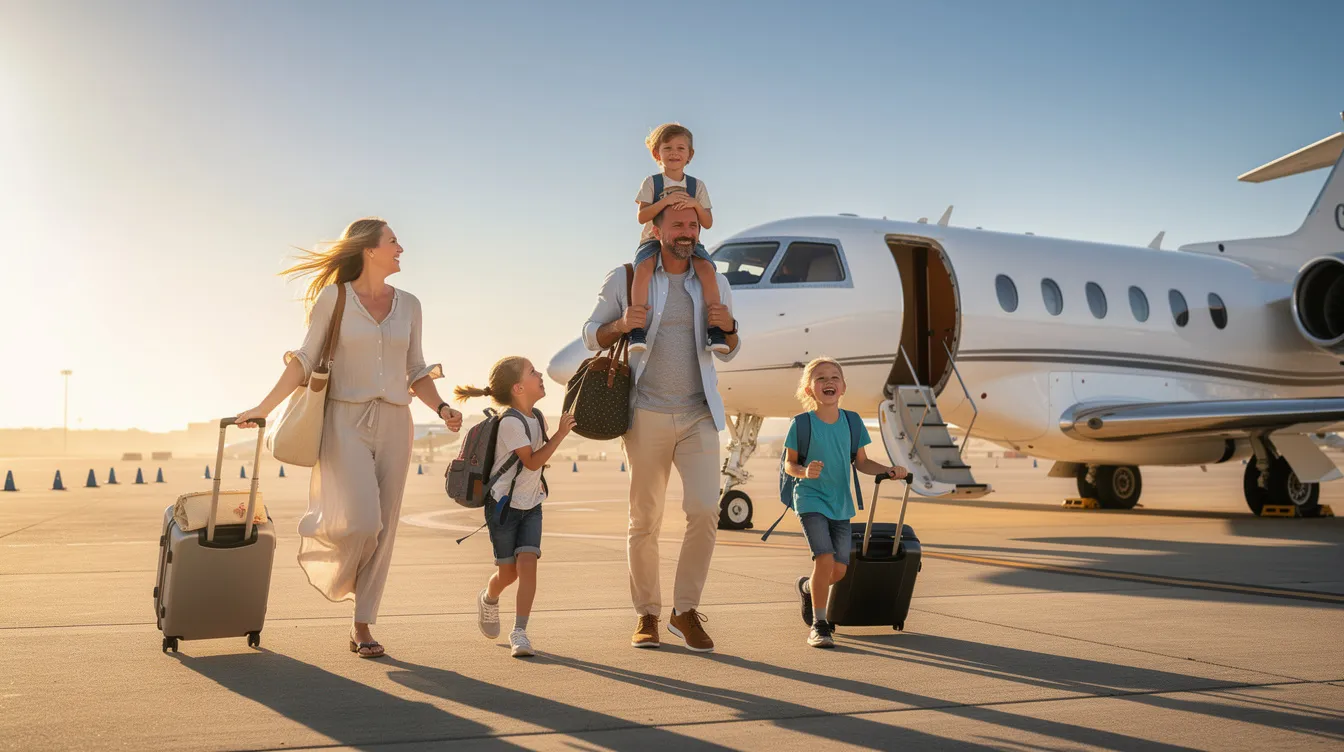
Core Benefits of Flying Private as a Family with BlackJet
Private jets save families 2 to 4 hours per trip compared to commercial aviation. Here is where those hours come from and what else families gain:
Faster boarding: Families can arrive 15 to 45 minutes before departure at a private FBO, versus the 90 to 120 minutes recommended by commercial airlines. Boarding itself takes 10 to 20 minutes because there is no jet bridge queue, no zone system, and no overhead bin competition. Private jets save time by bypassing commercial TSA lines and baggage claims entirely.
Schedule control: Private jets offer unmatched schedule flexibility for family travel. A family can depart Sunday at 8 PM after a full last day of vacation, arriving home with kids already asleep, rather than catching the only 2 PM commercial flight and losing half a day. Departure times can align with nap schedules, school pickup, or sporting events.
Airport access: Private jets can access over 5,000 airports worldwide, many of them small regional fields that commercial airlines do not serve. Fly into Truckee instead of Reno for Lake Tahoe. Use Teterboro instead of JFK for the New York metro area. Land at Eagle-Vail instead of connecting through Denver. Private jets provide direct access to thousands of regional airports near resort destinations, cutting ground transfer time from hours to minutes.
Privacy and health: Private jets enable privacy and comfort in a reserved cabin. No shared armrests, no stranger's cough two rows forward. Families maintain routines (meals, diaper changes, screen time) without judgment or interruption. Private jets can support family travel with health and safety control: fewer touchpoints, smaller terminals, and HEPA-filtered cabin air reduce exposure to illness. Private jets also allow families to bring pets in the cabin without cargo holds or breed restrictions.
Performance: Private jets can operate at higher cruising altitudes than commercial flights, often above weather and turbulence, which shortens flight times and smooths the ride for children.
Sustainability and support: BlackJet combines these benefits with carbon-neutral flights on every trip and 24/7 real-time support as part of the Jet Card experience, aligning with many features highlighted in guides to the best jet cards for frequent flyers. Private jets offer better family experiences for weekend trips and remote destinations where commercial service is limited or nonexistent.
How Child's Age Shapes the Ideal Family Jet Experience
The ideal aircraft and onboard setup shift based on every child's age. Here is how each stage maps to specific needs:
Infants (0 to 2)
Under FAA rules, children under 2 may fly as lap infants. On private flights, operators offer more flexibility for FAA-approved child restraint systems if families prefer a dedicated seat.
Quiet cabin pressurization matters: newer midsize and large cabin jets pressurize to lower cabin altitudes, reducing ear pain.
Cabin layouts with a flat divan near the front give caregivers space for diaper changes and feeding without crawling over other passengers.
Toddlers (2 to 5)
Car seat compatibility becomes critical. Families need to confirm seat width and belt type with BlackJet before the trip so that a convertible or forward-facing seat fits securely.
Toddlers need room to move safely during the cruise. Cabins with flat floor space between facing seats work well.
Simple entertainment: tablet holders, a few favorite snacks, and a small selection of toys keep a 3-year-old occupied for a 3-hour leg.
School-age (6 to 12)
Wi-Fi for streaming matters here. A midsize or super midsize jet with satellite connectivity lets kids watch movies while adults read or work in a separate zone.
Tables for homework, card games, or coloring give kids something tactile to do.
Enclosed lavatories (standard on midsize and above) are more practical than the curtained options on smaller aircraft.
Teens (13+)
Full connectivity: high-bandwidth Wi-Fi, multiple USB ports, and enough screen real estate for a laptop or tablet. Long-haul flights like LA to Hawaii (5+ hours) require sustained bandwidth.
Separate seating areas prevent the "everyone on top of each other" dynamic. Larger aircraft with club seating forward and a divan section aft let teens claim their own zone.
Gourmet catering with meal choices (not just one preset option) appeals to this age group.
BlackJet advisors ask about every child's age and needs during trip planning to match aircraft type and onboard setup accordingly.
Safety First: What Families Should Know About Family Jets
Private aviation has a lower accident rate than commercial aviation. But families still need to verify the specific safety credentials of every operator and aircraft they fly on. Safety is the first variable BlackJet optimizes, before cabin size or price.
Regulatory baseline
All charter operators in the U.S. must hold an FAA Part 135 Air Carrier Certificate, which governs crew training, maintenance standards, duty time limits, and operational control.
Third-party certifications BlackJet requires
ARGUS Platinum or Platinum Elite: the highest tiers of the ARGUS rating system, involving on-site audits of maintenance records, pilot records, insurance, and incident history.
Wyvern Wingman or Wingman PRO: requires captains with at least 1,500 total flight hours and first officers with 500+ hours, plus audits of safety management systems and flight data monitoring.
IS-BAO Stage II or III: the International Standard for Business Aircraft Operations, with Stage III representing a mature, proactive safety culture with regular internal and external audits.
Pilot experience
BlackJet's operator network requires pilot experience well above regulatory minimums. Recurrent training, type ratings on specific aircraft, and crew resource management are standard.
Health and hygiene
Private jets can support family travel with health and safety control through enhanced cabin cleaning before and after each flight, HEPA air filtration, and catering sourced with allergy awareness (nut-free, gluten-free, or other restrictions). Families with food allergies can specify requirements when booking; operators confirm compliance before flight day.
Child Seating, Car Seats, and Age-Specific Rules On Board
Rules for child seating on private jets parallel commercial standards, but the smaller, more flexible cabin environment often makes compliance easier in practice.
Children under 2 may fly as lap infants. For ages 2 and up, the FAA recommends an approved child restraint system secured to the aircraft seat. On private flights, families have more control over this process: they choose their seats, install the car seat themselves (or with crew assistance), and confirm fit before other passengers board.
Key steps for car seat flights:
Confirm seat width and belt type with BlackJet during booking. Many private jets use lap belts rather than three-point harnesses; car seat bases must be compatible. Some operators stock CARES harnesses (approved for children 22 to 44 pounds) as an alternative.
Pre-board from the FBO: The primary caregiver arrives first, installs the car seat in the chosen position, and verifies it is secure. The rest of the family boards after.
Cabin layout coordination: BlackJet can arrange specific seating configurations, placing car seats at positions with the best access for the caregiver, and keeping aisles clear for other passengers.
For families with multiple young children, midsize or larger cabins provide enough seat positions to install two car seats plus leave room for adults and older siblings.
Choosing the Best Private Planes for Family Vacations
Choosing the right jet category depends on family size and travel distance, and families concerned with budget can look at the cheapest private aircraft and access models when weighing options. The selection process starts with four variables:
Passenger count (including caregivers and nannies)
Ages of children (which drive car seat needs, entertainment, and cabin space)
Flight distance in nautical miles (which determines which aircraft categories can fly nonstop)
Luggage profile (ski gear, strollers, surfboards, or standard suitcases)
A family of 3 flying Dallas to Santa Fe for a weekend (roughly 500 nm) can use a very light jet comfortably. The same family heading from New York to Costa Rica (2,100+ nm) with dive gear and a stroller needs a midsize or larger.
This is the concept of a "mission profile": matching the aircraft to the specific trip, not choosing one jet for all occasions. BlackJet Jet Card members can switch aircraft categories trip by trip instead of being locked into one aircraft type as with aircraft ownership.
The sections below cover each category in detail, from very light jets to ultra-long-range jets, plus two specific aircraft families (Cirrus Vision Jet and Cessna Citation) that appear often in family travel discussions and help illustrate the broader meaning of charter flights and how they work.
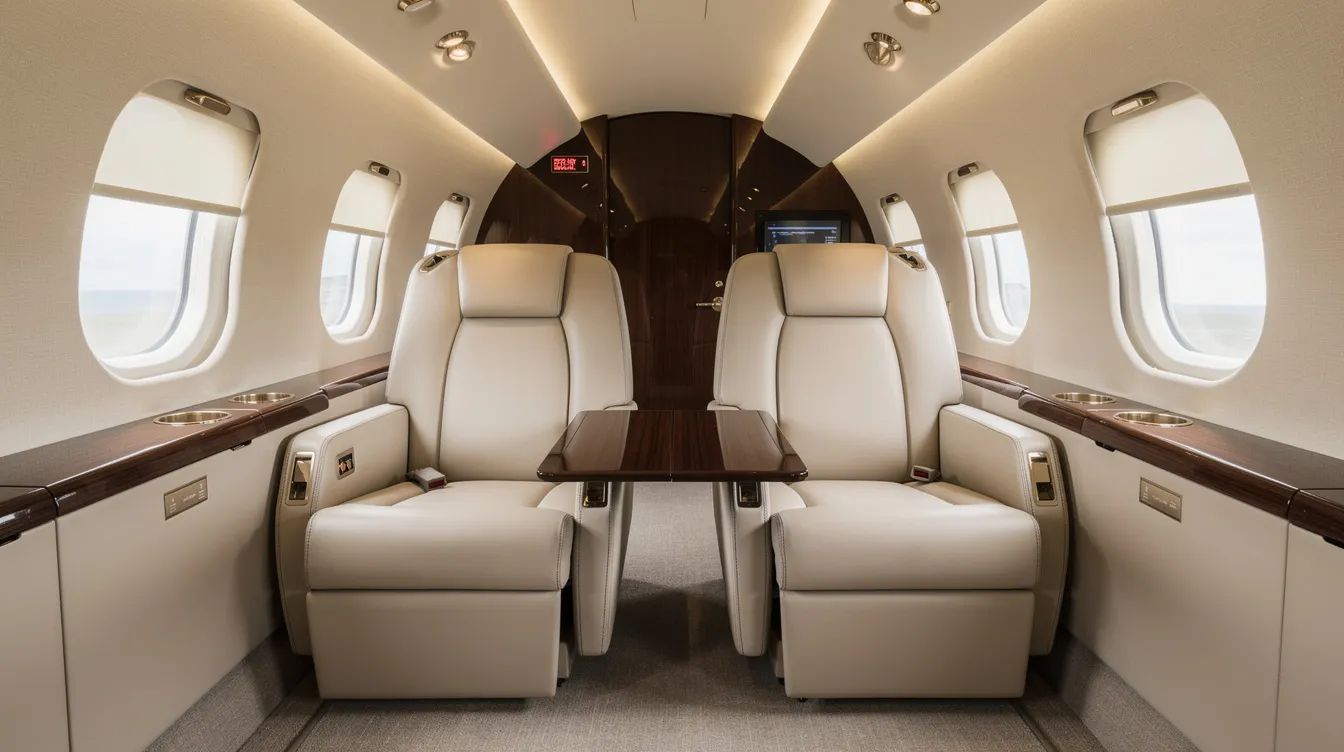
Very Light and Light Jets: Efficient Choices for Short Family Getaways
Very light jets accommodate 2 to 4 passengers with a range of 1,200 to 1,500 nautical miles. They are the smallest category of small jet aircraft in private aviation, designed for speed and efficiency on short hops and often feature prominently in discussions of the cheapest private jet options. Examples include the HondaJet Elite S, Embraer Phenom 100EV, and Eclipse 500.
Light jets step up to 6 to 8 passengers with a range of 1,800 to 2,000 nautical miles. The Embraer Phenom 300 and Cessna Citation CJ3 are common in this class. Cabins are wider, baggage holds larger, and basic galleys allow hot and cold refreshments.
Sample itinerary: A family of 4 flies from New York to Nantucket for a 3-day weekend. A light jet covers the 200 nm in under an hour. Total trip cost is a fraction of a midsize charter, and the family lands at Nantucket Memorial Airport, minutes from their rental.
Trade-offs to know:
Very light jets have limited stand-up cabin height; adults crouch when moving.
Baggage holds may not accommodate ski bags, oversized strollers, or multiple car seats simultaneously.
No enclosed lavatory on most very light jets; light jets vary.
A single pilot operation is certified on some very light jets, but families may prefer two-crew operations for redundancy.
BlackJet advisors often recommend stepping up to a midsize cabin if the family's trip involves car seats, a stroller, sports equipment, or more than 4 passengers. The marginal hourly cost increase is typically offset by the comfort difference.
Midsize Jets: The Sweet Spot for Most Family Trips
For families of 4 to 6 doing two or more long weekends plus one extended family vacation per year, midsize jets often represent the best balance of cost, space, and range. Midsize jets can hold 6 to 9 passengers with a range of 2,700 to 3,600 nautical miles.
Concrete models:
Model | Seats | Range (nm) | Stand-up cabin | Baggage (cu ft) |
|---|
Cessna Citation Latitude | 9 | 2,700 | Yes | 100+ |
Citation XLS+ | 8 | 2,100 | Yes | 90 |
Gulfstream G280 | 10 | 3,600 | Yes | 120 |
Sample trips a midsize jet handles nonstop: Chicago to Jackson Hole for a ski family vacation (1,200 nm). Miami to Costa Rica for a surf retreat (1,100 nm). New York to Turks and Caicos (1,400 nm). All well within range, even at full passenger and luggage loads.
Cabin features that matter for families: enclosed lavatory with a door, Wi-Fi capable of streaming, entertainment systems with screen mounts, and enough baggage hold for skis, golf clubs, and multiple checked bags. Spacious cabins in this class let parents and children occupy different seating zones, reducing friction on legs over 3 hours.
BlackJet frequently positions midsize jets as the default recommendation for domestic and Caribbean family trips, especially for families who find that chartering a private jet is worth it once time savings and flexibility are factored in.
Super Midsize, Large Cabin, and Ultra-Long-Range Jets: For Global Family Adventures
When the trip is international, or the group is multi-generational, super midsize jets and large cabin aircraft become the right tool.
Super midsize jets accommodate 8 to 10 passengers and have a range of 3,000 to 4,000 nautical miles. They handle transatlantic legs (U.S. East Coast to Western Europe with one fuel stop) and nonstop coast-to-coast domestic flights with full loads, while families traveling with much larger groups may need to explore the best private jets for 20 passengers in the heavy-jet category.
Heavy jets can carry 10 to 16 passengers with a range of 6,000 to 7,700 nautical miles. Ultra-long-range jets in this class accommodate global nonstop travel with maximum comfort, and some configurations can be stepping stones toward private jets for up to 50 passengers when extended families or event groups travel together. Specific aircraft:
Bombardier Global 7500: 7,700 nm range, four distinct living spaces, full galley, master suite, and a dedicated crew rest area. This aircraft offers five expansive cabin zones on select configurations, making it possible for grandparents, parents, children, and a nanny to each have their own area.
Gulfstream G700: five distinct living areas, ultra-quiet cabin, lie-flat beds for every passenger on long-haul flights.
Dassault Falcon 8X: known for exceptional fuel efficiency in the large cabin class, with a tri-engine design that allows steep approaches into challenging airports.
Sample itinerary: New York to Rome nonstop (3,700 nm) for a 10-day summer family vacation. The family departs Teterboro at 8 PM, children sleep in lie-flat beds through the Atlantic crossing, and the group arrives in Rome the next morning rested. Adults work or read in a separate forward cabin while kids watch movies in the aft section. The flight itself feels like part of the vacation, not a barrier to it.
Through BlackJet's global network, Jet Card members can request larger aircraft for key annual trips (summer in Europe, winter in the Caribbean) without bearing the fixed costs of ownership or aircraft management overhead.
The Cirrus Vision Jet: The Modern Personal Family Jet
The Cirrus Vision Jet (SF50) occupies a unique niche in personal aviation. It is a single-engine very light jet designed in Duluth, Minnesota, with a first prototype flight (its maiden flight) in June 2008. The production G2 and G2+ variants seat 4 to 5 passengers in a cabin that feels closer to a car interior than a traditional jet.
The Vision Jet appeals to owner-pilots and very small families who want to fly short hops (under 1,000 nm) with lower operational costs than conventional light aircraft or other private jets, making it a frequent reference point in discussions of the cheapest private aircraft options. Maximum takeoff weight for the SF50 is approximately 6,000 pounds, keeping it in a category that allows single-pilot operation.
The standout safety feature is the Cirrus Airframe Parachute System (CAPS): a whole-airframe ballistic parachute that can lower the entire Cirrus aircraft to the ground in an emergency. For parents thinking about worst-case scenarios, this is a concrete, tested system, not a theoretical safety margin. Cirrus aircraft have logged hundreds of CAPS deployments across their piston and jet lines, with the system credited with saving lives in situations where conventional flight would have ended differently. Cirrus VisionJet is not a replacement for a midsize charter; it is a different category entirely. It serves a niche within the aviation industry for families who want a flexible alternative to driving or flying commercial on routes under 3 hours. While BlackJet primarily provides professionally flown multi-engine jets through its charter services, some operators in the BlackJet network do position the Cirrus Vision Jet for ultra-short, efficient family hops where a larger aircraft would be unnecessary.
The Cessna Citation Family: Proven Workhorses for Family Travel
The Cessna Citation family is one of the most widely operated jet lines in business aviation. The original Citation 500 earned FAA certification in 1971, introducing the light jet category to the market. The CitationJet CE-525 launched in 1989 with its maiden flight in 1991, spawning a line of light aircraft that includes the CJ1, CJ2, CJ3, and CJ4.
For families, the Citation line offers two key features: a broad service network (parts and maintenance available across the U.S. and internationally) and cabin configurations that range from compact (CJ3, seating 6 to 7) to spacious cabins with stand-up height (Citation Latitude, seating 9).
Two models for family travel:
Citation M2: A light jet for short-to-medium hops (1,300 nm range, 7 seats). Good for a family of 4 doing regional trips under 3 hours.
Citation Latitude: A midsize jet with a flat-floor, stand-up cabin, 2,700 nm range, and 9 seats. Handles cross-country legs and Caribbean routes with modern amenities and enough baggage for a full family load.
BlackJet frequently arranges Citation-series aircraft for Jet Card members due to their flexibility across U.S. and Caribbean family routes and their operational history of reliability, especially on routes where families might otherwise charter a small plane for efficiency.
Ownership vs Charter vs Jet Card: The Smart Path for Family Jets
Families can consider alternative options like fractional ownership or jet cards, depending on how many flight hours they fly per year and how much operational complexity they want to manage.
Ownership
Private jet ownership requires a capital outlay of $5 million or more for a midsize aircraft; large cabin jets run $20M to $70M new. Private aircraft typically depreciate over time like luxury vehicles: 5 to 15% in the first few years, accelerating as the aircraft ages. Annual fixed costs include crew salaries, hangar fees, maintenance, insurance, and regulatory compliance. Owning a family jet requires complex management and logistics. Families who fly frequently (150+ hours per year) may justify the overhead, but most family-use profiles fall well below that threshold.
On-demand charter
Chartering a private jet operates on a pay-per-trip basis. This gives trip-by-trip flexibility, but pricing fluctuates with demand, fuel, and repositioning, as outlined in many private jet charter pricing guides. During peak school holidays (Christmas, spring break, summer), availability for a large cabin aircraft may disappear weeks in advance, or pricing may spike 30 to 50%, which is why families often ask whether chartering a private jet is worth it relative to commercial options.
Jet Card (BlackJet)
Jet card programs offer guaranteed aircraft availability and fixed hourly rates through prepaid blocks (25 or 50 hours), and families comparing options can review jet card membership pricing guides alongside the dedicated BlackJet 25+ Hour Jet Card. Members choose the aircraft type trip by trip: a light jet for a short weekend, a super midsize for an international trip. No hangar fees, no crew payroll, no maintenance schedules. Fractional ownership allows sharing costs among multiple users, but still locks families into one aircraft type and requires multi-year commitments. A jet card is a flexible alternative with lower commitment and broader access.
For families flying 25 to 100 hours per year across a mix of family vacations and occasional business travel, a jet card is typically the most cost-efficient path, while ultra-frequent flyers might compare that against 100-hour jet card cost structures from multiple providers.
Cost and Budgeting: What a Family Jet Really Costs Per Trip
Hourly charter rates in 2026 cluster into these bands, mirroring broader benchmarks on how much it costs to rent a private jet:
Aircraft Category | Hourly Rate Range |
|---|
Very Light Jet | $3,500 to $4,500 |
Light Jet | $5,000 to $8,000 |
Midsize Jet | $7,200 to $10,000 |
Super Midsize Jet | $11,000 to $13,000 |
Large Cabin / Heavy | $12,200 to $16,000 |
Example trip costed out: A family of 5 flying New York to Orlando round trip for a 5-day family vacation on a midsize jet. Round-trip flight hours total approximately 4 hours. At $8,000 per hour, the base flight cost is $32,000. Add landing fees, FBO handling, catering, and possible crew overnight: roughly $4,000 to $6,000 in additional charges. Total: approximately $36,000 to $38,000.
Compare that to 6 first-class tickets (parents, 3 children, nanny) at $2,000 to $2,500 each: $12,000 to $15,000. The commercial option costs less in absolute dollars, but the private flight saves 4 to 6 hours of total transit time, eliminates two nights of disrupted sleep schedules, and avoids crowded airports during holiday rushes—mirroring many scenarios covered in guides to how much it costs to rent a private jet.
Where private becomes cost-competitive per person: A group of 6 to 8 flying Long Island to Aspen on a super midsize jet pays roughly $40,000 to $50,000 round trip. Commercial first-class tickets with Denver connections for 8 passengers can exceed $40,000, and the commercial route adds 5 to 6 hours of travel each way, while even larger parties may need to evaluate charter plane costs for 100 passengers or more.
Hidden cost factors to budget for: repositioning fees (if the aircraft is not based near your departure airport), de-icing charges on winter ski trips, seasonal surcharges during holidays, and catering for special dietary needs. These align with broader private jet charter pricing factors. Jet Card fixed rates absorb many of these variables, which is why families focused on predictability prefer the prepaid model. BlackJet helps families model an annual budget around school calendars, target destinations, and trip length to avoid surprises.
Opportunity cost: The 2 to 4 hours saved per trip translate into fewer hotel nights bracketing flights, more vacation days actually spent at the destination, and less parental stress from logistics. For a family taking 4 to 6 trips per year, that is 16 to 48 hours recovered annually.
Carbon-Neutral Family Travel: Sustainability in the Family Jet Era
Private flights produce higher per-passenger emissions than full commercial flights. This is a structural fact of private aviation: fewer passengers per aircraft, higher fuel burn per seat mile, and it is one of several trade-offs families weigh when reviewing private jet price lists and options. Policy discussions around carbon levies and emissions charges for private jets are active in both the U.S. and Europe.
BlackJet's response is direct: BlackJet offers carbon-neutral flights at no extra cost to Jet Card members. Every flight is matched with verified carbon offsets funding reforestation, renewable energy, or other climate projects. Families do not pay a surcharge for this; it is built into the Jet Card model.
Environmental impact can be mitigated by using newer aircraft and carbon offsets together. Sustainable Aviation Fuel (SAF) can reduce life-cycle emissions by up to 80% compared to conventional jet fuel, and BlackJet sources SAF where available at partner FBOs. Newer jets like the Bombardier Global 8000 and Dassault Falcon 10X burn less fuel per nautical mile than aircraft from even 10 years ago, thanks to improved engine design and aerodynamic efficiency. The Dassault Falcon 8X already demonstrates exceptional fuel efficiency in its category.
For families, the sustainability conversation is also a teaching moment. Explaining offsets, SAF, and fuel efficiency to school-age and teenage children connects private jet travel to broader environmental responsibility. Emerging electric and hybrid aircraft concepts (short-haul air taxis, small regional electric planes) may eventually serve the ultra-short family hop market, though these remain in development.
Technology and Onboard Experience: Keeping Every Family Member Happy
The technology gap between aircraft built in 2010 and those built in 2024 is substantial, and it directly affects family comfort.
Connectivity: Newer super midsize and large cabin jets carry Ka-band satellite systems that support streaming, video calls, and real-time homework submissions. Older aircraft may offer only low-bandwidth satellite links that struggle with video. For teens and working parents on long-haul flights, bandwidth is not optional. Advanced technology in modern entertainment systems includes built-in screen mounts, Bluetooth audio, and USB-C charging at every seat.
Cabin zoning: The best layouts for families position kids in one area (typically aft, with screens and games) and adults in another (forward, with a quiet workspace or reading area). Divans convert into play areas for toddlers during the cruise. On larger aircraft with distinct living spaces, a curtain or partition separates the zones.
Catering: Private jets provide tailored in-flight dining options. Child-friendly menus, allergen-free meals, and pet-safe provisions are all arranged during booking through BlackJet's digital tools. Families request specific meals (grilled chicken fingers, fruit platters, nut-free snacks) when they book, and operators confirm sourcing and preparation standards before flight day. Personalized service extends to beverage selections, special occasion cakes, and meals timed to family routines rather than a standard service schedule.
Digital tools: BlackJet's booking platform handles aircraft selection, catering requests, car seat specifications, and real-time support for mid-trip changes. If weather forces a diversion or a family needs to adjust departure time by 2 hours, the 24/7 support team manages the logistics.
The goal is to make the flight feel like the start of the next family vacation, not a chore to endure before the vacation begins, and understanding the broader private jet price list and options helps families align that experience with their budget.
Planning Your First Private Jet Family Vacation with BlackJet
Here is how the process works, using a real example: a family of 5 (two parents, children ages 2, 7, and 14) planning a July trip from Boston to Turks and Caicos.
Step 1: Consultation
The family contacts BlackJet and provides trip details: dates, passenger ages, one pet (a 15-pound dog), car seat for the 2-year-old, dietary restrictions (nut allergy for the 7-year-old), and luggage estimate (5 checked bags plus a stroller). BlackJet recommends a midsize jet based on flight distance (1,500 nm), passenger count, and baggage, drawing on the same cost logic used when explaining how much it costs to charter a small plane. The advisor suggests a Jet Card over a single private charter if the family plans additional trips that year.
Step 2: Aircraft and FBO selection
BlackJet identifies available midsize jets (Citation Latitude or equivalent) and selects Hanscom Field (BED) as the departure FBO, 25 minutes from the family's home in the western Boston suburbs. Arrival: Providenciales International Airport (PLS), with ground transport pre-arranged to the resort.
Step 3: Onboard setup
Car seat installation is confirmed for the 2-year-old's position (second row, window seat). Catering is ordered: nut-free snacks and lunch for all passengers, dog treats and water bowl for the pet. The 14-year-old requests Wi-Fi access for streaming. Entertainment packs (coloring books, tablet mounts) are arranged for the 7-year-old.
Step 4: Day-of logistics
The family drives to Hanscom Field, parks in the FBO lot (no shuttle, no garage), and walks into the terminal 20 minutes before departure. The caregiver pre-boards to install the car seat. The whole family is on board and settled within 15 minutes. On international travel legs like this one, customs and immigration are handled at the FBO or on arrival, with paperwork pre-submitted. The dog rides in the cabin under the seat or on a lap.
BlackJet's team manages every detail so parents can focus on the vacation itself, not the logistics of getting there, consistent with the broader premium private jet card services BlackJet offers.
FAQ: Common Questions About Family Jets and BlackJet Jet Cards
What is the best jet size for a family of 4 to 6?
A midsize jet is typically the starting point. It offers 6 to 9 seats, an enclosed lavatory, adequate baggage, and enough range for U.S. domestic and Caribbean routes. For shorter hops under 2 hours, a light jet may work if luggage is minimal, while larger groups considering aircraft in the 10–12 seat range can review dedicated guides on 12 seater private jet costs and options.
Can we bring car seats and strollers?
Yes. Car seats must be FAA-approved and compatible with the aircraft's seat width and belt type. Strollers go in the baggage hold. BlackJet confirms compatibility during booking and can source a CARES harness if needed.
How far in advance should we book for school holidays?
For Christmas, spring break, and summer peak weeks, book 4 to 6 weeks in advance. Jet Card members receive guaranteed availability, but specific aircraft preferences (e.g., a Gulfstream G280 for a longer route) are easier to fulfill with lead time, especially for families evaluating whether a 100-hour jet card cost structure matches their annual travel pattern.
Can we bring pets?
Private jets allow families to bring pets in the cabin. BlackJet coordinates any required veterinary documentation and confirms the operator's pet policy before the trip.
What about international flights with children?
All children need valid passports. If a child is traveling with one parent, some destinations require a notarized consent letter from the other parent. BlackJet's team advises on documentation for each destination.
How does BlackJet handle unforeseen events or last-minute changes?
BlackJet provides 24/7 support. If weather delays a departure, the team rebooks or reroutes. If a family needs to extend a trip by a day, the return flight is adjusted. Jet Card hours are debited only for actual flight time.
How are BlackJet pilots vetted?
BlackJet uses only operators holding ARGUS Platinum, Wyvern Wingman, or IS-BAO Stage II/III certifications. Pilot minimums include type ratings, recurrent training, and operational history reviews. Details are available on BlackJet's safety page.
How are carbon-neutral flights verified?
Offsets are sourced from verified projects (reforestation, renewable energy) and matched to each flight's estimated emissions. BlackJet includes this on every trip at no additional cost. More information is available on the sustainability page.
Can Jet Card hours be used for both you and your family, and for business travel?
Yes. Hours are not restricted to one purpose. A family can use 30 hours for family vacations and 20 hours for business trips on the same card. Aircraft category can change trip by trip, so a sports team's charter or a solo business leg and a multi-generational holiday all draw from the same balance, in contrast to more rigid unlimited private jet flight memberships that bundle access into a flat annual fee.
Turning Family Travel into a Strategic Advantage with BlackJet
A well-chosen family jet turns transit hours into vacation hours. The right aircraft, matched to your family's ages, destinations, luggage, and calendar, removes the friction that makes travel with children exhausting. Private jet travel is not about unparalleled luxury for its own sake; it is about recovering time, maintaining routines, and arriving at the destination ready to enjoy it.
BlackJet's Jet Card model gives families access to the best private planes across every category, from a light jet for a weekend beach hop to a long-range family aircraft with a master suite for an international crossing. Every flight meets strict safety standards through BlackJet's certified process. Every flight is carbon-neutral. And every detail, from car seats to catering to pet paperwork, is managed by a team available around the clock.
If your family is considering flying private for the first time, or looking to move from ad-hoc charter to something more structured, speak with a BlackJet advisor about designing a personalized family travel plan for the next 12 months. The conversation starts with your calendar, your children's ages, and the destinations that matter to your whole family.


 Sign up with google
 Sign up with Apple