Introduction
The 50-seat regional jet generation—often called the “ERJ 200” class—reshaped short-haul air travel across North America and Europe during the 1990s and 2000s, though Embraer never built an aircraft officially named the ERJ 200; in practice, the term usually refers to the early ERJ family, especially the ERJ-135, ERJ-140, and ERJ-145. These aircraft proved that jet service could work on thinner routes once dominated by turboprops, and today many of these airframes are migrating into private and corporate operations as airlines retire them in favor of newer models.
For business travelers, jet card buyers, and high-net-worth leisure flyers comparing aircraft types and private travel options, that background is useful context: it explains what the ERJ generation was, how it compares with Bombardier CRJ competitors and modern business jets, and why cabin comfort, operating economics, safety standards, sustainability, and mission fit matter when choosing between an older regional jet and a current private aviation solution. It also frames why programs such as BlackJet appeal to travelers who want more privacy, flexibility, and service than aging regional aircraft can offer.
Strategic overview: Why the ERJ 200 still matters for high-end travelers
Consider a typical 400-mile flight on an aging regional airline route. You arrive at the terminal ninety minutes early, clear TSA, wait through a possible connection, and board a narrow cabin with 50 passengers for a flight that takes about an hour in the air but consumes four to five hours door to door. Now compare that with a similar-range trip on a modern light or midsize business jet arranged through a jet card: you arrive at a private FBO, clear security in minutes, and land at your destination in roughly two hours total-with your laptop open, your conversation private, and your schedule intact.
The Embraer ERJ 145 family is a reliable regional jet designed for short- to medium-range flights, and understanding this regional aircraft class helps private flyers choose the right cabin category and avoid "over-buying" capacity for short segments. Even though the plane is no longer in front-line production, its legacy informs how we think about range, runway access, and right-sized capacity.
BlackJet offers tailored access to modern light, midsize, and large-cabin jets through its premium private jet card programs-delivering the same "regional reach" the ERJ family pioneered, without the compromises of aging ex-airline aircraft. The evolution from the Embraer ERJ series to the Embraer E-Jet family and beyond frames the story this article tells: where the ERJ 200 fits, what replaced it, and why it matters for discerning travelers today.
Defining the Embraer ERJ 200: Clearing up the terminology
The term "ERJ 200" appears frequently in online search results and aviation forums, but here is the essential clarification: Embraer has never produced an aircraft called the ERJ 200. The company's actual regional jet lineup centers on the ERJ 135, 140, and 145-three variants differing primarily in fuselage length and seat count-followed by the e jet family of larger regional aircraft.
The confusion often arises because Bombardier's CRJ-200, a direct competitor, does carry the official "200" designation. The Bombardier CRJ-200 seats 50 passengers in a 2-2 configuration, while the ERJ-145 seats 50 passengers in a 2-1 configuration. Some charter brokers and second-hand aircraft listings colloquially label small ex-airline Embraer regional aircraft as "ERJ 200 category" based on seat count and role, which can mislead travelers comparing options for charter or jet cards.
Throughout this article, "ERJ 200" is treated as shorthand for the early 50-seat regional jet generation typified by the ERJ series and its rival, the CRJ-200, aligning with how most customers and brokers use the term in practice.
Historical context: Birth of the regional jet era in the 1990s
In the early 1990s, airlines across North America and Europe needed faster, more comfortable alternatives to the turboprop fleet that served 200–600 nautical mile routes. Aircraft like the EMB-120 Brasilia were adequate for range and economics but lacked the speed and cabin appeal that passengers increasingly demanded. The market segment was ripe for a jet-powered solution.
Embraer introduced the ERJ programme around 1989–1990, targeting roughly 45–50 seats, cruise speeds near 400 knots, and entry into service by the mid-1990s. The development leveraged approximately 30% parts commonality with the Brasilia, including nose and cabin sections, to reduce construction costs and accelerate the timeline. The first ERJ-145 flight took place on 11 August 1995, Brazilian and FAA certifications followed in late 1996, and revenue service launched on 6 April 1997 with ExpressJet operating on behalf of Continental Express.
Bombardier had already launched the CRJ-100/200, derived from its Challenger business jet line, establishing an early presence in the market segment. Together, the Embraer ERJ and the CRJ created the "regional jet" category that enabled hub-and-spoke expansion to secondary cities that couldn't justify larger narrow-body service from Boeing or Airbus. ERJ-family aircraft have lower operating costs per flight than larger airliners, making them ideal for these thinner routes. The ERJ family supports hub-and-spoke operations and point-to-point routing-a capability that directly foreshadowed the flexibility today's light and midsize business jets provide on similar sectors.
Technical profile: Core specifications of a 50-seat ERJ-class regional aircraft
The design features of the Embraer ERJ 145 include twin rear-mounted turbofan engines and a T-tail configuration-a silhouette that became synonymous with regional flying. The airplane is powered by two Rolls-Royce AE 3007 turbofan engines, with engine power supporting the thrust and performance needed to deliver a cruising speed of approximately Mach 0.78 to 0.80, depending on variant and conditions. Service ceiling sits near 37,000 feet, and the Embraer ERJ 145 has a maximum takeoff weight of approximately 24,100 kg in its XR form.
The range of the Embraer ERJ 145 is up to 2,000 nautical miles in the ERJ-145XR variant, though baseline ER models cover roughly 1,060 nautical miles with full passenger loads. Fuel capacity is approximately 5,973 kg, and the aircraft can operate from relatively short runways compared to larger jets, opening the door to secondary and regional airports that mainline narrow-bodies cannot reach.
The main passenger cabin of ERJ family jets uses a 1-2 layout to eliminate middle seats, meaning the seating arrangement of the Embraer ERJ 145 offers every passenger either a window or aisle seat. This was a notable comfort advantage over competitors. The Embraer ERJ 145 has high dispatch reliability and durability, and the ERJ family has a high parts commonality, which reduces maintenance costs-traits that kept these aircraft flying economically for decades.
For a BlackJet client comparing specs, the key question is whether a 50-seat aircraft makes sense for a group of 6–12 private travelers or if private jets for around 30 passengers present a more efficient option for larger parties. In almost every scenario, a modern light or midsize jet matches or exceeds the ERJ's range and runway performance while delivering a cabin designed for productivity and comfort rather than maximum seat density.
Design and spotting: How to recognize the ERJ family versus other regional aircraft
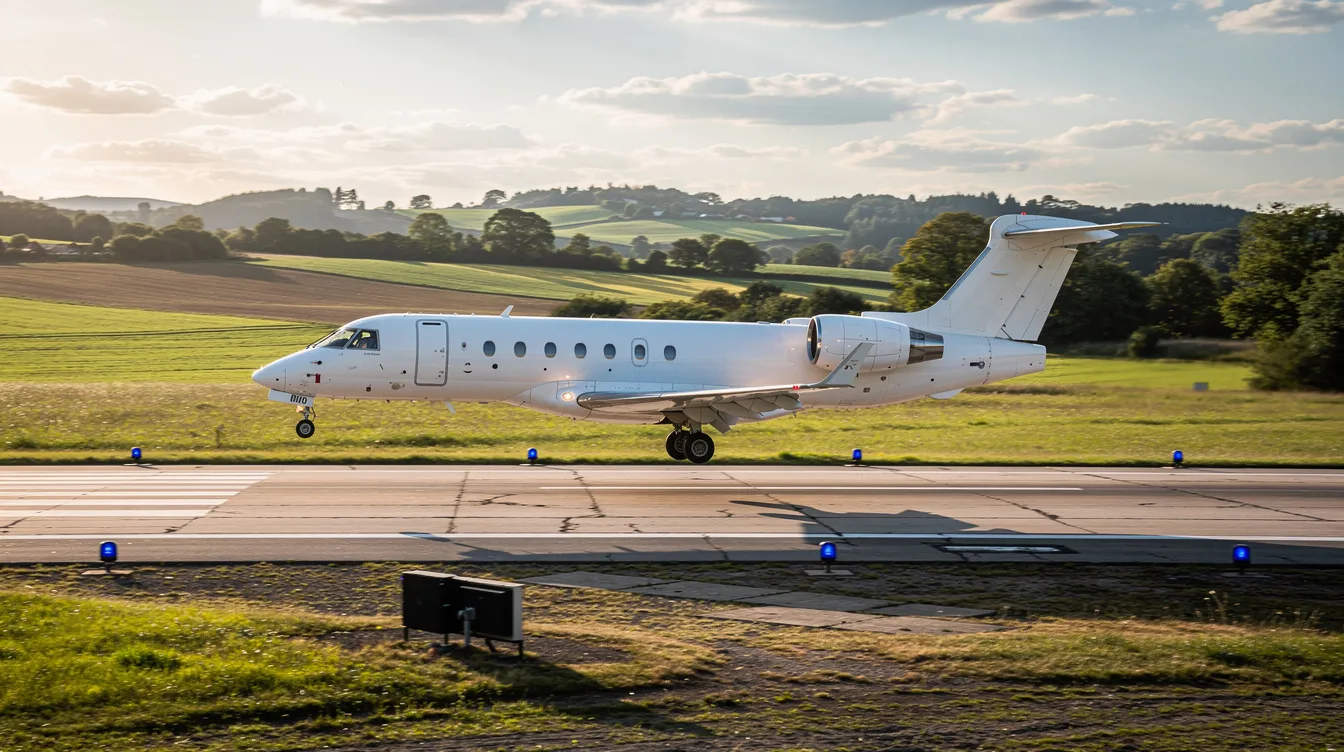
Aviation enthusiasts and frequent flyers can identify Embraer ERJ aircraft by several distinct visual cues. The elongated nose cone, inherited from the EMB-120 Brasilia, tapers more gradually than on competing models. The T-tail-mounted high on the vertical stabilizer-is immediately recognizable, and the jet engines sit on pylons at the rear fuselage rather than beneath the wing, unlike later E-Jets or Boeing and Airbus narrow-bodies.
One detail spotters look for is the APU exhaust pipe, which protrudes slightly from the tailcone on ERJ models. This contrasts with the pointed tail cone found on later Bombardier CRJ-700/900/1000 variants. The landing gear on the ERJ retracts into the fuselage belly, sitting forward of the wing root-a compact arrangement suited to the airplane's lighter weight class.
Distinguishing among the three variants within the ERJ family comes down to length and window count. The ERJ-135 is the shortest, with fewer windows aft of the wing; the ERJ-140 adds a modest stretched version of the fuselage; and the ERJ-145 is the longest, with the most cabin windows flanking the over-wing emergency exits. All share the same wing, engines, and cockpit, so from a distance, the differences are subtle.
Compared to the Bombardier CRJ-100/200-which also features tail-mounted engines but with a "fatter" nacelle profile and no APU exhaust cone-or to turboprop types like the Dash 8 and ATR family (identified by propellers and different ground clearance on their landing gear), the ERJ silhouette is sleek, narrow, and unmistakably jet-powered.
From ERJ to E-Jet: How Embraer evolved its regional aircraft for airlines and private use
The Embraer E-Jet family represents the second-generation regional jet line that Embraer launched in the late 1990s. The Embraer E-Jet family includes E170, E175, E190, and E195-four variants spanning roughly 70 to 130 seats. First E170 deliveries arrived in 2004, and subsequent models entered service through the mid-2000s, quickly establishing a presence with airlines like JetBlue, Air Canada, and LOT Polish Airlines.
The major design shift moved the jet engines from the tail to under-wing pylons, resulting in a quieter cabin, improved fuel burn, and a more headroom-friendly fuselage cross-section. The E-Jet family features a fly-by-wire flight control system, an advanced leap over the ERJ's conventional controls. The E-Jet family also includes winglets to reduce fuel burn, and the E175 consumes 6.4% less fuel than earlier models, a figure validated since 2017 refinements entered production.
Capacity expanded significantly. The Embraer E170 typically seats around 72 passengers in a single class, the Embraer E175 typically seats around 78 passengers, the Embraer E190 can carry up to 100 passengers in a two-class configuration, and the E195 can carry between 120 and 146 passengers depending on density. The E175 has a maximum takeoff weight of 85,000 pounds, reflecting the step up in capability. The E190-E2 received its type certificate on February 28, 2018, featuring enhanced efficiency with new engines. Embraer even developed the E190F freighter, which has a payload capacity of 10,700 kg for cargo operations.
For private aviation customers, the same engineering lineage underpins Embraer's Phenom and Praetor business jet series-aircraft commonly available through BlackJet's jet card programs and delivering a far superior private experience than any converted 50-seat airliner, similar in concept to the capabilities described for a modern 5 million dollar private jet.

The ERJ 200 vs CRJ-200 rivalry: Similar roles, different strengths
The notional "ERJ 200" concept-represented in practice by the ERJ-145-and the Bombardier CRJ-200 dominated regional skies through the late 1990s and early 2000s. Both carried 50 passengers and served similar route networks, but their cabins and performance profiles differed in ways that mattered to airlines and now matter to charter customers.
The ERJ-145's 2-1 seating gives every passenger either a window or aisle seat, creating a perception of more personal space despite a narrower fuselage. The Bombardier CRJ-200 seats 50 passengers in a 2-2 configuration, maximizing capacity but feeling tighter at shoulder level. For pilots and operators, the flight deck philosophies also diverged, with Bombardier drawing on its Challenger heritage and Embraer building on turboprop-era ergonomics.
On range and performance, the ERJ-145XR variant can fly up to 2,000 nautical miles, compared to roughly 1,700 nautical miles for the CRJ-200 LR. Embraer's fuel capacity and engine efficiency gave it a slight edge on longer thin routes, while some regional carriers favored the CRJ-200 for fleet commonality with larger jets in the CRJ-700/900 family.
This rivalry shaped airline network design for a decade. For today's private flyers, many of these aircraft now appear on the secondary market at relatively low acquisition costs, prompting some to ask whether chartering a private jet is worth it compared with sticking to regional airline service. But a private jets comparison quickly reveals that a purpose-built business jet offers a bespoke interior for 6–16 passengers-rather than 50 airline seats with worn finishes-alongside superior noise levels, cabin altitude, and service.
Operational history and geographic hotspots for ERJ-class jets
ERJ-family aircraft have been especially valuable for airlines seeking efficiency in regional aviation. In the United States, regional carriers operated massive fleet concentrations under brands like American Eagle, Delta Connection, United Express, and Continental Express. ExpressJet alone operated one of the largest ERJ-145 fleets in the world during the early 2000s, carrying passengers into and out of hubs that couldn't justify mainline service.
Beyond North America, Brazilian airlines deployed the ERJ-145 extensively on domestic routes, European operators like LOT Polish Airlines used them on thinner continental segments, and African carriers found the ERJ-145 LR and XR capable of connecting remote airfields. ERJ-family aircraft connect smaller airports to major hubs to enhance network efficiency-a role that defined the aircraft's global utility.
Governments and militaries also adopted ERJ-family jets for VIP and special mission roles: the Brazilian Air Force operates variants for government transport, and several European states have used the ERJ-135 and ERJ-145 in similar capacities. The Embraer ERJ 145 is often used for corporate shuttle services and charter operations, and the ERJ 145 family supports frequent daily flights on lower-demand routes, keeping utilization rates high.
From the 2010s onward, many airlines began replacing these aircraft with newer E-Jets, Airbus A220s, or up-gauged narrow-bodies, pushing ERJ-class jets increasingly into charter and private conversion roles. For BlackJet clients, this history explains why these older aircraft still surface in charter quotes-and why modern private programs prioritize newer types with better noise, emissions, and comfort profiles, especially when you evaluate whether chartering a private jet is really worth it versus relying on aging regional equipment.
Cabin experience: Airline ERJ vs modern private jets
Step aboard a 50-seat ERJ-145 configured for regional airline service, and you encounter a cabin that reflects 1990s design priorities: slim seats at roughly 31–33 inches of pitch, low overhead bins that struggle with standard carry-on bags, a compact lavatory, and engine noise that permeates the rear fuselage. The cabin is functional for a 90-minute hop, but it is not designed for productivity or relaxation over longer segments when compared with top 16-seat private jet options built around comfort and space for smaller groups.
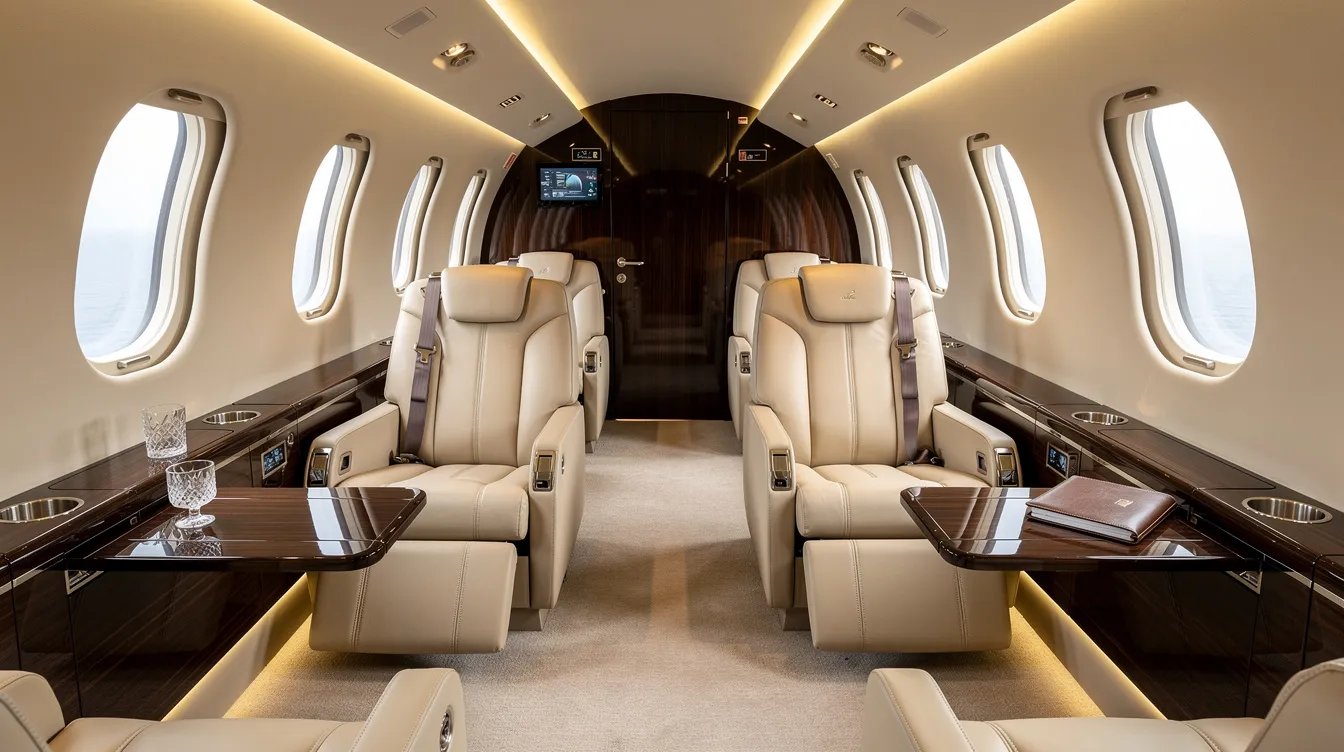
Now contrast that experience with boarding a 7–10 passenger light or midsize private jet arranged through a BlackJet jet card. You walk through the door of an FBO, cross a short tarmac, and settle into club seating arranged around a work table. Soundproofing is engineered for conversation. Catering is bespoke. There is no gate announcement, no middle seat, no overhead bin competition.
Modern business jets are also certified for lower cabin altitude at cruise-often around 4,500–6,000 feet compared to the 6,000–8,000 feet typical of older regional aircraft. This difference reduces fatigue and dehydration, a meaningful benefit for executives flying multiple segments per week.
Even when an ex-ERJ-145 is reconfigured for corporate use-with 16–23 premium seats, upgraded finishes, and improved insulation-it rarely matches the intimacy, noise levels, and tailored layout of a dedicated private jet. For groups under 20, the purpose-built business jet remains the superior choice for comfort, air quality, and flying experience.
Safety record and certification standards for ERJ-class regional jets
The Embraer ERJ 145 meets FAA Part 25 and EASA CS 25 safety standards-the same airworthiness framework that governs larger airliners from Boeing and Airbus. The ERJ family has accumulated over 26 million flight hours across more than 36 operators in 26 countries, with a notable safety outcome: approximately two dozen reportable incidents and 11 hull losses, but zero passenger fatalities attributed to ERJ-family accidents as of the mid-2020s-a level of rigor comparable to major providers such as those discussed in this overview of NetJets jet card cost and programs.
Recorded incidents have included runway overruns, weather-related events, landing gear issues, and procedural deviations. Each event has prompted operational improvements-updated emergency procedures, enhanced crew training, and airworthiness directives addressing specific structural or systems concerns.
The successor E-Jet family has also maintained a strong record. The E-Jet family has been involved in 22 incidents, including nine hull losses, and the E-Jet family exceeds International Civil Aviation Organization noise requirements, reflecting increasingly stringent certification standards with each generation.
For private aviation, the question extends beyond the aircraft type to the operator. BlackJet's network prioritizes operators that not only meet but exceed base regulatory standards, favoring newer fleet types with advanced avionics, enhanced ground proximity warning systems, and modern safety management systems, reinforcing the broader reality that private jets are extremely safe when operated under rigorous standards. Every flight is vetted against third-party safety ratings such as ARGUS and Wyvern, with minimum pilot hours and recurrent training requirements that are at least as rigorous as-and often more demanding than-those governing regional airline ERJ operations.
Sustainability: From fuel-efficient regional aircraft to carbon-neutral private flights
When the ERJ family launched, it was considered fuel-efficient for its category-right-sized capacity, and modern turbofans of the era meant competitive per-trip economics on thin routes. But standards have evolved dramatically. Embraer E-Jets exceed ICAO emission standards, and refinements continue: the E175 consumes 6.4% less fuel than original models since 2017, while the E190-E2 features enhanced efficiency with new engines that further reduce the environmental footprint.
The E-Jet family includes winglets to reduce fuel burn across the lineup, and each successive variant has pushed the bar higher for what regional aircraft sustainability looks like. These advances in the airline world have direct parallels in private aviation, where newer business jets incorporate similar aerodynamic and propulsion improvements.
BlackJet addresses environmental concerns through carbon-neutral flights via verified carbon offset programs, optional Sustainable Aviation Fuel participation where available, and route optimization to reduce unnecessary repositioning. The approach is straightforward: members maintain a high level of comfort and privacy while ensuring every flight's emissions are accounted for and offset-at no additional cost to the traveler, even when they opt for more affordable private jet solutions instead of larger regional aircraft.
Choosing the smallest practical cabin class, combining trips when schedules allow, and avoiding overly large aircraft for small groups all contribute to a more responsible travel footprint, often aligning with the cheapest private aircraft options that still meet mission needs. Sustainability stands alongside safety and service as one of BlackJet's core pillars.
Use cases: When a regional jet concept makes sense vs a dedicated business jet
There are scenarios where a 40–50-seat ex-airline regional aircraft or a private jet for up to 50 passengers still earns its place. A corporate roadshow hitting multiple Midwest cities with 35 employees, a professional sports team shuttle, or an emergency charter for a large group-these situations benefit from the capacity and cost-per-seat economics that the ERJ 200 generation was built to deliver.
But those scenarios are the exception for most private aviation customers. For a high-net-worth family flying to a smaller leisure airport, or an executive team of 8–12 heading to a board meeting, chartering a full-size airliner introduces unnecessary expense, noise, and complexity, especially when more economical private aircraft options are available. A single super-midsize or large-cabin jet handles 10–14 passengers with room for cargo and baggage, at a fraction of the operating footprint.
Consider a BlackJet member planning a three-city day trip: New York to Pittsburgh, Pittsburgh to Columbus, Columbus back to New York. On regional airline schedules using ERJ-type aircraft, this itinerary requires layovers, connections, and likely an overnight stay. With a private jet card, the same ground is covered in 8–10 productive hours, with meetings held en route and the member sleeping in their own bed that night.
The ERJ 200 generation proved the viability of jet service on short sectors, and ERJ family aircraft have been especially valuable for airlines seeking efficiency in regional aviation. Today's private travelers can capture those same benefits with far greater comfort and control through a jet card program rather than chartering an aging regional airliner.

BlackJet Jet Cards vs ad-hoc charter on ERJ-class aircraft
The distinction between a jet card and a one-off charter on a regional aircraft comes down to predictability. Jet cards provide prepaid access to private jets across multiple cabin types, with common jet card programs including 25-hour and 50-hour options described in more detail in this guide to jet card pricing and benefits. Jet cards offer 24/7 digital booking tools for users and cater to high-net-worth leisure travelers who need consistent quality without the variability of the open charter market.
Hourly rates for repurposed ERJ-145s can appear attractive on a per-seat basis when carrying 30 or more passengers-some brokers quote $7,600–$12,000 per hour, a range comparable to some 50-hour jet card cost structures. But those rates often involve minimum flight hour requirements, repositioning charges, and fuel surcharges that erode the perceived savings. For a group of 8, dividing that cost yields a per-person expense that a midsize jet card flight would match or beat-with incomparably better service, especially when you understand jet card cost per hour and how pricing compares across programs.
With a BlackJet Jet Card, members have guaranteed access to a curated fleet, standardized cabin quality, and transparent pricing-hallmarks of the best jet cards for frequent flyers. Contrast this with the limited availability and variable condition of ERJ-class charters, where cabin quality, crew training, and maintenance standards can fluctuate from one operator to the next.
A practical example: a client needing 8 passengers from New York to Chicago twice per month. Sourcing a rare ERJ-145-type charter each time means variable availability, inconsistent interiors, and logistical uncertainty. A midsize jet on a BlackJet jet card delivers a reliable blend of cost, comfort, and scheduling control-every single trip.
Technology and booking experience: From airline schedules to on-demand control
Regional airline schedules on ERJ-class routes are rigid by nature: fixed departure times, capacity constraints, weather cancellations that cascade through hub networks, and rebooking processes that treat every passenger identically. For the traveler who values time above all, this model imposes costs that no ticket price can offset.
Mobile booking platforms enable 24/7 access to jet services, and these platforms provide real-time flight support for users-a fundamentally different paradigm. BlackJet's technology stack integrates instant quoting, crew and aircraft availability data, and live support channels that keep travelers informed without monitoring airline apps or gate changes. Mobile booking tools enhance flexibility for private jet travelers in ways that scheduled service simply cannot replicate.
Modern operations software enables proactive rerouting, tail swaps, and weather avoidance that preserve schedules for high-value travelers. Instead of mass rebooking when an ERJ flight cancels, a BlackJet member's itinerary adjusts behind the scenes. Real-time flight support enhances private aviation travel experiences, and 24/7 digital booking tools are part of real-time flight support that includes safety certification for every private flight arranged through the platform.
The ERJ pioneered connectivity to smaller cities. It is the combination of aircraft choice and technology that now defines true premium access-and that is precisely where BlackJet's platform is positioned.
FAQs: ERJ-class regional jets and private jet cards
Is there really an Embraer ERJ 200 model? No. Embraer has never produced an aircraft called the ERJ 200. The company's regional jet family comprises the ERJ-135, ERJ-140, and ERJ-145. The "200" designation belongs to Bombardier's CRJ-200, and the two are often conflated in casual use.
Can I charter a 50-seat ERJ-145 as a private jet? Yes-many retired ERJ-145s have been converted to semi-private configurations with 16–23 premium seats. Charter availability depends on the operator and region, and interior quality varies widely, much like other forms of charter flights in private aviation. For groups under 20, a purpose-built business jet typically delivers a better experience.
How does flying on an ERJ compare with a light jet on a jet card? An ERJ in airline configuration offers 31–33-inch seat pitch, shared lavatories, and limited amenities. A light jet on a jet card provides club seating, bespoke catering, enhanced soundproofing, and the ability to depart on your schedule from a private terminal. The cabin altitude on modern business jets is also lower, reducing fatigue during flight.
Are regional jets safe compared to business jets? The ERJ family's safety record is strong-zero passenger fatalities across millions of flight hours. Safety depends heavily on the operator's maintenance program, crew training, and regulatory compliance. BlackJet vets all operators for third-party safety ratings and exceeds minimum industry standards.
Which is greener: a seat on a regional jet or a private jet card flight? A fully loaded 50-seat ERJ is more efficient per seat than a lightly loaded private jet. However, BlackJet offsets 100% of flight emissions through verified carbon programs and participates in Sustainable Aviation Fuel initiatives, ensuring every trip is carbon neutral regardless of aircraft size.
Can BlackJet arrange group flights that would normally run on ERJ-type aircraft? Absolutely. For larger groups, BlackJet can deploy multiple jets for flexible scheduling or arrange a single large-cabin aircraft through its network, tailoring the solution to group size, route length, and service expectations.
Conclusion: Lessons from the ERJ 200 era for today's private traveler
The ERJ 200 generation proved that regional jets could economically connect secondary cities, raise passenger expectations above the turboprop standard, and create an entirely new market segment in commercial aviation. That legacy carried forward into the more sophisticated Embraer E-Jet family designs and, ultimately, into the Phenom and Praetor business jets that serve private travelers today.
The takeaway for readers is clear: while ERJ-class aircraft remain relevant in airline networks and occasional group charters, discerning travelers now have access to superior comfort, safety, and sustainability through tailored jet card programs. The same regional reach that made the ERJ-145 revolutionary is now available without the noise, the narrow cabin, or the rigid schedule.
If you are ready to move beyond regional airline constraints and experience private aviation built around your priorities, explore BlackJet's Jet Card programs to discover how seamless, carbon-neutral flying can reshape every trip. As regional aircraft and business jets continue evolving-with next-generation propulsion, sustainable fuels, and ever-more-capable digital platforms-BlackJet is committed to keeping its members at the leading edge of what private aviation can deliver.


 Sign up with google
 Sign up with Apple