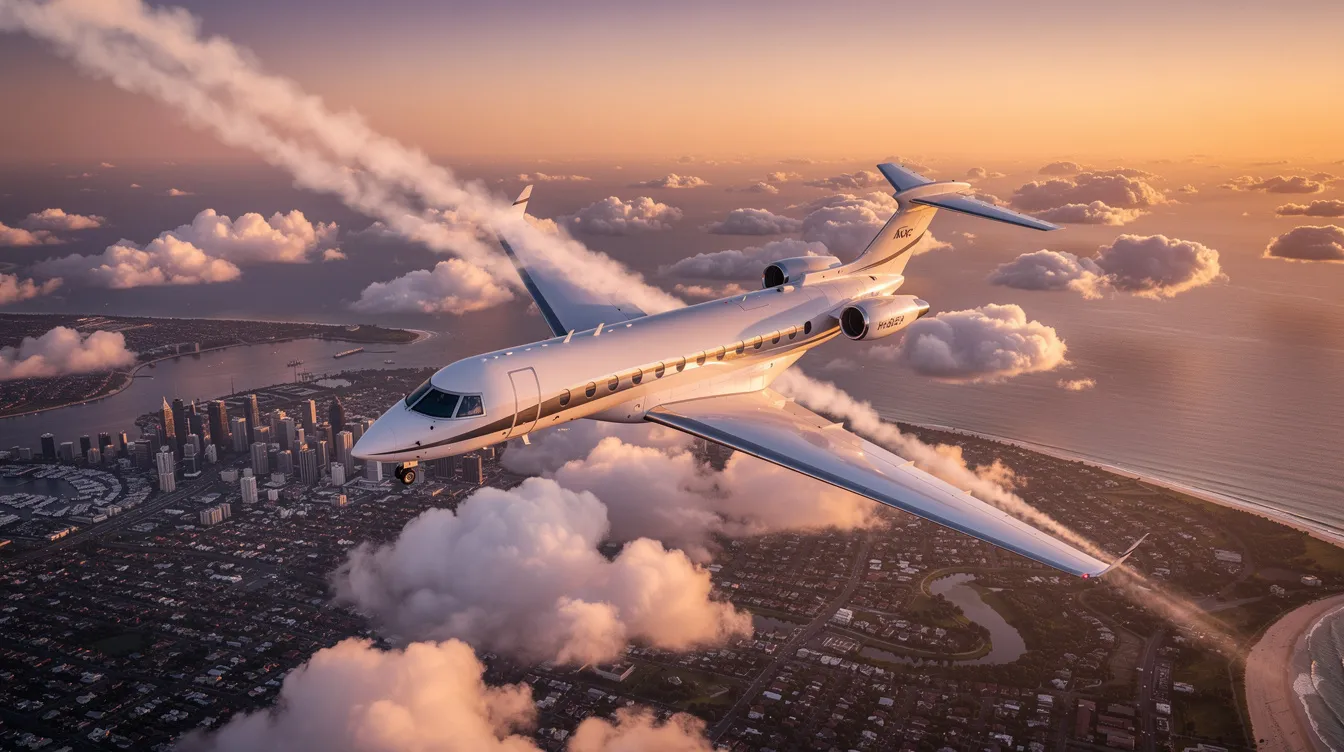
Even the fastest private jets in the world answer to the same airspace rules as every other civil aircraft in the sky. For executives and high-net-worth travelers who rely on private aviation to compress schedules and reclaim hours, understanding aviation speed limits is not trivia - it is a strategic edge.
This article covers the main speed limits that apply to private jets and other civil aircraft in US airspace, how these rules affect your flight experience, and what travelers should know about regulatory and operational constraints.
Why Aviation Speed Limits Matter for Private Jet Travelers
Consider a typical New York–to–Miami business trip. On commercial first class, you are looking at roughly five to seven hours door-to-door once you account for check-in, security, boarding, the three-hour flight itself, baggage claim, and ground transport. Commercial airliners generally cruise at speeds between 550 and 600 mph, yet the bulk of your lost time has nothing to do with cruise speed.
A BlackJet Jet Card flight on the same route compresses that timeline to approximately two and a half to three and a half hours. You arrive at a private FBO fifteen minutes before departure, board directly, and fly at Mach 0.82 or higher in a super-midsize cabin. But here is what most travelers do not realize: regulatory airspeed restrictions - 250 knots below 10,000 feet MSL, 200 knots near certain airports - still apply to your aircraft on every climb and descent. The time you save comes from smarter routing, reduced ground handling, and access to less congested airports, not from ignoring the rules.
This article breaks down the specific speed limits that govern every phase of your private flight: regulatory airspeed limits by altitude and airspace class, approach and procedure restrictions, aircraft-specific speed envelopes, and how BlackJet's end-to-end private jet service model planning optimizes within these boundaries.
Regulatory Basics: How Airspeed Is Defined and Controlled
A few definitions make the rest of this article clearer:
Indicated airspeed (KIAS): The speed displayed on the cockpit instrument, uncorrected for altitude or temperature. Regulatory limits are expressed in KIAS.
Mach number: The ratio of true airspeed to the local speed of sound. Mach 0.85 means 85 percent of the speed of sound.
Knots vs. mph: One knot equals approximately 1.15 mph. So 250 knots is roughly 288 mph.
In the United States, 14 CFR Part 91 - specifically §91.117 and §91.817 - governs most civil aircraft speed limits, including business jets. Speed limits do not dictate maximum travel speeds but establish airspace-specific rules designed to manage collision risk, wake turbulence spacing, and controller workload. Aviation speed regulations ensure safety and traffic separation across every airspace class, from class A through class E airspace.
These airspeed limits interact with altitude bands and airspace area designations. Pilots and dispatchers account for every layer - class B, class C, class D, and underlying shelves - during flight planning.
The Upper Limit: Subsonic Operations and Mach 1
Private jets often operate at subsonic speeds around Mach 0.85–0.93, placing them among the fastest civil aircraft in the sky. Some private jets can reach speeds approaching 700 knots under optimal conditions. Yet no civil aircraft may exceed Mach 1 in US airspace.
FAR 91.817 prohibits exceeding Mach 1 over the United States. Mach 1 regulations were established in 1973, codified after years of public backlash against supersonic flight over populated areas. Between 1956 and 1968, sonic booms led to 38,831 claims against the Air Force, ranging from cracked windows to structural damage. Aircraft may not exceed Mach 1 in US airspace, and this remains one of the firmest boundaries in aviation regulation - though an executive order may change Mach 1 regulations by June 2025 as "quiet supersonic" technologies advance.
For BlackJet members, "no supersonic" does not mean "slow." A typical large-cabin jet cruising at Mach 0.85–0.90 still delivers dramatic time savings versus airline schedules that include layovers, connections, and congested terminals.
Below 10,000 Feet MSL: The 250-Knot Civil Speed Limit
The core rule is straightforward: no aircraft may exceed 250 knots below 10,000 feet MSL. Under §91.117(a), no person may operate an aircraft below 10,000 feet msl at an indicated airspeed over 250 knots, unless specifically authorized by the Administrator. Maximum speed below 10,000 feet is 250 knots - roughly 288 mph.
Speed limits apply to all aircraft below 10,000 feet MSL, across all US airspace classes. This is the altitude band used during initial climb and final descent around busy city pairs like Los Angeles–Las Vegas or New York–Boston, which means it directly affects your trip time. Turbojets typically cruise at Mach speeds above 10,000 feet, so this lower-altitude restriction is where the speed transition happens.
In operational practice, turbine aircraft operating under BlackJet's partner operators often level briefly near 10,000 feet during climb or descent to decelerate through 250 knots. General aviation aircraft generally fly below maximum speed limits at these altitudes, and piston aircraft rarely approach the 250-knot threshold below 10,000 feet - but high-performance business jets feel this constraint on every departure and arrival.
ATC can occasionally authorize higher speeds below 10,000 feet MSL in specific situations, such as resolving a traffic flow conflict, but this is the exception. There is no maximum speed limit above 10,000 feet MSL except for supersonic flights.
200-Knot Limits Around Airports and in Special Situations
Beyond the 250-knot rule, tighter 200-knot 230 mph limits apply in certain terminal areas to keep mixed traffic flows manageable.
No aircraft may exceed 200 knots beneath class B airspace or in a VFR corridor designated through a class B airspace area, such as routes near major hubs like Los Angeles International. The airspace underlying a Class B airspace area designated for an airport carries this restriction regardless of aircraft type.
Within 4 nautical miles of the primary airport in class C or class D airspace, and at or below 2,500 feet above the surface, the limit is 200 knots indicated airspeed unless otherwise authorized or required by ATC. Class Charlie airspace and class delta airspace share this restriction. In class C/D airspace, the speed limit is 200 knots below 2,500 feet. 200 knots is the maximum speed near Class C/D airports, and the speed limit at or below 2,500 feet AGL within 4 nautical miles of an airport is 200 knots.
These restrictions safely blend fast business jets, slower training aircraft, and airline traffic near primary class airports. A BlackJet flight arriving at a class C airport at 3,000 feet MSL and 5 nautical miles out may legally exceed 200 knots, but must slow to 200 knots by 4 nautical miles from the primary airport and 2,500 feet above the surface - the crew sequences these speed changes smoothly to protect other traffic and maintain separation.
Speed Limits by Airspace Class: Class A, B, C, D, and E
Airspace class defines both traffic rules and, in some cases, the maximum speed permitted near the ground. Here is how each layer applies:
Airspace | Vertical Limits | Key Speed Rule |
|---|
Class A | 18,000 ft MSL to FL600 | IFR only; no numeric cap other than subsonic; ATC-assigned speeds govern |
Class B | Surface to specified altitude at major airports | Below 10,000 ft: 250 KIAS. Inside class B airspace above 10,000 feet MSL, there is no federal speed limit. Beneath shelves / in VFR corridor: 200 KIAS |
Class C | Surface to ~4,000 ft above airport | Within 4 NM / ≤2,500 ft AGL of primary class airport: 200 KIAS |
Class D | Surface to ~2,500 ft above airport | Same 200 KIAS within 4 NM / ≤2,500 ft AGL around a class D surface area with operating control tower |
Class E | Varies; often 700/1,200 ft AGL to 18,000 ft | No special class-specific cap; 250 KIAS below 10,000 ft still applies |
In class B airspace below 10,000 feet, the speed limit is 250 knots. The speed limit below Class B airspace is 200 knots. Above 10,000 feet, no specific speed limit in Class B airspace beyond the supersonic prohibition. The airspace area designated for an airport determines which rules apply, and the lateral limits and vertical limits of each class are published on sectional charts and in the AIP.
For other airspace outside these designations, the general altitude-based rules still govern. Such operations in class E airspace follow the standard 250-knot floor, and even the fastest private jets in the world must comply with these subsonic limits.
Procedure-Based Speed Limits: Approaches, SIDs, STARs, and Holding
Beyond generic airspace rules, many speed restrictions appear on the instrument procedure charts that BlackJet flight crews use daily.
Final approach segments: Approach plates can include maximum speed at the final approach fix - commonly 160 or 180 KIAS - to ensure stable approaches and obstacle clearance. A procedure turn typically carries a 200-knot maximum unless otherwise published.
Standard terminal arrival routes and SIDs embed multiple speed restrictions at waypoints. A STAR into Denver, for example, might specify "250K at or below 10,000 feet" at a specified altitude crossing, which crews comply with to maintain safe spacing. Such cases are routine.
Holding patterns: Altitude-dependent speed limits apply - 200 KIAS at or below 6,000 feet, 230 KIAS between 6,001 and 14,000 feet, and 265 KIAS above 14,000 feet, unless a charted speed is lower.
Modern flight management systems and BlackJet's digital flight time planning tools help crews manage these step-down speed constraints seamlessly, reducing pilot workload and enhancing passenger comfort through planned, gradual deceleration rather than abrupt corrections while still flying at an economically optimized jet card cost per hour.
Aircraft-Specific Speed Envelopes: Design Limitations and Performance
Every aircraft model carries its own certified speed limits, documented in the Airplane Flight Manual. Key terms a traveler might encounter on a spec sheet include:
VMO / MMO: Maximum operating indicated airspeed / Mach number
VFE: Maximum speed with flaps extended
VLO: Maximum speed for landing gear operation
Typical cruise speeds by category help frame how different aircraft families map to the broader private jet price spectrum and ownership options:
Category | Mach Range | Approximate Speed |
|---|
Light jets | 0.70–0.78 | 400–480 mph |
Super-midsize | 0.80–0.85 | 500–560 mph |
Large / ultra-long-range | 0.85–0.92 | 550–650+ mph |
BlackJet and its safety-certified operators always prioritize aircraft performance limitations over marginal schedule gains, taking a similar safety-first approach to other top private jet companies for luxury travel. A super-midsize jet with an MMO of Mach 0.82 and a VFE of 180 knots on approach requires a descent profile that smoothly transitions between these limits - something experienced crews plan well before top of descent, just as frequent flyers evaluate the best jet cards for their travel profile well before booking complex itineraries. Controlled speed changes reduce cabin noise, avoid abrupt attitude shifts, and deliver the smooth, predictable flight experience that defines premium aircraft operating standards.
ATC-Assigned Speed Restrictions and Operational Flexibility
Beyond the published rules, Air Traffic Controllers assign specific speeds to maintain safe spacing and sequencing into busy hubs. A controller might instruct a crew to "maintain 210 knots to the outer marker" or request the best forward speed to close a gap. Turbojet aircraft are often assigned speeds no less than 210 knots near runways during approach sequencing, which is especially relevant when coordinating arrivals for large-cabin private jets for 20 passengers or other group configurations.
When ATC assigns an airspeed restriction, pilots comply unless doing so would compromise safety or exceed an aircraft limitation - in which case they immediately advise ATC "unable." Air Traffic Control can authorize speeds above regulatory limits for safe operation in certain situations, and a pilot may also resume normal speed once an ATC no person may operate restriction is canceled.
The minimum safe airspeed exception in §91.117(d) is important: if an aircraft's minimum safe flying speed is higher than prescribed limits - for instance, a heavy jet in icing conditions where a particular operation is greater than the maximum speed prescribed - it may operate at that higher speed. The crew must still avoid careless or reckless operation, and the regulation accounts for the reality that, in such cases, slowing further could be dangerous.
Consider a winter approach into a busy Class B airspace area: ATC first asks a BlackJet crew for forward speed to close on a preceding aircraft, then requests a minimum speed reduction to fit behind a slower regional jet. This flexible speed management - balancing weather conditions, aircraft performance, and traffic - is routine for experienced crews flying under Part 135 standards, just as sophisticated travelers balance overall jet card cost and membership structure against their expected flying patterns.
How Speed Limits Influence Private Jet Trip Planning with BlackJet
For Jet Card members, speed limits translate into tangible outcomes: realistic block times, schedule reliability, and reduced fatigue on multi-leg days. BlackJet's flight planning team models every segment - the 250-knot climb through 10,000 feet, the 200-knot deceleration near a class D airspace area, and cruise at optimum Mach - when quoting flight times and recommending departure windows, the same rigor they apply when explaining jet card pricing structures and fees.
Smart airport selection often matters more than raw aircraft speed. Opting for a well-positioned class C or class D reliever field instead of a congested primary class B airport can reduce time spent in speed-restricted vectors, indirectly shortening total trip time.
Example: a client with meetings in Chicago and Detroit in a single day using a 25-hour Jet Card structured much like the options outlined in our complete guide to 25-hour jet cards. BlackJet may route through Chicago Executive (PWK) rather than O'Hare, avoiding complex class B arrival procedures, extended holding at a specified altitude, and additional ATC speed assignments. The result is not a faster cruise - it is fewer minutes spent at reduced speeds near the ground, which compounds meaningfully over a 100-hour jet card commitment.
BlackJet's technology platform surfaces realistic, regulation-aware schedule options in its digital booking tools, with real-time support available to adjust departure times or routes around weather and airspace constraints—whether you hold a Jet Card or are simply buying an individual seat on a private jet.
Safety, Sustainability, and Speed: The BlackJet Perspective
Respecting aviation speed limits enhances safety, supports noise abatement, and fits naturally with BlackJet's carbon-neutral commitment and broader focus on more affordable private jet options that broaden access without compromising standards. Smoother, regulation-compliant climb and descent profiles improve fuel efficiency compared to aggressive "rush then brake" profiles, reducing emissions and the size of carbon offsets BlackJet purchases on every member flight.
BlackJet works only with operators and aircraft that meet rigorous safety certifications, including Wyvern Wingman standards. Adherence to procedural speed restrictions on SIDs, standard terminal arrival routes, and approaches is fundamental to that safety culture.
For discerning travelers, the true premium is a calm, predictable, carbon-neutral journey that arrives on time - not a perception of flying at maximum speed at every moment. Sustainability in private aviation means disciplined operations: flown at efficient speeds, on appropriate routings, into the right airports, and aligned with a well-structured 50-hour jet card program that matches actual usage.
FAQs: Aviation Speed Limits and Your Jet Card Flights
Can private jets ignore the speed limits that apply to airlines?
No. The same federal regulations under 14 CFR §91.117 apply to all civil aircraft, whether a person operates a single-engine trainer or a large-cabin business jet. BlackJet partner aircraft comply with every airspeed restriction.
Why does the aircraft seem to slow down near 10,000 feet or on approach?
Because no aircraft may exceed 250 knots below 10,000 feet MSL, and the speed drops further to 200 knots within miles of the primary airport in class C or class D airspace. These transitions are normal and planned.
Do speed limits differ meaningfully between airspace classes?
Yes. Class A airspace has no numeric cap beyond subsonic. Inside class B airspace above 10,000 feet MSL, there is no federal speed limit. Near airports in class C or class D, the 200-knot limit within 4 nautical miles and 2,500 feet above the surface applies. Class E airspace follows the general 250-knot-below-10,000-feet rule. The differences matter most on short regional routes where climb and descent dominate.
Does flying slower save money or emissions on a Jet Card flight?
It can. Operating at optimum cruise Mach rather than maximum Mach improves fuel efficiency and reduces emissions. BlackJet balances schedule, comfort, and its carbon-neutral operations to deliver the most responsible - and reliable - travel experience, supported by transparent jet card pricing and cost structures.
Elevate Your Travel Within the Limits: Partnering with BlackJet
Aviation speed limits are a constant across every flight, every airspace, every day. What separates an exceptional private aviation experience is how an operator plans, routes, and supports your flights within those boundaries. Every BlackJet trip is carbon-neutral and flown under stringent safety standards, with crews who treat regulatory and aircraft speed limits as non-negotiable.
BlackJet's Jet Card programs provide access to a curated fleet, expert dispatch, and 24/7 support that intelligently navigates airspace rules, weather conditions, and ATC constraints, with options ranging from traditional hourly cards to unlimited private jet membership concepts. Prospective members can speak with a BlackJet advisor to review typical route times, aircraft categories, and how speed limits factor into their specific travel patterns.
Elevate your travel - effortlessly. Explore BlackJet's Jet Card options and discover how expertly managed private jet travel turns complex, multi-city schedules into something that feels seamless.


 Sign up with google
 Sign up with Apple