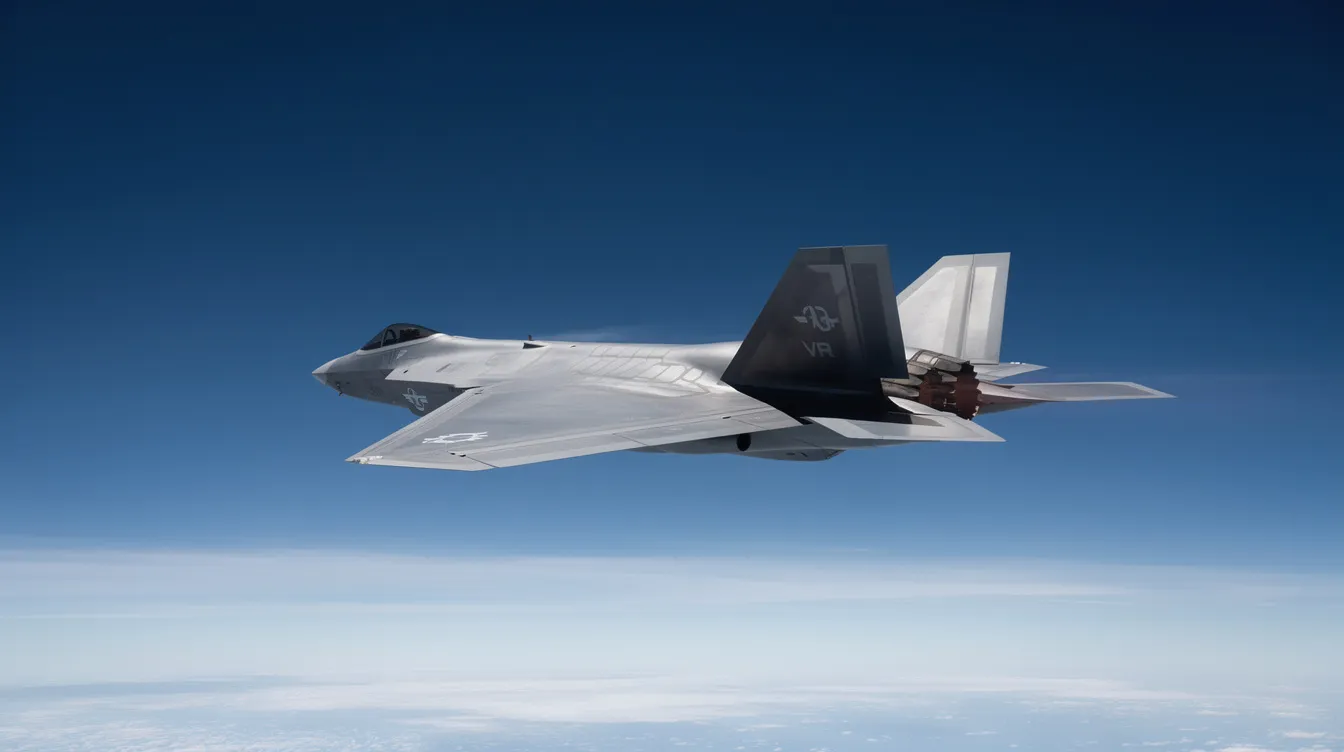
Few aircraft in history have commanded as much respect-or curiosity-as the F-22 Raptor. Built to achieve air dominance in contested skies, this stealth aircraft remains the benchmark against which every modern fighter is measured. But the question that draws the most searches is deceptively simple: how fast can it actually go? Below, we break down the top speed of the F-22, the engine power behind it, and the advanced aerodynamics that make sustained supersonic flight possible. Along the way, we'll explore what high-speed aviation means not only for the Air Force but also for discerning travelers who value time, safety, and precision in the air.
Quick Answer: The F-22 Raptor's True Top Speed
The F-22 Raptor's top speed is approximately Mach 2.25-roughly 1,500 mph (2,414 km/h) at altitude with full afterburner in a clean, air-to-air configuration. The F-22 can reach speeds of 1,500 mph at altitude, making it one of the fastest operational fighters on the planet.
However, the exact maximum speed remains partially classified. The U.S. Air Force officially describes the Raptor as a "Mach 2-class" aircraft capable of supercruise-sustained supersonic flight without afterburners-at speeds greater than Mach 1.5, with operational supercruise typically ranging from Mach 1.5 to 1.8.
A few key terms for context:
Mach number - the ratio of an aircraft's speed to the speed of sound. At 40,000 feet, Mach 1 is roughly 660 mph.
Afterburner - a system that injects fuel into the exhaust stream downstream of the turbine, producing a massive thrust boost at the cost of extreme fuel consumption.
Supercruise - the ability to fly at supersonic speeds without engaging afterburners, preserving fuel and reducing the aircraft's heat signature.
To put these numbers in perspective, a modern long-haul airliner cruises at about Mach 0.85 to 0.89, covering roughly eight to nine miles per minute. The F-22 at Mach 2.25 covers approximately 25 miles per minute at high altitude. That performance gap illustrates why speed-whether in a fighter aircraft or a private jet-translates directly into time saved and opportunities seized.
What Is the F-22 Raptor? A Snapshot of the USAF's Flagship Fighter Aircraft
The F-22 Raptor is a fifth-generation air superiority fighter designed and built by Lockheed Martin for the United States Air Force. It represents the most advanced combination of stealth technology, speed, integrated avionics, and agility ever assembled in a single airframe. The F-22 is recognized for its combination of speed, stealth, and agility in combat, a trifecta no other aircraft has matched.
Its primary roles include:
Air superiority and interception
Limited ground attack and precision strike
Suppression of enemy air defense
Intelligence, surveillance, and electronic warfare support
The F-22's first flight took place on 7 September 1997, progressing through extensive flight testing before reaching Initial Operational Capability in December 2005 with the 27th Fighter Squadron at Langley AFB. Only the USAF operates the Raptor. U.S. law prohibits export sales, making it one of the most exclusive and closely guarded weapons platforms in the world.
In military terms, the F-22 provides "air dominance on demand." For high-net-worth travelers and executives, BlackJet delivers an analogous advantage: assured access to private jets, on your schedule, with no commercial terminal delays. Control over your routes and your time is, in many ways, the civilian version of owning the sky.
Top Speed vs Supercruise: How Fast Can the F-22 Really Fly?
There is an important distinction between the F-22's maximum speed and its supercruise capability. Top speed refers to the fastest the jet can fly in level flight-about Mach 2.25 with afterburners at altitude. Supercruise, by contrast, is sustained supersonic flight without afterburners, demonstrated at Mach 1.5 to 1.8 in clean configurations.
The F-22 can sustain supersonic flight without afterburners, which is operationally far more significant than raw dash speed. Supercruise allows sustained supersonic flight without afterburners, meaning the Raptor can close distances faster than nearly all other aircraft while burning far less fuel and emitting a lower infrared signature.
Why doesn't the F-22 fly at Mach 2.25 all the time? Because extreme top speed is limited by:
Airframe heating at leading edges and intake surfaces
Structural loads and G-force constraints
Massive fuel consumption under afterburner
Metric | Value |
|---|
Top speed (afterburner, clean, altitude) | ~Mach 2.25 (~1,500 mph) |
Supercruise speed (no afterburner) | Mach 1.5–1.8 |
Typical airliner cruise | Mach 0.85–0.89 |
Distance covered per minute at Mach 2.25 | ~25 miles (40 km) |
In practice, fighter pilots spend most of their supersonic time in the supercruise regime-fast enough to dominate, efficient enough to sustain.
Engine Power: Pratt & Whitney F119 and the Muscle Behind Mach 2+
The F-22's performance begins with its twin Pratt & Whitney F119-PW-100 afterburning turbofan engines. The F-22's engines produce over 35,000 pounds of thrust each, delivering a combined output that the USAF describes as "more thrust than any current fighter engine."
That engine power gives the Raptor a thrust-to-weight ratio of nearly 1.25 in afterburner-meaning the aircraft generates more thrust than it weighs. This ratio enables:
Near-vertical climbs from runway level
Rapid acceleration through the transonic regime
Sustained supersonic airspeeds without afterburner in the supercruise envelope
Compared with legacy jets like the F-15 Eagle, which relies on the Pratt & Whitney F100 series producing roughly 29,000 lbf with afterburner, the F119 represents a generational leap. The F-15 needs afterburners to exceed Mach 1 in most configurations; the F-22 does it on dry thrust alone, producing more thrust per pound of engine weight than any predecessor.
This philosophy-modern, efficient power matched to a demanding mission-mirrors how BlackJet approaches its private jet network. Every aircraft in the fleet meets strict engine and maintenance standards, ensuring that members get reliable, high-performance travel without compromise.
Advanced Aerodynamics and Design: How the Airframe Enables High Top Speed
The F-22's advanced aerodynamics are inseparable from its speed. Every surface serves double duty: reducing radar signature while minimizing aerodynamic drag at transonic and supersonic speeds.
Key design features that enable high-speed performance include:
Trapezoidal wings with a leading edge swept at 42°, optimized for both low-speed maneuverability and supersonic cruise
Area-ruled fuselage that smooths the cross-sectional area distribution, reducing transonic wave drag
Blended wing-body design that merges the wing into the fuselage for cleaner airflow
Canted vertical stabilizers angled at 28° to reduce radar return while maintaining directional control at all speeds
The F-22 can carry weapons internally to maintain its stealth profile. Internal weapons bays eliminate the drag penalty of external pylons and missiles, meaning the Raptor maintains its aerodynamic performance even when fully armed for combat. Other aircraft from the fourth generation-F-15, F-16, F/A-18-lose significant speed and range once loaded with external stores.
These advanced aerodynamics also contribute to fuel efficiency. A cleaner airframe at Mach 1.5 burns meaningfully less fuel than a draggy one, extending mission range and time on station.
Thrust Vectoring: Steering the Exhaust for Speed and Agility
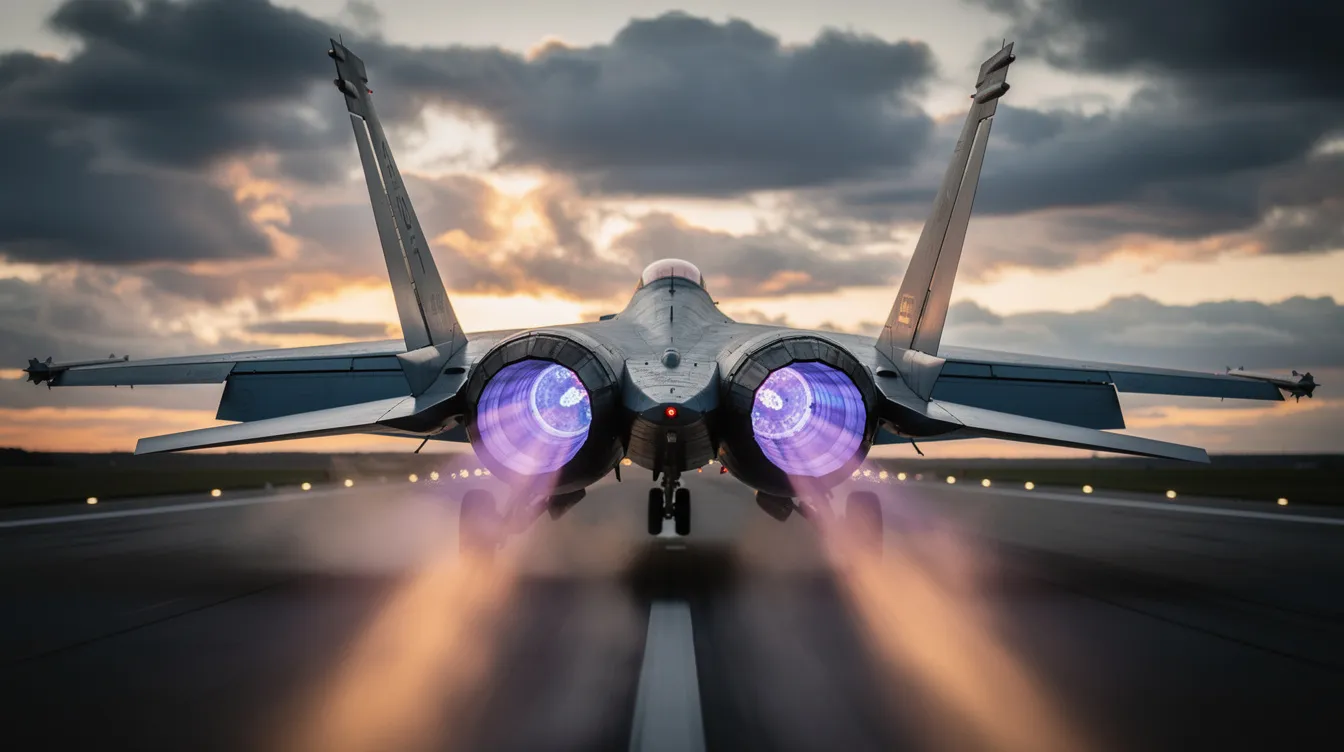
Thrust vectoring is the ability to redirect engine exhaust to help control an aircraft's attitude-essentially steering with power rather than just aerodynamic surfaces. The F-22 features two-dimensional thrust-vectoring nozzles, a critical component of its unmatched maneuverability.
The nozzles can pivot 20 degrees up or down, allowing the pilot to:
Execute post-stall maneuvers at extremely low speeds and high angles of attack
Perform sharper turns and rapid climbs that conventional fighters cannot match
Maintain controlled flight in regimes where aerodynamic surfaces alone would be insufficient
Thrust vectoring enhances the F-22's agility and maneuverability across the entire flight envelope. While thrust vectoring itself does not raise the aircraft's absolute top speed, it allows the pilot to sustain higher average speeds through dynamic engagements. Instead of bleeding energy in wide, sweeping turns, the Raptor uses its thrust vectoring nozzles to point and accelerate, maintaining kinetic advantage. The F-22's thrust vectoring supports sustained high-speed performance by keeping the jet in optimal energy states throughout a fight. Thrust vectoring allows sharper turns and rapid climbs that would be impossible with aerodynamic controls alone.
This "point-and-go" responsiveness has a civilian parallel: BlackJet's digital booking platform and operations team provide agile routing and quick-turn departures for members, ensuring you're never waiting on a system that can't keep up with your schedule.
Stealth and Speed: How Low Observability Supports High-Velocity Missions
Stealth and speed are not competing priorities in the F-22-they are mutually reinforcing. The F-22 Raptor includes low-observable stealth features that make it hard to detect, allowing the jet to close on threats at supersonic speeds with minimal warning.
The F-22's radar cross-section is equivalent to a honeybee. That extraordinary figure is achieved through:
Smooth, faceted surfaces and saw-tooth panel edges that scatter radar energy
The F-22 incorporates radar-absorbent materials to enhance stealth across multiple frequency bands
Internal carriage of weapons and fuel tanks that preserves the clean external profile
Canted surfaces and buried engine inlets that mask compressor faces from radar
The F-22's stealth design minimizes radar visibility and aerodynamic drag simultaneously. The same shaping that deflects radar waves also reduces parasitic drag, meaning stealth features directly contribute to speed and fuel efficiency. The F-22's stealth features reduce infrared and acoustic signatures as well, making it harder to track with heat-seeking sensors or passive detection systems.
This design philosophy allows the F-22 to keep its top speed available even when fully armed, unlike many fourth-generation fighters that slow down significantly with external stores. Just as the Raptor moves through contested airspace unseen, private travel with BlackJet minimizes your visibility in crowded commercial terminals while maximizing journey speed and discretion.
USAF Role: Why Top Speed Matters for Air Superiority
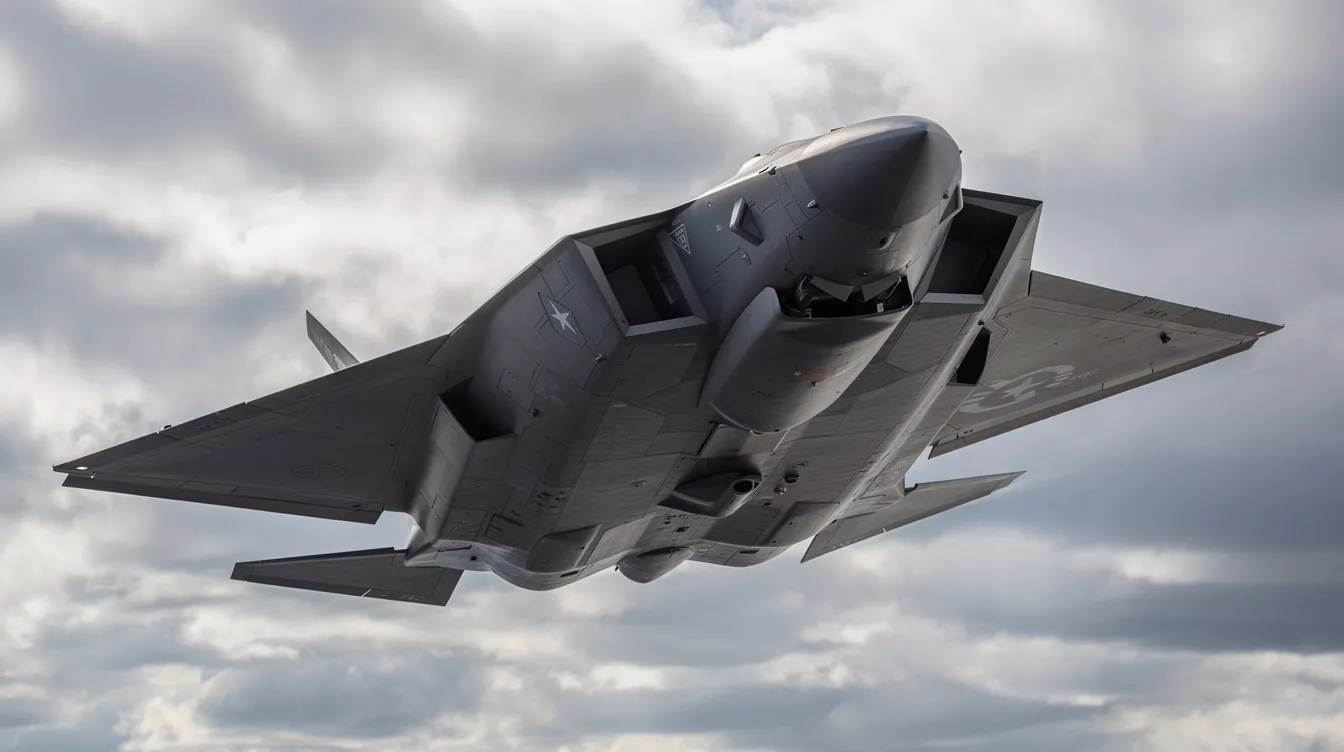
The F-22's primary mission is air superiority-clearing the skies so that friendly forces can operate without interference from enemy aircraft. Within the Air Force, the Raptor is the tip of the spear, and its speed is a foundational element of that capability.
High top speed shortens intercept times. When a hostile bomber or reconnaissance aircraft approaches defended airspace, every minute of response time matters. The F-22 redefined air dominance with a combination of stealth and supersonic cruise, allowing pilots to reach engagement range faster than any adversary expects.
The F-22 features advanced avionics and integrated radar systems for situational awareness, including the AN/APG-77 AESA radar. Combined with its speed, these systems allow the pilot to detect, track, and engage targets at extreme range. The F-22 can engage enemy aircraft with precision before being detected, firing beyond-visual-range air-to-air missiles like the AIM-120 AMRAAM while still invisible to the target's radar.
Mission sets where speed is critical include:
NORAD homeland defense intercepts of long-range bombers
Rapid redeployment across theaters to achieve air dominance in new operational areas
Time-sensitive strike escort profiles where minutes determine success or failure
This kind of airspace control on demand aligns with BlackJet's promise to clients who must reach critical locations at short notice. When your schedule can't wait, assured access to private jet charter is the executive's version of scramble readiness.
Tactical Advantages of Mach 2-Class Performance
Mach 2-class performance gives the F-22 decisive tactical advantages in both offensive and defensive scenarios. Speed is not merely about going fast-it reshapes the geometry of aerial combat.
Core benefits of the Raptor's speed include:
Rapid engagement of distant targets - closing the gap before the enemy can react or reposition
Ability to disengage from unfavorable fights - outrunning threats that lack the energy to follow
Quick repositioning between combat areas - covering hundreds of miles in minutes rather than tens of minutes
Enhanced missile performance - the aircraft's kinematic advantage in launching missiles increases their operational range, since air-to-air missiles inherit the launch platform's speed and altitude.
At very high speeds, pilot workload, G-forces, and situational awareness become limiting factors. A pilot closing at Mach 2 on a subsonic target has fractions of a second to identify friend from foe. The F-22's integrated avionics and sensor fusion help manage this workload, feeding the pilot a unified tactical picture in the cockpit rather than raw data from dozens of systems.
Consider a notional intercept: two hostile bombers detected 400 miles out, heading toward a defended coast. An F-22 at supercruise covers that distance in roughly 20 minutes. A legacy fighter at subsonic cruise takes nearly twice as long. That time difference can mean the difference between a clean intercept and a defensive scramble.
From First Flight to Operational Service: Evolving the Raptor's Performance
The F-22 emerged from the Advanced Tactical Fighter (ATF) competition of the mid-1980s-a Cold War–era program designed to counter the next generation of Soviet fighters. Lockheed Martin's YF-22 prototype won over the Northrop YF-23 in 1991, and full-scale Engineering and Manufacturing Development began in August of that year.
Key milestones in the Raptor's development:
Maiden flight: 7 September 1997
Flight testing: over 3,400 sorties and 7,600+ flight hours during EMD, including live fire testing of weapons systems and structural validation at Edwards Air Force Base
Low-rate initial production: began in 2001
Full-rate production: commenced after successful Initial Operational Test and Evaluation in 2004
Initial Operational Capability: December 2005
Performance envelopes-including permitted top speed, maneuvering limits, and supercruise ranges-were progressively expanded as flight data and structural testing confirmed safety margins. The F-22's fuselage is designed for a service life of 8,000 hours, a figure validated through rigorous ground and flight testing throughout the development program.
This systematic approach to testing and validation parallels the rigorous safety standards BlackJet applies when approving aircraft and operators for its Jet Card members. In both military and civilian aviation, performance claims are only as credible as the testing behind them.
Engine Efficiency, Range, and High-Speed Endurance
Raw top speed tells only part of the story. What separates the F-22 from its predecessors is how long and how efficiently it can operate at supersonic speeds.
The F-22's supercruise capability minimizes fuel consumption during supersonic flight compared to fighters that must use afterburners to break Mach 1. Supercruise enhances the F-22's operational range and efficiency, giving the Raptor a combat radius of roughly 460 nautical miles (~850 km) on internal fuel capacity alone-substantially further than many fighters flying the same speed profile.
Range Metric | Approximate Value |
|---|
Combat radius (internal fuel) | ~460 nm (~850 km) |
Ferry range (external tanks) | ~1,850 statute miles (~3,000 km) |
Service ceiling | Exceeds 65,000 feet |
The F-22's service ceiling exceeds 65,000 feet, where thinner air reduces drag and increases true airspeed for a given Mach number. At these altitudes, the Raptor's aerodynamic efficiency and modern engine design reduce specific fuel consumption compared with previous generations operating at similar speeds.
External tanks extend ferry range significantly but are typically jettisoned before high-speed, high-stealth operations. This trade-off between range and performance mirrors how BlackJet balances routing efficiency and fuel burn in its private jet operations, including its commitment to carbon-neutral flights that account for fuel consumed, not just distance flown.
Comparing the F-22's Top Speed to Other Fighter Aircraft
The F-22's Mach 2.25 top speed is not the fastest raw number among fighter jets. The F-15 Eagle, for example, can reach Mach 2.5 in clean configuration. But raw speed alone does not determine air superiority.
Aircraft | Top Speed | Supercruise | Stealth |
|---|
F-22 Raptor | ~Mach 2.25 | Mach 1.5–1.8 | Yes (5th gen) |
F-15C Eagle | ~Mach 2.5 | Very limited | No |
Eurofighter Typhoon | ~Mach 2.0 | Limited | Partial |
F-35A Lightning II | ~Mach 1.6 | Minimal | Yes (5th gen) |
The F-15 has a higher published maximum speed but requires afterburners to go supersonic and carries weapons externally, increasing drag. The Eurofighter Typhoon achieves roughly Mach 2 but lacks full stealth capability. The F-35A, designed for multi-role flexibility and cost efficiency, trades top speed for sensor integration and stealth.
What makes the F-22 unique among other aircraft is its combination of stealth, supercruise capability, acceleration, and internal weapons carriage. No other operational fighter delivers all four simultaneously. For air superiority missions, usable speed across the entire mission profile matters more than a peak number achieved in ideal conditions-which is exactly where the Raptor excels.
The same principle applies in private aviation. Not all "fast" jets deliver equally when you factor in range, cabin comfort, runway capability, and total journey time. A structured Jet Card built on transparent Jet Card membership pricing ensures you always fly the right aircraft for the mission.
Operational Use of Speed: NORAD, Middle East, and Pacific Deployments
The F-22's top speed and rapid climb have been validated in real-world operational service across multiple theaters.
NORAD Homeland Defense: Since approximately 2007, F-22s stationed in Alaska and along the U.S. eastern seaboard have flown intercept missions under NORAD, engaging Russian Tu-95 and Tu-160 bombers approaching North American airspace. The Raptor's speed at altitude allows it to achieve intercept positions faster than any other fighter in the Navy or Air Force inventory.
Combat Debut in Syria (2014): The F-22's 2014 combat debut over Syria marked its first operational strike missions. Speed and stealth allowed it to penetrate heavily defended airspace and conduct precision air-to-ground attacks on ISIS targets, demonstrating that the Raptor's capability extends beyond air-to-air combat.
Pacific Deployments: Rotational deployments to Japan, South Korea, and Guam leverage the F-22's rapid redeployment ability. Quick-reaction alert missions in the Pacific rely on the jet's combination of climb rate, speed, and sensor range to protect allied airspace.
Chinese Surveillance Balloon (February 2023): In a widely publicized engagement, an F-22 from Langley AFB used its climb performance and speed at altitude to position precisely for an AIM-9X heat-seeking missile shot against a high-altitude surveillance balloon-demonstrating that even unconventional threats require the Raptor's unique flight envelope.
Time-critical responses in military aviation parallel time-sensitive business and personal itineraries. When you need to be somewhere yesterday, BlackJet's on-demand private jet access and options to buy a seat on a private jet provide the civilian equivalent of scramble-ready defense.
Human Limits: G-Forces, Pilot Safety, and High-Speed Flight
The F-22 is capable of extreme speed and maneuvers, but the pilot's body is often the limiting factor. At Mach 2+ and during aggressive combat maneuvering, G-forces can reach levels that threaten consciousness and physical safety.
The F-22's flight control system can command up to +9G maneuvers, with structural limits of +9.0 / −3.0 G. Pilots wear specialized G-suits and undergo rigorous centrifuge and physiological training to tolerate these forces. Even so, sustained high-G turns at supersonic speeds push the boundaries of human endurance.
The Raptor's operational history includes sobering reminders of the human factor. Following a fatal crash in 2010 and a subsequent fleet-wide grounding in 2011 linked to oxygen system anomalies, the Air Force redesigned the On-Board Oxygen Generation System (OBOGS) and added backup oxygen supplies. These changes underscore that speed must always be balanced against pilot safety and mission effectiveness.
This emphasis on human safety at high performance resonates directly with BlackJet's approach to private jet safety. Every operator in the network meets strict pilot experience thresholds, third-party safety ratings, and crew training standards-because performance without protection is a risk no discerning traveler should accept.
Modernization and Upgrades: Keeping the Raptor Fast and Relevant
The F-22 has received continuous modernization since entering operational service. While the basic engine and airframe remain fixed, incremental software and hardware upgrades ensure the jet exploits every ounce of its performance envelope.
Key upgrade areas include:
Avionics and radar: the AN/APG-77(V)1 AESA radar has received software enhancements that improve target detection, tracking, and electronic warfare capability
Weapons integration: AIM-120D and AIM-9X missiles, JDAM, and Small Diameter Bombs expand the Raptor's first-shot and first-strike advantages.
Stealth coatings: improved radar-absorbent coatings reduce maintenance time and keep the airframe operationally ready at high speeds longer into its service life
Flight control software: refined throttle response and flight control laws improve how the jet manages energy at every point in its speed envelope
These updates don't increase engine thrust, but they improve how the aircraft uses its existing performance. Refined flight control laws, for instance, can allow the jet to transition more efficiently between supercruise and high-speed dash, reducing each flight hour's toll on the airframe.
BlackJet applies a similar philosophy: leveraging software platforms, real-time operations data, and continuously updated fleet standards—benchmarked against top private jet companies worldwide—to enhance the speed, reliability, and sustainability of the member experience without waiting for a "next-generation" overhaul.
Speed, Safety, and Sustainability: Lessons for Private Aviation
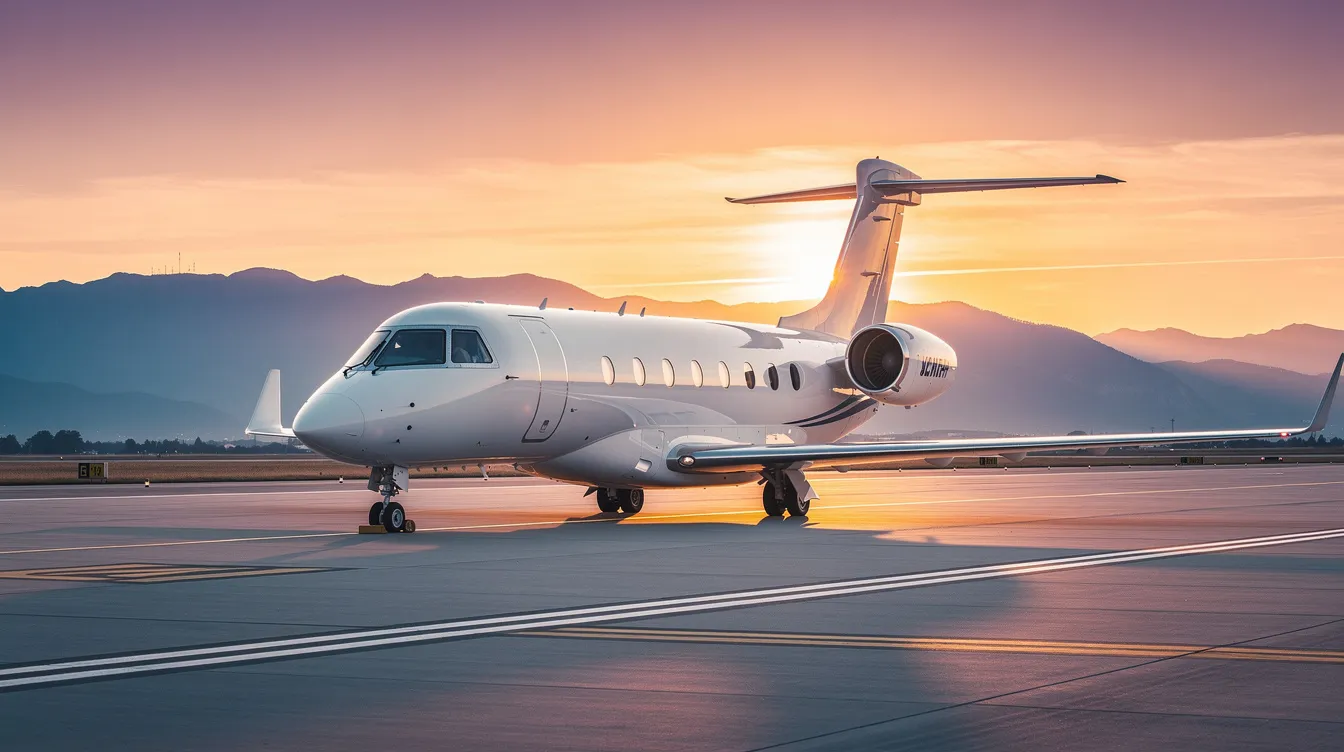
The F-22 demonstrates that the most capable aviation platforms balance speed, safety, and efficiency rather than optimizing for any single metric. That lesson translates directly to private aviation.
For executives and high-net-worth travelers, speed matters. Modern business jets cruise between Mach 0.80 and Mach 0.92, and direct point-to-point routing eliminates the hours lost to layovers and hub connections, especially when flying on some of the best private jets in the world. A New York–to–London trip on a large-cabin private jet takes roughly seven hours, departing on your schedule from a private terminal. A Los Angeles–to–Miami flight covers the distance in under five hours with no security lines, no middle seat, and no delay.
But speed alone is insufficient. BlackJet prioritizes total mission performance:
Safe operators vetted through ARG/US and equivalent audit programs
Rigorous maintenance aligned with or exceeding Part 135 standards
Certified crews meeting strict experience and training thresholds
Efficient routing that minimizes both travel time and fuel burn
BlackJet's commitment to carbon-neutral flights means that fuel burn-heightened at higher cruise speeds-is offset through verified carbon programs, even when clients choose budget-friendly private aircraft options to balance cost and performance. Speed and sustainability are not mutually exclusive when the right systems are in place.
BlackJet Jet Card Programs: Strategic Access to High-Speed Private Travel
A Jet Card is a prepaid block of private jet flight time-typically 25 or 50 hours-that secures guaranteed access and rates without the capital commitment of aircraft ownership. Think of it as the private aviation equivalent of having a fighter on alert: aircraft and crews are effectively on-call within agreed notice periods.
BlackJet's Jet Card programs deliver:
Predictable pricing - locked-in hourly rates eliminate cost uncertainty
Access to multiple aircraft categories - from light jets for regional hops to large-cabin jets for transatlantic flights
24/7 digital booking and real-time support - schedule changes, weather rerouting, and ground coordination handled seamlessly
Vetted operators only - every flight meets BlackJet's proprietary safety certification.n
Consider a practical example: a business executive uses a 25-hour Jet Card as part of the 25-hour Jet Card program over one quarter for six round-trip flights between New York and Washington, D.C., plus a single trip to Chicago. Total ownership cost? Zero. Hangar fees? None. Each departure is scheduled within hours, not days, from a private terminal. That is strategic access-the civilian analogue of operational capability on demand.
Choosing the Right Aircraft Class: Speed vs Cabin Experience
Unlike the F-22, which is a single-type platform optimized for one mission, private aviation offers a spectrum of aircraft categories with different speed, range, and cabin profiles that fit within a broader private jet price list of costs and access options.
Category | Typical Cruise Speed | Best Use Case |
|---|
Light jet | Mach 0.70–0.78 | Regional trips under 2 hours |
Midsize jet | Mach 0.78–0.82 | Domestic cross-country, 3–4 hours |
Super-midsize | Mach 0.80–0.85 | Coast-to-coast, stand-up cabin |
Large cabin | Mach 0.82–0.88 | Transcontinental, full amenities |
Ultra-long-range | Mach 0.85–0.92 | International, nonstop transatlantic |
Selecting the right class involves trade-offs between top speed, runway performance, cabin size, and cost per flight hour. BlackJet advisors help members choose the appropriate aircraft type per mission-short-hop shuttle versus transatlantic crossing-balancing flight time with comfort and economics, whether that means selecting the best private jet for 20 passengers or a smaller cabin for more intimate trips.
Just as the F-22's airframe and engines were optimized for its air superiority mission, high-net-worth travelers can optimize aircraft selection through Jet Card flexibility informed by a clear understanding of Jet Card pricing structures and benefits rather than locking into a single owned airframe that may be wrong for half their trips.
Private Aviation Safety Protocols: Matching Performance with Protection
The USAF invests billions in training, maintenance, and safety systems for the F-22. Sophisticated travelers should demand the same rigor from their private aviation provider.
BlackJet's safety framework includes:
Audited operators - only carriers holding ARG/US Gold or Platinum, Wyvern Wingman, or equivalent certifications are approved
Experienced captains - minimum flight hour thresholds and type-rating requirements for every crew
Fleet health monitoring - ongoing tracking of maintenance records, airframe age, and operational readiness
Transparent safety reporting - members can access operator certifications and safety records
Higher-performance aircraft magnify the importance of safety culture. The F-22's history of system refinements-from oxygen system redesigns to structural retrofits-demonstrates that even the most advanced platforms require continuous safety vigilance. BlackJet's clients get the benefits of jet-class speed within a transparent safety framework, rather than ad hoc charters where standards vary unpredictably.
FAQs: F-22 Top Speed and High-Speed Private Jet Travel
What is the F-22's published top speed?
The USAF officially classifies the F-22 as "Mach 2-class." Open-source technical references commonly cite a maximum speed of approximately Mach 2.25, or about 1,500 mph at altitude with afterburners engaged.
How fast can the F-22 supercruise?
The F-22 can supercruise at speeds over Mach 1.5 without afterburners, with operational profiles typically ranging up to Mach 1.8 in clean, high-altitude flight.
Why is some F-22 performance data classified?
Exact maximum speeds under various configurations, loadouts, and altitude profiles are classified to protect operational advantages. The Air Force releases enough data to demonstrate capability without revealing exploitable limits to adversaries.
How does the F-22's speed compare to a modern business jet?
A large-cabin business jet cruises at approximately Mach 0.85-roughly 570 mph. The F-22's top speed is nearly three times faster, and even its supercruise speed is about twice that of a business jet.
How fast do typical BlackJet aircraft fly?
Depending on the aircraft category, BlackJet members access jets cruising between Mach 0.70 (light jets) and Mach 0.92 (ultra-long-range jets). The right aircraft for your mission depends on distance, cabin needs, and schedule requirements.
How far in advance can I request a high-speed cross-country trip?
BlackJet's 24/7 booking platform supports requests with as little as a few hours' notice for domestic flights, subject to aircraft availability. Jet Card members receive priority scheduling.
Can my Jet Card be used internationally?
Yes. BlackJet Jet Cards provide access to international routing, including transatlantic and transpacific flights on appropriate aircraft categories. Speak with a BlackJet advisor for specific destination availability.
How are carbon-neutral flights calculated at higher cruise speeds?
Carbon offset calculations account for actual fuel burned on each flight-including the higher consumption at faster cruise speeds-not just distance. BlackJet partners with verified carbon offset programs to ensure every flight is carbon-neutral at no additional cost to the member.
Conclusion: From Air Superiority to Schedule Superiority
The F-22 Raptor's top speed, supercruise capability, advanced aerodynamics, and engine power give the USAF uncontested air superiority. The aircraft's ability to achieve Mach 2.25 at altitude, sustain Mach 1.5+ without afterburners, and protect its stealth profile while fully armed represents the pinnacle of military aviation engineering.
For discerning travelers, the lesson is clear: raw speed is only part of the equation. What matters is how speed integrates with safety, technology, and mission planning.
The F-22 combines speed with stealth, sensors, and pilot capability to dominate contested airspace.
BlackJet combines speed with safety, sustainability, and flexibility to dominate your schedule.
In both domains, the best outcomes go to those with assured, ready access-not those scrambling for options.
Elevate your travel-effortlessly. With BlackJet, private flight is accessible on your terms through our Jet Card programs, complete with rigorous safety, carbon-neutral performance, and unmatched flexibility. Explore BlackJet's Jet Card programs and discover how premium, on-demand private jet access can reshape your time and travel expectations.


 Sign up with google
 Sign up with Apple