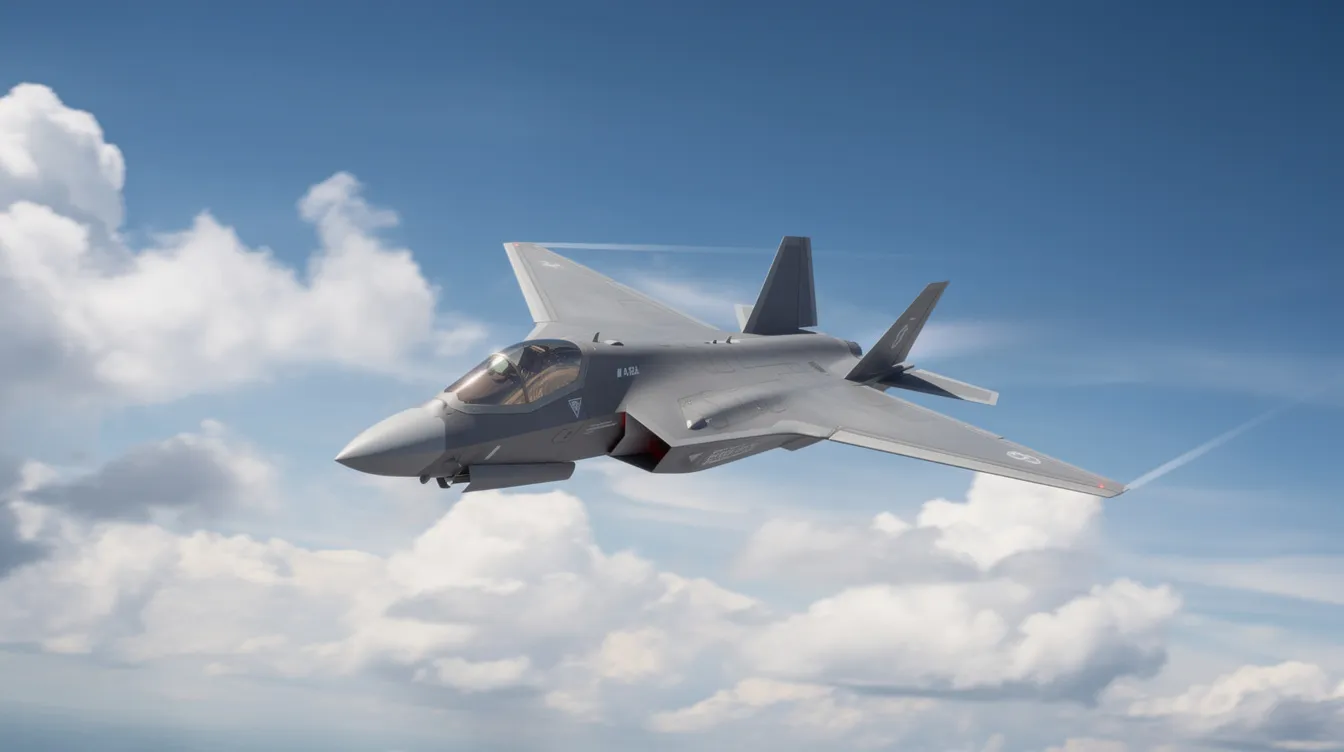
The fastest fighter jet, the stealthiest airframe, the most battle-tested platform: the world's top fighting planes in 2026 represent decades of engineering, doctrine, and real-world combat lessons compressed into ten operational aircraft. This guide ranks them, explains the technology that sets them apart, and draws a line between their design principles and what discerning travelers should expect from private aviation.
Quick overview: the 10 best fighter jets in 2026
The consensus among defense analysts points to these ten jets as the best fighter aircraft flying today:
Rank | Fighter Jet | Manufacturer | Role | Generation |
|---|
1 | F-35 Lightning II | Lockheed Martin | Multirole | 5th |
2 | F-22 Raptor | Lockheed Martin | Air Superiority | 5th |
3 | Chengdu J-20 "Mighty Dragon" | Chengdu Aircraft Group | Stealth Interceptor/Strike | 5th |
4 | Su-57 Felon | Sukhoi | Multirole Stealth | 5th |
5 | F-15EX Eagle II | Boeing | Heavy Multirole | 4.5th |
6 | Eurofighter Typhoon | European Consortium | Multirole | 4.5th |
7 | Dassault Rafale | Dassault Aviation | Omnirole | 4.5th |
8 | F-16 Fighting Falcon | Lockheed Martin | Multirole | 4th/4.5th |
9 | Su-35 Flanker-E | Sukhoi | Air Superiority | 4.5th |
10 | F/A-18E/F Super Hornet | Boeing | Carrier-based Multirole | 4.5th |
These jets earn their positions through a combination of stealth, sensor fusion, air combat agility, weapons payload, and proven operational use. They equip leading air forces including the US Air Force, US Navy, PLAAF, and Russian Aerospace Forces, reflecting each nation's global power priorities.
BlackJet specializes in private jet access, not fighters, but we draw direct inspiration from this tier of technology when it comes to safety protocols, mission planning, and the relentless pursuit of operational precision.
How we ranked the world's top fighting planes
This ranking weighs combat capability, technological maturity, and real-world deployment data as of late 2026. Where data remains classified, particularly for Chinese and Russian aircraft, we apply conservative estimates based on open-source intelligence and Western analyst assessments.
Key defining features of advanced fighter jets include stealth and sensor fusion; fifth-generation fighter jets prioritize both of these alongside advanced avionics and integrated sensor systems. Generational classifications of fighter jets indicate advancements in design and capabilities, from fourth-generation dogfighters to today's networked stealth platforms.
Scoring factors:
Low observability (stealth): airframe shaping, composite materials, internal weapons bays. Stealth technology minimizes radar detection through specialized airframe shaping.
Sensor fusion and situational awareness: how well the jet combines radar, infrared, electronic warfare, and data-link inputs into a unified pilot display.
Air-to-air and ground attack effectiveness: missile load, weapons diversity, fire control accuracy, and proven air-to-air kill record.
Speed and supercruise: supercruise capability allows jets to maintain supersonic speeds without afterburners, a defining feature for fifth-generation fighters.
Reliability, fleet size, and maintainability: a jet with 500 operational airframes counts differently than one with 30.
Upgrade path into the 2030s: open-architecture avionics, planned block upgrades, and production continuity.
Jets with decades of combat experience (the F-16 Fighting Falcon, the F-15 Eagle family) are judged alongside newer types. "Best fighter" is always mission-dependent: air superiority, multirole strike, long-range interception, or close-in air-to-air combat each demand different strengths.
#1 Lockheed Martin F-35 Lightning II: the best fighter jet in 2026
The F-35 Lightning II earns the top position through a combination no other aircraft matches in 2026: stealth, networked sensor fusion, multirole flexibility, and sheer fleet scale. The F-35 has over 880 units in active service across the United States Air Force, Navy, Marine Corps, RAF, and more than a dozen allied air forces.
Stealth: The F-35 has a radar cross section equivalent to a golf ball, achieved through all-aspect shaping and internal weapons bays. Stealth fighters employ internal weapons bays to enhance stealth profiles, and the F-35 is the benchmark.
Sensor fusion: the AN/APG-81 AESA radar, Distributed Aperture System (DAS), and fused infrared, radar, and electronic warfare data create a single integrated avionics display. This is why analysts describe the F-35 Lightning II as a multirole weapon system with extensive networking.
Weapons: internal bays carry precision munitions in stealth mode; in "Beast Mode," the F-35 can carry up to 22,000 pounds of ordnance externally for permissive environments.
Speed: top speed reaches approximately Mach 1.6 in clean configuration.
Fleet and combat use: over 1,335 F-35 aircraft have been delivered globally as of June 2026, with over one million cumulative flight hours. F-35s have flown strike missions in the Middle East and SEAD (suppression of enemy air defenses) operations.
Readiness caveat: the fleet's full mission-capable rate sat at roughly 25% during fiscal year 2025, reflecting ongoing software bugs and hardware supply chain issues. This is a real limitation that Lockheed Martin and the US Air Force continue to address.
Like the F-35's integrated data picture, BlackJet's digital booking and real-time support give private travelers a single, clear view of aircraft availability, safety status, and routing options before every flight.
#2 Lockheed Martin F-22 Raptor: air superiority benchmark
The Lockheed Martin F-22 Raptor remains the world's premier air superiority fighter. No other aircraft in active service today combines its stealth, supercruise, and kinematic performance in air-to-air combat.
First flight: 1997. Operational exclusively with the US Air Force.
Fleet: about 187 built, with approximately 175 remaining in the fleet and around 143 combat-coded. Production ended in 2012 due to cost and shifting priorities, making it a limited production run.
Stealth: radar cross section comparable to a marble; the lowest of any operational aircraft.
Supercruise: the F-22 Raptor can supercruise at Mach 1.8 without afterburners. Top speed reaches approximately Mach 2.0 with afterburner. Supercruise capability allows the F-22 to engage or disengage at will, a decisive advantage in beyond visual range combat.
Maneuverability: Fifth-generation aircraft utilize thrust vectoring for improved maneuverability, and the F-22's two-dimensional thrust-vectoring nozzles enable high-angle-of-attack maneuvers that no peer can replicate.
Cost: The F-22 Raptor costs over $140 million per unit, which contributed to the decision to cap production.
Combat: The F-22 scored its first confirmed air-to-air kill in 2023, after decades of deterrence patrols and dominance exercises. It has flown missions over the Middle East and Southeast Asia in ISR and strike roles.
The Martin F-22 Raptor is the "pure" air combat specialist; the F-35 is the more versatile, networked platform. Both are Lockheed Martin F designs, but they fill different roles in US doctrine.
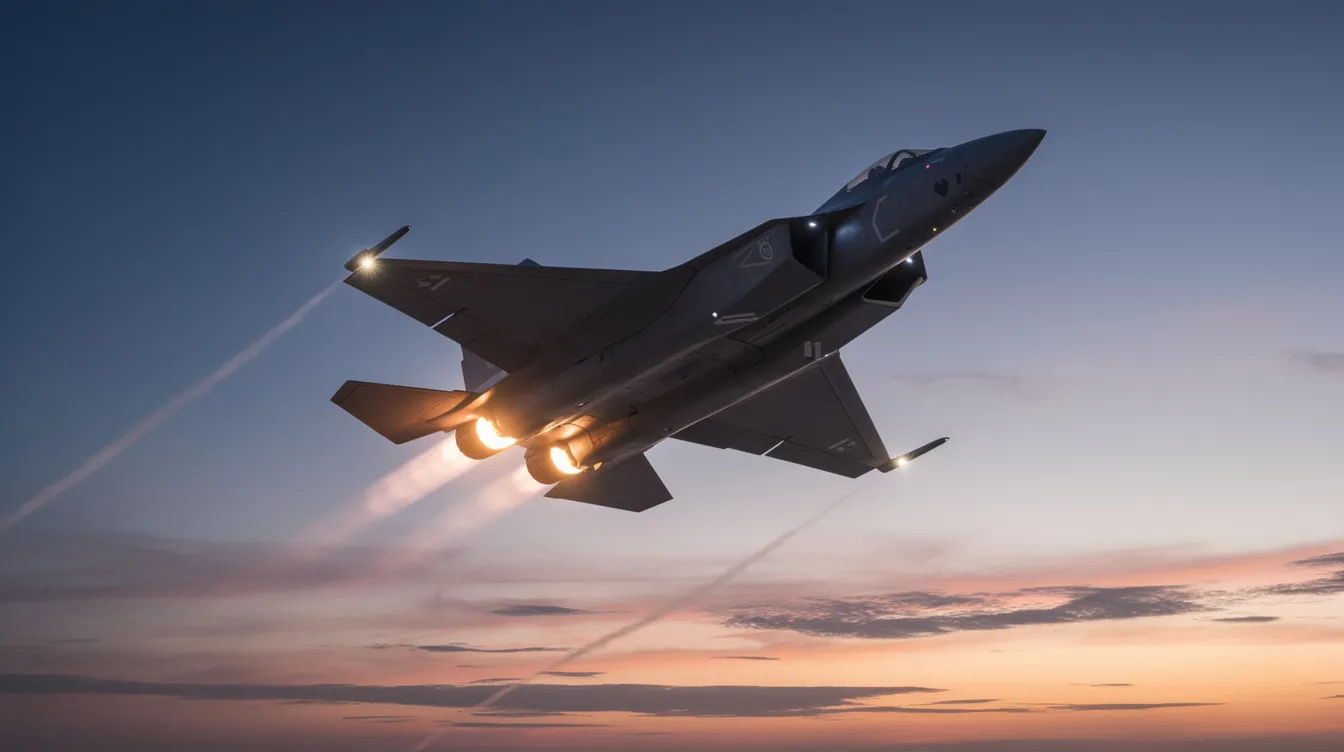
#3 Chengdu J-20 "Mighty Dragon": China's stealth spearhead
The Chengdu J-20 is China's first fifth-generation stealth fighter and one of only four operational stealth jets in the world today. It represents a deliberate shift in PLAAF doctrine toward contesting air superiority over the Western Pacific.
Timeline: first flight in 2011; entered PLAAF service in the mid-2010s. The Chengdu J-20 has 250 units in active service as of 2026, with production running at an estimated 120 airframes per year.
Design focus: long-range interception and strike. Large internal fuel capacity gives the J-20 extended reach. Internal weapons bays accommodate long-range PL-15 air-to-air missiles. The Chengdu J-20 has a weapons payload of 24,000 lbs.
Speed: The Chengdu J-20 can reach speeds of Mach 2, with growing supercruise capability expected as China transitions from interim WS-10 engines to the indigenous WS-15 powerplant.
Stealth trade-offs: strong frontal stealth shaping, but the J-20's larger airframe and canard layout may produce a bigger radar cross section than the F-22 or F-35 from certain aspects.
Strategic role: anti-access/area denial, escort for bombers, and targeting high-value support assets like tankers and AWACS.
Export: China restricts J-20 exports, keeping it exclusive to the PLAAF. This limits outside verification of its true capabilities.
China's production pace is the story to watch: projections suggest roughly 1,000 J-20 variants by 2030 if current manufacturing rates hold.
#4 Sukhoi Su-57 Felon: Russia's 5th-generation challenger
The Sukhoi Su-57 is Russia's answer to the F-22 and J-20: a twin-engine stealth fighter designed to combine stealth characteristics, speed, and supermaneuverability. Its operational record, however, remains thin.
Timeline: first flight in 2010. The Su-57 has approximately 30 units in service as of 2026, with a contract for 76 total airframes by 2028.
Speed: The Su-57 has a maximum speed of Mach 2.45, making it the fastest fifth-generation fighter currently in production.
Maneuverability: The Su-57 features 3D thrust vectoring for enhanced maneuverability, enabling extreme angles of attack in close-in air-to-air combat.
Weapons: Internal bays carry a mix of air-to-air and air-to-ground munitions; the jet has been used in Ukraine primarily as a stand-off strike platform, launching Kh-59/Kh-69 missiles from beyond the range of Ukrainian air defenses.
Limitations: relatively small fleet, less mature stealth shaping and avionics compared to the F-22 and F-35 by Western assessments, and ongoing engine development (the "Izdeliye 30" next-generation powerplant is still maturing).
The Sukhoi Su-57 ranks fourth on theoretical performance and agility, but its constrained production pace and limited verified combat data keep it below the top three.
#5 Boeing F-15EX Eagle II: the heavy-hitting Eagle
The F-15EX Eagle II is the latest evolution of one of the most successful fighter aircraft ever built. It trades stealth for raw payload, speed, and a combat record no other aircraft can match.
Lineage: The original F-15 Eagle first flew in 1972. The F-15 Eagle has a top speed of Mach 2.5, making it the fastest fighter jet in US service today. The F-15EX deliveries to the US Air Force began around 2021, with over 200 planned.
Weapons: The F-15EX can carry nearly 30,000 lbs of weapons across its hardpoints, functioning as a "missile truck" alongside stealthy F-35s.
Combat record: The F-15 Eagle has a combat record of 104 victories and zero losses in air-to-air combat, an unmatched achievement among modern fighters.
Avionics: Open-architecture avionics allow rapid integration of new sensors and weapons; the jet carries advanced avionics including AESA radar and a modern electronic warfare suite.
Role: The F-15EX is not a stealth aircraft. Its value lies in payload capacity, high speed, and the ability to complement stealthy platforms in contested airspace.
#6 Eurofighter Typhoon: European air superiority and agility
The Eurofighter Typhoon is a twin-engine, canard-delta multirole fighter developed by a consortium of the UK, Germany, Italy, and Spain. It remains one of the most agile jets in the world today.
Timeline: the development aircraft's first flight occurred in 1994. Combat service began in the 2000s, with continuous upgrades through Tranche 3, 4, and planned Tranche 5 configurations.
Agility: exceptional agility defines the Typhoon. Twin EJ200 afterburning turbofan engines each produce approximately 60 kN dry and 90 kN with afterburner, giving the airframe a thrust-to-weight ratio that enables supercruise at roughly Mach 1.5 in air-to-air loadout.
Payload: over 9,000 kg across 13 hardpoints, supporting air-to-air missiles, precision-guided bombs, and cruise missiles.
Multirole capability: from air superiority to precision ground attack and air policing missions over Europe, the Middle East, and Libya.
Operators: RAF, Luftwaffe, Italian Air Force, Spanish Air Force, plus exports to Saudi Arabia, Qatar, Kuwait, and others.
Stealth alternative: the Typhoon relies on agility, a powerful AESA radar (Captor-E on later tranches), and electronic warfare rather than ultra-low observability. Wing loading and aerodynamic design give it turn rates that rival or exceed the Rafale.
#7 Dassault Rafale: omnirole French fighter
The Dassault Rafale earns its "omnirole" label by switching between air-to-air, ground attack, reconnaissance, and nuclear strike tasks within a single sortie. The Dassault Rafale offers superb versatility and advanced electronic warfare systems.
Timeline: first flight in 1986; operational service in the early 2000s. Exported to India, Egypt, Qatar, Indonesia, Greece, and Croatia.
Technology: RBE2 AESA radar and SPECTRA electronic warfare suite provide sensor fusion comparable in philosophy to the F-35, built onto a 4.5-generation multirole aircraft platform.
Agility: delta wing and close-coupled canard layout, rated to +9g, with top speed around Mach 1.8 and MTOW of approximately 24.5 metric tons.
Upgrades: the F4 standard adds enhanced radar modes, improved connectivity, and capability against stealth targets. The French Air and Space Force also uses Rafale as its airborne nuclear deterrent carrier.
Combat record: deployed over Mali, Libya, Iraq, Syria, and Afghanistan. The Rafale is a combat-proven multirole fighter with one of the broadest operational histories of any European fighter.
#8 General Dynamics / Lockheed Martin F-16 Fighting Falcon: the workhorse
The F-16 Fighting Falcon is the most widely used Western fighter jet and the definition of a combat-proven multirole aircraft. Over 4,600 have been built since its first flight in 1974.
More than 2,100 remain in active service across over 25 air forces. The F-16 was the first operational aircraft to use relaxed static stability with fly-by-wire flight controls, giving pilots an agility advantage that was revolutionary at the time. It remains a potent air combat platform through continuous upgrades.
Production: still in production as of 2026 in the advanced Block 70/72 (F-16V Viper) configuration.
Performance: high thrust-to-weight ratio, compact airframe, strong performance in both air-to-air and ground attack roles.
Combat history: used in strike missions including the 1981 Israeli strike on Iraq's Osirak reactor, Desert Storm, Allied Force, Iraqi Freedom, and ongoing operations across the Middle East. The F-16 has accumulated more air-to-air kill credits than any other Western fighter since the end of the World War II-era piston fighters.
Modernization: F-16V variants carry AESA radar, modern electronic warfare systems, and digital cockpits that keep the airframe competitive into the 2040s.
#9 Sukhoi Su-35: supermaneuverable Flanker
The Su-35 is an advanced derivative of the Su-27 Flanker, optimized for air superiority with long range and extreme maneuverability. Among non-stealth modern fighters, it is one of the most capable Russian aircraft in service today.
Lineage: The Su-27 first flew in 1977. The Su-35 entered Russian service in the 2010s, with over 100 built by the mid-2020s.
Engines: powerful Saturn AL-41F1S engines with thrust vectoring provide post-stall maneuverability that few other aircraft can match.
Sensors: Irbis-E passive electronically scanned array radar and infrared search-and-track system; weapons payload exceeding 17,000 lb.
Export: operators include China, Egypt, and Algeria. The Su-35 has seen limited and debated use in air-to-air combat over Ukraine, where its true survivability against modern Western systems remains unclear.
#10 Boeing F/A-18E/F Super Hornet: carrier-based multirole fighter
The F/A-18E/F Super Hornet is the backbone of US Navy carrier air wings and the only aircraft on this list purpose-built for sea-based operations.
Timeline: first flight in 1995; operational from the early 2000s. Block III upgrades in the 2020s added conformal fuel tanks, advanced networking, and improved radar.
Design: an 80% new airframe compared to the legacy F/A-18C/D Hornet, with larger wings, more internal fuel, and payload capacity up to approximately 17,750 lb.
Carrier features: folding wings, reinforced landing gear, catapult and arrestor-gear compatibility. No other aircraft on this list combines this level of naval optimization with multirole air combat capability.
Combat use: strike missions in Iraq, Afghanistan, and Syria; maritime patrol; and fleet defense. Exported to Australia and ordered by other allies.
Role: The Super Hornet is not a stealth platform, but its reliability, versatility, and carrier compatibility make it the US Navy's primary fighter until the F-35C fleet matures.
How these fighters changed modern air combat
The arc from the F-15 Eagle and F-16 Fighting Falcon through the F-22 Raptor, F-35 Lightning II, and Chengdu J-20 traces a fundamental shift: from raw speed and maneuverability to information dominance and networked operations. Modern air warfare focuses on information dominance and networked operations above all else. Advanced fighter jets increasingly incorporate data sharing for tactical advantage.
Stealth and sensor fusion: fourth-generation jets relied on radar warning receivers and chaff. Fifth-generation types like the F-22 and F-35 combine stealth with fused sensor data, giving pilots a complete picture of the battlespace before the enemy detects them.
Multirole doctrine vs. pure interceptors: the Soviet Union built the MiG-25 Foxbat as a pure interceptor; today, every major air force demands multirole flexibility. The Eurofighter Typhoon and Dassault Rafale exemplify this shift; both perform air policing, strike missions, and reconnaissance in a single airframe.
Networked warfare: modern jets share targeting data across a fleet in real time. An F-35 can identify a threat and pass coordinates to an F-15EX "missile truck" or a naval destroyer without the pilot speaking a word.
AI-assisted decision tools: cockpit automation now filters and prioritizes threats, reducing pilot workload. Air dominance strategies in modern aviation rely on stealth, sensors, and networking rather than pure kinematic advantage.
This evolution parallels private aviation's trajectory: from speed records to integrated, data-driven, safe operations where the right information reaches the right person at the right moment.
Top fighting planes compared: F-22 vs F-35 vs Eurofighter Typhoon
Readers frequently ask whether the F-22, the F-35, or the Eurofighter Typhoon is the best fighter. The answer depends on what "best" means for a given mission.
Primary mission: the F-22 is optimized for first-look, first-shot, first-kill in air superiority. The F-35 balances stealth strike, ISR, and air combat. The Typhoon delivers high agility and proven multirole performance without full stealth.
Stealth: F-22 and F-35 are full-aspect stealth aircraft with internal weapons bays. The Typhoon's stealth characteristics are limited to reduced radar cross-section coatings and electronic countermeasures, not shaping.
Range and endurance: the F-35A carries more internal fuel than the F-22; the Typhoon's range falls between the two when carrying external tanks.
Weapons payload: the F-35 carries more externally (22,000 lb in Beast Mode); the Typhoon carries over 19,800 lb; the F-22 is more limited externally but carries AIM-120 and AIM-9 internally.
Export status: the F-22 is non-exportable (US Air Force only). The F-35 is widely exported. The Typhoon is exported to multiple NATO and Gulf state operators.
Cost: F-22 production ended at $140M+ per unit. The F-35A costs roughly $92 million in recent lots. Typhoon unit costs vary by tranche and buyer.
Choosing between them mirrors how travelers select between aircraft categories for private flights: a light jet for a short regional hop, a super-midsize for transcontinental range, or a large-cabin aircraft for intercontinental missions. Each is the "best" for its specific use case.
Best fighter by role: air superiority, multirole, value, and agility
"Best fighter" depends on mission profile and budget, just as selecting the right business jet depends on route length, passenger count, and timing.
Best overall multirole: F-35 Lightning II. No other aircraft matches its integration of stealth, sensor fusion, strike, and air-to-air capability across one airframe.
Best pure air superiority fighter: F-22 Raptor. The Lockheed Martin F-22 Raptor's combination of stealth, supercruise, and maneuverability remains unmatched for air dominance.
Best combat record: F-15 Eagle / F-15EX Eagle II family; 104 victories, zero air-to-air losses across five decades.
Best agility in close combat: Eurofighter Typhoon and Dassault Rafale; both demonstrate exceptional agility in exercises against fifth-generation opponents.
Best value for smaller air forces: modernized F-16V and, for nations seeking operational flexibility at lower costs, modern jets like the Gripen E are designed for operational flexibility at lower costs while remaining competitive against larger platforms, much like how travelers can choose budget-friendly private aircraft options without sacrificing mission effectiveness.
Emerging contenders: the Chengdu J-20 and Sukhoi Su-57 are rising competitors whose true air-to-air performance remains unproven in peer combat.
Beyond the airframe: pilot training, tactics, and supporting assets (AWACS, tankers, ground control) often determine air combat outcomes more than the airframe alone. A skilled pilot in an F-16 with superior situational awareness will outperform a less-trained pilot in a newer jet.
What elite fighter jets teach us about private jet standards
Fighter jets and private jets serve different purposes, but they share foundational priorities: safety, reliability, and mission execution under demanding conditions.
Situational awareness: an F-35 pilot sees a fused picture of every threat and asset in the battlespace. BlackJet's real-time support and flight tracking give travelers a similarly unified view of aircraft status, weather, routing, and alternatives before and during every flight.
Redundancy and safety protocols: fighters carry triple-redundant flight controls, ejection systems, and maintenance regimes that accept zero shortcuts. Private aviation mirrors this through strict safety certification and maintenance standards from organizations like ARG/US, Wyvern, and IS-BAO.
Matching aircraft to mission: air forces select fighters based on threat, range, and payload. Private travelers should select aircraft based on route, passengers, and timing; a light jet is the wrong tool for a transatlantic trip, just as an F-22 is the wrong tool for close air support.
Stealth and discretion: elite air forces value low radar visibility. BlackJet clients value low-profile, secure travel arrangements that protect privacy.
Sustainability: unlike high-emission fighters, BlackJet offsets emissions for carbon-neutral private jet flights, delivering environmental responsibility as a standard feature rather than an add-on.
Safety and technology: from combat-tested jets to secure private travel
The culture of rigorous testing and checklist discipline that keeps Air Force fighters safe under extreme stress is the same culture that defines top-tier private aviation. Military standards for aircraft certification, maintenance scheduling, and pilot proficiency have shaped civil aviation safety since the earliest days of commercial flight.
Avionics crossover: glass cockpits, terrain awareness and warning systems, and data links all originated in military experimental aircraft programs before migrating to business jets.
Maintenance rigor: a fighter jet's one airframe receives hundreds of maintenance hours per flight hour in some cases. Private aviation operators audited by Wyvern or ARG/US follow similar philosophies of preventive maintenance and inspection frequency.
BlackJet's approach: every flight booked through BlackJet uses operators that meet strict safety standards, including crew experience requirements and aircraft age limits.
Scenario: an executive attending an international defense expo in Paris watches Rafale and Typhoon demonstrations during the day, then departs that evening on a BlackJet-arranged flight; a certified, safety-audited aircraft, experienced crew, and real-time support handle routing, weather adjustments, and landing logistics.
BlackJet's Jet Card: precision mission planning without the afterburner
A Jet Card is a prepaid block of flight hours on private jets. BlackJet's premium private jet card programs give members predictable access and transparent pricing, similar in concept to how air forces allocate fighter sorties: pre-positioned assets, defined readiness levels, and rapid deployment on demand.
Guaranteed availability: aircraft confirmed within set notice windows, from light jets to large-cabin aircraft, mirroring the benefits highlighted in the best jet cards for frequent flyers.
Fixed or transparent rates: no surge pricing surprises; hourly rates are locked in at purchase, and understanding jet card cost per hour helps you benchmark value across providers.
Aircraft choice: light, midsize, super-midsize, and large-cabin categories matched to each mission's route, passenger count, and luggage needs, drawing on the full range of private jet types for every traveler and fixed-rate access options like the BlackJet 25+ Hour Jet Card.
24/7 digital booking: request, confirm, and manage flights from a mobile platform at any hour.
Real-time replanning: BlackJet's team supports rerouting and schedule changes in real time, analogous to mission replanning when a fighter encounters unexpected weather or threat changes.
Jet Card vs. alternatives: fractional ownership locks capital into a depreciating asset. On-demand charter offers no guaranteed availability. A Jet Card membership provides structured, flexible access for frequent flyers without ownership obligations.
Carbon-neutral by default: all BlackJet flights include carbon offsets at no additional cost; a differentiator that most competitors do not match and one that aligns with emerging affordable private jet options focused on efficiency and sustainability.
Choosing your own "best aircraft": from air force priorities to executive travel
Air forces rank fighters based on threat environment, doctrine, and budget. Individuals and corporations should apply the same logic when selecting business jets.
Trip length: regional flights (under 2 hours) suit light jets; transcontinental routes require super-midsize or large-cabin aircraft with the range to fly nonstop.
Passenger count and luggage: a party of two with carry-ons has different needs than a team of eight with presentation equipment—or a leadership offsite that truly requires the best private jet for 20 passengers or even the best private jet for 50 passengers for large delegations.
Inflight connectivity and workspace: for executives who need to work en route, cabin size and connectivity matter more than top speed.
Airport access: private jets reach thousands of airports that commercial airlines cannot serve, including short-runway and remote fields.
Commitment level: a Jet Card offers structured access without the capital commitment of ownership.
BlackJet advisors translate mission-style planning (origin, destination, timing, passenger count) into the right aircraft category for each trip, applying the same logic outlined in guides to private jet sizes and capacities and budget-friendly private aircraft choices. The same discipline that guides an air force's fleet decisions applies here: match the tool to the task.
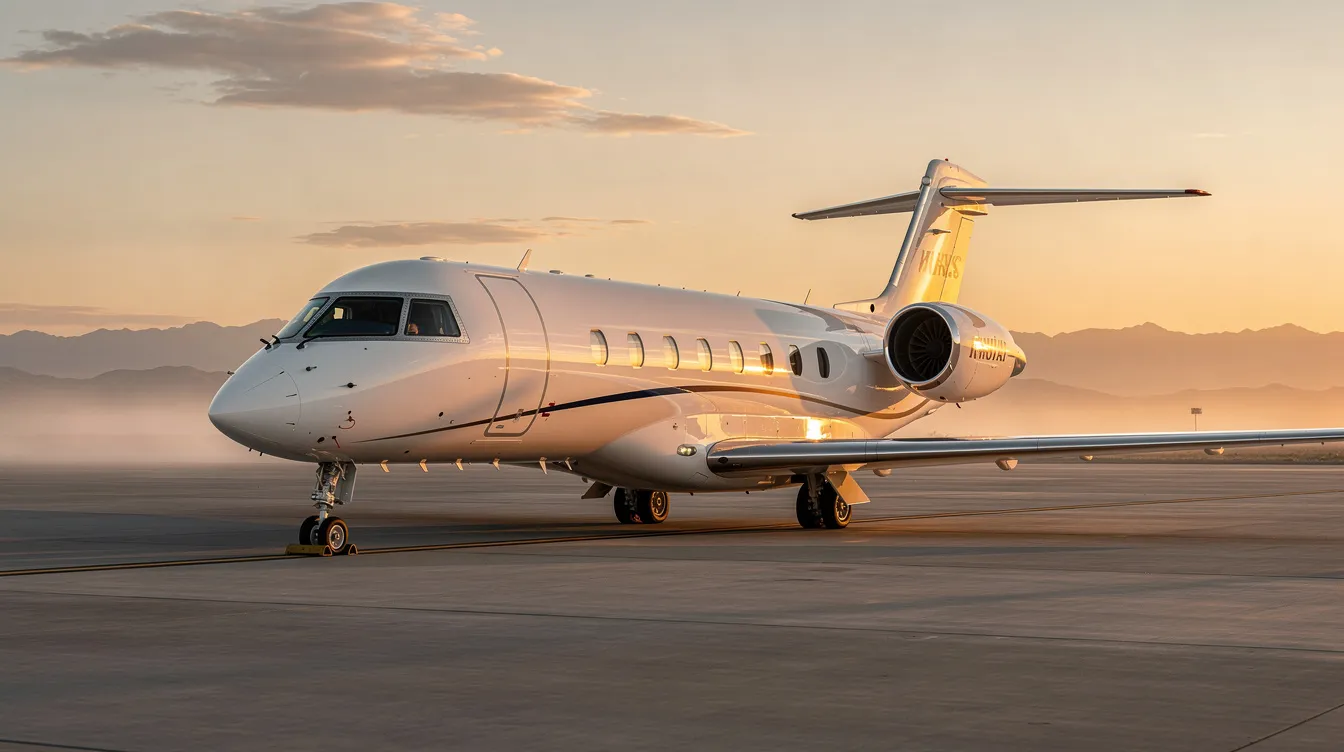
Frequently asked questions about the best fighter planes (and private jets)
What is the best fighter jet in the world right now?
By most analyst rankings in 2026, the F-35 Lightning II holds the top position for overall capability. It combines stealth with sensor fusion, networked air combat, and global fleet scale—just as the top private jets in the world blend cutting-edge performance with passenger-focused design. For pure air superiority, the F-22 Raptor remains unmatched.
How do the F-22 and F-35 differ?
The Lockheed Martin F-22 is a dedicated air superiority fighter with supercruise at Mach 1.8 and the lowest radar cross section of any operational aircraft. The F-35 is a multirole platform built for strike, ISR, electronic warfare, and air-to-air combat in a networked battlespace. The F-22 is US-only; the F-35 is exported to over a dozen allied nations.
Where does the Eurofighter Typhoon rank?
The Eurofighter Typhoon ranks sixth in this list. It excels in agility and multirole flexibility, with a strong combat record and wide European and Gulf state adoption. It is not a stealth aircraft but compensates with electronic warfare, high speed, and sustained maneuverability.
Why are jets like the F-15EX Eagle II still relevant in the age of stealth?
The F-15EX can carry nearly 30,000 lbs of ordnance and fly at Mach 2.5. In a networked force, it acts as a high-capacity weapons platform receiving targeting data from stealthy F-35s. Its 104-0 air combat record adds credibility.
What role do Chinese Chengdu J-series fighters play in modern air combat?
The Chengdu J-20 gives the PLAAF a fifth-generation stealth fighter for anti-access/area denial operations in the Western Pacific. With 250 units in active service and production accelerating, it represents a quantitative and qualitative challenge to US air superiority in the region.
What is the fastest fighter jet in service?
The MiG-25 Foxbat is the fastest fighter jet in service at Mach 3.2, reaching a top speed of 2,190 mph. Among current-production types, the Su-57 reaches Mach 2.45, and the F-15 reaches Mach 2.5. For the absolute speed record among piloted aircraft, the NASA/USAF X-15 holds the record at Mach 6.72, though the X-15 was an experimental aircraft, not a fighter.
How does private jet safety compare to commercial airlines?
Private jets operated under strict audit programs (ARG/US, Wyvern, IS-BAO) maintain safety records comparable to or exceeding commercial carriers. Overviews of the top private jet companies highlight how safety and audit standards define the leading brands, and BlackJet works exclusively with audited operators and experienced pilots.
What is a Jet Card and how does it work?
A Jet Card is a prepaid block of flight hours on private jets. Members purchase 25 or 50 hours, then book flights against that balance with guaranteed availability, fixed rates, and 24/7 support, with many travelers starting by evaluating 50-hour jet card costs, a 100-hour jet card cost guide, or provider-specific comparisons like Flexjet jet card pricing and NetJets jet card costs within transparent jet card pricing structures.
Can private jets be carbon-neutral?
Yes. BlackJet offsets all flight emissions at no extra cost to the member, making every trip carbon-neutral by default, an important factor to weigh alongside the broader private jet price list and cost options.
How quickly can I book a BlackJet flight?
BlackJet's digital platform and 24/7 support team allow members to request and confirm flights within hours, depending on aircraft category and availability, similar in ease to modern options for buying a seat on a private jet.
Conclusion: from the world's best fighters to the world's best private flying experience
The F-35 Lightning II, F-22 Raptor, Chengdu J-20, Su-57 Felon, F-15EX Eagle II, Eurofighter Typhoon, Dassault Rafale, F-16 Fighting Falcon, Su-35, and F/A-18E/F Super Hornet define the state of the art in fighter aviation in 2026. Each balances stealth, speed, sensors, and production scale differently, but the common thread is clear: modern air combat rewards precision, data, and mission-specific planning over brute force alone.
Those same pillars drive BlackJet's approach to private travel. Safety protocols built on military-grade discipline. Technology that puts real-time data in your hands. Sustainability that comes standard, not as an afterthought.
Elevate your travel on your terms. Explore how BlackJet's Jet Card can deliver fighter-level responsiveness with the comfort, privacy, and discretion of the world's finest private jets. Discover BlackJet's Jet Card programs and experience what precision-planned private aviation feels like.


 Sign up with google
 Sign up with Apple