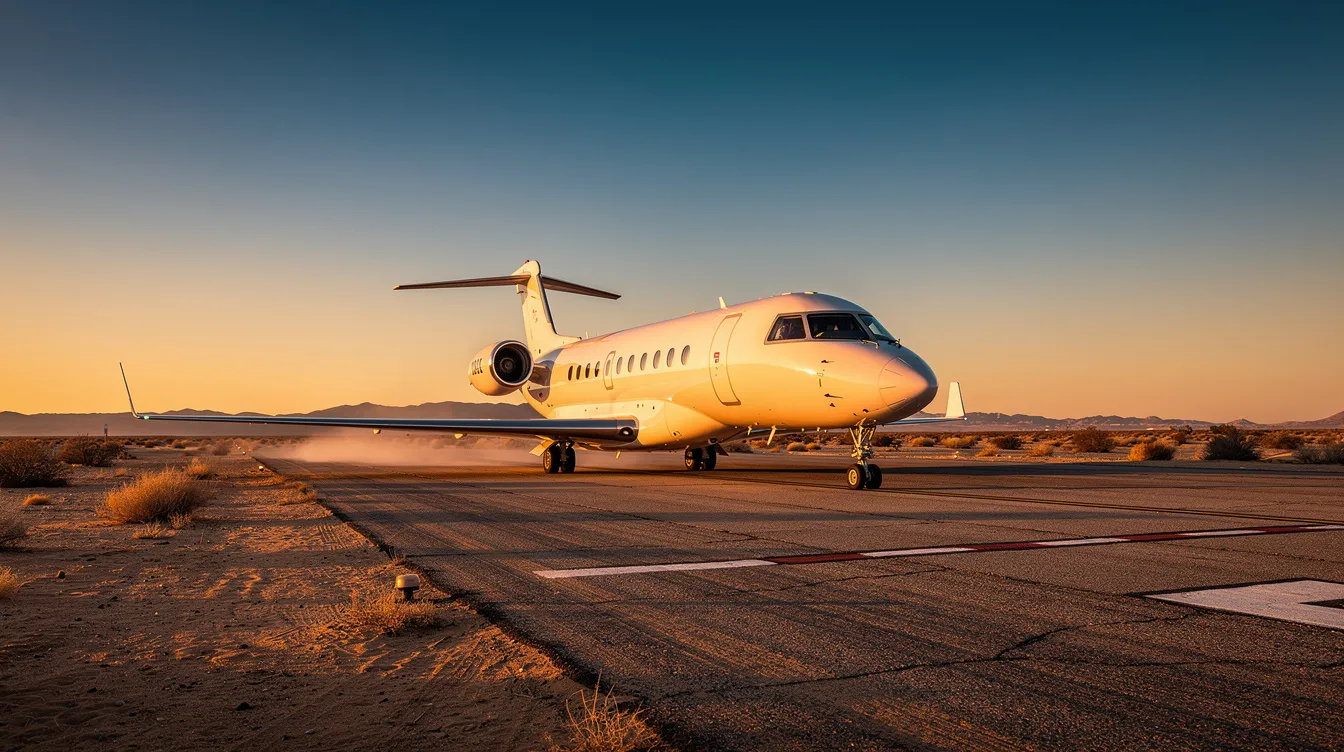
Overview: Why Saudi Arabia Plane Safety and Flexibility Matter Now
Two events in late 2026 forced travelers, airlines, and governments to reconsider how commercial aviation operates across Saudi Arabia and the broader Middle East. On September 30, a Flydubai Boeing 737 MAX 8 carrying passengers toward Israel lost roughly 17,000 feet of altitude in under two minutes after a cockpit attack, diverting to Tabuk. Eight days later, a Houthi missile destroyed a Saudi Airbus A320 parked at Riyadh Airport, killing three people, including the aircraft's captain. These incidents made global headlines and raised pointed questions about crew vetting, airport defense, and the limits of what commercial airlines can control.
For corporate executives and high-net-worth travelers who fly through the kingdom regularly, the calculus has shifted. Private aviation offers a different set of variables: control over passenger lists, the ability to select quieter airports, routing flexibility around conflict zones, and operations through dedicated terminals rather than crowded commercial halls. Saudi Arabia's aviation market includes both commercial and general aviation aircraft, and the private segment is where individual travelers gain the most direct influence over their own safety profile.
BlackJet provides Jet Card memberships that give prepaid access to private jets for routes touching Saudi Arabia, the Gulf, and beyond. Every BlackJet flight is carbon neutral. Private aviation includes both business and leisure aircraft operations, and BlackJet's model is designed for travelers who treat flight planning as a strategic decision rather than a booking transaction.
Key takeaways:
Security incidents: Two 2026 incidents exposed cockpit security and airport defense gaps on Saudi Arabian plane routes.
Commercial travel: Commercial airlines operate on fixed schedules with limited passenger control over routing or terminals.
Private aviation: Private jet travel offers flexible airports, known manifests, and real-time route adjustments.
BlackJet memberships: BlackJet's Jet Card programs deliver safety-certified, carbon-neutral private flights across the Middle East.
Recent Saudi Arabia Plane Incidents: What Actually Happened
Flydubai FZ1073 Cockpit Attack
On September 30, 2026, Flydubai Flight FZ1073 departed Dubai bound for Tel Aviv's Ben Gurion Airport. Approximately two hours and twenty minutes into the flight, the first officer, believed to be an Omani national, attacked the captain, Smit Machchhar, with a blade on the flight deck. The aircraft, a Boeing 737 MAX 8 carrying between 174 and 180 passengers, entered a steep descent over desert near the Saudi-Jordanian border. Crew members, including off-duty pilots traveling in the cabin, intervened and restrained the attacker. The plane transmitted both squawk code 7700 (general emergency) and 7500, the code reserved for unlawful interference by hijackers. It diverted to Prince Sultan bin Abdulaziz International Airport in Tabuk, Saudi Arabia, completing an emergency landing at approximately 09:45 local time. Both pilots were hospitalized. All passengers survived and reached Tel Aviv on a replacement aircraft later that day. (aviation24.be)
Saudi A320 Missile Strike
On October 8, 2026, Houthi forces in Yemen, an Iran-aligned group engaged in renewed fighting across the region, launched missile strikes against King Khalid International Airport in Riyadh. A Saudi Airbus A320 parked on the apron was left damaged beyond repair, engulfed in fire visible from terminal windows. Captain Hamoud Ali Alkalthami was killed. Three people died in total; dozens sustained injuries. (euronews.com)
Immediate Operational Consequences
The operational consequences were immediate:
Flight suspensions: International flights into Riyadh were suspended by carriers including Lufthansa (through October 16), Air India, IndiGo, and Akasa.
Heightened defenses: Saudi authorities and the Royal Saudi Air Force heightened air-defense posture around major airports.
Diversion restrictions: NOTAMs restricted Riyadh Airport's use as a diversion field.
Prior permissions: GACA, Saudi Arabia's General Authority of Civil Aviation, required prior permission for arrivals and departures at RUH.
Passenger confidence: Passenger confidence dropped; demand for alternative routing and airports rose across the region.
Both incidents occurred within recent weeks of each other, creating compounding disruption for anyone flying commercial through Saudi Arabia.
How Commercial Airlines Operate in Saudi Arabia and the Middle East
Saudi Arabia's Growing Aviation Sector
Saudi Arabia's commercial aviation sector is large and growing. The Saudi government has committed to modernizing the aviation sector under Vision 2030, with new carriers, expanded airports, and fleet renewal programs. A parallel ecosystem of Saudi royal and elite private aviation relies on wide-body VIP jets and high-end business aircraft. Saudia, the national airline (sometimes referred to as Saudi Arabian Airlines), operates the kingdom's primary hub-and-spoke network. The carrier plans to purchase up to 121 Boeing 787 Dreamliners as part of its fleet expansion. Riyadh Air, a new full-service airline, is preparing to operate a modern wide-body aircraft fleet on international routes. Flyadeal, a low-cost subsidiary, is one of several low-cost carriers rapidly expanding the domestic travel market in Saudi Arabia.
International airlines like Lufthansa, Air India, and Flydubai serve Saudi hubs with regular service. Religious tourism, particularly Hajj and Umrah seasons, influences aviation operations in Saudi Arabia to an extreme degree, concentrating millions of passengers through Jeddah's King Abdulaziz International Airport and other gateways.
Aircraft, Cargo, and Safety Requirements
Fleet composition: Saudi Arabia uses narrow-body aircraft like the Airbus A320 for regional routes. Wide-body aircraft like the Boeing 777-300ER serve long-haul routes to London, destinations across Africa, Pakistan, and beyond.
Cargo operations: Cargo aircraft are vital for logistics and international trade in Saudi Arabia, with dedicated freighter operations running through Riyadh, Jeddah, and Dammam.
Safety management: Airlines must maintain effective safety management systems to manage operational risks and ensure valid aircraft registration and airworthiness certificates.
Regulatory compliance: Airlines must comply with strict safety mandates when operating in Saudi Arabia, monitored by GACA in coordination with ICAO and IATA.
Civil aviation framework: The civil aviation regulatory framework covers pilot training standards, engineering oversight, maintenance schedules, and delivery of airworthiness directives.
Riyadh Airport Under Pressure: King Khalid International After the Missile Strike
Airport Operations and the October 8 Disruption
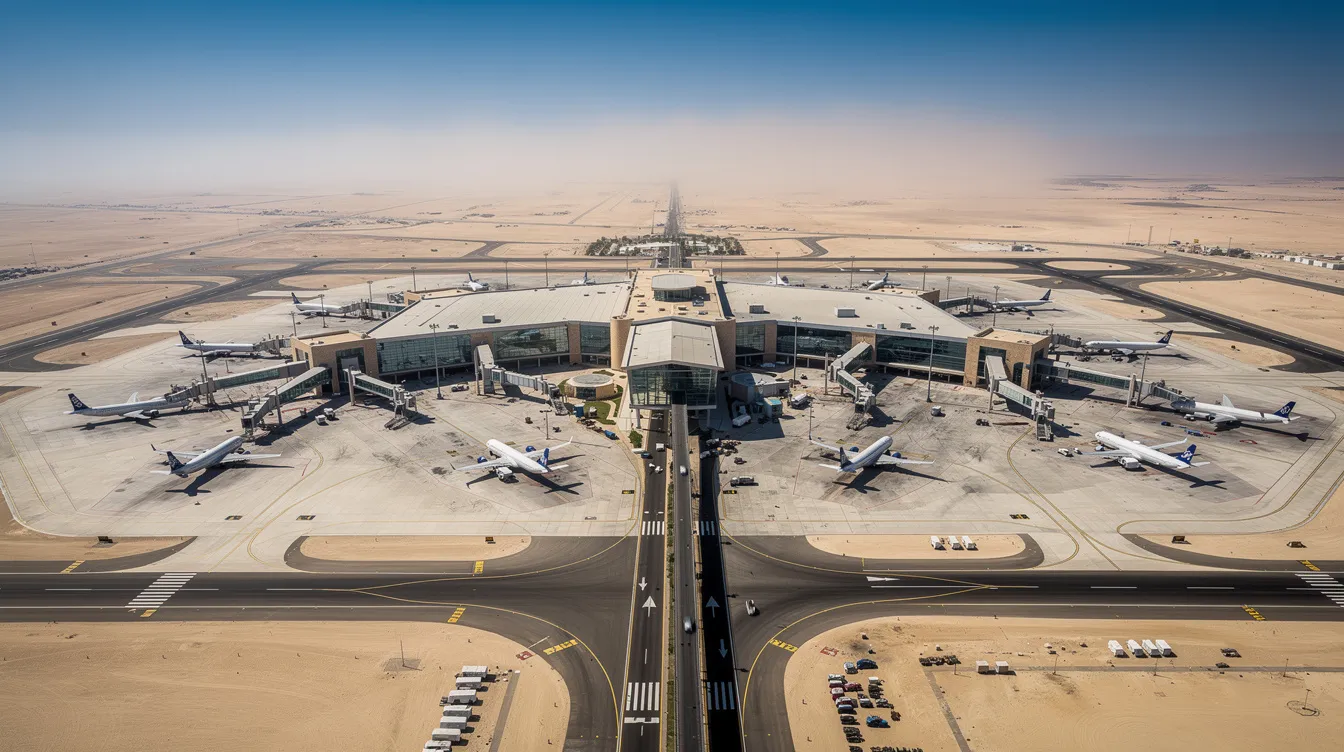
King Khalid International Airport in Riyadh handles the bulk of the capital's commercial and VIP traffic. The airport has multiple terminals, separate royal and VIP facilities, and connects Saudi Arabia to hub networks across Europe, Asia, and the Gulf. On a normal day, it processes thousands of passengers on dozens of international and domestic flights.
On October 8, 2026, that routine shut down. A Houthi-fired projectile struck a Saudia A320 parked on the apron. The fire was visible from terminal windows. Captain Alkalthami was killed aboard the aircraft. The country's main commercial gateway was effectively closed to normal operations for hours.
Effects on Travelers and Airport Security
Flight disruption: Hundreds of flights were delayed or canceled on October 8 alone; by some estimates, nearly 50% of departures from RUH were canceled that day.
Airline suspensions: Lufthansa suspended Riyadh service through October 16; Air India and other carriers followed with their own suspensions through mid-to-late October (travelmarketnews.com).
Stranded passengers: Passengers were stranded on tarmacs, stuck in terminals, or rebooked onto already-full flights.
Perimeter threat: Saudi Arabia employs advanced screening technologies for passenger and cargo security, but the missile threat came from outside the perimeter, not through the terminal.
Airfield defense: Airlines operating in Saudi Arabia must adhere to international aviation security standards; the strike exposed the gap between terminal-level security and airfield-level defense.
Rerouting: GACA issued stricter NOTAMs; certain international flights were rerouted to avoid Riyadh airspace entirely.
Inside the Cockpit: Lessons from the Flydubai FZ1073 Crisis
The Flydubai FZ1073 cockpit attack was not the result of a perimeter breach or an external weapon. It originated on the flight deck itself. The captain was stabbed at cruising altitude by the first officer, a scenario that no amount of terminal screening could have prevented. The reinforced cockpit door, designed to keep hijackers out, also kept help from reaching the captain quickly.
Off-duty pilots aboard, along with crew members from the cabin, forced their way into the cockpit and restrained the attacker. The aircraft, having lost roughly 17,000 feet in under two minutes during the struggle, stabilized and diverted under emergency clearance. Saudi authorities on the ground at Tabuk secured the aircraft after landing.
The incident raised questions that apply to every commercial airline:
Pilot training programs screen for technical competence but have limited tools for detecting psychological threats before they manifest on board.
The cockpit door, mandated after September 11 to stop external hijackers, becomes a barrier when the threat is internal.
Crew and passengers who intervened likely prevented a crash; their actions are now part of the ongoing investigation.
The captain was believed to have continued assisting with aircraft control even after being injured.
Safety Lessons for Travelers
Internal threats are harder to detect than external ones, regardless of airline or country.
Commercial airlines rely on standardized protocols that apply uniformly across thousands of crew; individual vetting depth is limited by scale.
For travelers who prioritize knowing exactly who is in the cockpit, private aviation offers a different model.
Passengers' Experience: What It Feels Like When a Plane Is in Crisis
In-Flight and Airport Disruptions
During FZ1073's rapid descent, passengers reported cabin power flickering in some sections, patchy oxygen mask deployment, unsecured items flying through the cabin, and people screaming in a partially darkened fuselage. Flight attendants attempted to manage the situation with limited information about what was happening on the flight deck.
The experience at Riyadh Airport on October 8 was different but equally distressing. Passengers waiting to board saw smoke rising from the apron. Terminal corridors were filled with conflicting announcements. Families with children, business travelers mid-connection, and diplomats were all stranded. Some passengers did not reach their destinations for over 24 hours.
These incidents are not isolated to 2026. Saudi Arabia has a history of aviation trauma: the Saudia Flight 163 crash at Riyadh in 1980 killed all 301 on board after a fire in the cabin, a disaster that still shapes how the kingdom thinks about onboard emergency response.
Why Some Travelers Consider Private Aviation
For travelers who have experienced or followed these events closely, the appeal of smaller cabins, known passenger lists, and direct communication with the crew is straightforward. Private jet flights reduce the number of unknowns in every phase of travel, from check-in to landing, and their overall safety profile compared with commercial travel is a key part of that appeal.
Individual support: Crises on commercial flights affect hundreds of passengers simultaneously with little individual support.
Regional uncertainty: Flying over or through conflict zones near Syria, Iran, or Yemen creates persistent background anxiety for many travelers.
Smaller, known groups: Private aviation puts the traveler in a smaller, more controlled environment where crew interaction is direct and every person on board is known.
Commercial Airline Security vs Private Jet Operations in Saudi Arabia
Both commercial and private operators in Saudi Arabia must comply with GACA regulations and international aviation security standards. The difference lies in how those rules translate into passenger experience. Saudi Arabia's General Authority of Civil Aviation governs all aviation operations, but the workflows for a 180-seat A320 and a 9-seat midsize jet are fundamentally different.
Commercial Airline Screening
Commercial airline security funnels thousands of passengers through centralized checkpoints at airports like Riyadh or Jeddah. Screening is thorough but impersonal. Queues at peak times can exceed an hour. Passengers board alongside strangers, with no control over who else is on the manifest. Passenger rights are protected under GACA regulations for all flights involving Saudi Arabia, but the system is designed for volume.
Private Jet Processing and Passenger Control
Private flights typically depart from dedicated FBOs with controlled access, where processing times are shorter, and every passenger is pre-identified. Private jet operators manage security more individually than commercial airlines, with tailored protocols adapted to specific missions. Private jets follow national aviation security regulations in Saudi Arabia but operate through quieter terminals with fewer exposure points. Private jet charters offer tailored security protocols during flights, including manifest control that commercial airlines cannot replicate, even when travelers are simply buying a seat on a private jet rather than chartering the whole aircraft.
Private jets can avoid congested airports during high-risk periods, using secondary fields like Abha Airport or terminals outside the main commercial flow.
Dedicated FBOs provide shorter processing times for private flights, often under 15 minutes from car to aircraft.
Corporate executives and security-conscious families increasingly prefer private aviation for Saudi Arabia routes because it reduces time spent in high-density public spaces.
During the October 2026 Riyadh disruptions, private operators rerouted to alternative airports within hours; commercial airlines required days to resume normal service.
How BlackJet's Jet Card Model Changes Saudi Arabia and Middle East Travel
Jet Card Access and Booking
A Jet Card is prepaid access to private jets without the capital outlay or management burden of ownership. BlackJet offers 25-hour and 50-hour Jet Card programs with transparent hourly Jet Card pricing locked at purchase. There is no asset risk, no hangar fees, and no maintenance scheduling. Private jets serve high-net-worth individuals and corporate executives who need guaranteed access without the complexity of running an aviation operation.
Mobile booking platforms offer 24/7 digital booking tools, and BlackJet's platform provides instant pricing for flights. The private jet charter market connects travelers to over 20,000 aircraft globally, and a detailed private jet price list or online estimator can help travelers understand likely charter costs before committing. Mobile platforms allow tailored itineraries based on security alerts, so a member can adjust a Riyadh departure to a different airport or time slot within minutes. Real-time flight support is available 24/7 for travelers, including during fast-moving events like the October RUH disruptions.
Flexible Route Examples
Concrete route examples, including regional missions such as private jet charters from Karachi or Lahore, illustrate how quickly itineraries can be adapted around Saudi Arabia:
A Riyadh-to-Dubai same-day business shuttle, departing from a private terminal and avoiding RUH's commercial congestion.
A nonstop Riyadh-to-London sector on an ultra-long-range jet, bypassing connections at crowded European hubs.
A family itinerary from Jeddah to Mediterranean vacation destinations, with flexible fuel stops and the ability to book directly through BlackJet's app.
Private jet operations follow regulations set by GACA in Saudi Arabia, and BlackJet coordinates with local handlers to secure permits, slots, and ground support. Private jet charters provide routing flexibility and access to less congested airports, which is the core advantage during periods of regional tension.
Choosing the Right Aircraft for Saudi Arabia and Middle East Routes
Aircraft selection for Saudi Arabia missions depends on range, passenger count, and runway requirements. Business aviation accounts for a significant portion of general aviation activities in Saudi Arabia, and the country operates a diverse fleet supporting various industry applications.
BlackJet members access multiple aircraft categories, ranging from ultra-luxury cabins to budget-friendly private aircraft options and the cheapest viable private jet choices for shorter regional hops:
Turboprop aircraft can fly up to 1,500 nautical miles, suitable for short hops between Saudi cities.
Midsize jets typically fly 2,000 to 3,000 nautical miles, covering regional routes to Doha, Muscat, or Amman.
Heavy jets have a range of 5,000 to 7,500 nautical miles, reaching London, destinations across Africa, or the eastern United States nonstop.
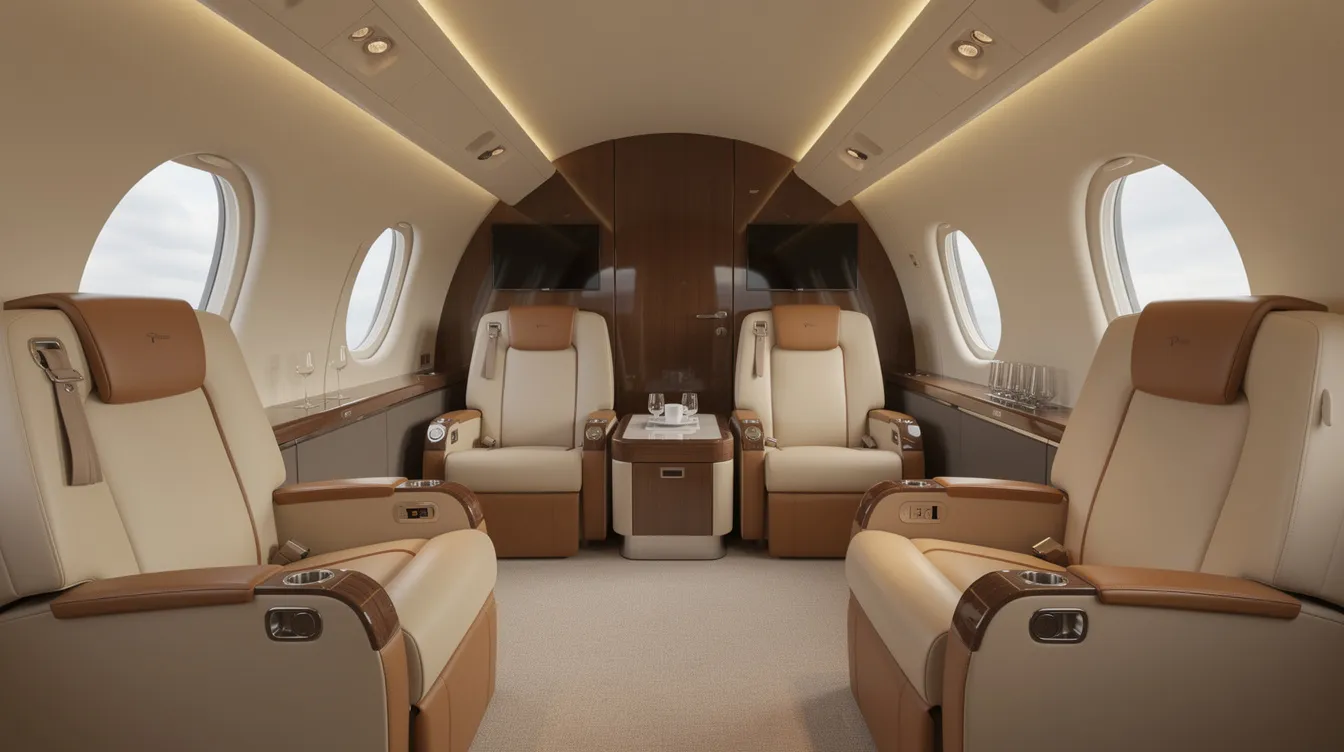
VIP configuration options on larger aircraft include lie-flat seating, private suites, and onboard connectivity.
Technical factors specific to Middle East operations include high-temperature performance penalties (summer tarmac temperatures in Riyadh can exceed 50°C), runway length at secondary airports, and overflight permissions near conflict zones in Syria and Yemen. While commercial airlines standardize their fleet for scale, BlackJet tailors each aircraft choice to the payload, comfort, and security profile of a specific trip, avoiding the fixed pilot staffing and scheduling costs that come with employing private jet pilots directly.
Safety, Certification, and Carbon-Neutral Flights with BlackJet
Operator and Pilot Standards
BlackJet works only with operators that meet or exceed third-party audit standards from ARGUS, Wyvern, and IS-BAO. These programs evaluate pilot flight hours, type ratings, recurrent training, maintenance records, and safety management systems, underpinning the strong safety record of private jets. When operating to or from Saudi Arabia, operators must comply with GACA rules for sustainable aviation and hold valid permits. Learn more about BlackJet's certification standards.
Private jet operations allow for flexible scheduling and routing, which matters for Saudi Arabia plane itineraries where NOTAMs or airspace restrictions can change on Thursday morning and affect flights by Friday. Private jets allow for tailored security protocols and bespoke routings that reroute around high-risk corridors.
Carbon-Neutral Flights
BlackJet ensures every flight is carbon neutral. Carbon offset programs are available for aviation in Saudi Arabia, and BlackJet calculates fuel burn based on route distance, aircraft type, and payload, then offsets emissions through verified carbon reduction projects at no extra cost to the member. Newer aircraft have lower per-seat emissions for sustainability, and BlackJet prioritizes modern fleets. These initiatives complement broader efforts to make private jet ownership and charter pricing more transparent and efficient. For more on BlackJet's environmental commitments, see our guide to green private jet travel.
Every BlackJet flight includes carbon offsets calculated per mission.
Operators are vetted through ARGUS, Wyvern, or IS-BAO audit programs.
Pilot vetting includes medical checks, recurrent training, and performance review.
Dynamic routing avoids high-risk airspace in real time.
Planning More Controlled Itineraries Around Saudi Arabia with BlackJet
Travel Scenarios
Corporate travel: A corporate group originally scheduled to fly commercial from England to Riyadh for a board meeting found their Lufthansa connection suspended after the October 8 missile strike. BlackJet's support team rebooked them on a heavy jet from London to a private terminal in Riyadh within 12 hours, maintaining their schedule while avoiding the disrupted commercial terminals.
Family leisure travel: A family traveling between Europe and the Middle East for leisure chose private jets to skip late-night connections and long security queues. Their itinerary included a fuel stop in Amman, avoiding Riyadh airspace entirely during the period of elevated power projection by Houthi forces.
BlackJet's real-time support team and mobile booking platform adjust departure times, aircraft size, and fuel stops as conditions change. The delivery of updated routing plans happens within minutes of a new NOTAM or security advisory.
Planning Steps for Jet Card Members
Practical steps BlackJet incorporates into each member's travel profile, especially for 25+ Hour Jet Card members:
FAQ: Flying to, from, and over Saudi Arabia with Private Jets
Is it safe to fly over Saudi Arabia and the Middle East after recent incidents?
Regulated air travel over Saudi Arabia remains statistically safe. GACA and the Royal Saudi Air Force have increased air-defense coverage, and NOTAMs guide operators away from active threat zones. Private aviation adds control over timing and routing that commercial airlines cannot offer on a per-passenger basis. Private jet safety depends on operator certification, crew quality, and route planning.
Can I use a private jet instead of commercial airlines into Riyadh Airport or Jeddah?
Yes. Private jets access FBO terminals at both airports, and BlackJet coordinates permits, slots, and ground handling through GACA's established process. Annual or single-flight permits for foreign-registered aircraft are typically processed within one business day.
How does private jet security screening differ at Saudi airports?
Private passengers clear security at dedicated FBO facilities with shorter queues, more personalized checks, and pre-known manifests. The process typically takes under 15 minutes.
What happens if my preferred route crosses a temporary conflict zone?
BlackJet proactively reroutes flights around restricted airspace, adds fuel stops at alternative airports, or shifts departure points to maintain compliance with NOTAMs and insurance zone requirements. This flexibility is built into every Jet Card membership.
Can I offset my trip's emissions when flying by private jet?
BlackJet automatically provides carbon-neutral flights. Fuel burn is calculated per mission, and emissions are offset through verified projects. Members can request documentation of offset projects at any time.
Conclusion: From Saudi Arabia Plane Incidents to Smarter Private Travel
The 2026 Flydubai cockpit attack and Riyadh Airport missile strike confirmed that commercial airlines in Saudi Arabia operate in an environment where geopolitical and internal-security risks can cause abrupt, large-scale disruptions. Both incidents were survivable for passengers, but the downstream chaos, from days-long flight cancellations to stranded families, illustrated the structural limits of commercial aviation when conditions deteriorate. These are realities that travelers to and from the kingdom must factor into their plans.
BlackJet's Jet Card model places routing, timing, and terminal selection back in the traveler's hands. Controlled passenger lists, access to quieter terminals, certified operators, and carbon-neutral performance are not abstract benefits; they are practical tools for anyone who flies through the Middle East with regularity. Safety certification through ARGUS, Wyvern, and IS-BAO, combined with 24/7 real-time support, makes every flight a managed operation rather than a seat assignment.
Explore BlackJet membership and discuss your Saudi Arabia or Middle East travel profile with an aviation specialist at blackjet.com.


 Sign up with google
 Sign up with Apple