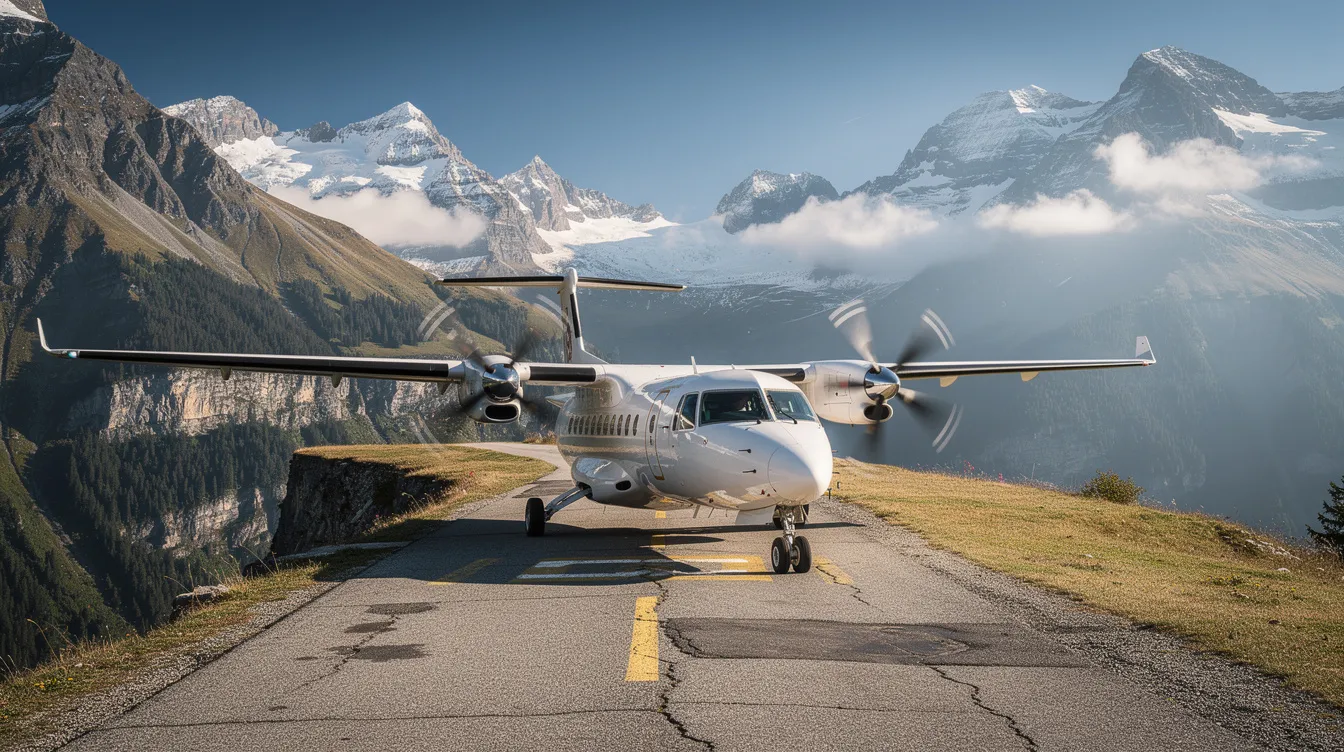
For the discerning traveler, choosing the right aircraft is not about sentiment—it is about strategy. A propeller engine turns mechanical power into thrust by spinning airfoil blades that move an aircraft forward, and in private aviation it remains one of the most efficient propulsion systems for lower-speed regional flying and access to shorter runways.
This guide is designed for private aviation travelers, Jet Card members, and anyone comparing aircraft for luxury regional travel. Understanding propeller engine fundamentals helps travelers make informed decisions about cost, range, and airport access.
For frequent business flyers, high-net-worth leisure travelers, and Jet Card members comparing the best small private aircraft for a specific mission, understanding how propeller-driven aircraft perform can shape better decisions on cost, range, airport access, sustainability, and safety. This guide explains propeller engine fundamentals, the differences between piston and turboprop designs, how turboprops compare with jets, the key components behind turboprop performance, and how BlackJet pairs turboprops with jet service to deliver efficient, flexible private travel.
Why Propeller Engines Still Matter in Modern Private Aviation
A propeller engine is a type of aircraft engine that converts mechanical power into thrust by rotating airfoil blades. These blades act as wings, displacing air to create a pressure difference and generate thrust by accelerating large volumes of air.
A propeller engine converts mechanical power into thrust by rotating airfoil blades that accelerate large volumes of air rearward to push the airplane forward. This principle generates maximum thrust at lower speeds compared to jet engines, making propeller-driven aircraft exceptionally suited for the short regional sectors that dominate many private travel itineraries. Fuel efficiency is often excellent at lower speeds, and propeller aircraft can often take off and land on shorter runways than jet aircraft—unlocking destinations that jets simply cannot reach.
Consider a New York–Nantucket hop or a Zurich–St. Moritz transfers into Samedan's alpine strip. On these legs, a turboprop aircraft departing a nearby business airport often delivers a faster door-to-door experience than a light jet routed through a major hub. For BlackJet Jet Card holders, understanding the distinction between turboprop engines and jet engines is not academic; it is the difference between wasting ninety minutes in ground transfer and arriving resort-ready.
Modern turboprop aircraft offer certified safety, cabin comfort approaching light jets, and significantly lower fuel burn on sectors under 500 nautical miles—qualities that align perfectly with BlackJet's commitment to reliability, efficiency, and sustainable private aviation.
Propeller Engines 101: From Piston Props to Turboprops
Propeller engines include piston engines and turboprop engines. Early piston engines—reciprocating designs where a crankshaft is directly connected to the propeller—powered planes like the Beechcraft Bonanza and Cirrus SR22 at cruise speeds of 120–200 knots. These workhorses served private aviation well after World War II, but their limitations in power, altitude, and vibration drove a search for something better.
The first turboprop engine was patented in 1929 by György Jendrassik, laying the groundwork for a new era in propulsion. Today's gas turbine–based turboprops, exemplified by the Pratt & Whitney Canada PT6 family, deliver shaft power through a compressor, combustion chamber, and turbine stages rather than relying on reciprocating pistons. Turboprops have a greater power-to-weight ratio than piston engines and fewer moving parts, translating into longer intervals between overhauls and superior reliability.
Key differences at a glance:
Power-to-weight: turboprops produce 500–2,000 shaft horsepower while remaining compact; piston engines top out far lower
Altitude: turboprops perform well to FL250–FL300; piston engines struggle above 15,000–20,000 ft
Vibration: turboprops spin smoothly on turbines; pistons create more cabin vibration
Maintenance: turboprops offer longer TBO periods and more predictable service cycles
BlackJet leverages turboprop private jet options where they deliver strategic advantages—regional hops, short runways, and cost-efficient access to secondary destinations like island strips and mountain airfields — all within its premium private jet card programs.
Turboprop Engines vs Jet Engines: How They Really Differ
For Jet Card members, aircraft category selection is a trip-by-trip decision, and understanding the different types of jet engines helps clarify where turboprops and jets each excel. Here is what separates the two engine families.
Jet engines use combustion to generate thrust through exhaust gases. In a turbofan, fan blades at the intake accelerate a large bypass airflow around the core while hot exhaust exits the rear. Jets excel at high altitude and speed—Mach 0.80 and above at FL350–FL450. Turboprop engines are generally used on small subsonic aircraft, functioning as hybrid systems: a gas turbine core extracts energy to spin a propeller via a shaft rather than producing high-velocity exhaust. The result is that turboprops are most efficient below 725 km/h (450 mph) and at speeds slower than Mach 0.6 to 0.8, while propellers are most efficient at low-to-medium aircraft speeds. Propellers lose efficiency as speed approaches the speed of sound, which is why jets dominate long-haul segments and turboprops generally own the regional domain, with lower service ceilings but superior short-field capability.
Route examples where turboprops win on total travel time also tie directly into how a private jet price list and cost structure can shift when you substitute a turboprop for a jet on regional sectors:
Dallas–Austin (~200 nm): nearly identical block time, dramatically less fuel
Milan–Corsica: turboprop powered aircraft access shorter resort runways, eliminating hours of ground transfer
Modern turboprop aircraft like the Pilatus PC-12 NGX (cabin noise ~78–82 dB) and the Beechcraft King Air 360 (~72 dB with noise cancellation) deliver business-class comfort. BlackJet's team helps members decide when a turboprop or a light jet is the smarter option based on distance, payload, runway length, and charter rates.
Inside a Turboprop Engine: How the Reduction Gearbox Transfers Power to the Propeller
Understanding engine architecture matters for safety- and performance-conscious travelers—even at a high level.
The gas generator core begins at the air intake, where airflow enters and passes through axial and centrifugal compressor stages that raise pressure six to eight times above ambient through compression. Fuel is injected into the combustion chamber, ignites, and hot gases spin a gas generator turbine that powers the compressor. A separate power turbine—mechanically independent—extracts remaining energy and, in a free-turbine configuration, drives the propeller rather than the compressor turbine, transmitting power through a propeller shaft and reduction gearbox. Because a turboshaft engine variant of this architecture also powers helicopters, the core technology is proven across thousands of airframe applications worldwide, from the Cessna Caravan to regional small airliners like the ATR 72.
The reduction gearbox is critical: turbines spin at 30,000–39,000 RPM, yet the propeller typically spins at a maximum of 1,900 RPM. Reduction gears convert that speed into usable torque. The gearbox output shaft is connected to the propeller, turning engine power into controlled thrust for takeoff, climb, and cruise. Roughly 30 percent of total engine power spins the propeller, with modern turboprop engines achieving bypass ratios of 50–100—far higher than any turbofan.
Rotating blades act as wings that displace air to create a pressure difference, generating lift in the forward direction. A constant-speed propeller adjusts blade pitch to maintain efficiency across speeds: fine pitch for takeoff, coarse pitch for cruise. Blade pitch settings influence performance in every flight phase. Reverse thrust through the Beta range shortens landing distances on challenging runways—a feature BlackJet clients flying into alpine or island strips rely on.
Key Components of a Modern Turboprop Engine
Each major component in a turboprop engine serves a distinct role in converting fuel into propeller-driven thrust. Turboprop engines are efficient for regional and utility roles at low altitudes precisely because of how these elements work together, especially when you compare them across all major jet engine types.
Air intake and compressor: air enters, gets compressed through axial and centrifugal stages; reverse-flow designs like the PT6 keep the engine compact and reduce drag on the airframe
Combustion chamber: fuel and compressed air mix and burn continuously at high pressure and temperature, with modern materials and cooling ensuring durability across thousands of hours of operation
Gas generator turbine: drives the compressor and accessories such as hydraulic pumps and generators, consuming the majority of turbine energy
Power turbine and output shaft: this free-wheeling turbine drives only the propeller, meaning the prop can remain stationary at idle while the core keeps spinning—an important safety feature during engine failure scenarios
Reduction gearbox: converts high-RPM turbine rotation to safe propeller speeds; modern gearboxes achieve TBO intervals of several thousand flight hours with minimal vibration. Turboprops have bypass ratios of 50–100, underscoring how much energy goes to the prop versus exhaust
Exhaust system: remaining gas exits with little thrust contribution; noise levels are lower than turbojet exhaust, supporting community acceptance at smaller airports
Propeller Design, Constant Speed Propeller, and Performance on Business Turboprops
Blade design directly affects comfort, speed, and efficiency for every passenger on board.
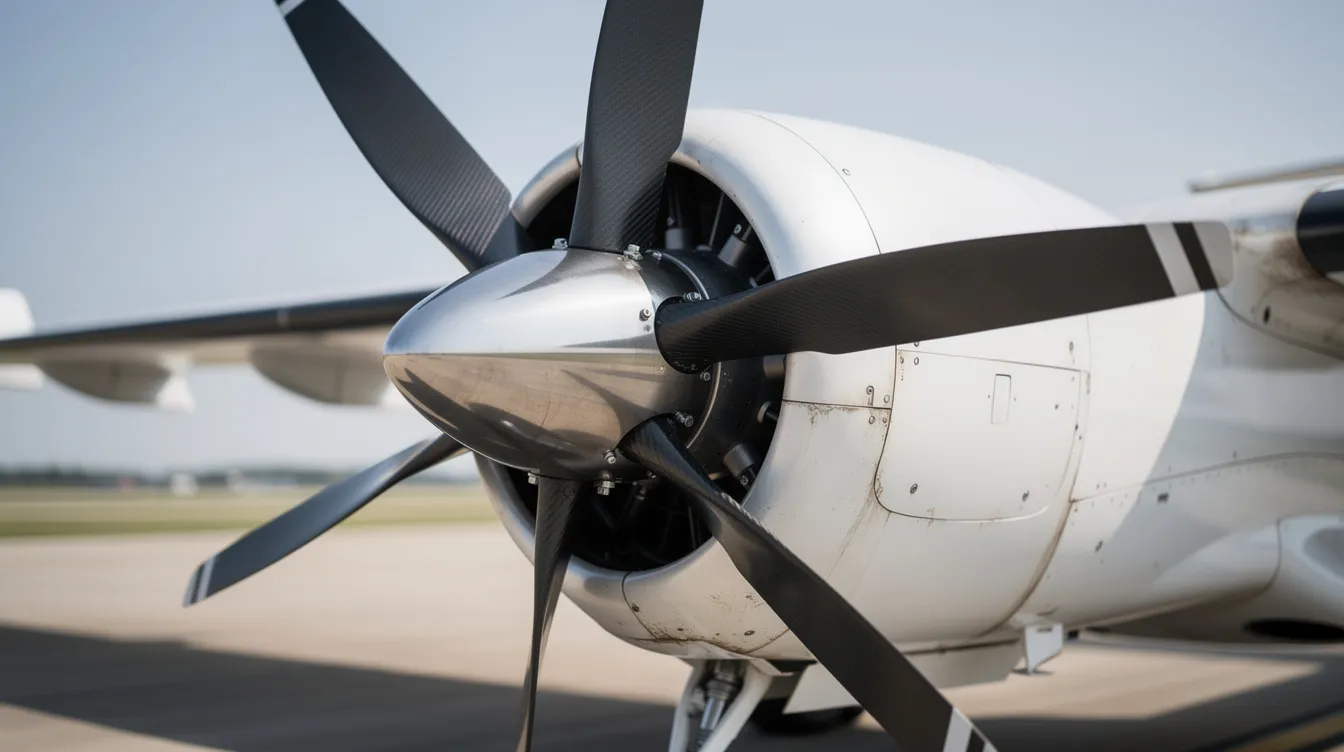
Propeller blades feature twisted airfoil cross-sections whose geometry traces back to early research by the Wright Brothers—optimized so each station from root to tip maintains a near-constant angle of attack. Modern blades use advanced composites from manufacturers like Hartzell and MT-Propeller to reduce weight, resist fatigue, and dampen vibration.
Blade counts matter: three-blade props suit lighter turboprops; the Pilatus PC-12 NGX uses a five-blade composite propeller for reduced noise and quicker climb; the Beechcraft King Air 350i flies with four- or five-blade configurations. Propellers generate thrust by accelerating large volumes of air, and more blades allow a smaller diameter at equivalent thrust, lowering tip speeds. Swept scimitar tips delay shockwaves and improve cruise efficiency. High static thrust allows propeller-driven aircraft to lift heavy payloads—critical for ski equipment, golf bags, and family luggage.
Contra-rotating propellers, seen on high-power designs like the Airbus A400M and the Rolls-Royce–powered Tu-95 (fitted with Kuznetsov engines developed with Rolls-Royce RB technology influences), push aeronautical engineering to its extremes but remain outside typical private aviation missions. Constant-speed governors and automatic feathering protect the engine and reduce drag if a failure occurs, ensuring the pilot retains full control during takeoff or climb.
Where Propeller Engines Excel in Private Travel
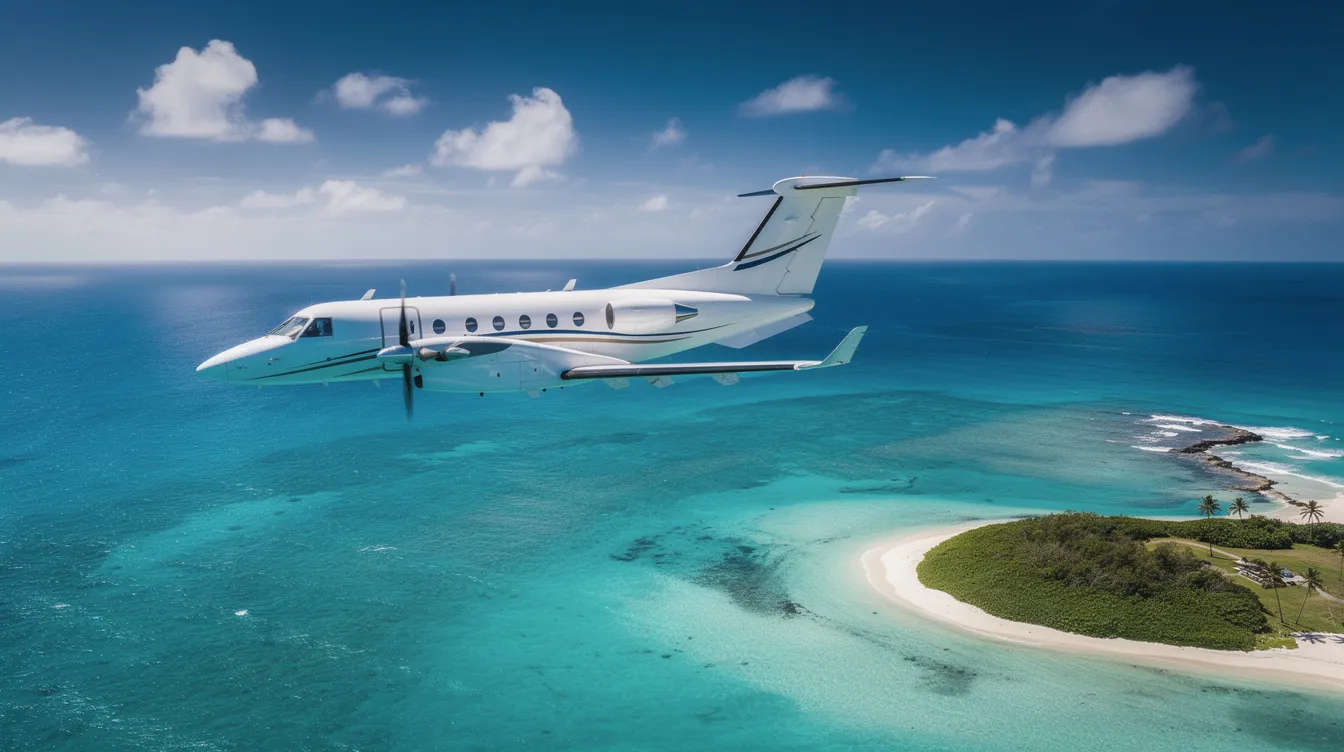
Turboprop aircraft are strategic assets in a Jet Card portfolio—not slower alternatives to jets — and they complement the bestJet Cardd solutions for frequent flyers.
They are ideal for short regional flights where runway performance matters most. Aircraft like the PC-12 operate from runways of 3,000 feet; the King Air 250 handles 4,000-foot strips comfortably, and similar performance benefits underpin many private plane rideshare options that rely on efficient turboprops. These are the airfields closest to alpine resorts, island retreats, and secondary business centers that jet airliners and even light jets cannot reach.
Turboprops burn two-thirds less fuel per passenger than jets on comparable short-haul segments, according to regional airliner data. That translates into lower hourly costs and a smaller carbon footprint per flight, aligning closely with budget-friendly private aircraft strategies for cost-conscious travelers.
Scenario examples where turboprops win:
London–Geneva ski trip: depart Biggin Hill, land at a smaller field near the resort, skip the two-hour drive from Geneva International
Miami–Bahamas island hop: land on a short island airstrip minutes from the resort; no connecting flight required
Sydney–Hamilton Island: turboprop reduces fuel logistics and runway demands, enabling direct access
BlackJet's real-time booking platform transparently presents turboprop and jet options for every leg, with guidance based on runway length, weather, wing configuration for crosswind limits, and load, whether you are accessing full-aircraft charters or simply buying a seat on a private jet. Members select turboprop categories for regional sectors to optimize value, then switch to midsize or large jets for long-haul legs—all within one membership.
Safety, Sustainability, and Technology in Turboprop Operations with BlackJet
For BlackJet, engine choice is inseparable from safety, certification, and environmental responsibility, even when evaluating the cheapest private jet options or entry-level turboprops.
Turboprop engines meet rigorous certification under FAA Part 33 and EASA CS-E. BlackJet's vetted operator partners maintain engines to or above manufacturer schedules, with trend analysis—vibration monitoring, oil particle tracking—used to predict issues before they affect a single flight. Dual-engine redundancy on aircraft like the King Air series, combined with FADEC-equipped engines (such as the PT6E series), provides electronic propeller and engine control that enhances safety across every phase of operation.
BlackJet's digital platform integrates performance data, runway requirements, and weather to recommend when a turboprop-engine aircraft is the safer or more suitable choice, including for shared-capacity models such as private jet rideshare services. On short-haul routes, turboprop engines move large amounts of air more slowly, delivering lower CO₂ emissions per passenger-kilometer than comparable regional jets. Combined with BlackJet's commitment to offset 100 percent of emissions from both turboprop and jet flights through verified carbon programs, every journey is carbon neutral—at no extra cost to you, whether you are choosing efficient turboprops or evaluating an ultra-long-range private jet for intercontinental missions.
The propeller engine is not a compromise. It is a precision instrument for the traveler who values access, efficiency, and environmental stewardship alongside luxury, and it often sits alongside premium private jets for sale in the UK or other markets as part of a broader fleet strategy. When paired with jets in a single Jet Card framework—such as the BlackJet 25+ Hour Jet Card—it creates something no single aircraft type can deliver alone: a complete, mission-optimized travel portfolio.
Explore how BlackJet's Jet Card programs combine turboprop and jet access into one seamless, sustainable travel experience—tailored to the way you fly, while our guides to jet card pricing structures, maximizing jet card tax deductions, understanding Flexjet jet card costs and NetJets jet card pricing, comparing the top private jet companies, and selecting large private jets for 20 passengers or 50-passenger private charters, plus insights on unlimited private jet flight memberships, help you benchmark every option available on the market.


 Sign up with google
 Sign up with Apple