The next generation of private jets is not arriving quietly. In 2026, a new jet generally means a private aircraft certified within the last three to five years or entering service now, with ultra-long-range performance, current-generation flight decks, advanced cabin environmental systems, and modern engines designed to use sustainable aviation fuel (SAF: Sustainable Aviation Fuel). For discerning business travelers, founders, executives, and high-net-worth leisure flyers who move regionally or internationally without wanting to own an aircraft, that shift changes what private flying delivers in practical terms.
With major milestones across business and commercial jet categories in 2025 and 2026, the definition of flying privately has fundamentally changed. Accessing a new jet is no longer about indulgence-it is a strategic decision that can save time, reduce fatigue, strengthen safety margins, and keep work moving in the air through better connectivity, while also improving the sustainability profile of each trip. This guide looks at what defines a new jet, which aircraft and technologies are setting the pace, how cabin comfort, wellness, avionics, and onboard productivity have advanced, and how BlackJet gives members access to these aircraft through a flexible Jet Card model.
Why the "New Jet" Era Matters for Elite Travelers
Consider the numbers. A commercial first class ticket from New York to London still involves at least 90 minutes of ground time at departure-security, lounges, boarding-plus another 30–60 minutes on landing. A private jet eliminates nearly all of it. Factor in the latest advancements in speed (the newest ultra-long-range models cruise at Mach 0.90 or higher), and you recover one to two hours per long haul that commercial aviation simply cannot match.
But the advantage extends beyond the clock. When a CEO steps off a flight after eight hours crossing the Atlantic, cabin altitude, humidity, and noise levels determine whether they arrive sharp or depleted. New jets maintain cabin altitudes around 2,500–3,000 feet-close to sea level-while older aircraft often pressurize to 6,000 feet or more. The difference is measurable in blood oxygen, cognitive clarity, and energy on arrival.
BlackJet's Jet Card model turns these aircraft capabilities into on-demand access for business and leisure travelers. Rather than committing capital to purchase an aircraft, members prepay hours and fly the world's newest models through a curated operator network, leveraging premium private jet cards and Jet Card programs.
Key benefits of flying newer private jets through BlackJet:
Faster nonstops with extended range, enabling global routing without stopovers on long hauls
Reduced fatigue through lower cabin altitude, higher humidity, and ultra-quiet interiors
Advanced avionics and safety systems that reduce risk across every flight
Onboard connectivity turning travel time into productive time
Sustainability features including SAF compatibility and automatic carbon offsets at no extra cost
What Counts as a "New Jet" in 2026?
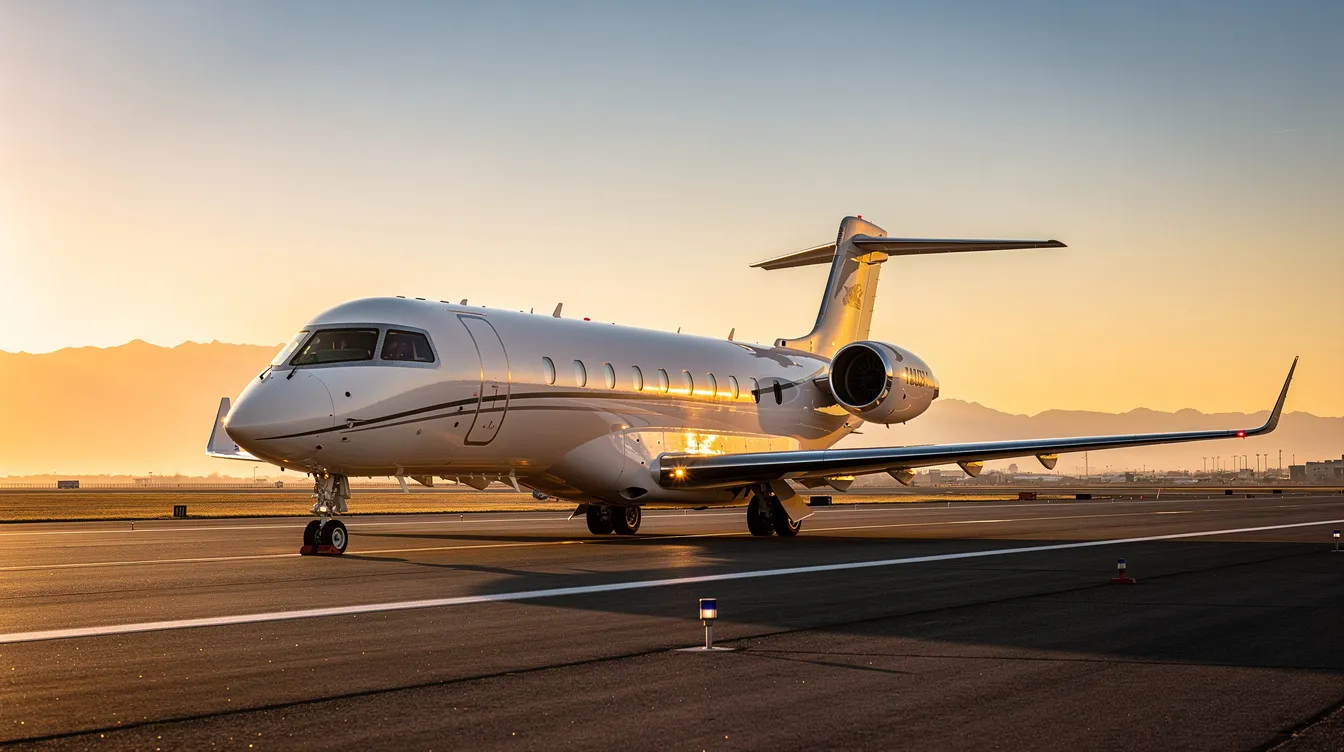
In business aviation, "new" is not just about the paint. A new jet is an aircraft type certified within roughly the last three to five years, or one currently in the beginning stages of its service entry following a recent first flight program.
Three models set the benchmark for the newest private jet innovations. The Bombardier Global 8000 was certified in December 2025, reinforcing Bombardier’s standing as a company with established business-aviation credibility while establishing new records in speed and cabin pressure. The Gulfstream G800 achieved FAA certification in April 2025, offering the longest maximum range in its class at approximately 8,200 nautical miles. The Dassault Falcon 10X completed its first flight in June 2026, with the model expected to enter service in 2027. Meanwhile, Airbus has been scaling production of the A321XLR for long-range strategies in the commercial world, and airlines utilize new aircraft for lower-capacity routes with variants like the Boeing 737-7, which offers a range of 3,800 nautical miles-illustrating how the entire aviation industry is pushing boundaries simultaneously.
There is a practical distinction between "factory new" and "almost-new." Factory-new aircraft come with full OEM warranties, the latest engines, and current-generation cabin technology. Almost-new models-think the Gulfstream G700 or Bombardier Global 7500-were certified within the last five to eight years and carry most of the same comfort and performance features at broader availability and often lower cost premiums.
BlackJet customers do not need to buy or manage a jet to access this new generation. Membership provides curated access across multiple cabin classes, from light jets to ultra-long-range flagships.
Criteria for "new jet" status:
Certified within roughly the last 3–5 years or entering service imminently
Ultra-long-range or long-range capability with nonstop intercontinental reach
Advanced cabin environmental systems (low altitude pressurization, higher humidity, noise mitigation)
Modern engines with SAF capability and improved fuel efficiency
Current-generation flight deck technology and safety systems
The Next Generation of Ultra-Long-Range Private Jets
The flagship category of the new jet era is ultra-long-range-aircraft designed for nonstop missions like Los Angeles to Singapore or London to Sydney. Business jets now feature advancements in high-speed cruising and extreme range that were unimaginable a decade ago. These are not just status symbols; they are productivity platforms in the sky, equipped for corporate teams to work, rest, and arrive at any destination on the globe without a connection.
Comparison of flagship ultra-long-range jets:
Specification | Bombardier Global 8000 | Gulfstream G800 | Dassault Falcon 10X |
|---|
Range | ~8,000 nm | ~8,200 nm | ~7,500 nm |
Top speed | Mach 0.95 | Mach 0.935 | Mach 0.925 |
Cabin zones | Up to 4 | Up to 4 | 3–4 |
Passenger capacity | Up to 19 | Up to 19 | Up to 16 |
Service ceiling | 51,000 ft | 51,000 ft | 51,000 ft |
Cabin altitude at cruise | ~2,691 ft | ~2,840 ft | ~3,000 ft |
The Falcon 10X boasts the widest cabin cross-section of any business jet, while the Global 8000 holds the title of the world's fastest civil aircraft. The Gulfstream G800 engines improve specific fuel consumption by 5–7 percent compared to prior Gulfstream powerplants, delivering both range and efficiency. New jets also achieve a 10% better lift-to-drag ratio than older models, translating directly into fuel savings and smoother performance.
BlackJet includes these aircraft in upper Jet Card tiers because they serve the moments that matter most-transoceanic business missions, milestone leisure trips, and itineraries where a single stopover would cost more in time and fatigue than the aircraft features justify in premium pricing. For members exploring private jets with the longest range or evaluating the best long‑range private jets for sale, these flagships represent the pinnacle.
Inside the Cabin: How New Jets Redefine Comfort and Wellness
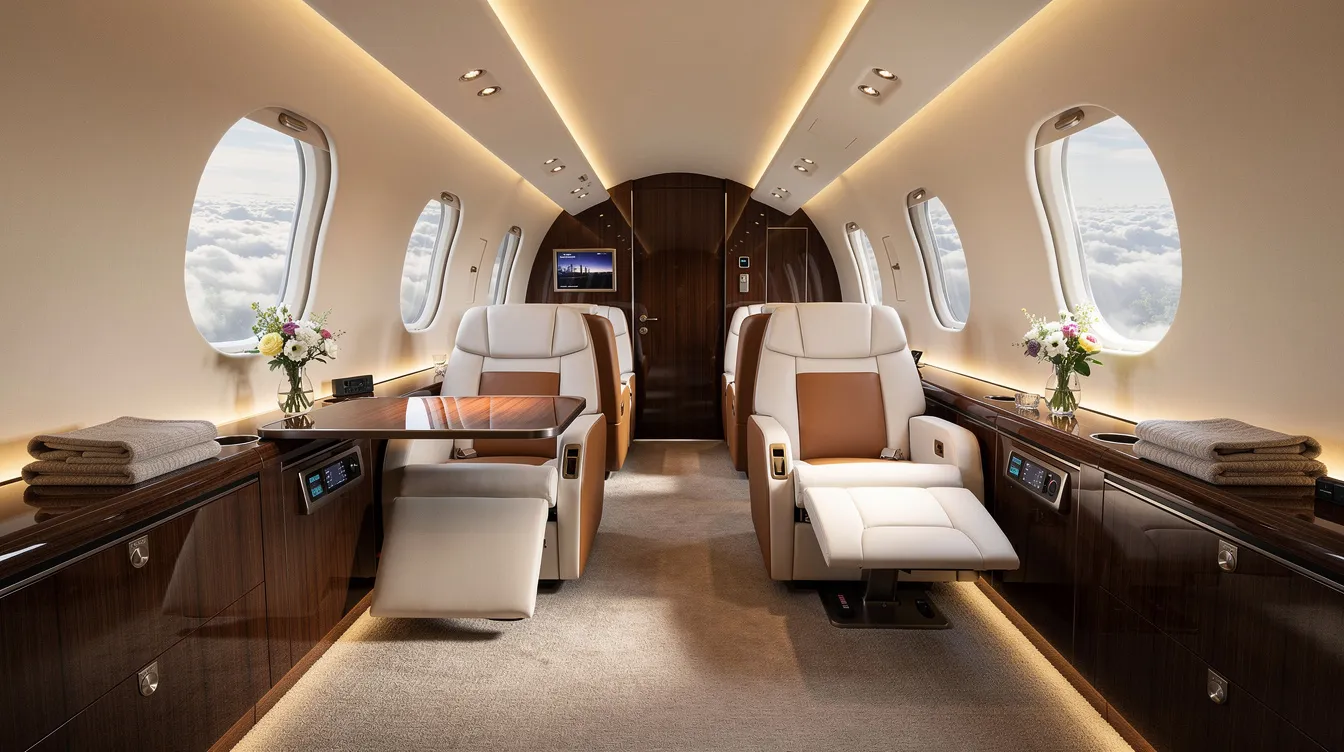
Next-generation cabins reduce fatigue through engineering, not just aesthetics. Modern jets maintain cabin pressure altitude equivalent to 3,000 to 4,000 feet on most models, with flagships like the Global 8000 pressing that down to 2,691 feet. Next-generation jets feature enhanced altitude pressurization for reducing fatigue, meaning passengers arrive with measurably more energy. Higher humidity levels in cabins-targeting 15–20 percent-prevent mucosal drying and dehydration that plagues older aircraft.
Quiet cabins operate below 50 dB, roughly the volume of a quiet conversation, thanks to composite structures, acoustic linings, and refined engine placement. Advanced air filtration and improved humidity control are now common features in new business jets, with systems like Gulfstream's plasma-ionized air renewal cycling 100% fresh air every two to three minutes.
New jets focus on luxury interiors with private bedrooms and high-speed internet, and the cabin space reflects it, rivaling the largest private jets for sale and charter:
Cabins feature multiple distinct living zones-up to four or five-for work, dining, rest, and socializing
Full-size beds and a grand suite or principal suite with closing doors for true privacy
Advanced lighting systems minimize jet lag during long flights, using circadian rhythm programming tied to destination time zones.
Nuage-style ergonomic seating, large panoramic windows (the Falcon 10X features 38 windows, nearly 50% larger than its predecessor), and HEPA-equivalent filtration
Optional showers on select ultra-long-range models
Scenario: A BlackJet member boards a Global 7500 at JFK for an overnight flight to Dubai. They work for two hours using onboard broadband, then retire to the interior suite for six hours of rest at 2,800-foot cabin altitude. On landing, they proceed directly to a board meeting-no hotel layover, no recovery day. The cabin becomes a tool, not just a space.
Flight Deck Innovation: Safety, Automation, and Peace of Mind
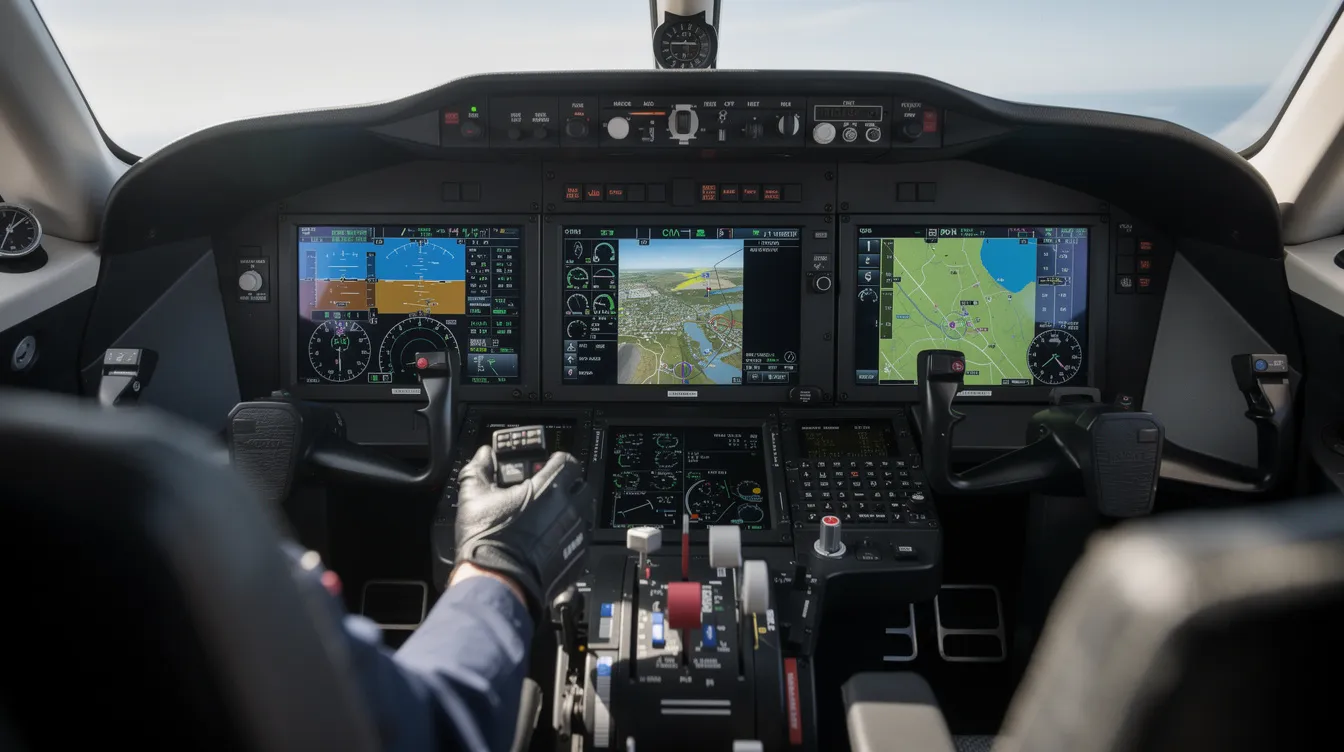
What happens behind the cockpit door matters as much as what happens behind it. New business jets increasingly integrate advanced avionics systems and emergency autoland capabilities, giving passengers an additional layer of protection that older aircraft simply lack. New jets often offer touchscreen flight decks and enhanced synthetic vision systems that render terrain, obstacles, and runway environments in high definition-even in zero-visibility conditions.
Key flight deck technologies on the newest models:
Full fly-by-wire controls derived from military programs-Dassault's Digital Flight Control System, for instance, draws directly from the company's air force fighter technology, preventing overstress, stall, and pilot-induced oscillations
Synthetic vision and enhanced vision displayed on dual head-up displays, improving situational awareness during landing and low-visibility approaches
Advanced weather radar and 3D terrain mapping that help crews navigate turbulence, mountainous terrain, and complex approaches with reduced pilot workload on long flights
Engine health monitoring via Rolls-Royce or GE systems providing predictive maintenance alerts, reducing unscheduled ground time.
Smart Throttle systems (Falcon 10X) managing both engines through a single-lever control with automatic recovery and windshear protection.
BlackJet partners exclusively with operators who meet or exceed leading safety standards, including ARG/US, Wyvern, and IS-BAO certifications, standards also used to evaluate the top private jet companies for luxury travel. BlackJet Certified operators use two-pilot crews even where regulations permit single-pilot operations, and every aircraft must pass rigorous maintenance and dispatch reliability audits before entering the network.
Latest Advancements in Connectivity and In‑Flight Productivity
High-speed satellite Wi-Fi systems are becoming standard in mid-to-large cabins, transforming aircraft from transport vessels into mobile offices, while smaller missions may be better served by the best small private aircraft for every need. Here is what the newest jets deliver:
Ka-band and Ku-band satellite broadband with speeds of 50–100 Mbps, sufficient for multi-participant video conferencing and large file transfers
VPN-compatible, encrypted networks with physical separation between passenger connectivity and flight deck avionics-critical for executives handling sensitive data
Integrated cabin management systems controllable via smartphone or tablet: lighting, temperature, entertainment, and privacy shades adjust with a tap
Power outlets and USB-C ports at every seat position, supporting laptops, tablets, and mobile devices simultaneously
App-based booking and in-flight support through BlackJet's platform, which features an intuitive modal window for flight requests; a close button and escape key let members quickly close modal dialog screens, review options, or cancel and rebook. Each close modal dialog end action saves preferences automatically, and the company's 24/7 concierge provides real-time support throughout
Example: A BlackJet corporate client flies eight team members from San Francisco to New York on a large-cabin jet. Mid-flight, they hold a live video call with investors in London, review and sign documents through a secure connection, and finalize a term sheet before landing at Teterboro. Five hours of flight time becomes five hours of billable, productive work.
For members curious about connectivity options, BlackJet details these capabilities for every aircraft class in its network-learn more about private jet Wi-Fi.
New Jet, Smaller Footprint: Efficiency and Sustainable Aviation
Key technology trends in new jets include efficiency and sustainability improvements that are reshaping the environmental profile of private aviation. Sustainable aviation fuel compatibility is a focus for new aircraft designs, and BlackJet is committed to carbon-neutral flights across its entire program, aligning with what defines the best private jets in the world today.
Concrete improvements on the newest models:
Modern engines reduce fuel burn by 15–20% compared to previous-generation powerplants. The Rolls-Royce Pearl series delivers lower thrust-specific fuel consumption while producing the thrust needed for Mach 0.90+ cruise.
Composites comprise 30% of the Bombardier Global 8000, reducing weight and drag; the Falcon 10X uses an all-composite wing for further aerodynamic refinement.
New jets support Sustainable Aviation Fuel blends up to 50% today, with engines like the Pearl 10X tested on 100% SAF. Lifecycle CO₂ reductions of up to ~70% are achievable when SAF is combined with carbon offsets.
BlackJet includes automatic carbon offsetting on every flight at no extra cost, and proactively sources operators using SAF where airport fuel infrastructure allows
Real-world comparison: A London–New York trip on a new Global 8000 using a 50% SAF blend and automatic offsets produces a dramatically smaller carbon footprint than the same route flown on a 15-year-old large-cabin jet burning conventional fuel-potentially 30–50% lower total emissions.
Aircraft manufacturers are also moving toward electric vertical takeoff and landing aircraft for urban trips, and jet manufacturers are exploring hybrid-electric and supersonic business jets, signaling that the sustainability trajectory in aviation will only accelerate.
How BlackJet Jet Cards Unlock Access to the Newest Private Jets
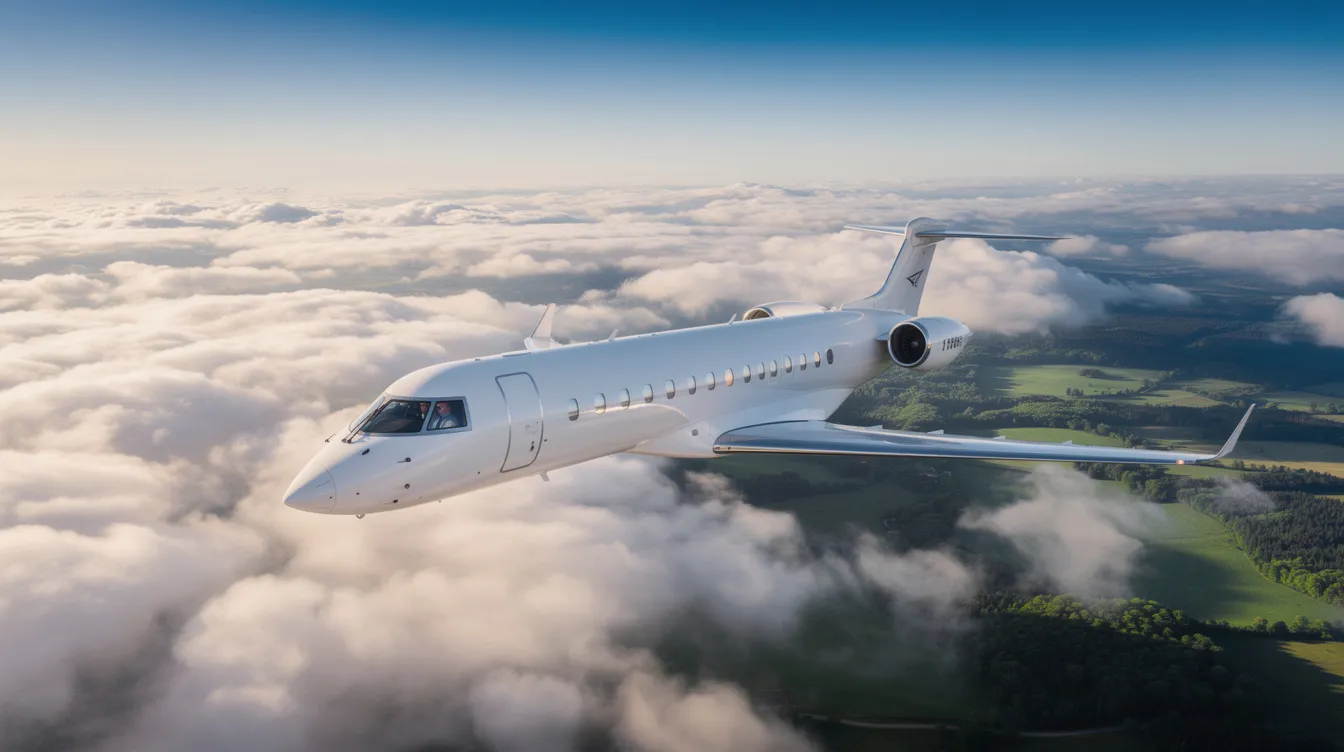
BlackJet offers 25-hour and 25+ Hour Jet Card and 50-hour Jet Card programs giving prepaid access across aircraft categories-light, midsize, super-midsize, large, and ultra-long-range. Hourly rates for new jets range from $14,500 to $18,000 depending on cabin class and model, with fixed pricing that eliminates fuel surcharge surprises.
How it works:
Join: Select a Jet Card membership tier and cabin class
Set your profile: Define typical routes, cabin preferences, and sustainability priorities
Request trips: Book via the BlackJet app or 24/7 concierge; the system matches you with the right aircraft from the Certified operator network
Fly: Hours are deducted from your balance; every flight includes safety certification, real-time support, and carbon offsets.
Jet Card vs. ownership vs. one-off charter: For many members, understanding the broader private jet price list and access options helps frame this decision.
New flagship jets cost 15–25% more to charter than older models on a one-off basis, and availability is unpredictable. Ownership solves access but creates a different problem: operational costs for private jet ownership can exceed $1 million annually in crew, maintenance, insurance, and hangar fees-before the purchase price. Entry-level jets can be priced around $4 million, while the most expensive private jets can cost over $78 million, with many clients considering 10 million dollar private jet options as a strategic middle ground. A Jet Card eliminates all of that, giving members fleet variety, fixed cost, zero maintenance liability, and the ability to operate across any cabin class.
Choosing the Right New Jet for Your Mission
Matching the right aircraft to each mission matters more than always chasing the newest model. BlackJet advisors help members balance distance, passenger count, cabin preferences, and budget, prioritizing the newest, most efficient aircraft available that day across airports worldwide.
Route examples and recommended categories:
London City to Ibiza (~1,000 nm): Light jet, 4–6 passengers-fast, efficient, no need for a large cabin
New York to Miami (~1,200 nm): Light or midsize jet, ideal for business or leisure day trips
Los Angeles to Honolulu (~2,500 nm): Super-midsize or large cabin with the range to fly nonstop to this destination
Paris to Dubai (~3,200 nm): Large cabin or ultra-long-range-missions at this distance benefit from a Global 7500, G800, or Falcon 10X for comfort and nonstop capability
These are guidelines, not rigid rules. A family of six heading to Hawaii for leisure may prioritize cabin space and rest zones over speed, while an executive flying solo to close a deal may want the fastest available model regardless of size, similar to how buyers weigh 20 million dollar private jet features against mission needs. BlackJet's digital tools and concierge adapt to both.
First Flight to Fully Routine: When New Models Reach Members
The journey from first flight to routine Jet Card availability typically spans 12–24 months after certification. Manufacturers conduct thousands of hours of flight testing, regulators review every system, and operators build crew training and maintenance programs before the aircraft enters charter or card service.
Current timeline for flagship models:
Gulfstream G800: FAA certified April 2025; entering operator fleets and increasingly available for Jet Card access through late 2025 and 2026
Bombardier Global 8000: Transport Canada certification November 2025, FAA/EASA following; expect charter and Jet Card placements through 2026–2027
Dassault Falcon 10X: First flight June 2026; certification expected late 2027; earliest member access likely 2028
Many members prefer almost-new aircraft like the G700 (certified March 2024) or Global 7500 (in service since 2018) for the balance of proven reliability, broader availability, and most of the same technology at a lower premium, even when also considering some of the most expensive private jet options on the market. BlackJet monitors new deliveries continuously and works with operators to bring the newest models into the accessible pool as soon as they are proven in service.
Members should expect that for any given trip, the best aircraft may be an almost-new model rather than a factory-fresh flagship-and that is often the smarter choice.
Frequently Asked Questions About New Jets and BlackJet
Are new jets always more expensive to book through my Jet Card hours?
Not necessarily. While flagship models carry a premium, the efficiency of a new jet-shorter flight times, fewer fuel stops-often reduces total trip cost. Fixed hourly rates through BlackJet keep pricing predictable regardless of model age, and tools for understanding jet card cost per hour help members benchmark value.
Can I request a specific new model like a G700 or Falcon 10X?
Yes. BlackJet allows preference settings for specific aircraft types, including some of the largest private jets available. Availability depends on whether Certified operators have taken delivery and whether the model is positioned for your route. Large Cabin cardholders are most likely to access the newest flagships first.
Is a new jet suitable for my first private flight?
It depends on the trip. For shorter regional flights, a light or midsize jet delivers better value, and resources on the best small private aircraft can help frame those options. For a first transcontinental or international flight, a newer model delivers comfort, wellness, and technology gains that make the experience exceptional.
Do I always get better Wi-Fi and flight deck technology on newer aircraft?
Generally, yes. Newer models are built with current-generation avionics, higher bandwidth, and secure networks, especially among the top private jets in the world. However, specific features depend on the operator's outfitting choices.
How does BlackJet ensure safety standards on the latest aircraft types?
Every operator in BlackJet's network is vetted against rigorous safety protocols, including ARG/US, Wyvern, and IS-BAO benchmarks, similar to the criteria used when comparing the best jet cards for frequent flyers. New aircraft must pass both OEM and regulatory certifications before entering the fleet, and two-pilot crews are standard.
Can I guarantee my new jet flight is carbon neutral or uses SAF?
BlackJet includes carbon offsets automatically on every flight. SAF usage depends on airport infrastructure, but newer engines are certified for high blends, and BlackJet works with operators to use SAF wherever supply allows.
From Simply Flying to Strategically Flying: Elevate Your Next Journey with BlackJet
The era of simply flying from origin to destination as a passive passenger is over. For executives, founders, and UHNW families, the next generation of private jets transforms travel into a strategic instrument-recovering hours, preserving energy, maintaining security, and reinforcing the signal that every detail of how you operate matters.
Speed. Comfort. Safety. Connectivity. Sustainability. These are not marketing words-they are measurable attributes of the newest aircraft in the world, and they are all accessible through BlackJet membership without the complexity of ownership.
Explore BlackJet's Jet Card options and, if you are comparing programs broadly, review a guide to understanding jet card costs and membership pricing, then speak with an advisor about optimizing your three to five most frequent routes whether your next mission is a transatlantic board meeting, a family trip across the Pacific, or a same-day round trip that no airline schedule can accommodate, BlackJet positions you to fly not just well, but with precision and purpose-today and as every new jet enters service tomorrow.


 Sign up with google
 Sign up with Apple