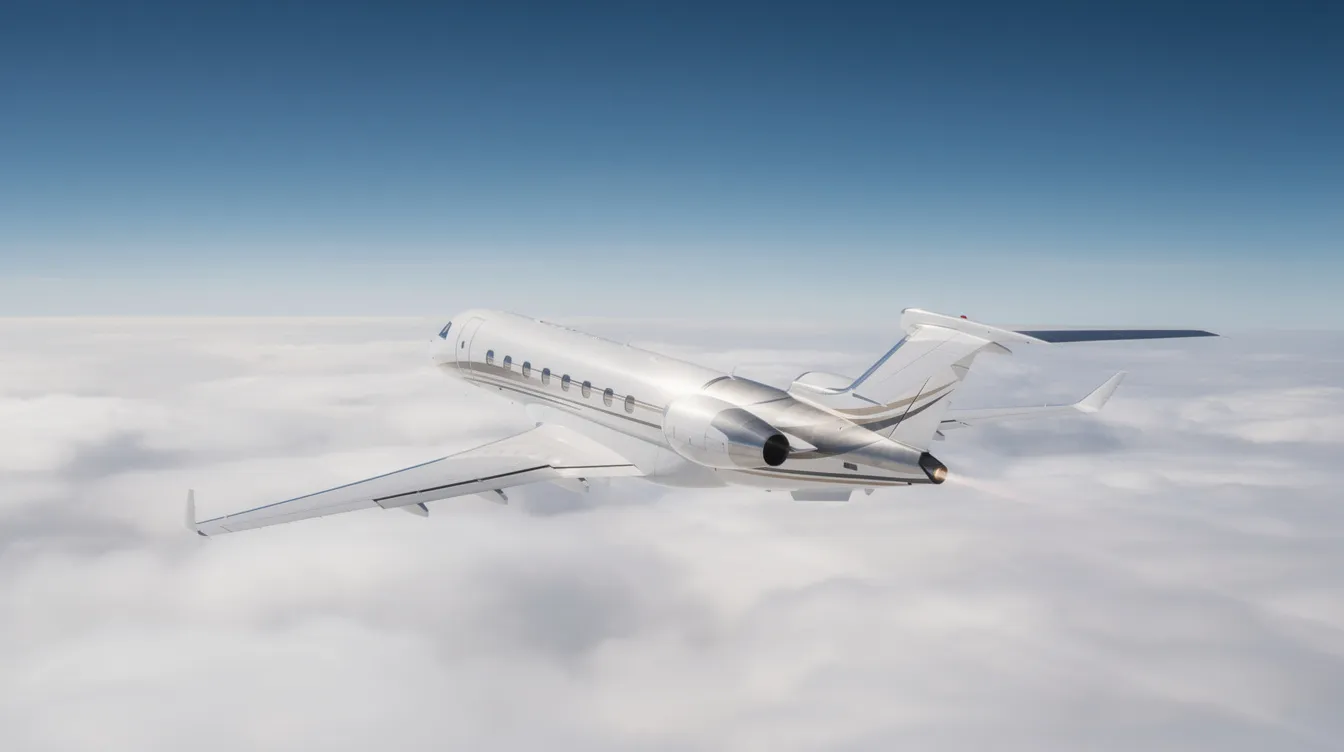
For the discerning traveler, Mach 1 converts to roughly 1,225 to 1,235 kilometers per hour at standard sea-level conditions, with 1,234.8 km/h commonly used in aviation. For frequent business flyers and high-net-worth leisure travelers who use private jets, that number is more than a technical benchmark: it is a practical way to compare aircraft performance, estimate travel time, and weigh speed against comfort and efficiency.
Understanding how Mach translates into kilometers per hour gives you a concrete way to evaluate aircraft performance and determine the real value of every flight. This guide explains how Mach numbers convert to km/h, why the speed of sound changes with altitude and temperature, what typical aviation speeds look like in practice, and how BlackJet applies these metrics to optimize private jet scheduling, performance, and customer convenience.
Quick Answer: Mach 1 to Kilometers per Hour (KPH)
At standard conditions near sea level, Mach 1 is approximately 1,225 km/h (kph). In standard dry air at 20 °C, the speed of sound is 343 m/s, making Mach 1 approximately 1,235 km/h.
ISA sea level (15 °C): Mach 1 ≈ 1,225 km h
Rounded aviation calculator value: Mach 1 ≈ 1,234.8 km/h
At 20 °C: Mach 1 ≈ 1,235 kilometers per hour
"Kilometers per hour" is a linear speed unit measuring distance traveled per hour, while Mach number is defined as the ratio of an object's velocity to the local speed of sound, making it dimensionless rather than a fixed value in any speed units.
Quick example conversions for context:
Mach 1 is not a fixed constant and varies by medium conditions. BlackJet uses both Mach and km/h when assessing optimal cruise speeds, fuel efficiency, and comfort for private jet card members, supported by advanced private jet flight time calculators that integrate aircraft performance and real-time conditions.
How to Convert Mach Number to Kilometers per Hour
The Mach number is the ratio of local flow velocity to the local speed of sound. Converting any Mach value to km/h requires knowing or assuming a speed of sound value for the given conditions.
Formula: speed (km/h) = Mach number × speed of sound (km/h)
Standard working value: use 1,234.8 km/h, so the formula becomes km/h = Mach × 1,234.8
Mach number is calculated as M = u/c, where u is the object moving through the fluid and c is the sound speed
Worked examples:
Mach 1 = 1 × 1,234.8 ≈ 1,235 km/h
Mach 2.7 = 2.7 × 1,234.8 ≈ 3,334 km/h (some rough references cite ~3,000 km/h based on slightly different assumptions)
Mach 1 changes depending on air temperature and altitude. At around 11 km altitude, Mach 1 is about 1,062 km/h due to colder air, meaning aviation flight computers constantly adjust for the atmosphere the aircraft is actually flying through, much as private jets flying higher than commercial airliners leverage altitude to improve speed, comfort, and efficiency.
Reverse Conversion: From Kilometers per Hour to Mach
Private jet clients often see speeds quoted in km/h or mph but want to know the eequivalentMach value to understand whether an aircraft is subsonic, transonic, or supersonic, and those comparing performance across premium private jet card programs use Mach awareness to evaluate how quickly different aircraft can complete key routes.
Examples:
BlackJet's flight support systems internally convert between Mach, km/h, and knots so card members see only the most meaningful unit for their itinerary, without delay or confusion.
Understanding Mach Number and the Speed of Sound
Mach number is fundamental in aviation. It is the ratio of flow velocity to sound speed, and it governs everything from aerodynamic design choices to cabin comfort limits.
A sound wave is a pressure disturbance traveling through an elastic medium — in this case, the gas mixture we call air. The speed of sound varies with temperature and air density: warmer air increases the speed of sound, while colder air slows down sound waves, reducing it. As altitude climbs and temperature drops, the local value of Mach 1 changes accordingly, and as speed increases toward and beyond Mach 1, airflow shifts from largely subsonic behavior to compressibility and shock-wave effects that alter pressure and temperature around the aircraft.
Reference Mach values for the speed of sound:
0 °C, dry air: ~331.3 m/s (≈ 1,193 km/h)
15 °C, ISA sea level: ~340.3 m/s (≈ 1,225 km/h)
20 °C: ~343 m/s (≈ 1,235 km/h)
This variability explains why sources quote slightly different conversions. Breaking the sound barrier means traveling around 1,200 km/h near sea level, yet Mach 1 approximates only 1,062 km/h at typical cruising altitudes where the atmosphere is far colder.
Speed regimes classified by Mach:
Regime | Mach Range | Key Characteristics |
|---|
Subsonic | Below ~0.8 | Subsonic speeds are below Mach 1, typically less than 0.8; minimal compressibility effects |
Transonic | 0.8–1.2 | Drag divergence rises steeply; shock waves are created on wings and fuselage |
Supersonic | 1–5 | Supersonic speeds range from Mach 1 to Mach 5; supersonic flow dominates |
Hypersonic | Above 5 | Hypersonic speeds exceed Mach 5, reaching up to Mach 10; severe aerodynamic heating and energy demands |
The critical Mach number is the lowest Mach number at which airflow over any part of the aircraft reaches Mach 1 — an important measure for understanding aviation speed limits, because compressibility and shock-related effects become more pronounced as aircraft move from high-subsonic into transonic and supersonic flight. Modern business jets typically cruise between Mach 0.78 and 0.92, which translates to roughly 900–1,100 km/h. For BlackJet members, staying in this high-subsonic range balances speed, fuel efficiency, and cabin comfort.
Kilometers per Hour (KPH) and Other Speed Units in Aviation
Kilometers per hour is a metric unit expressing the distance an object covers in one kilometer increment each hour. The formula is straightforward: speed (km/h) = distance (km) ÷ time (hours).
Other speed units common in aviation include:
Knots (nautical miles per hour) - the primary unit in flight operations
Miles per hour (mph) - prevalent in U.S. consumer contexts
Meters per second (m/s) - used in physics and engineering to measure the magnitude of velocity
Conversion anchors: 1 km/h ≈ 0.621 mph, 1 km/h ≈ 0.54 knots, and 1 m/s = 3.6 km/h. These let you move freely among other speed units. BlackJet's digital platform handles all conversions automatically so travelers view speeds in their preferred unit while pilots operate in professional standards.
Real-World Examples: From Mach 1 to KPH in Private and Military Aviation
Translating Mach into km/h makes the magnitude of high-speed flight tangible, especially when radical differences in aircraft designed for different missions become clear, from very light jets to VIP airliners that span the full spectrum of private jet sizes.
A long-range business jet (Gulfstream G650 class) cruising at Mach 0.90 ≈ 955–1,000 km/h — among the fastest private jets flying today and a benchmark for ultra-long-range private jets for sale
A commercial airliner at Mach 0.82 ≈ 900–950 km/h, a speed that helps highlight when chartering a private jet is worth it for travelers seeking faster, more flexible schedules
Supersonic aircraft like the F-22 Raptor at Mach 2.25 exceed 2,400 km/h; the F-14 Tomcat at Mach 2.37 ≈ 2,500+ km/h, speeds that rival some of the best private jets in the world in terms of raw performance, even if their missions differ
The Space Shuttle during re-entry reached hypersonic speeds above Mach 8 - over 8,000 km/h — a range shared with experimental spacecraft where aerodynamic heating becomes the dominant design constraint
Supersonic and hypersonic aircraft designed for supersonic speeds feature sharp edges, swept wings at a steep angle, and narrow profiles to cut through shock waves, while subsonic jets use rounded features and high aspect ratio wings for efficient lift in smoother flow, especially on the largest private jets for sale and charter that prioritize comfort as well as aerodynamic efficiency. Even propeller-driven aircraft, limited to lower Mach values, reflect how aerodynamic design adapts to speed regime. These are not minor differences in light of performance — they represent fundamentally different engineering philosophies across every length of the airframe, and understanding them is key when evaluating the best features of a 20 million dollar private jet or any other high-end aircraft purchase.
BlackJet scenario: An executive flying New York to London on a large-cabin jet at Mach 0.85 covers roughly 950 km/h at cruise altitude. Combined with optimized departure slots and direct routing, this can shave 1–2 hours off door-to-door travel time versus commercial schedules — a speed advantage private jets consistently deliver.
Why Mach and KPH Matter for BlackJet Jet Card Members
For high-net-worth travelers, the ability to convert Mach to km/h transforms abstract cockpit data into concrete schedule control — helping determine whether a flight fits your day, not the other way around.
BlackJet's jet card programs, including the flexible 25+ Hour Jet Card, leverage aircraft performance data in both Mach and km/h to:
Optimize routing and cruise levels for each mission profile using precise private jet flight time calculations
Balance speed with fuel burn and sustainability targets - cruising at Mach 0.80 instead of 0.85 on certain segments can meaningfully reduce emissions while still aligning with smart strategies to fly private more affordably
Maintain cabin comfort by avoiding transonic pressure regimes where turbulence created by compressibility effects can fly through the cabin as unwanted vibration
Safety remains paramount. BlackJet partners only with operators meeting strict certification standards, and adherence to recommended Mach envelopes is a core element of operational safety management, much like the rigorous standards followed by the top private jet companies worldwide. Every flight stays within published speed limits measured in both Mach and km/h.
Through BlackJet's mobile booking platform, members see estimated cruise speeds and flight times — with Mach values translated into km/h — so you intuitively understand how fast you are moving and how that speed reshapes your schedule, while also having clear visibility into private jet rental costs and considerations for each mission.
Explore BlackJet's Jet Card programs to discover how optimized cruise speeds translate into tangible hours saved on every journey, whether you're comparing the most expensive private jet options, planning a charter plane for 100 passengers, or selecting the best private jet for 15 passengers, 20 passengers, 30 passengers, or 50 passengers, or even exploring a premium UK private jet for sale.


 Sign up with google
 Sign up with Apple