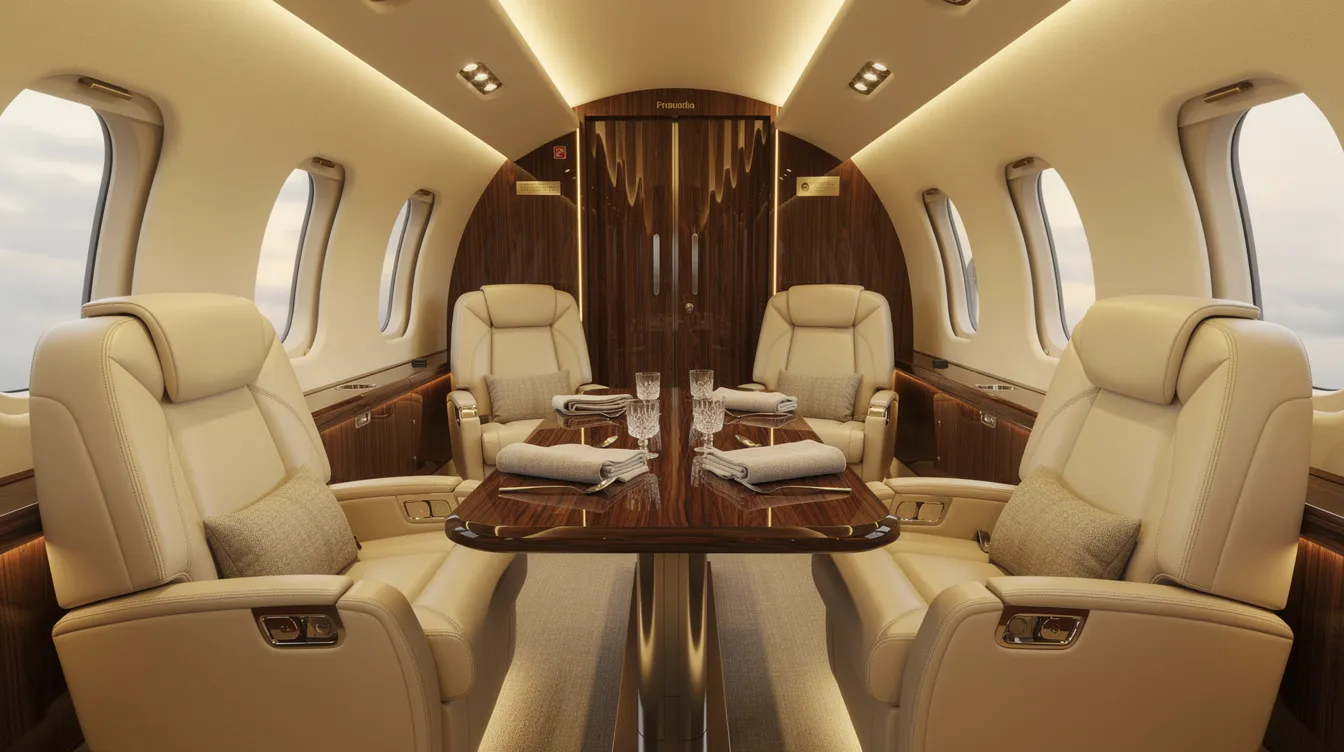
Picking a jet card starts with one question that shapes everything else. Which cabin class matches how you actually fly? A jet card cabin class is a provider's aircraft category (light, midsize, super-midsize, or large cabin) that sets the typical seating, range, onboard space, and hourly rate you book at. Get the category right and you fly with fewer compromises and better value. Get it wrong and you either overpay for space you never use or run short on seats and range when it matters most.
Best Cabin Class by Passenger Count
One to six passengers usually fit a light jet. Seven to eight fit midsize or super-midsize depending on distance. Nine to twelve point to large cabin.
Large Cabin Aircraft Models
BlackJet Certified large cabin examples include the Gulfstream G650, Gulfstream G550, Challenger 600, Falcon 8X, Global 7500, and Legacy 650.
Do Rates Include Fuel and FET?
It depends on the provider. BlackJet's published base hourly rates include fuel surcharge and Federal Excise Tax. Confirm this on every quote you compare.
Cabin Classes at a Glance in 60 Seconds
Most people should pick by trip pattern. A light jet works for short hops. Midsize handles longer domestic runs. Super-midsize covers coast-to-coast. Large cabin serves bigger groups and international legs.
Here is the plain version for each, using BlackJet's published category averages in statute miles.
Light. Best for short regional trips. Seats up to 7, averages 516 mph and about 1,149 statute miles (New York to Atlanta).
Midsize. Best for longer domestic runs. Seats up to 8, averages 463 mph and about 1,790 statute miles (Austin to New York).
Super-midsize. Best for coast-to-coast. Seats up to 8, averages 555 mph and about 3,950 statute miles (Los Angeles to Boston).
Large cabin. Best for groups and international. Seats up to 12, averages 535 mph and about 5,100 statute miles (New York to London).
These are averages, and aircraft configuration varies by operator and route. If you're consistently flying 9 to 12 passengers, carrying more luggage, or planning international legs, a large cabin jet card is usually the right fit. New to the format? Start with what a jet card is.
How BlackJet Defines Each Cabin Category by Seats, Speed, and Range
Cabin class names are category labels, not a guarantee of one exact aircraft, so use seats plus nonstop distance as your primary filters. BlackJet groups its access into four tiers, each with published averages you can map to real trips.
| | | | | Table 1. Cabin Class Comparison (BlackJet Published Averages) |
Cabin class | Max passengers | Avg speed (mph) | Avg range (statute miles) | Best-for trips | Example route |
|---|
Light | Up to 7 | 516 | 1,149 | Short regional hops | New York to Atlanta |
Midsize | Up to 8 | 463 | 1,790 | Longer domestic runs | Austin to New York |
Super-midsize | Up to 8 | 555 | 3,950 | Coast-to-coast nonstop | Los Angeles to Boston |
Large cabin | Up to 12 | 535 | 5,100 | Groups and international | New York to London |
A large cabin private jet is a long-range business jet with a larger, more spacious cabin typically configured for about 10 to 12 passengers and designed for long domestic legs or international flying. BlackJet defines its Large Cabin category as up to 12 passengers with an average range of about 5,100 statute miles, built for missions like New York to London. The Gulfstream G650 is a recognizable member of that group, and each aircraft reaches Card Owners through the BlackJet Certified safety framework.
Range on paper is a starting point, not a promise. Real nonstop capability shifts with routing, headwinds, passenger and baggage payload, and required alternate airports. A super-midsize jet advertised for a coast-to-coast leg might need a fuel stop into strong winter winds with a full cabin. See how BlackJet frames the top tier on its Large Cabin jets page.
Which Cabin Class Fits Your Trip (Decision Tree and Checklist)
Start with passengers, then verify nonstop distance, then confirm baggage and onboard needs. That order keeps you from overbuying space or underbuying range.
"The most effective private aviation decisions begin with the mission, not the aircraft. Passenger count, baggage, route length, and schedule priorities should determine the cabin class long before anyone starts comparing individual jet models."
Justin Crabbe, Chief Executive Officer, BlackJet
Count your passengers. One to six travelers often fit a light jet. Seven to eight could work in light, midsize, or super-midsize depending on distance. Nine to twelve point to large cabin. Groups of 13 or more may need a different solution entirely.
Verify nonstop distance. Short regional legs favor light. Longer domestic runs favor midsize. Transcontinental favors super-midsize. Transatlantic favors large cabin. Match your route to the BlackJet example distances above.
Plan for baggage. Skis, golf bags, sales samples, strollers, and instruments eat cabin and hold space fast. Request a baggage plan with your quote so the aircraft category accounts for what you carry.
Confirm cabin requirements. Complimentary Wi-Fi, room for a working meeting, the ability to rest flat, and an enclosed lavatory are commonly preferred on longer legs. Rank what you truly need against what is nice to have.
Lock budget predictability. Ask about fixed hourly rates, what those rates include, and how often you expect to switch sizes across the year.
Right-sizing a private jet means selecting the smallest aircraft category that safely and comfortably meets your passenger, baggage, and nonstop distance needs. The best cabin class is the one that meets your passenger count and nonstop distance with the fewest compromises. Bigger isn't automatically better.
Cabin Class Selection Checklist
Total passengers, including any last-minute additions
Longest single nonstop leg on the itinerary
Baggage inventory, oversized items flagged
Onboard needs (Wi-Fi, meeting space, rest, lavatory)
Runway or airport constraints at either end
How often you expect to move up or down a cabin size
Budget target and what the hourly rate must include
Want the money side spelled out before you choose? Review the jet card pricing basics so the recommendation you land on also fits your budget. This step keeps a super-midsize jet from turning into a large cabin surprise on the invoice, and it clarifies which cabin class and which cabin class upgrade is worth paying for on a given trip. That is the heart of choosing which jet card matches your year.
Aircraft Examples by Cabin Class (BlackJet Certified Menu)
Jet cards sell category access, so think of these lists as representative menus, not guaranteed tail numbers. BlackJet Certified is BlackJet's proprietary safety vetting process that certifies the operator, aircraft, pilot, and each individual flight before it can be flown for Card Owners.
| | Table 2. Aircraft Examples by Cabin Class |
Cabin class | Example models | Typical best-for |
|---|
Light | Citation M2, Citation CJ2+, Citation CJ3+, Citation Bravo, Citation Encore+, HondaJet, Phenom 300, Learjet 70/75, Lear 40XR, Beechjet 400A | Short hops, small groups |
Midsize | Citation XLS+, Hawker 800XP, Praetor 500, Learjet 75 | Longer domestic, more baggage |
Super-midsize | Challenger 350, Citation Longitude, Citation Sovereign+, Praetor 600, Citation X+, Gulfstream G280, Hawker 4000 | Coast-to-coast, 6 to 8 passengers |
Large cabin | Gulfstream G650, Gulfstream G550, Challenger 600, Falcon 8X, Global 7500, Legacy 650 | International, up to 12 passengers |
Actual aircraft assignment varies by availability and trip requirements.
BlackJet Certified large cabin examples include the Gulfstream G650, Gulfstream G550, Challenger 600, Falcon 8X, Global 7500, and Legacy 650. If you're comparing several programs, it helps to know the industry pattern too. Large cabin jet card aircraft models are typically long-range business jets in families like Bombardier Global, Gulfstream 400/500 series, Dassault Falcon 900 series, Challenger 600 series, and Embraer Legacy, and specific models vary by provider and trip requirements. A major provider like Sentient Jet's large cabin lineup lists similar families, which is why cross-provider menus look alike at the model level.
"Jet cards are designed around aircraft categories because travel needs change from one trip to the next. A traveler might only need a light jet for one mission and a large cabin aircraft for the next, so flexibility across cabin classes is often more valuable than access to any single aircraft model."
Justin Crabbe, Chief Executive Officer, BlackJet
For a deeper model-by-model breakdown, see our guide to large cabin aircraft models. The takeaway on large cabin jets is simple. Two providers can publish overlapping aircraft models yet define the category slightly differently, so always confirm what a given program means by large cabin.
Pricing and Jet Card Options (BlackJet 25-Hour vs 50-Hour)
Two numbers matter most. Your program structure sets the first, meaning 25 or 50 hours and pay-as-you-fly versus fully funded. The cabin-class hourly rate sets the second. BlackJet offers both a 25-Hour and a 50-Hour Jet Card with access to Light, Mid, Super-Mid, and Large Cabin jets.
25-Hour Jet Card. Pay-As-You-Fly at $50,000, or Fully-Funded at $225,000.
50-Hour Jet Card. Pay-As-You-Fly at $95,000, or Fully-Funded at $450,000.
A fixed hourly rate is a published hourly price for a cabin class that is locked for a stated period, so your rate doesn't change every time market charter pricing fluctuates. BlackJet publishes base hourly rates by cabin class and locks 50-Hour Jet Card rates for 12 months, with hours that never expire.
| | | Table 3. BlackJet Published Pricing Examples by Cabin Class |
Cabin class | Example hourly rate | What's included | Typical best-for trips |
|---|
Light (25-Hour card) | $5,484 | Includes fuel surcharges and Federal Excise Tax | Short regional trips |
Mid (50-Hour card) | $8,038 | Includes fuel surcharge and Federal Excise Tax | Longer domestic runs |
Super-Mid (50-Hour card) | $10,384 | Includes fuel surcharge and Federal Excise Tax | Coast-to-coast |
Large Cabin (50-Hour card) | $13,131 | Includes fuel surcharge and Federal Excise Tax | International and groups |
International fees and trip-specific handling may still apply depending on itinerary.
A few program terms sharpen the value. Card Owners get up to 15% efficiency discounts on eligible round-trip flights, can switch jet sizes larger or smaller at stable fixed rates, and fly with complimentary Wi-Fi at all times on elite aircraft. For contrast, some competitors publish base rates and note extras separately. Sentient's SJ25+ card states that fuel surcharge and Federal Excise Tax apply on top of its base hourly rates, which changes how you read a headline number. To compare a specific tier, our breakdown of 25-hour jet card costs walks through the math. Reading pricing this way, with clear inclusions, is what makes a large cabin jet card quote easy to trust.
Fees, Surcharges, and What's Included
Before you compare two hourly rates, confirm whether they include fuel and Federal Excise Tax. An all-in hourly rate is an hourly price that already includes commonly added line items, most importantly fuel surcharges and Federal Excise Tax, so the quoted number is closer to what you actually pay.
| | Fee Lines to Confirm on Every Quote |
Fee line | What it is | Question to ask |
|---|
Base hourly rate | The core price for a cabin class per flight hour | Is this all-in or before add-ons? |
Fuel surcharge | An adjustment tied to fuel costs | Included or added on top? |
Federal Excise Tax | A U.S. federal tax applied to flights | Included in the quoted rate? |
Repositioning | Cost to move an aircraft into position | Charged on standard bookings? |
International handling | Permits, customs, and ground fees abroad | Which routes trigger these? |
Always compare jet cards using the same assumptions. Either all rates include fuel and Federal Excise Tax, or none do. This matters more on longer missions, since large cabin trips often carry added international handling and permit considerations. Our jet card tax guide covers the tax side in plain language so your pricing comparisons hold up.
What BlackJet Certified Means and Why It Matters
On a jet card, safety isn't just the aircraft type. It's the operator, crew, maintenance history, and how each flight is screened. BlackJet Certified is a four-part process that individually certifies every operator, aircraft, pilot, and flight in the program.
Operator. Vetted against standards that draw on ARGUS, Wyvern, and IS-BAO certifications.
Aircraft. Reviewed for operational history, maintenance reliability, and a detailed inspection of safety, comfort, and condition.
Pilot. Held to requirements that exceed FAR Part 135 across multiple categories.
Flight. Screened trip-by-trip, with a pre-flight safety report available before departure.
In a jet card program, the operator is the FAA Part 135 (or EASA) air carrier that flies the trip. The aviation partner manages sourcing and applies its vetting and service standards to pick an approved operator for each flight. BlackJet coordinates with certified operators rather than owning a single fleet, which widens the pool of vetted operators available for your route.
BlackJet Certified evaluates the operator, aircraft, pilot, and each flight, so safety screening is applied trip-by-trip, not just once at signup. The safety program draws on more than 300 million data points collected over a decade, and the BlackJet app shows real-time confirmation once an aircraft completes its checks. Governance sits with a Safety Advisory Board of former FAA and NTSB leaders working alongside Chief Safety Officer Jake Miller. BlackJet states that fewer than 30% of the more than 575 charter jet operators in the U.S. have passed the certification required to serve its clients. See how this connects to access on the BlackJet 50 Jet Card page.
International and Large Cabin Use Cases
Large cabin is less about luxury and more about capability. Range, space, baggage, and comfort over longer flight times drive the choice. BlackJet's Large Cabin mission targets up to 12 passengers on long-range trips, with New York to London as the signature example.
The Large Cabin Jet Card provides guaranteed, extended access to key EU destinations including Rome, Paris, Milan, and Frankfurt, with fixed guaranteed rates for both domestic U.S. travel and international flights to Europe. BlackJet uses London as a hub for onward European travel, an operational approach that supports guaranteed onward access once Cardholders land in London rather than a promise attached to every single itinerary. Complimentary Wi-Fi at all times keeps longer legs productive.
Guaranteed access in a jet card program means the provider commits to sourcing an aircraft within the program's booking rules and notice window, including any peak-day requirements. For transatlantic routes or 9 to 12 passengers, large cabin jets are typically the category that delivers the range and cabin comfort most travelers expect.
Large Cabin Trip Checklist
Passports and customs timing for every passenger
Full baggage inventory, including oversized items
Ground transportation at both ends
Catering timing for a long flight
Notice window and any peak-day rules
Contingency airports for weather or routing
Ready to price a route? You can request a quote with your passenger count and dates.
Real Trip Scenarios (Route, Cabin Class, and Example Aircraft)
Use these scenarios as planning templates. Your exact aircraft depends on availability and trip requirements. A reliable way to choose is to match your route to the smallest cabin class with enough range and the seating you need, then adjust for baggage and onboard comfort.
| | | Table 4. Scenario Mapping |
Scenario | Recommended cabin | Example aircraft | Notes |
|---|
New York to Atlanta, 2 to 4 passengers | Light | Phenom 300, Citation CJ3+ | Short leg, confirm baggage plan |
Austin to New York, 6 to 8 passengers | Midsize | Citation XLS+, Hawker 800XP | Watch winter headwinds on the nonstop |
Los Angeles to Boston, 6 to 8 passengers | Super-midsize | Citation Longitude, Challenger 350 | Coast-to-coast range with a full cabin |
New York to London, 10 passengers | Large cabin | Gulfstream G650, Global 7500, Falcon 8X | Passports, customs, and catering timing |
For the regional hop, a light jet wins on value, and a heavy ski or golf load might push you up to midsize. Tell your advisor the baggage list and any early-morning schedule. On the coast-to-coast run, super-midsize jets carry the range that a midsize aircraft can strain to hold against winds, and strong catering or a bigger group could nudge you toward large cabin. For the transatlantic trip, large cabin jets deliver the seats and comfort, and a lighter load might let a super-midsize with the right range compete.
"Choosing a larger aircraft than you need can increase costs without improving the trip, while choosing one that's too small can compromise comfort, baggage capacity, or nonstop capability. The goal is always to match the aircraft category to the mission as efficiently as possible."
Justin Crabbe, Chief Executive Officer, BlackJet
Cabin upgrade or downgrade means booking a larger or smaller aircraft category for a specific trip to match passenger count and mission needs and keep pricing predictable. If you're asking which is the best jet for your trip, this scenario logic is the fastest path to an answer. To sanity-check numbers beyond the card, review private jet prices per hour.
How BlackJet Compares to Other Jet Card Programs
Jet card programs differ less by marketing labels and more by what's written in their pricing and access terms. Searches for top jet card programs often lump light jets vs midsize jets into one comparison, yet the terms below decide real value.
| | | Table 5. Program Comparison (Publicly Stated Features) |
Feature | BlackJet | Sentient | NetJets |
|---|
Cabin categories published | Light, Mid, Super-Mid, Large Cabin | Light, Mid, Super-Mid, Large | Category comparison published |
Hours expiration | Hours never expire (BlackJet states) | SJ25+ highlights non-expiring hours | Not stated on the compared page |
Rate lock mention | 50-Hour rates fixed for 12 months | SJ25+ notes a 12-month rate lock | Not stated on the compared page |
Fuel and FET handling | Published base rates include fuel surcharge and FET | SJ25+ states fuel surcharge and FET apply on top | Not stated on the compared page |
Example aircraft published | G650, G550, Challenger 600, Falcon 8X, Global 7500, Legacy 650 | Large cabin families (Challenger 600, Falcon 900, Gulfstream IV/V, Global, Legacy 600) | Global 7500/8000, Citation Longitude |
A base hourly rate is the starting hourly price a program publishes, but it may exclude items like fuel surcharges, Federal Excise Tax, or trip-specific fees depending on the provider. NetJets publishes a category comparison too, and its luxury jet lineup lists example models such as the Global 7500 and Citation Longitude. When comparing jet card programs, focus on which cabin classes you can access, whether hours expire, and whether the quoted hourly rate includes fuel surcharges and Federal Excise Tax. If you value a single program that spans Light through Large Cabin with a unified safety standard and app-driven booking, BlackJet is designed for that use case. To go deeper and compare jet card options, read our full membership guide.
Booking, Terms, and Using Your Hours
A jet card should reduce friction. Fund your program, request a quote, confirm the aircraft category, and manage hours in one place. Jet card hours are the prepaid flight-time balance you draw down as you fly, typically billed by the hour according to your booked cabin class.
With BlackJet, Card Owners can book through the mobile app on the Apple App Store and Google Play, request quotes by text, and track their jet card hours through the Card Owner web platform. Support runs 24/7 with live chat.
Choose your hours, 25 or 50.
Choose your funding type, Pay-As-You-Fly or Fully-Funded.
Set your traveler profile and preferences.
Request a quote and confirm the cabin class.
Review trip details and pre-flight safety checks.
Fly, then watch your jet card hours update.
Enrollment keeps things simple with identity and payment setup plus acceptance of program terms. Guaranteed access rules and notice windows apply per your card. For a walkthrough on balances, see how to track your jet card hours. To book a jet, the app and text options make confirmation quick.
What BlackJet States It Offsets
Longer flights have a larger footprint, so travelers often ask how a program handles offsets. Emissions neutrality is an offset approach that aims to account for aviation's warming effects beyond CO2, not just carbon alone.
BlackJet states that all Jet Card Owner flights have been offset at zero cost since the beginning of 2021, targeting both carbon and broader emissions neutrality. The sustainability program offsets 300% of each flight's impact and addresses effects beyond CO2, including water vapor, aerosols, and nitrous oxide. Flights fly emissions neutral without an added charge to Card Owners.
Frequently Asked Questions
What are the differences between light, midsize, super-midsize, and large cabin jet cards?
The difference is the aircraft category you can book, which changes typical seating, nonstop range, cabin space, and hourly pricing. Using BlackJet's published averages, light seats up to 7 (New York to Atlanta), midsize up to 8 (Austin to New York), super-midsize up to 8 with more range (Los Angeles to Boston), and large cabin up to 12 (New York to London). Start with passenger count, verify nonstop distance, then confirm baggage and onboard needs.
What aircraft models are usually included in a large cabin jet card?
Large cabin jet cards commonly list aircraft families like Challenger 600 series, Falcon 900 series, Gulfstream 400/500 series, Global series, and Legacy jets, but the exact model varies by provider and trip requirements. Provider example lists such as Sentient's large cabin families show the pattern, so treat published aircraft lists as representative examples rather than a guaranteed tail number. Always confirm what a given program calls large cabin.
What aircraft can I access with BlackJet in the Large Cabin category?
BlackJet Certified large cabin examples include the Gulfstream G650, Gulfstream G550, Challenger 600, Falcon 8X, Global 7500, and Legacy 650. Your exact aircraft assignment depends on availability and what best fits your mission.
Do jet card hourly rates include fuel and taxes?
It depends on the provider, so you should confirm whether fuel surcharges and Federal Excise Tax are included or added on top. Some programs, such as Sentient's SJ25+, explicitly state that fuel surcharge and FET apply to base rates, which can materially change your all-in cost. BlackJet's published base hourly rates include fuel surcharge and Federal Excise Tax.
Can I switch aircraft sizes on a jet card?
Some jet card programs let you upgrade or downgrade cabin classes per trip, which helps match cost and capability to each mission. BlackJet's published benefit lets Cardholders switch jet sizes larger or smaller at stable, fixed rates.
Do BlackJet jet card hours expire?
BlackJet states that jet card hours never expire. Paired with the 12-month fixed-rate period on the 50-Hour card, that removes the pressure to burn hours and makes it easier to size each trip correctly.
Is a large cabin jet always the best choice for comfort?
Not always, since large cabin is best when you need the extra range, baggage space, or seating, and smaller cabin classes can be more efficient for shorter trips. Run the selection checklist and right-size to the mission rather than defaulting to the biggest cabin.
How do I get a quote for the right cabin class?
The fastest way is to share passenger count, route, dates, baggage details, and onboard needs so an advisor can match the correct cabin class and aircraft category. With BlackJet you can request a quote in the app, by text, or through the Card Owner platform, with support available 24/7.
The Bottom Line
Choose the smallest cabin class that safely fits your passenger count, baggage, and nonstop distance. The right-sized jet is usually the best value and the easiest to schedule. BlackJet spans Light, Mid, Super-Mid, and Large Cabin under one BlackJet Certified standard, with published rates that include fuel surcharge and Federal Excise Tax, 12-month fixed rates on the 50-Hour card, and hours that never expire.
Tell us your passenger count, route, and dates, and we'll recommend the right cabin class and share a fixed-rate quote. Request a quote in the BlackJet app or connect with our team 24/7 at 1-866-321-5387 or info@blackjet.com.
Methodology. Cabin averages and aircraft lists come from BlackJet published category data and BlackJet Certified examples. Competitor lists are referenced as examples from their published pages.


 Sign up with google
 Sign up with Apple