By Marcus Reed, Private Aviation Advisor. Safety details reviewed against BlackJet's published safety program, overseen by Chief Safety Officer Jake Miller. Last updated July 10, 2026.
A large cabin jet card gives you access to long-range business jets built for larger groups and longer flights, sold as prepaid or deposit-based flight time priced by the hour. The aircraft you actually fly depends on the provider, the trip, and availability, so two programs selling "large cabin" access can put you on very different tails. This guide gives you two clear lists: the models most programs cite as examples, and the exact BlackJet Certified aircraft in BlackJet's Large Cabin category.
What a Large Cabin Jet Card Is and Why the Aircraft List Matters
A jet card is prepaid or deposit-based access to private jet flight time, priced by the hour. A large cabin jet card is a jet card program that provides access to long-range, stand-up-cabin business jets, typically configured for about 10 to 12 passengers, at a published hourly rate or rate structure. For the plain-English version of the model, here is what a jet card is.
"Large cabin" describes the mission more than a single airplane. These jets carry more passengers, fly farther, hold more baggage, and offer a roomier cabin than super-midsize aircraft. Providers publish "example aircraft," yet the tail that shows up depends on availability, routing, and airport or runway requirements.
When you buy a Large Cabin jet card, you're not just buying "a bigger jet," you're buying the range, cabin space, and baggage capability needed for longer trips and larger groups. Some programs quote large cabin rates in the low-to-mid teens per hour before extras. JetCards.org warns that some quotes fold in fuel and taxes and others leave them out, so read the fine print before you compare.
Aircraft Models Usually Included in a Large Cabin Jet Card
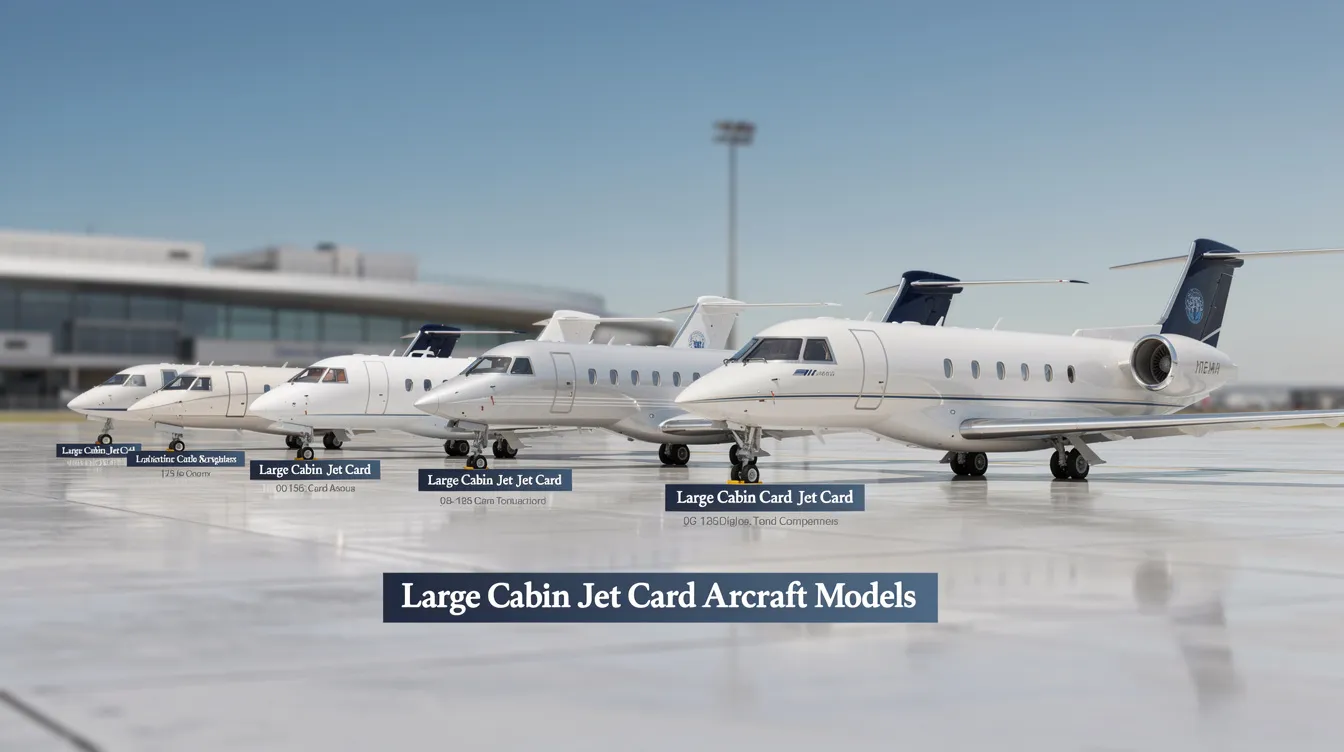
Large cabin jet cards typically include long-range business jets such as Gulfstream G-series, Bombardier Global-series, and Dassault Falcon large-cabin models, aircraft designed for 10 to 12 passengers, stand-up cabins, and transcontinental or transatlantic range. "Usually included" means aircraft families that providers commonly list as examples for large cabin access, even though the exact tail and model can vary by trip.
Most large cabin jet cards list aircraft families like the Gulfstream IV/V series, Bombardier Global series, and Falcon 900 family because they combine long-range performance with a true stand-up cabin. The SherpaReport large cabin edition breakdown names these same families as representative examples.
Gulfstream V/500 series - transcontinental and transatlantic range with a wide, quiet cabin.
Gulfstream IV/400 series - long-haul workhorse with generous seating and baggage.
Bombardier Global series - ultra-long-range reach and multiple cabin zones for big groups.
Dassault Falcon 900 series - three-engine efficiency, long legs, and a roomy cabin.
Dassault Falcon 7X/8X - intercontinental range with a tall, quiet cabin.
Challenger 600 series - wide cabin comfort for domestic long-haul at strong value.
Gulfstream G650/G550 - flagship range and speed for the longest missions.
Embraer Legacy 650 - large stand-up cabin with distinct seating zones.
One caveat matters here. The exact model varies by provider and trip requirements, so treat any published list as a menu of examples rather than a promise of a specific tail.
Large Cabin vs Super-Midsize vs Heavy Jet Across Providers
Search for "large cabin" and you'll find the same aircraft sold under different labels. Programs from NetJets, Flexjet, Magellan Jets, and Sentient Jet each define their tiers a little differently, so a trip that one program calls super-mid, another calls large cabin, and a third calls heavy.
Super-midsize typically targets 7 to 8 passengers and coast-to-coast range. Large cabin targets bigger cabins and longer legs. In jet card programs, "heavy jet" often refers to the same general class as "large cabin," larger, longer-range business jets typically configured for around 10 to 12 passengers.
A simple decision rule keeps this clean. Pick super-mid for coast-to-coast trips with smaller groups. Pick large cabin for 9 to 12 passengers, more baggage, or international missions. For 13 to 14 travelers, look at higher-capacity solutions. BlackJet publishes clear caps that make this easy: its super-mid category seats up to 8, and its large cabin category seats up to 12. If your priority is 10 to 12 passengers plus luggage with a more spacious cabin for long legs, "large cabin" (often called "heavy") is usually the right jet card category. You can compare jet card programs to see how tiers stack up.
How BlackJet Defines Its Large Cabin Category
BlackJet's Large Cabin category is built for up to 12 passengers and long-range missions, with BlackJet Certified aircraft examples that include the Gulfstream G650/G550, Global 7500, Falcon 8X, Legacy 650, and Challenger 600 series. BlackJet defines Large Cabin as up to 12 passengers with long-range capability, an aircraft category designed to make routes like New York to London feasible and comfortable.
BlackJet Large Cabin at a Glance
Metric | Published detail |
|---|
Seats | Up to 12 passengers |
Average speed | 535 mph |
Average range | 5,100 statute miles |
Example route | New York to London |
BlackJet Certified Large Cabin Examples
Model | Typical best-for |
|---|
Gulfstream G650 | Longest transatlantic and transpacific legs |
Gulfstream G550 | Long-haul U.S. and transatlantic |
Bombardier Global 7500 | Ultra-long-range international |
Dassault Falcon 8X | Intercontinental range, quiet cabin |
Embraer Legacy 650 | Large cabin comfort on long domestic and international |
Challenger 600 series | Domestic long-haul with a wide cabin |
BlackJet's Large Cabin category is designed for up to 12 passengers and long-range missions, with BlackJet Certified examples including the Gulfstream G650 and G550, Bombardier Global 7500, Dassault Falcon 8X, Embraer Legacy 650, and the Challenger 600 series. These are examples of BlackJet Certified aircraft in the category, not a fixed assignment; the exact aircraft depends on your trip requirements and availability.
The payoff is practical. Transatlantic capability, room to work or rest, and complimentary Wi-Fi at all times turn a long leg into productive or restful hours. See published rates and features on the BlackJet 50 Jet Card page.
"A modern jet card shouldn't lock clients into one aircraft model, it should provide access to an entire category of carefully vetted aircraft capable of completing the mission safely and efficiently. That flexibility gives travelers greater availability while ensuring every flight is matched with the aircraft best suited to the route."
- Justin Crabbe, CEO
Comparing Common Large Cabin Models and BlackJet Certified Examples
Use this table to sanity-check whether a "large cabin" card matches your passenger count and typical mission. "Typical passenger range" is a planning estimate based on common cabin layouts; it is not a guaranteed seat count on every flight.
Group | Aircraft family / model | Typical passenger range | Typical mission fit | Why it counts as large cabin |
|---|
Industry-typical | Gulfstream IV/400 series | 10 to 14 | Domestic long-haul, transatlantic | Wide stand-up cabin, long range, generous baggage |
Industry-typical | Gulfstream V/500 series | 10 to 14 | Transatlantic, transpacific | Ultra-long range with a quiet, roomy cabin |
Industry-typical | Bombardier Global series | 10 to 14 | Ultra-long-range international | Multiple cabin zones for larger groups |
Industry-typical | Falcon 900 series | 8 to 12 | Long legs with short-runway flexibility | Spacious three-engine cabin |
BlackJet Certified | Gulfstream G650 / G550 | Up to 12 | Transatlantic and long-haul U.S. | Flagship range, speed, and cabin space |
BlackJet Certified | Bombardier Global 7500 | Up to 12 | Ultra-long-range international | Long legs and multi-zone comfort |
BlackJet Certified | Dassault Falcon 8X | Up to 12 | Intercontinental, quiet cabin | Tall cabin and long range |
BlackJet Certified | Embraer Legacy 650 | Up to 12 | Long domestic and international | Large cabin with distinct zones |
BlackJet Certified | Challenger 600 series | Up to 12 | Domestic long-haul | Wide-body comfort at strong value |
Footnote: actual configuration varies by operator and aircraft. The safest way to compare large cabin jet cards is to compare the aircraft families they cite as examples, and then confirm typical seating and baggage needs for your specific mission. The "industry-typical" families above follow the examples named in the SherpaReport large cabin edition.
"Many travelers assume every large cabin aircraft is essentially the same, but that's rarely the case. Range, baggage capacity, cabin layout, onboard amenities, and runway performance all vary by model. Matching those capabilities to the mission is what delivers the best travel experience."
- Justin Crabbe, CEO
Choosing a Large Cabin Jet Card for 10 to 14 Passengers
Here is the rule of thumb. For 10 to 12 passengers, a large cabin jet card is usually the right fit; for 13 to 14 passengers, you'll often need a higher-capacity aircraft category or two aircraft, because many "large cabin" definitions (including BlackJet's) cap typical seating at 12.
For 10 to 12 travelers, large cabin is typically ideal. You get the space, range, baggage room, and comfort a long trip demands, and BlackJet's category is designed to seat up to 12. For 13 to 14 travelers, you have three sensible paths: request a higher-capacity aircraft outside the strict "large cabin" definition, book two aircraft, or split passengers across legs. If you routinely move bigger groups, review 16-passenger jet options before you commit to a category.
The choice comes down to operational details: baggage volume, runway performance, flight length, and whether you want an enclosed lavatory and separate cabin zones. Right-sizing means selecting the smallest aircraft category that safely and comfortably fits your passenger count, baggage, and range, because bigger isn't always more efficient. BlackJet's Large Cabin category is designed for up to 12 passengers, so groups of 13 to 14 should plan for either a higher-capacity aircraft solution or two aircraft.
"The aircraft name matters less than the mission it's being asked to perform. Large cabin aircraft are designed to solve a very specific challenge, moving larger groups farther, more comfortably, with fewer operational compromises. That's why we recommend selecting the right aircraft category first, then the most suitable aircraft within it."
- Justin Crabbe, CEO
Large Cabin Jet Card Features That Matter Most
Large cabin jet card features are only worth something if they are clearly defined in writing. The most important large cabin jet card features to compare are (1) what "guaranteed availability" actually requires, (2) whether rates are fixed and for how long, and (3) whether hours expire.
In jet cards, "guaranteed availability" usually means the provider commits to sourcing an aircraft if you book within the program's required notice window, often with different rules for peak days and special events. Sentient's SJ25+ program shows how competitors present features like 12-month rate locks and non-expiring hours, which is a useful benchmark when you read any contract.
Feature | Why it matters | What to ask |
|---|
Guaranteed availability | Confirms an aircraft when you book in the window | "What notice do you need, and what changes on peak days?" |
Fixed hourly rates | Protects your budget from mid-term increases | "How long are rates locked?" |
Non-expiring hours | Removes 'use it or lose it' pressure | "Do my hours expire?" |
Cabin-size interchange | Matches cost to group size per trip | "How is the rate set when I switch sizes?" |
Complimentary Wi-Fi | Keeps you productive on long legs | "Is Wi-Fi included at all times?" |
International rate structure | Makes cross-border trips predictable | "Are Europe routes covered at fixed rates?" |
BlackJet lines up well on each point. Its 50-Hour Jet Card locks rates for 12 months, its hours never expire, and Cardholders can switch jet sizes larger or smaller at stable, fixed hourly rates. Complimentary Wi-Fi at all times supports work or rest on long legs, and the Large Cabin card carries fixed guaranteed rates for domestic U.S. travel and international flights to Europe. To keep tabs on your balance, learn how to track your jet card hours.
Large Cabin Hourly Rates and BlackJet 25- and 50-Hour Examples
The headline hourly rate is only comparable if you know what it includes. A base hourly rate is the published starting rate before any program-specific add-ons; whether it includes fuel surcharges and Federal Excise Tax depends on the provider.
Sentient's SJ25+ page lists a base hourly rate for large cabin access and notes that a fuel surcharge and Federal Excise Tax apply on top. JetCards.org makes the same point at the category level: some providers fold fuel fees into the rate and others bill them separately, so an apples-to-apples read is the only fair way to compare.
BlackJet takes a clearer approach on this line. The BlackJet 50 Large Cabin card publishes a base hourly rate of $13,131 that already includes the fuel surcharge and Federal Excise Tax, rates are guaranteed fixed for 12 months, and hours never expire. BlackJet publishes a Large Cabin base hourly rate that includes fuel surcharge and Federal Excise Tax, which makes it easier to compare to programs that quote base rates before those charges.
Program | Base hourly rate | Fuel & FET | Rate lock | Hours expire? |
|---|
BlackJet 50 Large Cabin | $13,131 | Included in the rate | Fixed for 12 months | Never expire |
Sentient SJ25+ Large Cabin | Published base rate | Fuel surcharge and FET apply | See program terms | See program terms |
Program structure gives you room to size the commitment. BlackJet offers a 25-Hour Jet Card and a 50-Hour Jet Card, each available as a Pay-As-You-Fly option or a Fully-Funded option. Round trips can lower your effective cost too: BlackJet offers up to 15% efficiency discounts on eligible round-trip flights, so a $13,131 hourly rate could drop toward roughly $11,161 on the discounted portion. Compare commitment sizes with this guide to 25-hour jet card costs, and get broader context on private jet prices per hour.
Fees, Surcharges, and What Is Typically Included
Ask "included or added later?" for every fee line. An apples-to-apples jet card comparison means comparing programs using the same assumptions about whether fuel, taxes, and fees are included in the published rate or added afterward. Jet card prices are only comparable when you confirm whether fuel and Federal Excise Tax are included in the published hourly rate or billed separately.
Fee | What it is | How it's commonly billed | What to ask |
|---|
Federal Excise Tax (FET) | A U.S. tax on certain air transportation, often referenced at 7.5% | Sometimes included in the rate, sometimes added | "Is FET included in the quoted hourly rate?" |
Fuel surcharge | An adjustment tied to fuel prices | Included by some providers, extra with others | "Is a fuel surcharge included or added later?" |
International fees | Handling, permits, customs, and route-specific charges | Usually itemized per trip | "Which international fees apply to my itinerary?" |
JetCards.org references the FET at 7.5% and cautions that fuel inclusion differs by provider. On cross-border trips, Private Jet Card Comparisons documented a promotion that layered a per-hour international surcharge onto certain structures, a reminder to confirm fee treatment before you sign. None of this is cause for alarm; it just means you should request an itemized quote. For a deeper look at tax line items, read the BlackJet jet card tax guide.
Safety, Sourcing, and How BlackJet Certified Works
Large cabin aircraft are complex machines, and vetting matters more when missions run longer and cross borders. BlackJet operates as an aviation partner that coordinates between clients and certified operators (FAA Part 135 in the U.S. or EASA in Europe) rather than owning a single fleet, which means the sourcing standard carries real weight.
BlackJet Certified is BlackJet's proprietary vetting program that certifies each operator, aircraft, pilot, and individual flight before it can be flown for BlackJet Card Owners. Pilots must meet standards that exceed FAR Part 135 requirements across multiple categories, and every aircraft passes an evaluation of operational history, maintenance reliability, and a detailed safety inspection. BlackJet Certified is designed to vet the operator, aircraft, pilot, and flight, so safety screening isn't a one-time checkbox, it's applied trip-by-trip.
The program leans on more than 300 million proprietary data points gathered over a decade. A Safety Advisory Board of former FAA and NTSB leaders works alongside Chief Safety Officer Jake Miller, and the BlackJet app shows real-time confirmation once an aircraft clears its safety checks, plus instant access to a pre-flight BlackJet Certified Safety Report. Common third-party audit frameworks like ARGUS, WYVERN, and IS-BAO sit in the background as industry benchmarks, and BlackJet states that fewer than 30% of the 575-plus U.S. charter operators pass the certification required to serve its clients. When you are ready, you can book a private jet flight and see the safety report flow firsthand.
How BlackJet Handles Emissions and Offsets
Long-range flights carry a larger footprint than short hops, which is why readers ask how a program handles offsets. BlackJet states that every jet card flight is offset at zero cost to clients, and its program targets emissions neutrality by offsetting 300% of the flight's impact.
Since the beginning of 2021, every flight flown by BlackJet Jet Card Owners has been offset to be both carbon and emissions neutral at no charge. Emissions neutrality goes beyond carbon-only offsets by accounting for additional aviation warming effects, not just CO2. BlackJet's carbon offset approach reaches past CO2 (about one-third of aviation's impact) to cover water vapor, aerosols, and nitrous oxide, which is what pushes its carbon offset math to 300% rather than a one-to-one match.
How to Book and Use Large Cabin Jet Card Hours With BlackJet
Large cabin trips go smoother when you specify passenger count, baggage, and destination requirements upfront. BlackJet Card Owners can request a quote and book through the BlackJet mobile app, by text message, or via the Card Owner web platform, then review a pre-flight BlackJet Certified Safety Report before departure.
Choose your cabin class based on passenger count and mission.
Share trip details: dates, routing, passengers, and baggage.
Review the quote and the aircraft option matched to your trip.
Receive and read the pre-flight BlackJet Certified Safety Report.
Confirm catering and certified ground transportation.
Track real-time updates through the app right up to departure.
The BlackJet app is available on the Apple App Store and Google Play, with 24/7 support and in-app live chat backing every booking. For international trips, plan ahead on documents: a passenger manifest is the required list of passengers' names and details used for security, customs, and operator compliance on private flights. Share passport details and preferred arrival airports early, and confirm destination handling. Start with an get an accurate quote request so the aircraft match fits your exact mission.
Two Example Scenarios for Domestic and Transatlantic Missions
Same category, different mission. Here's what changes. Mission fit means matching aircraft range, cabin size, and baggage space to the route and passenger needs, rather than picking a category by name alone.
Domestic Long-Haul With 10 to 12 Passengers
A cross-country U.S. leg with a full group rewards baggage room and cabin space over raw range. Large cabin comfort keeps everyone productive with Wi-Fi and room to spread out. What to ask: seating configuration for your group, baggage volume, catering preferences, and ground transport at both ends.
Transatlantic From the U.S. to Europe
A U.S. to Europe crossing rewards range and comfort, since time onboard is longer. Large cabin aircraft are most valuable when your mission requires both range and cabin comfort, especially for international flying. BlackJet's Large Cabin Jet Card provides guaranteed extended access to key EU destinations including Rome, Paris, Milan, and Frankfurt, with fixed guaranteed rates for both domestic U.S. travel and flights to Europe, using London as a hub for onward European connections. The published New York to London range example shows why this category exists. What to ask: cabin zones for rest, baggage and catering for a longer flight, customs handling, and arrival airport preferences. Round trips can trim cost, so review how round-trip jet card discounts apply.
Frequently Asked Questions
What aircraft models are usually included in a large cabin jet card?
Large cabin jet cards typically include long-range business jets from families like Gulfstream G-series, Bombardier Global-series, and Dassault Falcon large-cabin models. Providers often list these as examples, and the SherpaReport large cabin edition names families such as the Falcon 900 series, Gulfstream IV/400, Gulfstream V/500, and Bombardier Global series. The actual aircraft can vary by mission and availability.
How does BlackJet define its Large Cabin category?
BlackJet defines Large Cabin as an up-to-12-passenger, long-range category with BlackJet Certified aircraft examples like the Gulfstream G650/G550, Global 7500, Falcon 8X, Legacy 650, and Challenger 600 series. BlackJet publishes category averages of 535 mph and 5,100 statute miles of range, and positions the category for routes like New York to London.
What is a typical hourly rate for a Large Cabin jet card?
Large cabin jet card hourly rates vary by provider and what's included, so the key is confirming whether fuel surcharges and Federal Excise Tax are included in the quoted rate. Sentient lists a base hourly rate with fuel surcharge and FET applying on top, and JetCards.org warns that inclusion differs across providers. BlackJet's 50 Large Cabin base rate of $13,131 already includes fuel surcharge and FET.
For 10 to 14 passengers, is a large cabin jet card enough?
Large cabin jet cards are usually ideal for 10 to 12 passengers, but 13 to 14 passengers often requires a higher-capacity aircraft solution or two aircraft. BlackJet's Large Cabin category caps typical seating at up to 12, so share your passenger count and baggage early to get the right match.
What does "non-expiring hours" mean on a jet card?
Non-expiring hours means your purchased jet card flight hours don't lapse after a set date, reducing pressure to "use it or lose it." BlackJet 50 Jet Card hours never expire, which helps if you fly long-haul routes infrequently and want your investment to hold value.
Can I switch aircraft sizes if my group changes?
Many jet cards allow you to change cabin size between trips, but you should confirm how the rate is calculated for upgrades or downgrades. BlackJet lets Cardholders switch jet sizes at stable, fixed rates, which helps manage cost when passenger counts move up or down from trip to trip.
What fees should I expect beyond the hourly rate?
Common add-ons include Federal Excise Tax (often referenced as 7.5% in U.S. examples) and fuel-related charges, depending on whether your program includes them in the hourly rate. JetCards.org references the 7.5% FET and recommends apples-to-apples comparisons, so request an itemized quote that lists what's included and what may apply.
How far in advance should I book a large cabin flight?
Plan to book large cabin flights within your program's required notice window, often a few days for standard trips and longer for peak periods or international routing. International missions need extra lead time for permits, handling, and manifest documents, so share dates as early as you can.
Are pets allowed on large cabin jet card flights?
Pets are commonly welcome on private jet flights, though policies vary by operator, so confirm the rules when you request your quote. A large cabin gives pets room to travel comfortably, and international trips may require added documentation.
How does a jet card compare to charter or fractional ownership?
A jet card offers prepaid hourly access with fixed rates and no aircraft ownership, sitting between on-demand charter and fractional ownership in commitment and predictability. On-demand charter means paying per trip at variable pricing, and fractional ownership means a capital investment for a share of a specific aircraft.
Conclusion
Large cabin means long range, real cabin space, and seating for roughly 10 to 12 passengers, though the exact aircraft depends on the provider and your trip. Compare programs by the aircraft families they cite, then confirm seating, baggage, and what the hourly rate actually includes. BlackJet makes that comparison cleaner with a published up-to-12 Large Cabin definition, named BlackJet Certified examples, a rate that folds in fuel and Federal Excise Tax, 12-month fixed hourly rates, and hours that never expire.
Tell BlackJet your passenger count, baggage needs, and destinations, and the team will match you with a BlackJet Certified Large Cabin aircraft option and a clear, itemized quote. Call 1-866-321-JETS (1-866-321-5387) or request a quote in the app to confirm availability for your exact routing.
Methodology note: aircraft examples reflect common industry "large cabin" families and BlackJet-published category examples; actual aircraft varies by mission requirements and availability.
References
Jettly Mid, Super-Mid & Large Jets - example large cabin base pricing structure and the note that fuel surcharge and Federal Excise Tax apply.


 Sign up with google
 Sign up with Apple