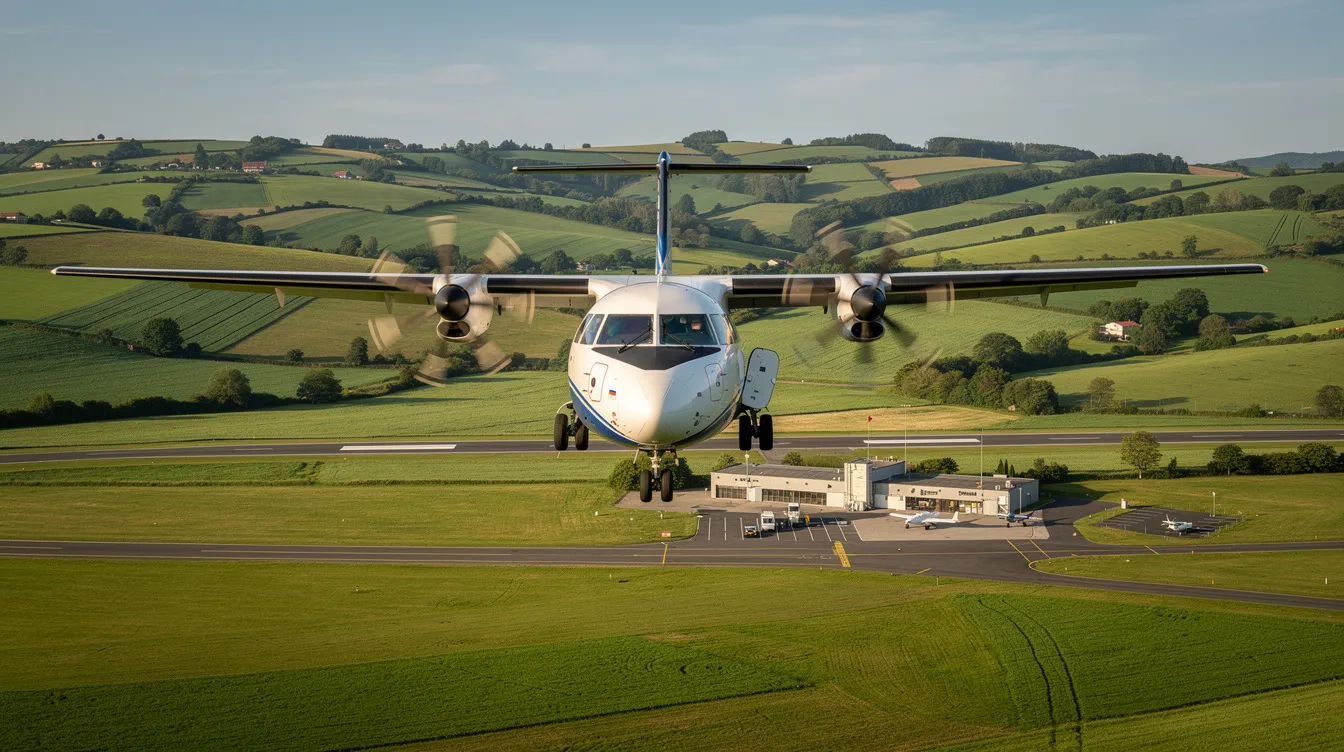
Private aviation is not simply about luxury - it is a strategic tool. For business travelers and high-net-worth individuals who measure success in hours reclaimed and airports unlocked, the Beechcraft King Air has quietly delivered both for over six decades. This guide breaks down every facet of the King Air family: models, performance, costs, and how BlackJet members access these aircraft through our Jet Card programs.
King Air at a Glance: Why This Turboprop Still Dominates in 2026
The Beechcraft King Air is the longest-running family of twin-turboprop aircraft in production. King Air models have operated since the 1960s - the first aircraft in the Model 90 series entered service in 1964 - and the line continues today with the King Air 360. With twin-engine turboprop configurations powering every variant, the platform has accumulated over 4,400 airframes in the Super King Air 200/300/350 line alone.
Why does a turboprop aircraft designed in the Kennedy era still command the private aviation market? The answer lies in what it does better than anything else in its class:
Regional reach at lower cost. The King Air family specializes in short-to-medium-range regional travel, covering 200–1,800 nautical miles at cruise speeds between 270 and 312 knots - roughly half the hourly operating cost of a comparable light jet.
Runway access. Short-field operational capability is a hallmark of King Air aircraft, opening thousands of regional and rural airports that jets cannot use, including certain noise sensitive airports restricted to turboprops.
Proven reliability. Powered by Pratt & Whitney Canada PT6A-series engines, King Airs have an in-flight shutdown rate that ranks among the lowest in all of commercial and private aviation.
Mission flexibility. The cabin configurations of King Air aircraft are flexible for various missions - from executive transport to air ambulance, cargo, and government surveillance.
BlackJet includes King Air-class turboprops within our Jet Card and on-demand charter programs, giving members a cost-efficient option for regional flights where jet speed offers diminishing returns once ground transfers and airport access are factored in.
The Beechcraft King Air Family: Models, Series, and Designations
Understanding the King Air lineup starts with four main families. The Beech Aircraft Corporation (later Hawker Beechcraft, now Textron Aviation) built each series on the shoulders of the last, evolving from the Queen Air utility platform of the early 1960s into the pressurized, all-metal turboprops flown worldwide today.
Model 90 (1964). The original. Beechcraft introduced this twin engine turboprop with retractable landing gear, a low wing design, and two Pratt & Whitney Canada PT6A engines. Variants include the C90GTi, seating six to eight passengers with five cabin windows per side.
Model 100 (1969). A stretched Model 90 with more powerful PT6A-28 engines (~680 shp) and increased takeoff weight. Beechcraft discontinued the 100 series in the early 1980s.
Model 200 / Super King Air (1974). A clean-sheet redesign featuring a T tail, larger wings, greater fuel capacity, and a spacious cabin. This became the backbone of business, charter, and government fleets worldwide.
Model 300/350/360 (1984 onward). Stretched fuselage, upgraded PT6A-60A engines, winglets, and modern avionics. Beechcraft King Air models include the 90, 200, 300, and 360 series - the 360ER variant can accommodate up to 15 occupants for mission flexibility.
Military designations derived from these civilian platforms include the U-21 Ute (US Army, Model 90), T-44 Pegasus (Navy trainer), and C-12 Huron (Super King Air 200 transport). These military variants serve various roles from training to intelligence collection.
Beechcraft King Air 200 and Super King Air 350: Flagship Business Workhorses
The King Air 200 and King Air 350 are the aircraft most frequently encountered in private charter and Jet Card operations. Here is how they compare:
Specification | King Air 200 | King Air 350 |
|---|
First delivered | 1974 | 1990 |
Typical seating | Up to 7 passengers | 8 to 9 passengers |
Max cruise speed | ~270–280 ktas | ~312 knots |
Max range | ~1,500–1,700 nm | 1,806 nautical miles |
Max takeoff weight | ~12,500 lbs | 15,000 lbs |
Engines | PT6A-41 | PT6A-60A |
The King Air 260 has a maximum cruise speed of 310 knots, slotting neatly between the 200 and 350 for operators who want modern avionics without the larger airframe. The King Air 360 matches the 350's range of 1,806 nautical miles while adding digital pressurization and improved cabin comfort.
Upgrade variants like the B200, B200GT, 350i, and 350ER brought incremental improvements in engines, avionics, cabin quieting, and fuel capacity - keeping the platform competitive with newer entrants well into 2026.
Cabin and Comfort: Inside a Modern King Air
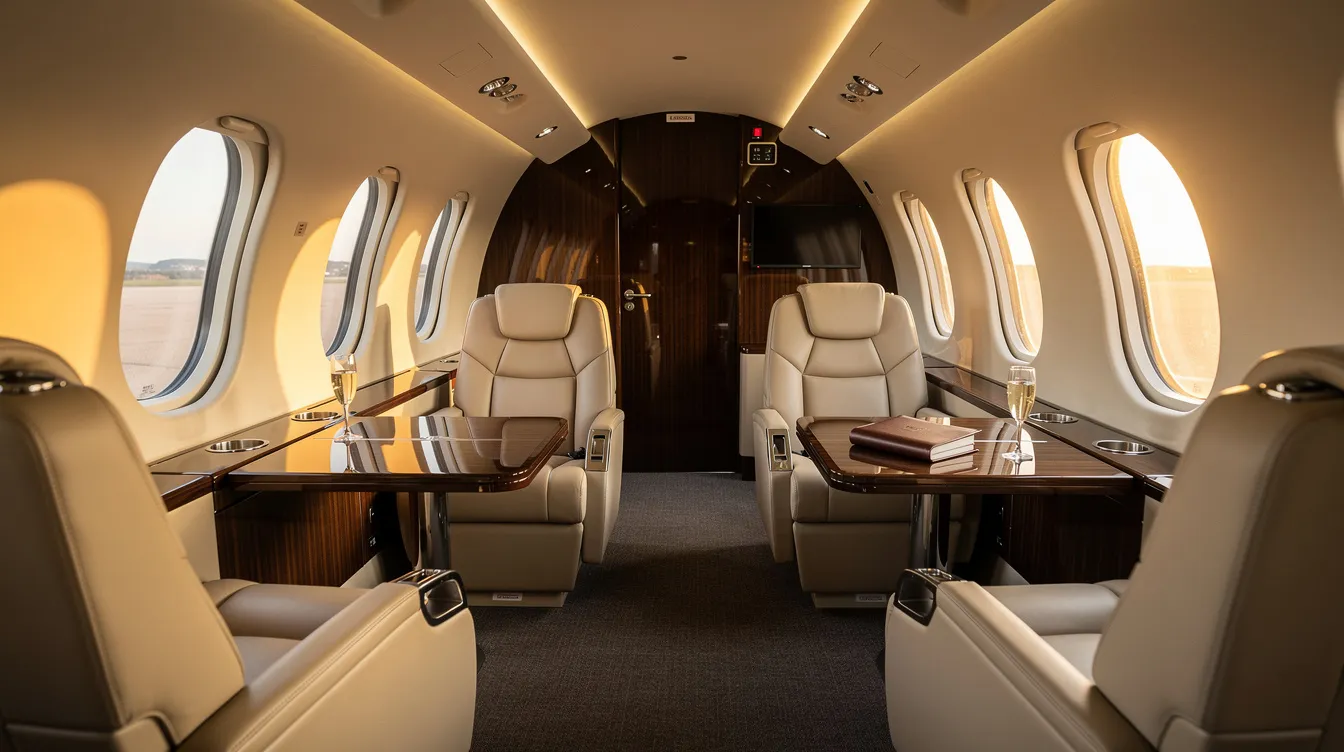
Step aboard through the rear airstair door and the first impression is a purposeful, well-proportioned workspace. The squared-oval cabin cross-section is narrower than a midsize jet, but intelligently designed for regional missions where passengers spend two to four hours in flight.
Dimensions. The King Air 200 offers a cabin length of approximately 16 feet 8 inches. The King Air 350 stretches to roughly 19 feet 6 inches, with a width of about 4 feet 6 inches and height of approximately 4 feet 9 inches.
Seating. Typical layouts feature club-four seating with forward or aft single seats. Options include a two-seat divan or a belted aft lavatory behind a privacy curtain.
Windows and light. Large rectangular cabin windows - the 350 has more than five cabin windows per side - flood the interior with natural light. Overhead LED lighting in newer models allows dimming for rest or focused work.
Noise. Cabin noise level is reduced to 78 dB in newer King Air variants, achieved through advanced sound insulation and constant speed propeller management.
Pressure. Cabin comfort in King Air models is enhanced by lower cabin pressure altitudes, meaning passengers experience less fatigue on flights at higher altitudes.
Amenities. BlackJet clients can expect work tables, power outlets or USB charging, Wi-Fi where equipped, refreshments, and an enclosed or curtained aft lavatory.
Technology and Performance: Engines, Avionics, and Operating Profile
King Air models are powered by Pratt & Whitney PT6 series engines - arguably the most dependable turboprop powerplant ever built. The King Air 200 features Pratt & Whitney PT6A-41 engines producing approximately 850 shaft horsepower each, while the 350 and 360 use the PT6A-60A with increased output for better climb rate and cruise performance.
Altitude and speed. The maximum operating altitude for King Air models is 35,000 feet. Practical cruise altitudes sit between FL200 and FL300, with fuel burn of approximately 113 gallons per hour for the 200 and 136 gph for the 350.
Engine reliability. Basic time between overhaul (TBO) is 3,600 flight hours for most PT6A variants, with hot section inspections at the midpoint. Select operators now qualify for extended TBO programs up to 8,000 hours.
Avionics. Advanced avionics in modern King Air models include the Collins Pro Line Fusion suite, Garmin G1000 NXi, synthetic vision, and terrain awareness warning systems. The IS&S ThrustSense Autothrottle system is standard in King Air models, reducing pilot workload during critical flight conditions such as takeoff, climb, and icing conditions.
Crewing. Most King Air charter operations require two pilots, though the platform is certified for single pilot operation in several variants - a proof of concept for its manageable workload design.
These technologies work together to keep the King Air relevant in 2026, delivering safe, efficient regional flight whether crewed by two pilots or operated by a single pilot in owner-flown configurations.
Military and Government King Airs: Designations and Missions
The King Air's combination of reliability, runway flexibility, and moderate operating costs has made it a staple for air force, navy, and government users worldwide.
T-44 Pegasus. Used by the U.S. Navy, Marine Corps, Coast Guard, and Air Force for multi-engine pilot training. Based on the Model 90 platform.
C-12 Huron. The US Army and other branches operate C-12 variants (A through L) derived from the Super King Air 200 for transport, liaison, and signals intelligence. Beechcraft designations for these aircraft differ from standard civil type certificate numbers.
U-21 Ute. An early Model 90-based utility aircraft flown by the US Army for liaison and light cargo.
JMSDF (Japan). The Japanese Maritime Self-Defense Force operates TC-90, LC-90, and UC-90 King Airs for training, transport, and liaison.
ICAO designators. Flight plans reference King Air 90/100 variants as BE9L, BE9T, or BE10 depending on model and engine configuration.
Government science missions. NOAA flies King Air 350CER and 360CER aircraft equipped with LIDAR, multispectral and hyperspectral sensors, gamma radiation detectors, and digital cameras for environmental survey, aerial mapping, and atmospheric research. King Air aircraft are used for special mission operations ranging from border surveillance to maritime patrol.
These versatile aircraft serve as a testament to the platform's adaptability, providing a reference point that AOPA Pilot and other aviation publications regularly highlight.
Modification, Upgrade, and Maintenance Pathways
One reason the fleet remains so large is the depth of modification and upgrade pathways available to operators:
Engine upgrades. Operators of older King Air 90 and 100 models can swap to more powerful PT6A-135A or even Honeywell TPE-331 engines. Initial engine overhaul for the King Air 350 costs between $500,000 and $550,000, making TBO extension programs financially significant.
Avionics retrofits. Moving from legacy analog panels or mid-2000s Pro Line systems to Garmin G1000 NXi or Collins Pro Line Fusion transforms situational awareness and reduces maintenance burden.
Winglets and aerodynamics. Aftermarket winglet STCs improve range, reduce fuel burn, and enhance climb rate - relevant for operations at high-altitude airports with challenging leading edges on approach.
Structural modifications. Cargo doors, belly sensor pods, reinforced wing spars, and hybrid cabin configurations (stretch divans, belted lavatories) allow missions from air ambulance to pure cargo. The wings and fuselage accept these modifications within well-documented STC frameworks.
BlackJet vets every operator in our network for up-to-date maintenance records, modern avionics upgrades, and adherence to strict inspection programs. If a King Air does not meet our standards for equipment and documentation, it does not carry our members.
Cost Profile: Ownership vs Charter vs Jet Card Access
Understanding King Air economics requires separating three paths: buying, chartering by the trip, or accessing through a Jet Card.
Ownership. The cost of buying a King Air 200 is $725,000 to $800,000 for a well-maintained pre-owned example. Newer King Air 350i models sell for $3–6 million depending on hours and interior condition. Total annual operating cost for a King Air 350 is roughly $1,163,166 when factoring in crew salaries, hangar, insurance, maintenance, and engine reserves - before depreciation.
Ad-hoc charter. Charter rates for King Air 350 start in the mid-$2,000s per hour, reflecting operator margins, positioning, and demand. Estimated direct operating costs for the King Air 350 range from $1,300 to $1,500 per flight hour. You can explore current turboprop charter rates for comparison across aircraft categories.
Jet Card access. BlackJet's 25-hour and 50-hour Jet Card programs let members lock in predictable, all-inclusive hourly rates for King Air-class turboprops without capital outlay, depreciation risk, or the operational burden of ownership. You fly; we handle the rest.
For members who fly 50–150 hours per year regionally, the Jet Card model eliminates the seven-figure annual commitment of ownership while providing guaranteed availability and consistent service standards.
King Air vs Light Jets and Other Turboprop Aircraft
Choosing the right aircraft depends on mission, not marketing. Here is how the King Air stacks up:
vs. Light jets (e.g., Citation CJ series). Light jets cruise faster (~430 ktas) but burn more fuel, require longer runways, and cost significantly more per hour. On flights under 600–800 nautical miles, the King Air often matches or beats door-to-door time once you factor in transit to jet-capable airports. Learn more about turboprop vs. jet trade-offs.
vs. Pilatus PC-12. The PC-12 is a superb single-engine turboprop with a large cabin, but the King Air's twin engine configuration provides redundancy that matters in IFR flight conditions and poor weather. The 350 also carries heavier payloads and seats more passengers.
When to choose a King Air. Six to eight passengers, short or unimproved runways, mixed weather, and routes under 1,500 nm. Noise sensitive airports that restrict jets often welcome turboprops without limitation.
Scenario. A BlackJet member flying Dallas to Aspen (~600 nm) on a King Air 350 arrives in approximately two hours at a cruise speed of around 300 knots, landing on Aspen's shorter runway without diversion risk. A light jet might cruise faster but needs a larger field, and the total time saved evaporates in ground transfer. The King Air Jet Card hour costs less, too.
Use Cases: How BlackJet Members Fly King Air Aircraft
King Air models are renowned for their versatility in operations. Here is how BlackJet members put that versatility to work:
Regional executive shuttles. Same-day out-and-back meetings between cities 200–600 nm apart, landing at airports minutes from downtown rather than hours.
Ski and resort access. Trips to airports with 3,000–4,000 ft runways - Aspen, Telluride, Sun Valley - where jets face weight restrictions or cannot operate at all.
Family weekends. Remote island or lodge strips that only a turboprop aircraft can reach, with enough seats for the whole group.
Example routes. New York to Nantucket (~200 nm, ~50 minutes), Dallas to Aspen (~600 nm, ~2 hours), or London City to a small European regional field - each dramatically faster than commercial connections and flown on BlackJet members' schedules.
Beyond passenger service, King Air 350 is used for corporate travel, serves air ambulance services, and is utilized for cargo transport. The King Air 200 can be configured for air ambulance use as well. The King Air lineup is used for corporate shuttling and air ambulance services across the globe. BlackJet focuses exclusively on passenger charter, comfort, and schedule control - but our members benefit from the same platform reliability that operators trust for critical missions.
Jet Card members use King Air-class turboprops as strategic tools: multi-stop regional tours, last-minute weather-robust options when jets are grounded, or simply the most cost-efficient way to reach a meeting 400 miles away and return the same evening.
Safety, Sustainability, and Technology: The BlackJet Standard
Every King Air mission booked through BlackJet meets a standard that goes beyond regulatory minimums:
Safety vetting. BlackJet requires third-party safety ratings (such as Wyvern Wingman or equivalent), verified pilot experience thresholds, recurrent training on turboprop operations, and strict maintenance documentation for every operator in our network. Our BlackJet Certified program ensures ongoing monitoring, not just initial qualification.
Twin-engine redundancy. Twin engine turboprop aircraft like the Beechcraft King Air are valued for redundancy and short-field capability, contributing to risk management on regional flights where single-engine alternatives carry higher exposure.
Carbon-neutral flights. BlackJet ensures every King Air flight is carbon-neutral at no extra cost to members, through verified carbon offset programs and, where available, use of Sustainable Aviation Fuel via partner operators. Turboprops are inherently more fuel-efficient per passenger-mile than most jets, further reducing environmental impact.
Technology. Members access 24/7 digital booking tools, real-time aircraft availability, and trip status updates - making the choice between a King Air and a jet seamless from a single platform.
Frequently Asked Questions About the Beechcraft King Air and BlackJet Access
How many passengers can a Beechcraft King Air 200 or 350 typically seat on a BlackJet charter? The King Air 200 typically seats up to seven passengers in a standard executive configuration. The King Air 350 accommodates eight to nine passengers in club and individual seating, with the 360ER variant seating up to fifteen in high-density mission layouts. BlackJet charters use executive configurations optimized for passenger comfort.
What are the main differences between a Beechcraft King Air and a light jet when booking through BlackJet? King Airs offer lower hourly costs, access to shorter runways, and twin-engine turboprop reliability. Light jets fly faster on longer routes. For regional trips under 800 nm, a King Air often delivers equivalent or better door-to-door time at a fraction of the cost. Your BlackJet advisor can recommend the right aircraft for each mission.
Can I specify a King Air when using my Jet Card hours? Yes. BlackJet Jet Card members can express aircraft category preferences - including King Air 200 or Super King Air 350 class turboprops - when booking. Availability is managed by category, and our team works to match your preference with the best-equipped, best-maintained option in the fleet.
How does BlackJet vet King Air operators for safety and maintenance standards? Every operator undergoes third-party safety audits, verification of pilot credentials and recurrent training, review of maintenance records and engine program compliance, and ongoing monitoring. Aircraft must be equipped with modern avionics and meet BlackJet's interior and service standards.
What does a King Air charter cost through BlackJet? Charter rates for King Air 350-class aircraft start in the mid-$2,000s per hour. Jet Card members benefit from locked-in, all-inclusive rates that eliminate surprises. Explore Jet Card pricing options to compare programs.
Conclusion: The King Air's Enduring Value in Private Aviation
The Beechcraft King Air remains a cornerstone of private and business aviation due to its unmatched combination of versatility, efficiency, and reliability. For travelers who prioritize access to regional airports, cost-effective operation, and mission flexibility, the King Air offers a strategic advantage that transcends luxury. Whether flying corporate shuttles, reaching remote resorts, or managing multi-leg itineraries, the King Air's proven performance and modern technology ensure seamless journeys.
Through BlackJet's Jet Card programs, members unlock effortless access to King Air-class turboprops with guaranteed availability, premium safety standards, and carbon-neutral flights — all without the burdens of ownership. As the private aviation landscape evolves, the King Air continues to deliver enduring value, blending heritage engineering with contemporary innovation to meet the demands of today's discerning travelers.
Discover how BlackJet can elevate your regional travel experience with King Air access tailored to your schedule and preferences. Learn more about our commitment to private aviation safety and how it enhances every flight experience.


 Sign up with google
 Sign up with Apple