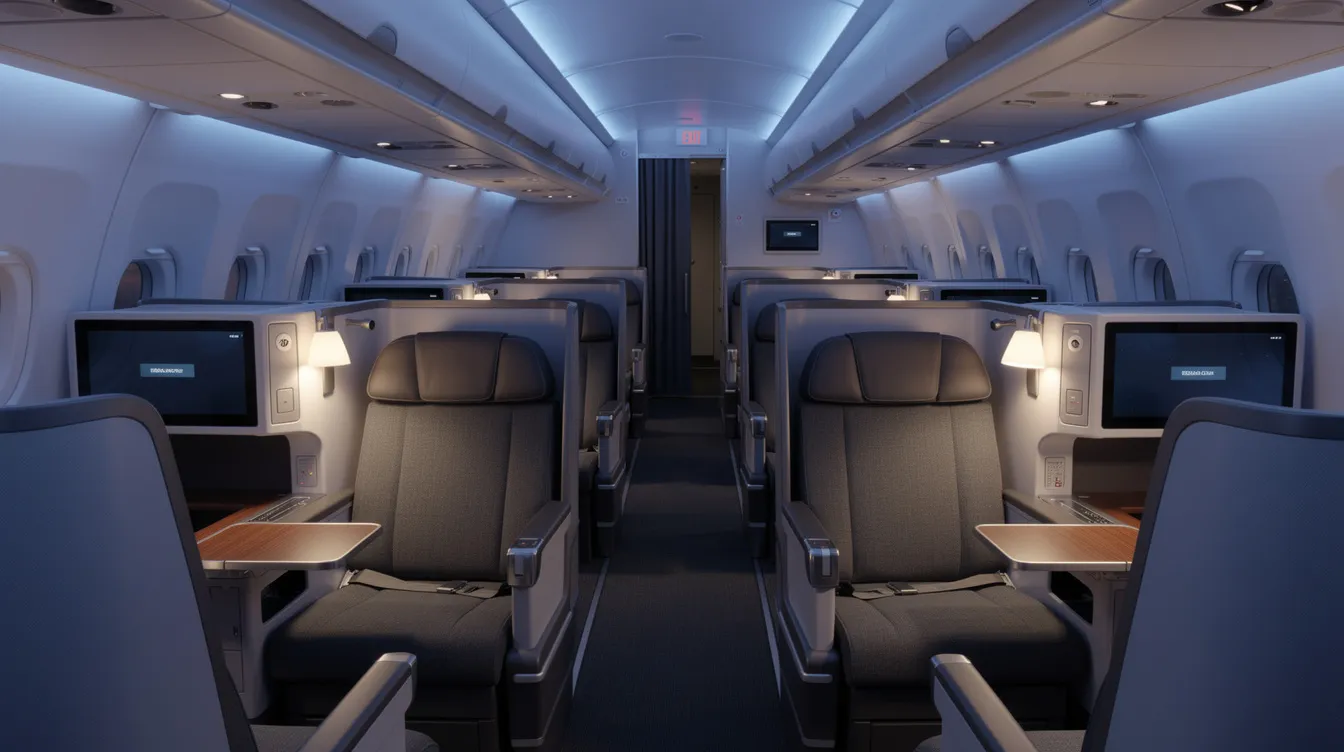
The way discerning travelers cross oceans has changed dramatically. Modern international business class now delivers lie-flat beds, curated dining, and suite-style privacy that would have been unthinkable a decade ago. Yet even the best commercial cabin comes with fixed schedules, crowded terminals, and compromises that cost high-value travelers their most precious resource: time. This guide breaks down what international business class actually offers in 2026, how it stacks up against private jet access through a BlackJet Jet Card, and when each option makes sense for your next trip.
Immediate Answer: When International Business Class Makes Sense (and When It Doesn't)
Consider two common routes. A round-trip business class ticket between New York and London in 2026 costs roughly $3,000–$5,500, depending on season and airline. The flight itself is about seven hours, but factor in the two-to-three-hour early arrival, security, boarding, baggage claim, and ground transfer, and door-to-door time often stretches past twelve hours each way. A private jet charter on the same route runs $59,700–$149,300 one-way on a heavy cabin jet — roughly 6 hours 38 minutes in the air, with a 15-to-30-minute arrival window at a private FBO and no queues on either end.
Now stretch the math to Los Angeles–Singapore: business class round-trip fares sit between $5,700 and $7,500, while a large-cabin private jet for that ultra-long-haul leg could run $230,000 or more one-way. The price gap is enormous, but so is the time and flexibility gap.
Modern business class seats on carriers like Singapore Airlines, Air France, and Air Canada now offer fully flat seats, direct aisle access, and refined meal service that genuinely rivals what many airlines once sold as international first class. For a traveler making one or two long-haul flights a year, booking one of these cabins is almost always the right call.
But for executives and frequent flyers logging six or more international trips annually, the calculus shifts. BlackJet's Jet Card model — with fixed hourly rates across cabin sizes and a broader ecosystem of premium private jet card programs - delivers 20–40% total journey time savings through direct routing, access to secondary airports, and schedule control that no commercial cabin can match. The ROI shows up in preserved productivity, eliminated hotel nights, and the ability to reach your destination on your own terms.
At a glance:
Seat / bed: Business class offers lie-flat beds (some with suite doors); BlackJet provides a fully private cabin configured for your group
Airport time: 2–3 hours pre-departure for commercial; 15–30 minutes at a private FBO with BlackJet
Privacy: Shared cabin with 30–60 other business class passengers vs. entire aircraft reserved for you
Schedule control: Fixed airline timetables vs. on-demand departure times
Price range per trip: $1,500–$7,500 one-way business class; $13,000+/hour all-in for BlackJet large cabin jets
What Defines International Business Class in 2026?
International business class has undergone a quiet revolution. In the 1980s and 1990s, long-haul business class meant a wider seat with a bit more recline — essentially an upgraded recliner with better food. By the 2010s, fully flat beds and premium lounges had become the baseline on most major carriers. Today, the best class cabins feature enclosed suites with closing doors, chef-driven menus, and ground service ecosystems that blur into what used to be first class territory.
The core elements of a modern international business class product include lie flat seats that convert into beds, enhanced multi-course dining, lounge access at departure and often at hub airports, priority boarding, priority check-in, generous baggage allowances, and high-speed Wi-Fi. International business class typically operates on long-haul, transoceanic flights, where these amenities justify the price premium. Business class provides access to premium airport lounges and passengers enjoy priority check-in and boarding in business class as standard benefits.
There is also a growing tier called premium business - sometimes branded as business premier (Air New Zealand), Premium Business (LATAM), or Signature Class (Air Canada). These labels typically signal wider or bulkhead-row seats, upgraded bedding, and elevated lounge privileges beyond what the standard forward cabin offers.
It is worth noting that the phrase "international business class" carries a second meaning in academic contexts. International business classes at universities cover international trade theories and balance of payments, and international business students learn how globalization affects corporate strategy and operations. Entry strategies like licensing, franchising, and joint ventures are key topics in international business education, while global economics examines international monetary systems and macroeconomic trends. Foreign exchange markets dictate currency risk and are essential for international finance. Cultural differences impact negotiation, management, and workplace behavior in international business contexts, and managing international human resources involves understanding cross-cultural leadership and labor standards. Corporate social responsibility includes navigating ethical dilemmas and sustainability in global operations. This article, however, focuses on the aviation product — the cabin you fly in, not the lecture hall.
Many airlines have phased out first class entirely, positioning their most expensive business class cabin to serve that ultra-premium market. Others - Air France, Singapore Airlines, Emirates - maintain a dedicated first class product. This overlap is exactly why many travelers now compare the best business cabins directly against private aviation options like BlackJet or even evaluate 10 million dollar private jet ownership choices when planning strategic international trips.
Business Class Seats Explained: From Recliners to Flat Beds
The marketing label on your ticket matters far less than what you actually sit — and sleep — in. Business class typically features lie-flat seats on long-haul flights, but the term "lie-flat" itself hides significant variation.
Three main categories define today's business class seat landscape:
Angled flat seats: The seat reclines to roughly 160–170 degrees but never reaches fully horizontal. Your body slides downward over time. Common on older widebodies and some regional long-haul flights.
Fully flat seats: True 180-degree recline, creating a proper flat bed. The standard on most modern long-haul cabins from major carriers.
Suite with door: A fully flat bed enclosed in a private pod with a sliding door or closing door. Found on Qatar Airways Qsuite, British Airways Club Suite, and Delta One Suites, among others.
Older business class cabins used 2-2-2 or 2-3-2 layouts across widebody aircraft, which meant many passengers were stuck in middle seats or climbing over neighbors. Newer configurations have shifted almost universally to 1-2-1 or staggered herringbone layouts, giving every business class seat direct aisle access.
Concrete examples highlight the range: an Aerolíneas Argentinas A330 still flies angled flat seats on some routes, while Singapore Airlines, Qatar Airways, and Air France deploy fully flat beds in modern 1-2-1 cabins on their A350 and 777 fleets. Even within a single airline, seat quality can vary dramatically by aircraft type and refit date - check the seat map and recent reviews before booking, especially on airlines with mixed fleets.
Private jet cabins, as flown via BlackJet, sidestep this variability entirely. You effectively fly a 1-1 layout: the entire cabin is private to your party, cruising at altitudes that often exceed commercial aircraft for smoother rides and more direct routings, with how high private jets typically fly compared to airlines shaping both comfort and efficiency, and with custom-configured seats and beds that rival or exceed even the best premium business products.
Best Business Class Airlines Right Now (and Why They Matter to Private Jet Flyers)
Even BlackJet clients often mix commercial business class with private flights on complex itineraries. Knowing which business class airlines excel helps you pick the right carrier for the commercial legs.
Leading products in 2026 include:
Singapore Airlines: A380, A350, and 777-300ER cabins with flat beds and direct aisle access; exceptional meal service and consistently great service across routes
Qatar Airways Qsuite: Industry-defining suite concept with privacy doors, adjustable panels, and a social "quad" configuration for groups
ANA "THE Room": Unusually wide seats with direct aisle access, offering among the most spacious seat dimensions in any business class cabin
JAL A350-1000: Herringbone suites with doors, excelling on transpacific routes
Air France: Latest A350-900 and 777-300ER suites with doors, strong soft product, and premium lounges at Paris CDG
Emirates: A380 and 777 cabins with generous seat width and beverage service, plus the newer A350 business product
In North America, Air Canada Signature Class stands out on 777 and 787 fleets, American Airlines offers fully lie-flat seats on select aircraft with its Flagship Suite on 777-300ER and 787-9, and Delta One Suites feature doors and direct aisle access in a 1-2-1 configuration. These products compete fiercely on transatlantic flights and transpacific routes.
BlackJet is not a commercial airline competitor but a complement. When schedules don't align, when you need to reach a secondary airport, or when privacy is non-negotiable, a Jet Card segment can replace the weakest link in your itinerary, much as discerning flyers compare leading private jet charter companies in the USA to assemble the right mix of providers.
International Business Class vs International First Class
International first class remains the pinnacle of commercial air travel - but its footprint is shrinking. Business class is now the default long-haul premium product, while international first class is an ultra-luxury niche maintained by a handful of carriers.
First class offers more exclusive amenities than business class. Consider the difference between Singapore Suites on the A380 — a fully enclosed private room with a separate bed and armchair - versus Singapore Airlines' already excellent long-haul business class. Or compare Emirates First on the A380, with its shower spa and onboard bar, against Emirates' business cabin. Air France La Première provides a dedicated suite, personalized service, and a chauffeur-driven car to the airport, standing well apart from Air France's newest business suites.
What does first class add? Ultra-private suites, higher crew-to-passenger ratios, elevated dining with caviar and à la carte timing, and exclusive ground services. First class often includes private lounges and chauffeur services that go beyond what even the best business class lounge can offer. First class tickets can cost double or more than business class tickets, and first class fares on routes like New York–Paris or London–Singapore often exceed $15,000 one-way.
The trend, however, is unmistakable: many airlines are phasing out first class. American Airlines' Flagship First is being retired, and Oman Air has rebranded its former first class seats as Business Studio. Others are expanding premium business cabins — with doors, wider beds, and elevated soft product — to capture that spend without maintaining a low-density first class section.
For many BlackJet members, private aviation replaces international first class altogether, especially once they understand the best jet cards for frequent flyers and how those programs compare to repeatedly buying first class tickets. A Jet Card delivers privacy and flexibility that even top first class seats cannot match, without tying capital into jet ownership. When the best seat on the plane still shares an airport with thousands of other passengers, the calculus often favors stepping off the commercial grid entirely.
How Business Class Compares to Private Jet Travel with BlackJet
Picture a CEO with meetings in London on Tuesday morning and Zurich by Wednesday afternoon. On commercial business class, that means booking two separate flights - JFK to Heathrow, then Heathrow to Zurich — with connecting check-ins, security, and the risk of delays cascading across an already tight schedule. Total journey time across both legs, door to door, easily exceeds 14–15 hours.
With BlackJet, the same executive flies a large-cabin jet from Teterboro (15 minutes from midtown Manhattan) directly to London City Airport or Farnborough, arrives at the meeting refreshed, then hops a super midsize jet from Farnborough to Zurich that afternoon. No terminal waits, no rebooking anxiety, no lost hours.
The productivity difference compounds over time. Even the best business class cabin is semi-private: you can work, but confidential phone calls, sensitive documents, and candid team discussions are constrained. On a BlackJet flight, the cabin is yours. Hold a board prep session at 40,000 feet without worrying about the passenger in 3A.
On cost, a last-minute fully flexible business class fare from New York to London can push above $10,000 round-trip. A BlackJet large-cabin hourly rate of around $13,131 on a 50-hour Jet Card translates to roughly $87,000 for a transatlantic one-way - steep for a solo traveler, but increasingly defensible when traveling with a team or when the time savings protect a deal worth multiples of that cost, especially when you compare the broader 50 hour jet card cost and value landscape across providers.
For complex itineraries — multi-city tours across Europe or South America where commercial business class would require connections and overnight hotel stays - BlackJet's model often eliminates two or three nights of hotel cost and a full day of wasted transit, and when groups approach 15–20 travelers, large-cabin private jets for 20 passengers can turn those itineraries into efficient rolling strategy sessions.
Cabin Layouts and Privacy: Suites, Doors, and Club Suite Concepts
Privacy matters for three reasons: sleep quality, work capability, and discretion. High-profile travelers — from executives to public figures - need confidence that their conversations and screens are shielded from neighboring passengers.
British Airways Club Suite represents a significant leap from the older Club World product. Its 1-2-1 layout with sliding doors on the A350-1000 and retrofitted 777s creates genuine personal space. Window seats in particular offer seclusion, with a partition and door that fully enclose the suite.
Qatar Airways Qsuite allows for shared space with privacy doors — couples or colleagues can open adjacent suites into a shared area, then close them for individual rest. Delta One Suites provide doors and direct aisle access in a 1-2-1 layout on A350 and refitted 767s. Air France's latest 777-300ER cabins and Iberia's A350 business suites follow the same enclosed-suite philosophy.
Some products deliver strong privacy without doors. EVA Air Royal Laurel and Finnair AirLounge create visual and acoustic separation through high partitions and thoughtful seat orientation, and some business class travelers prefer the open feel, while others gravitate toward the largest private jets for sale and charter where an entire cabin becomes a fully private workspace.
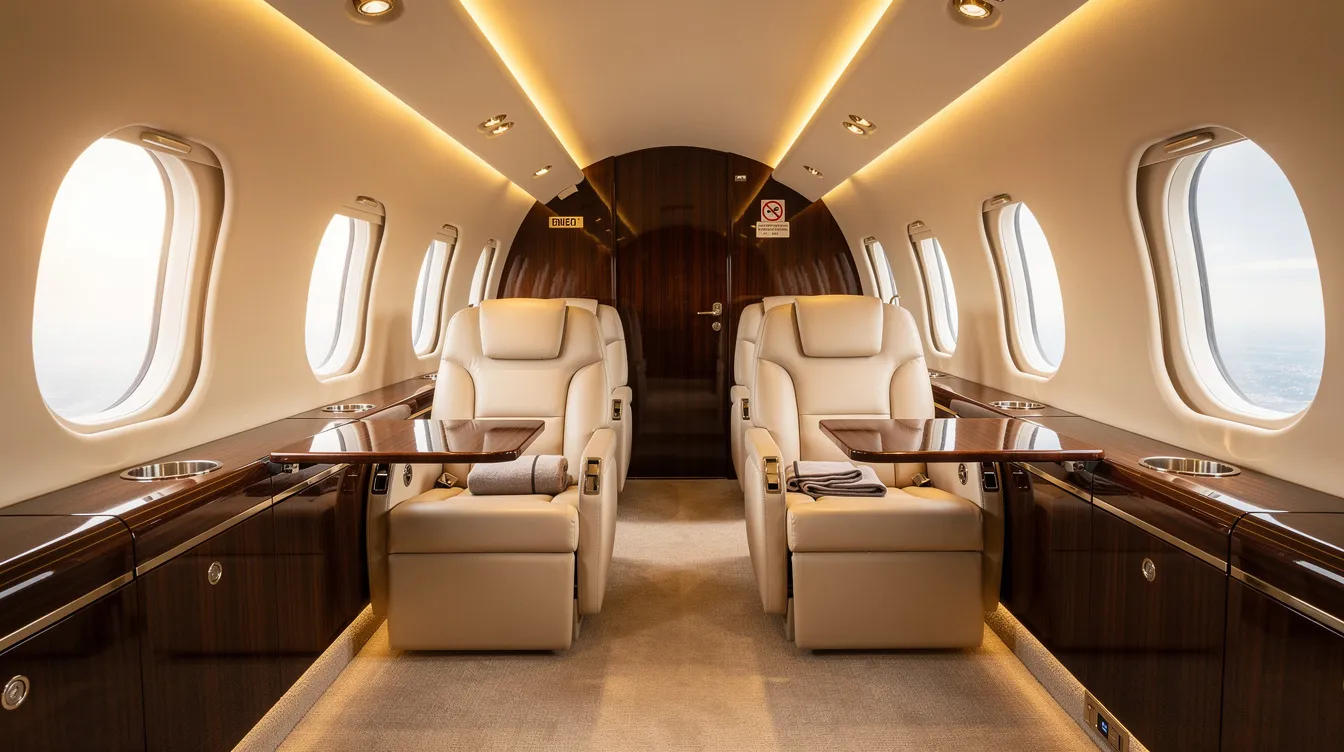
But contrast all of this with a typical BlackJet midsize or large-cabin jet interior. The entire aircraft is effectively a "suite" - with a closing door to the outside world shut exclusively for your party. No partitions needed because there are no strangers.
Regional, Domestic, and Transatlantic Business Class Nuances
The term "business class" means very different things depending on the route. Regular business class primarily serves shorter domestic flights — and on many of those legs, especially in Europe, business class is simply an economy seat with a blocked middle seat and slightly better meal service.
In North America, Air Canada, American, Delta, and United deploy full lie-flat business class seats on select transcontinental and Hawaii routes. But on shorter haul flights — say, Dallas to Denver or Toronto to Montreal - business class often means a recliner at best.
European intra-continental business class on carriers like Air France and British Airways typically uses economy-style seats in the forward cabin with enhanced ground service and lounge access but no flat beds. Short-haul flights generate more emissions due to takeoff phases, and the cabin product often doesn't justify the premium.
This inconsistency undermines end-to-end journeys. A traveler might enjoy a superb flat-bed transatlantic segment on British Airways' A350, only to connect onto a cramped intra-Europe leg to Geneva with no more room than an economy passenger.
This is precisely where BlackJet fits: as an efficient replacement for those short, non-flat segments. Fly private from Geneva to Paris Le Bourget, then connect onto a long-haul business class flight from Paris CDG to Singapore. The weak link in your itinerary disappears.
International Business Class to and within South America
South America is increasingly important for both business and luxury leisure travel. São Paulo, Santiago, Bogotá, and Lima are drawing investors, dealmakers, and travelers - but long flying distances and limited direct routes create friction.
Typical business class offerings to South America include LATAM's new 787 Premium Business suites (with doors, a result of its aggressive retrofit program), American Airlines Flagship Business to São Paulo and Santiago, and Air Canada Signature Class to São Paulo and Bogotá. The best seat on these routes features a fully flat bed with direct aisle access in updated 1-2-1 cabins. Older 2-2-2 or angled flat seats still fly to some markets, so checking the specific aircraft before booking is essential.
BlackJet can be used for intra-South America trips — say, Santiago to Mendoza to São Paulo - that would otherwise require backtracking through hub airports or enduring long connections on commercial flights. Cultural differences impact negotiation and management style across these markets, and arriving rested and on schedule rather than exhausted from a red-eye connection can make a meaningful difference—especially for clients used to the most expensive private jet experiences, who expect to land ready to perform.
Consider a specific use case: a week-long investor roadshow across Brazil, Chile, and Argentina. Fly business class from New York or the west coast to São Paulo, then use BlackJet segments between São Paulo, Santiago, Buenos Aires, and Mendoza. You eliminate three connecting flights, two overnight hotel stays, and roughly twelve hours of dead time.
Signature Products: Flagship Business, Business Premier, and Premium Business
Airlines rename business class for marketing and differentiation — signaling "this is better than standard business class" to justify higher fares and attract premium business class travelers.
American Airlines Flagship Business (and the newer Flagship Suite on 777-300ER and 787-9 aircraft) features lie-flat seats in updated 1-2-1 layouts with direct aisle access. On Flagship-designated routes, travelers also get Flagship Lounge access and Flagship First Dining at select hubs.
Air New Zealand Business Premier and Business Premier Luxe serve the 787-9 and 777-300ER. Standard Business Premier provides flat beds, while the larger front-row Luxe seats offer extra space, longer bed length, and upgraded amenity kits - approaching what many carriers sell as business elite.
LATAM Premium Business on 787s, now featuring suites with doors, has transformed the comfort level on South America routes. The retrofit program brought the product from middle-of-the-pack to genuinely competitive.
The lesson for travelers: decode the branding and focus on the underlying seat type, layout, and soft product — not just the name. A "business premier" seat on one airline may be inferior to a standard business class seat on another. Always verify the aircraft, seat map, and cabin generation before comparing any commercial product to a private jet solution.
Spotlight: Singapore Airlines Business Class vs Private Jet Access
Singapore Airlines is a benchmark for long-haul business class. Its A380 fleet features 78 flat-bed business seats in 1-2-1 configuration. The A350 and 777-300ER cabins offer similarly flat beds with direct aisle access, generous seat width, and the airline's signature meal service.
On the A380, center-section business class passengers can pair two seats together into a double-bed arrangement — an unusual feature for business class. Across all widebody types, the soft product is consistently strong: multi-course meals with regionally inspired options, complimentary beverages including premium wines, and good service from flight attendants trained at one of the industry's most selective programs.
Key routes like Singapore–London, Singapore–New York (via Frankfurt), and Singapore–Sydney are among the most popular for business class travelers choosing Singapore Airlines. Many premium travelers deliberately route through Singapore to fly the product.
A BlackJet itinerary can complement this beautifully. Imagine a client based in Aspen or Palm Beach: a private jet segment from their regional base to a major Singapore Airlines gateway - LAX or JFK - followed by world-class commercial business class across the Pacific or to Europe. The Jet Card handles the positioning leg, the airline handles the ultra-long-haul, and the client skips the domestic commercial connection entirely.
BlackJet's 24/7 support and digital booking tools simplify coordinating these multi-leg, multi-carrier journeys — building a seamless itinerary from fragments that would otherwise require hours of planning.
Air France, Air Canada, and Other Flag Carriers: What Their Business Class Really Offers
National flag carriers remain popular choices for premium travelers on routes to Europe and Asia, and their recent cabin investments have been substantial.
Air France's latest business suites on the A350-900 and 777-300ER feature 1-2-1 layouts with doors, offering genuine personal space on key routes like Paris–New York and Paris–Los Angeles. The soft product - French-inspired cuisine, curated wine lists, premium lounges at CDG — adds up to one of Europe's strongest business class products.
Air Canada Signature Class deploys flat beds on 777, 787, and A330 aircraft, with the upcoming A321XLR bringing flat-bed transatlantic operations from smaller Canadian hubs. For travelers connecting from Canada, Signature Class offers a cohesive experience with Maple Leaf Lounge access and a solid onboard product.
Other European and Middle Eastern carriers continue upgrading rapidly. Lufthansa Allegris introduces new suite-style business seats across its long-haul fleet. SWISS Senses refines the business cabin on A330 and A340 aircraft. Emirates' A350 business class adds a modern option alongside the airline's established A380 and 777 cabins. Korean Air has also invested in its long-haul product with Apex Suites and upgraded Prestige Class seats.
BlackJet customers typically select among these carriers based on schedule and hub access for their international legs, while relying on BlackJet for non-hub positioning flights and time-critical segments where commercial options are too slow or too rigid, often pairing them with the newest generation of private jets for the longest nonstop missions.
Beyond Seats: Service, Dining, and Sleep Quality in Business Class
A flat bed is only one dimension of the experience. The soft product — service, food, amenities - often determines whether business class feels worth the price, just as the ability to book a single seat on a private jet can shift the value equation for travelers who don't need an entire aircraft.
Business class meals are generally of higher quality than economy class, and on the best carriers, they rival fine dining. Business class meals are often curated by renowned chefs: Air France partners with Michelin-starred chefs for its long-haul menus; Singapore Airlines' "Book the Cook" program lets passengers pre-select premium dishes; and American Airlines and Delta have invested in elevated in-flight dining partnerships. Business class includes complimentary alcoholic beverages and premium wines, with beverage service typically featuring curated champagne, regional wines, and craft cocktails.
Beyond dining, amenity kits from brands like Diptyque, Rimowa, and Ferragamo, plus bedding packages that include mattress pad toppers and full-size pillows, define the premium experience. Bed length matters too — taller travelers should check whether the seat fully extends to at least 78 inches.
Factors that affect sleep quality include cabin temperature, noise levels, lighting cycles, and whether the airline offers a true turn-down service. Flight attendants on the best carriers dim lights gradually, offer hot towels, and minimize disruption.
On a private jet, all of these variables are under your control. Fully customized meal times, a quieter environment, the ability to adjust lighting and temperature for your group, and the option to design your own rest schedule with BlackJet flight planners. No compromise with 50 other passengers' preferences.
Booking Strategies: Cash, Points, and When Private Jets Win
Cash prices for international business class in 2025–2026 vary widely by route:
New York–London: $3,000–$6,000 round-trip; discounted fares through consolidators sometimes drop below $2,500
Los Angeles–Tokyo: $4,500–$9,000 round-trip, with significant seasonal swings
Los Angeles–Singapore: $5,700–$7,500 round-trip at published rates; consolidator deals occasionally reach $3,400
Frequent flyers book using miles through programs like AAdvantage, KrisFlyer, Flying Blue, and Aeroplan, or flexible point currencies from Amex Membership Rewards, Chase, and Capital One. Award availability varies, but booking early increases chances of securing premium cabin seats.
Upgrade paths include complimentary upgrades, which are often available through elite airline status, and bidding for upgrades, which is common on international flights. Monitor airline apps for upgrade availability before departure - many carriers release unsold premium seats at the gate or via app notifications; frequent travelers should also weigh whether stepping up to a 100 hour jet card commitment delivers better long-term value than constantly chasing last-minute upgrades.
Private jets become particularly competitive in several scenarios:
Last-minute travel when discounted fares have evaporated and remaining business class tickets exceed $8,000 one-way
Multi-city itineraries where connections waste entire days
Groups of 6–10 travelers sharing a cabin, where per-person private jet costs can approach business class
When schedule flexibility is priceless — a meeting moved by 24 hours, a deal closing earlier than expected
Consider four executives needing to reach São Paulo from a secondary US city by Monday morning. Four last-minute business class tickets through a hub might cost $36,000–$48,000 total, plus a hotel night and a connection. A BlackJet midsize jet segment from their city to Miami, plus business class to São Paulo, could deliver them faster and for a comparable total spend, and for larger teams the economics of 16-seat private jet options start to resemble a flying boardroom where per-person costs align with premium cabin fares.
Environmental Impact: Business Class, International First, and Private Jets
Aviation produces about 2% of global carbon emissions, with premium cabins carrying a disproportionate share. Business class emits three times more carbon per passenger than economy, because fewer seats share the same aircraft footprint. Carbon emissions for first class are four times higher than business class in terms of per-seat space allocation on many widebody aircraft. Short-haul flights generate more emissions due to the energy-intensive takeoff phases relative to distance covered.
Private jets have high emissions for a small number of passengers, especially on shorter legs or when flying with only one or two people. Reports suggest private aviation can be 5–14 times more polluting per passenger than commercial business class, depending on route and occupancy.
Mitigation strategies are advancing across the industry. Modern efficient aircraft like the A350 and 787 significantly reduce fuel burn per seat-mile. Sustainable aviation fuel (SAF) initiatives are scaling, and airlines are investing in lighter materials, more efficient cabin layouts, and next-generation engines.
BlackJet addresses this challenge directly: every BlackJet flight is carbon-neutral via high-quality verified offsets at 300% of emissions, included in the Jet Card price at no extra cost to the client, even on missions that use some of the top private jets in the world for range and performance. For travelers with corporate sustainability reporting obligations or personal environmental commitments, this makes private aviation a more defensible choice.
BlackJet Jet Cards vs Owning a Jet vs Flying Business Class
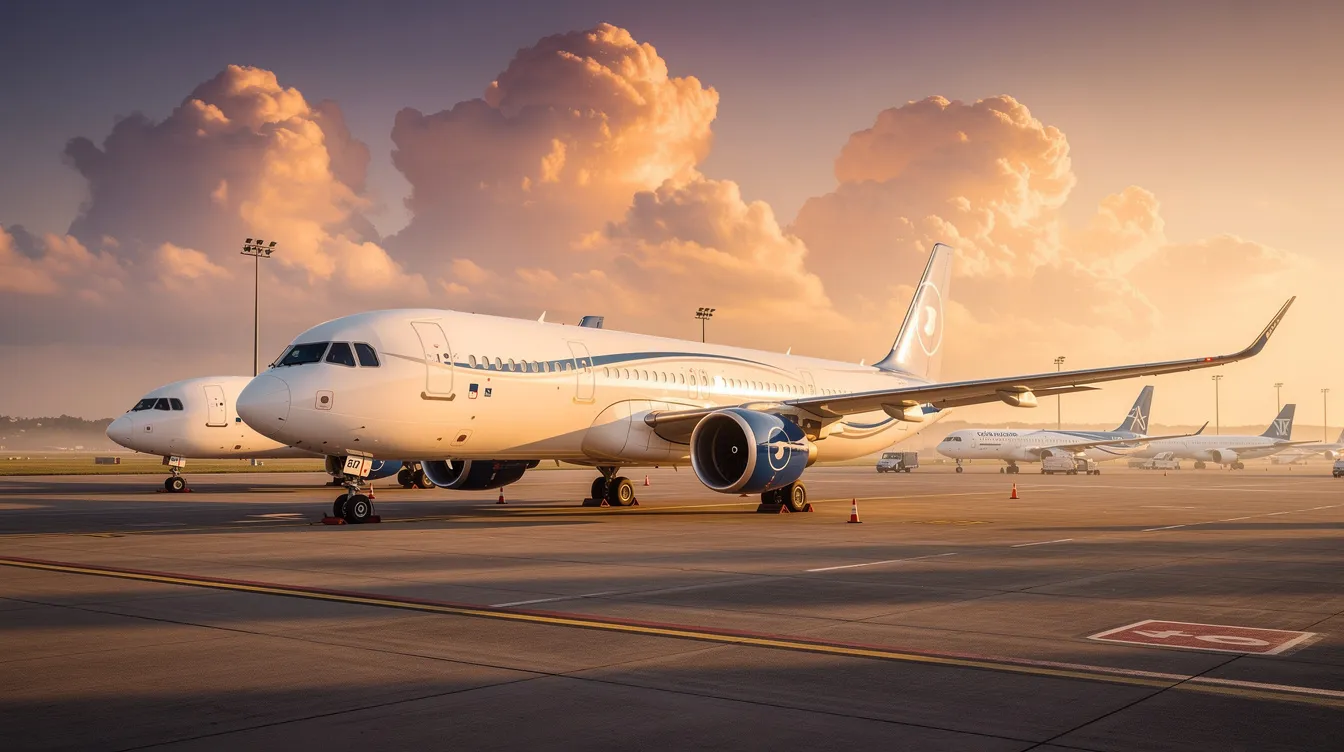
Three models define premium air travel: occasional business class tickets, full or fractional jet ownership, and Jet Card membership, with fractional programs often appealing because of tax benefits of fractional jet ownership that can offset some of the higher fixed costs.
Jet ownership — whether whole or fractional - involves substantial capital outlay, depreciation in fractional jet ownership, crew costs, hangar fees, maintenance schedules, and the complexity of managing an aviation asset. For details on what ownership entails, see this overview of private jet purchase costs. It makes sense only for those flying 400+ private hours per year, with teams dedicated to operations management.
BlackJet Jet Cards work differently: prepaid hours across cabin sizes (light, midsize, super midsize, large cabin), fixed hourly rates locked for 12 months on the 50-hour card, no asset risk, and 24/7 digital booking and support. Hours don't expire. All-in pricing includes fuel surcharges, federal taxes, standard catering, de-icing, and full carbon offsetting.
Compare a year in the life of a frequent international traveler:
Business class only: 8 international round-trips at $5,000 average = $40,000. Convenient, but locked into airline schedules, airport lines, and connecting flights—though for some travelers, a smaller 25-hour jet card structure can be a gentler introduction to private access.
Hybrid approach: 4 trips on commercial business class ($20,000) plus 30–40 hours of BlackJet private segments for positioning and intra-regional flights (~$300,000–$520,000 depending on cabin size). More expensive in absolute terms, but potentially transformative in time savings and schedule control.
Jet Cards are the "capital-light" alternative that sits between commercial business class and full ownership - ideal for high-usage but flexibility-focused travelers who want access without the burden of managing an aircraft, and resources that break down jet card membership pricing and cost drivers help clarify when they make financial sense.
Safety and Certification: What Premium Travelers Should Ask About
Premium seats don't automatically mean higher safety; standards are set at the airline and operator level, not by ticket class.
Top-tier business class airlines maintain IATA membership, operate modern fleets, follow rigorous maintenance protocols, and comply with regulatory oversight in jurisdictions like the EU, US, and Singapore. These are table-stakes requirements.
In private aviation, the picture is more fragmented. What to check: operator certifications (ARGUS Platinum, Wyvern Wingman), minimum pilot experience hours, maintenance standards, and published safety records.
BlackJet's safety framework goes further: proprietary vetting of every operator in its network, minimum pilot experience thresholds, and ongoing audits of safety compliance. This is why safety-conscious executives increasingly choose structured Jet Card programs over ad-hoc spot charters, where operator quality can be unpredictable, and why they study the top private jet companies for service and safety before committing to any long-term access model.
Technology and Real-Time Support: Business Class Apps vs BlackJet's Platform
Digital tools now shape the entire premium travel experience. Airline apps let business class travelers select seats, track mileage, receive upgrade offers, and rebook during disruptions. These tools have improved significantly over the past few years.
But their limits are real: you have little control over aircraft swaps that downgrade your seat product, fixed schedules that don't bend to your needs, and the same customer service phone queues as everyone else during major disruptions.
BlackJet's platform operates on a different model: 24/7 mobile booking, live flight support, real-time routing adjustments, and direct communication with a dedicated team. If a meeting shifts from Nice to Geneva mid-trip, BlackJet can reroute your London–Nice private jet to London–Geneva within hours—even for private jets configured for up to 50 passengers on major corporate movements. Try rebooking a business class ticket on that timeline.
Use Cases: When to Fly Business Class and When to Choose BlackJet
Scenario 1: Monthly Miami–São Paulo commuter. A US-based executive flies this route twelve times a year. Business class on American or LATAM runs $4,000–$6,000 per round-trip. But the executive is based in Nashville, not Miami — meaning a connecting domestic leg each way. Solution: BlackJet from Nashville to Miami (super midsize, ~2 hours), then business class to São Paulo. Eliminates two domestic connections per trip, saves roughly four hours each way, and avoids the inconsistency of domestic short-haul business class.
Scenario 2: Family holiday to the Maldives. A family of four from suburban Connecticut. Business class on Qatar or Emirates, JFK or Newark to Malé via Doha or Dubai, costs $7,000–$9,000 per person round-trip. The pain point is getting to JFK with luggage and children. A BlackJet light jet from Westchester County Airport to JFK's private FBO terminal, then a seamless transfer to the international business class flight, turns a stressful two-hour ground transfer into a 20-minute flight.
Scenario 3: European investor tour. London–Zurich–Milan–Madrid in five days. One transatlantic business class ticket to London, then three BlackJet super midsize legs between European cities. Each intra-European private segment saves 3–5 hours versus commercial connections and eliminates two hotel nights. The total itinerary wraps in four days instead of six.
Guidance: Business class is ideal where schedules are frequent, and routes are straightforward. BlackJet becomes the strategic layer that eliminates connection pain points and protects your calendar when itineraries get complex.
International Business Class for Non-Air Travel: Rail and Alternatives
"Business class" extends beyond aviation. Eurostar Business Premier between London and Paris offers wider seats, quiet cars, priority boarding, premium meals, and fast-track formalities at St Pancras and Gare du Nord. China's high-speed rail business class provides similar upgraded comfort on routes like Beijing–Shanghai.
On specific corridors, these rail products can beat short-haul flights in door-to-door time—London–Paris by Eurostar is roughly 2 hours 15 minutes city center to city center, often faster than flying when accounting for airport time.
BlackJet clients sometimes combine private jets with high-speed rail for maximum efficiency: a private jet to Paris Le Bourget, then Eurostar to London, avoiding congested airspace and Heathrow entirely.
Frequently Asked Questions About International Business Class and Private Jets
Is business class replacing international first class? On many airlines, yes. Carriers like American and Oman Air are phasing out dedicated first class cabins, while upgrading business class with suite doors and elevated service. Singapore Airlines, Emirates, and Air France still maintain true first class products.
Which business class seats feel most like first class? Qatar Airways Qsuite, ANA "THE Room," and the United Polaris Studio concept rank highest for spacious seat dimensions, privacy, and overall experience.
Are doors in business class really necessary? Not strictly, but they measurably improve sleep quality and privacy. Products like the British Airways Club Suite and Delta One Suites demonstrate the difference. Some travelers still prefer open-cabin layouts like EVA Royal Laurel for their airy feel.
When does a Jet Card make more sense than booking business class? When you fly six or more international legs per year, travel with groups, need last-minute flexibility, or route through airports not well-served by commercial carriers. Learn how Jet Cards work.
Can I mix private jet segments with commercial tickets in one trip? Absolutely — and many BlackJet members do exactly this. Use a Jet Card for positioning and regional legs, commercial business class for the ultra-long-haul.
How does BlackJet handle international safety and permits? BlackJet vets every operator in its network against proprietary certification standards, including minimum pilot hours and maintenance benchmarks. International permits, overflight clearances, and landing slots are managed by the operations team.
Is private aviation environmentally defensible? BlackJet includes 300% carbon offsetting on every flight at no extra cost, making each journey carbon-neutral. While private jets have higher per-passenger emissions, verified offset programs and growing SAF availability help address the gap.
What's the difference between a Jet Card and chartering a jet? A Jet Card provides prepaid hours at fixed rates with guaranteed availability. Ad-hoc charters are quoted per trip with variable pricing and no rate lock. See the full comparison.
Which aircraft size do I need for transatlantic or transpacific flights? Large cabin or ultra-long-range jets (10–14 passengers, 4,000+ mile range) are required for nonstop transatlantic flights. Review the private jet price list by aircraft category.
How to Decide: A Simple Framework for Your Next International Trip
Use these steps to determine whether economy, business class, international first class, or BlackJet makes sense for your next journey:
Assess route and distance. Red-eye flights over seven hours almost always justify at least business class for rest and productivity. Ultra-long-haul routes (12+ hours) demand a true flat bed.
Count your annual international trips. Fewer than four? Business class is likely sufficient. Six or more premium cabin legs per year? A Jet Card program starts delivering measurable ROI.
Evaluate schedule constraints. If your itinerary involves more than two cities in a week, or if commercial connections add more than four hours of dead time, private segments save real money in hotel costs and lost productivity.
Factor in group size and privacy. Traveling with four or more colleagues, or needing confidentiality for onboard discussions? Per-person private jet costs can approach business class when the cabin is shared.
Quantify your time value. Instead of comparing ticket prices alone, calculate what each hour of travel is worth in billable rates, deal value, or leadership bandwidth. For a CEO whose hour is worth $2,000+, saving five hours per trip via private access changes the equation.
Check sustainability and corporate policy. If your organization has carbon reporting obligations, BlackJet's built-in carbon-neutral flights simplify compliance.
Key Takeaways
International business class in 2026 offers a genuinely premium experience —lie-flat seats, suite doors, curated dining, and premium lounges - that rivals what first class delivered a decade ago.
The gap between the best commercial business class cabin and private aviation has narrowed in comfort but widened in flexibility, privacy, and time efficiency.
For occasional long-haul travelers, business class remains the smart choice. For frequent international flyers, combining business class with BlackJet private segments optimizes both cost and calendar.
Safety, sustainability, and technology differentiate structured Jet Card programs from ad-hoc charter options.
Next Steps: Explore BlackJet as Your Premium Travel Companion
If you routinely book international business class or international first class and find yourself wishing for more control—over your schedule, your airport, your cabin — a BlackJet Jet Card may be the natural next step.
With guaranteed access to vetted private aircraft, fixed hourly rates across cabin sizes, 24/7 digital booking, safety certification, and carbon-neutral flights included at no extra cost, BlackJet is designed for travelers who already expect the best and are ready for more.
Schedule a confidential consultation to explore how a 25-hour or 50-hour Jet Card complements your existing travel patterns. Request a sample New York–London–Zurich itinerary comparison, or simply start a conversation about what private aviation could look like for you.
The smartest international travelers don't choose between business class and private jets - they build a system that uses both. BlackJet is the platform that makes that system seamless.


 Sign up with google
 Sign up with Apple