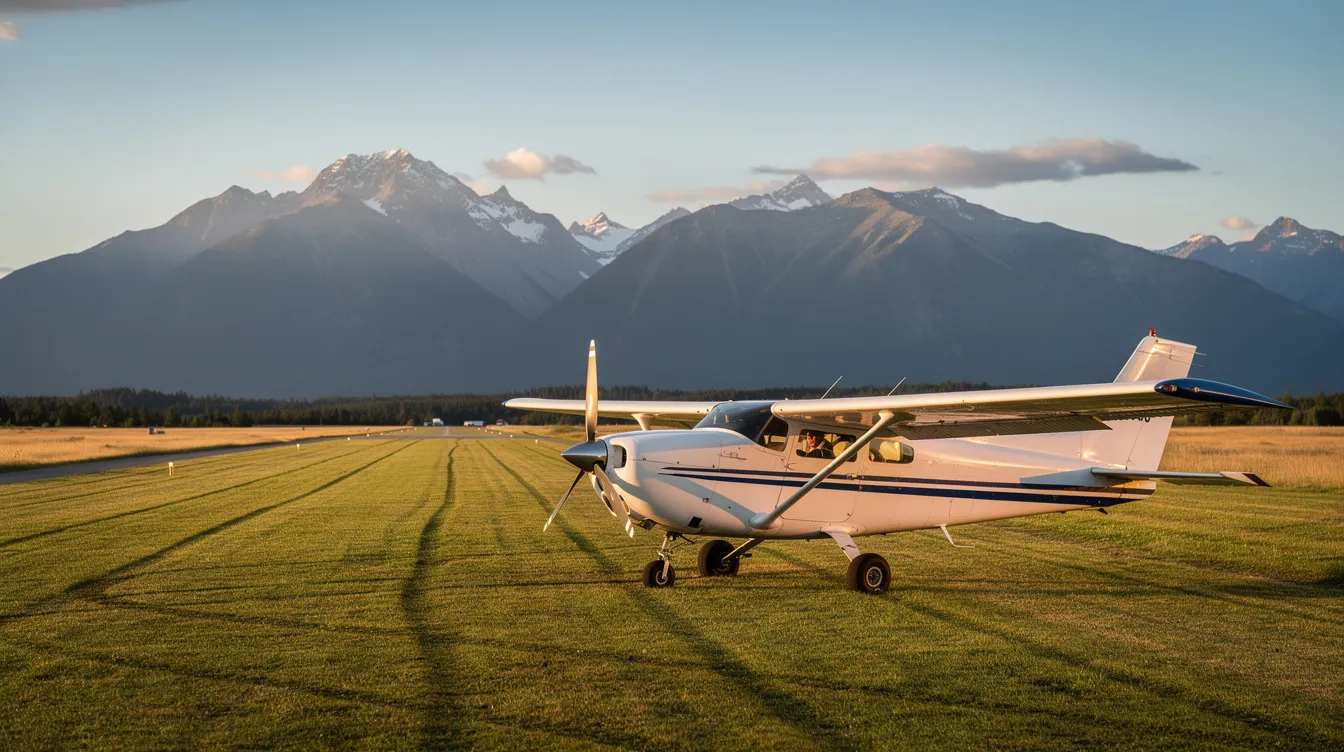
A plane’s weight capacity is set by its maximum takeoff weight (MTOW), and it ranges from just over 1,100 kg for a Cessna 172 to 575,000 kg for an Airbus A380, including the aircraft itself, fuel, passengers, and cargo. Between those extremes sits every aircraft category that matters to private and commercial travelers, each governed by strict weight limits that shape safety, range, fuel burn, and what you can bring aboard.
For frequent business travelers, Jet Card members, and high-net-worth leisure flyers comparing private aviation options, those limits directly affect aircraft choice, baggage allowance, passenger count, flight planning, and even how you evaluate jet card cost per hour across aircraft types. This guide breaks down aircraft weight categories, the key terms behind those limits, how weight changes performance and regulatory compliance, the differences between private jets and commercial airliners, and why fuel load, aircraft materials, and luggage all matter before departure.
At a Glance: How Much Weight Can a Plane Hold?
Aircraft from light piston trainers to super jumbos operate under maximum takeoff weight limits that vary by a factor of 500. Understanding airplane weight is not academic; it determines how many passengers fly, how much luggage fits, which airports are accessible, and whether a given route works nonstop.
Cessna 172 Skyhawk (light aircraft): MTOW ~1,157 kg (2,550 lb)
Embraer Phenom 300 (light jet): MTOW ~8,150 kg (17,968 lb)
Gulfstream G650 (heavy jet): MTOW ~45,178 kg (99,600 lb)
Boeing 737-800 (average passenger plane): MTOW ~79,000 kg (174,200 lb)
Airbus A380 (super jumbo): MTOW ~575,000 kg (1,268,000 lb)
How much weight a plane can hold equals its certified maximum takeoff weight. MTOW includes aircraft, fuel, passengers, and cargo. The number is set by the manufacturer, verified through structural and flight testing, and approved by regulators like the Federal Aviation Administration (FAA) and EASA.
BlackJet uses these weight figures to match Jet Card members with the right aircraft category for each mission, so flights are safe, efficient, and appropriately sized for the route and passenger count.
Key Airplane Weight Terms: Empty Weight, Fuel Weight, and Maximum Takeoff Weight
Answering "how much weight can a plane hold?" requires knowing three terms: empty weight, fuel weight, and maximum takeoff weight. Every other weight calculation in aviation builds from these.
Empty weight (also called basic empty weight or BEW) includes the aircraft structure, engines, fixed equipment, unusable fuel, and oil. It excludes usable fuel, passengers, baggage, and cargo. Basic Empty Weight includes the aircraft's weight and permanent equipment. For reference, a Boeing 737-800 has an empty weight of about 41,000 kg (~91,300 lb).
Fuel weight is calculated based on volume multiplied by density. Jet A fuel weighs approximately 0.8 kg per liter (~6.7 lb per U.S. gallon). On long flights, fuel weight can account for up to 40% of total takeoff weight. A Boeing 737-800 on a long domestic leg may carry about 20,000 kg of fuel.
Maximum takeoff weight (MTOW, sometimes written as max takeoff weight) is the certified structural and performance ceiling for any departure. It cannot be exceeded. MTOW combines empty weight, usable fuel, passenger and cargo payload, catering, and crew. Manufacturers define the limit; regulators certify it.
Related terms you will encounter later: maximum landing weight (MLW), which is often lower than MTOW due to structural stress constraints on the landing gear and airframe during touchdown. Zero Fuel Weight (ZFW) is the loaded plane's weight before adding fuel. Ramp weight (or maximum taxi weight) accounts for the fuel burned during taxi before takeoff.
How Much Do Different Types of Airplanes Weigh?
Airplanes weigh anything from a few hundred kilograms empty to over 575,000 kg at takeoff, depending on their mission: training, private charter, scheduled airline service, or heavy freight.
Light aircraft typically weigh between 500 and 1,200 kg empty, with MTOW under 5,670 kg (12,500 lb).
Very light jets and light jets: roughly 3,000 to 9,000 kg MTOW, often featured among the cheapest private jet options for new flyers.
Midsize and super-midsize jets: roughly 9,000 to 30,000 kg MTOW, sitting in the middle of the spectrum when you compare all major private jet types.
Heavy jets: up to ~45,000 to 48,000 kg MTOW.
Narrow-body airliners: narrow-body airliners weigh between 90,000 and 175,000 lbs (~41,000 to 79,000 kg) empty to MTOW. Narrow-body aircraft typically have MTOW around 150,000 to 190,000 kilograms in the broadest classification. Average commercial aircraft MTOW ranges from 110,000 pounds to over 775,000 pounds across all categories.
Wide-body and jumbo jets: wide-body aircraft commonly exceed 300,000 kilograms in MTOW, reaching up to 575,000+ kg for the Airbus A380.
Aircraft category influences cabin size, range, and airport access. For BlackJet members choosing between a light jet for a two-hour hop and a heavy cabin for a transatlantic crossing, the weight class determines what is physically possible on a given route and guides how you compare private jet sizes for your journey.
Light Aircraft and Small General Aviation Planes
Light aircraft are piston-powered or very small turboprop airplanes used for training, personal flying, and short regional hops. They sit at the bottom of the weight spectrum, and their payload sensitivity is extreme.
Empty weight: usually 500 to 1,200 kg.
MTOW: often 1,000 to 1,800 kg, always under 12,500 lb per general aviation certification rules.
Seating: 2 to 6 people depending on model.
Cessna 172 Skyhawk: empty ~762 kg (1,680 lb); MTOW 1,157 kg (2,550 lb). With full fuel, useful payload drops to roughly 254 kg (560 lb), enough for two average adults and minimal baggage.
Cirrus SR22: empty ~1,020 kg (~2,250 lb); MTOW ~1,634 kg (~3,600 lb).
On these lighter aircraft, adding even two passengers at 85 kg each plus 15 kg of carry on luggage each quickly eats into the fuel budget. Operators sometimes reduce fuel load or limit baggage to stay within weight limits. That payload constraint is one reason private jet operations begin at the light jet category for most business travelers; a light jet like the Phenom 300 carries seven times the maximum weight of a Cessna 172.
Private Jets and Turboprops: From Light Jets to Heavy Jets
Most BlackJet flights use private jets and turboprops across five categories: very light, light, midsize, super-midsize, and heavy. Private jets range from under 5,700 kg to 45,000 kg MTOW. Each step up in class adds passenger capacity, baggage volume, and range.
MTOW by category:
Very light jets usually weigh under 5,700 kg MTOW. They seat 4 to 6 passengers on short-range missions of one to two hours.
Light jets: ~5,000 to 9,000 kg MTOW, 6 to 8 passengers, regional routes. Light jets like the Embraer Phenom 300 have 8,150 kg MTOW.
Midsize jets typically have MTOW between 9,000 and 18,000 kg, seating 6 to 9 passengers for coast-to-coast U.S. flights.
Super-midsize jets: ~18,000 to 30,000 kg MTOW, 8 to 10 passengers, transcontinental or shorter international.
Heavy jets can reach up to 48,000 kg MTOW, carrying 10 to 16+ passengers on intercontinental routes, and are often the starting point when evaluating the best private jet for groups of around 20 passengers.
Specific aircraft data:
Aircraft | Category | Empty Weight | MTOW |
|---|
Embraer Phenom 300 | Light jet | ~5,350 kg | 8,150 kg |
Cessna Citation CJ4 | Light jet | ~4,700 kg | ~7,760 kg |
Bombardier Challenger 350 | Super-midsize | ~10,500 kg | ~18,400 kg |
Gulfstream G650 | Heavy jet | ~24,400 kg | 45,178 kg |
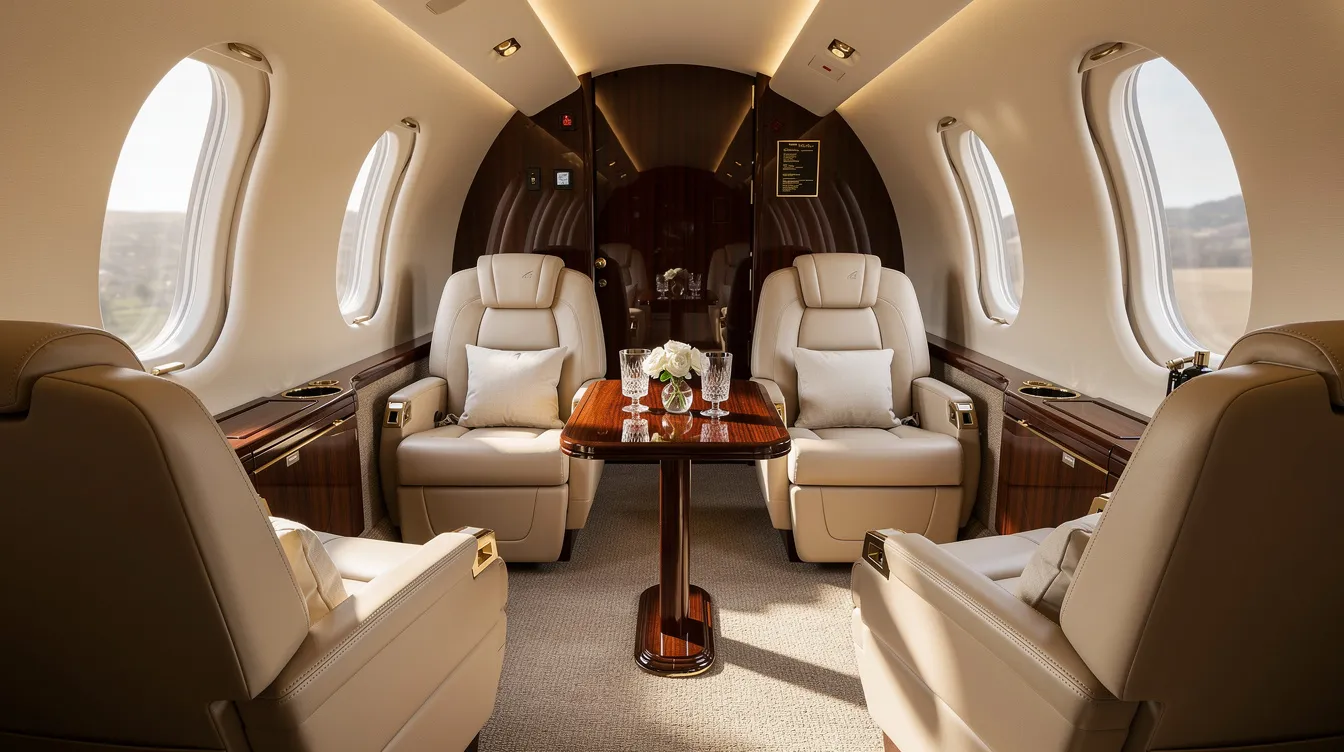
Airplane weight affects cabin volume and comfort, baggage allowance (skis, golf bags, oversized luggage), and range. A Gulfstream G650 can fly New York to London nonstop at full passenger count; a Phenom 300 is optimized for regional missions where luggage and passenger count are more modest.
Aircraft configurations influence maximum passenger and cargo capacities, which is why BlackJet's Jet Card model lets members choose the appropriate aircraft weight class per trip. A short flight with heavy baggage may call for stepping up to a super-midsize rather than cramming into a small private jet, and a Jet Card gives that flexibility without owning a single airframe, especially when you understand overall Jet Card cost and pricing.
Commercial Airliners and the "Average Passenger Plane"
When people ask about the average passenger plane, they usually mean a typical narrow-body airliner: a Boeing 737 or Airbus A320 family aircraft handling domestic and medium-haul flights with 150 to 190 passengers.
On a long domestic leg, the weight of the aircraft breaks down roughly as follows:
Empty weight (airframe, engines, fixed equipment): ~41,500 kg
Fuel load: ~18,000 to 20,000 kg
Remaining payload capacity for passengers, baggage, and cargo: ~17,500 to 20,000 kg up to MTOW
Standard passenger weights are set by aviation authorities. The FAA assumes roughly 84 to 86 kg per adult, including carry-on bags, for weight and balance calculations. Multiplied by 170 passengers on a typical 737-800 configuration, that is roughly 14,500 kg of passenger weight alone, leaving the remainder for checked luggage, mail, and belly cargo.
Compared with a heavy private jet like the Gulfstream G650, a 737-800's MTOW is about 75% higher. But the G650 offers far more cabin space per passenger and access to smaller executive airports, which is the core advantage of private aircraft and a key distinction when you compare different types of private jets for every traveler.
Jumbo Jets, Super Jumbos, and Cargo Giants
At the top of the scale, jumbo jets and dedicated cargo aircraft push airplane weight to its certified extremes. These machines require long runways, reinforced pavement, and specialized ground infrastructure.
Boeing 747-8: empty weight ~220,000 kg; MTOW ~447,700 kg.
Airbus A380-800: the Airbus A380 has a maximum takeoff weight of 575,000 kg (~1,268,000 lb), making it the world's largest passenger airliner. Empty weight: ~276,000 kg.
Antonov An-225: The Antonov An-225 had an MTOW of 640,000 kg before its destruction in 2022, one of the heaviest airplanes ever built. It served as a dedicated cargo aircraft capable of carrying outsized industrial equipment and relief supplies.
Passenger versions of these aircraft seat 400 to 800 people plus massive luggage and belly cargo. Cargo payload can significantly add to the airplane's total weight; freighter variants maximize floor load limits and volume to carry palletized freight. Runways for these aircraft often stretch 3,000+ meters (10,000+ ft), and taxiway and gate structures must be built to handle the load on the landing gear.
By contrast, heavy private jets offer superior privacy and access to smaller executive airports. A G650 weighs about 8% of an A380 at takeoff but delivers a cabin experience no airline can match for 10 to 14 passengers, and similar large-cabin aircraft are often the best private jet options for around 20 passengers on group charters.
How Airplane Weight Is Shared: Fuel, Passengers, and Cargo
An airplane's MTOW does not belong entirely to passengers. It must be allocated between the aircraft itself, fuel, and payload (people, baggage, freight). Real-world planning balances these three every time a flight is dispatched, with precise weight calculations used before departure to confirm current weight and balance.
Boeing 737-800 on a 4- to 5-hour route:
Empty weight: ~41,500 kg
Fuel for the route: ~18,000 to 20,000 kg
Remaining capacity up to MTOW (~79,000 kg): ~17,500 to 20,000 kg for passengers and cargo
Embraer Phenom 300 on a regional private mission:
Empty weight: ~5,350 kg
MTOW: ~8,150 kg
Leaves roughly 2,800 kg for usable fuel, passengers, baggage, catering, and crew
Cargo payload significantly adds to the airplane's total weight, and larger loads can also require stronger floors, loading equipment, and airport infrastructure. Standard average weights for passengers are set by aviation authorities, typically ~84 to 86 kg per adult including hand luggage. Operators multiply that assumption by passenger count to estimate total passenger weight. When actual weight deviates from those assumptions, particularly on small private jets or hot-and-high departures, operators may request actual weights from each traveler.
Weight distribution must keep the aircraft's center of gravity within safety limits. BlackJet's operations teams collect passenger numbers, estimated baggage weight, and luggage types in advance to confirm that every flight stays within certified limits while meeting range requirements, whether you charter the entire aircraft or simply buy a seat on a private jet through shared options.
Why Airplane Weight Matters: Safety, Performance, and Airport Access
Airplane weight affects almost every aspect of a flight: runway length requirements, climb gradient, fuel burn, and how far the aircraft can travel.
Safety:
Exceeding maximum takeoff weight is prohibited by aviation authorities. FAA and EASA regulations make takeoff above certified MTOW illegal for all operations.
Airplane weight impacts climb performance and obstacle clearance margins. An overweight aircraft may fail to meet required climb gradients after an engine failure during takeoff.
Performance:
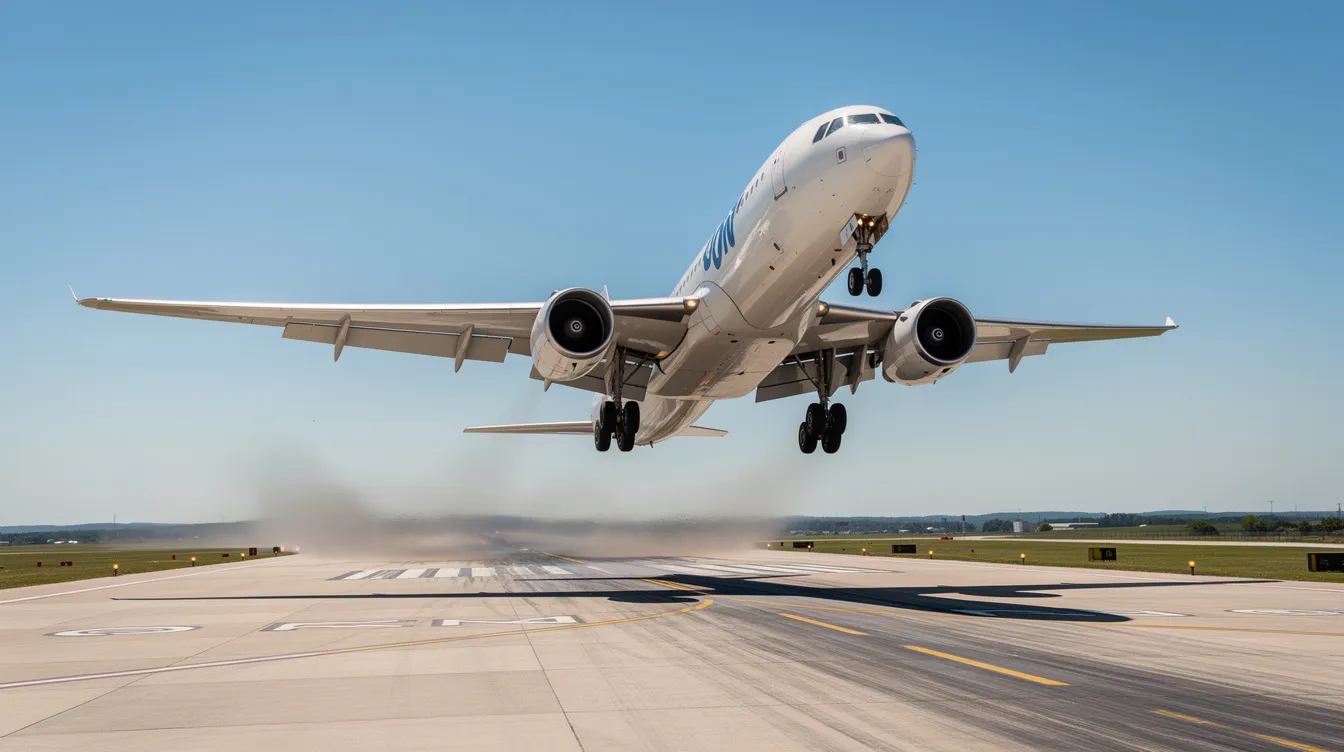
Heavier aircraft require longer runways and higher takeoff speeds. A fully loaded 737-800 at 79,000 kg needs a longer roll than the same aircraft departing at 70,000 kg.
Heavy airplanes may cruise at lower initial altitudes until they burn fuel and lighten, leading to higher fuel consumption early in the flight.
Range shortens when payload is maximized because less fuel can be carried for a given weight cap.
Airport access:
Air density decreases at high altitudes and high temperatures. Environmental conditions can reduce the amount of weight an aircraft can safely carry. Air density and altitude decrease engine performance and lift. Airports like Aspen (elevation 7,820 ft), Denver, or Mexico City may require weight reductions on hot days.
Runway length and condition affect the maximum takeoff weight allowed. Short-runway or steep-approach airports used by charter airplanes impose strict takeoff weight limitations.
Strong headwinds can improve lift, allowing higher weight limits on a given runway.
BlackJet's certified operators integrate safety margins, runway performance data, and real-time weather into every dispatch, ensuring aircraft performance margins are maintained on every member's itinerary.
Fuel Weight: How Much Does Airplane Fuel Weigh and Why It Matters?
Fuel is often the single largest variable affecting how much weight a plane can hold on any given flight. How much does airplane fuel weigh? That depends on the mission length and aircraft type.
Jet fuel (Jet A / Jet A-1) has a density of ~0.8 kg per liter (~6.7 lb per U.S. gallon at 15 °C).
A Boeing 737-800 on a long domestic leg carries ~20,000 kg of fuel, roughly half the aircraft's empty weight.
A fully fueled Boeing 777-300ER carries roughly 145,000 kg of fuel, nearly matching the airplane's empty weight (~168,000 kg), which has major implications for jet card pricing structures and surcharges on ultra-long-haul missions.
More fuel increases aircraft weight and fuel consumption. An aircraft burning fuel at a rate proportional to its total weight means the first hour of a heavy flight burns more fuel per nautical mile than the last hour.
The trade-off between fuel weight and payload is constant: to fly farther nonstop, aircraft may need to reduce passengers, baggage, or freight to stay below MTOW. On shorter stages, operators may tanker less fuel to maximize payload capacity and reduce weight-related fuel burn.
BlackJet's real-time support team optimizes fuel load and routing for members, balancing nonstop convenience, reserves, and efficient fuel consumption. Where possible, newer, more fuel-efficient aircraft are selected. Remaining emissions are offset to keep flights carbon neutral.
How Can Something So Heavy Fly? Weight, Lift, and Balance Explained Simply
How can an Airbus A380 weighing over 575,000 kg or a heavy private jet at 45,000 kg get airborne? The answer comes down to forward speed, wing design, and angle of attack.
Wings generate lift when air flows faster over the curved upper surface than the flat lower surface, creating a pressure difference. At sufficient forward speed and angle of attack, lift equals or exceeds the weight of the aircraft, and the airplane leaves the ground.
Heavier airplanes need more lift. That comes from larger wings, higher speeds, or both.
Typical rotation speeds:
Center of gravity and balance:
The center of gravity (CG) must stay within certified limits for controllability throughout the flight. Passenger seating, baggage placement, and fuel distribution all shift the CG. Weight and balance calculations are performed before every departure. Think of loading a large yacht: where you place heavy items affects how it handles. In an aircraft, the margin between safe and unsafe CG can be just a few hundred kilograms of misplaced load.
BlackJet's operators use detailed weight and balance software and standardized loading procedures to confirm that every flight operates within safe CG and weight limits.
Do Newer Aircraft Weigh Less? How Materials and Design Shape Airplane Weight
Newer aircraft weigh less per unit of structural strength, even if their MTOW figures are similar to or higher than predecessors. The difference is in airframe materials.
Traditional airliners and older aluminum alloy designs relied on riveted aluminum alloy panels and stringers.
Modern planes like the Boeing 787, Airbus A350, and Gulfstream G500/G600 use carbon fiber composite materials for up to ~50% of the aircraft structure. Composites can reduce structural empty weight by up to ~20% compared with older aluminum designs of similar size.
Operational impact:
Lower empty weight allows more fuel or payload for the same MTOW. A lighter aircraft can fly farther or carry more.
Improved fuel efficiency translates to longer range, reduced emissions, and lower operating cost per hour. Airframe materials play a direct role in fuel efficiency because every kilogram saved in structure is a kilogram available for fuel or passengers.
A 1990s-era wide body aircraft may burn 15 to 25% more fuel per seat than a comparable modern composite wide-body aircraft on the same route.
Newer aircraft weigh less in structural terms, which means they deliver more usable payload. BlackJet prioritizes access to newer aircraft categories where available, including budget-friendly private aircraft options that balance operating costs with performance. For remaining emissions, BlackJet offsets carbon to keep every flight carbon neutral.
How Airplane Weight Affects What You Can Bring on a Private Jet
For travelers, airplane weight translates to a practical question: how much luggage, sports equipment, pets, and special cargo can you bring?
Key constraints:
Payload capacity equals MTOW minus empty weight minus required fuel. On short flights, more of the airplane's weight capacity is available for passengers and bags. On long flights, more must go to fuel.
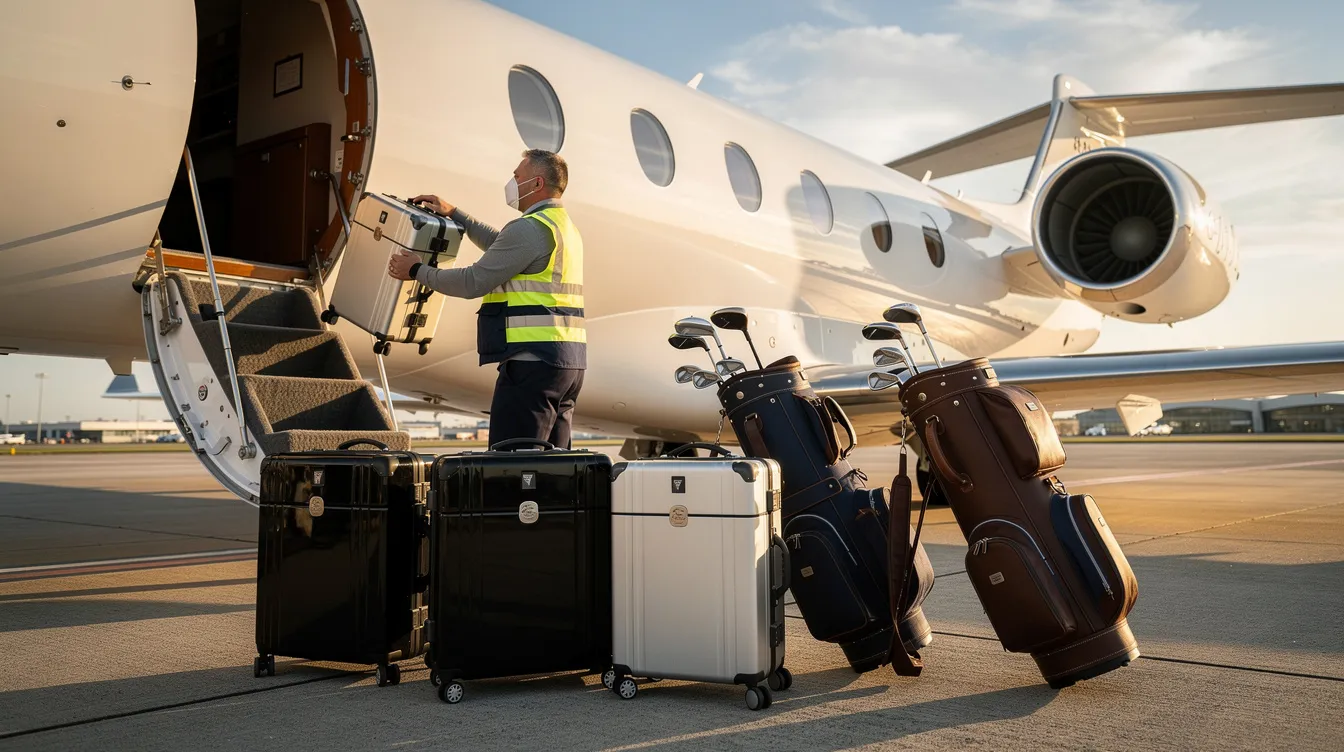
Light jets (Phenom 300, Citation CJ4) with 6 to 8 passengers and standard carry on luggage may be near their payload limit. Adding ski bags, golf clubs, or large suitcases may require reducing passenger count or stepping up to a larger jet.
Heavy jets (G650) allow more generous baggage and passenger weight, suitable for 10 to 14 travelers with long-haul luggage and even pets, and they are a common choice for travelers considering a 100 hour jet card cost guide to lock in predictable long-range access.
Standard passenger weight assumptions in private jet operations:
Operators typically assume 84 to 90 kg per adult, including carry-on bags. For unusual loads (large groups, children, pets, oversized items, or hot-and-high airport departures), operators may ask for actual weight figures in advance, which also influences how you evaluate 50-hour jet card cost and value for your typical trip profile.
How BlackJet handles this:
During trip planning, the team confirms passenger count, estimated passenger weight, luggage type (hard cases, soft bags, skis, surfboards, golf bags), and any bulky items. Based on those inputs, the team recommends the aircraft category that keeps everyone within weight limits without forcing you to limit baggage or compromise comfort. If you need to know how much luggage a given aircraft can carry, BlackJet's advisors provide exact breakdowns before you book. How Do Jet Cards Work explains the flexibility of choosing different aircraft for different trips, and the BlackJet 25+ Hour Jet Card gives fixed-rate access to mid, super-mid, and large cabin jets for that flexibility.
Frequently Asked Questions About How Much Weight a Plane Can Hold
These questions cover the most common searches about airplane weight, from how much charter airplanes weigh to who sets maximum takeoff weight limits.
How much weight can an average passenger plane hold?
A Boeing 737-800 has an MTOW of 79,000 kg; an Airbus A320neo reaches ~79,000 to 82,000 kg. Empty weight runs ~41,000 to 44,000 kg. After subtracting fuel load for the route, payload for passengers and cargo is roughly 15,000 to 20,000 kg.
How much does airplane fuel weigh on a typical flight?
Jet A density is ~0.8 kg per liter. A 737-800 on a long domestic leg carries ~20,000 kg. A wide-body aircraft on a long-haul route can carry over 100,000 kg. Fuel weight can account for up to 40% of total takeoff weight.
How much does a light aircraft weigh compared with a light jet?
A Cessna 172 has an MTOW of 1,157 kg. An Embraer Phenom 300 has an MTOW of 8,150 kg: about seven times heavier, with proportionally greater range, speed, and payload capacity.
Who sets maximum takeoff weight limits?
The manufacturer defines design limits through structural and flight testing. Regulatory authorities (FAA, EASA, Transport Canada, and others) certify them under rules like FAA Part 25 for transport-category aircraft or Part 23 for general aviation. Certified MTOW is legally binding. Exceeding MTOW is prohibited by aviation authorities.
Does passenger weight really matter on a private jet?
Yes. Passenger weight and distribution affect both payload and balance. On light jets, the margin between safe and overweight can be tight. Operators use standard passenger weights for routine flights and request actual weights when loads are unusual, which is also important for accurately tracking expenses and potential jet card tax deductions on business travel.
Do newer aircraft weigh less than older models?
Newer aircraft often have lower empty weights relative to capacity thanks to composite airframe materials and more efficient engines. For the same MTOW, a modern aircraft can carry more payload or more fuel than an older model, and at the very top of the market this is visible in the most expensive private jets and their ultra-luxury configurations.
For specific weight breakdowns on charter airplanes or different plane categories, BlackJet's team can provide exact figures tailored to your upcoming trip, and you can also review a detailed private jet price list with costs and options to align aircraft choice with budget.
Conclusion: Understanding Airplane Weight When You Fly or Charter with BlackJet
Airplanes weigh from under 1,000 kg (light aircraft) to over 575,000 kg (the Airbus A380). A plane's ability to hold weight is defined by its maximum takeoff weight, which combines empty weight, fuel weight, and passenger and cargo payload. That number determines safety margins, aircraft performance, airport choices, how much luggage you can bring, and whether a route works nonstop.
BlackJet ensures every flight is planned with expert weight and balance analysis, vetted operators, and access to modern, fuel-efficient aircraft. The Jet Card model gives you the freedom to choose the right aircraft weight class per mission: a light jet for a short regional hop, a heavy jet for a transatlantic crossing, without owning a single airframe, all within BlackJet's broader premium private jet card programs.
Explore BlackJet Jet Card options or speak with an advisor to discover which aircraft category and weight profile fit your typical routes, luggage needs, and airport preferences.


 Sign up with google
 Sign up with Apple