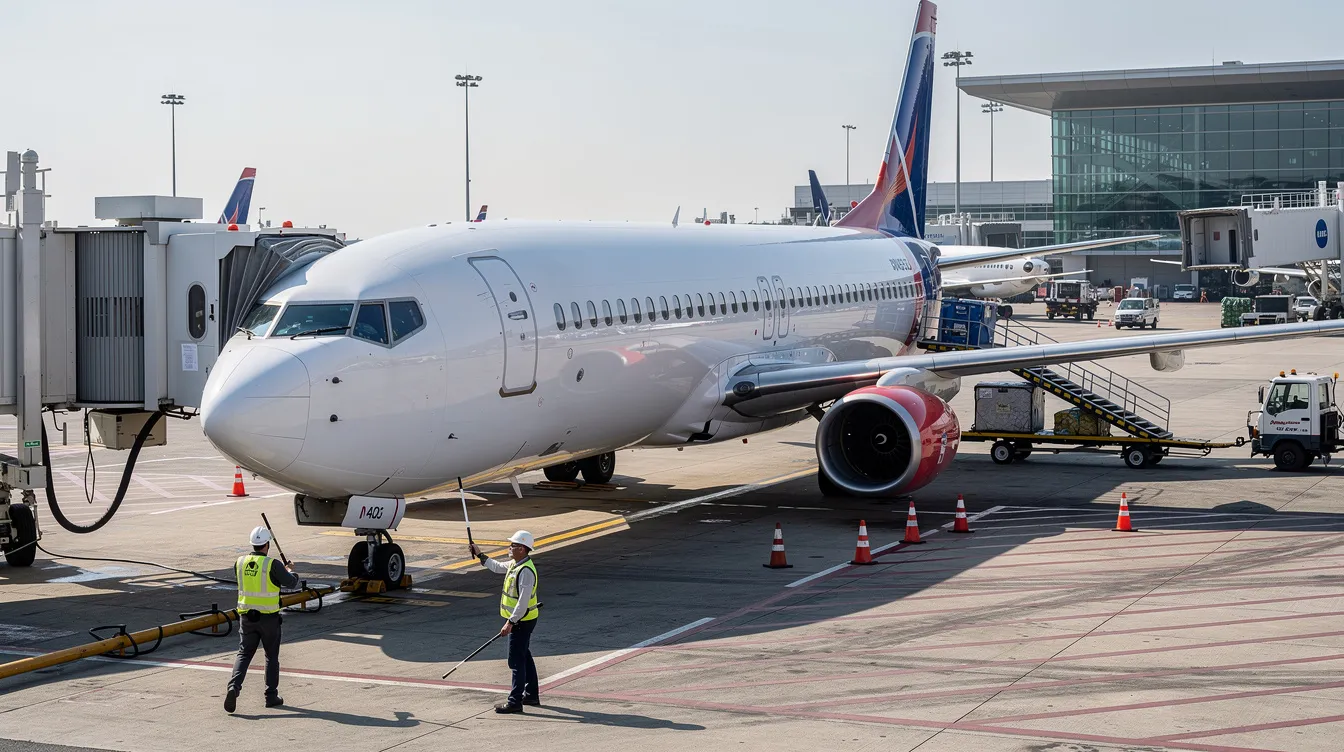
Key Takeaways: How Much Fuel Does A Boeing 737 Hold?
A Boeing 737 typically holds between 4,720 and 6,875 U.S. gallons of jet fuel in standard configurations, depending on the generation and variant. With auxiliary tanks on select models, that number can exceed 7,800 gallons.
Fuel capacity varies across generations and models of the Boeing 737: Original and Classic series hold roughly 4,700 to 5,300 gallons, while Next Generation and 737 MAX variants carry approximately 6,800 to 7,800 gallons with auxiliary tank options.
At typical jet fuel density, 6,875 gallons weigh about 46,000 pounds (roughly 21,000 kg). That fuel is stored primarily in wing tanks and a center tank located in the fuselage/wing box area.
Most Boeing 737 commercial jets burn approximately 750 to 900 gallons per hour during cruise, making fuel the single largest variable cost on every flight.
For context: a well-loaded 737 achieves roughly 70 to 100 miles per gallon per passenger, placing its per-person fuel use in a range comparable to a fuel-efficient car carrying one occupant over the same distance.
Introduction: Why 737 Fuel Capacity Matters In Commercial Aviation
A Boeing 737 typically holds about 4,720 to 6,875 U.S. gallons of jet fuel in standard configurations, and some variants with auxiliary tanks can carry more than 7,800 gallons. As the best-selling commercial jet in history, with over 11,000 delivered since 1967, the 737 gives frequent business travelers, high-net-worth leisure flyers, and anyone comparing commercial airline efficiency with private aviation a practical benchmark for what fuel capacity means in real-world travel.
That capacity affects airline fuel costs, ticket prices, operating range, and aviation emissions, so understanding a 737’s fuel load helps put fuel-efficiency claims, flight costs, and travel choices into concrete terms. It also gives readers evaluating commercial service against private flying a clearer baseline for how aircraft size, mission, and efficiency differ.
This article breaks down 737 fuel capacity across every major generation, from the Original series through the 737 MAX, along with fuel burn rates, fuel stored in the wings and center tank, how airlines plan fuel loads, fuel cost implications, and why they rarely fill the tanks completely. It also compares commercial jet fuel use with private jet travel and shows how BlackJet applies the same planning and efficiency principles in private aviation and its premium Jet Card programs.
Boeing 737 Generations And Why Fuel Capacity Differs
Boeing has produced four main generations of the 737: Original, Classic, Next Generation (NG), and 737 MAX. Each brought structural changes to the wings, engines, and maximum takeoff weight that altered both fuel capacity and range.
Original (-100/-200): The smallest tanks and shortest range. These were early short-haul workhorses designed for routes under 2,000 nautical miles.
Classic (-300/-400/-500): Larger tank size, improved jet fuel efficiency, and more powerful CFM56 engines gave the Classic series a meaningful range and payload advantage.
Next-generation models (-600/-700/-800/-900): Redesigned wings with greater span and volume, significantly higher fuel capacity, and optimized aerodynamics for longer routes. Boeing focused heavily on reducing fuel burn per seat.
737 MAX (7/8/9/10): Similar fuel capacity to the NG family, but the LEAP-1B engines, split-tip winglets, and lighter materials deliver double-digit fuel consumption reductions per seat.
While total fuel capacity changed only moderately from NG to MAX, fuel use per mile improved substantially thanks to newer engines, aerodynamic refinements, and better flight management systems.
Boeing 737 Fuel Capacity By Major Variant
Below are approximate usable fuel figures for each main 737 family. "Usable fuel" means the volume that the aircraft can actually deliver to the engines, excluding small amounts trapped in lines or low points.
737-200 (Original): approximately 4,720 gallons (~17,870 liters). Original series models hold between 4,720 and 5,311 gallons of fuel, depending on configuration.
737 Classic series (-300/-400/-500): roughly 5,300 gallons in standard configurations, consistent across the -300, -400, and -500 variants.
737 NG (-700/-800/-900): approximately 6,875 gallons standard. Next-generation models hold approximately 6,875 to 7,837 gallons of fuel when equipped with auxiliary tanks on high-range versions.
737 MAX family: around 6,800 to 6,900 gallons in typical configurations, with the MAX sharing a common fuel system architecture across its variants.
Exact numbers vary by airline configuration and whether optional auxiliary tanks are installed. Route planners consider both total fuel capacity and the maximum takeoff weight limit when deciding how much fuel to load for a given flight plan.
How Much Fuel Does A 737-800 Hold?
The 737-800 is one of the most common single-aisle aircraft in the global fleet. Airlines including American Airlines, Ryanair, and Southwest operate hundreds of them daily.
Standard usable fuel capacity: approximately 6,875 U.S. gallons of jet fuel. The 737-800 typically holds about 6,875 gallons of fuel.
With two auxiliary tanks installed (common on Boeing Business Jet variants and some special-mission configurations), capacity rises to approximately 7,837 gallons.
Fuel weight: 6,875 gallons at roughly 6.7 pounds per gallon comes to about 46,000 lb (approximately 21,000 kg). Jet fuel weighs approximately 6.7 pounds per gallon.
Range: Modern 737-800 and 737 MAX variants can cover ranges of 3,000 to 3,500 nautical miles with standard passenger loads.
For a concrete route example, consider a Chicago O'Hare to Los Angeles flight, roughly 1,500 nautical miles. That trip uses only about half of the 737-800's full fuel capacity, leaving a healthy safety margin for reserves, alternate airports, and wind conditions.
How Much Fuel Does A 737 MAX Hold?
The 737 MAX family (MAX 7, 8, 9, and 10) is Boeing's latest generation of single-aisle commercial jets, designed to replace the NG series on short- and medium-haul routes worldwide.
The 737 MAX 8 holds around 6,820 gallons of usable fuel.
Other MAX variants (7, 9, 10) fall in a very similar range, since all share the same engines and a common fuel system architecture.
Although tank size is nearly identical to the 737-800, the 737 MAX uses 20 to 30% less fuel than older models. That improvement comes from the LEAP-1B engines, Advanced Technology Winglets, and lighter structural materials.
Cruise burn rate for a MAX 8 under typical conditions runs approximately 720 to 750 gallons per hour, compared with roughly 850 gallons per hour for a comparable NG aircraft.
The improved fuel efficiency directly lowers fuel costs and CO₂ emissions per seat. That is the primary reason airlines on fuel-sensitive routes have aggressively ordered the 737 MAX. United Airlines, for example, has ordered hundreds of MAX aircraft, specifically citing fuel burn reductions as a core driver.
Where Does All That Fuel Go On A Boeing 737?
Fuel on a 737 is not stored in a single large container. It is distributed across several tanks designed to maintain structural balance and keep the center of gravity within safe limits throughout the flight.
Wing tanks: The left and right wing tanks are the primary storage locations, integrated into the wing structure itself. These are always filled first and drained last.
Center tank: Located in the fuselage at the wing box area, the center tank is used primarily on longer flights that require more fuel than the wings alone can hold.
Auxiliary tanks: Some high-range versions, especially Boeing Business Jet variants, can add multiple tanks in the lower cargo hold to increase capacity for long-distance flight missions.
Fuel flow sequence: Crews burn fuel from the center tank first, then transition to wing tanks. This sequence keeps all that fuel balanced so the aircraft's center of gravity remains within certified limits.
Ground use: A small amount of fuel powers the APU (auxiliary power unit) on the ground, which provides electrical power and air conditioning to the cabin before the main engines start.
The flight deck displays show real-time fuel flow and tank levels throughout the flight, giving pilots continuous visibility into fuel state.
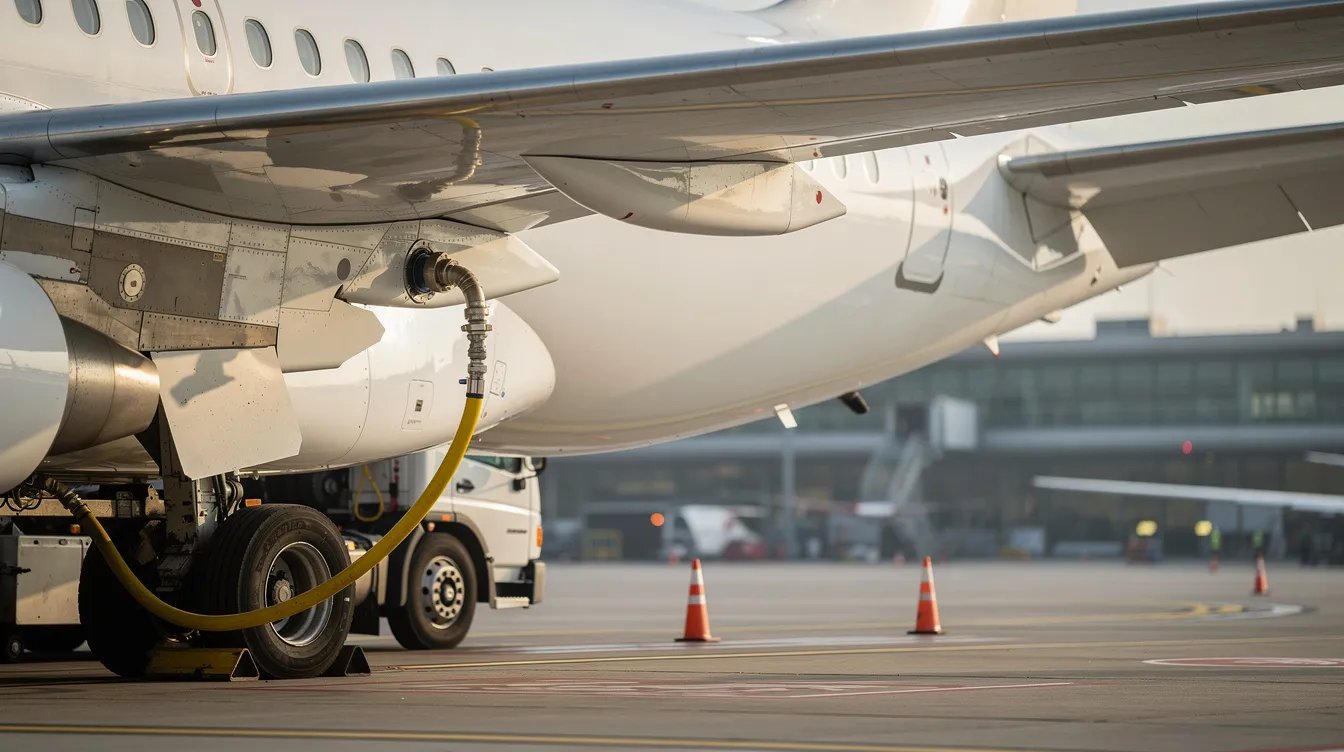
How Much Fuel Does A 737 Use Per Hour?
Fuel burn depends on aircraft weight, cruising altitude, speed, and weather, but average ranges are consistent enough to be useful for comparison.
A Boeing 737 burns approximately 750 to 900 gallons per hour during cruise. That translates to roughly 5,000 to 6,000 pounds of jet fuel consumed every hour.
Heavier fuel load, low altitude operations, or strong headwinds push the burn rate toward the higher end of that range.
Taxi, takeoff, and initial climb are less fuel-efficient on a per-minute basis. Takeoff alone, with engine thrust near maximum thrust levels, can consume 5 to 10% of total trip fuel.
Newer jets like the 737 MAX cruise at the lower end of the burn rate range (720 to 750 gallons per hour) due to their more fuel-efficient engines and reduced drag from advanced winglets.
A simple example: a 2.5-hour flight at approximately 850 gallons per hour on a 737-800 would burn about 2,100 to 2,300 gallons in the air, plus ground fuel for taxi and APU operations.
Fuel Use On A Typical 737 Flight: A Concrete Example
Consider a Boeing 737-800 commercial flight from Miami (MIA) to New York JFK, with a block time of approximately 2.5 hours and a passenger count of 160.
Total fuel uplift for this route: roughly 2,700 to 3,000 gallons, including all required reserves.
In-flight burn: A 737 burns about 2,200 gallons for a 2.5-hour flight covering the trip portion itself.
Remaining fuel on landing: Approximately 500 to 800 gallons covers contingency fuel, alternate fuel for a potential diversion, and the final regulatory reserve.
Per-passenger fuel use: Dividing 2,200 gallons by 160 passengers yields roughly 14 gallons per passenger for the total trip fuel.
For comparison, driving the same Miami-to-New York distance (roughly 1,280 miles) in a fuel-efficient car averaging 35 miles per gallon would require about 37 gallons per person traveling alone, whereas someone choosing to buy a seat on a private jet along the same corridor trades some fuel efficiency for time savings and comfort. Per person, the 737 is surprisingly efficient when operated at or near full capacity.
Airlines also use reduced-thrust takeoffs when runway length allows, cutting engine thrust below maximum levels to save fuel and reduce engine wear during departure.
Fuel Efficiency: 737 Versus Other Commercial Jets
The Boeing 737 is a narrow-body jet optimized for short- and medium-haul flights, while wide-body airliners cover long intercontinental routes. Here is how fuel capacity compares across different aircraft types:
Boeing 737 NG / MAX: approximately 6,800 to 7,800 gallons fuel capacity
Boeing 787-9: roughly 33,000 gallons
Boeing 777-300ER: over 47,000 gallons
Boeing 747-400: 57,000 gallons or more
Large long haul jets carry far more fuel, but they also seat 250 to 400+ passengers and cruise for 10 to 16 hours. Under optimal conditions, per-passenger fuel efficiency on a well-loaded widebody can be comparable to a typical commercial jet like the 737 on a medium-haul route.
Both narrow-body and wide-body aircraft types aim for roughly 70 to 100 miles per gallon per passenger when cabin occupancy is high. Aircraft size alone does not determine efficiency; load factor and route distance matter just as much.
Fuel Capacity, Payload, And Range Trade-Offs On A 737
Having large fuel tanks does not mean airlines can always fill them. The maximum takeoff weight caps the combination of passengers, cargo, and fuel on every departure.
Fuel load vs. payload: Adding more fuel means less room for passengers and cargo, or vice versa. On a short hop, filling the tanks wastes payload capacity. On a long route near the 737's limit, airlines may board fewer passengers or reduce cargo to carry enough fuel.
How much payload an airline can carry depends on the gap between operating empty weight and the MTOW limit. Every additional gallon of fuel needed for range comes at the expense of revenue-generating weight.
Performance constraints: Runway length, ambient temperature, and airport elevation all affect how much weight the aircraft can safely lift. A hot day in a Middle Eastern hub, for example, may force a reduction in fuel load or passenger count.
Landing gear limits: The maximum landing weight also constrains operations; an aircraft loaded with maximum fuel that needs to land shortly after takeoff (due to a diversion) may need to dump or burn fuel first.
Fuel affects aircraft performance in takeoff, climb, cruise, range, and landing efficiency. Dispatchers balance these factors on every single flight.
Why Airlines Care So Much About 737 Fuel Efficiency
Jet fuel is typically one of the largest operating expenses for airlines, often accounting for 20 to 30% of total direct costs. Volatility in global oil markets can swing an airline's quarterly profit by tens of thousands of dollars per aircraft, per month. Better fuel efficiency helps airlines protect margins and offer more competitive ticket prices.
Even a 1 to 2% improvement in fuel efficiency translates into millions of dollars saved annually across a fleet of 737 aircraft. Here is how airlines pursue those gains:
Investing in newer aircraft: Replacing older 737 Classics with 737 MAX models cuts fuel consumption per seat by double-digit percentages. Newer jets pay for themselves partly through fuel savings.
Winglet installations: Boeing's split-tip winglets reduce aerodynamic drag, lowering the burn rate by roughly 1.5 to 2% on a typical commercial flight.
Optimizing flight plans: Airlines use sophisticated routing software that accounts for wind conditions, cruising altitude selection, and speed schedules to minimize fuel needed for each trip.
Reducing onboard weight: Lighter seats, digital manuals on the flight deck instead of paper, and careful catering loads shave pounds that compound into fuel savings over thousands of flights.
Single-class layout configurations on some carriers (like Ryanair) maximize passenger count per flight, improving fuel efficiency per seat even further.
Better fuel efficiency also directly reduces CO₂ emissions, helping airlines meet regulatory targets and sustainability commitments. The environmental impact of aviation is tied directly to how much fuel each aircraft burns.
Jet Fuel Basics: What Kind Of Fuel Does A 737 Use?
Boeing 737 aircraft use turbine fuel, specifically Jet A or Jet A-1, not automotive gasoline or aviation gasoline (AvGas, used only in small piston-engine aircraft).
Fuel type: Kerosene-based jet fuels are designed for turbine engines operating at high altitude and low temperatures. They have high energy density and a low freezing point compared with standard gasoline.
Density: Approximately 6.5 to 7.0 pounds per U.S. gallon (about 0.8 kg per liter), though the exact figure shifts with temperature. Pilots and dispatchers plan fuel by weight (pounds or kilograms), not volume, because weight determines aircraft performance.
AvGas distinction: Aviation gasoline powers small piston aircraft with reciprocating engines. A 737's LEAP-1B or CFM56 turbofan engines cannot run on AvGas; the same engines across a 737 fleet all require Jet A or Jet A-1.
Sustainable aviation fuel (SAF) is a drop-in replacement blended with conventional Jet A on selected routes. SAF reduces lifecycle carbon emissions without requiring engine or fuel system modifications.
How Fuel Capacity Impacts Fuel Costs For Airlines
How much fuel a 737 can carry, and actually does carry, drives major cost decisions on every route.
At a retail airport price of $4 to $6 per gallon (prices vary by location and contract), filling a 737-800's tanks to full 6,875-gallon capacity costs roughly $27,500 to $41,250 before discounts.
Airlines rarely pay retail. They negotiate supply contracts and use hedging strategies to manage price volatility in global oil markets. A large carrier might lock in prices months or years ahead, smoothing out fuel costs that would otherwise swing with crude oil.
Planning the right fuel load is one of the most direct levers for controlling operating costs. Carrying extra fuel increases overall aircraft weight and hourly fuel consumption, so dispatchers calculate the minimum safe fuel load for each route, plus mandated reserves.
On some routes, airlines "tanker" fuel by uplifting extra at a cheaper airport to avoid buying expensive fuel at the destination. This saves money on fuel price but costs more fuel to carry the extra weight.
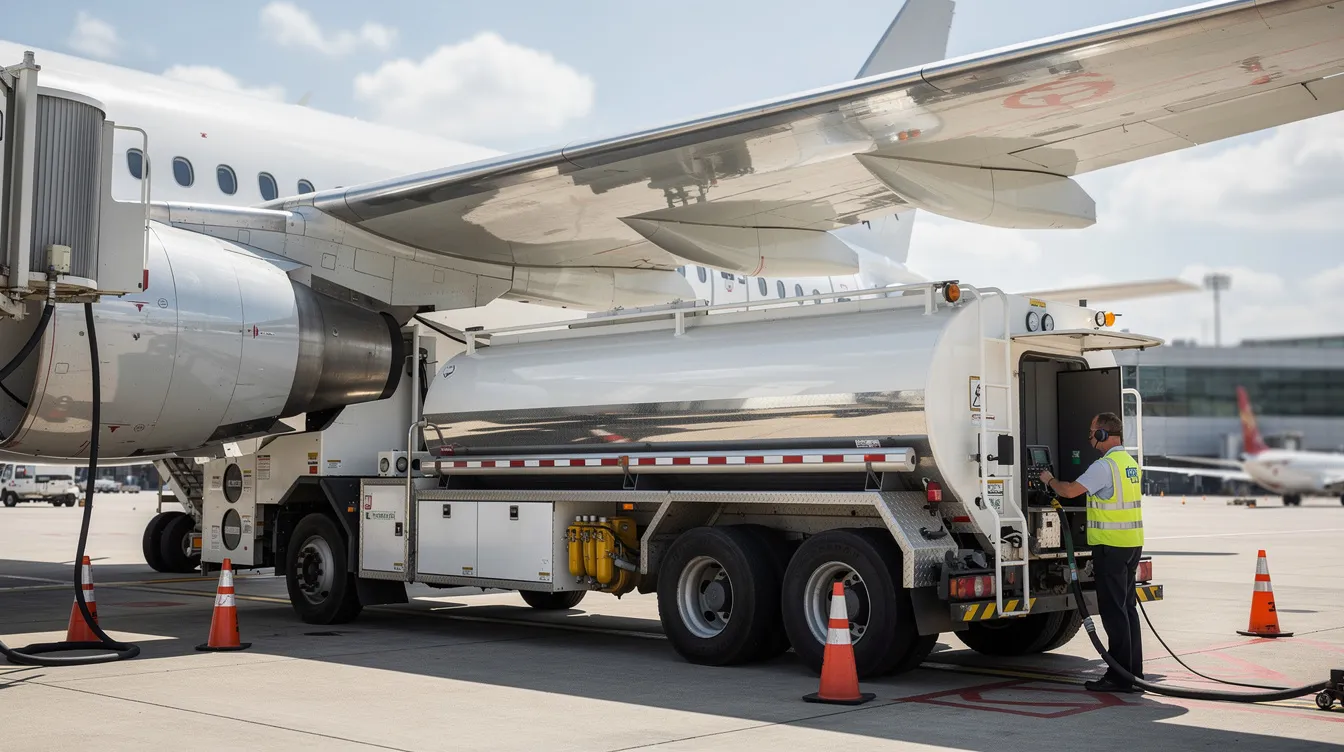
Why Planes Don't Always Fill Their 737 Tanks To The Top
Carrying unnecessary fuel is counterproductive. More fuel means more weight, and more weight means higher fuel burn, reducing overall fuel efficiency.
Dispatchers load only what the flight plan requires, broken into specific categories:
Trip fuel: The fuel needed to fly from departure to destination under planned conditions.
Contingency fuel: An additional buffer, typically 3 to 5% of trip fuel, covering minor route deviations, unexpected weather, or air traffic delays.
Alternate fuel: Enough fuel to fly from the destination to a designated alternate airport if a diversion is necessary.
Final reserve: A regulatory minimum (usually 30 to 45 minutes of flight time) that must remain in the tanks upon landing, providing a safety margin for unexpected holding or go-arounds.
Tanks are filled close to capacity only on flights near the aircraft's maximum range, or where en-route fuel availability is uncertain. On a short domestic hop, a 737 might depart with less than half its tanks filled because carrying full fuel would waste money and burn more fuel unnecessarily.
Fuel Efficiency Per Passenger: Is A 737 Fuel Efficient?
Fuel efficiency in commercial aviation is best measured per passenger mile, not by total gallons burned. By that measure, a well-loaded 737 performs well.
A 737 burns about 0.2 to 0.3 gallons per passenger per mile on a typical route.
That translates to roughly 70 to 100 miles per gallon per passenger when the cabin is at or near capacity. Modern jets achieve these figures consistently on medium-haul routes.
By comparison, a modern fuel-efficient car averaging 35 mpg with a single occupant covers 35 passenger-miles per gallon. A 737 with 160 passengers aboard beats that figure by a factor of two or more.
The 737 MAX family pushes these numbers further, reducing fuel burn per seat by 20 to 30% compared with the Original and Classic series variants.
The key variable is the load factor. A half-empty 737 in a single-class layout with 189 seats burns the same total fuel as a full one, so per-passenger efficiency drops sharply when fewer passengers are on board.
From Airline Operations To Private Jet Travel: Why 737 Fuel Numbers Matter
Understanding how much fuel a Boeing 737 holds gives travelers a baseline for comparing energy use across different modes of flight. The 736,800-to0 to 7,800-gallon fuel capacity anchors one end of the spectrum, whether you are flying commercial or arranging private jet charters in Karachi and other major cities worldwide.
Light and midsize business jets typically carry 1,000 to 2,500 gallons of fuel, enough for regional and transcontinental trips, and can be among the cheapest private aircraft options for cost-conscious travelers.
Large long-range private jets may carry 4,500+ gallons, still well below a widebody airliner but sufficient for nonstop intercontinental routes, with select models configured as the best private jets for around 20 passengers.
Commercial jets like the 737 achieve excellent per-seat efficiency because they spread fuel consumption across 150 to 190 passengers. Private jets trade some of that per-seat efficiency for privacy, schedule flexibility, and access to smaller airports.
BlackJet's 25+ Hour Jet Card members fly aircraft where fuel costs and efficiency are already optimized by type and routing. The operational details, from fuel load to reserve calculations, are handled by vetted operators so clients focus on their schedule rather than fuel spreadsheets.
How BlackJet Optimizes Fuel-Efficient Private Jet Travel
BlackJet is a private aviation provider that helps clients access jet travel while keeping fuel efficiency, safety, and sustainability built into every trip, for travelers evaluating whether chartering a private jet is worth it. Unlike operating a Boeing 737, private jet clients do not see line-item fuel charges, but fuel costs heavily influence charter pricing and Jet Card hourly rates.
BlackJet works with operators who deploy modern, fuel-efficient aircraft matched to each cabin class and mission distance, helping clients understand how much it costs to rent a private jet for specific routes. A light jet handles a 90-minute hop; a super-midsize covers a transatlantic leg. Right-sizing the aircraft prevents burning more fuel than the trip requires.
Digital flight planning tools match aircraft type and range to each trip, factoring in passenger count, baggage, distance, and weather to minimize unnecessary fuel burn.
Every BlackJet flight is carbon neutral. Emissions tied to fuel use are automatically offset through verified programs, at no additional cost to the client.
By benchmarking against how commercial jets like the 737 manage fuel capacity and efficiency, BlackJet selects aircraft that deliver strong efficiency per passenger for private itineraries.
Safety, Certification, And Fuel Planning In Private Aviation
Airlines rigorously plan 737 fuel loads under strict regulatory frameworks. Certified private operators follow the same discipline for every departure, whether an aircraft is chartered on demand or arranged through a longer-term private jet leasing program.
BlackJet works exclusively with safety-certified operators whose crews fflyat altitudes comparable to or higher than commercial airliners for smoother, more efficient routes, as described in our guide on how high private jets fly compared to commercial flights:
Calculate trip fuel, contingency fuel, alternate fuel, and final reserve fuel using the same methodology as airline dispatchers operating under Part 135 regulations.
Account for runway length, airport elevation, temperature, and passenger load when determining how much fuel to uplift.
Use standardized procedures to confirm adequate fuel on board for unexpected delays, holding patterns, or diversions.
Verify that each flight operates within the aircraft's maximum takeoff weight limit, balancing fuel needed against passenger and baggage weight.
Clients experience this as a single trip confirmation with a departure time and aircraft type. The fuel planning, weight calculations, and reserve requirements happen behind the scenes, managed by professionals whose job is to eliminate guesswork from the process.
Sustainability: From 737 Fuel Efficiency To Carbon-Neutral Private Flights
Improvements in 737 fuel efficiency reflect a broader industry push toward lower carbon emissions per seat mile. Several trends are accelerating this shift:
Engine and wing technology: Each new generation of 737 has cut fuel consumption per seat. The LEAP-1B engine on the MAX family represents a step change, but even older NG models with blended winglets outperform the Classics they replaced.
Sustainable aviation fuel: SAF blends are now certified for use in commercial and private turbine aircraft, reducing lifecycle CO₂ by up to 80% compared with conventional jet fuel. Airlines and private operators are increasing SAF adoption as supply grows and pricing stabilizes.
Fleet renewal: Retiring older, less fuel-efficient jets in favor of newer aircraft like the 737 MAX lowers fleet-wide emissions without requiring fundamental changes to airport infrastructure.
BlackJet extends this sustainability focus to private aviation, with membership options explained in our guide to understanding Jet Card cost:
Every flight is made carbon neutral through verified offsets tied directly to fuel burn and route length.
Clients can request sustainability-focused aircraft types and routing when options are available, further reducing the environmental impact of their travel.
Fuel capacity and fuel use are not just operational numbers. They are key drivers of aviation's environmental footprint, which is why choosing fuel-efficient options matters whether you fly commercial or private.
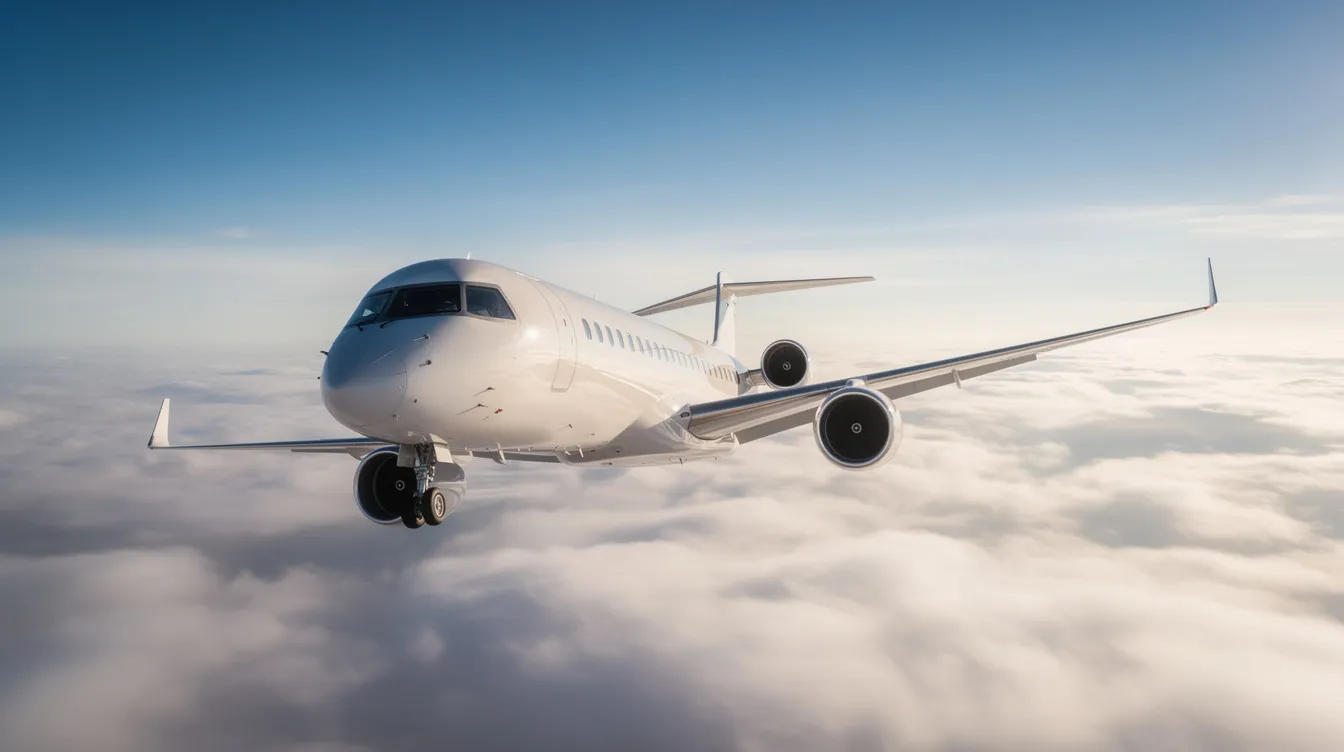
Planning Your Next Trip: Using Fuel Capacity And Range To Choose The Right Aircraft
Travelers do not need to memorize 737 fuel capacities. But understanding approximate fuel capacity and range helps judge what is realistic for nonstop flights versus connections or fuel stops, and when a structured jet card for frequent flyers might be more practical than ad hoc bookings.
A 737's 2,900 to 3,100 nautical mile range means nonstop service from New York to most of Europe, or coast-to-coast across the United States. That range defines the ceiling for a typical commercial jet on medium-haul routes.
Common long-range private jets in the super-midsize and large cabin categories cover 3,000 to 4,000+ nautical miles nonstop, overlapping with the 737's range while seating 8 to 16 passengers.
A New York to Dallas trip (roughly 1,200 nm) or London to Marrakech (about 1,300 nm) fits comfortably within many fuel-efficient private jet types without refueling.
BlackJet's digital tools and 24/7 team automatically match mission profiles, including passengers, distance, and timing, with aircraft that have appropriate fuel capacity and reserves for the route, while helping clients compare Jet Card cost per hour across aircraft categories.
Understanding how much fuel a 737 holds serves as a useful reference point when evaluating the capabilities of private jets for your own travel pattern, including premium programs such as NetJets jet cards and their costs.
Frequently Asked Questions About 737 Fuel Capacity And Use
Below are answers to the most common questions about how much fuel 737s hold, how quickly they burn it, and what that means for passengers and private flyers.
How long does it take to fuel a Boeing 737?
Fueling a 737 from near-empty to full capacity typically takes 20 to 30 minutes using single-point pressure refueling through a panel in the right wing. Actual time depends on how much fuel is needed, the fuel flow rate of the airport's hydrant system, and any required quality checks. Partial uplifts for shorter routes take less time.
How much does it cost to fill a 737 with jet fuel?
At a typical retail jet fuel price of $4 to $6 per U.S. gallon, filling a 737-800's standard 6,875-gallon tanks costs roughly $27,500 to $41,250. Airlines pay below retail through supply contracts and fuel hedging programs. Actual cost per flight is lower because tanks are rarely filled to capacity for shorter routes.
Do airlines ever fill the tanks completely?
Only on routes near the aircraft's maximum range, or when fuel availability at the destination is uncertain or priced at a premium. On short domestic hops, airlines load the trip fuel plus reserves and leave the rest of the tank empty to avoid carrying unnecessary weight. Carrying extra fuel increases overall aircraft weight and hourly fuel consumption, so dispatchers avoid it whenever possible.
Is a 737 more fuel-efficient per passenger than a private jet?
When a 737 is full or nearly full (150 to 189 passengers depending on configuration), it achieves roughly 70 to 100 miles per gallon per passenger, which is difficult for a private jet carrying 6 to 12 passengers to match on a pure per-seat basis. Private jets compensate by offering privacy, flexibility in scheduling and airport access, and time savings that often outweigh the per-seat fuel efficiency gap. For a deeper look at private jet fuel consumption, see our full guide.
Can private jets use the same jet fuel as a 737?
Yes. Most turbine-powered private jets use the same Jet A or Jet A-1 as commercial 737 aircraft. The fuel type is identical; both are kerosene-based jet fuels designed for turbine engines. Only small piston-engine aircraft use aviation gasoline (AvGas), which is a different product entirely.
Conclusion: What 737 Fuel Capacity Reveals About Modern Air Travel
The Boeing 737 holds between 6,000 and 7,800 gallons of fuel, varying by model and the presence of auxiliary tanks. That fuel capacity enables several hours of flight across routes up to 3,500 nautical miles while keeping per-passenger fuel use surprisingly efficient compared with ground transportation.
Fuel capacity varies by model, generation, and tank configuration. Original series aircraft carried under 5,000 gallons; current NG and MAX variants carry close to 7,000 gallons standard.
Airlines balance fuel load, payload, fuel costs, and environmental goals on every departure. Technological advances like the 737 MAX have made commercial aviation more fuel-efficient than any previous generation.
BlackJet clients benefit from the same planning discipline: careful fuel use, safety-focused reserves, and carbon-neutral commitments, all managed by experienced operators so you can focus on where you need to be, whether you choose a traditional charter or a 50-hour Jet Card program.
If you are exploring how private jet travel can fit your schedule and priorities, discover how BlackJet's Jet Card can offer efficient, tailored access to private jets for the routes that matter most to you, and review our complete guide to Jet Card pricing, costs, and benefits.


 Sign up with google
 Sign up with Apple