Speed is at the heart of private aviation, but understanding what "Mach 1" means is essential for anyone interested in the science and performance of modern jets. This article explains Mach 1, its exact speed under different conditions, and why it matters for private jet travelers and aviation enthusiasts. Whether you fly privately or are simply fascinated by high-speed flight, knowing how Mach 1 works will help you appreciate the technology and decision-making behind every jet journey.
Mach 1 is the speed at which an object moves as fast as sound travels through air. In the context of jet travel, understanding Mach 1 is crucial because it defines the aerodynamic and operational limits of modern aircraft. For private jet travelers, this knowledge translates into real-world benefits: faster trips, optimized comfort, and enhanced safety. This article will clarify what Mach 1 is, how fast it really is in different units, and why it’s a key benchmark in aviation.
What Is Mach Number? (The Core Definition)
Mach number is the ratio of speed to the speed of sound. Specifically, Mach 1 is defined as the speed of sound in a medium. Expressed as a formula: M = V / a, where V represents the local flow velocity of the object and a is the local speed of sound. Because it is a ratio, Mach is dimensionless and does not depend on the units used (knots, mph, or km/h).
The speed of sound varies with air temperature and density, which means Mach 1 is not a fixed value—it changes depending on altitude and atmospheric conditions. The concept is named after Ernst Mach, a pioneering Austrian physicist. Whether someone refers to "Mach speed" or simply "Mach," they are describing this fundamental ratio between an object's speed and the speed of sound.
Understanding this ratio is foundational before diving into the specific values and implications of Mach 1 in aviation. Now, let’s answer the core question: how fast is Mach 1?
Answering "How Fast Is Mach 1?" Right Away
Mach 1 is a dimensionless Mach number equal to the local speed of sound in the surrounding air. Mach 1 is approximately 343 meters per second at 20 °C. At sea level in standard conditions, Mach 1 is approximately 767 mph. At sea level, the speed of sound is approximately 761 mph. At 36,000 feet, the speed of sound is about 659 mph.
It is important to note that Mach 1 is not a constant. Because the speed of sound depends almost entirely on air temperature (and to a lesser extent, air density), and temperature decreases as altitude climbs through the troposphere, Mach 1 at a typical cruise altitude of 36,000 ft corresponds to only about 1,060–1,070 km/h (~660 mph)—noticeably slower than at sea level.
To put these speeds in context:
A modern commercial airliner cruising at Mach 0.83 moves at roughly 890–920 km/h through the air at altitude.
Concorde at Mach 2.0 traveled at approximately 2,150–2,200 km/h—nearly twice the speed of sound.
A high-performance business jet at Mach 0.85 covers around 900 km/h at FL410.
BlackJet's Jet Card members cruise comfortably at high-subsonic Mach numbers that approach, but never exceed, Mach 1—optimizing the balance between speed, safety, and cabin comfort while leveraging premium private jet card programs that emphasize flexibility, safety, and sustainability.
Why Mach 1 Matters To High‑Performance And Private Aviation
Understanding Mach number is not academic—it is the operational language of every pilot, dispatcher, and performance engineer working in modern jet aviation. At high altitude, crews manage flights by Mach, not by ground speed or simple mph readouts, because Mach number directly governs aerodynamic forces on the airframe.
Commercial vs. Private Jet Mach Management
Commercial airliners fly fixed schedules at standardized cruise Mach values, typically between 0.78 and 0.85. Private jet operations are different. Pilots and dispatchers tailor cruise Mach to each mission profile—factoring in distance, winds aloft, passenger urgency, and fuel reserves.
The Trade-Offs of Speed
Flying closer to Mach 1 shortens flight time but raises fuel burn, increases airframe stress, and can introduce buffeting that degrades passenger comfort. For example, a BlackJet member flying New York to Los Angeles in a super-midsize jet cruising around Mach 0.82–0.83 will complete the flight in roughly four and a half hours. When you factor in the elimination of security lines, terminal waits, and taxi delays, the door-to-door time advantage over commercial options stretches to several hours.
Optimizing Every Flight
BlackJet's planning tools use precise Mach and air speed data—not rough mph estimates—to optimize climb profiles, cruise altitude, and arrival timing for every leg. This ensures that every flight is tailored for both speed and comfort.
Now that we understand why Mach 1 is operationally significant, let’s look at how Mach 1 is measured and what values it takes under different conditions.
How Fast Is Mach 1 in km/h, m/s, and Knots?
The speed corresponding to Mach 1 shifts with temperature. Here are the concrete reference values presented in a table for easier comparison:
Condition | Speed (m/s) | Speed (km/h) | Speed (knots) | Speed (mph) |
|---|
Sea level at 20 °C (68 °F) | 343 | 1,235 | 667 | 767 |
ISA sea level (15 °C) | 340 | 1,225 | 661 | 761 |
At ~36,000 ft (−56.5 °C) | 295 | 1,060–1,070 | 570–580 | 659 |
Published numbers differ slightly across sources because of different reference temperatures, rounding conventions, and whether humidity is accounted for. In perfectly dry air, values are marginally higher than in humid conditions—though this difference is small enough that aviation calculations treat it as negligible.
For distance intuition: at Mach 1 at sea level, sound travels roughly one kilometer in under three seconds and one mile in under five seconds. A large-cabin business jet cruising at Mach 0.82 at FL410 moves approximately 870–900 km/h through the air. Concorde's cruise at Mach 2.02–2.04 was roughly 2,150–2,180 km/h at altitude—speeds greater than anything in civil aviation today.
Now that we've seen how Mach 1 varies with conditions, let's explore what determines the speed of sound itself.
Speed Of Sound: What Determines Mach 1?
The speed of sound describes how fast pressure disturbances—sound waves—propagate through an elastic medium like air. In still air, a sound wave radiates outward at a velocity determined almost entirely by the absolute temperature of the gas.
The standard formula for the speed of sound in air is:
a = √(γ × R × T)
Where γ (gamma) is the ratio of specific heats for air (~1.4), R is the specific gas constant for air (~287 J/kg·K), and T is the absolute temperature in Kelvin. The square root relationship means that the speed of sound varies with temperature—but not linearly. The speed of sound decreases with lower temperatures, which is why Mach 1 in km/h is slower at altitude than at sea level.
While air density and pressure both change dramatically with altitude, their individual effects on sound speed in an ideal gas cancel out; only temperature remains as the dominant variable. In the ISA model:
From sea level to approximately 36,000 ft (the tropopause), temperature drops steadily, and the speed of sound decreases.
Above the tropopause, temperature stabilizes or even increases in the stratosphere, meaning sound speed levels off or climbs slightly.
This is why experienced crews monitor temperature aloft—it directly determines where Mach 1 sits and how close the aircraft operates to its aerodynamic limits, which matters whether you’re flying large-cabin jets or exploring more affordable private plane options.
Next, let’s look at how flight regimes are categorized by Mach number.
Flight Regimes: Subsonic, Transonic, Supersonic, Hypersonic
Aircraft designers and operators categorize flight regimes by Mach number rather than raw km/h or mph, because the physics of fluid flow around an airframe changes fundamentally at different Mach values.
Subsonic (M < 0.8): Subsonic speeds are below Mach 0.8. Most commercial airliners and many business jets spend cruise time here or just above. Smooth, predictable aerodynamics. Example aircraft: Gulfstream G280, Citation XLS+, Airbus A320.
Transonic (M ≈ 0.8–1.2): Transonic speeds range from Mach 0.8 to Mach 1.2—the transonic range where subsonic and supersonic flow coexist on the airframe. Strong compressibility effects appear. Modern long-range jets cruise near Mach 0.90, deliberately operating in this transonic regime.
Supersonic (M ≈ 1–5): Supersonic speeds range from Mach 1 to Mach 5, with the entire flow field largely supersonic and strong shock waves present. Concorde, military fighters like the F-22 Raptor, and the Eurofighter Typhoon operate here. Even a propeller-driven aircraft can encounter localized supersonic flow at blade tips.
Hypersonic (M > 5): Hypersonic speeds exceed Mach 5. The experimental X-15 and the space shuttle during re-entry experienced extreme aerodynamic heating at these speeds. No current civil operations exist in this regime.
BlackJet's fleet access focuses on high-subsonic business jets—aircraft designed to balance speed, range, cabin comfort, and fuel efficiency without crossing Mach 1, including many of the best private jets in the world known for combining performance with luxury.
With these regimes in mind, let’s examine what happens as aircraft approach and exceed Mach 1.
The Sound Barrier, Shock Waves, And Sonic Booms
Before 1947, many engineers believed the so-called sound barrier represented an insurmountable wall of drag and control instability. Chuck Yeager shattered that belief aboard the Bell X-1, reaching Mach 1.06 in level flight and proving that an aircraft moves through Mach 1 without disintegrating—provided it is properly designed.
As an aircraft approaches Mach 1, air accelerating over curved surfaces (especially the wing's upper surface) reaches supersonic flow locally, even while the free stream remains subsonic. This creates shock waves—extremely thin regions where pressure, temperature, and air density jump abruptly. Shock waves create a pressure difference in front of supersonic aircraft, and as the Mach number increases, these pressure effects intensify.
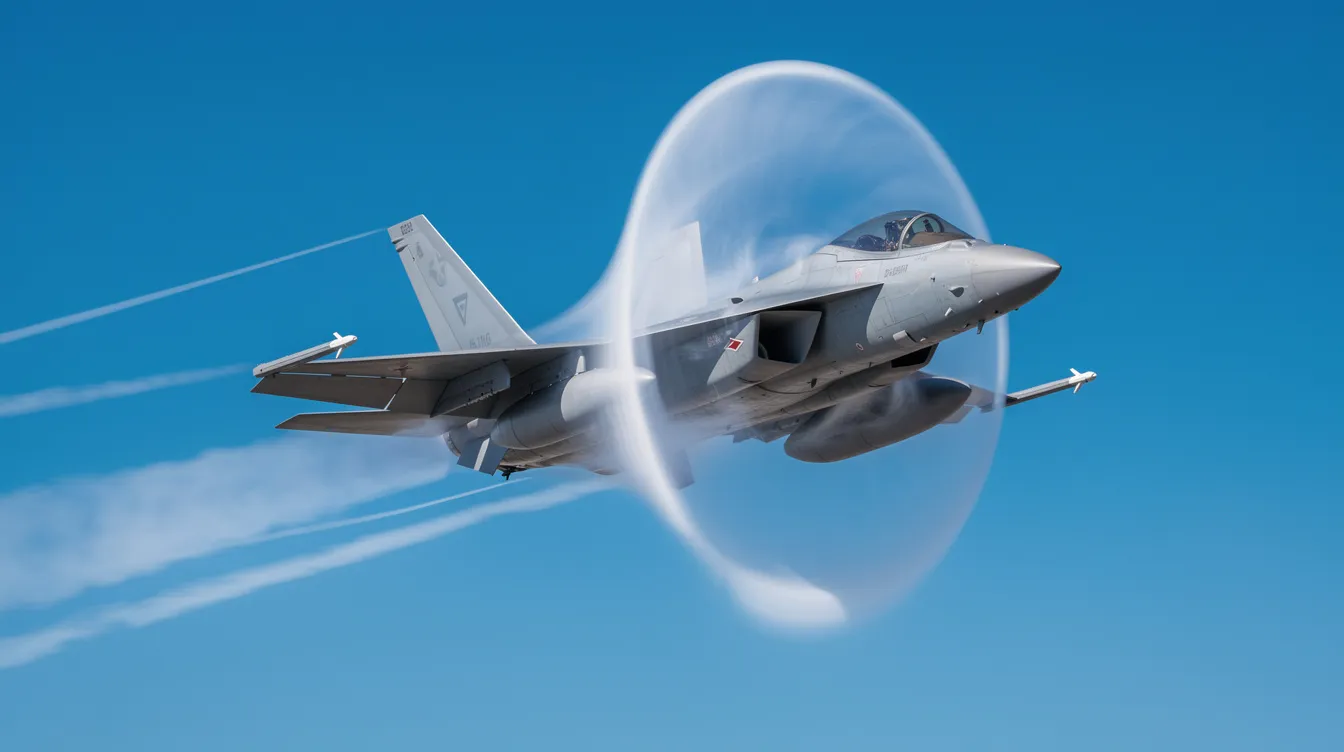
When a supersonic aircraft sustains flight above Mach 1, it generates a continuous Mach cone of shock waves trailing behind. The shock wave from a supersonic aircraft spreads in a cone shape, and when this cone intersects the ground, observers hear it as a sonic boom. A sonic boom occurs when an object exceeds Mach 1, and sonic booms are caused by shock waves from supersonic objects. These booms can be powerful enough to cause damage, like broken windows on the ground.
People inside the aircraft, however, hear nothing dramatic—the aircraft and its shock wave move together. This is one reason civil high-subsonic jets, including those available through BlackJet programs, stay below Mach 1: avoiding sonic booms, regulatory restrictions, and the structural penalties of sustained supersonic flight.
Next, let’s explore the concept of critical Mach number and its effects on jet performance.
Critical Mach Number And Compressibility Effects
The critical Mach number (Mcrit) is the lowest free stream Mach number at which airflow somewhere on the airframe—often the wing upper surface—first locally reaches Mach 1. The critical Mach number is the lowest Mach number at which airflow reaches Mach 1, and it marks the onset of serious compressibility effects.
Effects of Exceeding Critical Mach
Even when an aircraft flies at, say, Mach 0.78, the local flow velocity accelerating over curved surfaces can hit Mach 1. This means compressibility effects begin well before the aircraft itself reaches Mach 1 overall. As an aircraft nears Mach 1, air no longer behaves like an incompressible fluid, so lift and control responses begin to change. At high altitude, the margin between the two speeds that define the usable envelope can become very narrow. Key consequences include:
Shock waves forming at localized regions on the wing, creating sharp edges in the pressure distribution.
Sudden drag increase at the drag divergence Mach—where wave drag climbs steeply.
Shifts in lift distribution and center of pressure, altering handling characteristics
Onset of buffeting and potential Mach tuck (a dangerous nose-down pitch tendency)
Aerodynamic Solutions
Modern aerodynamic design counters these effects. Swept wings delay the onset of local supersonic flow by presenting the airstream with an effectively thinner wing section. Supercritical airfoils—with their flattened upper surfaces and rounded features along leading edges—push Mcrit higher, allowing efficient cruise around Mach 0.80–0.85 without severe shock penalties. These techniques reflect radical differences from early straight-wing jets and explain why today's large differences in cruise capability exist between aircraft generations.
Premium business jets accessible through BlackJet's programs are engineered with generous margins between cruise Mach and their critical Mach number and MMO, ensuring smooth, quiet cabins even near the edge of transonic flow, and these principles also guide the best small private aircraft for different missions.
With an understanding of critical Mach, let’s see how pilots measure and manage Mach number in real time.
Indicated Airspeed, Pitot Tubes, And Machmeters
Every jet relies on a pitot tube and static ports to measure speed. The pitot tube captures total (ram) pressure from the oncoming airflow, while static ports measure ambient pressure. The difference—dynamic pressure—feeds the airspeed indicator.
Indicated airspeed (IAS) is based on this dynamic pressure reading and is reasonably accurate near sea level at low Mach. But at higher altitudes and Mach numbers, IAS under-reads relative to true airspeed (TAS) because of lower air density and compressibility effects. This is why pilots transition from managing IAS during climb to flying a constant Mach number during cruise.
A Machmeter works by computing the ratio of total to static pressure from the pitot-static system. Modern Air Data Computers incorporate altitude, pressure, and temperature data to output a precise Mach number on the cockpit display. At subsonic speeds, compressible-flow versions of Bernoulli's equation suffice. At supersonic speeds, the Rayleigh pitot formula and normal shock relations would be needed—but civil business jets virtually never exceed Mach 1, making this academic for private aviation.
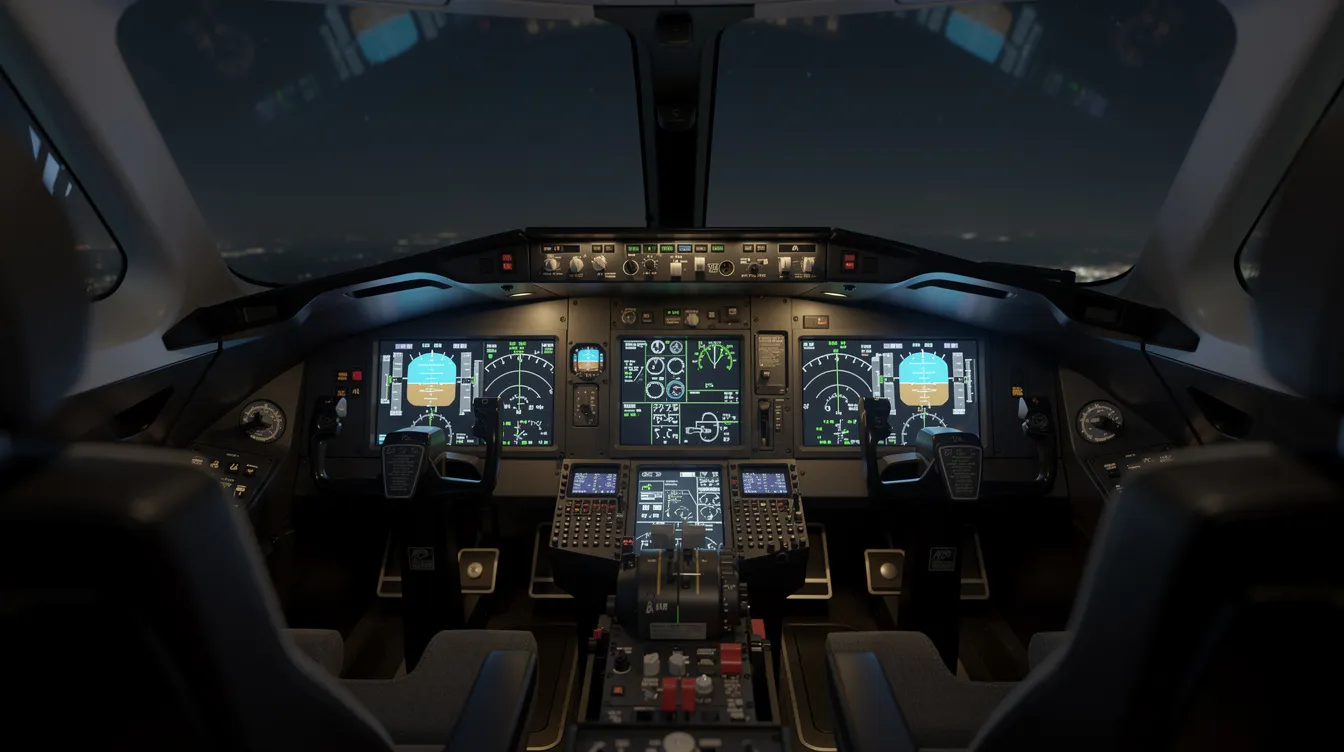
Modern BlackJet aircraft rely on advanced digital Air Data Computers and integrated flight decks that continuously compute Mach, IAS, and true airspeed, feeding both safety systems (overspeed alerts, MMO warnings) and performance optimization tools—advantages that pair naturally with top jet card programs for frequent flyers.
With these tools, pilots can safely manage Mach limits and ensure optimal performance.
Managing Mach Limits: MMO, Mach Tuck, And Safety Margins
MMO—Maximum Mach Operating—is the certified red-line Mach for any aircraft. Exceeding it risks structural damage, loss of control authority, and severe buffeting. Every business jet has a published MMO that crews must respect under all normal operating conditions.
Mach tuck is one of the most insidious dangers near the transonic regime. As shock-induced flow separation moves rearward over the wing at high transonic Mach, the center of lift shifts aft. This creates a nose-down pitching moment. If not corrected, the nose-down attitude causes speed increases, deepening the problem in a dangerous feedback loop.
Safety Systems and Procedures
Modern jets counter this with:
All-moving tailplanes that provide powerful pitch authority
Automatic Mach trim systems that compensate for center-of-pressure shifts
Strict MMO limits paired with audible and visual overspeed warning systems
Consider a high aspect ratio business jet cruising at Mach 0.84 at FL410. If the crew encounters an unexpected temperature rise aloft, the local speed of sound increases, effectively narrowing the margin between current Mach and MMO. The crew reduces Mach slightly—perhaps to 0.82—to maintain safe distance within certified limits.
BlackJet ensures that only operators with rigorous safety certifications fly its members. Professional crews are trained on Mach effects, overspeed recovery, and high-altitude operations. Operational oversight guarantees that every flight is dispatched with ample speed and altitude margins, which is a key consideration when evaluating whether chartering a private jet is worth it for your specific trips.
Let’s see how these principles play out in real-world private jet operations.
Mach Number In Real‑World Private Jet Operations
In day-to-day flying, pilots do not chase km/h readings—they manage Mach number and IAS according to procedures and performance charts.
Typical Flight Profiles by Jet Category
A standard flight profile looks like this:
Climb: Initial climb at a fixed IAS (typically 250–300 knots indicated)
Transition: Around FL280–FL300, the crew transitions to a constant Mach (e.g., Mach 0.78–0.82)
Cruise: Maintaining constant Mach at the assigned flight level
Descent: Constant Mach down to a crossover altitude, then constant IAS for the approach
Typical cruise Mach values vary by aircraft category:
Light jets (e.g., Citation CJ4): around Mach 0.74–0.77
Super-midsize (e.g., Challenger 350): around Mach 0.80–0.82
Long-range large-cabin (e.g., Gulfstream G650): long-range cruise around Mach 0.85, high-speed cruise up to Mach 0.90–0.92
Dispatchers choose cruise Mach by balancing fuel burn versus time. Flying 0.05–0.10 Mach slower on long legs can cut fuel use by 5–10%. Wind conditions matter too: higher Mach into headwinds preserves schedule, while strong tailwinds invite fuel-saving lower Mach. For BlackJet Jet Card members, this means every trip is tailored—urgent same-day business flights may use higher cruise Mach, while relaxed leisure legs favor efficiency and extended range, all while keeping a close eye on jet card cost per hour.
With operational Mach management covered, let’s examine how Mach 1 relates to range and sustainability.
Mach 1, Range, And Sustainability In Private Aviation
There is an inescapable trade-off between speed, range, and environmental impact. As an aircraft approaches its critical Mach, drag rises sharply due to compressibility and shock formation. Pushing past this point into the transonic or supersonic regime demands more fuel per nautical mile, dramatically shortens range, and increases CO₂ per trip.
This is precisely why flying "just below" the drag divergence Mach is far more efficient than chasing Mach 1. BlackJet addresses the environmental equation on two fronts. First, carbon-neutral operations through verified offset programs ensure every flight's emissions are accounted for. Second, optimized Mach and altitude settings reduce unnecessary fuel burn before offsets are even applied—an approach that complements transparent jet card pricing structures.
Consider a BlackJet Jet Card client flying London to Dubai in a large-cabin jet. Rather than pushing to MMO for the entire leg, the crew selects an optimized Mach that balances an overnight arrival window, fuel costs, and minimized emissions. The result: the client arrives on schedule, rested, and with a meaningfully smaller carbon footprint than a full-speed profile would produce. Advanced route planning, real-time weather data, and performance modeling are integral to BlackJet's technology stack, helping clients match optimized Mach profiles with cheaper private aircraft options when cost-efficiency is a priority.
Looking ahead, let’s see how future supersonic and hypersonic travel could change the meaning of Mach 1.
How Future Supersonic And Hypersonic Travel Could Change Mach 1
Civil supersonic travel is not purely historical. Concorde cruised at Mach ~2.0 over the North Atlantic until 2003, and the Soviet Tu-144 operated briefly in the 1970s. Today, companies like Boom Supersonic are developing the Overture concept, targeting cruise at Mach 1.7 with reduced sonic boom footprints, while innovative platforms are also expanding access through private plane rideshare options at high-subsonic speeds. NASA and industry partners are testing low-boom demonstrators that aim to make overland supersonic flight viable.
Technical and regulatory challenges remain substantial. Managing shock waves and noise restrictions—especially over populated land—requires aircraft designed with sharp edges and careful contouring to minimize boom intensity. Fuel efficiency at sustained supersonic speeds lags far behind subsonic cruise. Material and engine limits at the extreme temperatures generated by aerodynamic heating at sustained high Mach add cost and complexity. And unlike subsonic jets, a supersonic aircraft faces large differences in certification and infrastructure requirements.
For now, mainstream private aviation focuses on high-subsonic Mach for compelling reasons: significantly better fuel efficiency, simpler maintenance, and established safety certification frameworks. BlackJet monitors next-generation high-speed developments closely. As supersonic or hypersonic jets become commercially viable and meet strict safety and sustainability standards, BlackJet can integrate them into its aircraft access network for members who value extreme time savings—just as it does today with a range of jet card membership pricing options.
Finally, let’s summarize what understanding Mach 1 means for BlackJet members and private jet travelers.
Choosing The Right Speed: What It Means For BlackJet Members
Several key takeaways emerge from understanding how fast Mach 1 really is and what it means for private travel:
Mach 1 is a moving target defined by the local speed of sound, not a single fixed km/h value. The speed of sound varies with temperature and altitude, so the answer to "how fast is Mach 1?" always depends on where you are.
Most business aviation operates in the high-subsonic regime (Mach 0.75–0.90), just below transonic drag and safety limits. This is where speed, efficiency, and comfort converge.
Understanding Mach explains performance differences between jet categories—why some aircraft fly farther, faster, or more quietly than others.
For a BlackJet Jet Card holder, this translates into practical advantages. You select an aircraft category and cabin class; BlackJet and its operators handle Mach, flight regimes, and performance details in the background. Safety margins around critical Mach and MMO are built into every flight plan. Sustainability is addressed through both efficient cruise Mach selection and carbon-neutral operations—factors that become especially relevant when evaluating a 100-hour jet card cost against your annual flying profile.
Compare your options:
If the physics of speed fascinates you, the experience of it is even better. Explore BlackJet's Jet Card programs to experience fast, high-subsonic private travel—seamlessly booked via mobile or desktop, supported 24/7, and guaranteed carbon-neutral on every flight, whether you’re arranging private jets for 20 passengers or planning large-group charters for up to 50 travelers.


 Sign up with google
 Sign up with Apple