Paying full price for a long-haul business class ticket is a choice, not a requirement. Here's how to fly smarter—and when to leave the airline cabin behind entirely.
Fly Business Class Cheap: The Fast-Answer Playbook
You do not have to spend $6,000–$10,000 on a round-trip business class flight ticket to enjoy lie flat beds, premium food, and airport lounge access. With the right combination of timing, credit card points, and fare awareness, you can fly business class for a fraction of the sticker price—and for travelers who cross a certain annual spend threshold, a BlackJet Jet Card can outperform commercial business class on both cost-per-trip and time saved.
Here are five quick wins to get started:
Use credit card points to book a business class ticket to London for as little as 57,500 miles one-way through transfer partners like Aeroplan.
Book 60–90 days out for shoulder-season New York–Paris fares under $2,500 round trip.
Watch for Qatar "Lite" and Emirates "Special" fares at 30–50% below standard business class fares.
Use airline upgrade auctions to move from premium economy to business for roughly 25–40% of the fare difference.
Set price alerts on Google Flights for your top city pairs to catch the best deals the moment they drop.
Airlines like Qatar Airways (Qsuite), Singapore Airlines, Emirates, and Air Canada Signature Class offer world-class cabins you can access for far less than the average price suggests. The rest of this guide covers every commercial hack first—then explains when frequent travelers should graduate to BlackJet's Jet Card for private jet access instead of chasing every business class sale.
What Counts as a "Cheap" Business Class Ticket in 2026?
"Cheap" is relative, and it depends heavily on the route. A business class ticket that would carry a hefty price tag at full fare can become genuinely affordable during the right sale window or through the right channel.
2026 Benchmarks for Key Long Haul Flights
East Coast US (JFK, BOS) → Europe (LHR, CDG, MAD):
West Coast US (LAX, SFO) → Europe:
Full fares: $6,000–$10,000+
Realistic deals: $2,800–$4,200 round trip
US → Asia (Tokyo, Singapore, Seoul):
US domestic transcontinental:
Airlines known for consistently lower business class flight deals include TAP Air Portugal, Turkish Airlines, Condor, and LOT Polish. Meanwhile, "lite" business class products—like Emirates Special and Qatar Business Lite—strip ancillary perks (no chauffeur service, limited changes) while preserving the core onboard experience.
Even on discounted fares, the amenities that matter most remain intact:
The Smart Timing Strategy: When to Book Business Class for Less
Flight prices for business class swing dramatically based on departure date and booking window. Understanding these patterns is one of the fastest ways to cut costs.
Ideal Booking Windows by Route
US domestic business class: 21–45 days before departure
Transatlantic (NYC–London, BOS–Paris): 60–120 days out
Long-haul routes to Asia or the Middle East (LAX–Tokyo, JFK–Dubai): 90–150 days before travel dates
Seasonal Sweet Spots
Europe: January through March and late August through October are the cheapest windows. Avoid Christmas/New Year and US summer school holidays, when fares spike 30–50%.
Asia: Late February through April (outside Lunar New Year) tends to offer relief.
Day of Week: Most airlines price Tuesday and Wednesday departures 10–12% cheaper than Friday or Sunday flights for the same cabin class.
Mini-Scenario: Booking Timing Impact
A New York–London corporate traveler booking a March trip in early January might lock in business class at $2,800 round trip. Wait until late February for the same departure date, and the fare can climb past $4,800—a swing driven by numerous factors including inventory, demand, and fare bucket availability. Use fare calendars on Google Flights or Skyscanner to visually scan the cheapest departure windows on long haul routes before committing.

Using Airline Loyalty Programs and Credit Card Points Strategically
Airline loyalty programs and flexible bank currencies are the backbone of "almost free" business class flights. The key is knowing which programs to join, which credit card points ecosystems to build, and where the sweet spots hide.
Best Transfer Partners
Amex → Aeroplan: Transfer Membership Rewards points to Air Canada's Aeroplan program to book Lufthansa or Air Canada business from New York to Zurich at competitive redemption rates.
Chase/Amex → KrisFlyer: Use Singapore Airlines KrisFlyer miles for a San Francisco–Singapore business redemption when "Saver" award availability opens up.
Flying Blue off-peak awards: Programs like Air France-KLM's Flying Blue offer calendar windows where business class redemptions cost significantly fewer frequent flyer miles.
United MileagePlus mixed upgrades: On United Airlines, "miles + copay" upgrades on expensive cash tickets remain strong value.
How Many Miles You Need
US → Europe business class: 50,000–80,000 miles one-way
US → Asia business class: 70,000–110,000 miles one-way
US domestic transcontinental: 25,000–40,000 miles one-way
Programs like American AAdvantage, Delta SkyMiles, Alaska Airlines Mileage Plan, and Aeroplan each have distinct strengths on different corridors.
Maximizing Credit Card Points
High-spend professionals can use premium credit cards—Amex Platinum, Chase Sapphire Reserve, or co-branded airline cards—to accumulate enough points through category bonuses and welcome offers for several long-haul business class tickets per year. The math works especially well for executives already spending heavily on business travel.
Finding Cheap Business Class: Tools, Aggregators, and Price Alerts
To find cheap business class flights consistently, you need a repeatable workflow—not luck. Metasearch tools let you compare prices across dozens of airlines and OTAs, filter by cabin class, and visualize the cheapest windows in seconds.
Step-by-Step Workflow for Finding Cheap Business Class Flights
Start with Google Flights: Map the cheapest months for your route (e.g., LAX–Tokyo, JFK–Rome). Filter for "Business" and scan the fare calendar.
Switch to Skyscanner: Toggle "whole month" or "cheapest month" to find cheap business class tickets across flexible travel dates.
Use Kayak: Compare fares from alternative airports—flying from Newark instead of JFK, or into Gatwick instead of Heathrow—where a different airline may price business class significantly lower.
Set price alerts for specific city pairs and cabins (JFK–LHR business, YYZ–FRA business). Sharp drops or rare "glitch" fares may only last a few hours, so fast action matters. The booking process on these platforms is straightforward, but always verify the final fare before completing.
Using Specialist Consolidators and Agencies
Specialist consolidators and business-class-focused agencies negotiate unpublished fares to find business class flights and book business class flights below published rates. To vet them, look for:
IATAN/ARC accreditation
PCI DSS compliance
SSL security
Credible reviews
Trade-offs: More restrictive changes, sometimes reduced mileage accrual, and occasionally poor customer service from less reputable operators. For affordable business class flights at scale, though, a vetted consolidator can be worth the effort.
Exploiting Fare Structures: Lite Fares, Odd Routings, and Upgrade Auctions
Discounted business class flights don't always come from sales or points. Sometimes the fare structure itself is your greatest lever.
Business Class Lite and Special Products
Emirates (Special), Qatar Airways (Business Lite), Singapore Airlines (Promo fares): Can be 30–50% cheaper than fully flexible business class offers.
What’s included: Full onboard experience—the same seat, meals, and in-flight service.
What’s not included: No chauffeur service on Emirates, no advance seat selection without a fee, less generous change/refund policies, and sometimes no lounge access.
For leisure or self-funded business class passengers, these remain the best value class fares available.
Creative Routing Strategies
Choosing a one-stop itinerary through hubs like Istanbul (Turkish Airlines), Lisbon (TAP), or Reykjavik (Icelandair) instead of nonstop flights often saves $1,000–$2,000+ on the same corridor.
Example: New York–Istanbul–Rome on Turkish versus a direct JFK–Rome flight on a legacy carrier.
Airline Upgrade Auctions
Airlines such as Singapore Airlines, Air New Zealand, and Cathay Pacific invite bids to move from economy class or premium economy into business class 3–7 days before departure. Starting bids of roughly 25–40% of the typical economy ticket-to-business price difference are a reasonable opening. Virgin Atlantic and other airlines run similar programs seasonally.
Route and Airline Tactics: Where Business Class Is Consistently Cheaper
Not all corridors are created equal. Certain airlines and routes offer consistently affordable business class, regardless of season.
Value-Rich Corridors to Watch
US–Portugal on TAP Air Portugal: Business class round trip fares from the East Coast to Lisbon regularly dip below $2,000–$2,600 in sale periods.
US–Türkiye and beyond on Turkish Airlines: Sub-$3,000 round trip business fares with excellent onboard product and Star Alliance connectivity.
US–Germany via Condor: From select East Coast gateways, occasional promotions land at $1,300–$1,800 round trip.
Canada–Europe on Air Canada: Signature Class during off-peak months from departure city options like Toronto or Montreal.
Asia Routes Where Competition Helps
West Coast US to Tokyo: Japan Airlines, ANA, or American Airlines benefit from multi-carrier competition.
Flights to Singapore via Tokyo or Hong Kong: Cathay Pacific or Singapore Airlines see tactical sales from select hubs.
British Airways: Occasionally runs competitive business fares on secondary routes.
Air India: Has emerged as a value option on US–Delhi corridors.
Other airlines cycle through promotions unpredictably, so monitoring deal alerts is essential.
Origin-Point Arbitrage
Starting your trip in a cheaper region—for instance, buying a Europe–USA–Europe round trip originating in Lisbon instead of New York—can yield significantly lower per-segment business fares than the same itinerary purchased from a US departure city.
Business Class Seats, Cabins, and What to Prioritize When You're on a Deal
When you find cheap business class, the next question is whether the seat itself justifies the price. Not all business class seats are created equal, and cabin class alone doesn't guarantee a good experience.
Main Seat Types to Know
Fully flat 1-2-1 reverse herringbone (e.g., Cathay Pacific, American 777-300ER): Direct aisle access for every passenger, good privacy, consistent sleep quality.
Staggered pods with doors (e.g., Qatar Qsuite): Private suites with suite style seating and closing doors—the gold standard for privacy.
2-2-2 flatbeds on older aircraft: Lie-flat beds without direct aisle access for window passengers—common on aging widebodies.
Angled-flat or recliner seats: Still used on some secondary routes; fine for daytime flights, poor for overnight red-eyes.
Always check the actual seat map and aircraft type before booking. A "deal" on an angled-flat overnight seat from New York to London may be worse value than a slightly pricier lie-flat seat on a competitor with standard lie-flat seats.
Use airline seat map resources and photos to confirm lie flat suites, direct aisle access, and privacy levels—especially on red-eye flights where quality sleep is the main reason for paying a premium. Premium food quality and in-flight amenities also vary significantly between carriers.
The hierarchy is clear:
Premium economy as a compromise
Business class as the mass-market sweet spot
Private jets as the top tier for business class travelers whose time, privacy, and security justify leaving the airline cabin model entirely
Advanced Hacks: Glitch Fares, Overbooked Flights, and Last-Minute Upgrades
For travelers with flexibility and fast reflexes, there are ways to access business class at near-economy ticket prices.
Glitch Fares (Mistake Fares)
Occur when airlines file incorrect pricing due to currency errors or system glitches.
Can surface as $800–$1,500 round-trip business class tickets from the US to Asia or Europe.
Flight deal newsletters, Telegram groups, and Discord communities dedicated to fare errors are the fastest way to spot them.
The catch: glitch fares may be live for only a few hours, and airlines don't always honor them. Book first, then wait a few days before making nonrefundable plans like hotels or meetings.
Overbooked Flights
Volunteering your seat on a packed economy class flight—especially on busy US–Europe and transcontinental routes—can sometimes earn vouchers or operational upgrades into business class.
Negotiate for a confirmed cabin upgrade rather than just a future travel voucher where possible.
Last-Minute Upgrades
Become available at online check-in (24 hours before departure) or at the airport gate when unsold business class seats remain.
Airlines may discount the upgrade versus the original fare.
Rule of thumb: if the upgrade costs less than 40% of the difference between your economy fare and the full business class fare, it's generally worth taking.
When Flying Private Becomes the Better "Business Class Deal"
For frequent business class flyers—executives, founders, and groups traveling together—there is a threshold where private aviation via a Jet Card can rival or beat the cost of repeatedly buying premium airline tickets. Guides that break down Jet Card cost and membership pricing can help you evaluate that tipping point.
Comparing Annual Costs: Business Class vs. Private Jet
Example: A New York–London executive flying business class 10–12 times per year at roughly $6,000 per round trip spends $60,000–$72,000 annually on tickets alone.
Hidden costs: Add the hours lost to check-in queues, security lines, lounge waiting, boarding delays, and ground transfers from major airports, and the true cost of business travel climbs much higher.
Private Jet Comparison
With a BlackJet Jet Card, that same executive arrives at a smaller airport like Teterboro or London Farnborough just 20–30 minutes before departure.
No lines, no delays, no sharing a cabin with 300 strangers.
Industry benchmarks suggest that 25–30 flight hours per year is around the break-even point where a Jet Card approaches the cost of equivalent commercial business class spend—before factoring in the enormous value of saved time and total privacy.
Understanding Jet Card cost per hour is essential when you run the numbers.
Per-Seat vs. Whole-Aircraft Math
Commercial business class sells individual seats.
BlackJet prices the aircraft and hours—which becomes surprisingly efficient for C-suites, legal teams, or investor groups.
Four executives buying separate $6,000 business class tickets spend $24,000; the same group sharing a midsize or large cabin jet via a Jet Card may spend a comparable amount while gaining full schedule control, personalized service, and the ability to fly private at competitive rates.
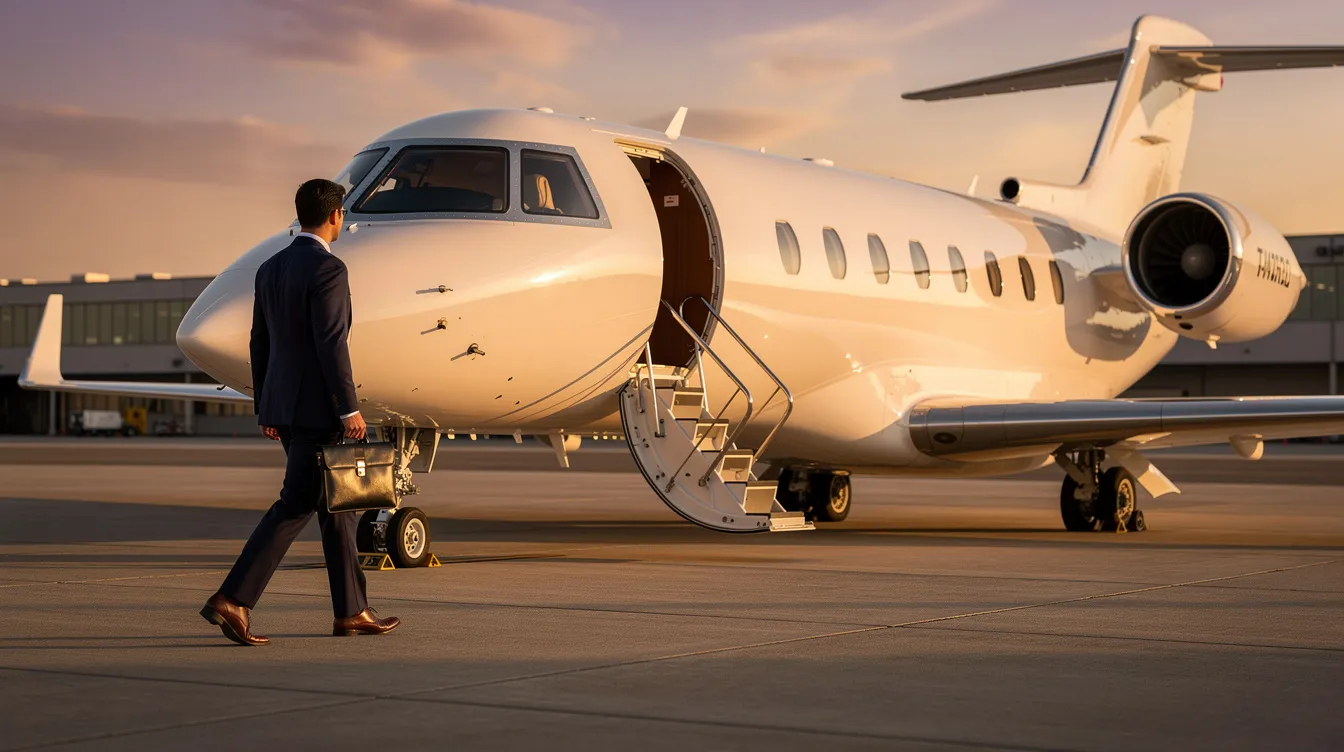
Inside BlackJet's Jet Card: A Premium Alternative to Commercial Business Class
BlackJet's 25+ Hour Jet Card model is built for travelers who want the predictability of prepaid access without the burden of aircraft ownership. The program offers 25-hour and 50-hour blocks covering multiple aircraft categories—light, midsize, super-midsize, and large cabin—with fixed, all-in hourly rates that include fuel surcharges and Federal Excise Tax, mirroring the kind of Jet Card pricing structures discussed across the wider private aviation market.
2026 Jet Card Hourly Rates
Large cabin hourly rates on a 50-hour Jet Card: Approximately $13,131 per hour
Super-midsize: Around $10,384 per hour
Midsize and light categories: Proportionally lower
This transparent pricing structure means no surprise fees—a stark contrast to the fare volatility that business class flyers face when booking last-minute commercial tickets. It aligns with what you’d expect from a well-structured private jet price list that clearly outlines categories and costs.
Jet Card as a Budgeting Tool
High-frequency business class passengers can use a Jet Card as a budgeting tool:
Lock in hourly rates
Avoid last-minute business fare spikes
Consolidate travel spend into a single, transparent program
24/7 digital booking tools and a dedicated human support team offering premium services around the clock
Safety and Certification
BlackJet partners exclusively with vetted operators meeting:
Third-party safety ratings
Standardized pilot experience thresholds
Rigorous maintenance protocols
This level of consistency compares favorably with the variable quality of airline regional partners or last-minute aircraft swaps, and reflects the realities outlined in discussions of how safe private jets really are.
Sustainability
Every BlackJet flight is carbon-neutral through verified offset programs, with Sustainable Aviation Fuel available at selected hubs. For corporate travelers managing ESG reporting or environmentally conscious high-net-worth individuals, this removes the guilt factor that can accompany moving from commercial to private aviation.
Choosing Between Business Class, First Class, and a Private Jet
The right choice depends on your specific trip, not a blanket rule.
Comparison Table: Business Class vs. First Class vs. Private Jet
Feature | Discounted Business Class | First Class | Private Jet (BlackJet) |
|---|
Best for | Solo/couples, fixed routes | Ultra-long-haul, luxury | Groups, tight schedules, privacy |
Price predictability | Moderate | Low | High (fixed hourly rates) |
Privacy | Moderate | High | Maximum |
Schedule flexibility | Low | Low | Maximum |
Amenities | Lie-flat, lounge, meals | Suites, dedicated service | Custom, full aircraft |
Time savings | Some | Some | Maximum |
Environmental options | Limited | Limited | Carbon-neutral, SAF available |
Three Scenarios That Illustrate the Trade-Offs
A legal team needs to visit Chicago, Dallas, and Miami in 36 hours.
A family of six flying Los Angeles to Aspen for New Year's.
Six business class tickets at holiday pricing could exceed $18,000+.
A large cabin charter may approach similar territory while delivering door-to-door convenience and zero airport chaos, similar in spirit to the large-group solutions described when evaluating the best private jet for around 20 passengers.
A founder roadshow from San Francisco to Austin, New York, and Toronto.
This guide is not anti-business class. BlackJet is the natural next step for those who have already optimized commercial fares and now want to optimize the entire journey—time, privacy, safety, and sustainability, even if they start by exploring the cheapest private aircraft and budget-friendly private options.
Putting It All Together: Your Action Plan to Fly Better for Less
For Commercial Business Class Savings
Map your annual routes and peak months. Know where you fly and when fares are cheapest.
Enroll in 1–2 key airline loyalty programs plus one transferable bank points ecosystem (Amex, Chase, or Capital One).
Use fare calendars and alerts to lock in business class 60–120 days out on your target long haul routes.
Exploit lite fares, upgrade auctions, and creative routings when flexibility allows—these are where the deepest discounts hide.
Frequently Asked Questions About Flying Business Class Cheap
Q1: How far in advance should I book business class tickets to get the best deals?
Booking 60–120 days before your departure date is generally the sweet spot for securing affordable business class fares, especially on long-haul international routes. For domestic US business class flights, booking 21–45 days ahead is often optimal.
Q2: Can frequent flyer miles help me save money on business class flights?
Absolutely. Redeeming frequent flyer miles or credit card points is one of the most effective ways to fly business class cheap. Programs like Aeroplan, KrisFlyer, and MileagePlus offer award tickets and upgrades that can significantly reduce out-of-pocket costs.
Q3: What are "lite" or "special" business class fares?
These are discounted business class tickets offered by airlines such as Emirates and Qatar Airways that include core onboard amenities like lie-flat seats and premium meals but exclude extras like lounge access, chauffeur service, or flexible ticket changes.
Q4: Are upgrade auctions a good way to fly business class for less?
Yes. Many airlines offer upgrade auctions where you can bid to move from economy or premium economy into business class at a fraction of the full fare difference, often around 25–40% of the cost.
Q5: When is the cheapest day of the week to fly business class?
Midweek departures, especially Tuesdays and Wednesdays, tend to be 10–15% cheaper than weekend flights, making them ideal for saving money on business class tickets.
Q6: How does flying private with a Jet Card compare cost-wise to buying business class tickets?
For frequent travelers flying 25–30 hours annually or more, a Jet Card can offer better cost predictability, time savings, and privacy compared to repeatedly purchasing business class seats, especially when factoring in hidden costs like airport delays and ground transfers.
Q7: Do business class tickets include extra baggage allowances?
Typically, business class passengers receive two checked bags up to 32 kg each, which is more generous than economy class allowances, helping you avoid extra fees.
Q8: What dining options can I expect in business class?
Business class dining usually includes multi-course meals curated by top chefs, accompanied by premium beverages and fine wines, designed to enhance the in-flight experience.
Q9: How can I stay updated on business class flight deals?
Setting price alerts on platforms like Google Flights, Skyscanner, and Kayak is an effective way to monitor fare drops and snag deals as soon as they become available.
Q10: Are there sustainability options when flying business class?
While traditional business class flights have limited sustainability features, private jet programs like BlackJet offer carbon-neutral flights and access to Sustainable Aviation Fuel, aligning luxury travel with environmental responsibility.
For Private Aviation Tipping Point
If two or more of these apply, evaluate a Jet Card as part of your 12–24 month travel strategy:
You fly internationally in business class more than 6–8 times per year
You regularly travel with colleagues or family
You place a high premium on privacy, schedule control, and productive travel time
You want cost predictability rather than fare volatility
Consider whether a 100-hour Jet Card option aligns with how intensively you actually fly. BlackJet's prepaid programs offer guaranteed access to private jets, carbon-neutral flights, and round-the-clock human support for your highest-value trips—no more chasing every sale, no more compromising your schedule to match an airline's timetable, and a compelling alternative to some unlimited private jet membership concepts that promise frequent flying for a fixed fee.
Explore BlackJet's Jet Card programs and discover what it means to move beyond the best business class deal—to a travel experience designed entirely around you.


 Sign up with google
 Sign up with Apple