Every private jet mission begins with a single number that most travelers never see: the aircraft's empty weight, or its baseline mass without passengers, cargo, or usable fuel, including the airframe, engines, standard equipment, fixed ballast, hydraulic fluid, unusable fuel, and full engine oil. This foundational figure shapes payload, baggage allowance, range, fuel burn, and safety margins on every flight. For BlackJet members and frequent private jet travelers, understanding that number means understanding the operational decisions behind a safe, efficient, and effortless trip. This introduction explains empty weight alongside related aircraft weight categories, the trade-offs between passengers, bags, and fuel, the safety role of weight planning, and even how these principles compare with vehicle weight on the ground—all part of how BlackJet uses weight data to support performance, efficiency, and sustainability.
Executive Overview: Why Empty Weight Matters for BlackJet Members
Empty weight defines the baseline mass for every performance and capacity calculation an aircraft undergoes before departure. It is the airplane's weight stripped of passengers, cargo, and usable fuel — the fixed starting point from which flight planners build upward toward certified limits like maximum takeoff weight, maximum landing weight, and maximum ramp weight.
Why should a Jet Card holder care? Because empty weight directly shapes the outcomes that matter most: how many travelers can fly a given route, how much baggage each person may carry, and whether the plane can reach the destination nonstop—key considerations when comparing the best jet cards for frequent flyers. Weight management also affects an aircraft's climb performance and stall speed, and excess weight can affect obstacle clearance as well as overall performance and safety, meaning precision here is inseparable from safety.

Key takeaways for BlackJet members:
Empty weight impacts an aircraft's performance, including climb rate and fuel consumption — a lighter baseline means greater range and efficiency.
Knowing empty weight is essential for calculating payload capacity and safety margins on every flight.
Maximum takeoff weight ensures safe flight performance; all loads (fuel, people, bags) must fit beneath it.
BlackJet's flight planning team uses precise aircraft weight data to maximize useful load while maintaining carbon-neutral operations.
Core Definitions: Basic Empty Weight and Related Aircraft Limits
Empty weight excludes payload, cargo, and usable fuel. Exclusions from aircraft empty weight include usable fuel and passengers.
This section is the technical backbone of the article. The weight terms below appear in manufacturer documents, regulatory filings, and every dispatch sheet BlackJet's operations team reviews before your aircraft pushes back. The General Aviation Manufacturers Association (GAMA) standardized empty weight definitions in 1975, yet subtle differences persist across regulations and flight manuals, with a weight standard serving as the baseline for comparing those definitions, so clarity matters.
Standard empty weight - the aircraft with its airframe, engines, and all the standard equipment installed, plus fixed ballast, hydraulic fluid, unusable fuel, and full engine oil. It reflects a baseline configuration with standard equipment installed but no optional additions. Standard empty weight includes fixed equipment and fluids.
Basic empty weight - everything in standard empty weight plus optional and permanently installed operating equipment, full operating fluids (engine oil, hydraulic fluid, coolant where applicable), and unusable fuel. Basic empty weight includes optional equipment and full operating fluids and serves as the primary baseline in modern private jet weight-and-balance work.
Licensed empty weight - similar to basic empty weight but includes only undrainable oil, not full engine oil. Licensed empty weight excludes full engine oil from calculations and appears mainly on older documentation. A pilot or dispatcher must add the drainable oil mass to convert it to a usable basic empty weight.
Operating Empty Weight - includes crew and necessary operational items but excludes usable fuel and payload, and it factors into hourly cost structures for programs such as NetJets jet card offerings.
Zero Fuel Weight (ZFW) - the plane's total weight with everything except usable fuel loaded. Zero fuel weight excludes all fuel from the aircraft's weight and exists to limit stress on the aircraft structure. Exclusions from aircraft empty weight include usable fuel and passengers; empty weight also excludes payload and cargo.
Maximum takeoff weight (MTOW) - the maximum allowable weight at which the aircraft may begin its takeoff roll, certified by the manufacturer and regulator, and a key performance constraint evaluated by top private jet companies when matching aircraft to missions.
Maximum landing weight (MLW) - the heaviest the plane may weigh at touchdown to preserve structural integrity and brakes.
Maximum ramp weight (MRW) - the maximum weight allowed during ground maneuvering, typically slightly above MTOW to account for taxi fuel burn.
From Empty Weight to Takeoff Weight: How Loads Are Built Up
Imagine six passengers boarding a Cessna Citation CJ4 Gen2 at Teterboro for a flight to Opa-locka, a mission profile similar to many 5 million dollar pre-owned light and midsize jets. Here is how loads stack from empty to airborne, using published CJ4 specifications:
Basic empty weight (BEW): ~10,300 lb - airframe, engines, all materials, fluids, components.
Add payload: 2 crew (~400 lb) + 6 passengers (~1,080 lb) + baggage (~600 lb) = ~2,080 lb. The difference between maximum takeoff weight and basic empty weight is the aircraft's useful load. BEW + payload = zero fuel weight of ~12,380 lb, just under the 12,500 lb limit that protects the fuselage and wing root from excess stress.
Add fuel: suppose the route requires 4,800 lb of usable fuel (trip + reserves + taxi). Before taxi burn, that pre-departure ramp figure is the taxi weight, so ramp weight becomes ~17,180 lb. The CJ4's maximum ramp weight is 17,230 lb - tight but legal.
Taxi fuel burn: after burning ~120 lb taxiing, takeoff weight drops to ~17,060 lb, within the 17,110 lb MTOW. Gross takeoff weight includes all usable fuel and payload and must not exceed this ceiling.
En-route burn: the aircraft consumes roughly 2,400 lb in flight. Gross landing weight at touchdown ≈ 14,660 lb - comfortably under the 15,660 lb MLW.
Exceeding maximum landing weight risks structural damage to the landing gear and airframe. Gross landing weight must stay within safety limits on every arrival. A heavier empty weight also increases momentum and requires longer stopping distances, which is why precision in these numbers protects every passenger onboard.
Payload Capacity, Fuel Weight, and Practical Trade-Offs
Every private jet trip is a three-way negotiation between payload, fuel weight, and range — all anchored to empty weight and certified limits, just as every Jet Card program is a balance of hours, aircraft category, and jet card pricing structures.
Payload is the combined mass of passengers, crew, baggage, and cargo, which becomes especially important when evaluating private jets for 20 passengers.
Useful load in aviation is the weight remaining after subtracting empty weight from maximum takeoff weight, and it can vary by mission depending on fuel and route requirements, particularly on large-cabin aircraft such as private jets for 30 passengers. For the CJ4, that yields roughly 6,930 lb of useful load.
Payload capacity is the maximum weight an aircraft can safely carry once fuel is accounted for. In formula terms: payload capacity ≈ useful load – fuel weight loaded for the mission.
Fuel weight adds up fast, and extra weight increases the energy required to move the aircraft, which reduces fuel efficiency, a dynamic that informs many of the innovations highlighted in the best aircraft of 2026. Jet A fuel weighs approximately 6.7 pounds per US gallon, so a 700-gallon load exceeds 4,600 lb.
Consider two scenarios that mirror the trade-offs found when configuring private jets for up to 50 passengers. A light jet with a low basic empty weight (~7,500 lb) and MTOW around 13,500 lb offers ~6,000 lb of useful load - but full tanks for a long route may consume 4,000 lb, leaving only 2,000 lb for people and bags, making small private aircraft selection a mission-critical decision. A super-midsize jet like the CJ4 weighs more empty yet offers proportionally greater useful load, allowing more passengers and luggage at similar stage lengths, and many 16-seat private jet options push this balance even further for larger groups.
On hot days or short runways, density altitude can reduce the effective maximum weight, tightening margins further. Knowing empty weight assists in calculating operating limits and fuel ranges so BlackJet's flight support team can propose optimized solutions — a fuel stop, a different cabin class, or adjusted baggage - to maximize comfort without compromising safety. The power-to-weight ratio is also critical for vehicle acceleration and handling during takeoff, and empty weight helps determine fuel efficiency across every leg.
Weight Concepts Beyond the Aircraft: GVWR, GVW, and Ground Transfers
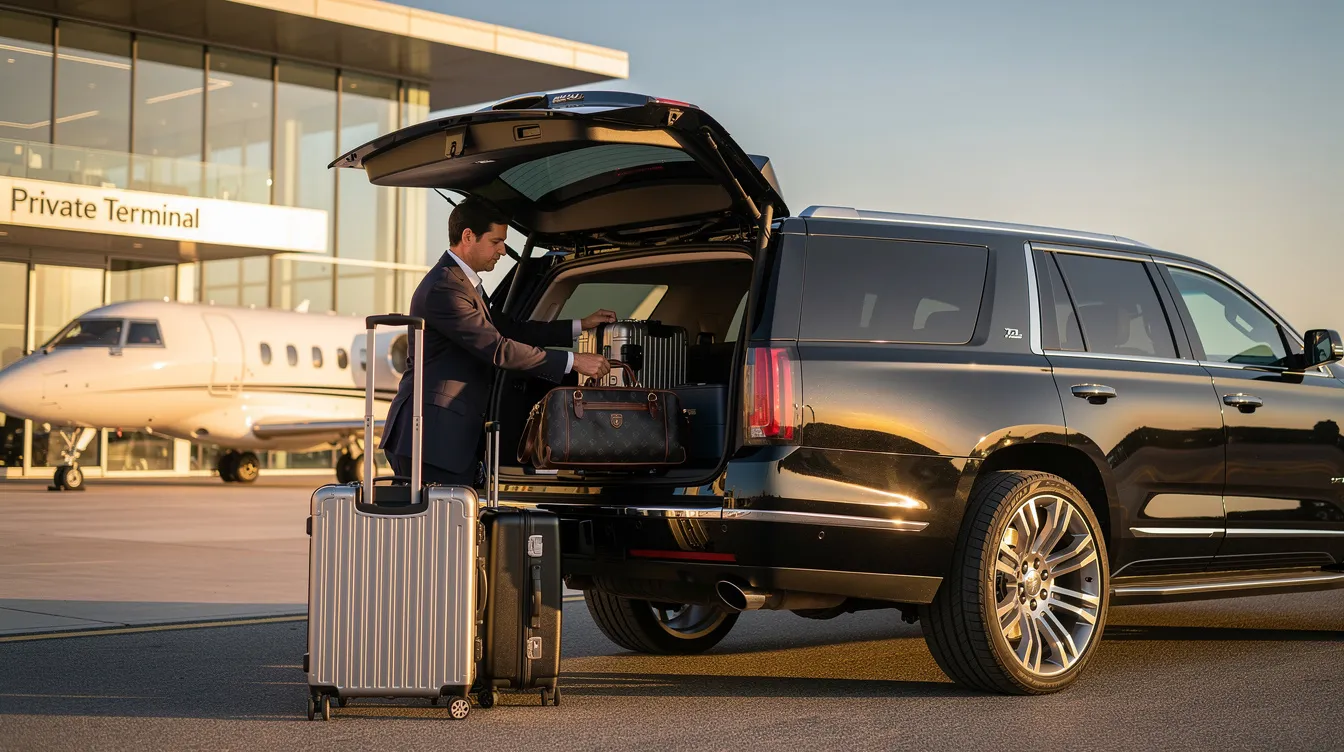
Weight management does not end at the boarding stairs. For BlackJet members, it extends to the vehicles that carry you between city center and the private terminal as part of premium private jet card and membership services.
Gross vehicle weight rating (GVWR) is a ground vehicle's manufacturer-specified maximum safe total weight — analogous to an aircraft's MTOW. It covers curb weight (the vehicle's own mass with fluids), passengers, and luggage. In automotive contexts, empty weight often refers to curb weight; automobile empty weight includes standard equipment and a full tank of fuel. For private transfers, that baseline is useful, while commercial vehicle classifications can trigger different weight and licensing rules.
Gross vehicle weight (GVW) is the actual weight at any moment and must never exceed the GVWR.
A Mercedes-Benz Sprinter configured for airport transfers typically has a GVWR near 11,030 lb and a curb weight around 8,500 lb, leaving roughly 2,500 lb of payload margin — sufficient for six travelers with luggage.
The conceptual parallel is direct: curb weight mirrors basic empty weight, and GVWR mirrors MTOW. Safety culture at BlackJet spans both air and ground, from New York transfers to private jet charters in Karachi.
Frequently Asked Questions About Empty Weight in Aviation
Q1: What is the difference between standard empty weight and basic empty weight? Standard empty weight includes the aircraft's airframe, engines, standard equipment, fixed ballast, hydraulic fluid, unusable fuel, and full engine oil. Basic empty weight builds on this by adding optional equipment and full operating fluids, serving as the primary baseline for weight and balance calculations.
Q2: Why is empty weight important for private jet travelers? Empty weight sets the baseline for all weight calculations affecting payload, fuel, range, and safety. Understanding it helps ensure the aircraft can safely carry passengers, baggage, and fuel without exceeding certified limits.
Q3: How does empty weight affect fuel efficiency ? A heavier empty weight increases the energy required to move the aircraft, leading to higher fuel consumption. Managing empty weight carefully helps improve fuel efficiency and reduce carbon emissions.
Q4: What is the relationship between empty weight and maximum takeoff weight? Empty weight is the baseline mass of the aircraft without payload or usable fuel, while maximum takeoff weight is the certified limit the aircraft cannot exceed at takeoff. The difference between them determines the useful load available for passengers, baggage, and fuel.
Q5: How does BlackJet use empty weight data to enhance safety? BlackJet incorporates empty weight data into flight planning to ensure every load sheet keeps the aircraft within center of gravity and structural limits, supporting rigorous safety certifications and operational protocols.
Q6: What is the significance of pounds in empty weight measurements? Empty weight is typically measured in pounds, the standard unit for aircraft weight in the United States and many aviation contexts, enabling precise calculations for performance and safety.
Q7: Can empty weight change over time? Yes, empty weight can vary with modifications, added optional equipment, or changes in operating fluids. Accurate, up-to-date weight data is essential for safe flight planning.
Q8: How does empty weight compare to curb weight in ground vehicles? Empty weight in aviation is analogous to curb weight in automobiles, which includes the vehicle's mass with standard equipment and a full tank of fuel but excludes passengers and cargo.
Q9: What role does empty weight play in sustainability efforts? By minimizing unnecessary weight, BlackJet optimizes fuel consumption and calculates precise carbon offsets, contributing to carbon-neutral private jet travel.
Q10: Where can I learn more about the technical definitions of empty weight? The General Aviation Manufacturers Association (GAMA) standardized empty weight definitions in 1975, and detailed explanations can be found in pilot operating handbooks and BlackJet's educational resources.
How BlackJet Uses Weight Data: Safety, Efficiency, and Sustainability
BlackJet treats empty weight and related metrics as core operational data, not obscure technicalities. Behind every digital booking request, the system factors in average passenger weights, typical baggage per traveler, and fuel planning to propose viable aircraft options — all in real time, whether you are chartering or exploring private jets for sale under 10 million dollars.
Strict adherence to maximum takeoff weight, maximum landing weight, and maximum ramp weight underpins BlackJet's internal safety protocols. An aircraft's empty weight influences its center of gravity and balance, so every load sheet is verified to keep the center of gravity within published limits. This focus on structural integrity and regulatory compliance is why BlackJet pursues rigorous third-party safety certifications and provides clear guidance for members who ask, “Are private jets safe?”
Accurate weight forecasting also powers BlackJet's sustainability commitment. By minimizing unnecessary fuel carriage—carrying only what the mission demands — the team improves efficiency per nautical mile and precisely calculates carbon emissions for offset. For a member using a 25-hour Jet Card on frequent New York–Chicago flights, predictable passenger counts and baggage allow consistent ZFW calculations, stable fuel planning, and optimized carbon offsets — flight after flight.
Empty weight may be invisible to the traveler, but precision here is what transforms complexity into a seamless, safe, punctual experience. Discover how BlackJet's Jet Card programs can reshape the way you travel — effortlessly.


 Sign up with google
 Sign up with Apple