The Embraer 175 sits at the intersection of efficiency and comfort in regional aviation - a plane that millions of travelers board each year without fully appreciating what sets it apart. For those who split their time between commercial and private travel, understanding this aircraft is more than trivia; it shapes how you plan connections, evaluate comfort trade-offs, and decide when to switch from scheduled service to a private cabin. This guide breaks down everything from the Embraer 175 seat map and cabin amenities to performance specifications, then shows where a BlackJet Jet Card picks up where even premium commercial service leaves off.
Embraer 175 Overview
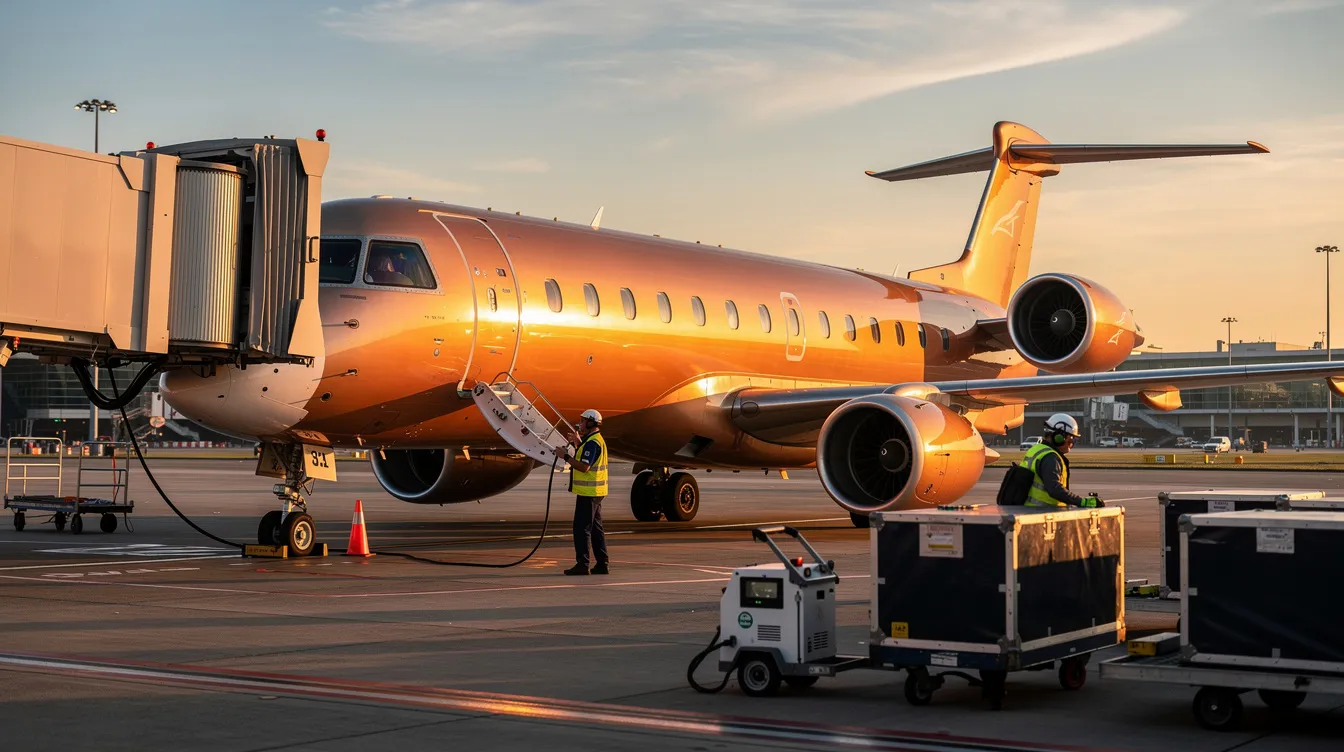
The Embraer 175 is a twin-engine regional jet that has quietly become the backbone of short- to mid-range flying across North America and Europe. Designed and manufactured in Brazil by Embraer, this aircraft typically seats 76 passengers in a dual-class configuration and is optimized for routes up to approximately 2,200 nautical miles. It first entered commercial service in July 2005, when the first E175 was delivered to Air Canada, beginning a production run that has kept the aircraft in airline service for many years and, as of 2024, remains active for regional airlines worldwide.
Its signature comfort feature is the 2+2 seating arrangement with no middle seats anywhere in the cabin. Every passenger sits in either a window or aisle position, a stark contrast to the 3-3 layouts found on an Airbus A320 or Boeing 737. The E175 is a popular choice for regional airlines in North America, operated by carriers such as American Eagle, Delta Connection, United Express, and Alaska's regional partners. In Europe, airlines including LOT Polish Airlines have added it to their fleet, and in July 2010, Flybe ordered 35 E175s valued at $1.3 billion. By July 2020, 25 million passengers had flown on E175s - a number that underscores just how central this airplane has become to domestic and regional networks.
The Embraer Jet 175 complies with U.S. pilot union scope clauses defining regional airline service, including scope-clause rights tied to fleet restrictions and aircraft size and capability within major-airline agreements, which is why it dominates the 76-seat category at major U.S. carriers. For BlackJet clients, encounters with the Embraer 175 are common when connecting from commercial flights to reach hubs before continuing on a private jet charter. Understanding its cabin standard helps set expectations - and clarifies where private travel offers a different experience entirely.
Cabin Layout, Seat Map & Middle-Seat-Free Design
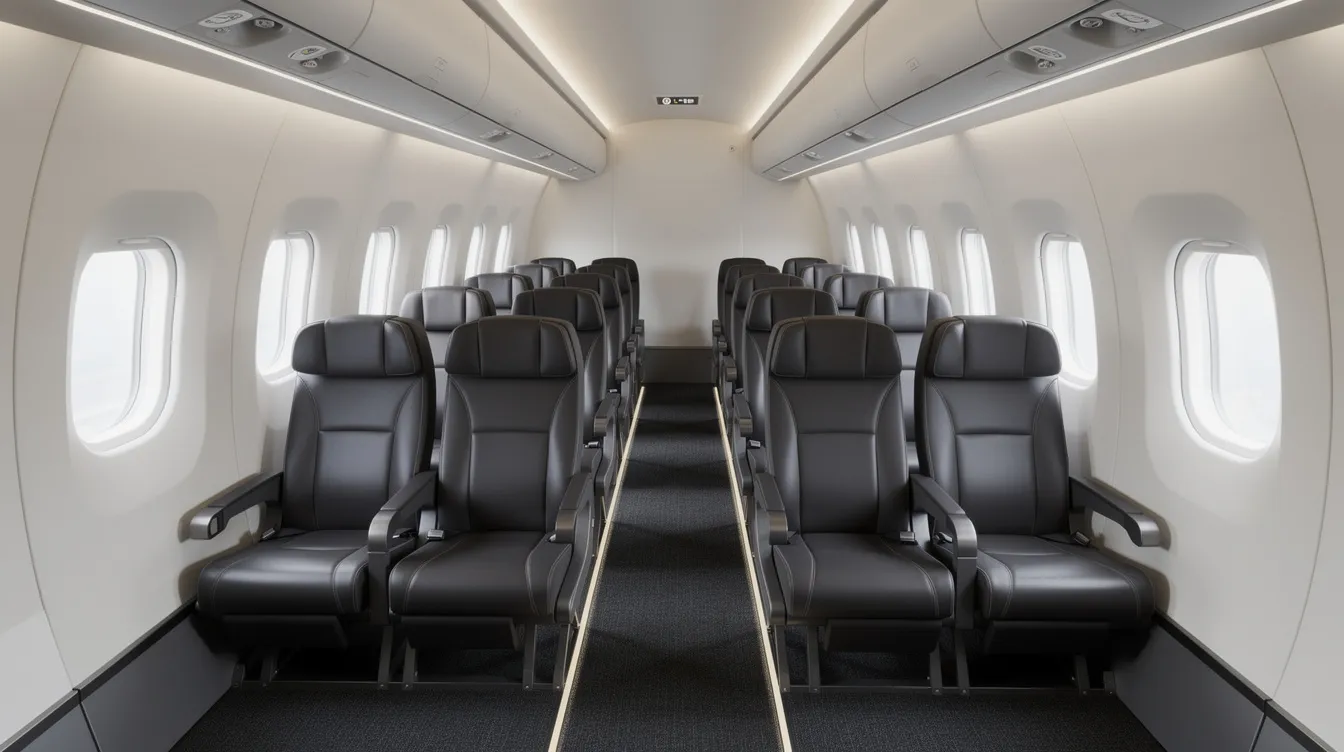
Walking through an Embraer 175 seat map reveals a cabin designed around one principle: no middle seats. Four seats per row - two on each side of the aisle - ensure every passenger has direct access to either a window or an aisle.
A standard dual-class layout breaks down as follows:
Cabin Section | Rows | Typical Seats | Pitch |
|---|
First Class | 1–3 | 12 seats | 36–38 in |
Extra Legroom / Comfort | 4–7 (varies) | 12–16 seats | 34–35 in |
Main cabin | Remaining rows | 44–48 seats | 30–32 in |
Total | | ~76 seats | |
Exit rows and bulkhead positions offer the best legroom. Forward cabin seats tend to be quieter and more private, while rows near galleys and lavatories at the rear attract more foot traffic and noise. On most airline seat map views, these details are marked with color coding or icons.
Compared to a 737 or A320 with 3-3 seating, the E175's layout eliminates the dreaded middle seat entirely. Seat width in the main cabin runs approximately 18–18.3 inches - competitive for the class. Air Canada transferred its E175 fleet to Sky Regional in April 2013, but the cabin configured in that familiar 2-2 arrangement remained unchanged.
For BlackJet members, the contrast is even sharper: a light or mid-size private jet offers fully club-style seating where the entire cabin is yours, with no rows, no assigned seats, and no shared space, while larger cabins such as 16-seat private jet options can comfortably accommodate bigger teams without sacrificing luxury.
Embraer 175 Aircraft Features & Onboard Amenities
The Embraer E175 has a distinct fuselage design providing increased headroom - approximately 6 ft 7 in of cabin height - and modern systems that create a spacious cabin for passenger comfort. Its aircraft features set it apart from older regional jets in several concrete ways:
Large overhead bins sized to carry standard carry-on bags without gate-checking
Large windows measuring 185 square inches, allowing a generous view at altitude
LED lighting with adjustable cabin mood settings on newer-configured aircraft
Seat width of approximately 18.3 in in extra-legroom sections, ~20 in in First Class suite areas
The aircraft is equipped with Wi-Fi and power outlets for passengers across most operators. First Class seats universally include AC power or USB charging, with many airlines continuing to extend power outlets into Comfort and extra-legroom sections. Connectivity is capable of supporting email, VPN, and light video streaming on equipped fleets.
Cabin noise is notably lower than on older regional jets such as the CRJ-200 or CRJ-700, thanks to sound-absorbing panels and improved insulation - details that matter when you're trying to work or rest on a short flight.
By comparison, BlackJet charter aircraft offer unlimited Wi-Fi, guaranteed power at every seat, bespoke catering, and cabin interiors you can customize to your needs. The E175 delivers the best the regional commercial page of aviation has to offer, but it operates within the requirements of scheduled service.
Performance, Range (km h) & Operating Profile
For the business traveler choosing between routes or carriers, an aircraft's performance specifications directly affect schedule reliability and destination access.
Key performance numbers for the Embraer 175:
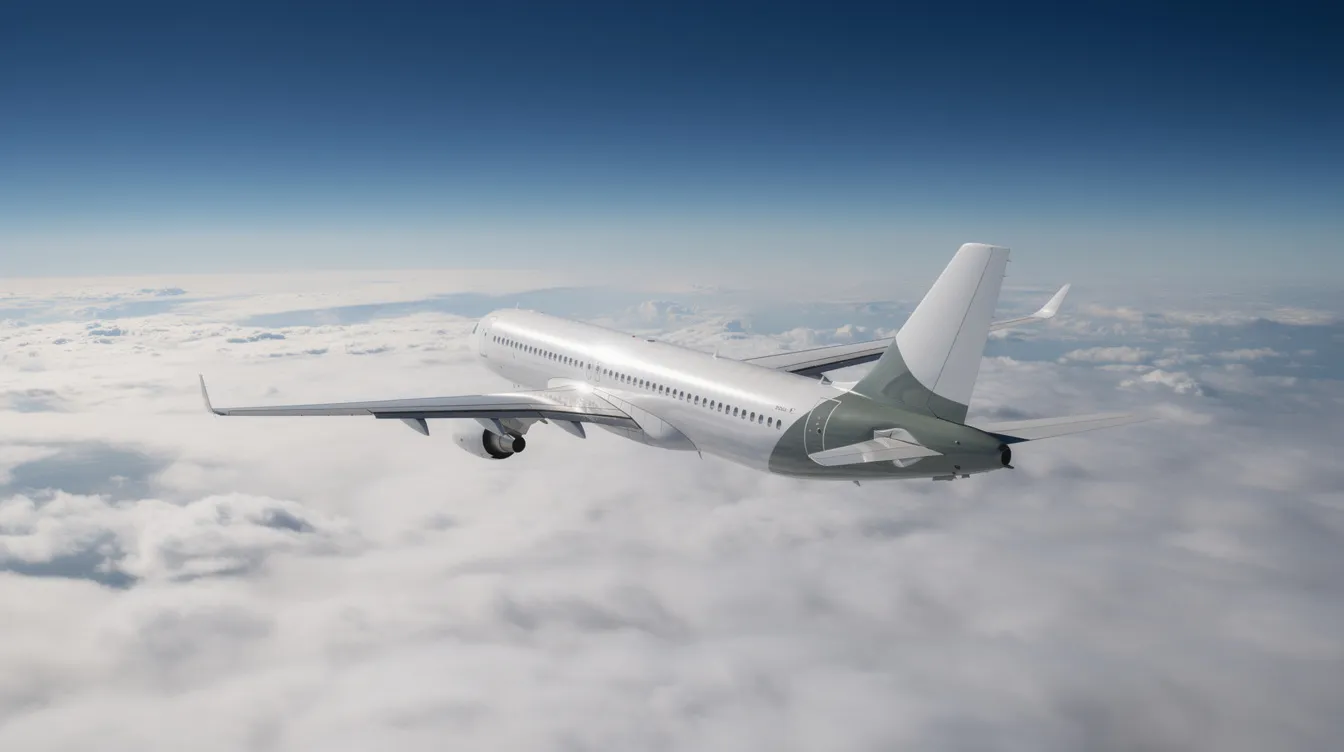
Cruising speed: approximately 545 mph (Mach 0.82), or roughly 870 km h at standard cruise conditions
Service ceiling: 41,000 ft - the max altitude this plane is capable of reaching
Range: up to 2,200 nautical miles, making it suitable for city pairs like New York–Dallas, Chicago–Denver, or destinations across Europe such as London–Rome
Maximum takeoff weight: approximately 85,000 pounds (LR variant)
Takeoff field length: about 4,154 ft for a 500 nm mission at full load - short enough to land at and depart from airports that larger narrow-bodies cannot access
The E175 is equipped with two wing-mounted turbofan engines - specifically, General Electric CF34-8E engines - allowing it to operate from shorter runways and into regional airports that expand network flexibility for airlines starting new routes.
BlackJet-accessible private jets of similar range add another layer: the ability to fly point-to-point from smaller airfields closer to your final destination, eliminating connections entirely, which is one of the clearest scenarios where chartering a private jet is worth it compared to sticking with regional commercial routes.
Environmental Efficiency & Sustainability
Growing ESG expectations among corporate and high-net-worth travelers have made the environmental profile of any aircraft a relevant data point - not just a talking point.
E175 aircraft consume 6.4% less fuel than earlier models, driven largely by aerodynamic improvements. New winglets on E175 improve fuel efficiency, and the E175's design reduces CO2 emissions by 6.4% compared to previous-generation configurations. The E175 is powered by General Electric CF34-8E engines, and those engines exceed ICAO emission standards - a standard benchmark for commercial aviation.
The E-Jet family, including the E175, is certified to operate with sustainable aviation fuel (SAF) blends where available. Airlines are increasingly adopting SAF on high-frequency regional routes as part of broader sustainability plans.
BlackJet takes a different but complementary approach: every BlackJet flight is carbon-neutral through high-quality offsets, at no extra cost to the client, which factors into any broader private jet price and cost analysis for sustainability-minded travelers. Members can also request SAF where operationally available. When comparing per-passenger emissions on an efficiently loaded Embraer 175 versus a lightly loaded large-cabin private jet, the numbers vary - but smart scheduling through a Jet Card program can balance luxury and environmental footprint.
Passenger Experience: Comfort, Noise & Working in the Air
What does it actually feel like to fly an Embraer 175? For the beginning of the journey, the experience is markedly better than that of older regional aircraft. Higher sidewalls, more headroom, and wider cabin dimensions mean fewer cramped window positions and a lot more breathing room.
The E175 is known for its excellent dispatch reliability and operational efficiency - which translates to fewer delays and cancellations. One operator, Envoy, logged 3,500 consecutive flights without a single controllable cancellation after deploying new E175s. For travelers whose time is measured in hours, that reliability is easy to appreciate.
Cabin noise sits comfortably below that of many turboprops and older jets, making the E175 practical for laptop work, messaging, or simply resting. The absence of middle seats psychologically improves perceived space and privacy compared to densely packed narrow-bodies - a change that frequent flyers notice immediately.
Boarding and deplaning with ~76 passengers is faster than on an 180-seat mainline jet, though security queues and gate processes remain standard.
Mini-scenario: A managing director named John commutes from Chicago to Toronto weekly. In E175 First Class, he gets a quiet window seat, power, Wi-Fi, and 36 inches of pitch, but on peak weeks he might instead buy a seat on a private jet to keep travel time predictable and meetings uninterrupted. Traveling via a BlackJet mid-size jet, the same trip starts at an FBO - no security lines, no boarding process, a meeting-ready cabin, and arrival at a regional airport minutes from his destination.
Embraer 175 vs. Other Regional Aircraft
Aircraft type matters when you choose your route or carrier. Here's how the E175 stacks up:
Feature | E175 | CRJ-700/900 | Embraer 170 |
|---|
Cabin width | ~9 ft | ~8.3 ft | ~9 ft |
Seats per row | 2-2 | 2-2 | 2-2 |
Headroom | Higher sidewalls | Lower | Similar |
Overhead bins | Full-size carry-on | Smaller | Similar |
Noise level | Lower | Higher | Similar |
Typical seats | 76 | 70–76 | ~66 |
The first E170 deliveries were made in March 2004, and the E175 followed as its stretched sibling in the same Embraer E-Jet family. Newer E2 models (E190-E2, E195-E2) offer larger capacity and longer range but serve different market segments. The E175 remains the preferred number one choice where scope clause compliance and regional economics intersect.
Among the best planes to fly on commercial regional routes, the E175 earns consistent praise from passengers and crews, while larger groups may step up to private jets for around 30 passengers when they need a comparable level of comfort on a much bigger scale. Yet even the most comfortable regional jet cannot match the privacy, customizable layout, and bespoke services of a private jet arranged through BlackJet.
Safety, Certification & Reliability
Safety standards for the Embraer 175 are equivalent to those of any mainline commercial airplane - a point that matters for risk-conscious clients who plan their travel around certainty.
The E175 received type certification from Brazil's ANAC in 2004, EASA certification in 2005, and FAA certification in 2006. It meets every global commercial airliner safety standard, and the E-Jet family's dispatch reliability statistics across North American regional networks are among the strongest in the industry.
Like all major aircraft families, E-Jets have had isolated incidents - each led to targeted service bulletins, maintenance program updates, and pilot training enhancements that continuously raise safety margins.
BlackJet applies an equally rigorous safety-first approach, extending the same audit standards and planning discipline to private jets for 20 passengers and other large-cabin group charters. Every operator in the BlackJet network must meet high independent audit standards such as ARG/US, Wyvern, or IS-BAO-equivalent certifications, with fleets maintained under Part 135 or equivalent commercial programs. Emergency preparedness, crew qualifications, and maintenance records are vetted before any aircraft enters the network.
Safety is a non-negotiable baseline - whether you're connecting on an Embraer 175 or flying privately via a BlackJet Jet Card.
Using Commercial E175 Flights Alongside BlackJet Private Travel
Many BlackJet members strategically blend premium commercial flights on aircraft like the Embraer 175 with private segments, using BlackJet private jet card and charter programs as the backbone of their itinerary and layering in regional links only where they add efficiency. It's not an either-or decision - it's a plan built around efficiency.
Example itinerary: A client flies long-haul in commercial business class from London to New York JFK, connects onto a Delta-operated E175 regional leg to Albany, then boards a BlackJet charter from a nearby regional airport for a last-mile flight to a private estate in Vermont.
Staying on commercial E175 services makes sense on very high-frequency shuttle routes or at heavily slot-controlled airports where private jet access is limited. The comfort advantages - no middle seats, quieter cabin, speed comparable to larger jets - make the E175 one of the more acceptable commercial links within an otherwise private-focused travel strategy.
Shifting to a BlackJet private jet is more efficient when you're visiting multiple destinations in a single day, when E175 networks don't serve your endpoint, or when tight boardroom-to-boardroom schedules leave no room for connection risk. BlackJet's 24/7 team can help design itineraries that coordinate private departures with known airline schedules, including those operated by E175 fleets, and can also recommend the cheapest private aircraft options when budget sensitivity is as important as speed.
BlackJet Jet Cards vs. Relying on Embraer 175 Scheduled Service
How does guaranteed private access through a BlackJet Jet Card compare to premium regional commercial travel, and which of the best jet cards for frequent flyers is the right fit for your pattern of E175 and private segments?
Factor | BlackJet Jet Card | E175 First Class |
|---|
Schedule | On your time | Fixed airline schedule |
Privacy | Full cabin | Shared with 75 passengers |
Airport experience | FBO, no security lines | Standard terminal process |
Booking | 24/7 digital platform | Airline booking systems |
Carbon status | Carbon-neutral every flight | Varies by airline |
Multi-city flexibility | Unlimited routing | Hub-dependent |
For travelers logging dozens of hours per year, comparing a 50-hour jet card cost to the equivalent amount of premium regional flying can clarify where guaranteed access wins.
Use case: A CEO needs to visit three cities in one day - starting in Dallas, then Houston, then New Orleans. No combination of scheduled E175 flights can accomplish this in under 14 hours. A mid-size jet via Jet Card completes the circuit by early afternoon, and a detailed look at 100-hour jet card cost helps determine when that level of access becomes more economical than ad-hoc bookings.
On certain high-frequency city pairs, flying an Embraer 175 in First Class may be cost-effective for a single passenger. But once you factor in time lost to connections, overnight stays, and team travel for multiple executives, Jet Cards often deliver better total value. BlackJet also maintains carbon-neutral status across all flights, helping clients meet sustainability commitments more transparently than ad-hoc commercial travel, even on large-group trips that call for private jets carrying up to 50 passengers.
FAQ: Embraer 175 & Private Jet Alternatives
Does the Embraer 175 have middle seats? No. The E175 features a 2-2 layout throughout - every seat is either a window or aisle. This is one of its most appreciated design details, and a key contrast with the exclusively private cabins you access through a BlackJet 25+ Hour Jet Card.
How do I read an Embraer 175 seat map, and which rows are best? Look for forward extra-legroom rows (typically rows 4–7) for the best combination of legroom, quiet, and privacy. Avoid rear rows near galleys and lavatories. Exit rows offer generous legroom but may have limited recline, but if you’d rather avoid the seat-map game entirely, you can explore the cheapest private jet options that still get you into dedicated cabins.
How does E175 First Class compare to a private jet seat? E175 First Class offers ~36–38 in pitch and ~20 in seat width - a significant upgrade over the main cabin. However, private jet cabins through BlackJet provide fully reclining club seats, complete privacy, bespoke catering, and cabin layouts you can customize for meetings or rest, especially if you’re considering assets in the range of a 5 million private jet rather than relying solely on charter.
Is the E175 good for working in-flight? Yes - Wi-Fi, power in premium classes, and relatively low cabin noise make it practical for email, documents, and light video. Private cabins, however, offer an office-like environment with no interruptions and guaranteed connectivity, which is why many executives evaluate whether chartering a private jet is worth it once their schedule becomes more demanding.
What about safety and reliability? The E175 holds FAA, EASA, and ANAC certifications and has an excellent dispatch reliability record. BlackJet vets every operator in its network against independent safety standards, including ARG/US and Wyvern, while also helping clients understand how those requirements interact with overall jet card cost structures.
When should I consider a BlackJet Jet Card instead of flying commercial on an Embraer 175? When schedule flexibility, privacy, custom routing, or multi-stop days are your priority - or when commercial flights simply don't align with your itinerary. Understanding jet card cost per hour makes it easier to compare that flexibility directly with premium regional fares.
Conclusion: Elevate Your Regional Travel Experience with BlackJet
The Embraer 175 stands as a benchmark in regional aviation, combining comfort, efficiency, and reliability in a way that has transformed short- and mid-range travel. Its no-middle-seat design, modern amenities, and strong safety certifications make it a preferred choice for millions of passengers annually. However, for discerning travelers who value ultimate flexibility, privacy, and seamless travel experiences, the transition from scheduled regional service to private jet access through BlackJet offers unmatched advantages.
By integrating BlackJet’s Jet Card programs with commercial E175 flights, travelers can craft itineraries that optimize time, minimize hassle, and elevate comfort—whether flying solo or with a team. BlackJet’s commitment to safety, sustainability, and technology ensures that every journey not only meets but exceeds the expectations of today’s luxury traveler.
Discover how BlackJet can reshape your travel by providing effortless private jet access that complements and surpasses the regional commercial experience. Explore premium jet access and join our exclusive Jet Card program to unlock a new level of travel sophistication tailored to your unique needs.


 Sign up with google
 Sign up with Apple