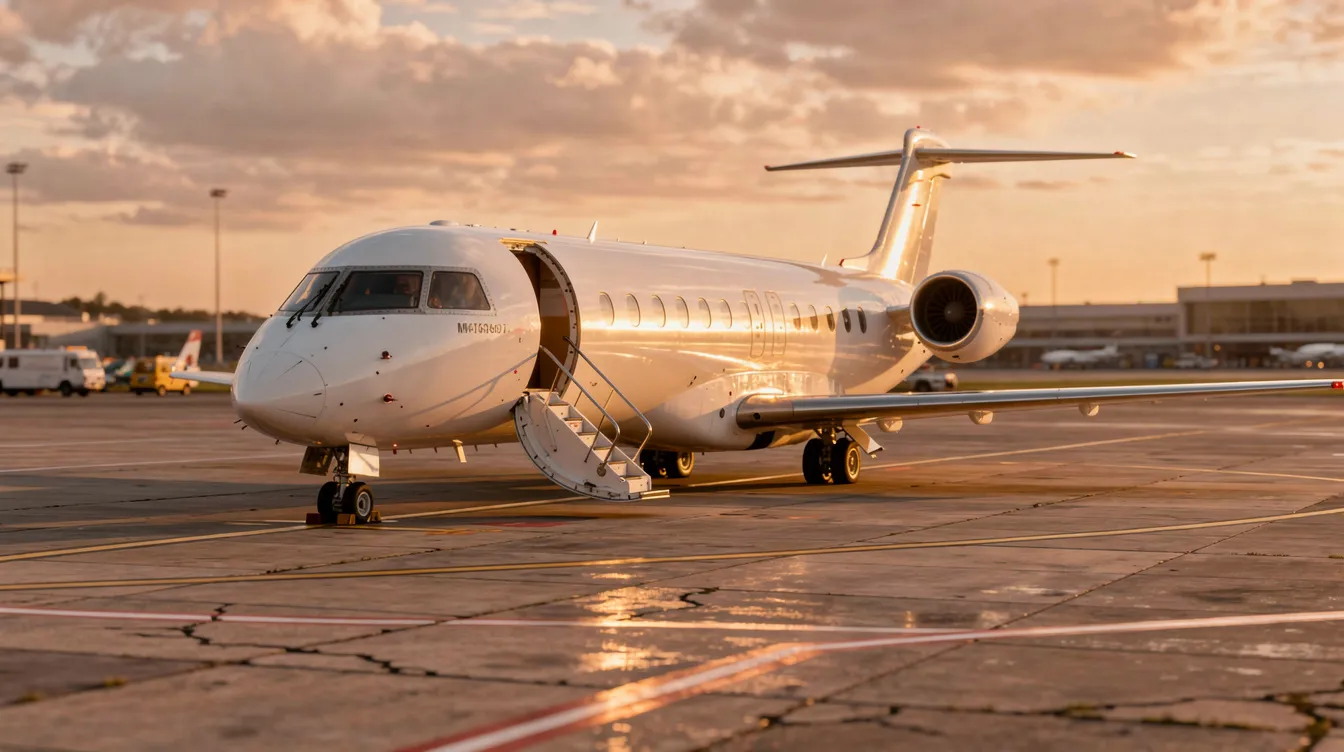
For high-net-worth travelers and corporate groups, the cabin you fly in is not just a detail-it is the difference between arriving ready to perform and arriving depleted. This guide is designed for corporate travel planners, executive assistants, and high-net-worth individuals evaluating group charter options, including those who might also be comparing 10-million-dollar private jet ownership options with flexible access to aircraft like the ERJ 145. The Embraer ERJ 145 interior offers one of the most versatile platforms in regional aviation, capable of seating 50 passengers in dense airline service or transforming into a spacious, business-class environment for as few as 16. Understanding what this aircraft delivers-and what it can become-is essential for anyone evaluating group charter options.
Strategic advantages of choosing the Embraer ERJ 145 interior
Private flight on the ERJ 145 is not simply a luxury gesture. It is a strategic advantage rooted in arithmetic: a single 30-to-40-seat charter consolidates an entire team, delegation, or executive group onto one aircraft, often comparing favorably with both ad hoc charter rates outlined in guides to renting a private jet and typical jet card cost per hour structures. Compare that to purchasing 20 or more individual first-class tickets on American Airlines, coordinating connections through congested hubs, and losing hours to security lines and boarding queues. Chartering the ERJ 145 is cost-effective for group travel because it amortizes operating costs across enough seats to keep per-person pricing competitive while delivering an experience that commercial service cannot match, especially when compared with other access models analyzed in guides to jet card pricing and membership value.
BlackJet uses the ERJ 145 and other aircraft across the Embraer ERJ family as a flexible "mini airliner" for corporate roadshows, sports teams, and executive shuttles, complementing more ad hoc solutions for travelers who buy a seat on a private jet rather than chartering an entire aircraft, and for decision-makers evaluating the underlying cost to rent a private jet versus committing to longer-term access programs. The aircraft can fly non-stop for about three-and-a-half hours, covering high-demand regional routes without refueling stops. For a group of 25 executives heading from New York to Miami-or a sports franchise moving 30 players between cities-this means direct routing into smaller airports, zero layovers, and total control over scheduling, catering, and cabin comfort, similar to the experience travelers seek when evaluating private jets suited for 15 passengers on longer, nonstop missions.
While major airlines like American Airlines fly the ERJ 145 as a 50-seat economy workhorse, private layouts transform the same airframe into something far more refined. Typical airline seat pitch hovers around 31 inches in a tight 2-1 cabin layout. Private configurations open that up dramatically, with some operators reducing capacity to 16–28 passengers and expanding pitch to 38 inches or more. The result: the same regional jet, reimagined as a business jet variant that rivals dedicated corporate aircraft in feel and function.
Aircraft overview: where the Embraer ERJ 145 sits in the ERJ family
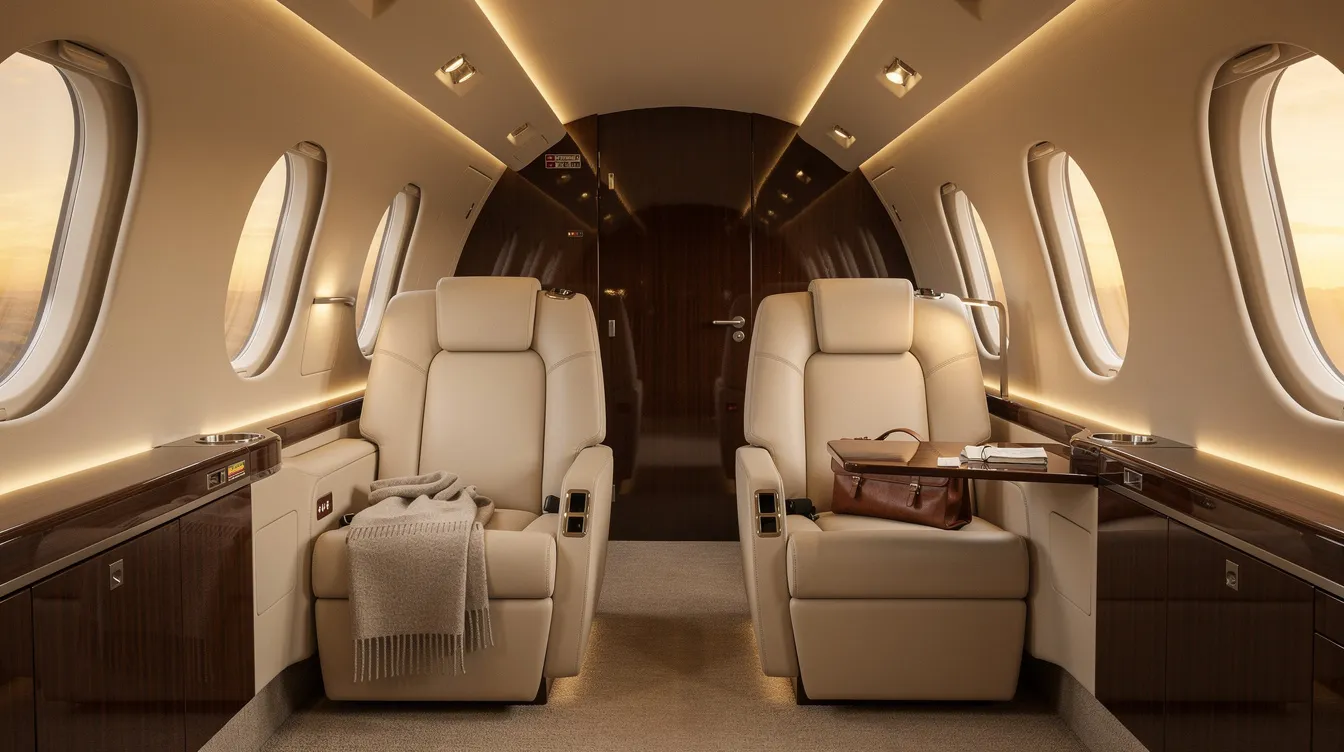
The Embraer ERJ family encompasses three closely related aircraft: the ERJ-135 (approximately 37 seats), the ERJ-140 (approximately 44 seats), and the ERJ 145 (up to 50 seats). All share a common flight deck, systems architecture, and rear fuselage-mounted engines- specifically variants of the Rolls-Royce AE 3007 turbofan. The ERJ 145 entered commercial service in 1996–1997, and over 892 ERJ 145 units were delivered by 2006. Embraer estimated continued demand through the 2000s as regional airlines built dense route networks with this smaller aircraft, a dynamic that also shaped the fleets of several of the top private jet companies for luxury travel. The Embraer ERJ 145 is designed for short- to medium-haul flights, with a maximum cruise speed of Mach 0.78 and a maximum takeoff weight of 36,375 lb.
The long-range LR variant and the extra-long-range XR version-which feature increased fuel capacity using modifications to the same tanks-can cover approximately 1,550 nautical miles with a full load, enough for most domestic and near-international regional routes. These variants provide improved climb characteristics and improved cruise performance through numerous aerodynamic improvements and high-performance engines, achieving lower cruise configuration drag without fundamentally changing the cabin shell, making them attractive platforms for fleet operators who also compare NetJets jet card costs and broader jet card cost per hour benchmarks when planning access strategies. The extended range capability, combined with a crew alerting system shared across all variants, means operators can serve the European market and transcontinental segments with confidence. Carriers like American Eagle, ExpressJet Airlines, and CommuteAir-the largest operator of the type with 165 aircraft-built their regional division networks around this platform. Now, as airlines retire older ERJ aircraft, many airframes are moving into private charter, corporate shuttle, VIP transport, and military models with new interiors—often evaluated alongside 20 million-dollar private jet ownership and upgrade strategies for long-haul and intercontinental missions.
For BlackJet clients, the ERJ 145 sits precisely where it is most useful within the spectrum of private jet sizes: larger than a light or midsize private jet carrying 8–16 people, yet far more practical and economical than a full narrowbody for missions involving 20–45 travelers.
Standard airline ERJ 145 interior and cabin layout
In commercial service, the standard Embraer ERJ 145 interior seats 50 passengers in a single-aisle 2-1 configuration, which many cost-conscious travelers compare against the cheapest private jet options for smaller groups when deciding between regional airline service and entry-level private aviation. The ERJ 145 features a 2-1 seating configuration with no middle seats. One seat occupies the left side (the A position, a single seat by the window), while two seats sit paired on the right (B and C). There is no middle seat in the traditional sense-every passenger has either an aisle seat or a window, which is one of the ERJ 145's underappreciated advantages for solo travelers and those who dislike being sandwiched on regional flights.
The cabin interior spans approximately 54 feet long across roughly 18 rows. Seat pitch is approximately 31 inches, providing functional comfort on sectors under two hours but feeling compressed on longer legs. Seat width measures approximately 17 inches on the paired side, with slightly more shoulder clearance on the single-seat side. Cabin height is around 6 feet at the centerline-adequate for most passengers but affecting taller passengers' comfort, particularly those over 183 cm (6 ft) who may find themselves ducking slightly when standing. The ERJ 145 is known for its narrow fuselage, creating an intimate cabin feel, and cabin windows are relatively large and positioned well for natural light, which offsets the compact dimensions.
Seat numbering runs from row 1 through approximately row 18 or 19, with the exit row near the wing offering extra legroom-a preferred spot for taller travelers. A single compact lavatory is typically located at the rear of the cabin, while a compact galley occupies the forward section near the main cabin entrance. A simple seat map would show the asymmetric aisle, the A-side single seat, B/C paired seats, forward galley, and rear lavatory-a straightforward layout that American Eagle and other operators have used for decades on regional routes.
Private charter ERJ 145 interiors: how layouts transform the experience
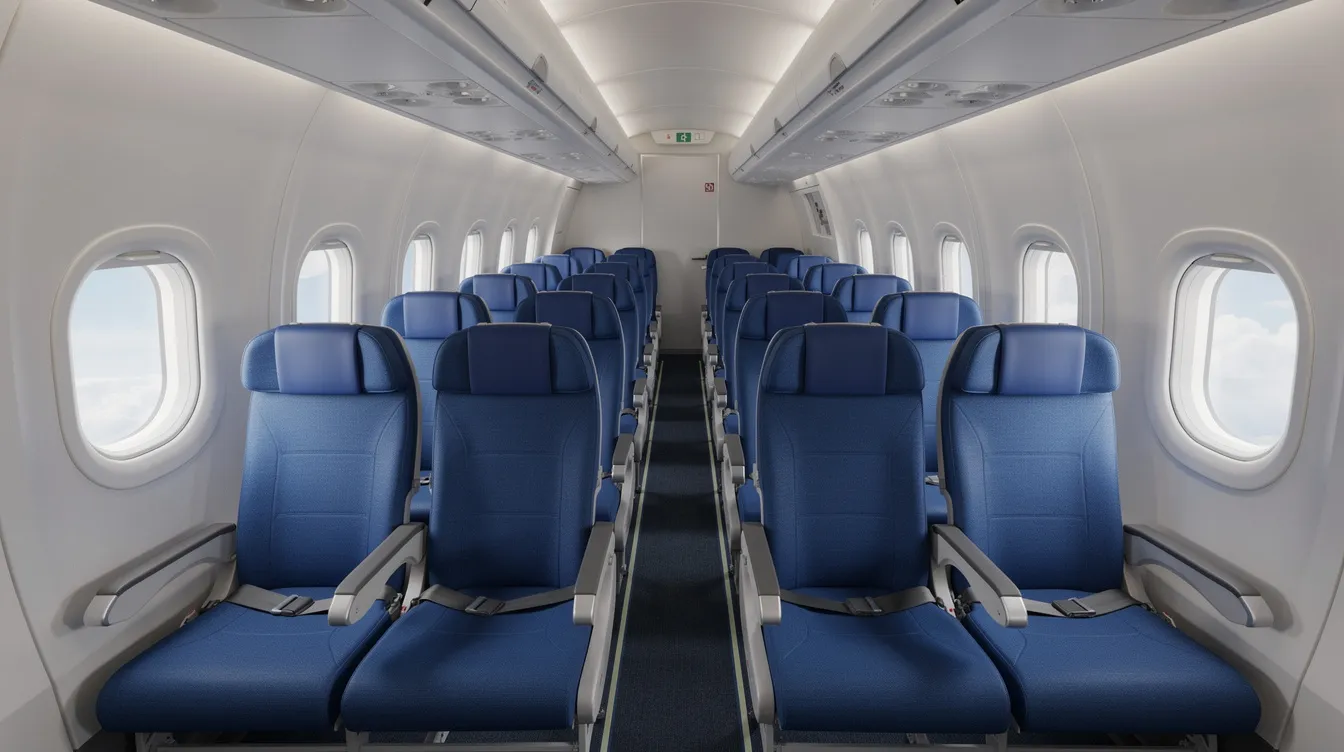
Private and corporate operators reconfigure the ERJ 145 interior from 50 seats down to dramatically fewer passengers-sometimes as few as 16 to 28 passengers-to create a fundamentally different cabin experience, comparable in comfort to the top 16-seat private jet options used on longer-range missions. Private configurations can reduce seating to 16–28 for more space, but BlackJet typically recommends 28–36 passenger seats for corporate shuttle and sports-team missions. This range balances cost efficiency with generous personal space.
Several common layout approaches exist:
All-forward-facing business class: 30–36 seats with increased pitch (34–40 inches), wider armrests, and full recline. This is a business jet variant based on the standard seat track system but with significantly upgraded mechanical components and premium leather upholstery.
Club seating pods: Groups of four seats facing each other across fold-out tables, ideal for in-flight meetings, strategy sessions, or dining. Space-saving retractable panels between pods offer privacy when needed.
Hybrid VIP layout: A forward lounge zone with sofas or a conference table, followed by standard or semi-standard rows in the rear. This works well for delegations where principals need separation from support staff.
Private charters allow flexible seating arrangements for groups, and modern interiors may feature LED mood lighting and updated upholstery that transform the cabin ambiance entirely, while programs such as Flexjet jet card options illustrate how frequent flyers secure consistent access to similarly equipped aircraft. C&L Aviation, for example, has converted multiple ERJ 145s into 30-seat luxury configurations with new ceiling panels, enhanced lavatories, and Wi-Fi-a process taking roughly four to five months per airframe. Arcus Air operates a 22-seat VIP ERJ 145 in a 1-1 configuration with 109 cm seat pitch and premium leather seats approximately 58 cm wide.
Consider a West Coast tech company running a 32-seat ERJ 145 for a three-city investor roadshow, or an East Coast professional sports franchise using a custom 30-seat layout for weekly away games. In both cases, the cabin delivers cohesion-the entire group travels, strategizes, and arrives together.
Cabin comfort: seating dimensions, noise levels, and ergonomics
The same airframe dimensions produce radically different cabin comfort depending on configuration. In airline service, seat dimensions are dictated by density: 31-inch pitch, 17-inch width, minimal recline. In a 30–36-seat private charter, that same main cabin opens to 34–38 inches of pitch or more, with wider seat cushions and genuine aisle clearance.
Key comfort contrasts:
Legroom: Airline pitch of ~31 in versus 34–40 in on private layouts; some VIP configurations exceed 43 inches
Shoulder room: The single seat side always feels roomier; private layouts may convert to a 1-1 center-aisle arrangement for maximum width
Aisle movement: Fewer seats mean fewer obstructions-passengers can stand, stretch, and move freely
Exit row and bulkhead rows: In airline service, these are the only options for extra legroom; on BlackJet charters, dedicated "tall traveler" rows can be positioned anywhere
Engine noise and vibration are worth understanding. The Rolls-Royce turbofans are mounted at the rear fuselage, so the front rows are noticeably quieter. The rear of the cabin tends to be warmer and quieter despite being close to the engines-a counterintuitive fact owed to insulation design and airflow patterns in many refurbished frames. Private charters can buffer the noisiest rows by leaving them empty, assigning them to baggage, or seating crew there. Acoustic insulation upgrades during conversion further dampen ambient noise throughout the cabin.
Carry-on luggage, overhead bins, and baggage planning
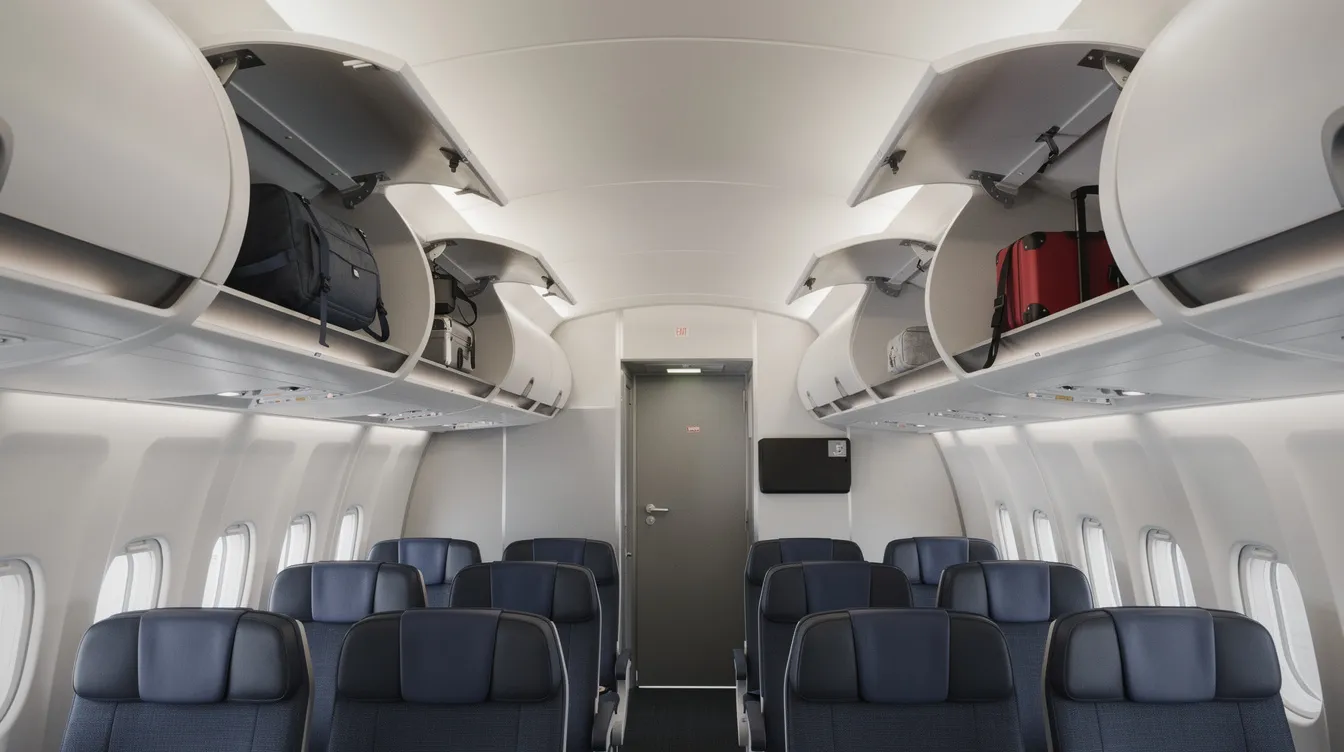
Overhead bin space is significantly limited compared to mainline aircraft. The ERJ 145's overhead stowage compartments are shallower than those on narrowbody jets-standard 22-inch hard rollaboards often will not fit. Large carry-on items may need to be gate-checked due to size restrictions, particularly on full 50-seat commercial flights. Along the A-side (single-seat side), bins may be shallower or absent in some frames; the B/C-side bins offer more consistent depth but still limited height.
For commercial passengers, practical advice is straightforward:
Prefer soft-sided carry-on luggage that can compress into smaller bins
Keep essentials (laptop, medications, documents) in a small under-seat bag
Expect to gate-check if the flight is at or near full capacity
For BlackJet charters, the calculation changes entirely, especially for clients who integrate ERJ 145 usage into broader aviation strategies that may include maximizing jet card tax deductions. Thirteen fewer passengers-or more-means substantially more available cabin stowage. The aircraft has a total luggage volume of around 500+ cubic feet in the cargo hold, and passengers can bring a 45 lbs bag in the luggage hold per standard allowance. For group charters involving musicians with instruments or sports teams with gear, BlackJet coordinates precise baggage weights and volumes in advance to match the selected ERJ 145 configuration, ensuring no logistical difficulties on the day of travel.
Onboard aircraft features: lighting, galleys, lavatory, and tech upgrades
The base ERJ 145 in airline service offers modest aircraft features: the compact galley is equipped for basic beverage and snack service, individual overhead reading lights and air nozzles line the cabin, and a standard PA system handles announcements. The aircraft lacks standard seatback screens and in-flight entertainment systems-passengers rely on personal devices. Classic ERJ 145 configurations lack in-seat power outlets and USB ports, which presents a real limitation on working flights.
In the 2020s, interior refreshes have become common. CommutAir, for instance, refurbished all 75 of its ERJ-145 XR aircraft with upgraded sidewalls, overhead bins, lavatories, and LED reading lights. Private charter operators go further:
Power: AC outlets (110V), USB ports, and USB-C PD at every seat
Connectivity: Satellite Wi Fi or air-to-ground broadband
Galley: Espresso machines, refrigerated catering storage, full meal service capability
Lighting: LED mood lighting with adjustable color temperature
Audio: Premium cabin speaker systems for briefings or ambient sound
A concrete "before and after" example: a retired American Eagle airframe, originally configured with 50 economy seats and no connectivity, converted into a 32-seat corporate shuttle with full Wi-Fi, power outlets at every seat, upgraded leather seating, and a refreshed galley—squarely in the category of larger-cabin layouts covered in guides to types of private jets for every traveler and relevant to decision-makers studying airplane financing options and strategies. The mechanical components are overhauled, sidewalls replaced, and the lavatory receives premium finishes. The transformation illustrates how private jet customization can reimagine a workhorse regional jet into a genuinely productive flying office.
ERJ 145 interiors across roles: commercial, private, and military models
The ERJ 145's cabin can be customized for various market sectors, and its operational history reflects remarkable adaptability. In commercial service, interiors prioritize density, durability, and fast turnaround, whereas smaller categories highlighted in guides to the best small private aircraft and broader rundowns of the cheapest private aircraft options emphasize mission flexibility over maximum seat count. In corporate and VIP transport roles, the same platform receives premium seating, full galleys, and enhanced lavatories. Military models and government aircraft retain the basic cabin shell but add mission consoles, secure communications, and specialized seating for passenger transport or surveillance.
Belgium operated an ERJ 145 for VIP transport from 2001 to 2020, using a hybrid layout with a forward lounge and conference zone followed by standard rows. The ERJ 145 has been adapted for medical and military roles by several nations, with airborne surveillance variants carrying sensor consoles in place of most passenger seats. These adaptations demonstrate the structural flexibility that makes the ERJ family appealing across missions-from a joint venture regional carrier operation to a head-of-state shuttle- and also explain why many organizations evaluate leasing a private jet as an alternative to outright ownership when deploying ERJ platforms.
While BlackJet does not operate military models, understanding these variants underscores a key point: the ERJ 145 is not a one-trick platform and competes with larger charter solutions discussed in analyses of charter plane 100 passengers cost. Its design accommodates everything from 50-seat regional flights to fewer passengers in highly specialized configurations, bridging the gap between the cheapest private jet choices for individuals and full-size airliner charters for very large groups.
ERJ 145 vs other Embraer ERJ family interiors
The ERJ-135 and ERJ-140 share the same cabin cross-section as the ERJ 145-identical ceiling height, width, and 2-1 seating geometry- even though clients comparing options for the best private jet for 15 passengers may ultimately choose wide-cabin heavy jets instead of regional types. The only significant changes are fuselage length and seat count. The ERJ-135 carries thirteen fewer passengers than the ERJ-145 in standard airline service (approximately 37 versus 50), while the ERJ-140 seats around 44. All three share the same family fuel-capacity architecture across most variants, with the ERJ 145ER serving as the extended-range version while still drawing from the same tanks in baseline configurations, and use the same physical engines from the Rolls-Royce AE 3007 family.
From a passenger perspective, the cabin feel is nearly identical across the ERJ family once interiors are standardized, though groups evaluating the best private jet for 20 passengers or researching how much a 12-seater private jet costs will often weigh ERJ family shuttles against large-cabin business jets and VIP airliners. Private operators often install the same leather, carpets, and lighting across all three types so that passengers barely notice whether they are on a smaller aircraft like the ERJ-135 or the full-length ERJ 145-only the number of rows and fewer seats distinguish them. Cockpit commonality enables a single pilot pool across all variants, and cabin crew procedures remain consistent, minimizing any training flight overhead when transitioning between types.
For BlackJet clients, aircraft selection within the Embraer ERJ family comes down to passenger count, runway requirements, and budget, especially when comparing ERJ shuttles with widebody options profiled in guides to the best private jet for 50 passengers and understanding private jet charter pricing for different group sizes:
ERJ-135: 16–24 seats in private configurations, ideal for smaller executive groups
ERJ-140: 20–30 seats, a middle option for mid-size delegations
ERJ-145: 28–40 seats in private layouts, the choice for larger groups or when the company's internal documents call for maximum flexibility
Planning your ERJ 145 private charter interior with BlackJet
BlackJet matches travelers with the right ERJ 145 interior by evaluating four variables: route distance, passenger count, baggage requirements, and onboard priorities (productive work versus relaxation), then aligning those needs with its broader ecosystem of premium private jet cards and charter programs and a broader understanding of the private jet price list, costs, and access options. The estimated cost and cabin layout are then tailored to the mission, whether that is a domestic corporate shuttle or a regional itinerary such as bespoke private jet charters in Karachi or private jet charters in Lahore.
Consider a concrete scenario: 25 executives need a corporate shuttle from Boston to Charlotte. BlackJet assigns a 30-seat ERJ 145 with Wi-Fi, power outlets, front "quiet" rows for C-suite principals, and branded headrest covers. The galley is stocked for a full breakfast service. Rear rows are reserved for support staff and equipment. The entire group boards in minutes at a private terminal, bypassing commercial infrastructure entirely.
Jet Card members can predefine preferences-minimum seat pitch, required aircraft features like Wi-Fi and USB ports, catering style, even cabin scent-so each booking delivers a consistent interior experience regardless of which specific ERJ 145 airframe is assigned, and travelers who fly frequently may benefit from enrolling in a dedicated BlackJet 25+ Hour Jet Card or exploring a 100-hour jet card cost guide for predictable access and pricing. BlackJet independently audits every operator for safety compliance, maintenance history, and crew qualifications, applying many of the same evaluation criteria highlighted in reviews of the best jet cards for frequent flyers. Every flight is carbon-neutral at no additional cost, positioning the ERJ 145 as both efficient and responsible for group travel, and many clients pair aircraft selection with an understanding of overall jet card cost and value along with detailed 25-hour jet card features and costs to optimize their annual travel spend.
Frequently Asked Questions about the Embraer ERJ 145 Interior
How many passengers does the Embraer ERJ 145 typically seat?
The standard airline configuration seats 50 passengers in a 2-1 layout with no middle seats, offering either aisle or window seats for every passenger.
Can the ERJ 145 interior be customized for private charters?
Yes, private operators often reconfigure the cabin to seat between 16 and 40 passengers, increasing legroom and adding premium features like leather seats, Wi-Fi, and power outlets, making them a logical upgrade path for pilots who started in the cheapest planes and entry-level aircraft but now require regional-capacity solutions.
What is the seat pitch and width in the standard ERJ 145 interior?
Typical seat pitch is approximately 31 inches with a seat width of about 17 inches, providing functional comfort for regional flights.
How does the ERJ 145 handle carry-on luggage?
The overhead bin space is limited, especially on the single-seat side. Large carry-on bags often need to be gate-checked on full flights, but private charters coordinate baggage allowances in advance.
Are there power outlets and in-flight entertainment on the ERJ 145?
Classic ERJ 145 airline interiors lack in-seat power outlets and seatback entertainment. However, many private charters upgrade cabins with USB ports, power outlets, and Wi-Fi.
What are the advantages of chartering an ERJ 145 for group travel?
Chartering the ERJ 145 consolidates large groups onto one aircraft, saving time and cost compared to booking multiple commercial tickets, while offering flexible seating and customized service informed by transparent private jet charter pricing fundamentals.
How does the ERJ 145 compare to other Embraer ERJ family aircraft?
The ERJ 145 is the largest variant with up to 50 seats. The ERJ 140 and ERJ 135 offer fewer seats but share the same cabin cross-section and fuel capacity.
What is the typical flight range of the ERJ 145?
The ERJ 145 and its extended range variants can fly approximately 1,550 nautical miles nonstop, suitable for most short- to medium-range regional routes, while owners of smaller aircraft discussed in guides to the cheapest planes for budget-conscious pilots may still turn to larger regional jets or charter solutions for these longer segments.
Is the ERJ 145 cabin comfortable for tall passengers?
Cabin height is about 6 feet. Taller passengers may feel cramped standing but can select exit or bulkhead rows with extra legroom for seating comfort.
How does BlackJet enhance the ERJ 145 charter experience?
BlackJet offers Jet Card programs with tailored cabin layouts, onboard amenities, carbon-neutral flights, and rigorous safety audits to ensure a premium, responsible travel experience.
Conclusion: Why the Embraer ERJ 145 Interior Stands Out for Group and Corporate Travel
The Embraer ERJ 145 interior exemplifies the perfect intersection of efficiency, comfort, and versatility for regional group travel. Its standard 50-seat, 2-1 configuration offers more personal space than many regional jets, while private charter layouts transform the cabin into a premium environment accommodating as few as 16 passengers with business-class amenities. The aircraft’s operational flexibility, including extended range variants with the same fuel capacity, ensures it can serve a wide range of short- to medium-haul missions with ease and can complement unlimited private jet flight membership models for organizations that mix shuttle operations with on-demand trips.
For corporate groups, sports teams, or high-net-worth travelers seeking to consolidate large parties without sacrificing comfort or convenience, the ERJ 145 provides a compelling alternative to multiple commercial tickets or costly heavy jets. Its proven reliability, combined with modernized interiors featuring Wi-Fi, power outlets, and enhanced galleys, makes it a productive flying office or a comfortable retreat in the sky.
BlackJet’s tailored Jet Card programs and private charter expertise unlock the full potential of the ERJ 145 interior, delivering seamless, carbon-neutral travel with rigorous safety standards and personalized service supported by transparent 50-hour jet card cost and value insights. Whether your mission calls for a 30-seat corporate shuttle or an intimate 16-seat VIP layout, the ERJ 145 stands ready to elevate your group travel experience with unmatched flexibility and style.
Elevate your group travel-effortlessly. Whether you are coordinating a corporate roadshow, moving a sports franchise, or organizing an executive retreat, the Embraer ERJ 145 interior delivers the space, comfort, and flexibility your group deserves. Explore BlackJet's Jet Card programs or request a tailored ERJ 145 proposal to discover how refined, purposeful group travel becomes your new standard.


 Sign up with google
 Sign up with Apple