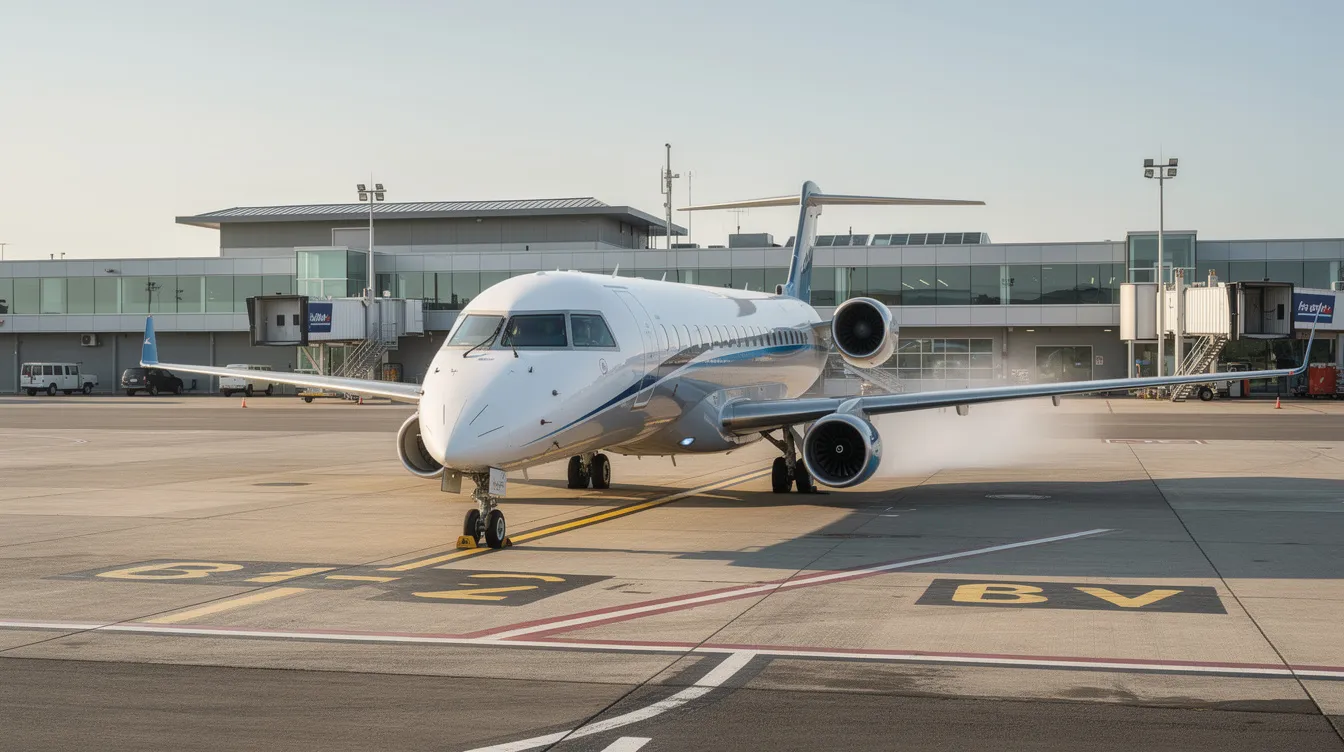
The Embraer 175 regional jet has quietly become the most important airplane in North American commercial aviation. If you fly domestically with any frequency, you have almost certainly boarded one. This guide breaks down everything premium travelers need to know about the E175-its cabin, aircraft features, specifications, safety record, and limitations-and explains when graduating to private jet travel makes strategic sense.
Why the Embraer 175 Matters for Premium Travelers
The Embraer 175 is the backbone of the U.S. regional aviation market. It is widely utilized for short-to-medium-haul flights, connecting smaller cities to major hubs on behalf of American Airlines, Delta, United Airlines, and Alaska Airlines. With a typical flight duration of 1 to 3 hours, this aircraft handles the routes lasting between 300 and 1,000 nautical miles that keep the national air network functioning-routes too thin for a Boeing 737 or Airbus A320, but too long or high-demand for a turboprop.
For the premium traveler, the E175 offers genuine comfort advantages over larger narrowbodies. The airplane uses a 2+2 seating layout throughout the cabin, which means no middle seats. Every passenger sits in either a window or an aisle position. The Embraer 175 provides a quiet cabin with wider aisles compared to older regional jets, and the first class cabin forward of the wing feels genuinely intimate-fewer passengers, less noise, and faster boarding and deplaning.
Yet even at its best, the E175 remains a commercial flight with fixed schedules, shared spaces, and TSA queues. Compare that with a private jet experience: you depart from a private terminal on your timetable, skip security lines entirely, and work or rest in a cabin that belongs only to you. Understanding exactly what the E175 delivers-and where it falls short-helps high-frequency travelers decide when commercial service is sufficient and when private aviation becomes a strategic advantage.
Embraer 175 at a Glance: Key Aircraft Facts
The Embraer 175 belongs to the first-generation e-jet family, which Embraer launched in June 1999 alongside the E170, E190, and E195. Designed in São José dos Campos, Brazil, these E-Jets brought mainline-style cabins to regional routes for the first time.
The E175 prototype first flew on 14 June 2003. The aircraft received FAA type certification on 31 August 2005, and Air Canada, the E175's launch customer, began revenue service in July 2005. By September 2013, Embraer had delivered its 1,000th E-Jet across the family, underscoring the platform's commercial success.
Core specifications paint a capable regional picture. The Embraer E175 has a maximum range of 2,150 nautical miles-approximately 1,800 miles (2,897 km)-with a cruising speed of 545 mph (875 km/h), or roughly Mach 0.78 to 0.82. Its service ceiling reaches 41,000 ft. The E175 typically seats 76 to 88 passengers depending on configuration, with the 76-seat dual-class configuration dominant in the U.S. market. It is powered by two General Electric CF34-8E engines, each delivering approximately 14,500 pounds of thrust, designed for short- to mid-range routes and high daily utilization.
Design & Development: From E170 to the Stretched E175
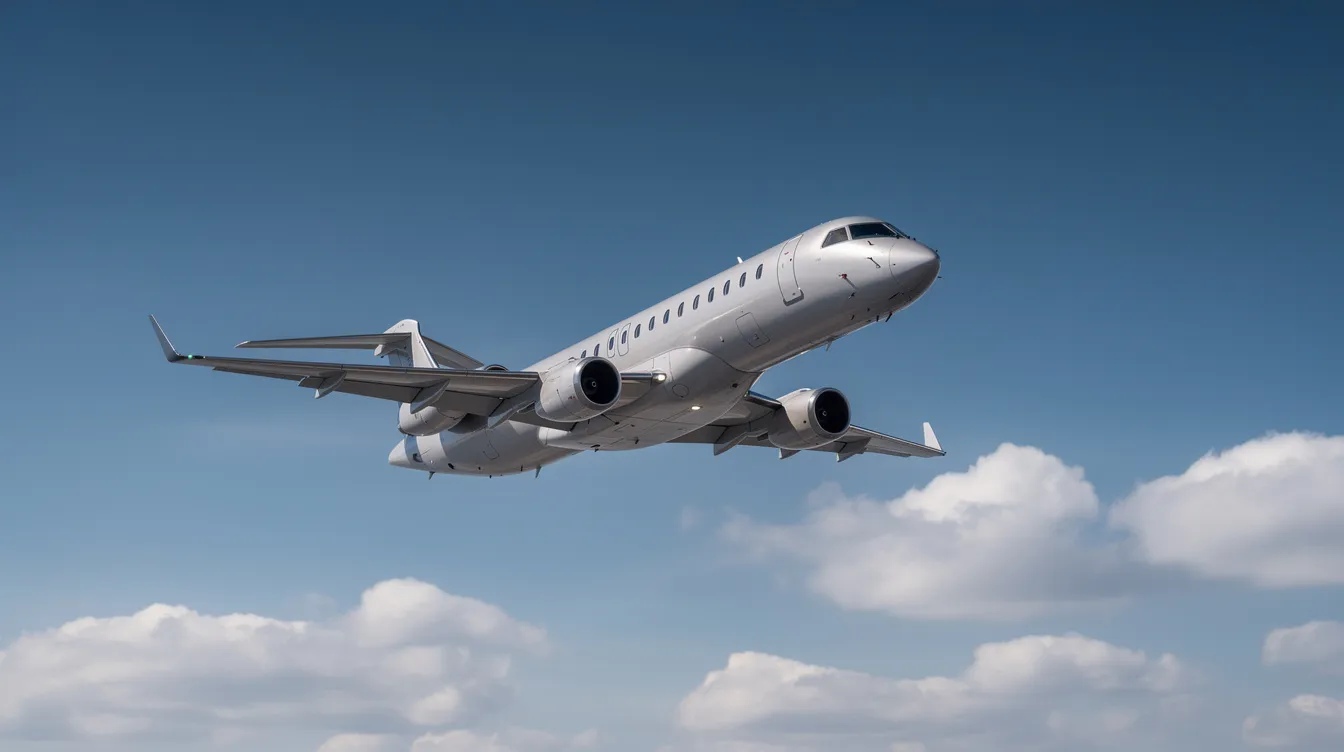
The E175 is a stretched derivative of the smaller E170. Embraer inserted a fuselage plug of approximately 1.78 meters (5 ft 10 in) to add extra rows of seats while retaining the same wing, cockpit systems, and engines. This approach maximized fleet commonality-pilots who fly the E170 share type certificates with the E175, reducing training time and cost for regional carriers.
Embraer's design goal was specific: deliver mainline comfort on regional routes while remaining optimized for scope clause restrictions in the U.S. Pilot union contracts with major airlines cap regional jets at 76 seats and impose maximum takeoff weight constraints, effectively defining the airplane's configuration ceiling. The E175 complies with these US pilot union scope clauses limiting jet size, which is precisely why it dominates the American regional fleet.
Certification milestones followed the E170's path. FAA and EASA approvals arrived in 2004–2005, and the common systems architecture-shared avionics, hydraulics, and structural components-means that maintenance requirements are simplified across mixed E170/E175 fleets. For operators like SkyWest Airlines and Republic Airways, this part's commonality directly reduces operating costs and turnaround times.
Technical Specifications & Aircraft Features
The E175's technical profile balances regional flexibility with enough capability to serve longer sectors when needed. Here are the key numbers:
Dimensions: Approximate length of 31.7 meters (103 ft 11 in), wingspan around 26 meters (with enhanced winglets extending to roughly 28.7 m), and height of about 9.85 meters.
Weight variants: The E175 has a maximum takeoff weight of 86,000 pounds in its heaviest configuration. Three variants exist-STD (Standard), LR (Long Range), and AR (Advanced Range)-each trading payload capacity against long range capability. The advanced range variant pushes MTOW slightly higher to extend range without sacrificing passenger load.
Runway performance: The E175 can operate from runways under 2,300 meters long, with takeoff field lengths as short as approximately 1,266 meters under ideal conditions. This makes it well-suited for secondary and regional airports that cannot accommodate larger narrowbodies. The Embraer 175 performs well at airports with shorter runways, opening routes that would otherwise require turboprop service.
Flight deck: A modern glass cockpit with advanced avionics, integrated flight management systems, and auto-throttle supports both safety and fuel efficiency. The flight crew benefits from high situational awareness and reduced workload on short sectors.
Engines, Fly-by-Wire & Handling
The heart of the E175's propulsion system is the General Electric CF34-8E turbofan. Each engine produces roughly 14,500 pounds of thrust and descends from the military TF34 lineage, refined for commercial regional jets. The CF34-8E is a high-bypass, twin-shaft design optimized for fuel burn efficiency on sectors where engines cycle frequently between takeoff thrust and cruise.
Engine management relies on Full Authority Digital Engine Control-commonly called authority digital engine control or FADEC. In simple terms, FADEC is a computer system that governs every aspect of engine operation, from idle to maximum power, automatically protecting against over-temperature and overspeed conditions while optimizing fuel burn across all phases of flight.
The E175 employs a fly-by-wire flight control system with envelope protection, meaning the aircraft's computers prevent pilots from exceeding safe flight parameters. Multiple redundant Flight Control Modules, dual hydraulic systems, and redundant electrical architecture ensure that no single failure compromises controllability. Carbon brakes, anti-skid systems, and ground spoilers enhance landing performance and safety across varied runway conditions.
This mature, well-understood design contributes to the Embraer 175's high dispatch reliability rate of around 99.9% according to Embraer-a number that matters deeply to business travelers who depend on on-time regional connections.
Cabin Layout & Seat Configuration: How Many Seats Are on an Embraer 175?
The defining characteristic of the E175 cabin is its 2+2 seating layout with no middle seats. Every single seat on this plane is either a window or aisle position-a feature that immediately distinguishes it from the 3+3 configuration found on most larger narrowbodies.
So how many seats are on an Embraer 175? The answer depends on the operator:
76-seat dual-class configuration (most common in the U.S.): 12 first-class seats, 20 Main Cabin Extra seats, and 44 standard economy seats. This is the layout used by American Airlines, Delta, United Airlines, and Alaska Airlines through their regional partners.
78-seat single class: Reduced pitch throughout, used by some international operators.
82–88-seat high-density: Pitch compressed to approximately 29–30 inches, more common outside North America. LOT Polish Airlines and other operators have used denser configurations.
One practical note: overhead bins on the E175 are narrower than those on mainline aircraft. Standard 22-inch carry-on rollers fit, but oversized bags frequently require gate checking. Plan your carry-on strategy accordingly.
The general cabin vibe is quieter and more intimate than large narrowbodies, especially forward of the wing where engine noise is minimal, and the smallest aircraft sections feel almost private.
First Class on the Embraer 175
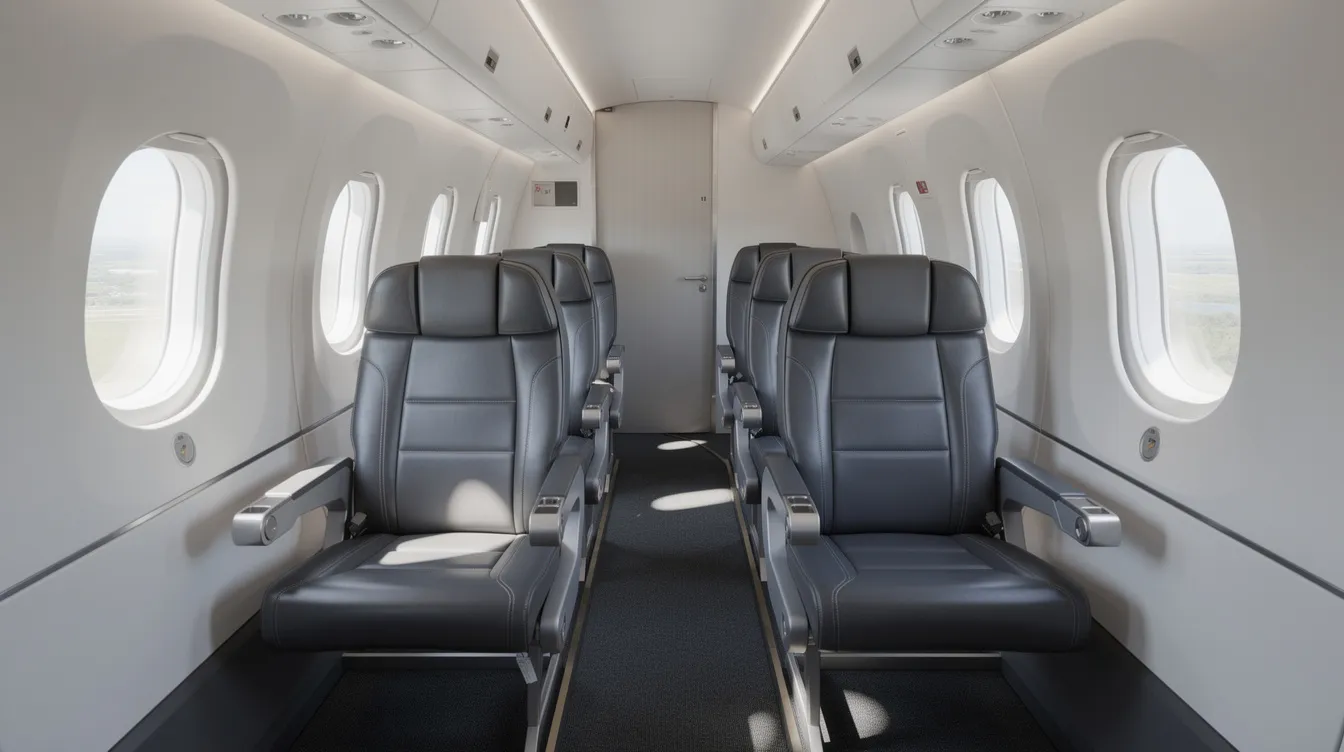
First class on the E175 is often considered one of the most pleasant regional cabins in North America-and with good reason. The first class cabin typically holds 12 first class seats arranged in a 1-2 configuration: one solo seat on the A-side (offering both window view and direct aisle access) and a pair on the opposite side. Those solo first-class seats are among the most coveted in domestic regional flying.
Seat dimensions are generous for routes lasting one to three hours. Pitch runs approximately 36 to 37 inches, seat width measures about 19 to 20 inches, and recline reaches 5 to 6 inches. These are not lie-flat seats, but for a 90-minute hop, they provide ample space to work or rest comfortably. Class seats in first come equipped with adjustable headrests, tray tables built into armrests, and power outlets at each seat for charging devices.
Service in the first class cabin includes priority boarding, enhanced catering on longer sectors (snacks, complimentary beverages), and faster deplaning thanks to the forward position. Some fleets operate with only 8-class cabin seats in first, which increases cabin privacy but reduces upgrade odds for elite frequent flyers hoping to move up from economy.
Main Cabin, Main Cabin Extra & Economy: Comfort Without Middle Seats
Behind first class, the same 2+2 layout continues throughout the main cabin. The absence of middle seats is the single largest comfort advantage the E175 holds over 3+3 narrowbodies-no elbow battles, no climbing over strangers, no feeling boxed in.
Main Cabin Extra (or equivalent premium economy-style rows, depending on the airline) sits immediately behind first class, typically rows 5 through 9. Main Cabin Extra seats offer approximately 34 inches of pitch versus roughly 30 inches in standard economy, with the same seat width of about 18 to 19 inches. Benefits often include preferred boarding, complimentary premium drinks, and USB ports for device charging.
The E175's main cabin includes 64 standard economy seats (in the typical 76-seat layout, combining Main Cabin Extra and standard main cabin seats). Standard economy features slimline seats with limited recline. Noise increases toward the rear, particularly near galleys and lavatories.
High-level seat guidance:
Best rows: Forward main cabin seats (rows 5–9) for legroom and quick deplaning; exit rows for extra space.
Rows to avoid: Last rows of each cabin section, seats adjacent to lavatories or galleys, and positions with misaligned windows that reduce natural light and views.
Onboard Amenities: Wi‑Fi, Power Outlets & In-Flight Tech
The Embraer 175 is often equipped with Wi-Fi and in-flight service that make short regional hops surprisingly productive. Wi-Fi is available for all passengers onboard most American Airlines, Delta, and United E175s, with performance suitable for email, messaging, and light streaming.
Most E175s lack built-in seatback screens. Instead, passengers can stream entertainment on personal devices during flights through airline-specific portals-a model that keeps the aircraft lighter and maintenance simpler.
Power availability varies by cabin:
First class: AC power outlets at every seat, often with USB-A or USB-C ports
Main Cabin Extra: Many Main Cabin Extra seats feature USB ports, with some rows also offering shared AC power outlets
For comparison, private jet cabins-like those accessed through a BlackJet Jet Card-serve fewer passengers sharing bandwidth and outlets, and different private jet sizes change how much personal space and connectivity each traveler enjoys. The result is more reliable connectivity for uninterrupted business work, video calls, or streaming without the congestion of a full commercial cabin.
Operational History & Global Operators
The E175 entered commercial service with Air Canada in July 2005 and quickly became a favorite of North American carriers. Its operational history spans millions of flight hours across dozens of operators worldwide.
Major U.S. operators fly the E175 under contract to the Big Three and Alaska Airlines:
American Airlines via Envoy Air, Republic Airways, and SkyWest Airlines
Delta via SkyWest Airlines and Republic Airways
United Airlines via SkyWest Airlines (and historically Mesa Airlines)
Alaska Airlines through SkyWest
Beyond North America, other operators include KLM in Europe, LOT Polish Airlines, and carriers across Latin America and Asia-Pacific. The Embraer E-Jet series is known for serving lower-demand routes effectively, and the E175 operates well on thin-to-medium density routes that larger production aircraft cannot serve profitably.
Typical route profiles include sectors like Chicago–Boston, Dallas–Omaha, and New York–Raleigh-regional routes connecting secondary markets to major hubs. The Embraer 175 is used by major airlines to connect smaller cities to major hubs, filling a role that neither turboprops nor full-size narrowbodies can match economically.
Scope clause restrictions in U.S. pilot contracts shaped the 76-seat dual-class configuration and have kept the first-generation E175 in production long past when a successor might normally have replaced it. The broader E-Jet family's operational history includes the E170's launch in 2004 and the E190/E195's deployment on longer, thicker routes.
Safety Record, Incidents & Hull Losses
The Embraer 175 has an exceptional safety record. The E175 has zero hull loss accidents and has recorded no fatal accidents involving passengers since entering service in 2005. The E175 has accumulated millions of flight hours since 2005, and its accident rate is statistically negligible.
It is important to differentiate the E175's record from the wider E-Jet family. Across the E170, E190, and E195 variants, there have been a limited number of hull losses-nine among 22 incidents, according to aviation safety databases-but none involved the E175 specifically, and external factors such as weather and pilot error were typical probable cause findings.
Common incident themes across regional jets include runway overruns in adverse weather, pitch-trim anomalies (such as the Republic Airways incident in November 2019, which led to service bulletins and procedural improvements), and routine maintenance findings. Each event prompted regulatory oversight enhancements, training updates, and inspection protocols.
Safety features that underpin the E175's record include fly-by-wire envelope protection, redundant flight control and hydraulic systems, and rigorous maintenance under Part 121 regulations. For travelers who prioritize safety, comparable or stricter standards-Part 135 operations, Safety Management Systems, and third-party audits-apply to aircraft in the BlackJet network; you can review how safe private jets are in practice compared with commercial aviation.
Environmental Performance & Long-Range Efficiency
The E175 has benefited from aerodynamic enhancements over its production life, particularly retrofitted winglets and wingtip devices. Airlines like Alaska Airlines report that enhanced winglets reduce CO₂ emissions by roughly 6.4%, improving fuel burn on every sector without changes to the airframe or engines.
Compared with older regional jets and turboprops, the E175 offers a strong balance of speed, passenger comfort, and fuel efficiency. Its fuel-efficient profile is most favorable at high load factors on routes where its 76-seat capacity matches demand. The advanced range variant extends operational flexibility, allowing longer regional legs that reduce takeoff and landing cycles-the most fuel-intensive phases of any flight-and trim total emissions per trip.
The airplane is efficient for commercial operations, but individual passengers have limited control over airline sustainability policies, fuel sourcing, or carbon offsets. That stands in contrast to private aviation providers like BlackJet, where every flight is carbon-neutral with offsets covering CO₂ and additional climate effects, included automatically at no extra cost. For travelers who care about their environmental footprint, this distinction matters and sits within broader trends in the global private jet fleet and market. Learn more about sustainable private aviation.
Embraer 175 vs Other E-Jets & the E2 Generation
Within the original E-Jet family, the E175 sits between the E170 (approximately 70 seats in dual class) and the larger E190/E195 variants (up to 114–132 seats). The E175 occupies the sweet spot for U.S. regionals: enough capacity to justify jet service, small enough to comply with scope clauses.
The second generation E175-E2 promises significant improvements: a redesigned wing, Pratt & Whitney geared turbofan engines, lower fuel burn, and reduced noise. However, its higher maximum takeoff weight exceeds current U.S. scope clause thresholds, blocking its deployment in the American regional market until contract negotiations change the limits-unlikely before the late 2020s at earliest.
This regulatory reality means the first-generation E175 remains in production as the only aircraft that uniquely fits current U.S. regional contractual constraints. While the E190-E2 and E195-E2 have gained traction globally, the original E175 continues rolling off the line in Brazil.
For context on Embraer's platform flexibility, the E-Jet family has also spawned passenger-to-freighter conversions (E190/E195) and the E190-based Lineage 1000 business jet, illustrating how the same fundamental design serves roles from regional workhorse to ultra-long-range executive transport. You can explore how different types of private jets compare across these categories and how to choose among the best small private aircraft for specific missions.
Seat Strategy on the Embraer 175: Making Commercial Flights More Bearable
Smart seat selection can meaningfully improve your E175 experience. Here is a high-level strategy:
Best categories: Solo first class seats on the A-side (window plus aisle access), forward Main Cabin Extra rows (extra pitch, quick deplaning), and exit rows with additional legroom.
Seats to avoid: Last rows of each cabin section (limited recline, proximity to lavatories), seats directly adjacent to busy galleys, and positions with misaligned windows that reduce views and daylight.
How frequent travelers do it: Use the seat map during booking on American Airlines, Delta, or United to identify specific rows. Leverage elite status or fare class to lock in preferred positions early. Monitor for aircraft swaps that might change the cabin layout.
Yet even the most meticulous seat strategy cannot eliminate TSA lines, boarding queues, weather delays, or the shared cabin environment, which is why some travelers consider private plane rideshare options as an intermediate step between commercial and full private charter. You can optimize your seat on the plane, but you cannot optimize away the commercial aviation experience itself. That is the same point where many frequent flyers begin exploring a different model entirely-selecting the aircraft and the schedule, not just the seat.
How the E175 Experience Compares with BlackJet Private Jet Travel
Consider a concrete scenario: a business executive who shuttles between Boston and Washington, D.C. twice weekly.
On a commercial flight aboard an E175 in first class, the typical door-to-door journey takes roughly 4.5 to 5 hours each way, accounting for airport arrival 90 minutes early, security, boarding, the flight itself, taxiing, and ground transportation from a major hub. Productive work time during the actual flight is fragmented by boarding announcements, beverage service, and seatmates.
On a BlackJet light cabin jet, the same executive departs from a private FBO terminal minutes from downtown, boards immediately, and arrives at an FBO closer to the final destination, similar to many ways you can buy a seat on a private jet without chartering the whole aircraft yourself. Total door-to-door time drops to approximately 2.5 to 3 hours. Every minute in the air is available for uninterrupted work or rest in complete privacy.
The structural difference is fundamental: airlines sell individual seats at fixed times on fixed routes, while BlackJet sells prepaid hours on aircraft you schedule around your life, following familiar Jet Card pricing structures that make budgeting more predictable. The E175 is an excellent regional airplane, but private aviation changes the paradigm from finding the best seat on the plane to choosing the best plane for your mission.
BlackJet Jet Card Programs: From Regional First Class to Full Cabin Control
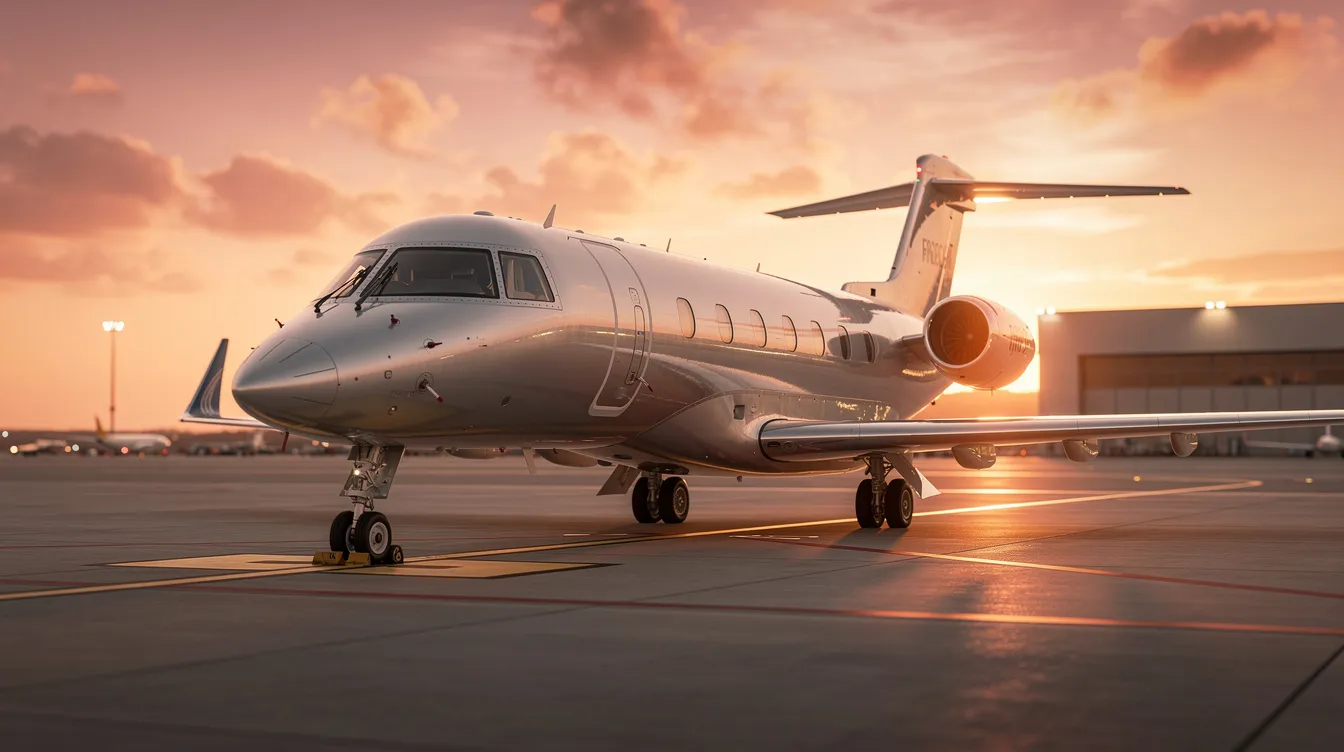
BlackJet offers Jet Card programs designed for travelers who have outgrown the limitations of even the best commercial cabin. The model is straightforward: purchase prepaid flight hours and use them across multiple aircraft categories, with guaranteed access, transparent hourly pricing, and 24/7 digital booking.
The 25-hour Jet Card is an ideal entry point for executives and families currently flying regional jets like the E175 several times a year, and the dedicated BlackJet 25+ Hour Jet Card focuses specifically on mid, super-mid, and large cabin aircraft. It provides enough hours for regular regional hops plus the occasional longer domestic trip. For those mixing regional connections with transcontinental or international flights, 50-hour and higher tiers offer additional flexibility and rate advantages; understanding 50-hour Jet Card cost and value helps determine which tier aligns with your flying profile.
Every BlackJet flight is carbon-neutral at no extra cost, which factors into the overall private jet price list and cost structure when comparing options with traditional ownership or charter. The fleet spans light, midsize, and heavy cabin categories, and the Jet Card model eliminates the complexity of aircraft ownership while delivering the privacy, schedule control, and cabin customization that commercial aviation-even in first class-simply cannot provide, especially when you understand Jet Card costs and membership pricing.
If you currently spend time optimizing E175 seat maps, consider instead optimizing aircraft type, departure time, and cabin layout through BlackJet membership, starting with a clear view of Jet Card cost per hour across aircraft categories.
FAQs: Embraer 175 Cabin, Seats & Private Alternatives
How many seats are on the Embraer 175 used by American Airlines?
American Airlines configures its E175 fleet with 76 seats in a dual-class configuration: 12 first class, 20 Main Cabin Extra, and 44 main cabin seats in standard economy. This typical seating layout is shared across most U.S. regional operators.
Are there middle seats on the Embraer 175?
No. The E175 features a 2-2 seating configuration with no middle seats. Every passenger sits in either a window or an aisle seat throughout the entire cabin.
Does the Embraer 175 have Wi-Fi and power outlets?
Most U.S.-operated E175s offer wi fi for all passenger s. First class seats come equipped with power outlets, and many Main Cabin Extra rows offer USB ports for passenger use. Standard economy power availability varies by carrier and aircraft; check your airline's seat map before booking.
Is the Embraer 175 safe?
The E175 has zero hull losses and no fatal passenger accidents across its entire operational history. It has accumulated millions of flight hours with a statistically negligible accident rate, supported by redundant systems, fly-by-wire controls, and rigorous regulatory oversight.
When does it make sense to switch from regional first class to a Jet Card? If you fly regionally more than twice per month, need schedule flexibility or privacy for work calls, or find that airport time consistently exceeds flight time, a Jet Card may deliver better value than repeated first-class tickets. Comparing Jet Card pricing structures and even specialized tiers like the 100-hour Jet Card can clarify which program fits your usage. Explore BlackJet's options for a tailored consultation.
Conclusion: Choosing Between a Great Regional Jet and Complete Control
The Embraer 175 is a standout among regional jets-a comfortable 2+2 cabin with no middle seats, an impeccable safety record, modern systems, and mainline-style amenities compressed into the smallest aircraft class that still feels like a proper airline experience. For millions of travelers each year, it delivers exactly what a regional connection should.
Yet even with careful attention to seat maps and cabin classes-first class, Main Cabin Extra, main cabin-commercial flying imposes fixed schedules, shared spaces, and the accumulated friction of airports. There is a ceiling to how much any seat strategy can improve.
BlackJet exists for travelers who have reached that ceiling. When the question shifts from "Which seat on the E175?" to "Which aircraft best serves my next trip?", a Jet Card membership puts the answer in your hands. Guaranteed access, carbon-neutral flights, and a fleet matched to your mission-not to a scope clause.
Discover how BlackJet can reshape your regional and long-range travel. Explore Jet Card membership today.


 Sign up with google
 Sign up with Apple