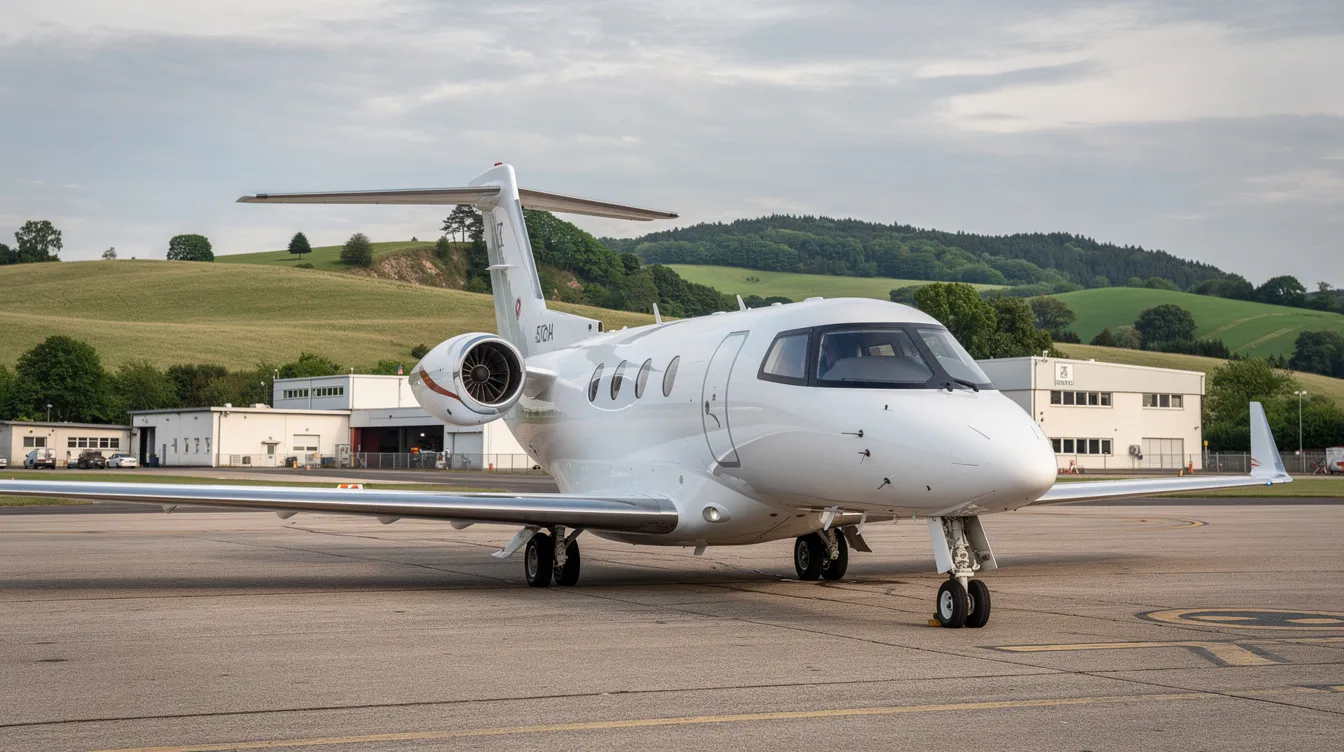
The Eclipse 500 remains the cheapest very light jet to buy in 2026, with airworthy pre-owned models selling between $1 million and $1.5 million. Close behind sit the Cirrus Vision Jet (the most affordable new-production single-engine private jet), the Cessna Citation Mustang at $1.5 million to $2.5 million, and the Embraer Phenom 100 at $1.75 million to $2.5 million. Very light jets are the most affordable private jets available, and understanding which ones deliver real value requires looking past the purchase price and comparing them with other cheaper private aircraft.
Consider a New York to Chicago trip. A commercial flight in business class takes about 5 hours door-to-door once you factor in check-in, security, boarding, and ground transport. A very light jet flying Teterboro (TEB) to Midway (MDW) covers the roughly 640 nautical miles in under two hours of block time, and you skip the terminal entirely. For executives running two or three meetings in a day across cities, that time compression is not a perk; it is a competitive edge.
VLJs access over 5,000 airports in the United States alone, compared to roughly 500 served by commercial airlines. That reach turns secondary destinations like Aspen, Santa Fe, or Martha's Vineyard into direct flights instead of multi-leg ordeals. For families and small teams of four passengers, the math on a very light jet often closes faster than most people assume, whether through ownership, private travel by charter, or a Jet Card program like BlackJet's. This article breaks down each model, its true costs per hour, and the smartest ways to fly private without overspending.
What Counts as a Very Light Jet (VLJ)?
A very light jet has a maximum takeoff weight under roughly 10,000 lbs, seats between four and six passengers, and is certified for single-pilot operation. These aircraft are optimized for short regional flights and medium-range flights, typically covering 500 to 1,400 nautical miles per leg. VLJs are designed for single-pilot operation, which reduces crew costs and training overhead compared to larger aircraft categories and other types of private jets.
The very light jet category sits below the light jet category (heavier airframes, bigger cabins, longer range) and well below midsize, super-midsize, and large jets built for intercontinental range. Older turboprop planes can be purchased for as low as $50,000, but they lack the speed, pressurization, and altitude capabilities that make jet engines practical for business travel. Most "cheapest private jet" and "most affordable private jets" lists are dominated by VLJs and single-engine designs because their economics occupy a unique middle ground: faster than turboprop planes, cheaper than anything in the light jet category or above.
Popular models in this space include:
Eclipse 500 (twin-engine, 4-5 seats)
Cirrus Vision Jet SF50 (single-engine, up to 7 occupants)
Cessna Citation Mustang (twin-engine, 4-5 seats)
Embraer Phenom 100 / 100E / 100EV (twin-engine, 4-7 seats)
HondaJet HA 420 (twin-engine, borderline VLJ/light jet)
Very Light Jet Comparison Table
Aircraft | Typical pre-owned price | Approximate range | Passenger capacity | Key consideration |
|---|
Eclipse 500 | $1 million–$1.5 million | 1,125 nautical miles | 4–5 | Lowest-cost twin-engine jet ownership; compact cabin |
Cirrus Vision Jet SF50 | $1.8 million–$3.2 million | 1,200 nautical miles | 5 adults plus 2 children | Single-engine efficiency, CAPS parachute system |
Cessna Citation Mustang | $1.5 million–$2.5 million | 1,000–1,150 nautical miles | Up to 4 passengers, optional fifth seat | Broad service network and twin-engine redundancy |
Embraer Phenom 100 | $1.75 million–$2.5 million | About 1,178 nautical miles | 4–7, configuration dependent | More cabin space and a proper lavatory option |
HondaJet HA-420 | Around $3 million–$4 million | 1,200–1,400 nautical miles | 4–5 | Faster cruise and distinctive over-wing engine mounts |
Typical VLJ performance: range of 1,000 to 1,400 nautical miles, cruise speed of 300 to 420 knots, and total operating costs starting under $1,000 per hour for the lowest-cost models. Prices vary by model year, condition, maintenance history, equipment, and engine-program status.
The Absolute Cheapest Very Light Jet to Own in 2026: Eclipse 500
The Eclipse 500 is the cheapest private jet to own. On the pre-owned market, airworthy examples sell between $1 million and $1.5 million depending on avionics, total airframe hours, and engine life remaining. That makes it the most affordable aircraft in the twin-engine jet segment by a wide margin, and a low-cost entry point into twin-engine jet ownership for first-time jet owners.
The aircraft seats four to five passengers in a compact cabin, cruises at roughly 370 knots, and covers about 1,125 nautical miles on a full fuel load. Fuel consumption sits around 62 gallons per hour, contributing to variable costs as low as $800 to $1,200 per hour under favorable conditions. But low operating costs come with trade-offs: the cabin has limited stand-up height, baggage space is tight, and the shrinking number of Eclipse service centers can push unscheduled maintenance costs higher as the fleet ages.
A concrete example: an owner-pilot based in Dallas flying to Denver (roughly 640 nm) completes the trip in about 1.75 hours at cruise. At $900 per hour variable cost, the round trip runs roughly $3,150 in fuel and maintenance. For someone making that trip 20 to 30 times per year, the Eclipse's low acquisition cost starts to justify itself. For non-pilots flying 25 to 100 hours per year, though, the fixed cost burden (hangar, insurance, annual inspections) erodes that advantage quickly. A Jet Card with Eclipse-class access is usually the smarter move for flyers who want predictable jet card cost per hour.
Cirrus Vision Jet SF50: Cheapest Brand-New Single-Engine VLJ with Modern Tech
The Cirrus Vision Jet is the most affordable new-production single-engine private jet on the market. Cirrus Aircraft initially priced early G1 models around $2 million new. Pre-owned models from the G1 and G2 generations now trade between $1.8 million and $3.2 million, while the current G3 variant starts at roughly $3.5 million.
Performance numbers favor the Vision Jet for regional missions: the Cirrus Vision Jet has a range of 1,200 nautical miles, cruises at about 310 to 320 knots, and burns roughly 70 to 81 gallons per hour on its single Williams FJ33 engine. The cabin seats five adults plus two children (seven total including the pilot), giving it respectable cabin space compared to the Eclipse 500. Hourly operating costs frequently land between $650 and $750 for fuel and maintenance reserves, making it one of the most affordable private planes to run.
What sets the Vision Jet apart from older budget-friendly jets is its safety technology. The whole-aircraft CAPS parachute system deploys if the pilot loses control. Later G2+ and G3 models add Safe Return autoland, which can guide the aircraft to a runway and land it if the pilot becomes incapacitated. For safety-conscious families and private aviation enthusiasts who also hold a pilot certificate, this innovative technology is a decisive factor.
Ownership of a Vision Jet starts to pencil out above roughly 150 to 200 flight hours per year compared with other small private jets. Below that threshold, BlackJet's Jet Card delivers similar personal jet performance and comfort with no capital outlay and no depreciation risk.
Cessna Citation Mustang: The Budget Workhorse VLJ
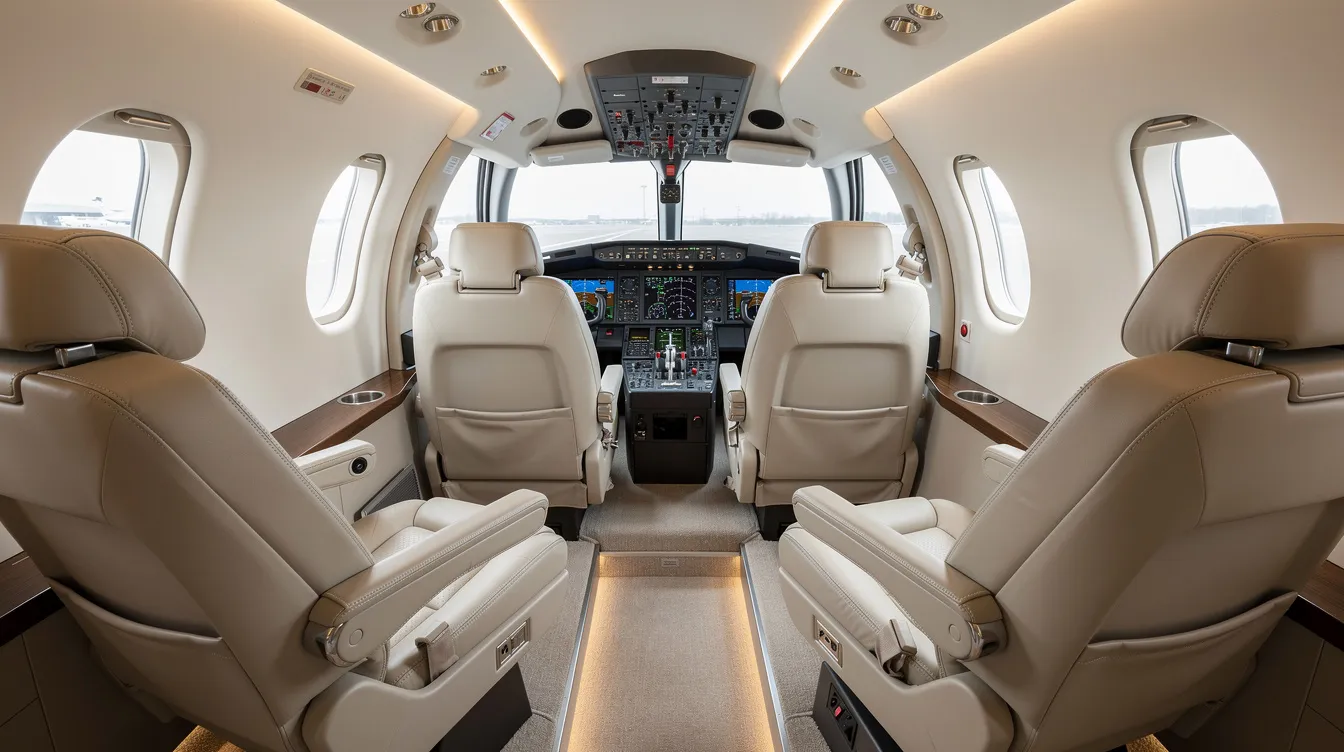
A used Cessna Citation Mustang typically sells for $1.5 million to $2.5 million, placing it squarely among the most affordable private jets with twin-engine redundancy. Cessna produced the Mustang from 2006 to 2017, and the pre-owned market now holds enough inventory to give buyers genuine leverage on price and configuration.
The Citation Mustang seats up to four passengers in a club arrangement (with an optional fifth seat), cruises near 340 knots, and covers 1,000 to 1,150 nautical miles depending on payload. Its twin Pratt & Whitney PW615F jet engines deliver reliable and efficient aircraft performance, and the vast Cessna Citation service network means parts and qualified mechanics are available at hundreds of locations worldwide.
Operating costs run roughly $1,000 to $1,200 per hour in variable expenses (fuel, engine reserves, routine maintenance). Fixed costs push the all-in number higher, but the Mustang's reputation as a budget workhorse holds up on concrete missions. A four-person executive team flying New York (TEB) to Chicago (MDW), roughly 640 nm, saves three or more hours each way versus commercial flight. On a London to Nice leg (about 530 nm), the Mustang delivers door-to-door in under three hours while avoiding crowded terminals at Heathrow or Nice Côte d'Azur.
BlackJet frequently sources Citation Mustang and similar compact light jets for Jet Card members who want affordable private jet hourly rates without acquisition and annual operating costs, while travelers flying less frequently might instead charter a small plane on demand.
Embraer Phenom 100: Affordable Private Jet with a Bigger-Cabin Feel
The Embraer Phenom 100 occupies the upper end of the cheapest very light jet bracket. Original Phenom 100 models (2008 to 2014) sell for $1.75 million to $2.5 million on the pre-owned market, while the upgraded Phenom 100EV (2017 onward) commands $3.5 million or more for low-hour examples.
Where the Phenom 100 separates itself from the Eclipse, and Mustang is cabin volume. The interior stretches about 11 feet long and nearly 5 feet wide, delivering a spacious cabin that feels closer to a light jet than a very light jet. Seating for four in a club configuration is standard; some layouts accommodate six to seven with a belted lavatory option. Range reaches roughly 1,178 nautical miles (NBAA IFR with four passengers), and cruise speed sits between 380 and 390 knots, both figures above the Mustang.
Hourly operating costs of $1,200 to $1,600 per hour (variable) reflect the larger cabin and twin PW617F-E engines. For tech founders commuting San Francisco to Seattle (about 680 nm) or small teams hopping Paris to Berlin (about 470 nm), the Phenom 100 provides the cabin space compared to smaller VLJs that makes it feel like a true business aviation tool.
Fleets of Phenom 100 and 100EV aircraft are widely used in charter and Jet Card programs, and BlackJet often positions them as a sweet-spot option in the very light jet category for three to five passengers who need comfort and a proper lavatory on short regional flights.
HondaJet HA-420: Innovative Yet Still Relatively Affordable
Honda Aircraft Company's HondaJet HA-420 straddles the line between very light jets and the light jet category. Pre-owned HondaJets trade around $3 million to $4 million in 2026, with newer Elite S variants priced higher. That initial purchase price sits above most VLJs but well below the cost of midsize or heavy jet alternatives.
The aircraft's signature design, over-the-wing engine mounts, reduces cabin noise and frees up interior volume that conventional fuselage-mounted engines would consume. Cruise speed approaches 420 knots, the fastest in this segment. Range stretches to 1,200 to 1,400 nautical miles with four to five passengers, making the HondaJet a capable platform for medium-range flights that stretch beyond typical VLJ territory.
The HondaJet appeals to owner-operators and small corporate flight departments that prize fuel efficiency and cabin refinement. For travelers who want this level of performance but prefer not to tie up $3 million to $4 million in a single asset, on-demand access through BlackJet's premium private jet cards avoids the capital commitment while still delivering luxurious aircraft comfort and speed.
Single-Engine vs Twin-Engine Very Light Jets: Where Do You Really Save?
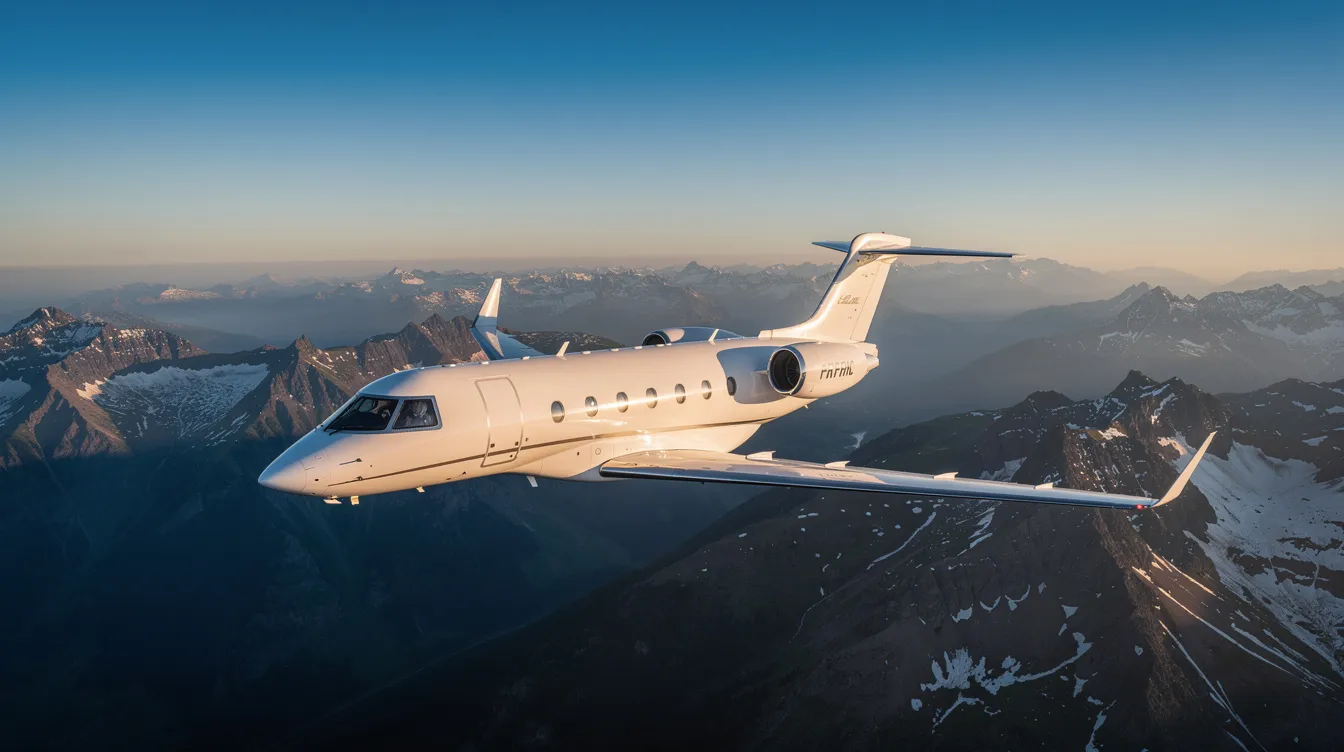
Single-engine personal jets generally have lower acquisition and operating costs than twin-engine VLJs. The Cirrus Vision Jet's variable costs of $650 to $1,100 per hour reflect one engine burning fuel, one engine requiring overhaul reserves, and lower insurance premiums. By contrast, the Cessna Citation Mustang runs $1,000 to $1,200 per hour in variable costs, and the Phenom 100 sits higher still at $1,200 to $1,600.
Twin-engine VLJs offer higher speeds and longer range than single-engine jets. The Mustang cruises at 340 knots versus the Vision Jet's 310; the Phenom 100 reaches 390. Twin-engine designs also provide engine-out redundancy, a factor that some insurance underwriters and corporate travel policies require. Fuel consumption for VLJs typically ranges from 50 to 80 gallons per hour, with single-engine models clustering at the low end and twins at the high end.
At 100 to 150 hours per year, the annual budget difference is material. A Vision Jet owner might spend roughly $250,000 to $300,000 all-in. A Mustang owner at the same utilization faces $400,000 to $500,000 or more once fixed costs are included. Those gaps widen or narrow with fuel prices, maintenance events, and hangar fees.
Key differences at a glance:
Low fuel burn and low operating costs favor single-engine VLJs for cost-conscious buyers.
Twin-engine designs deliver faster cruise speed, better hot-and-high runway performance, and engine-out margins.
Cessna and Embraer support networks for twins are broader than Eclipse or Cirrus for singles in many regions.
BlackJet sidesteps this trade-off entirely by giving Jet Card members access to single-engine VLJs, twin-engine light jets, and large jets within one program.
How Cheap Is "Cheap"? Acquisition Price vs Operating Costs
The cheapest private jet cannot be judged on sticker price alone. Owning a VLJ generally involves variable costs including fuel and maintenance reserves that accumulate flight hour by flight hour, plus fixed costs that arrive whether the aircraft flies or not. Pre-owned VLJs depreciate in their first 5 to 10 years, often losing 30% to 50% of their original value, which adds a hidden cost layer that purchase price alone does not reveal, similar to the dynamics seen in fractional jet ownership depreciation.
Operational costs include aviation fuel, engine maintenance, and pilot fees, and those same inputs drive the economics behind a 100-hour jet card cost guide. Here is what those line items look like for a typical VLJ flown 150 hours per year:
Fuel costs range from $300 to $700 per flight hour depending on consumption and regional Jet-A pricing.
Annual maintenance costs can vary from $50,000 to $200,000 depending on scheduled inspections and unscheduled events.
Hangar fees typically range from $1,000 to $3,000 monthly at U.S. airports.
Pilot salaries can add $80,000 to $200,000 annually if you do not fly the aircraft yourself.
Insurance runs $15,000 to $30,000 per year for most VLJ owners.
Total operating costs for VLJs can range from $1,000 to $1,800 per flight hour when all variable expenses are included. Operating costs for private jets can exceed $800,000 annually at higher utilization or when fixed costs, crew, and engine reserves are fully loaded. An Eclipse 500 or Citation Mustang flown 150 hours per year carries an all-in annual budget of roughly $200,000 to $400,000 or more, even though the acquisition price looks modest.
Contrast that with accessing the same class of aircraft through BlackJet's Jet Card or on-demand charter, where you pay per hour and avoid capital risk, depreciation, and residual value exposure; this mirrors the trade-offs outlined in a broader private jet price list.
Ownership vs Charter vs Jet Card for Very Light Jets
Three paths lead to very light jet access: full private jet ownership, fractional ownership, and non-ownership options (charter and Jet Cards), and evaluating whether chartering a private jet is worth it is often the first step.
Ownership makes sense at 200 or more flight hours annually. Below that threshold, fixed costs (hangar fees, insurance, crew, inspections) dilute the per-hour economics of even the cheapest aircraft. Fractional ownership splits the purchase price and monthly fees across multiple owners, targeting the 50 to 150-hour-per-year range, but comes with scheduling constraints, exit complexity, and its own fractional jet ownership depreciation profile to manage.
Chartering a private jet can cost between $2,000 and $14,000 per hour depending on aircraft size and route, as detailed in guides on how much to rent a private jet. Chartering eliminates ownership costs like maintenance and storage, making it rational for infrequent flyers. Jet cards typically save 10 to 20% compared to charter pricing by locking in rates upfront, and a dedicated guide to jet card cost can help clarify how those savings work across providers. Jet cards offer guaranteed availability and fixed hourly rates, removing the price volatility that spot-charter markets introduce; understanding jet card pricing structures is key to comparing programs accurately. Empty-leg flights can offer discounts up to 75% off standard rates, but availability is unpredictable, especially if you want simply to buy a seat on a private jet rather than charter the whole aircraft.
Consider a founder flying 35 trips per year, each averaging 1.5 hours. That is roughly 50 flight hours. Owning a Citation Mustang at that utilization means spending over $5,000 per hour all-in once fixed costs are spread across so few hours. A BlackJet Jet Card at fixed hourly rates, with no hangar, no crew payroll, and no maintenance surprises, delivers the same private flight experience at a fraction of the total outlay and aligns closely with best practices for evaluating jet card cost per hour.
Safety, Certification, and Sustainability at the Lower End of the Price Spectrum
"Cheapest very light jet" does not mean compromised airworthiness. The FAA and EASA hold every certificated aircraft, old or new, to identical safety standards through mandatory airworthiness directives, recurring inspections, and maintenance programs. An Eclipse 500 built in 2007 must meet the same regulatory requirements as an Embraer Phenom 100EV delivered last year.
Reputable operators undergo third-party safety audits through programs like ARGUS, Wyvern, and IS-BAO. BlackJet partners only with operators that meet these standards, ensuring that every private jet charter or Jet Card flight is flown on a properly maintained, safety-vetted aircraft. BlackJet's technology platform surfaces only compliant single-pilot jets, light aircraft, and larger private jets; there is no shortcut to chase a lower price.
On sustainability: smaller, efficient aircraft burn less fuel per mission than large jets or heavy jet alternatives. BlackJet further ensures every Jet Card flight is carbon-neutral through verified offsets and, where available, sustainable aviation fuel. For travelers who want to fly private responsibly, these measures are built into every booking, not sold as an add-on.
Use Cases: When a Very Light Jet Is the Smartest (and Cheapest) Private Jet Choice
VLJs can access shorter runways than larger corporate jets, opening destinations that midsize and heavy jets cannot reach. That access, combined with low operating costs, creates scenarios where economical private jets beat every alternative.
Regional executive hops. Two to four executives flying Los Angeles (VNY) to Scottsdale (SDL), about 370 nm. A Citation Mustang covers the distance in just over an hour. Commercial options require connecting through Phoenix Sky Harbor, adding three or more hours. At roughly $1,800 total variable cost for the Mustang leg, the per-seat cost for four passengers is about $450 each way; comparable to a last-minute commercial business-class fare, but two hours faster door-to-door.
Family trips to secondary airports. A family of five flying to Martha's Vineyard (MVY) from the New York area faces connecting flights or a long drive. A Vision Jet handles the 180 nm hop in under 45 minutes.
Multi-stop day trips. A private aviation sales executive visiting clients in three cities (Charlotte, Atlanta, Nashville) in a single day. No commercial itinerary makes this feasible; a VLJ does.
BlackJet can dynamically place clients into the right aircraft category—very light jets, turboprop planes, or larger private jets—depending on passenger count, baggage, and runway length, rather than forcing one aircraft type. That flexibility turns a Jet Card into a multi-tool, not a one-size commitment.
Frequently Asked Questions About the Cheapest Very Light Jets
What is the absolute cheapest very light jet to buy in 2026? The Eclipse 500 is priced between $1 million and $1.5 million for airworthy pre-owned models, making it the lowest-cost entry into the very light jet category. It seats four to five and cruises at about 370 knots.
Can I find a private jet under $2 million? Yes. The Eclipse 500 and earlier Cirrus Vision Jet G1/G2 pre-owned models fall under $2 million. Some early Citation Mustang examples with higher hours also trade near or below the $1.5 million mark.
How much does it cost per hour to run a Citation Mustang or Phenom 100? The Citation Mustang runs roughly $1,000 to $1,200 per hour in variable costs. The Embraer Phenom 100 ranges from $1,200 to $1,600 per hour. Fuel costs range from $300 to $700 per flight hour depending on the model and fuel prices.
Are pre-owned very light jets safe? Yes. Every certificated aircraft must comply with FAA/EASA airworthiness directives regardless of age. Pre-owned prices do not correlate with safety; they reflect age, hours, and equipment. A properly maintained 2009 Mustang is as airworthy as a 2024 Phenom 100EV.
Is fractional ownership cheaper than a Jet Card for VLJs? It depends on utilization. Fractional ownership suits 50 to 150 hours per year but locks capital into a depreciating share, making it critical to understand fractional jet ownership depreciation before committing. A Jet Card avoids that capital commitment, and jet cards typically save 10 to 20% compared to on-demand charter pricing. For frequent flyers under 150 hours, a Jet Card often wins.
What is the cheapest way to fly on a very light jet without owning one? BlackJet's Jet Card programs offer fixed hourly rates with guaranteed availability across multiple jet categories, from very light jets to large jets. You avoid aircraft sales risk, private jet sales commissions, depreciation, and all fixed costs.
Does BlackJet offer carbon-neutral flights on VLJs? Yes. BlackJet ensures every Jet Card flight is carbon-neutral through verified carbon offsets, whether the aircraft is a single-engine Vision Jet or a twin-engine Phenom 100. The cost is built into the program; there is no surcharge.
How does a Cirrus Vision Jet compare to a King Air turboprop? The Vision Jet cruises about 100 knots faster (310 vs roughly 210 for a King Air 350), flies higher (up to 31,000 ft vs 35,000 ft for the jet), and offers excellent fuel efficiency at 70 to 81 gallons per hour. A King Air carries more payload, but the Vision Jet delivers jet speed at turboprop-like operating costs.
Conclusion: The Smart Way to Use "Cheapest Very Light Jets" to Your Advantage
The Eclipse 500 ($1 million to $1.5 million), Cirrus Vision Jet ($2 million to $3 million pre-owned), Cessna Citation Mustang ($1.5 million to $2.5 million), and Embraer Phenom 100 ($1.75 million to $2.5 million) form the core group of cheapest very light jets worth knowing. Each delivers a range between 1,000 and 1,275 nautical miles, seats four to six passengers depending on configuration, and offers a private plane experience that commercial flight cannot replicate on regional routes.
For most high-net-worth individuals and business travelers flying under 150 hours a year, the smartest play is not owning the cheapest private jet. It is accessing very light jets and light jets through a high-quality Jet Card or charter solution that eliminates depreciation, hangar fees, crew payroll, and maintenance risk.
BlackJet's Jet Card programs deliver safety-vetted operators, carbon-neutral flights, and real-time booking technology across every aircraft category. Whether your first private jet experience is a 45-minute hop on a Vision Jet or a coast-to-coast leg on a midsize cabin, the access is built to flex with your schedule. Explore BlackJet's Jet Card offerings and discover how to elevate your travel without elevating your expenses.
About BlackJet: Jet Card Access to Very Light Jets, Light Jets, and Beyond
BlackJet offers prepaid Jet Card programs (25-hour, 50-hour, and custom) that provide access to multiple aircraft categories, from very light jets and compact light jets through midsize and large jets. Every flight is backed by 24/7 digital and human support, real-time flight support through BlackJet's booking platform, and partnerships limited to ARGUS/Wyvern/IS-BAO audited operators.
A BlackJet member might use a VLJ for a quick 400 nm regional hop, a light jet for a four-city sales roadshow, and a large jet for a transatlantic trip—all under the same membership, with consistent safety standards and carbon-neutral performance. To compare ownership, fractional ownership, and Jet Card options tailored to your flying profile, speak with a BlackJet aviation advisor and experience private aviation on your own terms.


 Sign up with google
 Sign up with Apple