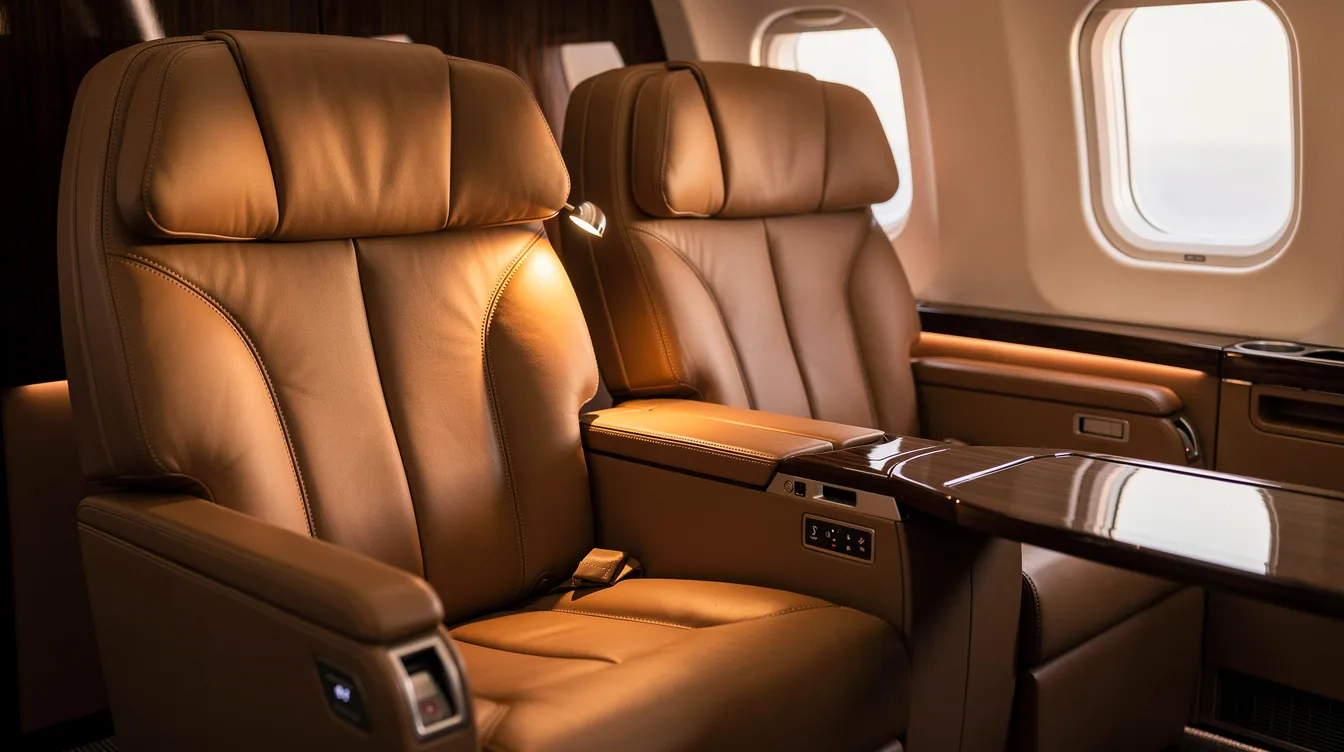
The modern business class seat has evolved from a slightly wider recliner into a genuine private suite-complete with closing doors, lie-flat beds, and screens larger than some home televisions. But even the finest commercial cabin still operates on someone else's schedule, in someone else's space, surrounded by passengers you didn't choose. Here is a detailed look at every major type of business class seat flying today, the manufacturers behind them, and the point at which a private jet cabin becomes the smarter move.
Fast answers: what is a business class seat & how it compares to a private jet
A business class seat on a long-haul commercial flight refers to a premium cabin offering significantly better space, service, and sleep than economy class. On overnight routes like New York–London or Los Angeles–Tokyo, the difference between a fully flat bed and a reclined economy seat is the difference between arriving rested and arriving wrecked. Business class offers a more comfortable and spacious experience than economy class, and traveling in business class reduces travel fatigue and helps passengers arrive ready to perform.
But even the best business class product still locks you into fixed schedules, shared cabins, and crowded hubs. BlackJet's private jet cabins offer a fundamentally different proposition: you choose the departure time, you control who is onboard, and the cabin layout is configured for your party-not 30 strangers- with premium private jet card programs designed specifically for frequent travelers.
| Business Class Seat | Private Jet Cabin |
|---|
Seat types | Recliner, angled lie-flat, fully flat bed, suite with door | Club seats, sofas, divans converting to full flat beds |
Privacy | Shared cabin; suite doors on select airlines | Full privacy-entire cabin is yours |
Scheduling | Fixed airline timetable | Depart on your schedule, 15–30 min before wheels-up |
Airport access | ~500 commercial hubs | ~5,000 airports via BlackJet |
Cabin control | Assigned seat in fixed row | Configure seating, meetings, rest zones |
Many BlackJet Jet Card members previously flew business or first class on airlines like Qatar Airways or Japan Airlines. They transitioned to private aviation once they calculated the time saved-no queues, no hub connections-and experienced consistent cabin comfort on every flight.
This article covers the main types of long-haul business class seats, how they are built by manufacturers like Collins Aerospace and Safran Seats, which airlines have the best business class seats in 2026, and when a private jet is the more strategic choice.
How business class seats became the new first class
Business class seats evolved from recliners to suites over three decades. Understanding that arc explains why today's business class cabin often rivals what first class delivered just ten years ago-and why private jets sit in a category beyond both.
1990s: Business class meant recliner or cradle seats at 150–160° with more legroom than economy but no real sleeping surface. Lie-flat seats were previously exclusive to first class.
Early 2000s: Angled lie-flat seats appeared (e.g., the MiniPod by B/E Aerospace), reclining near-flat but at an angle that left passengers sliding toward the aisle.
2010s–present: True 180° lie-flat beds became standard on competitive long-haul routes. Qatar Airways introduced Qsuites in 2017 with the first business class closing door. All Nippon Airways launched "The Room" business class in 2019 with a 38-inch-wide suite on the 777-300ER.
Today, premium economy in 2026 roughly equals what a 1990s business class seat delivered in seat pitch and width-proof of how rapidly expectations have escalated. Many airlines that once flew first class on routes like London–Hong Kong or New York–Tokyo now offer only enhanced business class seats with suite doors and onboard service that matches old upper class cabins, while the most discerning travelers increasingly compare these products with the best private jets in the world rather than traditional first class alone.
Private jets exist beyond this spectrum entirely: no fixed rows, no class separation, and cabin layouts limited only by aircraft size and your preferences.
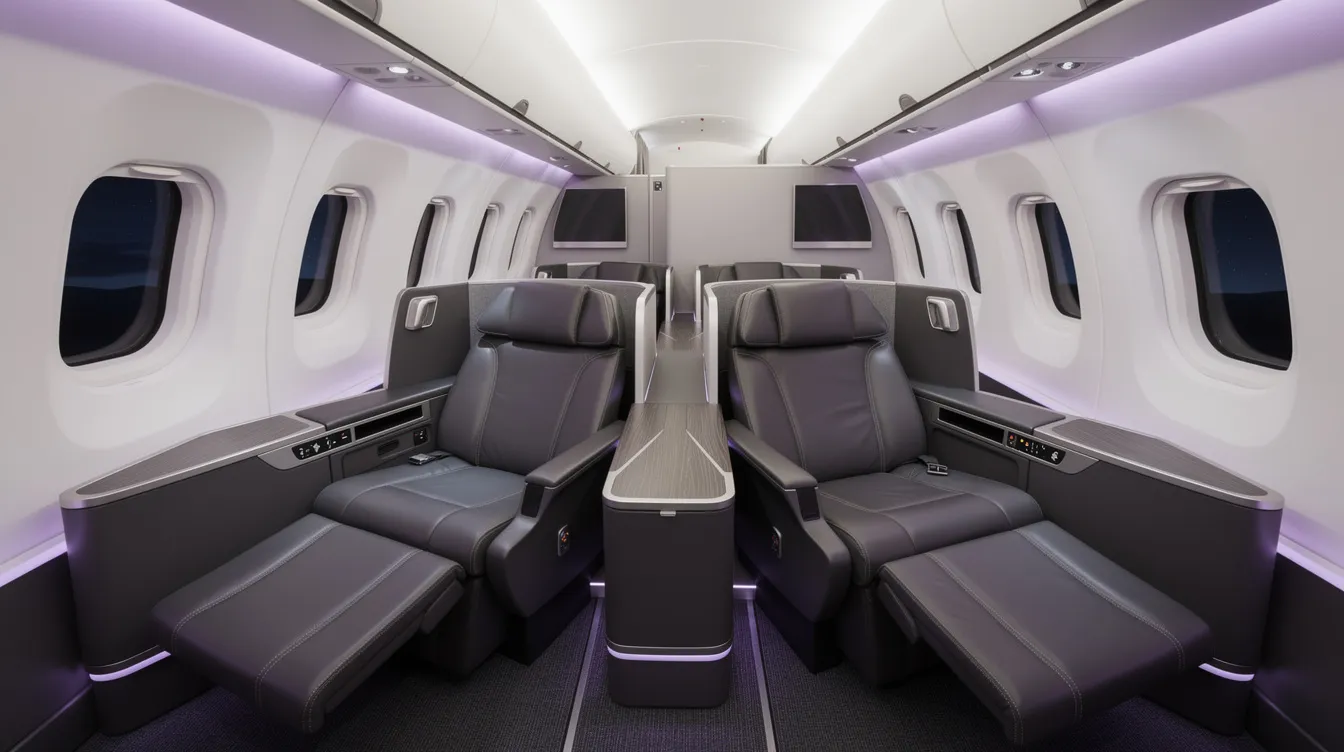
Main types of business class seats on long-haul flights
Not all business class seats are equal. Business class seats include recliners, angle lie-flat, and full flat beds, and the differences matter enormously for sleep and productivity on flights longer than six hours.
Recliner/cradle seats: Recline 150–160°. Recliner seats do not fully recline into a flat position. Common on regional business class routes (U.S. domestic, intra-Europe) and older aircraft.
Angled lie flat: Angle lie-flat seats recline to nearly 180 degrees but are not fully flat. The slope creates pressure points and a sliding sensation. Mostly phased out on competitive long-haul routes.
Fully lie-flat (180°): Full flat beds allow passengers to lie completely flat for comfort. The standard for intercontinental routes like New York–London, Sydney–Doha, or Singapore–Frankfurt.
Suite with door: A lie-flat seat enclosed by walls and a closing door. Some airlines offer private suites in business class for added privacy-Qatar Airways Qsuite being the most prominent example. Many business class seats now feature privacy doors or higher walls for enhanced seclusion.
Most of these seats come from a small group of manufacturers: Collins Aerospace, Safran Seats, Stelia Aerospace, Thompson, and Jamco. The next sections break down key designs from each.
Reverse herringbone & Cirrus-style seats.
The reverse herringbone layout arranges business class seats at an angle away from the aisle in a 1-2-1 configuration, giving every passenger direct aisle access and angling window seats toward the fuselage for more privacy. Many airlines offer direct aisle access in business class through this configuration, and it remains one of the most popular designs onlong-haull fleets worldwide.
Cirrus lineage: Originally developed by Zodiac (now Safran Seats), the Cirrus seat appeared on US Airways, Cathay Pacific, and American Airlines fleets. Known for consistent quality but occasionally narrow footwells in older versions.
Bed and comfort: Typical lie-flat bed length of 75–80 inches. Window seats face the wall, providing a sense of enclosure that solo travelers appreciate.
Evolution: The design has matured into products like Collins Aerospace Elements (with doors, 48.5-inch wall height, and 24-inch screens) and Safran Versa, now deployed by Cathay Pacific, Air France, and several other airlines.
Collins Super Diamond vs Elements at a glance:
Feature | Super Diamond | Elements |
|---|
Layout | Reverse herringbone 1-2-1 | Reverse herringbone 1-2-1 |
Bed length | ~78 inches | ~78 inches |
Wall height | Standard partition | ~48.5 inches with "halo" top |
Door | No (open pod) | Yes (full door capable) |
Screen | 18–20 inches typical | Up to 24 inches |
Business class seats often feature direct aisle access for convenience in both designs, but Elements literally closes the gap between business and first class hardware.
Staggered layouts: Thompson Vantage XL, Optima, and Safran Unity
Staggered layouts alternate seat positions so that one row's "throne" (window seat with a wide side table) sits next to another row's narrower aisle-adjacent seat. This creates different types of experiences depending on where you sit in the same cabin.
Thompson Vantage XL: Used by Delta for its Delta One Suite (with a closing door), Qantas, and other carriers. Lie-flat seats with a mix of highly private window thrones and more exposed positions. The Delta One Suite remains one of the most recognized staggered products flying.
Safran Optima (United Polaris): Alternates forward-facing and herringbone-style center seats in a 1-2-1 layout. Every seat has direct aisle access, but seat position dramatically affects privacy-some face directly into foot traffic.
Safran Unity (Japan Airlines A350-1000): Large private suites with doors, wireless charging, Bluetooth audio, and improved footwell room. Represents the newest generation of staggered seats and one of the best business class seats introduced in 2025–2026, yet still very different from the cabin layout of 16-seat private jets designed for group travel.
For solo travelers, window suites in staggered layouts deliver more privacy and room. Couples may prefer center-pair seats or configurations that convert to a shared space in bed mode. Seat selection in staggered cabins matters more than in uniform herringbone layouts-always check the seat map before booking.
Apex Suites & 2-2-2 configurations that still impress
Not every impressive business class cabin uses a 1-2-1 layout. Apex Suites deploy a 2-2-2 configuration with smart engineering that provides direct aisle access from window seats via a private walkway-eliminating the need to climb over another passenger.
Where they fly: Gulf Air 787-9, certain Japan Airlines 777-300ERs, Korean Air 777/787, and Oman Air 787. Window seats in Apex layouts are considered among the best business class seats due to unlimited foot space and strong privacy.
Why they still work: While density is higher than some 1-2-1 cabins, Apex can feel more spacious in bed mode than many staggered designs with tight footwells. The flat bed surface and open foot area compensate for the denser cabin.
The catch: Generic 2-2-2 flat seats without the Apex walkway force window passengers to step over neighbors-a significant downside on overnight flights. Design details matter more than seat count alone.
Collins Aerospace Super Diamond, Elements & other flagship designs
Collins Aerospace is one of the most influential seat makers in commercial aviation. Their products sit beneath business class passengers on dozens of airlines, and understanding their lineup helps decode what you are actually flying.
Super Diamond: Reverse herringbone, fully lie-flat, approximately 78-inch bed length. Deployed on British Airways (Club World suite), Air Canada, American Airlines, China Airlines, and some Qatar Airways aircraft. A proven, reliable design.
Elements: New-generation reverse herringbone with doors, larger walls (~48.5 inches), wider seats, and screens up to 24 inches. Business class often provides larger entertainment screens compared to economy, and Elements pushes this further. Deployed on Starlux A350s, Etihad and Royal Jordanian 787s, and Cathay Pacific's 777 Aria Suites.
Qsuite collaboration: Collins Aerospace helped build Qatar Airways' Qsuite-some business class seats have private suites with closing doors that convert center pairs into double beds or quad meeting spaces.
Horizon and beyond: Newer products continue the trend toward business class suites that rival first class, with the highest level of enclosed privacy previously reserved for cabins costing twice the fare.
The real-world difference on a long-haul sector between an open-pod Super Diamond and a doored Elements suite is substantial: noise isolation, visual privacy, and the sense of having your own room at 40,000 feet.
Other key players: Stelia, Jamco, and niche business class seats
Stelia Aerospace: Known for Solstys and Solstys III staggered lie-flat seats, used by Turkish Airlines (Aurora-branded on B787-9 and A350-900) and Singapore Airlines on regional 787-10 services. Strong on ergonomics and efficient cabin density.
Jamco: Japanese manufacturer with its Venture seat (fishbone layout, direct aisle access) entering service. Earlier concepts like Dovetail focused on lightweight geometry. Primarily deployed by Asian carriers.
RECARO: Specializes in lighter-weight ergonomic seats for short- andlong-haull, often in regional business class or premium economy rather than ultra-luxury suites. Their strength is weight savings and durability.
Bespoke products: One airline may commission a fully custom seat-Qatar Airways' Qsuite is the clearest example of a carrier pushing a manufacturer to create something unprecedented for the business class cabin, just as large groups can commission tailored charter experiences on the best private jets for around 20 passengers.
What makes the best business class seats on paper vs. in real life
Marketing renders can make any aisle seat look palatial. The reality depends on dimensions, engineering, and details that only emerge at 35,000 feet. The choice of aircraft and seat layout can significantly impact the business class experience-and online reviews and seat maps can help identify the best business class seats before you commit.
Core criteria to evaluate:
Truly flat bed length (ideally 78+ inches) and width
Direct aisle access from every seat
Privacy: partitions, doors, wall height
Storage within arm's reach for personal items
Table size and stability for working or dining
In-seat power (AC, USB-C), wi fi performance, Bluetooth audio
Screen size and resolution
What the specs don't tell you:
Two reverse herringbone seats can feel entirely different because of footwell depth, armrest padding, or proximity to other seats. Cabin design influences noise levels and foot traffic, affecting passenger comfort.
Bulkhead business class seats (e.g., Air France Safran Versa bulkhead on 777-300ER) often deliver significantly more legroom and wider footwells than the same seat in mid-cabin rows.
Business class cabins usually have fewer seats than economy, resulting in a quieter environment. Business class typically features higher passenger-to-crew ratios for personalized service.
Business class passengers may receive complimentary premium alcoholic beverages throughout the flight, and business class meals typically include multiple courses and premium beverages.
Business class often includes amenities such as designer kits and upgraded bedding that no spec sheet captures.
Trade-offs to expect: A high-privacy suite with a door may reduce openness and window views. Couples may prefer center seats that pair together. A quiet rear mini-cabin offers more privacy but slower service.
Business class vs first class vs private jet: which seat is truly premium?
In 2026, the gap between business and first class on commercial airlines has narrowed considerably. Many airlines have removed first class entirely, choosing flagship business class seats with suite doors and elevated service instead.
First class advantage: Wider seats, finer multi-course dining, dedicated crew, and typically no more than 8–12 seats. But the hardware- lie-flat bed, doors, screens-is often similar to top-tier business.
Business class closing the gap: Qatar Airways' Qsuite, Japan Airlines' Safran Unity suite, and ANA's upcoming "The Room FX" deliver features that match or exceed many first class products at a lower fare.
Private jet cabin-a different category: No fixed class seat rows. Spacious club seats, sofas, and divans that convert to flat beds, configured for your party only. Full privacy for sensitive conversations, room to spread out, and freedom to carry extra baggage and pets, and even options to scale up to private jets for 50 passengers when you need full-charter group capacity.
Business class passengers often enjoy priority check-in and lounge access, but private jet travelers bypass the terminal entirely. Arriving 15–30 minutes before departure at a private FBO, with no security lines and no boarding process, changes the mathematics of flying. When you factor in time saved across multiple trips, private jets vs. commercial flights present a compelling case for frequent travelers.

Environmental impact: premium cabins, emissions, and BlackJet's carbon-neutral stance
Aviation contributes about 2% of global carbon emissions. Premium cabins carry an outsized share of that figure: business class emits three times more carbon than economy class per passenger due to the floor space each seat occupies, and first class can reach four times the impact.
Private jets have higher per-passenger emissions due to lower load factors and smaller aircraft. A typical private jet emits roughly 810 tonnes of greenhouse gases per year, equivalent to approximately 177 passenger cars.
Short-haul flights are more environmentally damaging than long-haul flights on a per-mile basis. Carbon emissions increase with multiple takeoff phases in connecting flights-meaning nonstop routes are always preferable.
Route choices (nonstop vs. connection) and aircraft type (new vs. old engines) significantly affect totals for both commercial and private flights.
BlackJet addresses this directly: every Jet Card flight is carbon neutral through high-quality offsets or insetting projects, with no additional cost to the member, while also helping clients understand the footprint and economics of more affordable private jet options. When possible, sustainable aviation fuel is integrated into operations.
For travelers who regularly book business class seats on multiple long-haul trips each year, practical steps include consolidating itineraries, choosing newer aircraft, and using carbon-neutral private flights when schedule efficiency eliminates extra legs, or even exploring budget-friendly private aircraft options where they make sense.
From business class to BlackJet: when upgrading to private jets makes sense.
The transition from commercial business class to private aviation typically happens when a traveler realizes they are optimizing for the wrong variable. Business class comfort is excellent. What it cannot solve is time.
The monthly transatlantic executive: Flying New York–London in business class means checking in 90 minutes early, boarding queues, and baggage waits on arrival. A private jet via BlackJet eliminates 3–4 hours of friction per round trip. Early boarding in business class ensures access to overhead bin space and settling in comfortably, but it still requires showing up well before departure, whereas you can also book just a seat on a private jet via select semi-private and shared-flight models.
Multi-city roadshows: A founder visiting Geneva, Milan, and Paris in three days faces layovers and connections on commercial airlines. On a private jet, all three cities happen in one day, especially when using 16-seat jets optimized for executive teams or 20-passenger private jets configured for larger delegations. Business class often includes a more generous checked baggage allowance compared to economy, but private travel removes baggage limits altogether.
Sensitive travel: Even private suites in business class share cabin crew and adjacent passengers. A private cabin allows confidential conversations, secure documents, and complete control.
BlackJet's Jet Card model-available in 25-hour and 50-hour programs and the flexible 25+ Hour Jet Card-gives predictable pricing and instant access to multiple aircraft categories without the complexity of ownership. Configure club seating for meetings, use the entire cabin as a quiet lie-flat zone for overnight rest, or bring pets and extra luggage. The flexibility is the point.
Priority check-in, security, and boarding help streamline the airport experience for business class travelers, but private aviation removes the airport experience entirely and shifts the conversation toward jet card cost per hour instead of ticket-by-ticket fares.
Safety, certification, and technology: why the cabin you don't see matters most
Both commercial business class seats and private jets operate under strict certification regimes. EASA and FAA mandate seat testing for crash dynamics, flammability, and evacuation compliance. But private jet providers vary widely in operational safety standards-and that variance matters.
BlackJet's approach: Every operator in the network undergoes third-party safety audits, pilot experience thresholds (minimum flight hours, type ratings), and ongoing compliance monitoring. Operations meet FAA Part 135 certification standards as a baseline, with additional proprietary checks layered on top, all within the broader economics outlined in a comprehensive private jet price list and cost guide.
Technology: Digital booking tools, real-time flight monitoring, and proactive disruption management ensure that the seat you have chosen is backed by robust operational support-not just a nice cabin.
Cabin health: Modern private jets feature HEPA filtration, cabin pressurization typically equivalent to 6,000–8,000 feet altitude, and notably lower ambient noise than large commercial business class cabins with hundreds of passengers and galley activity.
The point is substance over marketing. Any provider can claim "luxury" or "premium safety." What matters is verification: certifications, audit records, and operational transparency, plus a clear understanding of the best jet card options for frequent flyers if you plan to commit significant hours to private travel.
Frequently Asked Questions about Business Class Seats and Private Jet Cabins
What is the difference between a business class seat and a private jet cabin seat?
Business class seats on commercial flights range from recliners to fully flat beds, with some offering private suites with doors. Private jet cabins provide full privacy with configurable seating such as club seats, sofas, and divans that convert to flat beds, tailored exclusively for your party.
Are all business class seats fully lie flat?
No. Business class seats vary from recliner seats that do not fully recline, to angled lie-flat seats that recline nearly flat but at an angle, to fully lie-flat beds which are standard on long-haul international flights. Some premium business class seats even offer suite doors for added privacy.
How does privacy in business class compare to private jets?
Business class cabins are shared with other passengers, though some seats feature higher walls or doors for privacy. Private jets offer complete privacy as the entire cabin is reserved for you and your guests.
What are the advantages of private jet travel over business class?
Private jets offer flexible scheduling with departures on your time, access to many more airports, full cabin control and configuration, no security lines, and a seamless airport experience. They also provide privacy and space not possible in commercial business class.
How does the environmental impact of business class compare to private jets?
Business class seats emit about three times more carbon per passenger than economy seats due to space allocation, while private jets have higher per-passenger emissions because of smaller aircraft and fewer passengers. BlackJet offsets all Jet Card flights to be carbon neutral at no extra cost.
What should I consider when choosing a business class seat?
Look for true lie-flat beds, direct aisle access, privacy features like doors or partitions, seat dimensions, storage, power outlets, and onboard amenities. Checking seat maps and reviews helps select the best seat for your needs.
When does upgrading to private jet travel make sense?
For frequent flyers, multi-city itineraries, sensitive or confidential travel, or when saving time is critical, private jets offer superior convenience and flexibility that business class cannot match.
Does BlackJet offer carbon-neutral private jet flights?
Yes. BlackJet ensures every Jet Card flight is carbon neutral through high-quality offsets and sustainable aviation fuel integration when possible, without additional cost to members.
Choosing your next premium flight: practical checklist & how BlackJet fits in
Whether you are booking a business class seat or considering private aviation, use this checklist to ensure you are getting what you pay for.
When booking commercial business class:
Confirm the seat is a true lie-flat (180°), not a recliner or angled lie-flat—and, if you are flying privately instead, benchmark that against the economics of a 100-hour jet card program
Check the seat map for layout (1-2-1 vs 2-2-2) and identify the manufacturer (Super Diamond, Qsuite, Apex, Safran Unity)
Verify added features: wi fi speed, power outlets, screen size, and whether the seat has a closing door
Research the specific aircraft-the same airline may offer very different business class seats on different aircraft types in its long-haul fleet
Confirm lounge access, priority check-in, and boarding benefits-or, if you are transitioning toward private flights, compare 25-hour jet card options and 50-hour jet card programs that bundle similar perks into membership.
When private aviation becomes the strategic choice:
Multi-stop itineraries or tight schedules where connections waste hours, or where an unlimited private jet membership model may outperform pay-as-you-go business class tickets in both time and predictability
Team travel or corporate trips where cabin configuration matters and comparing NetJets jet card costs with BlackJet-style programs clarifies your long-term strategy
Sensitive meetings requiring full privacy
Frequent flying where cumulative time savings justify the investment
The best seat in the sky is the one that returns your most valuable asset: time. For single city trips on well-equipped long-haul routes, commercial business class delivers exceptional comfort. For everything more complex, private aviation redefines what premium travel means.


 Sign up with google
 Sign up with Apple