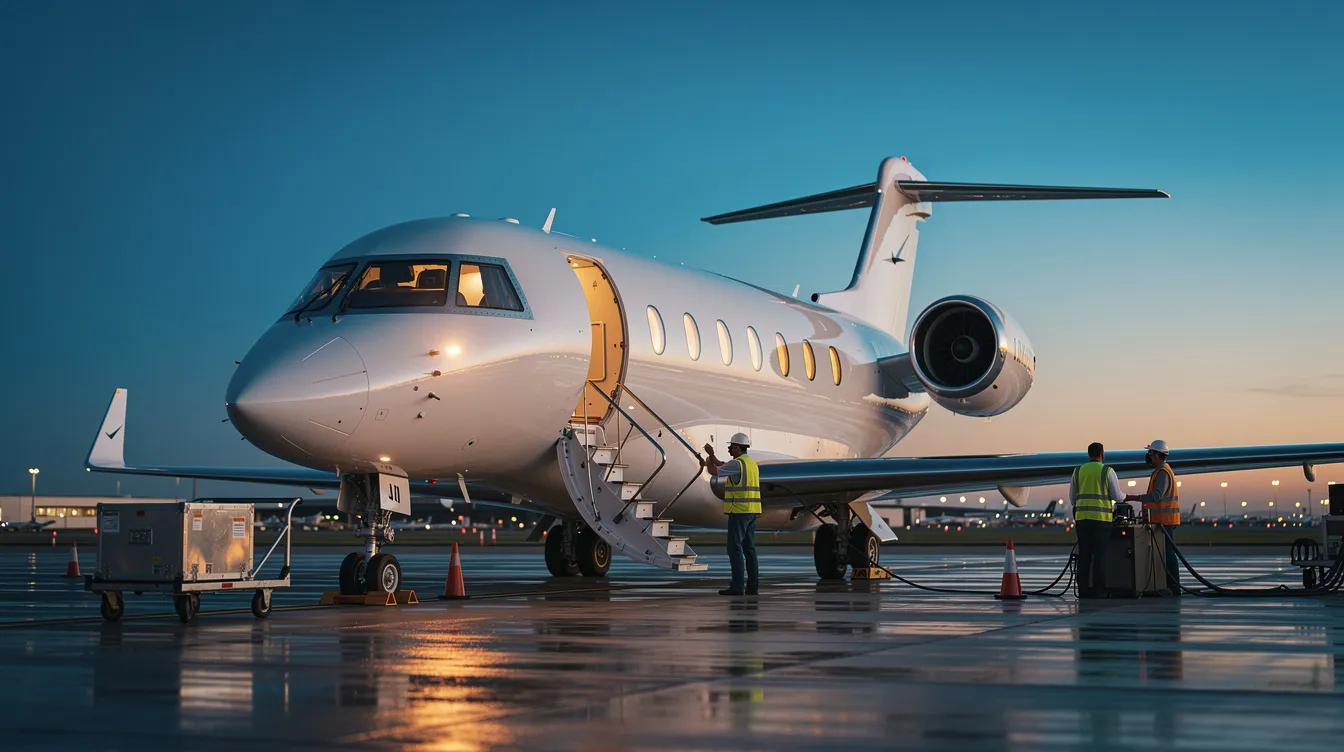
The Boeing Business Jet BBJ1 is not a relic of the 1990s corporate jet market. It remains one of the most capable platforms for moving 8 to 19 VIP passengers across continents without stopping.
This guide is for corporate flight departments, government travel planners, and high-net-worth individuals considering ultra-long-range private travel. It covers the BBJ1’s design, performance, cabin layouts, ownership and charter economics, and how it compares with other BBJ models.
Why the Boeing Business Jet BBJ1 Still Matters for Serious Travelers
Commercial first class on a widebody airliner gives you a flat bed, a meal, and a schedule you cannot control. A large cabin jet like a Gulfstream G650 or Bombardier Global 7500 gives you privacy and range, but seats only a handful of passengers in a fuselage that measures roughly a third of the cabin space available on a Boeing BBJ. The Boeing Business Jet BBJ1 is the original BBJ model: a VIP airliner built on the Boeing 737-700 fuselage with 737-800 stronger wings and landing gear, carrying up to nine auxiliary fuel tanks in the cargo hold, and delivering intercontinental range beyond 6,000 nautical miles for typically 8 to 19 passengers in a cabin measuring approximately 79 ft long and 11.5 ft wide.
For corporations flying board delegations, governments transporting heads of state, or high net worth individuals hosting multi-family trips, the BBJ1 offers personalized space that no Gulfstream or Bombardier, or even many options evaluated as the best private jet for 15 passengers, can replicate at this passenger count. If you are weighing ultra-long-range private travel for executive teams, family groups, or diplomatic missions, this guide breaks down the BBJ1’s design, performance, cabin layouts, ownership and charter economics, how it compares with other BBJ models, and when BlackJet can arrange vetted Boeing BBJ charter access. The appeal is practical as much as luxurious: the BBJ1 fills the gap between smaller private jets and widebody airliners, giving travelers who need privacy, productivity, security, and specialized cabin configurations a platform suited to missions where conventional business jets are simply too small.
Most BlackJet members fly super-midsize and large cabin jets through premium private jet card programs. When a mission calls for a Boeing BBJ, BlackJet sources BBJ charters through vetted BBJ operators on demand. Every flight, whether on traditional private jets or BBJ aircraft, is backed by BlackJet's pillars: independent safety certification, onboard technology for productivity, and 100% carbon-neutral operations at no extra cost to the member.
What Is the Boeing Business Jet BBJ1?
The Boeing Business Jet BBJ1 is a VIP configured version of the Boeing 737 Next Generation commercial aircraft, optimized for private jet travel. It is the original BBJ, the first narrow-body airframe Boeing adapted for corporate and government use under the Boeing Business Jets program.
BBJ aircraft refers to any Boeing airliner platform converted for private, government, or VIP transport with long-range capability and bespoke interiors.
Boeing BBJ1 (also called the BBJ 737 or simply the Boeing BBJ) uses the 737-700 fuselage combined with the 737-800's wing and landing gear structure for higher gross weight and extended range.
The conversion adds auxiliary belly fuel tanks, a luxurious configuration with custom cabinetry and furnishings, a low cabin altitude system pressurized to approximately 6,500 ft, and integrated self-stowing airstairs for independent boarding at any airport; these cabin upgrades support premium onboard comfort and other luxury features.
The BBJ1 can be configured to seat up to 50 passengers in high-density layouts, though most configurations carry 8 to 19 in VIP zones. BBJ aircraft can accommodate 8 to 50 passengers in VIP configurations overall.
The BBJ1 is favored by heads of state for its security and comfort, and it enables specified configurations for medical and disaster-relief missions beyond standard corporate use.
History and Development of the BBJ1
The initial BBJ program was launched in 1996, spearheaded by Boeing President Phil Condit and General Electric CEO Jack Welch. Both saw demand for an aircraft that could fly a corporate delegation nonstop across oceans in a cabin far larger than any purpose-built business jet available at the time. Designer Borge Boeskov led the engineering work.
1996: Program launch decision. Boeing and GE partnered to create the Boeing Business Jets unit within Boeing Commercial Airplanes.
July 26, 1998: First BBJ1 rolled out of Boeing's Renton, Washington, factory.
September 4, 1998: First flight of the BBJ1.
1999: First delivery to customers. The corporate jet market and government buyers provided early orders.
Through 2018, Boeing delivered 113 BBJ1s to private owners, governments, and charter operators. Total Boeing Business Jets delivered globally across all BBJ variants (BBJ1, BBJ2, BBJ3, widebody BBJs) exceeded 250 units by the early 2020s.
The BBJ2 is 19 ft 2 in longer than the BBJ1, offering additional cabin area for operators who needed more room but the same 737-based platform.
Airframe and Technical Design: How the BBJ1 Is Built
The BBJ1 is a high-performance derivative of the standard Boeing 737, not a cosmetic upgrade, and sits above typical private jets optimized for 30 passengers in both range and cabin flexibility. The structural changes are specific and measurable.
Airframe mix: The BBJ1 combines features from both the Boeing 737-700 and 737-800 airframes. The narrow-body fuselage comes from the 737-700; the stronger wings, landing gear, and center fuselage section come from the 737-800. This yields a maximum takeoff weight of approximately 171,000 lb.
Auxiliary fuel system: The BBJ1 incorporates up to nine auxiliary fuel tanks installed in the lower cargo hold, extending fuel capacity to approximately 72,367 lb. These additional fuel tanks push the aircraft's range beyond 6,000 nautical miles.
Improved aerodynamics: Aviation Partners blended winglets are standard or available as a retrofit, delivering roughly a 5% range improvement and a visual signature recognized on BBJ1 aircraft worldwide.
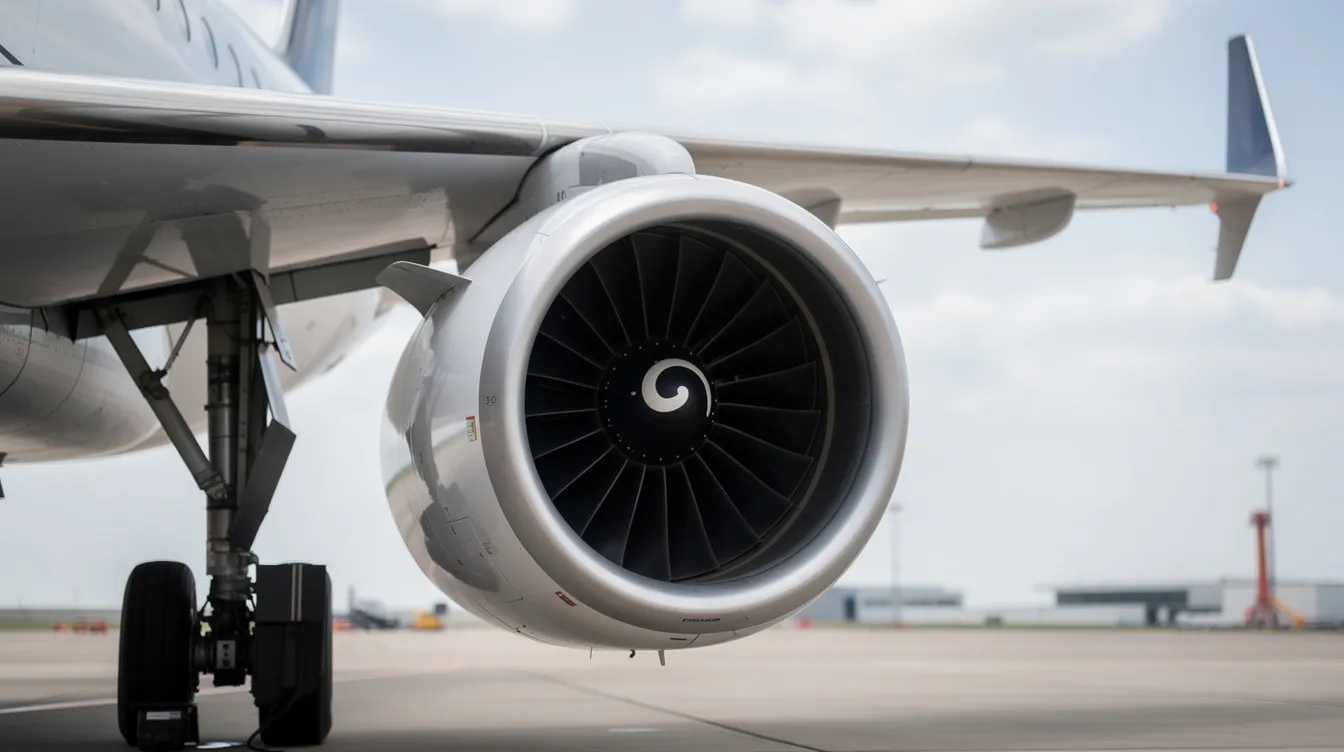
Engines: The BBJ1 uses commercial-grade CFM56 engines, the same powerplant family operating on thousands of Boeing 737s in airline service, providing thrust, reliability, and a global parts network.
Durability: The aircraft is designed for high-utilization cycles, capable of flying up to 4,000 hours annually and engineered for a 75,000-cycle structural life.
Performance, Range, and Operating Capabilities
The BBJ1's performance specifications place it between traditional private jets and full-size commercial airliners.
Cruise speed: Mach 0.79 normal cruise; Mach 0.82 maximum cruise (approximately 486 knots true airspeed).
Service ceiling: Boeing's BBJ1 has a service ceiling of 41,000 feet for cruising, with typical operations in the high 30,000s.
Typical range: BBJ 737-based models range from 5,900 to 6,500 nautical miles depending on payload. The maximum range of the BBJ1 is about 6,200 nautical miles with auxiliary tanks and 8 passengers under NBAA IFR reserves. With a heavier passenger count of 19, the range drops to roughly 5,900 nm, a slightly reduced range but still intercontinental.
City pairs: Dubai to London (2,980 nm), New York to Geneva (3,650 nm), and Hong Kong to Sydney (3,900 nm) are all within nonstop reach. Los Angeles to Tokyo (4,700 nm) is feasible with appropriate payload planning.
Airport flexibility: BBJ1 features integrated self-stowing airstairs, allowing boarding at remote or private airports without jet bridges. Takeoff at sea level requires approximately 5,500 to 6,500 ft of runway; at higher elevation and temperature, that figure grows to roughly 9,600 ft.
For corporations, this performance translates to fewer tech stops, shorter duty days, and productive time in the air rather than wasted time in terminals, making chartering a private jet or chartering a small private plane for shorter hops a compelling alternative to commercial schedules for the right mission profiles. BBJ1 cabin altitude of 6,500 ft (versus 8,000 ft on most commercial flights) reduces fatigue and shortens recovery after long sectors.
Cabin Experience and Typical Layouts on a BBJ1
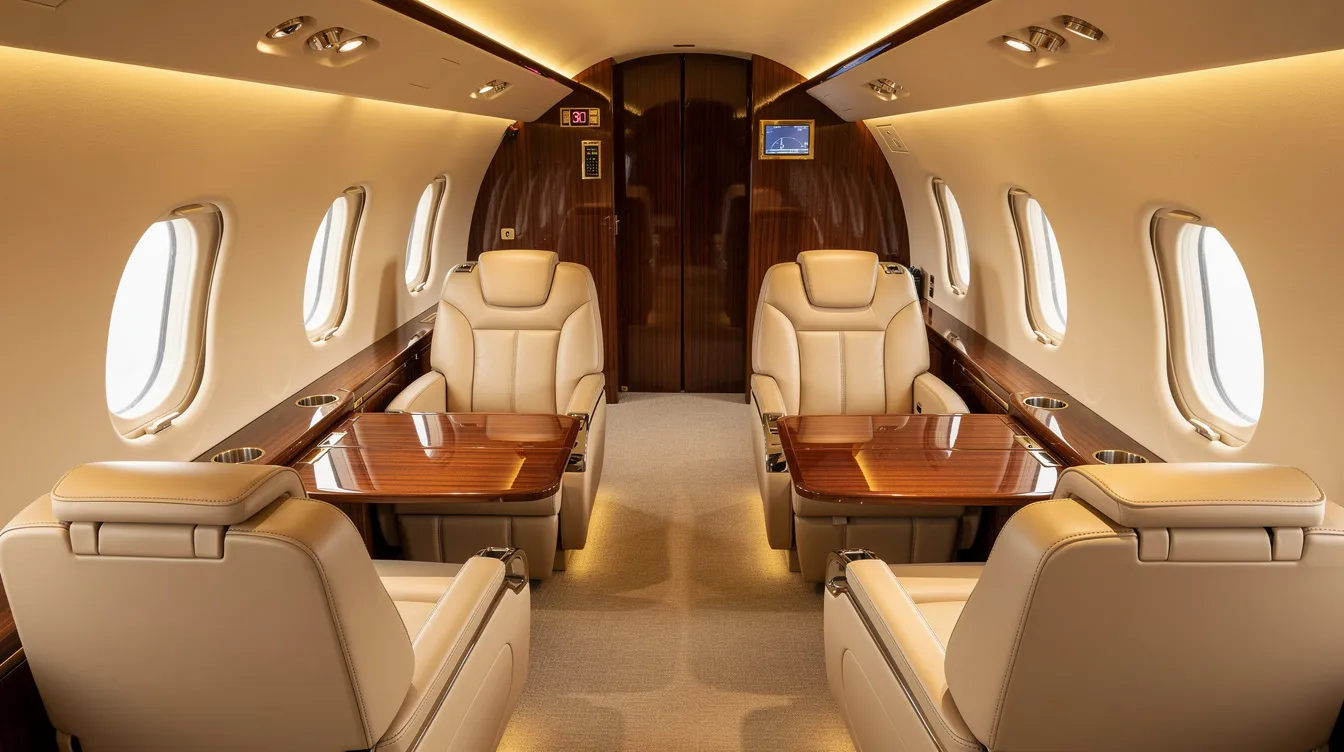
The BBJ1 offers approximately three times the cabin volume of traditional large-cabin private jets, making it a step up from typical 12-seat private jet solutions in both space and mission flexibility. At roughly 5,400 cubic feet (about 153 cubic meters) across 807 square feet (about 75 square meters) of floor area, the cabin space of the BBJ1 allows for multiple functional zones like offices and bedrooms. The interior of the BBJ1 is highly customizable, allowing for multi-zone layouts that transform the aircraft from a transport vehicle into a mobile office and a private residence in the sky.
Typical VIP layouts divide the cabin into three or four zones:
Forward lounge: Club seating for conversation or pre-meeting briefings, often seating 6 to 8.
Mid-cabin conference and dining area: A full-size table for board meetings, investor presentations, or family meals. BBJs provide privacy for confidential meetings in-flight.
After master bedroom suite: BBJs typically include a master bedroom suite with a full bathroom, and many include a shower. Some operators install two-bedroom suites, each with a private lavatory.
Multiple lavatories: Most layouts include two to three lavatories, a step beyond what even large cabin private jets can accommodate.
Cabin altitude on many refits sits at 6,500 ft, reducing the dry air and fatigue common at higher pressurization differentials. BBJs offer a lower cabin altitude of 6,500 feet, matching or beating the newest composite airframe widebodies. High-speed satellite Wi-Fi, encrypted data links, and integrated cabin management systems (lighting, temperature, entertainment) controlled from personal devices complete the luxurious amenities package, while the spacious multi-zone cabin delivers unmatched comfort. Noise insulation is upgraded well beyond a standard 737, making conversation and rest equally comfortable.
BBJs accommodate 15 to 50 passengers in luxury, depending on configuration. For travelers evaluating the best private jet for 15 passengers, how many passengers fit comfortably depends on mission length: for 16-seat configurations on flights over 10 hours, lie-flat sleeping for all is standard.
BBJ1 vs BBJ MAX, BBJ 787, and BBJ 777X
The original BBJ holds its own, but newer BBJ variants extend the Boeing Business Jet concept with better efficiency and greater range. The BBJ MAX family was launched on April 2, 2014, building on the 737 MAX platform.
Model | Engine | Range (8 pax) | Cabin Area | Fuel Burn vs BBJ1 |
|---|
BBJ1 (737 NG) | CFM56 | ~6,200 nm | ~807 sq ft | Baseline |
BBJ MAX 8 | LEAP-1B | 6,350 nm | ~968 sq ft | 15% lower |
BBJ 787-8 | GEnx | 9,960 nm | ~217 m² (~2,336 sq ft) | Lower per pax |
BBJ 777-8 | GE9X | 11,835 nm | ~3,200+ sq ft | Lower per pax |
BBJ 777-9 | GE9X | 11,330 nm | ~3,700+ sq ft | Lower per pax |
BBJ MAX models achieve a 15% reduction in fuel burn versus the BBJ1's CFM56 engines, along with a cabin altitude of 6,500 ft and improved aerodynamics from the MAX winglet design. BBJ MAX features make it the natural successor for operators replacing aging BBJ1 airframes.
Widebody BBJs enter a different category. The BBJ 787-8 has a range of 9,960 nautical miles with a composite airframe that lowers cabin altitude further and reduces maintenance burden. The BBJ 777-8 can fly 11,835 nautical miles nonstop, while the BBJ 777-9 has a range of 11,330 nautical miles. BBJs can fly nonstop over 11,000 nautical miles in these widebody configurations, covering any city pair on Earth. For a deeper look at Boeing 777X pricing, BlackJet has a dedicated guide.
The BBJ1 remains the right aircraft for groups of 8 to 19 on routes under 6,000 nm who want smaller private jets with jetnomics relative to widebody operating costs, but need cabin space that large cabin jets cannot deliver, while private jet options for 20 passengers and above often point toward larger VIP airliners or widebody platforms or creative solutions like buying individual seats on semi-private jets.
Cost Profile: Ownership vs. Chartering a BBJ1
Owning a BBJ1 requires capital and commitment. Pre-owned Boeing BBJ1 aircraft list between $25 million and $60 million, depending on year, interior condition, and total hours. Annual fixed costs for BBJs typically total $1.5 to $3 million, covering crew salaries, insurance, hangar, and training. Maintenance planning also benefits from major checks occurring every four years, adding six-figure costs in those years, plus ongoing low utilization maintenance program costs for aircraft that fly fewer hours.
Direct operating costs for BBJs range from $5,200 to $5,600 per hour, covering fuel burn (approximately 758 gallons per hour), engine reserves, maintenance, and parts, alongside crew expenses such as low-utilization costs. A BBJ1 flying 300 hours annually can generate total ownership costs approaching $4.5 to $5 million per year, fitting into the broader landscape of private jet pricing and access options.
Hourly charter rates for BBJs range from $10,000 to $20,000 or more, depending on routing, repositioning, and interior configuration, with group charter economics resembling those outlined in guides to chartering aircraft for 100 passengers when scaling to very large delegations and following the same private jet charter pricing fundamentals. Chartering avoids capital lock-up, depreciation, and fleet management overhead, while fractional programs introduce different dynamics around fractional jet ownership and depreciation planning. For a comparison of jet card versus charter versus ownership models, BlackJet breaks down the economics in detail, and a separate guide explains overall jet card costs and membership pricing inc, including how to analyze jet card cost per hour across providers and understand jet card pricing structures and benefits.
Decision framework: If your BBJ missions total fewer than 100 flight hours per year, on-demand charter layered on top of a Jet Card for shorter trips, a 100-hour Jet Cardgram, or a dedicated 25+ hour Jet Card for frequent flyers is the more efficient path, especially when you compare options using the best Jet Cards for frequent travelers. Ownership begins to make sense above 200 to 300 hours annually with consistent routing.
Accessing a Boeing BBJ1 with BlackJet Jet Cards
BlackJet's 25-hour and 50-hour jet card programs provide access to light, midsize, super-midsize, and large cabin jets for frequent private aviation needs, functioning as a flexible alternative to some unlimited private jet membership concepts. When a member's mission requires a BBJ aircraft, BlackJet sources it through vetted operators as a bespoke charter solution, applying the same cost and pricing principles used when renting a private jet.
Use case: A 20-person executive roadshow departing New York for London, continuing to Dubai and Singapore, or regional itineraries leveraging private jet charters in Karachi. BlackJet's flight support team coordinates permits, fuel planning, ground handling, security, and interior configuration for the entire itinerary.
Safety: BlackJet works only with operators holding top independent safety audits (Wyvern, ARGUS), maintaining airline-level maintenance on Boeing Business Jets, and staffing experienced BBJ-qualified crews.
Access: Speak with a BlackJet advisor to determine when a Boeing Business Jet BBJ1 or newer BBJ 737 MAX fits your travel profile, and when a large cabin jet is the better match.
Safety, Sustainability, and Technology on BBJ1 Flights
The BBJ1 inherits transport-category certification from the Boeing 737 platform: redundant avionics, dual hydraulic systems, and structural design tested across thousands of airframes in airline service. BlackJet's safety standards layer additional requirements on top of regulatory minimums, including continuous crew training and operator audits, which are critical when comparing major providers such as Flexjet jet card programs and pricing, NetJets jet card cost structures, or long-term private jet leasing solutions.
On sustainability: large airliner-based business jets burn more fuel than smaller private jets. The BBJ1's winglets improve efficiency by roughly 5%, and BBJ MAX engines cut fuel burn by 15%. BlackJet offsets 100% of carbon emissions on all Jet Card and charter flights, including BBJ missions, at no additional cost to members, and many clients additionally explore Jet Card deduction strategies to further optimize their aviation spend.
Onboard technology includes high-speed satellite Wi-Fi, secure VPN-friendly connectivity for sensitive corporate work, and cabin management systems that passengers control from tablets or phones. For large groups handling confidential deal work or government communications at altitude, this infrastructure is not optional; it is a requirement that BBJ operators build into every aircraft.
Frequently Asked Questions about Boeing Business Jet BBJ1
What is the range of the Boeing Business Jet BBJ1?
The BBJ1 has a maximum range of about 6,200 nautical miles with auxiliary fuel tanks and a typical VIP passenger load of 8. This allows nonstop intercontinental flights such as New York to Dubai or London to Tokyo.
How many passengers can the BBJ1 accommodate?
The BBJ1 can seat up to 50 passengers in high-density layouts, but VIP configurations typically accommodate 8 to 19 passengers for optimal comfort and luxury.
What makes the BBJ1 different from other private jets?
Unlike traditional business jets, the BBJ1 is based on a commercial Boeing 737-700 airframe combined with stronger wings and landing gear from the 737-800. It features auxiliary fuel tanks for extended range, a large cabin space about 79 ft long and 11.5 ft wide, and a low cabin altitude system pressurized to approximately 6,500 feet.
What are the operating costs of a BBJ1?
Direct operating costs for the BBJ1 range from $5,200 to $5,600 per hour, including fuel, maintenance, and crew expenses. Annual fixed costs typically range from $1.5 million to $3 million.
Can the BBJ1 be chartered?
Yes, the BBJ1 is available for charter through vetted operators and platforms like BlackJet, offering on-demand access without the capital commitment of ownership.
How does the BBJ1 compare to newer BBJ models?
The BBJ1 offers excellent range and cabin space but newer BBJ MAX models provide approximately 15% better fuel efficiency, lower cabin altitude for enhanced comfort, and modernized avionics.
What kind of interior configurations are possible on the BBJ1?
The BBJ1 interiors are highly customizable, often including forward lounges, mid-cabin conference/dining areas, master bedroom suites with full bathrooms, multiple lavatories, and advanced technology for productivity and entertainment.
Is the BBJ1 suitable for government or diplomatic use?
Yes, the BBJ1 is favored by heads of state and government agencies for its security, privacy, and ability to host confidential meetings onboard.
What safety features does the BBJ1 have?
The BBJ1 inherits commercial airline certification with redundant avionics, dual hydraulic systems, and structural durability. BlackJet operators meet or exceed independent safety audits and crew training standards.
How does the BBJ1 support sustainability?
While larger than typical private jets, the BBJ1 benefits from winglets that improve fuel efficiency by about 5%. BlackJet offsets 100% of carbon emissions on all flights, including BBJ charters, at no extra cost to members.
When a Boeing Business Jet BBJ1 Is the Right Choice
The BBJ1 fits a specific mission profile within the broader landscape of private aviation, which ranges from the cheapest private aircraft options for short regional hops to widebody BBJs for ultra-long-range heads-of-state missions. It is not the right aircraft for every trip, and recognizing when it adds value versus when smaller private jets or widebody BBJs serve better is what separates informed travelers from those paying for unused capacity.
BBJ1 is the right fit when:
Passenger count is 10 to 20 VIPs on routes exceeding 8 to 10 hours
The mission requires a master bedroom, conference area, and multiple lavatories in one aircraft
Security, privacy, and presence matter (government delegations, high-profile brand launches, fortress transportation for executives in sensitive regions)
Large groups of entertainers, athletes, or corporate teams need to move together with luggage and equipment in the cargo hold
Consider alternatives when:
Passenger count is 2 to 8: a large cabin jet or super-midsize often delivers better economics, especially if you prioritize the most affordable private jet options
Routes exceed 9,000 nm nonstop: widebody BBJ 787 or BBJ 777X models handle those legs without compromise
The BBJ1 is a specialized, powerful tool for global mobility. Matching the aircraft to the mission is where a trusted partner adds value. Explore BlackJet membership or consult with a BlackJet advisor to find the right Boeing Business Jet solution for your next high-stakes itinerary, whether you are tracking billionaire private jet price trends and ownership strategies.


 Sign up with google
 Sign up with Apple