Boeing 737 First Class vs Private Jet: Who Should Care and Why This Comparison Matters
Boeing 737 first class is a familiar choice for frequent business travelers, high-net-worth individuals, and premium cabin flyers seeking comfort on domestic U.S. routes. This article directly compares Boeing 737 first class with private jet travel through BlackJet, helping travelers decide if upgrading to private jet access is worth the investment. If you regularly fly in premium cabins, understanding the differences in comfort, privacy, flexibility, and value can help you make smarter travel decisions.
We’ll break down the experience, costs, and benefits of each option, so you can determine which is best for your needs—whether you’re a corporate executive, a family traveling together, or someone who values time and privacy above all.
Quick Answer: Is the Boeing 737 First Class Enough for Luxury Travel?
Boeing 737 first class on domestic U.S. carriers offers wider seats, more legroom, and complimentary drinks compared to economy class. On routes like Seattle to Boston, Chicago to Seattle, or Newark to Anchorage, it is a noticeable upgrade. But for frequent, high-value travelers, the gap between a 737 first-class cabin and private jet access through a Jet Card is measured in hours saved, privacy gained, and flexibility that no commercial airline can match.
A typical 737 first-class seat provides 37 to 41 inches of pitch in a 2-2 configuration. You sit next to a stranger, share lavatories, and navigate crowded terminals. A light or midsize private jet through BlackJet seats 4 to 8 passengers in a fully enclosed cabin with club seating, direct FBO access, and departure times you choose.
Feature | 737-800 First Class | 737 MAX First Class | Private Jet (BlackJet Jet Card) |
|---|
Privacy | Open cabin, 12-16 passengers | Open cabin, 16 passengers | Fully private, your group only |
Boarding time | 30-60 min before departure | 30-60 min before departure | 15-30 min, direct to aircraft |
Cabin width | Shared narrowbody, 2-2 layout | Shared narrowbody, 2-2 layout | Enclosed cabin, 4-8 seats |
Flexibility | Fixed airline schedule | Fixed airline schedule | Depart when you're ready |
Lie-flat seats | Not available on domestic 737s | Not available on domestic 737s | Available on midsize+ jets |
For executives and high-net-worth travelers who regularly buy domestic first-class tickets, BlackJet's Jet Card programs represent a strategic step up: prepaid hours, fixed rates, and the ability to reclaim the time commercial flying takes from you.
Boeing 737 First Class at a Glance
The Boeing 737 is the workhorse of domestic and short-haul international flying for American Airlines, United Airlines, and Alaska Airlines. Common variants include the 737-800, 737-900, and 737 MAX 8 and MAX 9, all sharing a narrowbody fuselage with a first-class cabin up front and economy class behind. In bespoke configurations, the 737 can even be adapted for private Boeing 737 ownership for corporate or VIP operations.
Airlines brand these forward cabins as "first class" on domestic U.S. routes and sometimes "business class" on Mexico City, Caribbean, or short international segments, even though the physical cabin and seats are nearly identical. First-class capacity on a 737 typically ranges from 12 to 16 seats:
The 737 MAX can fly long domestic segments; United operates Newark to Anchorage at roughly 7.5 hours. Even on those flights, travelers get recliners, not lie-flat seats. That distinction separates domestic first class from long-haul business class products and from many private jets, where lie-flat divans and enclosed cabins are standard.
Check-In and Ground Experience: Airport vs Private Terminal
For many travelers, the class experience begins on the ground. The check-in process, security checkpoint, and boarding sequence at hubs like SeaTac, Newark, Chicago O'Hare, LAX, and Mexico City shape the trip before the aircraft door even closes.
Boeing 737 First Class Check-In Process
Boeing 737 first-class passengers receive priority boarding as a standard perk. For example:
United Airlines includes priority boarding and check-in through Premier Access lanes.
Alaska Airlines offers priority check-in at SeaTac's Door 31.
American Airlines provides early boarding groups and priority baggage tagging.
These perks shave minutes, not hours, from the airport experience.
The security checkpoint remains the equalizer. Even with TSA PreCheck or CLEAR (SeaTac's Checkpoint 6 now offers biometric eGate access), travelers must arrive 60 to 90 minutes before departure at busy hubs, navigate crowded terminals, and wait at gates. Lounge access helps on some routes, but not every airport or ticket tier includes it.
BlackJet Private Terminal Experience
The ground experience with a BlackJet Jet Card is different in kind, not just degree. Members arrive at a private FBO (such as Signature Flight Support or Atlantic Aviation) 15 to 30 minutes before departure. There is no standard TSA line, no gate assignment, and no boarding group. The process is simple:
Arrive at the FBO.
Walk from your car to the aircraft stairs.
Your checked bag is loaded by the crew directly.
The BlackJet experience replaces the entire terminal process with direct car-to-cabin access.
Cabin Layout: 737-800 First Class vs 737 MAX
Most Boeing 737 first-class cabins share a 2-2 layout, but details vary by airline and aircraft generation.
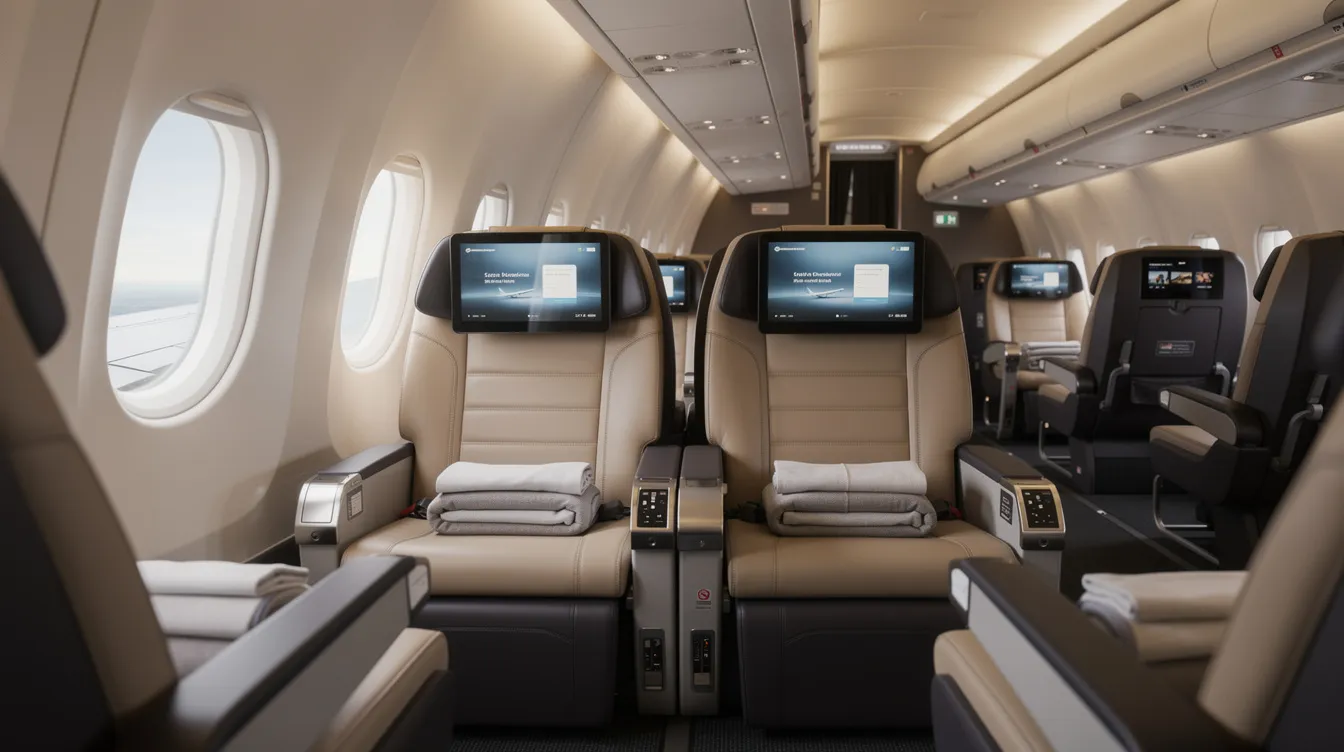
The standard 737-800 first-class cabin seats 12 to 16 passengers. American Airlines 737-800 first class has 16 seats in a 2-2 configuration. Alaska Airlines' pre-retrofit 737-800 interiors had 12 seats; the post-retrofit version adds a fourth row for 16. United's 737-800 "United Next" refresh brings updated overhead bins, mood lighting, and new window shades.
The 737 MAX 8 and MAX 9 first-class cabins seat 16 in the same 2-2 layout but add Boeing Sky Interior features: upgraded cabins feature more spacious overhead bins, pivot-style storage, and larger, brighter windows compared to older NG models. Mood lighting adjusts through phases of flight, and materials feel more contemporary.
Despite these refreshes, these are still narrow-body aircraft. Aisles are tight enough that a flight attendant with a cart blocks passage. The first-class cabin is open to the rest of the plane; there are no doors, no suites, and no partition that provides real privacy. That openness contrasts with the fully enclosed cabin of a light jet or midsize jet, where 4 to 8 passengers occupy a private space with a closed door and typically cruise at higher private jet altitudes than commercial flights for smoother, less congested routes.
First Class Seats: Comfort, Pitch, and Power
Key Definitions:
Seat pitch refers to the distance between a point on one seat and the same point on the seat in front of it. On the Boeing 737, first-class seat pitch ranges from 36 to 41 inches depending on the airline and variant.
Seat width is the measurement of the seat from armrest to armrest. First-class seating typically measures 20 to 21 inches in width.
2-2 configuration means there are two seats on each side of the aisle in each row, for a total of four seats per row in the first-class cabin.
A typical 737 first class seat is a wide recliner with roughly 5 inches of recline. Window seat passengers have no direct aisle access; they step over their seatmate. The seats are a clear improvement over economy class but not comparable to lie-flat business class on wide-body aircraft.
American Airlines 737-800 first-class seats measure 37 inches of seat pitch and 20 inches wide. Each seat includes AC power outlets and USB ports. There is a small side storage space, but no seatback screen on many aircraft. The design is minimalist gray, functional, and occasionally shows wear.
Alaska Airlines 737-800 first-class seats use Recaro frames at 21 inches wide with 40 inches of pitch, providing generous legroom among domestic first class options. These seats include a leg rest and calf rest, dual 60W USB-C ports, device holders, and shared center armrests with integrated cup holders.
United 737 MAX 8 first class offers 16 seats with 37 inches of pitch. United 737 MAX 8 first-class seats are 20.7 inches wide, with large seatback IFE screens, adjustable armrests, and a USB port plus AC outlet per seat.
First-class seating across carriers typically measures 20 to 21 inches in width, and first class seating has a legroom range of 36 to 41 inches depending on the airline and variant.
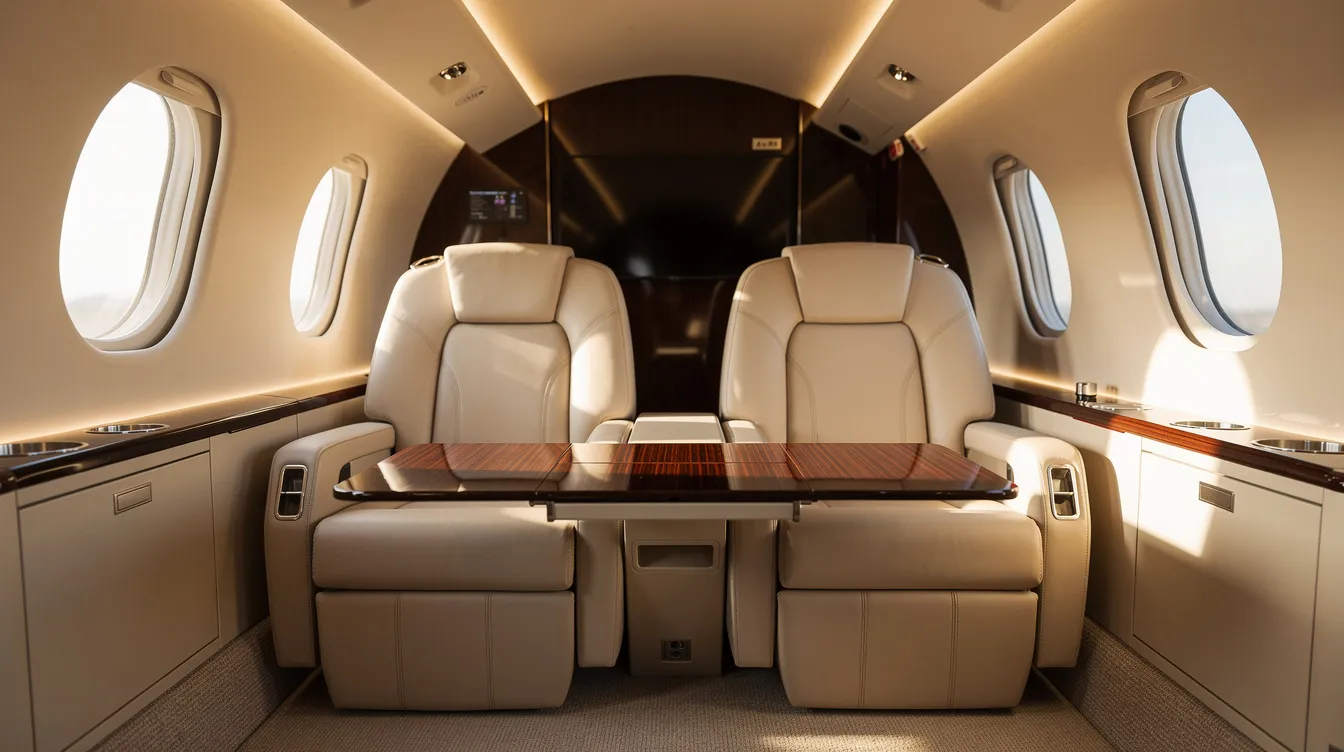
On a BlackJet-arranged aircraft, class seats look different: club seating for four in a facing layout, swivel and recline capability, footrests, and, on midsize and super-mid jets, divans that function as lie-flat beds for rest on longer missions.
Onboard Service: Comparing the Class Experience
Commercial First Class Service Flow
Service quality on commercial airlines varies flight to flight, even within the same first-class cabin. The typical 737 first-class service flow runs like this:
Free pre-departure beverages are typically served before takeoff in first class (though some flights skip this step when boarding runs late).
A hot towel follows certain routes.
United Airlines offers warm nuts and a beverage before meals.
Complimentary alcoholic beverages are offered in first class across all three carriers, including sparkling wine, spirits, and beer.
A flight attendant addresses passengers by name on Alaska Airlines and refills drinks roughly every 30 minutes on well-staffed flights.
Limitations show up consistently:
Pre-departure beverages occasionally don't arrive.
Mid-flight, service thins; on shorter segments, a single meal service and one follow-up pass may be all that happens.
On some American Airlines 737-800 first-class flights, passengers report long stretches without a drink refill or a visible crew member.
The flight attendant call button exists for these moments, but pressing it in a quiet cabin draws attention.
Private Jet Service Experience
On a BlackJet flight, the crew is dedicated to your party. Catering and drink lists are customized in advance. There is no competition for attention with dozens of other first-class passengers. You can hold confidential conversations, take calls, or simply rest without interruption, supported by the rigorous private jet safety standards and practices common in this segment. Follow-up comments from BlackJet members frequently cite this consistency as the big difference from commercial flying.
Dining and Drinks: 737 First Class Meals vs Custom Catering
Breakfast Options
Class food is often the first thing passengers notice when comparing economy, 737-800 first class, and private jets, especially on flights over three hours.
American Airlines: Three-cheese omelet on morning departures.
United Airlines: Basic breakfast with no menu options on many routes; passengers may preview meal details in the United app before the flight. Typical options include orange juice, warm bread roll, and a simple protein plate.
Alaska Airlines: Multi-course meal service is provided on flights over 900 miles.
Lunch and Dinner Selections
Lunch service and dinner options are more varied. For example:
Alaska Airlines:
American Airlines:
Charcuterie plates
Pasta
Side salad
United Airlines:
The meal included on shorter flights may be nothing more than a snack box.
Pre-Order Meal Programs
The class food ceiling on a commercial 737 is limited by catering scale and station quality.
On a BlackJet flight, catering is fully customizable:
Vegan, kosher, gluten-free, or a specific restaurant's menu matched to your schedule.
For example, a New York-to-Miami executive heading home after a board meeting can skip the generic 737-800 first-class breakfast and instead pre-order a light working lunch timed to the midpoint of a 2.5-hour private flight, with sparkling water, espresso, and pastries for the team.
Entertainment, Wi-Fi, and Productivity in the Air
Inflight Entertainment Systems
Inflight entertainment on Boeing 737 first class has shifted over the past few years from seatback screens to a mix of streaming and built-in displays, depending on the carrier.
United's 737 MAX 8: Features a large touchscreen IFE with movies, shows, and a moving map. United's IFE includes Bluetooth connectivity for personal devices, letting passengers pair wireless headphones directly. Some 737-800 United frames also carry seatback screen options, though older aircraft may require connection to the inflight Wi-Fi portal for full content.
Alaska Airlines does not install seatback IFE screens on narrowbodies. Instead, Alaska Airlines provides free streaming content via onboard Wi-Fi to any personal device through alaskawifi.com. On transcon flights of 5 to 6 hours, Wi-Fi speeds support video streaming, and the system is reliable enough for sustained use.
American Airlines: Offers streaming IFE without seatback screens on many 737-800 first-class cabins, relying on onboard Wi-Fi. In-flight Wi-Fi is commonly available on Boeing 737s across carriers; American's pricing runs around $21 to $28 per flight depending on duration.
Productivity and Privacy
Productivity constraints persist across all three carriers:
On a private jet through BlackJet's network, aircraft equipped with high-speed satellite Wi-Fi support encrypted corporate VPN use. You can hold a confidential meeting at altitude without a neighbor reading your screen.
Safety, Certification, and the 737 MAX vs Private Aviation
Safety concerns around the 737 MAX prompted one of the most scrutinized recertification processes in commercial aviation history. Both commercial airlines and private operators now respond with heightened transparency.
Key 737 MAX safety updates include:
Airlines like United and American operate 737 MAX aircraft under ongoing airworthiness directives and communicate compliance through safety cards, crew briefings, and public statements.
BlackJet Certified operators undergo vetting that includes ARG/US, Wyvern, or IS-BAO-rated auditing of crews and airframes. Where large airlines operate hundreds of 737-800 and 737 MAX aircraft across diverse maintenance environments, BlackJet selects specific Part 135 operators and tail numbers to maintain a consistently high safety profile for a smaller, more discerning clientele. Safety is not a selling point; it is a non-negotiable baseline. BlackJet's approach offers individual travelers more visibility into the specific aircraft and crew flying their mission.
737 First Class vs Private Jet Comfort on Longer Routes
Boeing 737 first class performs adequately on flights of 2 to 3 hours. On longer domestic segments of 4 to 7 hours, its limitations become harder to ignore.
Newark to Anchorage on United's 737 MAX runs roughly 7.5 hours.
Seattle to Boston on Alaska Airlines 737-800 takes 5 to 6 hours.
Chicago to Seattle or LAX to Pittsburgh on American Airlines 737-800 falls in the 4- to 5-hour range.
On all of these, first-class passengers sit in recliners with no ability to lie flat, limited leg support (except on select Alaska Recaro seats with leg rests), and a first-class lavatory that feels cramped after the third visit.
Fatigue factors add up:
Crowded boarding and deplaning
Shared cabin noise
Bright cabin lights during meal service
Inability to control your environment (e.g., window shades may be open when you want to sleep)
The crew manages 16 first-class passengers plus the entire aircraft; individual attention is limited.
On a 5-hour cross-country mission in a midsize jet, a BlackJet member boards from an FBO, settles into a quiet cabin with club seating, and has the option to sleep on a divan, work at a proper tray table with more space than any 737 first class seat provides, or hold a private meeting. Baggage handling at FBOs is direct; the crew loads and unloads under personal supervision, eliminating the open zippers and missing items some travelers have reported after flights arriving in San Francisco or other busy commercial airports.
Cost and Value: When Does a Jet Card Beat 737 First Class?
A single 737-800 first-class ticket appears cheaper than chartering a whole aircraft. That comparison breaks down for frequent travelers, groups, and anyone who accounts for time.
Sample commercial fares on recent domestic routes:
LAX to Pittsburgh, American Airlines 737-800 first class: approximately $540
Newark to Anchorage, United first class: $780 to $1,000
Alaska Airlines 737-800 first class transcon: $400 to $800
For a solo traveler flying United or any carrier once a month, commercial first class is the obvious choice. Scale that to a family of four or a small executive team, and the math shifts.
BlackJet's Jet Card model works on prepaid hours:
25-hour or 50-hour blocks at all-inclusive hourly rates by cabin class
A light jet starts around $5,484 per hour
Midsize runs approximately $8,000 to $9,000 per hour
Super-midsize around $10,384
Large cabin at roughly $13,131 per hour
These figures align with broader Jet Card cost per hour benchmarks across the private aviation market.
For a 3-hour New York to Miami flight on a midsize jet at $9,000 per hour, the total cost is approximately $27,000. Split among six passengers, that is $4,500 per person. Compare that to six last-minute first-class tickets at $800 to $1,200 each ($4,800 to $7,200 total), plus the 3 to 4 hours per person lost to airport logistics. The big upgrade is not just comfort; it is recovered time, especially once you understand the broader costs of renting a private jet across aircraft types and routes.
Factor in the cost of lost productive hours in airports, overnight hotel stays forced by limited airline schedules, and the ability to choose exact departure times and secondary airports closer to final destinations. For travelers who already routinely purchase domestic first-class tickets, a Jet Card becomes the logical next step, particularly once they compare different Jet Card pricing models and benefits available in the market.
Environmental Impact and Sustainability in Premium Air Travel
Premium cabins face scrutiny over environmental impact. How airlines and private operators respond matters to travelers and corporate travel policies alike.
Commercial airlines manage carbon impact through fleet-wide programs. The 737 MAX burns less fuel per seat mile than older NG models, and carriers run SAF (Sustainable Aviation Fuel) trials with varying availability. Some airlines include carbon offset options at booking, but participation is optional, and coverage varies.
BlackJet takes a different approach: every flight is carbon-neutral through verified offsets at 300% coverage, included in the base rate at no extra cost to members. While private jets can produce higher per-passenger emissions on a single flight, BlackJet mitigates this through offsets, selection of fuel-efficient aircraft, and routing that minimizes unnecessary repositioning. For travelers who will fly regardless of cabin class, BlackJet offers a measurable environmental commitment that most commercial first class tickets do not include by default.
How to Decide: Stick with Boeing 737 First Class or Move to Private?
Boeing 737 first class on Alaska Airlines, American Airlines, and United Airlines is good enough for solo travelers on occasional trips, especially when flying United or another carrier under a fixed corporate travel policy. The class review across all three carriers confirms a solid product: wider seats, complimentary drinks, meal service, and priority boarding that reliably beats economy.
The triggers for upgrading to a BlackJet Jet Card are specific and mirror what many guides to the best Jet Cards for frequent flyers highlight as ideal use cases:
Traveling in groups of 3 to 8 on a regular basis, with occasional trips that might require a private jet suitable for 15 passengers or more
Needing to visit multiple cities in a single day, where large-cabin 16-seat private jets and similar aircraft make complex itineraries practical
Requiring confidentiality for deals, board meetings, or sensitive work
Wanting to reclaim 2 to 4 hours per trip currently lost to security lines, connections, and delays
Heading home on your schedule, not the airline's, while still staying mindful of budget-friendly private aircraft options that can keep costs in check
Steps to Get Started with BlackJet Jet Card
Schedule an initial consultation.
Choose a cabin class mix across light, midsize, super-mid, and large cabin aircraft.
Fund a Jet Card with 25 or 50 hours.
Use BlackJet's mobile platform or 24/7 support team to book on demand.
Non-members can request a consultation to compare their current travel spend against Jet Card economics or reference a 50-hour Jet Card cost guide to frame expectations.
If you already fly Boeing 737 first class several times a month and find yourself wanting more control, more privacy, and less time in terminals, explore premium jet access with BlackJet and see whether a Jet Card can reshape how you move between the cities that matter most. You can benchmark options using resources on 100-hour Jet Card program costs, Flexjet Jet Card pricing and structure, and even alternatives that let you buy a seat on a private jet instead of a whole aircraft. For travelers comparing brands, digging into NetJets Jet Card costs and benefits provides a useful reference point alongside BlackJet’s model. Those moving larger teams might look to aircraft sized as the best private jet for 20 passengers or even 50-passenger private jet solutions, while aviation enthusiasts can explore the top private jets in the world or more accessible entries like the cheapest private jet options as part of their research.
The upgrade from commercial first to private is not about luxury for its own sake. It is about safety, certified operators, carbon-neutral flights, and technology-backed convenience that turns travel from an obligation into a strategic advantage.


 Sign up with google
 Sign up with Apple