By the BlackJet Editorial Team. Reviewed by Jake Miller, Chief Safety Officer, BlackJet. Last updated July 10, 2026.
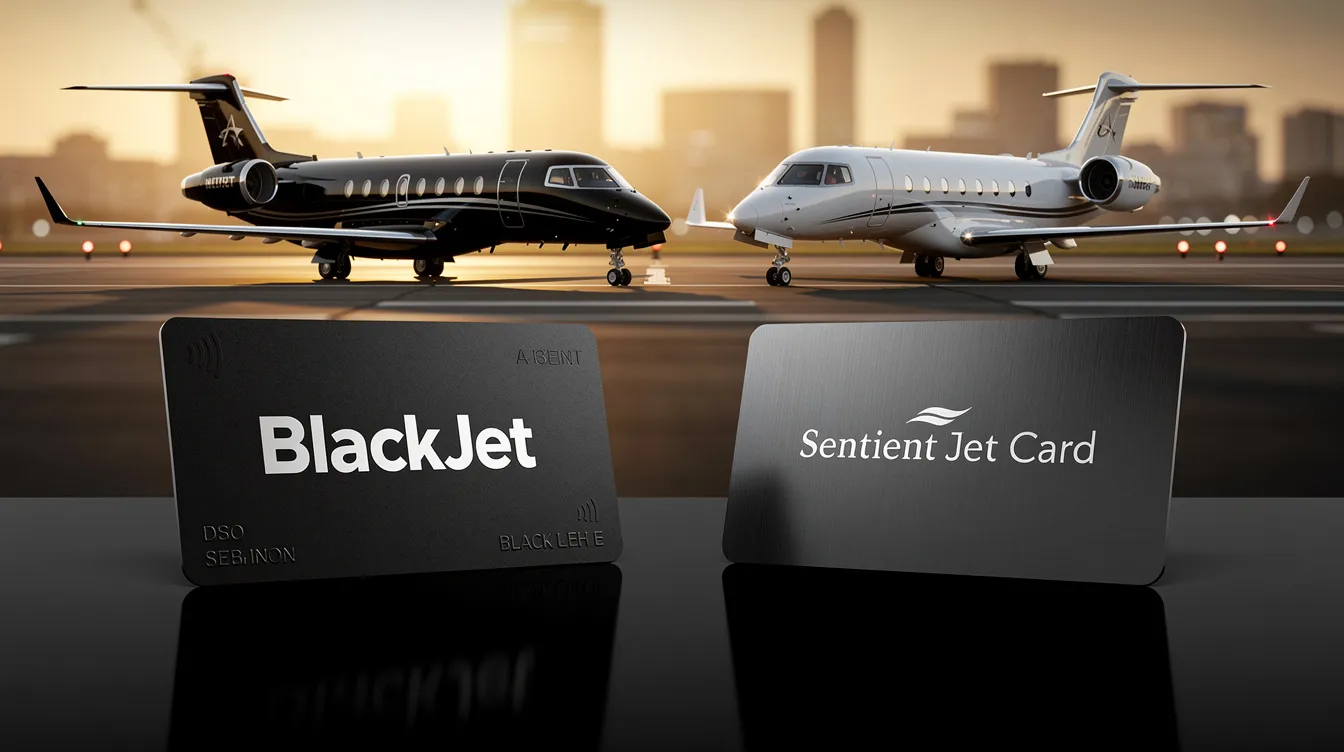
BlackJet and Sentient Jet both sell jet card programs built around fixed hourly rates, non-expiring hours, and a safety standard each brands as Certified. The choice in a BlackJet vs Sentient Jet comparison rarely comes down to a headline price. It comes down to what the hourly rate actually includes, whether taxes and fuel ride on top, and exactly what gets certified before you board a private jet. This guide defines every term, then maps it to what each company publishes on its own pages.
"Private aviation programs often sound similar until you compare the details. Hour expiration policies, safety vetting standards, aircraft availability, and pricing inclusions can have a much greater impact on long-term value than a few hundred dollars per flight hour."
- Justin Crabbe, CEO
How we compared. This article uses published program pages and named third-party pricing guides. Where a claim comes from a provider, we attribute it. Pricing and policies change, so confirm current terms in your written agreement before you buy.
At-a-Glance Verdict and Who Each Fits Best
Four factors decide this comparison: fixed-rate clarity, hour expiration, cabin categories, and how each company defines Certified. BlackJet publishes fixed hourly rates guaranteed for 12 months on its 50-hour card, hours that never expire, access to four cabin classes including Large Cabin, and a four-part BlackJet Certified process. Sentient Jet markets its SJ25+ card for Mid, Super-Mid, and Large Cabin with a 12-month rate lock and hours that never expire, and it notes that fuel surcharge and Federal Excise Tax apply.
Quick Answers
Do the hours expire? BlackJet states that its Jet Card hours never expire, and its 50-hour Jet Card rates are guaranteed fixed for 12 months.
Are rates fixed? Both providers publish a 12-month hourly rate lock. Confirm whether fuel and FET sit inside that number or get added.
What does Certified mean? It is a provider-defined vetting standard, not one universal industry rule. Ask what gets certified and by whom.
Match the program to how you fly:
If you want the hourly rate you see to already include fuel surcharges and FET, BlackJet publishes inclusive rates on its cards.
If you want a card scoped to Mid, Super-Mid, and Large Cabin, Sentient's SJ25+ targets those three classes.
If you want light jet access plus the option to move up to a large cabin jet card tier at fixed rates, BlackJet spans all four categories on one card.
| | BlackJet vs Sentient at a glance |
Feature | BlackJet | Sentient Jet (SJ25+) |
|---|
Rate lock | 12 months (50-hour card) | 12 months |
Hours expire | No | No |
Cabin access | Light, Mid, Super-Mid, Large | Mid, Super-Mid, Large |
Wi-Fi | Complimentary at all times | Confirm with provider |
Certified definition | Four-part: operator, aircraft, pilot, flight | Network of vetted direct air carriers |
Surcharge/tax note | Inclusive of fuel and FET on certain cards | Fuel surcharge and FET apply |
If you want a checklist-style comparison of fixed-rate terms and what Certified means, focus on what each provider explicitly states in its own program pages, not marketing shorthand. Start with the BlackJet 50 Jet Card page for the full published terms.
What a Jet Card Is and Why Fixed Rate Confuses Buyers
A jet card is prepaid access to private jet flights, usually sold in blocks of hours (often 25 or 50) at a set hourly rate with defined booking windows and rules. You buy hours up front, then draw them down as you fly. For a fuller primer on what a jet card is, the model rewards travelers who value predictable pricing and guaranteed availability over one-off charter quotes.
The confusion starts with the word "fixed." A fixed hourly rate is a contracted price per occupied flight hour. It is only truly fixed after you confirm which taxes and surcharges are included versus billed separately. Some providers quote an all-in number. Others quote a base rate, then add fuel surcharge, Federal Excise Tax (FET), peak-day premiums, or de-icing on top.
A Jettly pricing guide draws the line plainly: an all-in rate already includes the 7.5% FET on domestic flights. A plus-FET rate adds it afterward. The Jettly explainer shows why two quotes with the same headline number can bill very differently, which is where careful jet card pricing pays off.
Two operational models show up in contracts. Operator-owned or managed-fleet programs fly aircraft the company controls directly. Brokered programs source flights from vetted FAA Part 135 operators and coordinate the trip for you. BlackJet works as an aviation partner that coordinates between clients and certified operators rather than owning a fleet, a structure common across private aviation.
| What a fixed hourly rate does and does not cover |
Category | What it means |
|---|
Fixed rate covers | The occupied flight hour at the contracted rate |
Often extra | FET, fuel surcharge, de-icing, peak-day premiums |
Must verify | Minimums, cancellation windows, interchange rules |
A fixed hourly rate isn't the same as an all-in total price. Always confirm whether FET and fuel surcharges are included or added.
Fixed-Rate Terms and Rate-Lock Language Compared
Rate-lock language matters for two reasons: budgeting across a year of flying, and knowing your renewal risk when the lock ends. A rate lock is the time period a provider commits to keeping the contracted hourly rate unchanged. In jet cards it is commonly 12 months.
Sentient's SJ25+ page markets the ability to lock in hourly rates for 12 full months alongside jet card hours that never expire, per its published program page. The same page states that fuel surcharge and Federal Excise Tax will apply to the listed rates.
BlackJet states that its Jet Card hours never expire, and its 50-hour Jet Card rates are guaranteed fixed for 12 months. BlackJet publishes specific base hourly rates by cabin category that are inclusive of fuel surcharge and FET on its cards, so the number you compare sits closer to an all-in figure from the start.
Ask the same questions of any provider. What happens to the rate after the 12-month lock ends? Are there CPI escalators built into renewals? Are peak days surcharged, and how many are there? How are upgrades and downgrades priced when you switch cabin size mid-agreement?
Fixed-rate cards paired with guaranteed availability grew popular for a reason: they remove two variables at once, price volatility and the risk of no aircraft on busy dates. Private Jet Card Comparisons describes fixed one-way rates and guaranteed availability as distinct contract features you should confirm separately.
| | | | Table A. Rate terms compared |
Provider | Rate lock | Where stated | Fuel/FET note | Questions to confirm |
|---|
BlackJet (50-hour) | 12 months | Program pages | Inclusive of fuel and FET | Post-lock renewal, cabin-switch pricing |
Sentient (SJ25+) | 12 months | SJ25+ page | Fuel surcharge and FET apply | All-in conversion, peak-day rules |
Sentient Jet and BlackJet both market 12-month hourly rate locks, so the real comparison is what's included in that hourly number and what can still be added as surcharges. For deeper context, read this jet card pricing breakdown.
"The best jet card isn't necessarily the one with the lowest advertised hourly rate. It's the one whose contract is the easiest to understand. Buyers should compare what's included, how flight hours are calculated, what happens during peak periods, and whether rates remain predictable throughout the agreement."
- Justin Crabbe, CEO
Hour Expiration and Why Non-Expiring Hours Change the Math
Expiration quietly raises your real cost. Take a 25-hour card where three hours go unused and lapse at the deadline. You paid for 25 hours but flew 22, so your effective hourly cost climbs by roughly 14% (25 divided by 22). Non-expiring hours erase that penalty.
Non-expiring hours means your prepaid flight time does not lapse after a set term. You can use it whenever you fly, subject to program rules.
Sentient's SJ25+ page lists jet card hours that never expire. BlackJet states the same: Jet Card hours never expire, which supports multi-year planning, seasonal flying, and corporate budget timing that does not reset every December. Non-expiring hours reduce use-it-or-lose-it pressure and can lower your effective cost if your flying is irregular.
Confirm these five contract items before you sign:
Expiration date on prepaid hours, if any
Refundability of unused funds
Transferability to another user or entity
Termination conditions and notice periods
What happens to unused time if program terms change
JetCards.org pricing guidance reminds buyers to compare what each program includes and excludes, along with peak-day and blackout differences, before assuming two cards are equal. Read the expiration and funds language with the same care.
| | Table B. Expiration and funds rules |
Provider | Hours never expire | Items to confirm |
|---|
BlackJet | Yes (published) | Refunds, transfers, termination notice |
Sentient (SJ25+) | Yes (SJ25+ page) | Program variant differences, refund policy |
Once you own a card, it helps to track your jet card hours so remaining time and effective cost per trip stay visible across the year.
Cabin Access and Large Cabin Availability
Start with three questions: how many passengers you usually carry, how long your typical leg runs, and whether international flying is common. Passenger count and stage length point you to a cabin class. International trips push you toward super-midsize or large cabin aircraft with the range to cross oceans without a fuel stop.
BlackJet sorts fleet access into four categories: Light, Midsize, Super-Midsize, and Large Cabin. Its large cabin roster of BlackJet Certified aircraft includes the Gulfstream G650 and G550, the Global 7500, the Falcon 8X, and the Legacy 650, seating up to 12 passengers with transatlantic range (New York to London as a reference leg). A first-time buyer can review current 25-hour jet card costs across these classes.
Sentient's SJ25+ page covers three classes: Mid, Super-Mid, and Large Cabin. It lists a Mid base hourly rate of $9,434, Super-Mid at $11,529, and Large Cabin at $13,640, with the note that fuel surcharge and Federal Excise Tax will apply.
Both BlackJet and Sentient publish large-cabin jet card options with fixed hourly rates. Sentient notes that fuel surcharge and Federal Excise Tax may apply, and BlackJet publishes rates that are inclusive of fuel surcharges and Federal Excise Tax on certain card pricing.
A cabin category jet card gives you access to a class of aircraft (e.g., large cabin) rather than a single tail number. The exact aircraft can vary by trip. Large cabin trips carry extra planning too: longer-range routing, international handling and permits, and clarity on what the fixed rate covers on overseas legs. Avi-Go reports that large cabin private jet availability is expanding through 2026, useful context, though availability on any given date still depends on your contract's guaranteed availability terms.
| | | | Table C. Cabin access by class |
Class | Typical use | Passengers | BlackJet | Sentient |
|---|
Light | Short regional hops | Up to 7 | Published | Not on SJ25+ |
Midsize | Transcontinental | Up to 8 | Published | Published |
Super-Mid | Coast-to-coast, longer legs | Up to 8 | Published | Published |
Large Cabin | International, larger groups | Up to 12 | Published | Published |
Cabin access is a contract term. Confirm whether your card guarantees a category (or better) and what happens if the preferred aircraft isn't available.
What Certified Means for Sentient and BlackJet
"Certified" is not one universal industry standard. Two companies can both say Certified and mean different things. Always ask what is being certified and by whom before you read it as a safety guarantee.
In jet card programs, Certified typically means the provider has a defined vetting standard for operators and flights. It does not automatically mean the provider itself operates the aircraft.
Sentient says flights are sourced through its proprietary Sentient Certified™ Network of direct air carriers that meet FAA (or comparable foreign) standards plus additional safety standards established by Sentient. That framing, on its SJ25+ page, positions Sentient as an air charter broker sourcing flights from vetted carriers.
BlackJet Certified is BlackJet's proprietary four-part process that certifies the operator, aircraft, pilot, and individual flight before it's offered to card owners. BlackJet publishes several supporting elements: a safety program drawing on more than a decade of proprietary data and over 300 million data points, pilot standards it states exceed FAR Part 135 requirements across multiple categories, and in-app access to a pre-flight BlackJet Certified Safety Report with real-time safety-check updates. BlackJet states that fewer than 30% of the more than 575 charter jet operators in the U.S. pass the certification required to serve its clients, and it vets operators for ARGUS, Wyvern, or IS-BAO credentials. A Safety Advisory Board of former FAA and NTSB leaders works alongside the Chief Safety Officer on private aviation safety oversight.
Use these five steps to verify any Certified claim before you buy:
Ask for the operating carrier name for your trip (the Part 135 operator) before you fly.
Ask which third-party safety credentials are required (ARGUS, Wyvern, or IS-BAO) and whether they must be current.
Ask whether the specific aircraft is vetted as an individual tail (maintenance history and reliability), not just the operator.
Ask for pilot minimums in writing and how they exceed baseline regulatory requirements.
Ask how substitutions work and what "or better" means (category, seat count, or range).
The lesson mirrors advice from Private Jet Card Comparisons: promises like guaranteed availability and fixed pricing only count when they sit in the contract. Treat certification the same way. For more background, see our guide to jet card programs.
| | | Table D. Certified meaning map |
Layer | BlackJet Certified | Sentient Certified | Buyer question |
|---|
Operator | Certified in the four-part process | Direct air carrier in the network | Who is the Part 135 operator? |
Aircraft | Individual tail evaluated | Carrier-level vetting | Is this tail vetted, or just the operator? |
Pilot | Standards exceed FAR Part 135 | FAA or comparable standards | What are the written minimums? |
Flight | Individually certified pre-departure | Sourced through the network | Can I see a safety report first? |
The safest way to evaluate any Certified claim is to confirm whether the operator, aircraft, pilot, and individual flight are vetted, and what documents you can review before departure.
"A trustworthy jet card program should make every important term transparent before you purchase. Clients deserve to know exactly how rates are structured, what protections are built into the program, and how each flight is vetted long before they step onto the aircraft."
- Justin Crabbe, CEO
Published Pricing and an Apples-to-Apples Normalizer
Build every estimate the same way: published base hourly rate, plus published notes about fuel and FET, multiplied by your route length. A base hourly rate is the published price per flight hour before any listed add-ons (e.g., fuel surcharge or FET) the provider says may apply.
Sentient's SJ25+ page lists three published prices. Mid runs a base 25-hour price of $235,850 at a base hourly rate of $9,434. Super-Mid lists $288,225 and $11,529. Sentient lists an SJ25+ Large Cabin base 25-hour price of $341,000 and a base hourly rate of $13,640, with fuel surcharge and Federal Excise Tax applying.
BlackJet publishes rates inclusive of fuel surcharges and Federal Excise Tax on its cards. The 25 Light Jet Card lists $50,000 for 25 hours at a base hourly rate of $5,484. On the 50-hour card, where rates are guaranteed fixed for 12 months and hours never expire, the published base hourly rates run $8,038 for Mid, $10,384 for Super-Mid, and $13,131 for Large Cabin.
BlackJet offers each card two ways. The 25-Hour Jet Card is priced at $50,000 as Pay-As-You-Fly and $225,000 as Fully-Funded. The 50-Hour Jet Card is priced at $95,000 as Pay-As-You-Fly and $450,000 as Fully-Funded.
Normalize before you compare. Take a plus-FET quote and add the 7.5% Federal Excise Tax to reach an all-in figure. Sentient's $13,640 Large Cabin rate becomes about $14,663 once you add FET (13,640 times 1.075), before any fuel surcharge the page says applies. Set against BlackJet's $13,131 Large Cabin rate that already includes fuel and FET, the gap widens after normalization. JetCards.org stresses that providers differ in whether they fold fuel and FET into headline rates, which is why one conversion step protects your budget.
The most accurate comparison is to convert every quote into the same format, either all-in (including FET) or plus-FET, then add any stated fuel surcharges the provider says apply. To benchmark categories across the market, compare hourly rates before reading the snapshot below.
| | | | | Table E. Published pricing snapshot |
Program | Base hourly | 25-hour base price | Fuel/FET note | Hours expire | Source |
|---|
Sentient SJ25+ Mid | $9,434 | $235,850 | Fuel surcharge and FET apply | No | Sentient |
Sentient SJ25+ Super-Mid | $11,529 | $288,225 | Fuel surcharge and FET apply | No | Sentient |
Sentient SJ25+ Large Cabin | $13,640 | $341,000 | Fuel surcharge and FET apply | No | Sentient |
BlackJet 25 Light | $5,484 | Card priced $50,000 (Pay-As-You-Fly) | Inclusive of fuel and FET | No | BlackJet |
BlackJet 50 Mid | $8,038 | Card priced $95,000 (Pay-As-You-Fly) | Inclusive of fuel and FET | No | BlackJet |
BlackJet 50 Super-Mid | $10,384 | Card priced $95,000 (Pay-As-You-Fly) | Inclusive of fuel and FET | No | BlackJet |
BlackJet 50 Large Cabin | $13,131 | Card priced $95,000 (Pay-As-You-Fly) | Inclusive of fuel and FET | No | BlackJet |
Fees and Surcharges Checklist
If a cost isn't explicitly included, assume it may be billed as a pass-through. A pass-through fee is a third-party cost (de-icing, certain airport fees) billed to you at cost on top of the contracted hourly rate.
The single biggest source of confusion is FET. An all-in rate folds in the 7.5% domestic tax; a plus-FET rate adds it later, as the Jettly guide details. Fuel surcharges work the same way and can move with the market.
Common add-ons across private aviation programs include:
Fuel surcharge
De-icing in winter months
Catering beyond standard provisioning
International handling, permits, and customs fees
Overnight crew and hotel costs
Peak-day premiums on high-demand dates
Taxi-time and minimum daily billing
Repositioning outside the standard service area
Copy these questions into an email to any sales team:
Is fuel included in the hourly rate?
Is FET included, or added on top?
What is your peak-day policy, and how many peak days are there?
What are your daily and per-leg minimums?
What is your cancellation window and penalty?
How are de-icing and international handling billed?
Do you charge for repositioning, and when?
Will you list every pass-through item in writing?
JetCards.org notes that programs include or exclude fuel differently and that peak-day rules vary widely, so written answers beat verbal ones. Always ask "Is this hourly rate all-in?" and get the answer in writing with a list of pass-through items. When you are ready, get an accurate quote.
The Objective Buyer Checklist Before You Sign
Use this as a pass/fail checklist. Do not rely on verbal assurances.
| | Objective buyer checklist |
Checklist item | What to look for | How to verify |
|---|
Rate lock | 12-month guarantee | Read the lock clause and renewal terms |
Definition of fixed rate | All-in vs plus-FET | Request a sample invoice |
Inclusions (fuel/FET) | Written into the rate | Request the pass-through list |
Hours expiration | Hours never expire | Confirm in the agreement |
Substitution policy | Category or better | Get the "or better" definition |
Peak-day rules | Count and surcharge | Ask for the peak-day calendar |
Cancellation rules | Window and penalty | Read the cancellation clause |
Safety vetting | Operator/aircraft/pilot/flight | Request credentials and a safety report |
Large cabin access | Guaranteed availability | Confirm lead time by category |
Customer support | 24/7 access | Test the booking channel |
A guaranteed availability clause is a contractual promise that if you book within the required notice window, the provider will supply the aircraft category (or better), subject to the contract's terms. Private Jet Card Comparisons explains that guaranteed availability is defined by required lead time and specific contract language, not by a slogan.
BlackJet clears most of this checklist on its published terms. Hours never expire. The 50-hour card locks fixed rates for 12 months. BlackJet Certified vets operator, aircraft, pilot, and flight. Every flight has been offset to carbon and emissions neutral at no cost to clients since the program began, with offsetting stated at 300% of each flight's impact. Its large cabin jet card provides guaranteed access to European destinations including Rome, Paris, Milan, and Frankfurt at fixed rates for both domestic U.S. and transatlantic private jet travel. Organizational buyers can review corporate jet cards or benchmark against NetJets jet card cost.
The best jet card is the one with terms you can verify in writing: what's fixed, what's extra, what expires, and what certified actually requires.
Frequently Asked Questions
Do BlackJet jet card hours expire?
BlackJet states that Jet Card hours never expire. Confirm the policy in your card agreement, and note that rate-lock terms differ by card and cabin category. The 12-month fixed-rate guarantee applies to the 50-hour Jet Card.
Do Sentient Jet card hours expire?
Sentient's SJ25+ page states that jet card hours never expire. Verify which program you are buying, since variants can differ, and ask about termination and refund policies in writing. Check the details on the Sentient SJ25+ page.
Are BlackJet and Sentient hourly rates fixed?
Both providers publish fixed hourly rates with a 12-month rate-lock concept, but you must confirm what's included in that hourly figure. Sentient notes fuel surcharge and FET apply; BlackJet publishes rates inclusive of fuel and FET on its cards. Normalize both to the same format before comparing.
What does Sentient Certified mean?
Sentient says flights are sourced through its proprietary Sentient Certified™ Network of direct air carriers meeting FAA (or comparable foreign) standards plus Sentient's additional safety standards. This is a provider-defined vetting standard, so request the operating carrier's details before you fly.
What does BlackJet Certified mean?
BlackJet Certified is BlackJet's proprietary process that certifies the operator, aircraft, pilot, and each flight. The BlackJet app provides real-time safety-check updates and access to a pre-flight BlackJet Certified Safety Report, so you can review vetting before departure.
What fees can be added on top of a jet card hourly rate?
Even with a fixed hourly rate, items including FET, fuel surcharges, de-icing, and peak-day premiums may be billed separately depending on the program. Guidance from JetCards.org and Jettly both stress confirming inclusions in writing. Ask for a full pass-through list before you sign.
Which is better for large cabin travel?
For large cabin jet cards, compare the published large-cabin hourly rate, what's included (fuel and FET), and the provider's substitution and international handling policies. BlackJet publishes large cabin access with fixed rates that include fuel and FET; Sentient lists an SJ25+ Large Cabin base hourly rate of $13,640 with fuel surcharge and FET applying. Confirm guaranteed availability lead times for the category.
The Bottom Line for Buyers
BlackJet and Sentient Jet both deliver 12-month rate locks and non-expiring hours, so the decision turns on inclusions and verification. Sentient publishes clear SJ25+ pricing for Mid, Super-Mid, and Large Cabin, with fuel surcharge and FET added on top. BlackJet publishes rates inclusive of fuel and FET across Light through Large Cabin, hours that never expire, a four-part BlackJet Certified process, and emissions-neutral flying at no extra cost. If you want fixed rates, non-expiring hours, and documented safety vetting, request a BlackJet Jet Card quote and ask for a sample BlackJet Certified Safety Report. Reach BlackJet at 1-866-321-JETS (1-866-321-5387) or info@blackjet.com.
Policies and pricing can change. Confirm all terms in your written contract before purchase. Figures reflect published sources as of July 10, 2026.
References
Jettly Jet Card Pricing Guide - All-in versus plus-FET explanation and example math for normalizing rates.


 Sign up with google
 Sign up with Apple