Introduction
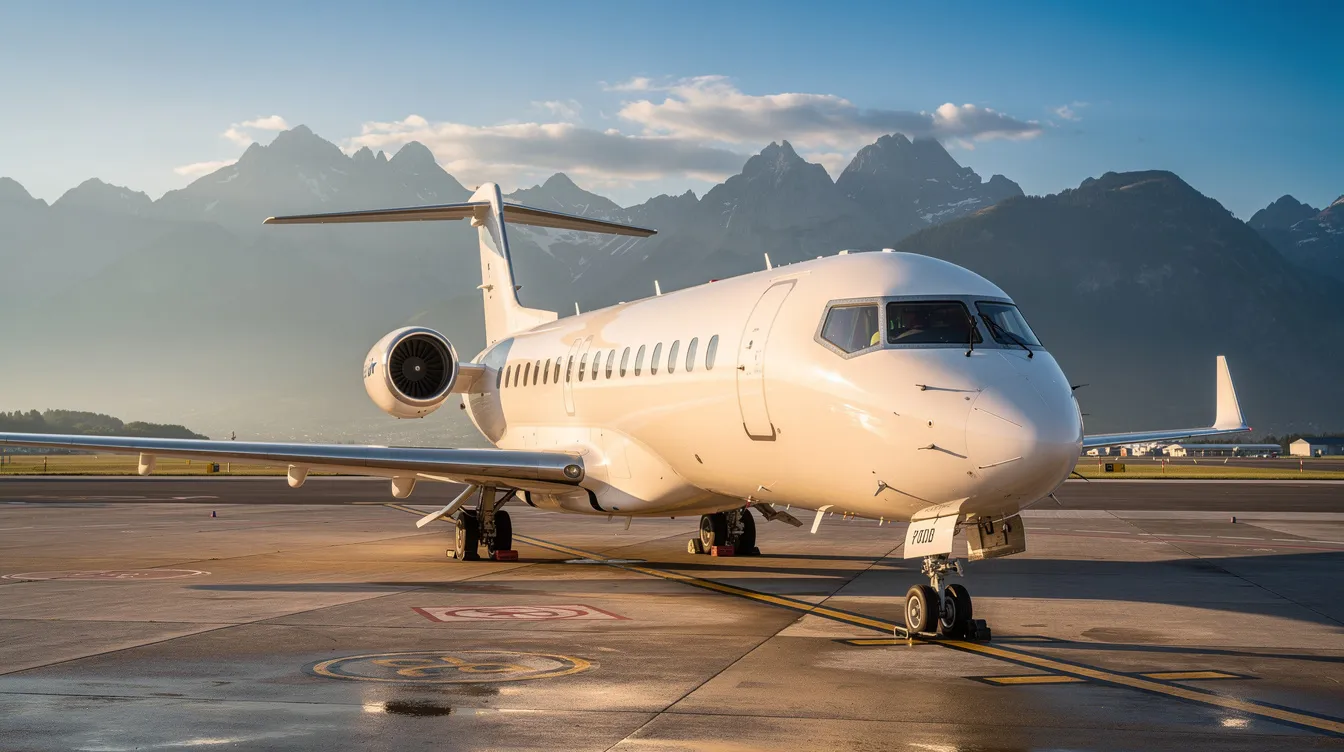
The Boeing BBJ (Boeing Business Jet) occupies a category of its own in private aviation, standing as an airliner-sized airplane configured with palace-style interiors and intercontinental range. This comprehensive guide covers every essential aspect of the BBJ, including its history, technical specifications, cabin layouts, performance, cost profile, and charter options. Whether you are a private aviation client, a corporate traveler, a government delegation, or an ultra-high-net-worth family, this article is tailored to help you understand why the BBJ remains a premier choice for long-range private travel in 2026. We explore the unique features that set the BBJ apart—such as its unmatched cabin space, extended range, and bespoke luxury—while also addressing its relevance in today’s evolving aviation landscape. For those seeking a flying headquarters that offers both productivity and comfort, the BBJ delivers a solution that smaller jets and commercial first-class simply cannot match.
Why the Boeing Business Jet (BBJ) Still Matters in 2026
The Boeing Business Jet is based on proven 737 airframes but transformed into an ultra-long-range aircraft capable of carrying 10–40 passengers nonstop across oceans. A BBJ1 can fly nonstop from New York to Dubai, eliminating the fuel stops and schedule constraints that limit typical large-cabin jets. For corporate teams routing through Las Vegas, London, or Singapore, that extended range translates directly into hours saved and meetings gained compared with even the most capable 16-seat large-cabin private jets.
Serious customers - UHNW families, government delegations, corporations running multi-city roadshows - choose the Boeing BBJ when they need space to work, sleep, and meet onboard without compromise. BlackJet members can access Boeing BBJ charters through Jet Card programs without owning an airliner-class aircraft, giving them flexibility, rigorous safety oversight, and carbon-neutral operations on every flight.
BBJ vs Large-Cabin Jet vs Commercial First Class
Feature | Boeing BBJ | Large-Cabin LR Jet | Commercial First Class |
|---|
Cabin floor area | 807–1,120 sq ft, multiple rooms | 400–700 sq ft, single zone | Per-seat suite only |
Nonstop range (VIP load) | 5,900–6,600 nm | 5,000–6,000 nm | Limited by airline routing |
Master bedroom & shower | Yes | Rarely | No |
Schedule control | Complete | Complete | Airline-dependent |
Baggage capacity | 100+ bags in cargo hold | 10–20 bags | Airline limits |
What Is a Boeing Business Jet (BBJ)?
The acronym BBJ carries several meanings depending on context - it is the IATA airport code for Bitburg Airport in Germany, shorthand for Bad Beat Jackpot in poker discussions, a reference to regional publications like the Birmingham Business Journal, a term for Burpee Box Jump in fitness circles, and in adult-oriented slang, BBJ commonly means bare blowjob. In aviation, however, BBJ refers exclusively to Boeing Business Jet - a family of VIP-configured airliners created jointly by Boeing and GE for private, corporate, and VIP travel.
The core Boeing BBJ (often called the original BBJ or BBJ1) is based on the 737-700 platform with strengthened structure, blended winglets, and up to nine additional fuel tanks installed in the cargo hold beneath the fuselage.
The BBJ1 features a cabin measuring approximately 79 ft long and 11.5 ft wide, yielding roughly 807–968 sq ft of floor area - about three times the space of a standard large-cabin jet.
The BBJ1 can accommodate 8 to 50 passengers in various configurations, from ultra-luxury VVIP seats to high-density government shuttles, making it one of the best private jet options for 50 passengers.
The BBJ1 inherits commercial airline certification standards, ensuring every airplane meets the same structural and systems requirements as a scheduled airliner.
Boeing Business Jets offer customized interiors like executive offices and bedrooms, making each aircraft a purpose-built environment for its customers and an ideal large-cabin private jet for 20 passengers.
History and Evolution of the Boeing BBJ Family
The BBJ program launched in July 1996 as a joint effort between Boeing and GE to create an airliner with genuine private-jet appeal. The first BBJ rolled out from Boeing's Renton facility in July 1998, completed its first flight in September 1998, and reached its first customer in 1999.
Subsequent models expanded the family's options:
BBJ2 (launched 1999, based on 737-800): roughly 19 ft of extra cabin length and nearly double the baggage volume, with slightly reduced range at maximum payload.
BBJ3 (announced 2006, based on 737-900ER): approximately 35% more cabin space than the first BBJ, with up to eight auxiliary fuel tanks and optimized performance for larger groups.
BBJ MAX series (deliveries from 2018): powered by LEAP-1B engines with lower fuel burn, advanced winglets, and larger windows, giving the history of the line its most efficient chapter yet.
Widebody variants - the BBJ 787, 777-200LR, and 777X - entered service for heads of state and very large delegations through the 2010s and 2020s, complementing the newest generation of ultra-long-range private jets. By the early 2020s, Boeing delivered over 250 BBJ units across all types.
Airframe, Fuel Tanks, and Performance: How the BBJ Achieves Long Range
The core Boeing BBJ merges a 737-700 fuselage with the stronger wings, center fuselage section, and landing gear of the 737-800, sharing many fundamentals with those considering buying a Boeing 737 for private use. This combination supports a higher maximum takeoff weight, which in turn allows for substantially more fuel.
Fuel architecture: up to 9 auxiliary fuel tanks sit in the belly cargo hold, increasing total fuel capacity to roughly 72,000 lb. This is what gives the BBJ1 a maximum range of 6,200 nautical miles with auxiliary tanks - enough for nonstop legs like New York–Geneva, Dubai–London, or Las Vegas–Honolulu.
Aerodynamics: blended winglets on classic models (and split-scimitar or advanced winglets on newer versions) reduce drag by improving the lift-to-drag ratio. The BBJ1's winglets improve fuel efficiency by about 5%, translating directly into extended range and better climb performance.
Avionics and systems: the BBJ1 features redundant avionics and dual hydraulic systems, and is designed for high-utilization cycles up to 4,000 hours annually.
Performance snapshot (typical narrow-body Boeing BBJ):
Cruise speed: Mach 0.79–0.82
Service ceiling: 41,000 ft
Range with 8 passengers: 5,900–6,600 nm depending on variant
Runway requirement: 5,500–9,000 ft depending on weight and airport elevation, which aligns well with major international fields that support private jet charters in Karachi.
Inside a Boeing BBJ: Cabin Layouts, Master Bedrooms, and Onboard Experience
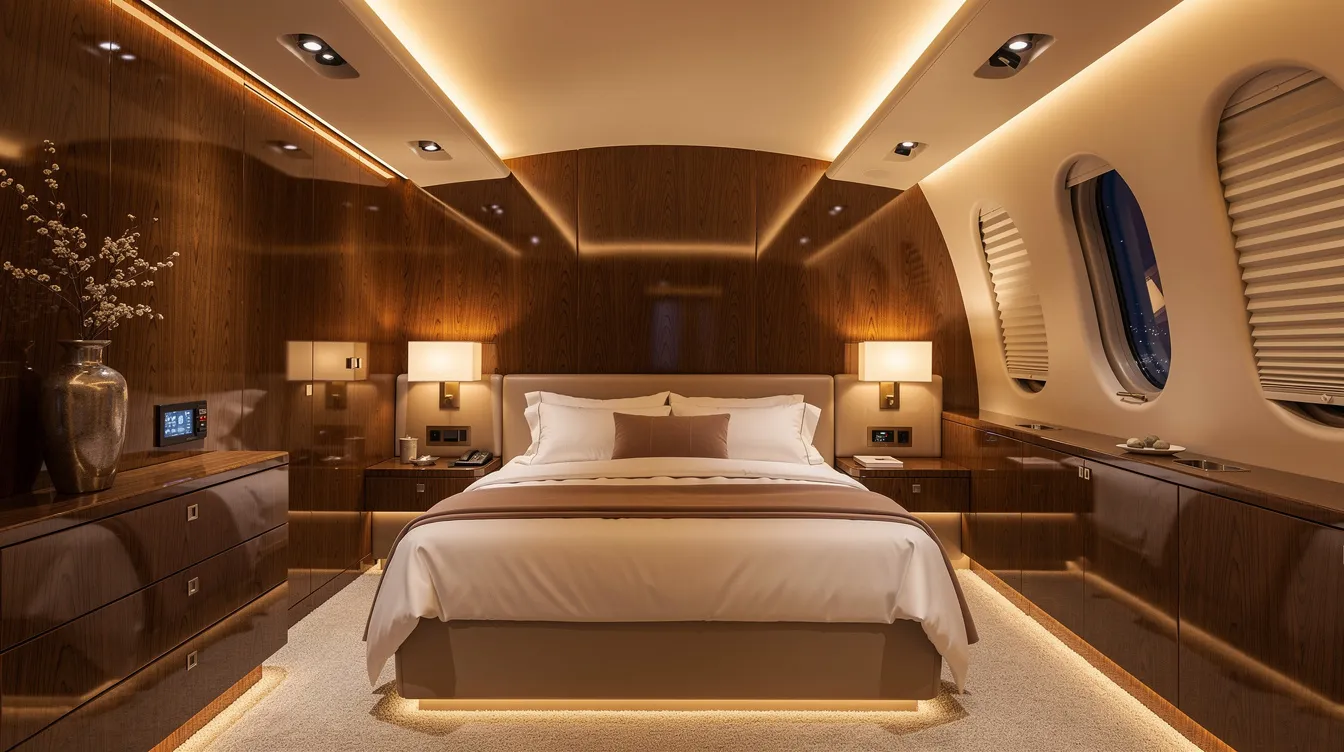
Stepping aboard a Boeing BBJ feels nothing like boarding a commercial airliner. Full standing room, wide aisles, and multiple living zones replace the single-tube cabin. The BBJ1 offers approximately 5,400 cubic feet of cabin space. Typical VIP layouts divide the BBJ1 cabin into three or four zones, and a skilled interior design team can create environments that transform the airplane into a mobile office, residence, or meeting venue, delivering far more privacy than simply buying a seat on a private jet.
Forward lounge: club seating and divans for working or socializing.
Mid-cabin: conference and dining room with seats for 6–8, powered by a full galley capable of fine-dining service.
Aft suite: BBJ1 interiors often include master bedroom suites with full bathrooms, sometimes featuring a shower. Multiple lavatories (typically 2–3) serve the remaining cabin.
Environment: lower cabin altitude of around 6,500 ft even at max cruise altitude, quieter interior than commercial configuration, customizable mood lighting, and high-speed satellite Wi-Fi for VPN, video calls, and streaming.
Consider a BlackJet client on a 12-hour New York–Tel Aviv flight with a team of 12: the group works in the conference area for the first four hours, dines mid-flight, then sleeps - some in lie-flat seats, others in the master bedroom. Baggage for extended trips fits easily in the generous cargo hold. That is the kind of trip a Boeing BBJ is built for.
Boeing BBJ Variants and Use Cases: BBJ1, BBJ2, BBJ3 and Beyond
BBJ1 (737-700 based): strongest focus on long range, up to 9 fuel tanks, ideal for smaller VIP groups of 8–19 demanding maximum nonstop capability.
BBJ2 (737-800 based): about 25% more cabin space and nearly double the baggage room, with slightly reduced range at full payload - the right choice when a larger lounge, bigger master bedroom, or more staff seating is needed.
BBJ3 (737-900ER based): roughly 107 ft of cabin length, optimized for 8–19 VIPs but capable of seating up to 50 in mixed layouts.
The BBJ MAX series (MAX 7, 8, 9) represents a generational leap: BBJ MAX engines cut fuel burn by 15% compared with classic variants, reducing both operating cost and emissions. Industry analysts at firms like Conklin & de Decker account for these efficiency gains when modeling per-hour costs, and sustainability-minded travelers increasingly specify MAX variants for that reason.
Scenario: A corporation runs a roadshow - New York to Los Angeles to Las Vegas to Mexico City with 25 executives. A BBJ2 or BBJ3 handles the routing efficiently: ample seats, onboard meetings, equipment in the cargo hold, and no connecting flights.
Cost Profile and Why Chartering a BBJ via BlackJet Is Often the Right Choice
Ownership is expensive. A new BBJ MAX-7 lists at roughly $101.5 million. Annual fixed costs for BBJs - crew, training, hangar, insurance, maintenance - range from $1.5 million to $3 million. Direct operating costs for BBJ1 range from $5,200 to $5,600 per hour. A BBJ1 flying 300 hours annually costs about $4.5 to $5 million all-in before the selling price or residual value risk is even considered, a figure that often surprises newcomers when they first study a detailed private jet price list.
Charter pricing for a Boeing BBJ typically falls in the range of $15,000–$22,000 per hour in 2026, depending on interior, operator, and routing, which places it well above the cheapest private aircraft options aimed at budget-conscious flyers.
Jet card programs offer prepaid access to private jets and eliminate these capital burdens entirely, and a detailed guide to jet card costs helps many travelers benchmark BBJ access against other solutions. BlackJet's 25-hour jet card programs include 25-hour and 50-hour options, and the dedicated BlackJet 25+ Hour Jet Card provides fixed-rate access to larger cabins suited to BBJ clients. Members pre-purchase hours, access a curated network from light jets to Boeing BBJ, and pay only for time flown - no hangar fees, no maintenance reserves, no idle aircraft, making it easy to compare jet card cost per hour with full ownership.
Accessing a Boeing BBJ with BlackJet: Safety, Sustainability, and Tech
BlackJet sources Boeing BBJ aircraft exclusively from vetted charter operators running airline-level maintenance programs with crews experienced on 737-class jets. BlackJet ensures continuous crew training for safety compliance across every operator in its premium private jet service network.
Safety layers: FAA Part 135 or equivalent foreign approvals, independent audits through programs like ARGUS and Wyvern, recurrent simulator training, and BlackJet's own certification process. BlackJet operators meet or exceed independent safety audits - no exceptions, positioning its network as a strong alternative to well-known providers with premium NetJets jet card pricing.
Sustainability: newer BBJ MAX engines and advanced winglets cut fuel burn versus earlier 737s. BlackJet offsets 100% of carbon emissions on all flights, providing carbon-neutral travel at no added cost to the member, even for clients who might otherwise consider the cheapest private jet options to manage budgets.
Technology: members can access multiple cabin types through the best jet card programs for frequent flyers with 24/7 digital booking tools for convenience and real-time support - from overflight permits to ground logistics for complex itineraries, all structured around transparent jet card pricing models.
A Boeing Business Jet is the right choice within BlackJet's portfolio when groups of 10–30 passengers need a master bedroom, meeting space, and full galley on flights over 6–8 hours. For a min group on a shorter trip, a large-cabin or super-mid jet may be more practical, especially when evaluated against the economics of a 100-hour jet card program.
Frequently Asked Questions about the Boeing Business Jet (BBJ)
What is the range of the Boeing Business Jet BBJ1?
The BBJ1 has a maximum range of about 6,200 nautical miles with auxiliary fuel tanks and a typical VIP passenger load of 8. This allows nonstop intercontinental flights such as New York to Dubai or London to Tokyo.
How many passengers can the BBJ1 accommodate?
Clients whose annual flying justifies it sometimes evaluate BBJ access against unlimited private jet memberships that cap costs instead of seats.
The BBJ1 can seat up to 50 passengers in high-density layouts, but VIP configurations typically accommodate 8 to 19 passengers for optimal comfort and luxury.
What makes the BBJ1 different from other private jets?
Unlike traditional business jets, the BBJ1 is based on a commercial Boeing 737-700 airframe combined with stronger wings and landing gear from the 737-800. It features auxiliary fuel tanks for extended range, a large cabin space about 79 ft long and 11.5 ft wide, and a low cabin altitude system pressurized to approximately 6,500 feet.
What are the operating costs of a BBJ1?
For frequent flyers comparing ownership to membership, these figures are often weighed against detailed analyses of 50-hour jet card costs.
Direct operating costs for the BBJ1 range from $5,200 to $5,600 per hour, including fuel, maintenance, and crew expenses. Annual fixed costs typically range from $1.5 million to $3 million.
Can the BBJ1 be chartered?
For business users, structuring those charter flights or memberships correctly can unlock significant jet card tax deductions.
Yes, the BBJ1 is available for charter through vetted operators and platforms like BlackJet, offering on-demand access without the capital commitment of ownership.
How does the BBJ1 compare to newer BBJ models?
The BBJ1 offers excellent range and cabin space but newer BBJ MAX models provide approximately 15% better fuel efficiency, lower cabin altitude for enhanced comfort, and modernized avionics.
What kind of interior configurations are possible on the BBJ1?
The BBJ1 interiors are highly customizable, often including forward lounges, mid-cabin conference/dining areas, master bedroom suites with full bathrooms, multiple lavatories, and advanced technology for productivity and entertainment.
Is the BBJ1 suitable for government or diplomatic use?
Yes, the BBJ1 is favored by heads of state and government agencies for its security, privacy, and ability to host confidential meetings onboard.
What safety features does the BBJ1 have?
The BBJ1 inherits commercial airline certification with redundant avionics, dual hydraulic systems, and structural durability. BlackJet operators meet or exceed independent safety audits and crew training standards.
How does the BBJ1 support sustainability?
Many sustainability-focused travelers also compare BBJ charter to providers like those outlined in our guide to Flexjet jet card costs before deciding on an access model.
While larger than typical private jets, the BBJ1 benefits from winglets that improve fuel efficiency by about 5%. BlackJet offsets 100% of carbon emissions on all flights, including BBJ charters, at no extra cost to members.
Conclusion: Why the Boeing BBJ Remains a Premier Choice for Private Aviation
The Boeing Business Jet (BBJ) continues to set the standard for ultra-long-range private travel, combining the proven reliability of the Boeing 737 platform with bespoke luxury and unmatched cabin space. For discerning travelers—whether corporate executives, government officials, or ultra-high-net-worth families—the BBJ offers a unique blend of range, comfort, and privacy that smaller jets or commercial first-class simply cannot match.
With BlackJet's Jet Card programs, accessing a Boeing BBJ is seamless, safe, and sustainable. Members enjoy the flexibility of prepaid hours, real-time booking support, and the assurance of rigorous safety certifications including ARGUS audits and FAA compliance. The integration of cutting-edge technology and carbon-neutral operations further elevates the travel experience, aligning luxury with responsibility.
Whether your mission requires a master bedroom suite, onboard conference facilities, or the ability to fly nonstop on complex international itineraries, the BBJ delivers a flying headquarters tailored to your needs. Elevate your travel with BlackJet and discover how the Boeing BBJ can transform your journey into a strategic advantage—where every detail is engineered for excellence, safety, and sustainability.


 Sign up with google
 Sign up with Apple