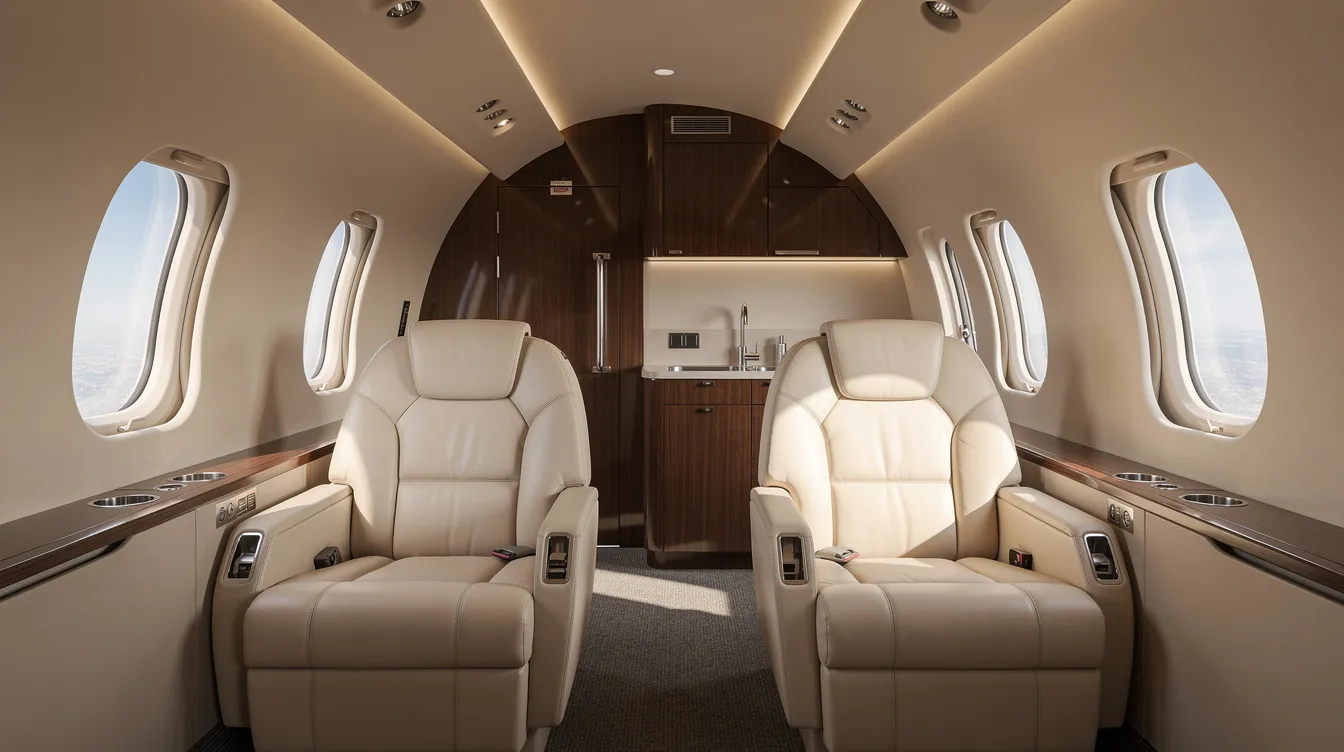
Why the Front View from Your Plane Seat Matters
Picture this: you're climbing out of Teterboro, heading south toward Miami. From your forward-facing seat, you see the cockpit partition, a polished wood-grain bulkhead, a colleague across the club seating, and crew preparing your espresso in the galley. No seatback in your face. No overhead bin crowding your sightline. The airplane seat front view on a private jet is not a minor detail; it is a transcript of the entire cabin's design philosophy, written in leather, lighting, and open space.
Forward visibility and cabin layout carry different weight in private aviation than on commercial airlines. On a plane operated by airlines, economy class seats are commonly arranged in 3-3 configurations on narrow-body jets, and even front-row passengers in business class face a wall of seatbacks or a bulkhead with a flush-mounted entertainment screen and USB charging port. Private jets replace that grid with open, lounge-style layouts where you can see colleagues, crew, workspace, and exits from a single seated position. For BlackJet's executive and high-net-worth clientele, this visibility is a strategic tool: it supports meetings, situational awareness, and the kind of calm productivity that a cramped commercial cabin cannot deliver.
This article covers:
What the front view looks like across light, midsize, and large-cabin private jets, with specific aircraft and route examples
How that view affects comfort, safety perception, and in-flight work
How BlackJet's Jet Card program helps you choose the right cabin configuration and seat position before you board
What the Airplane Seat Front View Reveals in Different Private Jet Cabins
The front view from your seat shifts noticeably between a light jet on a two-hour hop and a large-cabin aircraft crossing the Atlantic. BlackJet's Jet Card gives members access to four cabin categories (Light, Midsize, Super-Midsize, Large Cabin), and the aircraft assigned depends on mission length, passenger count, and route. A New York-to-Miami leg might call for a midsize jet; London to Dubai, a large cabin. Each category produces a different visual experience from your seat.
Light Jets: Phenom 300E, Citation CJ3+, Learjet 75
When you sit facing forward in an Embraer Phenom 300E, you see the seatback or refreshment center directly ahead, overhead LED lighting strips along the ceiling, and a compact aisle that runs roughly 17 feet 2 inches from front to rear. The cabin measures about 4 feet 11 inches in height and 5 feet 1 inch in width, so the field of view is intimate rather than expansive (Embraer spec sheet).
That closeness has an upside. Sitting near the front of a light jet puts you within a few feet of the cockpit door, and because most light-jet engines are mounted at the rear of the fuselage, the forward cabin is quieter. BlackJet members regularly select light jets for routes like Boston to Toronto, Paris to Geneva, or Los Angeles to Las Vegas, where the 1,100- to 1,800-mile range is more than sufficient, and these missions often align with more affordable private jet options that still deliver a premium cabin experience. For these shorter flights, the tight front view feels purposeful rather than constrained: you board, you sit, you arrive.
Midsize and Super-Midsize Jets: Citation Latitude, Challenger 350, Gulfstream G280
Step up to a midsize cabin and things change. A Cessna Citation Latitude offers 72 inches of cabin height, 77 inches of width, and nearly 22 feet of length (FlypPrivate spec). From a forward-facing seat, you can see deeper into the cabin: club seating arranged in pairs, a small galley or partition before the cockpit area, fold-out tables, and side consoles. Bulkhead rows in these aircraft provide extra knee and leg room because there is no seat ahead that can recline into your space, though bulkhead seats lack under-seat storage due to the wall in front of them.
This layout turns the cabin into a working boardroom. An executive flying New York to Dallas on a Challenger 350 can look ahead at colleagues in club seating, reference documents on a fold-out table, and glance at a monitor mounted on the forward bulkhead. Modern airline seats exhibit a top-to-bottom layout that includes headrests, armrests, tray tables, and recline mechanisms, but they are packed into rows designed for maximum passenger space and safety across hundreds of passengers. A super-midsize jet seats six to nine people in the same footprint that airlines would fill with 30 economy passengers, and the front view reflects that difference directly, especially when cruising at higher private jet altitudes than commercial flights.
Large-Cabin and Long-Range Jets: Gulfstream G550, Bombardier Global 6000
A Gulfstream G550 cabin stretches 43 feet 11 inches, stands 6 feet 2 inches tall, and spans 7 feet 4 inches wide (Guardian Jet specification). From a mid-cabin seat, the forward view can include multiple zones: a forward club group, a conference table, a galley, crew areas, and possibly a partition or door. Entertainment monitors are flush-mounted into bulkheads. In-flight entertainment screens are often paired with USB charging ports and power outlets, but on a G550, these are integrated into side ledges and table surfaces rather than crammed into a seatback.
BlackJet Jet Card members booking Los Angeles to London or Miami to São Paulo on a large-cabin aircraft experience Gulfstream interiors with refined lighting, wider windows, and cabin zones that accommodate lie-flat divans for overnight rest. The front view on these flights is closer to scanning a well-designed apartment than squinting past a seatback.
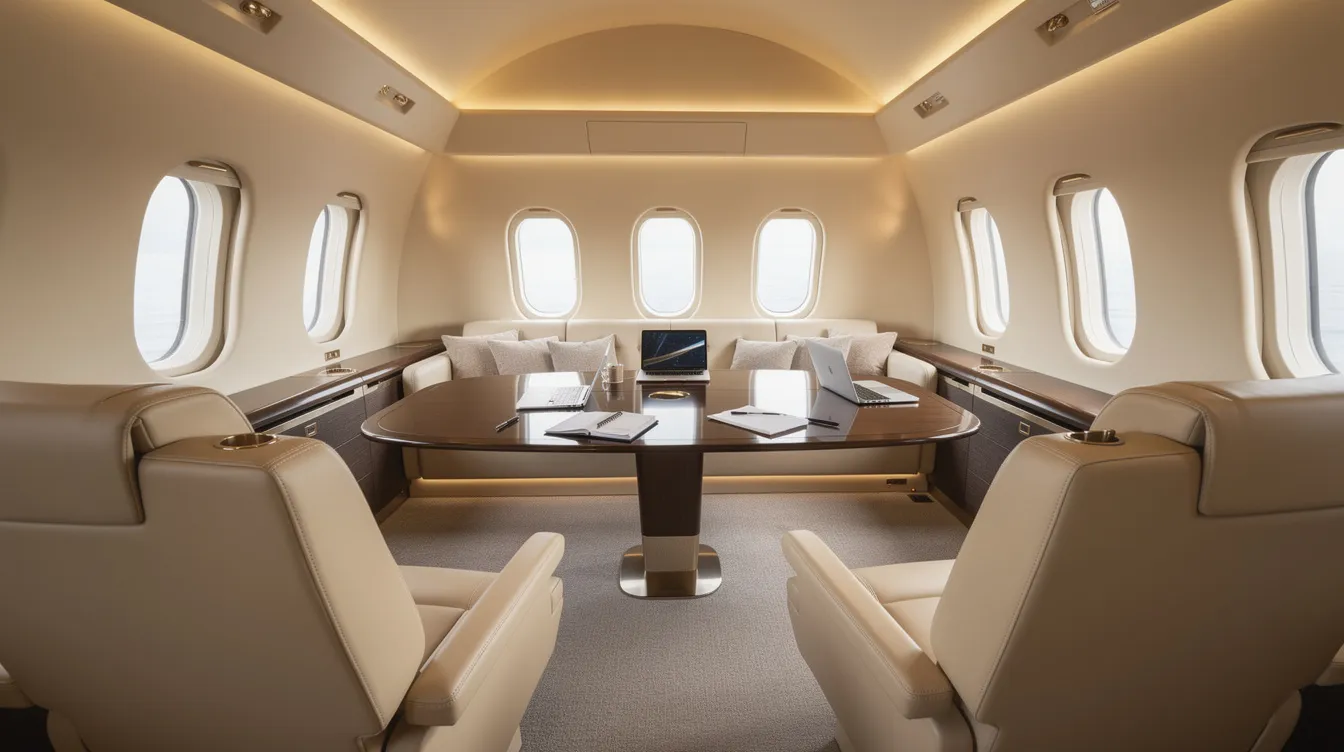
Private jet front view vs. commercial plane first and business class
On a commercial wide-body, economy class seats can also be arranged in 3-4-3 or 3-3-3 configurations. Even in business class, front seats provide wider cushions and more recline capabilities than economy class, but the airplane seat front view still consists of the seatback ahead, an overhead bin, and a narrow aisle. Many front-row seats on airlines are dedicated to first or business class, offering extra legroom and faster meal service, and airlines frequently position preferred economy rows at the front of the cabin for extra legroom. Flight attendants typically serve food and beverages starting from the front of the cabin, and front-row passengers are often the first to deplane after landing. Seat numbering on commercial planes typically uses standard letters, with A as the window seat.
Feature | Private jet | Commercial plane (first and business class) |
|---|
Seat arrangement | Six to fourteen seats in an open, lounge-style cabin; club seating may place passengers facing one another. | Seats are arranged in rows, with economy layouts commonly in 3-3 on narrow-body jets and 3-4-3 or 3-3-3 on wide-body aircraft. |
Front view | The entire cabin is effectively the "front row," with sightlines to colleagues, crew, workspace, and exits. | The view generally consists of the seatback ahead, an overhead bin, and a narrow aisle; front-row seats may face a bulkhead. |
Amenities and service | Cabin layouts may include fold-out tables, side consoles, a galley, and entertainment monitors integrated into bulkheads or cabin surfaces. | Front-row passengers may have extra legroom, faster meal service, and earlier deplaning; business-class seats offer wider cushions and more recline than economy. |
Seat positioning | Travelers can choose a position suited to their work, rest, or group interaction. | Standard seat letters are used, with A typically the window seat; airlines may designate preferred economy rows at the front for extra legroom. |
None of those things are relevant in a private jet with six to fourteen seats. The entire cabin is "front row," and travelers can access this experience even by buying a single seat on a private jet instead of chartering the whole aircraft.
How seating orientation and window position change what you see
Club Seating Orientation
Club seating, where two seats face forward and two face rearward, alters the front view entirely. In a rear-facing seat, you look at colleagues' faces and the aft cabin; in a forward-facing seat, you see the cockpit partition and galley. Many BlackJet members prefer a forward-facing seat for takeoff and landing to better feel the plane's attitude and runway environment.
Window Position and View
Turn your head slightly to the side,e and window placement matters. Views from seats in front of the wing are generally unobstructed by aerodynamic surfaces, offering a clean view of the sky and horizon. Sitting over the wing can block views of the scenery below, though window seats near the wing enhance the flying experience with views of flap and slat movement during approach. Sitting behind the wing offers unique views of wing movement and engine nacelles. On commercial flights, passengers in the back feel more aircraft movement during flight, which is one reason private-jet travelers who value stability prefer forward cabin positions and pay close attention to the proven safety record of private jets.
Safety, Comfort, and BlackJet Jet Card Advantages Shaped by Your Front View
The airplane seat front view is not a cosmetic detail. It directly shapes how safe, calm, and productive a traveler feels, particularly on business-critical flights where arriving rested and prepared is non-negotiable. BlackJet engineers these outcomes through aircraft selection, operator certification, and cabin-layout standards that apply across every Jet Card booking- the same fundamentals that distinguish the best jet cards for frequent flyers in terms of reliability and comfort.
Clear sightlines support real and perceived safety.
When passengers can see the aisle, exit locations, and crew positions from their seat, anxiety drops. The design of airplane seats balances ergonomics, safety, and passenger controls, and in a private jet cabin where only a handful of seats exist, every occupant has a direct line of sight to emergency exits and crew. BlackJet partners only with operators holding ARG/US Platinum or Wyvern Wingman certifications. Pilot-in-command minimums are set at 3,500 total hours with at least 500 hours on type, and cabin layouts sourced by BlackJet Certified operators must meet strict emergency egress and visibility standards. These are not marketing comments; they are contractual requirements applied to every operator in the network and mirror what sophisticated buyers evaluate when comparing overall jet card cost and value.
Passengers near the front of an airplane experience less turbulence during flights because the center of gravity sits closer to the wing box. On a private jet, sitting in the forward club group puts you near the cabin's structural center, where ride quality is smoothest.
Productivity from a forward-facing seat
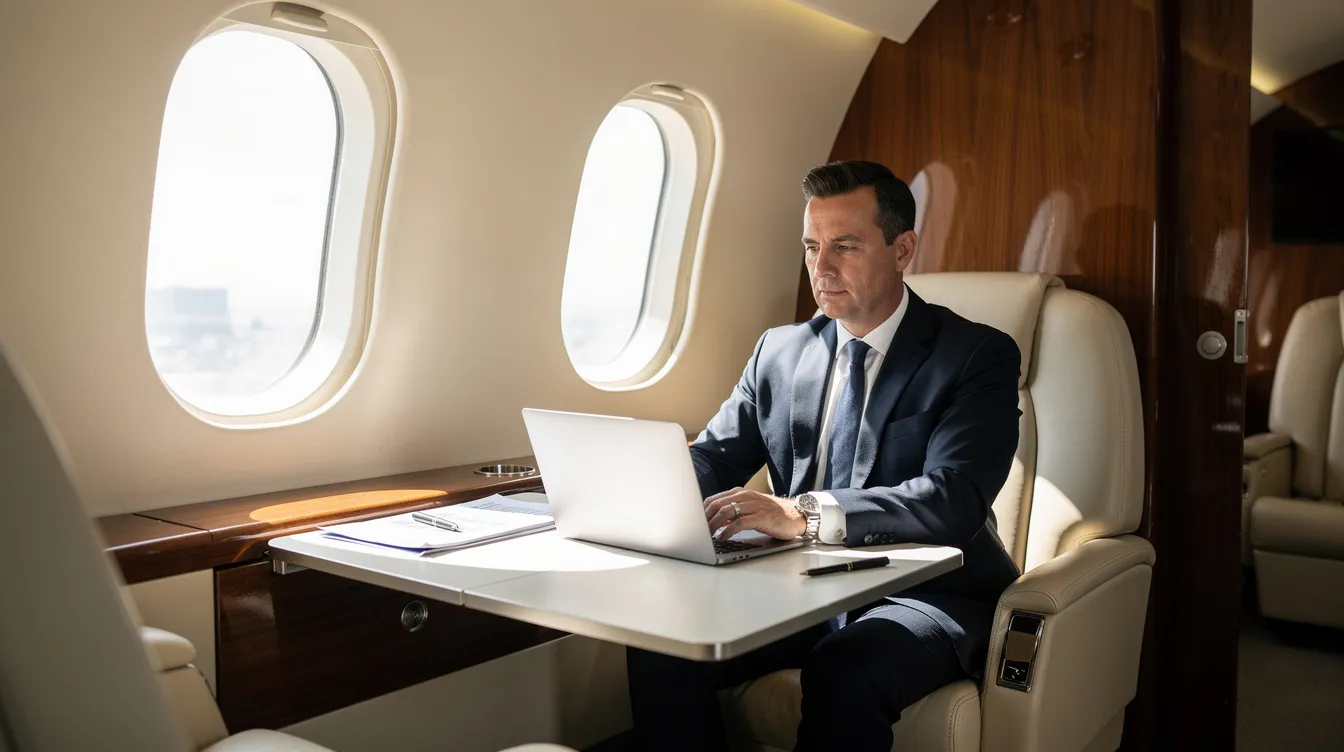
From a forward-facing seat with an unobstructed front view, fold-out tables, power outlets, and in-flight Wi-Fi are within arm's reach, all of which influence how travelers evaluate jet card cost per hour relative to the productivity they gain onboard. Consider an executive flying San Francisco to Chicago on a super-midsize Challenger 350: the large forward monitor is visible from her seat, her presentation deck is mirrored on screen, and three colleagues sit in club configuration across the aisle. That scenario is routine for BlackJet members, including those who structure their flying to take advantage of jet card-related tax deductions for business use.
BlackJet's 24/7 digital booking platform lets members review sample cabin layouts and seat maps before confirming an aircraft, so they understand what they will see from each position and how that experience compares with renting a private jet on a trip-by-trip basis. Real-time phone and chat support helps clients choose seats further forward for a quieter ride and cleaner front view, or aft club seats for group interaction. The BlackJet 50 Jet Card provides this level of access across all cabin categories, from light jets at roughly $5,484 per hour to large-cabin aircraft at roughly $13,131 per hour, pricing that aligns with broader market benchmarks for 50-hour jet card cost and value.
Sustainability and the modern cabin
BlackJet guarantees carbon-neutral flights on all Jet Card hours by purchasing high-quality offsets at no additional cost to the member, a sustainability approach that complements emerging private plane rideshare options aimed at reducing per-passenger emissions. Newer, fuel-efficient aircraft in the fleet also tend to carry more refined cabin designs: better LED lighting, flatter sidewalls, and larger windows that improve what passengers see and feel from their seat, factors that sit alongside acquisition and operating numbers on any serious private jet price list. These design enhancements are not accidental; cabin designers now use lengthwise lighting strips and lighter wall colors to elongate the perceived cabin space and reduce the sensation of enclosure (Rosen Aviation).
Jet Card consistency vs. ad-hoc charter
With a BlackJet Jet Card, members access defined aircraft categories with consistent cabin standards. That means the front view, workspace surfaces, privacy screens, and seating orientation fall within a predictable range trip after trip. Ad-hoc charter bookings can mean wildly inconsistent layouts where forward visibility, work surfaces, or privacy vary depending on whatever tail number happens to be available.
Owning a jet removes that variability but introduces fixed costs, crew management, and maintenance logistics that most travelers prefer to avoid, which is why many compare those obligations against the flexibility of jet card pricing structures. The Jet Card occupies the middle ground: you know what the experience will look like without carrying the overhead. For a detailed breakdown, see our Jet Card provider comparison or explore how a 100-hour jet card can fit into a comprehensive private aviation strategy.
Choose the front view that fits your mission.
The things you see from your seat at 41,000 feet shape how you work, rest, and arrive. BlackJet's team helps members choose not only the right aircraft class and route but also the cabin configuration and seat position that delivers the ideal front view for business, family travel, or quiet reflection above the clouds, whether that means starting with a 25-hour jet card, comparing Flexjet jet card pricing, evaluating NetJets jet card costs, or selecting large-cabin jets for 20 passengers and even VIP airliners for up to 50 travelers.
Frequently Asked Questions
What does an airplane seat front view show?
An airplane seat front view depends on the aircraft and seat position. On a commercial flight, you may see the seatback ahead, a bulkhead, or the aisle. On a private jet, the sightline may open onto club seating, a conference table, a galley, or a forward partition, with fewer visual obstructions and more space to work or talk.
Is the front of an airplane the best place to sit?
It depends on your priorities. Front-row seats can offer extra legroom, faster meal service, and earlier deplaning, while a forward cabin position on many aircraft can feel quieter. A seat near the wing may provide a distinctive view of the engines and wing movement, while seats behind the wing offer another angle on the aircraft in flight.
Are bulkhead seats more comfortable?
Bulkhead seats often provide extra knee and legroom because there is no seat ahead to recline into your space. However, the wall in front means there is usually no under-seat storage, and some aircraft require passengers to stow personal items in an overhead bin during takeoff and landing. Check the specific aircraft layout before choosing a seat.
How does private jet seating differ from commercial first class?
Commercial first-class cabins still use assigned rows, while private jets typically have a smaller lounge-style cabin with club seating and more room to move. With a BlackJet Jet Card, members can access several aircraft categories and use the 24/7 booking platform or real-time support to discuss cabin layouts and seating preferences before a flight.
What safety standards should travelers consider when booking a private jet?
Ask about the operator’s independent safety certifications, pilot experience, and aircraft-specific requirements. BlackJet works with operators holding ARG/US Platinum or Wyvern Wingman certifications and applies minimum pilot experience standards across its network. Cabin sightlines can help passengers orient themselves, but they do not replace the operator’s safety procedures or crew instructions.
Are BlackJet Jet Card flights carbon neutral?
BlackJet states that Jet Card flights are made carbon neutral through the purchase of carbon offsets at no additional cost to members. Travelers can ask the team about the applicable offset approach and how it is documented when planning a trip.
Conclusion: Choose a View That Works for You
An airplane seat front view can shape how you experience a flight, from the space and cabin features directly ahead to the work, conversation, or quiet time the layout makes possible. Commercial front-row seats may offer extra legroom and faster service, while private jets provide a more open cabin with sightlines across club seating, work surfaces, and shared spaces. Explore how private jet cabin interiors compare with commercial layouts.
The right position depends on your priorities: choose a forward-facing seat for a clear view into the cabin, a window seat for the landscape, or a place near the wing to watch the aircraft in motion. For frequent travelers, BlackJet’s Jet Card program combines access to multiple aircraft categories with digital booking and real-time support and operator safety standards—without the responsibilities of owning a private jet. Explore BlackJet’s Jet Card programs to find private jet access that fits the way you travel.


 Sign up with google
 Sign up with Apple