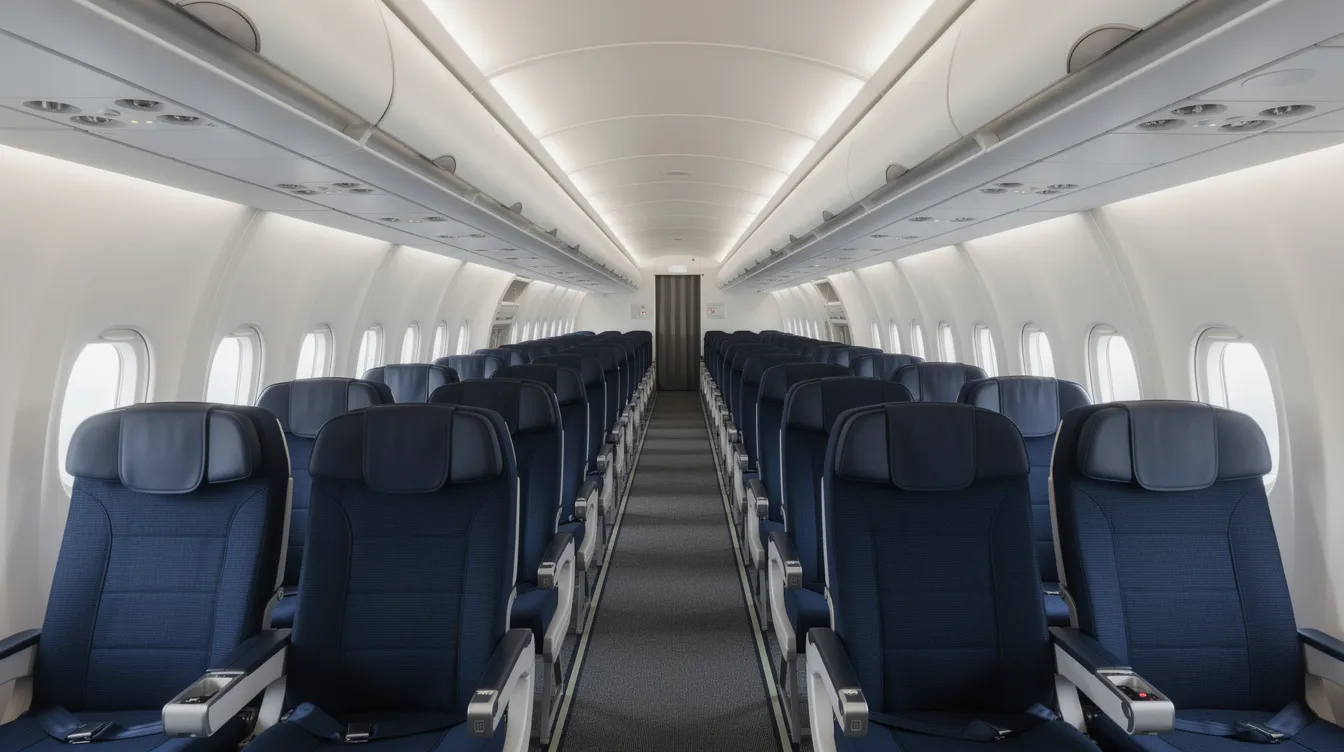
Airplane rows are the numbered sequences that organize a commercial aircraft seat map, with seat letters assigned left to right; if a row number is skipped, it usually reflects airline superstition, fleet standardization, or aircraft type rather than missing seats. For travelers accustomed to private cabins with six lie-flat seats and no boarding queue, that rigid grid can feel like stepping into a different era of travel.
For BlackJet Jet Card members, frequent business flyers, and high-net-worth leisure travelers weighing a commercial backup or staff positioning flight, understanding how row numbers, seat maps, and cabin divisions work is strategically useful, especially if you're comparing them with the cheapest private jet options for certain routes. This guide explains how airlines create and label rows, why some rows appear to be missing, the tradeoffs of different seat positions in business and economy, and how safety, certification, and aircraft layout shape the seating experience—while also showing how BlackJet’s private jet model removes much of the seat-selection complexity altogether.
Why airplane rows matter more when you're used to private jets
Consider the contrast. A BlackJet 25-hour Jet Card member flying New York to London on a super-midsize jet selects a cabin layout - perhaps eight fully reclining seats in a club configuration - with no row numbers, no seat letters, and no middle-seat lottery. That same route on a commercial Airbus A350-900 in a typical three-class configuration carries 300 to 350 passengers across 40-plus business class rows and 200-plus economy seats, each assigned by a strict row-and-letter grid.
On airlines, aircraft seat maps govern everything: which rows sit near the emergency exit, which are bulkhead positions with extra leg room, where engine noise peaks, and which seats recline into the passenger behind, a level of micro-detail that disappears when you buy just a seat on a private jet. Skipping row numbers - like the famously absent row 13 - adds another layer of confusion. While BlackJet trips don't use public seat maps, our operations team routinely analyzes airline layouts when arranging crew travel, positioning flights, or commercial backup options for members' next flight.
The sections ahead break down how airplane rows are numbered, why whole rows vanish, what makes certain seats better than others, and how private aviation - through aircraft categories, cabin design, and jet cards - lets you bypass the entire row problem in the first place within a broader private jet pricing and access landscape.
How airplane rows are numbered – and why whole rows seem to disappear
Airplane rows are organized to make it easy to identify each seat: rows are designated by numbers and seats by letters from left to right - A through F on a narrow-body, A through K on many wide-body aircraft. But if you look closely, the numbering is rarely a straight, unbroken sequence.
United Airlines skips rows 5, 6, 9, and 13 on some aircraft, including certain A320-200 configurations where economy class begins at row 7, and the exit row is fixed at row 20 regardless of variant. American Airlines may also omit certain row numbers on some aircraft, depending on seat-map standardization or superstition. United's seat maps often end with row 38 for consistency across its fleet, even when the physical seat count doesn't require that many numbers. A bunch of carriers skip row numbers to keep seating maps consistent, reflect superstition, or support operational standardization so that exit rows, class boundaries, and cabin divisions fall on the same round number across different aircraft types - making crew procedures and aircraft swaps smoother.
Specific seat maps vary by aircraft model, affecting row numbering. For example, regional jets like certain Bombardier CRJ-900 configurations keep full sequential numbering with no gaps. Meanwhile, seat maps may skip rows for consistency across aircraft in a carrier's fleet.
The point is clear: missing row numbers don't mean missing physical seats. The whole row is still there - it's only the label that disappears. For BlackJet members, private jets don't use public row numbers at all. Seat locations are shown in operational diagrams during the briefing, and every seat is functionally "row 1," whether you're on a light jet or a 12-seater private jet configuration.

Superstition, culture, and the missing row 13 (and 4, 14, 17)
One of the most common reasons for absent row numbers is superstition. Some airlines skip row 13 due to superstition - the same logic that leads hotels to omit the thirteenth floor. Most airlines serving North American and European routes simply remove it from the seat map, and passengers rarely notice.
The pattern extends globally. Airlines may skip rows to avoid negative connotations with certain numbers: in parts of East Asia, numbers like 4 and 14 are sometimes omitted because their pronunciation in Cantonese, Mandarin, Japanese, or Korean sounds similar to words meaning "death." In parts of Italy, 17 carries its own negative weight. Some airlines skip certain row numbers for cultural reasons that vary by market.
Carriers such as Lufthansa, Air France, and United structure their seat maps so that these sensitive numbers disappear between cabin classes, minimizing anxiety among nervous passengers. Neither the FAA nor EASA requires skipping numbers - it is entirely an airline-brand and customer-comfort choice embedded in their internal LOPA conventions.
For BlackJet's clientele, the superstition dynamic shifts. When you select aircraft type, cabin size, and departure time rather than row numbers, any "superstition management" tends to center on travel dates or flight times - not on whether your seat carries a particular digit.
How aircraft seat maps are created: from LOPA to public seat map
Every commercial seat map begins with a LOPA - the Layout of Passenger Accommodations - a certified technical drawing that defines every cabin element: seat rows, galleys, lavatories, exit doors, emergency equipment, and bulkhead positions. Aircraft type can influence the number of rows and layout, and the LOPA is where those details become official.
Manufacturers like Airbus and Boeing produce baseline LOPAs for each model. Airlines then customize them: setting exact business class, premium economy, and economy class seat counts, reserving specific rows as exit row seats, and positioning galleys. A Boeing 777-300ER (often coded "77W"), for example, may carry 50 to 80 business class seats across 14 to 25 rows, with the rest divided between premium economy and a large economy cabin, a very different model from programs like the NetJets jet card where you control the entire cabin.
Once finalized, the LOPA is translated into digital aircraft seat maps in reservation systems like Sabre or Amadeus. These often simplify complex staggered layouts into flat grids, which can be misleading - a "window seat" icon may actually sit several inches from the nearest window. Newer tools like AeroLOPA recreate layouts more faithfully, showing accurate angles and storage positions. An airline website is usually the best first source for detailed seat maps, with specialized references useful for cross-checking, though many legacy resources lag behind actual LOPA revisions.
BlackJet's internal operations teams rely on similarly precise diagrams for private jets to ensure weight and balance, emergency egress, and cabin comfort meet stringent safety standards. The difference: our members never need to decode a public seat map grid.
How to read airline seat maps in Economy and Premium Economy
While BlackJet members mainly fly privately, understanding economy and premium economy seat maps proves helpful when arranging commercial positioning flights for staff, family, or overflow travel, or when comparing them to private plane rideshare models. Most airlines use a two-dimensional array for seat maps, with rows along one axis and seat letters along the other.
On narrow-body airplanes like the Boeing 737 and Airbus A320, economy seats typically have a 3-3 configuration - single-aisle planes typically use a 3×3 layout with letters A through F. Rows near the front are often marketed as "Economy Plus" or extra legroom seats, and they may come with an extra charge when sold as preferred seating or added-legroom options. Seat pitch typically ranges from 28 to 32 inches in standard economy, though premium rows may stretch to 34 or more.
Wide-body aircraft carry more complex patterns. Twin-aisle planes use configurations like 3×3×3 on the Boeing 777 or 2-4-2 on many 787s. Premium economy is usually placed in a smaller mini-cabin between business and economy, often using 2-3-2 or 2-4-2. Regional jets often feature a 2×2 configuration with a single aisle, four across the cabin, while large-cabin aircraft can support 16-seat private jet layouts more comparable to a flying conference room than a typical airline row.
Seat maps provide details about recline and proximity to lavatories, and they typically show economy seats in 2-2 or 3-3 configurations depending on the aircraft. To identify exit row seats, look for prominent icons on the map. Bulkhead seats appear as the first row of each cabin section. Some seats labeled as "window" may have no actual window due to fuselage structure - always verify before your next flight.
Seats near the center of gravity, over the wing, generally feel less turbulence but can register slightly higher engine noise - measured differences of around 1 to 2 decibels behind the wing. Airline websites, apps, and tools like ExpertFlyer can show seat occupancy, but layouts can change up to departure day due to aircraft swaps, so recheck during online check-in.
Business Class and First: why some rows are better than others
Not all seats in business class cabins are equal. Seat maps may show identical icons across every row, but position relative to galleys, lavatories, and bulkheads creates significant variation in privacy and noise.
The main layouts include 1-2-1 straight forward-facing cabins, 1-2-1 staggered configurations where "true" window seats alternate between high-privacy positions against the fuselage and spots closer to the aisle, and older 2-2-2 or 2-3-2 arrangements where not every seat has direct aisle access. In staggered layouts, careful seat map reading is essential - a window seat in one row may sit right against the glass, while the same column one row forward is offset toward the aisle.
Bulkhead business class seats on carriers like Singapore Airlines and Air France (on their A350-900 and 777-300ER) often feature larger footwells and ottomans, making them attractive for sleeping. But they can experience more galley noise and light spill until the curtain is drawn. Front cabin seats allow for fast deplaning and better meal service options, which matters on long-haul sectors.
Rear business class mini-cabins sometimes feel more exclusive and quiet, yet meal service may start later and overhead storage fills differently. Seat maps typically show these mini-cabins as distinct blocks of rows.
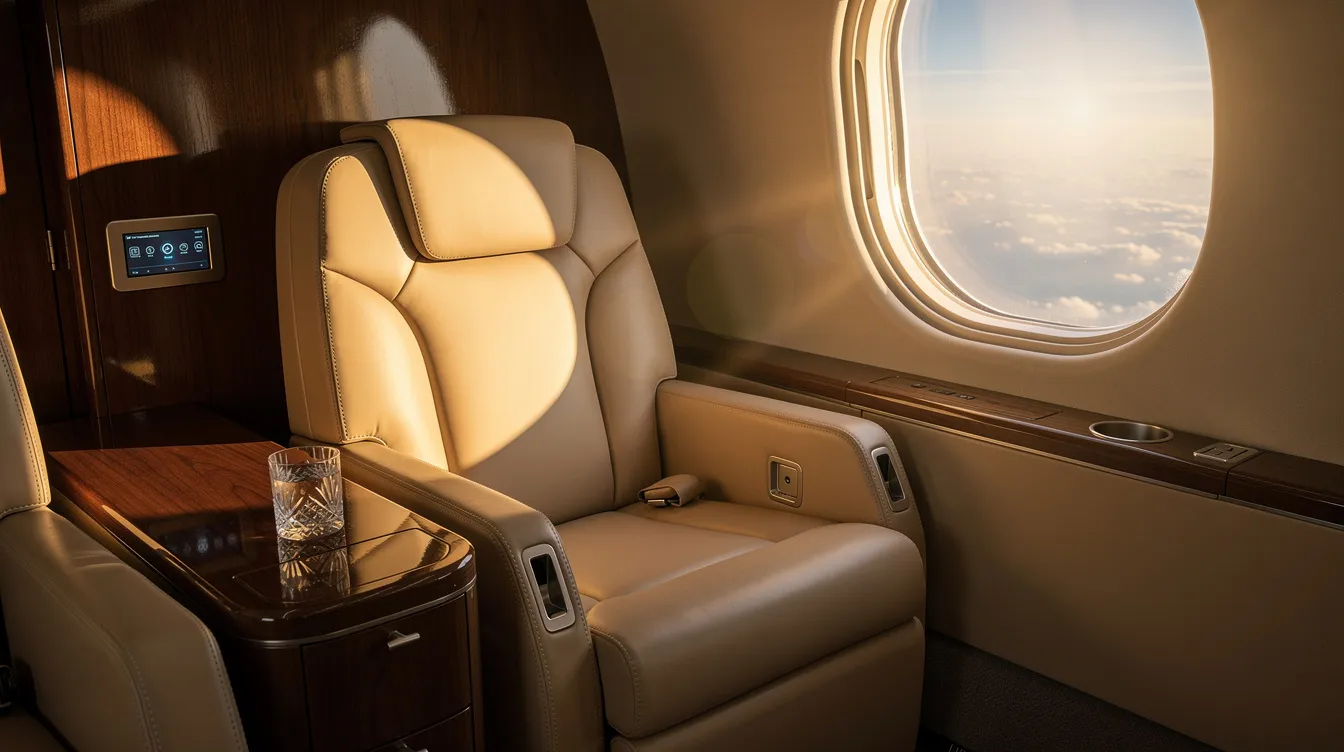
The contrast with BlackJet is straightforward: in a private cabin sized to your journey, every seat is lie-flat or near-lie-flat with direct aisle access by design. You choose cabin class by aircraft category - light, midsize, or large cabin - rather than hunting for the best seat in a crowd of 60, drawing on the full range of types of private jets for every traveler.
Bulkhead, window, exit row, and back-of-plane seats: pros and cons
Not all seats within a row trade comfort equally. Each position carries distinct advantages and compromises that depend on your priorities.
Seat Type | Advantages | Disadvantages |
|---|
Bulkhead Seats | Extra legroom; first row in cabin section | No under-seat storage; can be noisy near galleys or lavatories |
Window Seats | View outside; wall to lean against | Restricted aisle access; some may have blocked or no window |
Exit Row Seats | More legroom | Do not recline; fixed armrests; no under-seat storage during takeoff/landing; passenger eligibility requirements. |
Middle Seats | Often cheapest option | Least privacy; no aisle or window access |
Aisle Seats | Easy access to stand and stretch | Potential for disturbance from passing passengers |
Rear Cabin Seats | Higher chance of empty adjacent middle seats | Limited recline; noise and foot traffic near lavatories |
The BlackJet contrast is simple: no lavatory queues in the aisle, no exit row restrictions, no last row penalty, even when you're moving groups that might otherwise require a private jet for 20 passengers on a commercial carrier. Every seat is effectively premium, and the "best seat" is usually a matter of view preference rather than layout compromise, especially if you opt to buy a seat on a private jet instead of navigating commercial cabin tradeoffs.
Noise, turbulence, and comfort: how row position changes the ride
Cabin noise and ride feel vary meaningfully by row. Studies measuring noise across commercial flights found mean levels around 83.5 dB(A), with peaks exceeding 110 dB during takeoff. Seats behind the wing often register higher engine noise, while over-wing seats tend to offer the smoothest ride with the least turbulence - the center of gravity sits near the wing box, dampening pitch and roll. Seats over wings are preferred for reduced motion sensitivity on turbulent routes.
Modern composite wide-body aircraft like the Airbus A350 and Boeing 787 are materially quieter than earlier generations such as the 747-400 or older 767s, so row choice is somewhat less critical on these airplanes, especially paired with noise-cancelling headphones.
Front-cabin business class sections tend to feel calmer due to fewer passengers passing through. Rear economy sections experience more queueing near lavatories, adding chatter, door noise, and light spill overnight. On regional jets with tail-mounted engines, the quietest rows sit in the mid-front - the reverse of wing-engine aircraft where noise peaks near the trailing edge.
For BlackJet members flying super-midsize or large-cabin private jets, cabins are engineered for low cabin altitude and reduced noise, making row management irrelevant while maintaining the high safety standards of private jets. Still, seat positioning relative to engines is considered during aircraft selection for ultra-long sectors.
From commercial rows to private cabins: how BlackJet redefines "seat selection"
On a typical Boeing 777-300ER long-haul flight, a business class passenger might sift through 40 to 50 seat map options across 10 to 15 rows, weighing the details of bulkhead noise, window alignment, and galley distance. A BlackJet Jet Card member instead chooses aircraft category, departure time, and city pair - not row numbers- leveraging many of the best jet cards for frequent flyers' advantages like guaranteed availability and predictable pricing.
Jet Card programs - available in 25-hour, 50-hour jet card blocks, and larger commitments - give prepaid access to private jets across multiple cabin types: light jet, midsize, super-midsize, and large cabin. The entire aircraft is effectively one private row. A 25-hour light-jet card typically starts around US$150,000 to $250,000, while midsize programs run in the US$200,000 to $350,000 range, positioning the investment as a fraction of ownership cost and fitting within typical jet card pricing structures and benefits.
Seat-planning decisions shift from micro - which window seat in which exit row - to macro: which cabin size, which sleeping configuration, how many club seats versus divans. BlackJet's premium private jet card programs and digital booking tools display aircraft layouts more like LOPAs than consumer seat maps, with clear depictions of seating arrangements that can be tailored for specific trip profiles - a board meeting en route, a family ski trip, or solo rest on a red-eye.
For the occasional commercial segment, BlackJet advisors still assist: recommending the correct seats based on aircraft seat maps and frequent-flyer-grade knowledge, such as avoiding specific noisy rows or misaligned windows. The advantage is having someone who understands both worlds.
Safety, certification, and exit rows: airline rules vs private aviation standards
Exit row seats on commercial aircraft are tightly regulated. Passengers must meet age, mobility, and language requirements, agree to assist in an evacuation, and store no bags under the seat directly in front during critical phases of flight. These are not suggestions - they're enforced at the gate and in the cabin.
LOPAs are reviewed by regulators like the FAA and EASA to ensure that the number and placement of exits, seat rows, and aisles support timely evacuation. This determines exactly how many rows can sit between exits, the minimum aisle width, and the distance passengers must travel to reach an emergency exit. Slide housings and door mechanisms sometimes intrude into window exit rows, reducing the view and legroom despite the seat map's promise of more space.
In private aviation, the certification process differs but remains rigorous. BlackJet's partner operators hold stringent safety certifications - including ARG/US and Wyvern standards - covering cabin layout, exits, crew training, and operational procedures. Weight and balance considerations on private jets mean seat allocation is managed by the crew for safe loading rather than by arbitrary row numbers, yet every passenger has rapid access to exits and receives an individual safety briefing.
Whether you're seated in row 21 on a 787 or in a club seat on a super-midsize jet, properly certified operators and a disciplined safety culture matter more than the specific row label. This is an area where BlackJet positions itself as a curator of best-in-class operators, making safety a non-negotiable line rather than a marketing bullet point.
Frequently Asked Questions (FAQs) about Airplane Rows and Seating
Q: Why do some airplanes skip certain row numbers like 13 or 4?
A: Airlines often skip row 13 due to superstition, similar to hotels omitting the 13th floor. In some cultures, numbers like 4, 14, and 17 are avoided because their pronunciation is associated with bad luck or death. These omissions help reduce passenger anxiety and maintain consistency in seat maps.
Q: Does skipping a row number mean the seats are missing?
A: No. Skipping row numbers is usually a labeling choice for superstition, fleet standardization, or operational reasons. The physical seats remain intact; only the numbering changes to maintain consistency or passenger comfort.
Q: How do exit row seat rules differ from other seats?
A: Exit row seats require passengers to meet age, mobility, and language criteria and be willing to assist in emergencies. They offer extra legroom but often do not recline and prohibit under-seat storage during takeoff and landing, per safety regulations.
Q: What are the advantages of bulkhead seats?
A: Bulkhead seats provide extra legroom and are often the first row in a cabin section. However, they may lack under-seat storage and can be noisier due to proximity to galleys or lavatories.
Q: How does private jet seating differ from commercial airplane rows?
A: Private jets like those available through BlackJet do not use traditional row and seat letter numbering. Instead, seating is arranged in private cabins with fewer seats, often fully reclining, with direct aisle access and no middle seats, removing much of the complexity and discomfort of commercial seat maps.
Q: Can I pay extra for better seats on commercial flights?
A: Yes, many airlines charge extra for preferred seats such as bulkhead, exit row, or economy plus seats with more legroom. Pricing can vary depending on booking time and seat demand.
Q: How can I find the best seat on a commercial flight?
A: Checking detailed seat maps on airline websites or specialized tools like AeroLOPA helps identify seats with extra legroom, better recline, or quieter surroundings. Avoid seats near lavatories or galleys if noise is a concern.
Q: Why do airlines sometimes skip multiple rows in a sequence?
A: Airlines may skip rows to standardize seat maps across their fleet, ensuring exit rows and cabin divisions fall on consistent row numbers for operational ease and passenger clarity.
Q: Are window seats always next to a window?
A: Not always. On some aircraft, structural elements or staggered seating layouts mean some "window seats" may be set away from the actual window or have blocked views. Always verify on the seat map.
Q: How does turbulence affect seat choice?
A: Seats over the wings typically experience the least turbulence due to the aircraft's center of gravity, while seats at the rear may feel more motion. Engine noise is also louder near the rear of the cabin.
Technology, sustainability, and the future of "rows" in premium travel
Technology is reshaping how passengers interact with airplane rows. Dynamic aircraft seat maps in airline apps now offer real-time visibility into occupied seats and algorithmic pricing for extra legroom rows and exit row seats - you may pay a different amount for the same seat depending on when you book and how full the plane is.
Some airlines are experimenting with staggered or "suite" business class products where the row concept becomes less linear - alternating rows of window-facing suites and center "honeymoon" seats, designed to feel more like private mini-cabins than commercial rows. Sustainability goals are accelerating this shift: lighter seats, reconfigured premium economy cabins, and more efficient layouts on modern types like the A320neo and 737 MAX change row counts and seat map patterns across entire fleets.
BlackJet integrates technology and sustainability differently. Digital booking and real-time flight support optimize positioning to reduce empty legs, while carbon-neutral flights ensure every journey is offset without additional cost or action from the member. As premium airline products begin to emulate private layouts, the meaningful distinction shifts from choosing the best seat in row 12A to choosing the best access model overall - owning, chartering, or using a Jet Card.
If you find yourself studying aircraft seat maps and row numbers before every flight, it may be worth asking whether private jet access could remove that friction entirely - while adding the control, safety transparency, and sense of calm that no seat assignment can provide. Discover how BlackJet can reshape your travel.


 Sign up with google
 Sign up with Apple