Why Premium Air Travel Is a Strategic Advantage
Time Savings
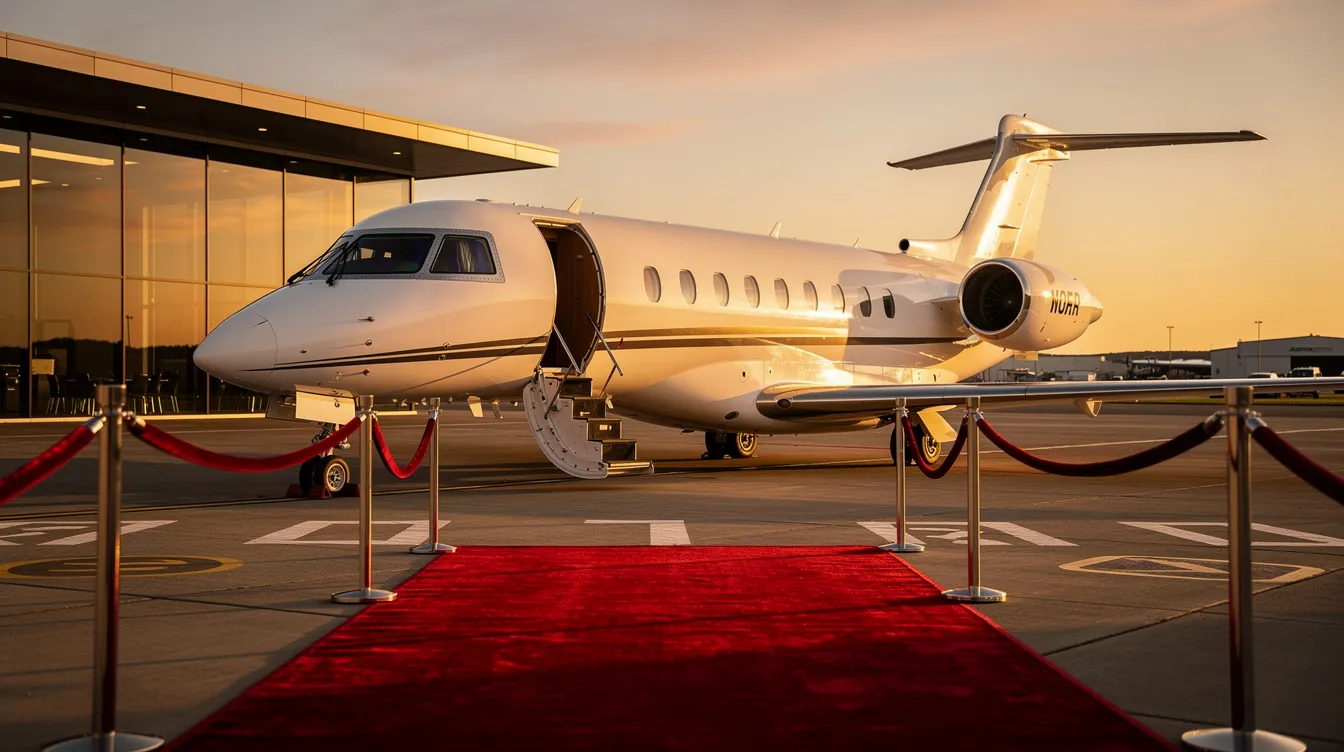
Picture the scene at JFK Terminal 1: a packed gate, boarding groups called by number, passengers jostling for overhead bin space. Now contrast that with a private terminal five minutes away, where a traveler steps out of a car, walks across a lounge, and boards a waiting jet in under ten minutes. The gap between those two experiences is not about taste; it is about how much of your day you control.
First class air travel represents the highest tier of commercial service, and it delivers real time savings over economy class. On a New York to Los Angeles flight, a first-class passenger skips the standard security queue, boards first, and benefits from priority baggage handling that clears baggage claim faster on arrival. That alone can recover 60 to 90 minutes. On a New York to London long-haul route, where first class tickets often exceed $10,000 round trip, the savings compound: dedicated check-in, expedited customs, and a flat bed that lets you land rested enough to walk into a 9 a.m. meeting.
Target Audience
This article is built for business travelers and high-net-worth individuals who already fly first or business class on long-haul international flights and want a clear framework for choosing between commercial premium cabins and private jet access. BlackJet, a carbon-neutral private aviation company offering prepaid Jet Card programs and premium private jet services, serves as the private aviation benchmark throughout. The goal: help you decide where your next trip's budget and schedule are best spent.
Private Jet Comparison
A private jet, by comparison, can shave 2 to 4 hours total by using secondary airports and eliminating terminal wait times altogether.
First Class vs Business Class: What Really Changes When You Upgrade
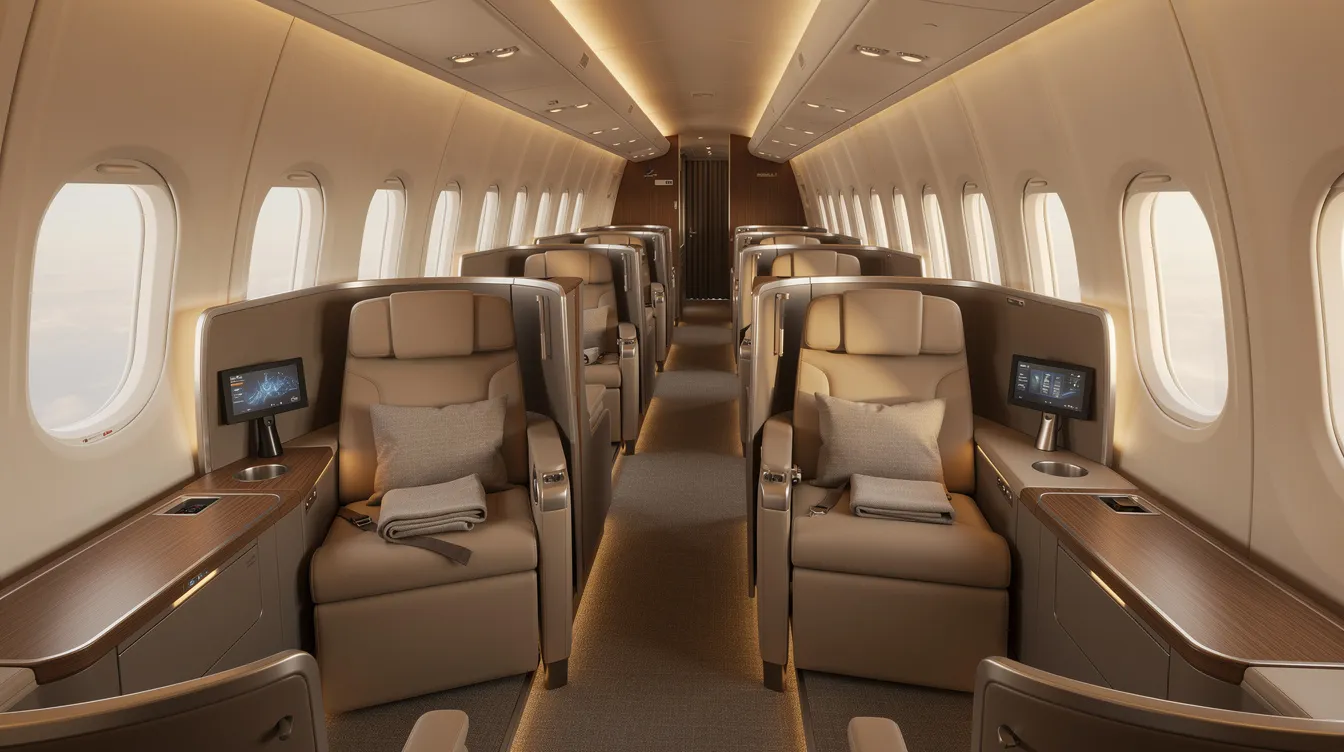
Consider a 2026 overnight flight from New York to Paris. In business class, you settle into a lie-flat pod with a sliding partition, eat a three-course meal on a fixed schedule, and share your flight attendants with roughly eight other passengers. In first class, you close the door of a private suite, enjoy true first class service with on-demand dining from a Michelin-caliber menu, and share your cabin crew with two or three class passengers at most. First class offers more personalized service than business class, and the physical environment is built to reflect that.
Category | First Class | Business Class |
|---|
Seat type | Private suite with closing door | Open pod or staggered lie-flat seats |
Service ratio | 1 attendant per 2–3 passengers | 1 attendant per 5–10 passengers |
Dining | On-demand, multi-course, chef-curated | Scheduled meal service, fewer options |
Lounge access | Exclusive first class lounge (often separate facility) | Shared business class lounge, sometimes with airport lounge access as a premium perk |
Cabin size | 4–8 first class seats on most flights | 30–60+ business class seats |
Priority services | Dedicated check-in counter, priority boarding, fast-track immigration | Priority check-in, early boarding |
First class cabins are often smaller and less common than business class cabins, which is part of what makes the experience distinct. On carriers like Air France, Cathay Pacific, Emirates, and American Airlines, the first class cabin is a separate section with its own galley and crew. On other airlines, business class is the top product, sitting above the main cabin when no first class cabin exists at all.
The price gap is worth noting. Business class fares typically range from $4,000 to $5,000 on competitive long-haul routes. First class on the same route can run 1.5 to 3 times higher, and sometimes more for ultra-luxury products. That multiplier often exceeds the gap between economy class and business class.
When first class is worth it over business class:
Overnight long-haul flights where arriving rested determines the day's outcome
Trips preceding critical meetings, board presentations, or client negotiations
Special occasions like honeymoons or milestone celebrations
Routes where first class passengers have access to exclusive airport lounges with private dining, showers, and spa services
Inside the First Class Cabin: Seats, Suites, and Sleep Quality
Seat vs Suite
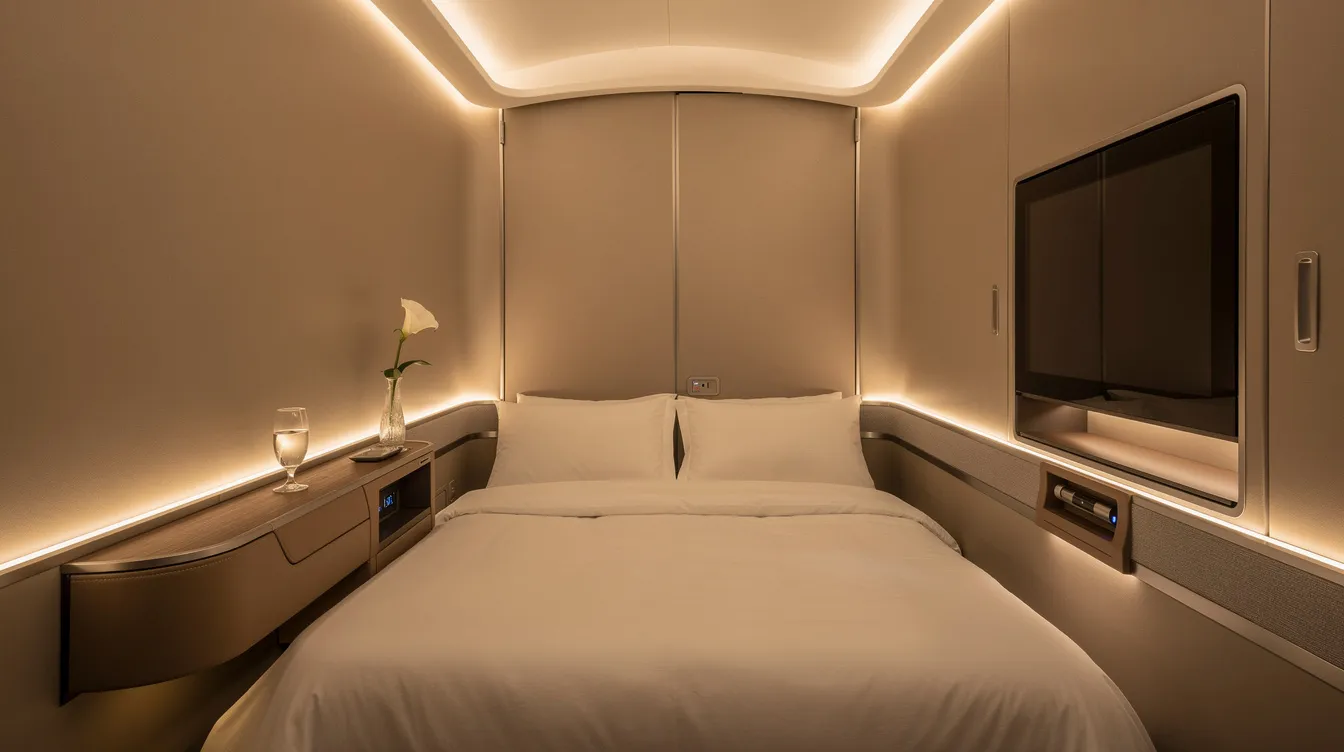
The distinction between a first class seat and a first class suite defines the entire experience. A "seat" implies a recliner or lie-flat bed integrated into a single unit. A "suite" means a walled enclosure with a closing door, often containing a separate armchair, a dedicated bed, and a workspace.
Privacy and Cabin Density
First class cabins may feature very low-density seating offering more privacy, with some configurations seating only four to six people in the same space that would hold 30+ economy seats.
Air France's first class features a 1-2-1 seat configuration on the Boeing 777-300ER under its La Première brand, with only a handful of seats per cabin. Singapore Airlines Suites on the A380 go further: a separate bed and armchair inside a walled suite, and Singapore Airlines Suites allow creating a double suite for couples by opening the partition between adjacent units. Cathay Pacific first class on the 777-300ER offers open suites with premium bedding and generous floor space. First class seats often include lie-flat beds on long-haul flights, and first class seats often recline further and offer more legroom than any other commercial product.
Sleep Features
Sleep-related features that separate first from business:
Mattress toppers and full duvets (not blankets) on carriers like Singapore Airlines and Cathay Pacific
Cabin noise levels reduced by smaller cabin volume and fewer other passengers
Individual air nozzles and improved soundproofing on SWISS and Lufthansa A350 cabins
Turn-down service with pajamas on most international first class products
Domestic first class in the U.S. is a different category, and some travelers instead compare it with budget-friendly private aircraft options. On flights like New York to Miami, domestic first class typically means a wider recliner seat with extra legroom, not a suite with a closing door. International first class differs from domestic first class in every dimension: bed size, privacy, meal quality, and cabin density. The exception is transcontinental flight services like American Airlines Flagship First on JFK to LAX, which offer a true lie-flat bed and a full meal service closer to international standards, though high-frequency travelers on these routes may also look at owning a premium UK-based private jet or similar aircraft for maximum control.
Overnight? Choose a bed. Daytime? A wide recliner may be enough.
Soft Product: Service, Dining, and Amenities at 35,000 Feet
"Soft product" refers to everything the crew delivers: food, drinks, attention, and amenities. On top-tier airlines, this layer can matter as much as the hardware. First class typically includes gourmet meals designed by renowned chefs, and personalized service in first class includes customized meal schedules that let you eat when you want, not when the galley dictates.
Dining Experience
Air France first class serves menus created by Michelin-starred chefs, with wine pairings selected by sommeliers. Emirates offers caviar and vintage champagne in its enclosed suites. Japan Airlines and All Nippon Airways provide tailored Japanese menus with seasonal kaiseki courses. First class meals are often curated by renowned chefs across these carriers.
Typical first class soft product advantages over the business class experience:
Dine-on-demand with personalized course pacing
Bespoke cocktails and premium champagne (Krug, Dom Pérignon)
Upgraded sleepwear on long-haul flights
A welcome drink served before departure, often in the lounge or at-seat
Amenity Kits and Bedding
Lounge Access
For many business travelers, the real benefit is predictable rest and hydration before key meetings, not indulgence for its own sake. Evaluate the beverage service, meal quality, and more attentive service style by route and airline before booking.
BlackJet's private jet experience replaces mass-catering with pre-selected menus tailored to passenger preferences, similar in spirit to the cabins found on top private jets combining luxury and performance. That level of customization can exceed even top commercial first class in personalization, since the aircraft serves only your party.
Domestic First Class vs Long-Haul International First: Two Very Different Products
Domestic First Class Features
Domestic first class on American Airlines, Delta, or United Airlines is closer to premium economy or regional business class than to what Emirates or Singapore Airlines call "first." First class air travel enhances comfort on long-haul flights in ways that short domestic flights simply cannot replicate.
Feature | Domestic First Class | International First Class |
|---|
Seat | Wider recliner or lie-flat on select transcons | Private suite with closing door and lie-flat bed |
Meal | Snack box or basic hot meal on domestic flights | Multi-course dining, chef-curated, dine-on-demand |
Duration | 2–5 hours | 8–15 hours |
Privacy | Curtain divider, no door | Full walls, closing door, low-density cabin |
International First Class Features
On a New York to Los Angeles transcontinental flight, premium transcon products blur the line: United Airlines Polaris Business and American Airlines Flagship First both offer lie-flat seats with meal service on these specific routes. But a typical New York to Miami domestic first class ticket buys you a recliner and a beverage service, not a suite.
European airlines and many Asian regional carriers handle this differently. On short-haul routes, business class fills the role that domestic first class fills in the U.S., often with blocked middle seats or slightly wider recliners rather than suites, which is a different model entirely from leading private jet companies for luxury travel.
When to Choose Each
When domestic first class is worthwhile:
When to consider private jet solutions instead:
Multi-city days requiring 2–3 stops with no commercial connections, or complex itineraries where private jets for 20 passengers keep an executive team together
Remote airports not served by premium cabin products
Groups of 4–8 where splitting a private jet by aircraft category can be cost-competitive per person
Top-Tier First Class Airlines: Benchmarks for Commercial Luxury
This is not a ranking. It is an overview of the benchmark products that define what a first-class ticket buys on the world's leading carriers in 2026.
European Carriers
Air France La Première (Boeing 777-300ER): 1-2-1 configuration, curtained suite, Michelin-starred dining, dedicated La Première lounge at CDG
Cathay Pacific First (777-300ER): Open suites with attentive service and caviar dining
Middle Eastern Carriers
Emirates 777 First Class: Emirates offers fully enclosed first class suites with doors, virtual windows, and an onboard shower on the A380 upper deck
Etihad A380 Apartments and The Residence: Etihad's first class includes onboard showers and dine-on-demand menus; The Residence adds a living room and private bathroom
Qatar Airways Qsuite and A380 First: Qatar Airways' first class features a bar on the upper deck of the A380; Qsuite in business class has also raised the standard for business class cabins across the industry
Asian Carriers
Singapore Airlines A380 Suites: Separate bed and armchair, double bed option, Lalique amenities
Japan Airlines A350-1000 First: Japan Airlines' first class has a massive 43-inch 4K television, Noritake tableware, and Japanese-Western hybrid menus
ANA "The Suite" (777-300ER): Fully enclosed, sliding door, premium Japanese dining
Air India recently refreshed its premium cabin on select international routes.
Many airlines have removed first class entirely and now treat business class as their top class product. That trend is one reason frequent travelers are comparing first or business class to private jet programs that offer consistent cabin quality on every flight.
First or Business Class vs Private Jets: Which Premium Option Fits Your Trip?
A CEO flying London to New York can book Air France, first class via Paris, Singapore Airlines via Frankfurt, or Cathay Pacific via Hong Kong, each adding a connection, and should weigh those fares against the broader private jet price list and access models. Or that CEO can arrange a Gulfstream or Challenger via a BlackJet Jet Card, departing from London's Farnborough at a chosen time and landing at Teterboro, 12 miles from midtown Manhattan.
Category | Business Class | First Class | Private Jet (BlackJet) |
|---|
Privacy | Shared cabin, 30–60 passengers | 4–8 first class passengers in a separate cabin | Fully private; your party only |
Departure flexibility | Fixed airline schedule | Fixed airline schedule | Depart when ready |
Check-in lead time | 60–90 min before departure | 45–75 min (prioritizing check-in) | 10–15 min |
Route flexibility | Hub-to-hub only | Hub-to-hub only | Access to 5,000+ airports |
Group cost (4–8 people) | 4–8 individual business class tickets | 4–8 individual first class tickets | Single hourly rate split across group |
Onboard customization | Standard menu, fixed schedule | Dine-on-demand, premium service | Fully tailored: meals, timing, cabin layout |
Cost Comparison
On a per-seat basis, business class or first class is typically cheaper for solo travelers on fixed routes, while cost-conscious flyers exploring private options may look at the cheapest private aircraft and entry-level access models. Understanding Jet Card cost per hour is key to comparing those options against first or business class.
Group Travel Considerations
For groups of 4 to 8 on time-sensitive or multi-city itineraries, a private jet via a Jet Card can be cost-competitive when you factor in time saved and hotel nights avoided. One case study showed a CEO saving roughly 20 hours over five days by using private aviation for a four-city tour that would have required multiple commercial connections, a pattern similar to executives evaluating 10 million-dollar private jet options as part of a broader access strategy.
Jet Card Model Explained
BlackJet's Jet Card model differs from ad-hoc charter: prepaid hours at transparent hourly rates across cabin types, guaranteed availability windows, and 24/7 real-time support, all structured to deliver predictable Jet Card membership costs and benefits.
Use first or business class for scheduled trunk routes. Use BlackJet for schedule-critical, multi-stop, or privacy-sensitive missions.
Productivity, Privacy, and Safety: The Return on Premium Travel
Reframe the conversation: the value of a premium cabin is not the champagne. It is the return on time and the control of your environment.
First or business class over economy delivers reliable in-seat power, Wi-Fi, a workspace, fewer interruptions, and better sleep on long-haul international flights. A managing director who lands at Heathrow after seven hours of genuine sleep in a first-class suite can walk into a board meeting performing at full capacity. That is not a luxury; it is a competitive input.
Private jets via BlackJet take this further: a fully private cabin allows confidential discussions, secure document review, and in-flight strategy sessions. Consider a four-person team visiting Chicago, Dallas, and Atlanta in a single day on a BlackJet Light Jet, or even learning how to buy a seat on a private jet when a full-aircraft charter is unnecessary. No commercial itinerary can replicate that without overnight stays and lost mornings.
On safety, commercial airlines operate under strict regulatory regimes (FAA, EASA). BlackJet uses vetted operators that meet or exceed industry audit standards. BlackJet's safety certification program ensures consistent standards across its network.
On sustainability: commercial first class has higher per-seat emissions than economy because fewer seats occupy more space, and even the cheapest private jet options will generally have higher per-passenger emissions still. Private jets produce higher per-passenger emissions still. BlackJet addresses this directly: since early 2020, every Jet Card flight has been fully offset to carbon-neutral status at no extra cost to clients, covering CO₂, water vapor, aerosols, and nitrous oxide.
How to Decide When Flying First Class Is "Worth It"
"Worth it" depends on what you optimize for: comfort, time, or client perception.
Decision checklist:
Flight length: Sub-3 hours, domestic first class or premium economy is usually sufficient. 8+ hours: a lie-flat bed in first class or a private cabin changes your arrival performance.
Time of day: Overnight flights maximize the value of a bed and premium service. Daytime return flight? A business class seat may be enough.
Purpose: Critical meetings and roadshows warrant the investment. Routine commutes lean toward business class as the best value for a round trip.
Traveler count: Solo travelers get better per-seat value from commercial first class. Teams of 4+ should evaluate whether a Jet Card fits their travel style by reviewing a detailed guide to Jet Card membership pricing.
Quick price-comparison approach:
Check published fares for first class and business class tickets, then compare miles and points redemptions (often 50–70% cheaper in point value)
Compare against BlackJet's transparent hourly Jet Card pricing and broader Jet Card pricing structures, which lock in rates per aircraft category.
If your trip involves a fixed trunk route on a set date, first or business class on a top airline wins on price. If your trip requires last-minute scheduling, multiple stops, or total privacy, consider BlackJet and compare leading jet card options for frequent flyers to find the right balance of flexibility and value.
Using Miles, Points, and Memberships to Access Premium Cabins
Many travelers experience first class or business class primarily through loyalty programs and credit card points, not cash fares. An around-trip first-class ticket from JFK to London carries a published fare around $12,000; the same seat redeemed through miles might cost 80,000 to 120,000 points plus taxes.
Common paths to premium seating:
Airline miles: American Airlines AAdvantage, Air France-KLM Flying Blue, Cathay Pacific Asia Miles
Bank points transferred to airlines: Amex Membership Rewards, Chase Ultimate Rewards, Citi ThankYou
Upgrade offers at check-in or via elite status bids
The best first class seats, like Emirates A380 suites, Singapore Airlines Suites, and Air France La Première, have strict award rules, high points requirements, and limited availability on specific routes and dates.
BlackJet's approach is different. Instead of chasing award space, Jet Card members lock in a known hourly rate and availability window across multiple aircraft categories, removing guesswork and waitlists, and can benchmark that against industry-standard Jet Card cost per hour. Think of airline points as a way to test first or business class. If you find yourself flying premium service 10+ times per year, a 25-hour or 50-hour Jet Card may be the more consistent solution.
Why Frequent First Class Flyers Graduate to Jet Cards
A BlackJet client who previously flew first class between New York, Los Angeles, and London on different airlines eventually moved to a 50-hour Jet Card. The reason was not dissatisfaction with flying first on carriers like American Airlines or Air France. It was the friction around those flights: award availability that vanished 48 hours before departure, aircraft swaps that downgraded the first class cabin to business class seats, and connections through crowded hubs that consumed three hours per trip.
Core frustrations that push frequent premium cabin travelers toward private aviation:
Limited first class availability on desired routes and dates
Irregular aircraft swaps that replace suites with standard business class
Crowded hub airports where even first class passengers face long walks and tight connections
Inability to depart from airports closer to home or meeting locations
A Jet Card solves these directly: guaranteed aircraft type categories, one-call or in-app booking, consistent cabin standards, and access to 5,000+ airports, all at a clearly defined Jet Card hourly rate structure. BlackJet Certified operators maintain safety and service standards across the network, and every flight is carbon-neutral as standard.
BlackJet is not a replacement for every first-class ticket. It is the natural next step for travelers who already fly first or business class multiple times per year and have concluded that their time and privacy are worth more than any airline's best premium seating, especially once they understand the types of private jets available for every traveler.
FAQs About First Class Travel, Business Class, and Private Jets
What is the difference between domestic first class and international first class?
Domestic first class on U.S. carriers typically means a wider recliner with a basic meal on flights of 2–5 hours. International first class on carriers like Air France, Emirates, or Singapore Airlines means a private suite with a lie-flat bed, multi-course dining, and turn-down service on flights of 8–15 hours.
Is first class always better than business class?
Not always. On flights under 5–6 hours, the incremental comfort over a good business class seat is small. On airlines that have upgraded their business class cabins to include closing doors and dine-on-demand, the gap narrows further.
Why have some airlines removed first class cabins?
Cost, aircraft utilization, and demand. Many airlines found that upgrading business class to near-first-class standards captured the same revenue at lower cost. Various airlines now treat business class as their top class product.
How do private jets compare to first class on long-haul flights?
Private jets offer total privacy, departure flexibility, and access to smaller airports. First class on airlines offers a proven sleep environment, full meal service, and lower per-seat cost for solo travelers on fixed routes.
What is a Jet Card and how does it work?
A Jet Card is a prepaid block of flight hours (typically 25 or 50) at a fixed hourly rate by aircraft category. BlackJet's Jet Card programs cover light, mid, super-mid, and large cabin jets.
For a New York to Miami trip, is first class or a private jet better?
A commercial first-class ticket costs roughly $500–$1,500 each way for one person. A private jet costs more but saves approximately 2 hours door-to-door and allows departure from Teterboro or White Plains. For groups of 3+, the per-person gap shrinks.
Are private jets worse for the environment than first class?
Per-passenger emissions are higher on private jets. BlackJet offsets all Jet Card flights to carbon-neutral at no extra cost, covering CO₂, water vapor, aerosols, and nitrous oxide.
Do first class passengers get better food than business class passengers?
Yes. First class typically features dine-on-demand with better food options curated by renowned chefs, premium wines, and personalized course pacing. Business class meals follow a fixed schedule with fewer choices.
Elevate Your Standard, Not Just Your Seat
First class, business class, and private jets each serve distinct needs. A Singapore Airlines Suite is a remarkable way to cross the Pacific. A Polaris business seat handles a monthly New York to London commute efficiently. A BlackJet Jet Card is built for the trips where schedule control, privacy, and time savings outweigh every other factor.
The smartest choice is not the most expensive one. It is the one that best protects your time, your performance, and your ability to arrive ready. For travelers who already understand what a premium cabin delivers, private jet access through BlackJet removes the last barriers: limited availability, rigid schedules, and crowded terminals.
Explore BlackJet's Jet Card programs or contact the team to discover how private aviation can complement your existing first-class and business-class travel routine.
"For the serious traveler, first class is a comfort; private jet access is an advantage."


 Sign up with google
 Sign up with Apple