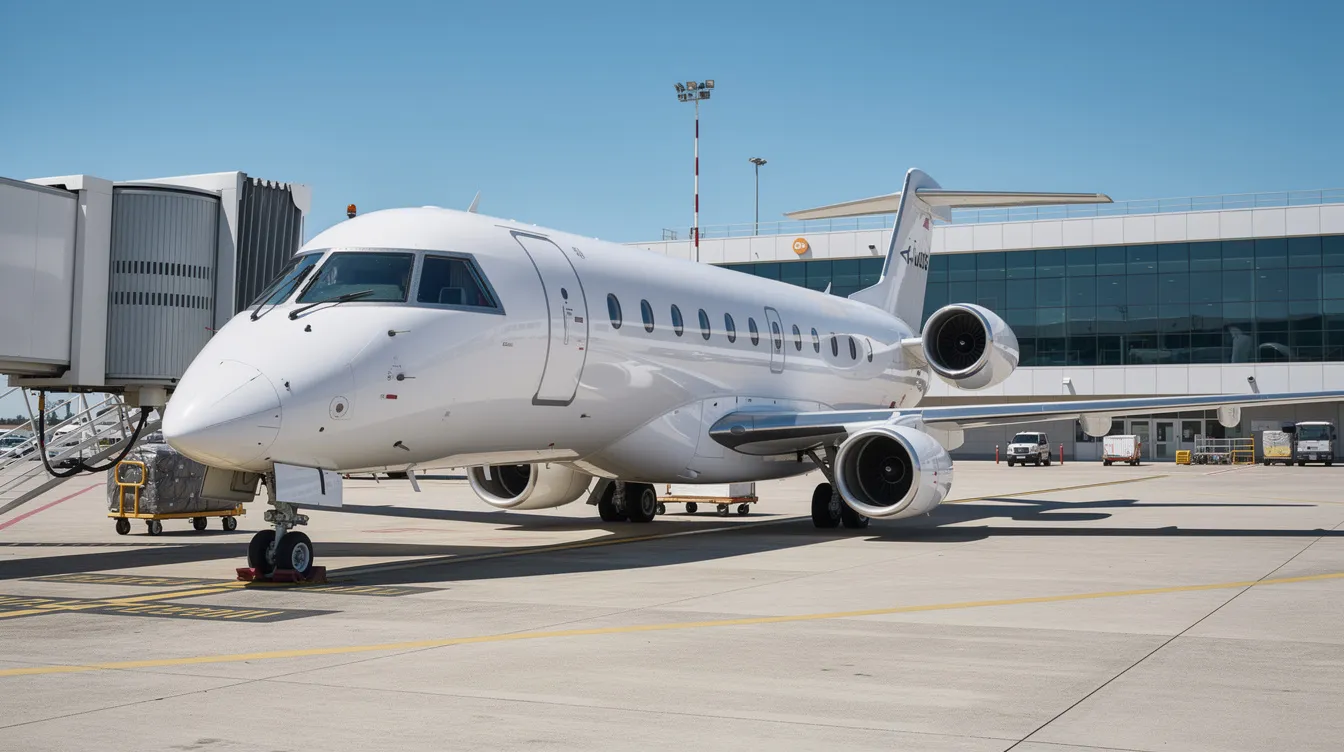
For travelers who see the code "E7W" appear in their booking confirmation, here is everything you need to know about this aircraft-and why it may be the last commercial regional jet you fly before stepping into private aviation.
What is the United E7W and why does it matter for premium travelers?
"United E7W" is United Airlines' internal designation for the Embraer 175 regional jet operated on United Express routes, a 70-seat, two-cabin aircraft used mainly on short-haul regional flights. You will see this aircraft type referenced across seat map tools, the United app, the airline website, and third-party review sites whenever you book a short-haul flight through a United hub, so knowing what E7W means helps when comparing seats, upgrades, and schedules.
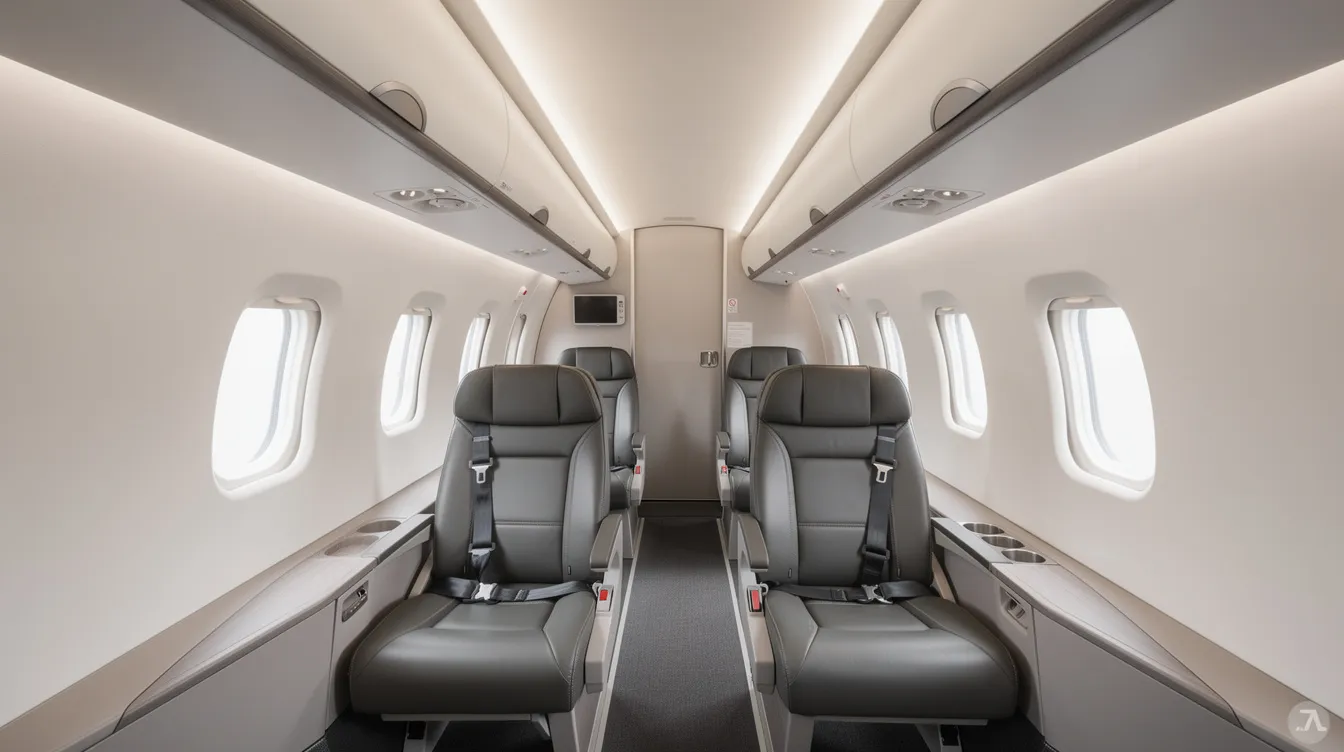
The United E7W has 70 total seats across two classes. First class features 12 seats with a 1-2 layout, while economy class has 58 seats in a 2-2 configuration. Among those 58 economy seats, there are 16 Economy Plus seats with extra legroom, positioned near the front of the cabin.
Affluent and frequent travelers pay attention to this aircraft type because the E7W often sets the standard for regional commercial comfort: its 2-2 seating eliminates middle seats entirely, a clear advantage over older 50-seat jets like the CRJ200, and most 2024–2026 frames now offer wi fi and power outlets. For business travelers and high-net-worth leisure flyers weighing whether to keep traveling on regional airline routes or move to private aviation, that benchmark matters. This guide looks at the United E7W's cabin layout, seat strategy, performance, safety, and role in United's network, then compares that experience with BlackJet's private jet service on similar city pairs where privacy, flexibility, and time savings can outweigh what is available to passengers traveling on these short-haul city pairs.
For many passengers considering a move into private aviation, commercial regional jets like the E7W serve as the comparison baseline, whether they ultimately charter whole aircraft, compare private jet rideshare options for shared seats, or invest in Jet Cards.
United Express and the role of the E7W in United's network
United Express is the brand under which regional partners-SkyWest Airlines, GoJet, Republic Airways, and others-operate flights on behalf of United Airlines. These partners fly the Embraer 175 to link secondary cities to major hubs: Denver (DEN), Chicago O'Hare (ORD), Houston (IAH), Newark (EWR), Washington Dulles (IAD), and San Francisco (SFO). Typical routes include Burbank–San Francisco, Madison–Chicago, and Spokane–Denver, whereas private aviation can scale up to group movements on the best private jet options for 20 passengers when corporate teams or families travel together.
The E175 typically operates with a capacity of 70 to 76 passengers, and it sits at the upper limit of what regional partners can fly under U.S. scope clause agreements with pilot unions-typically capped at 76 seats and specific maximum takeoff weights around 86,000 lbs. These clauses are why the heavier next-generation "E175-E2" has not entered U.S. regional service, keeping the current E7W configurations relevant well into 2026 and beyond.
The E175 can operate efficiently from airports with lower passenger volumes, making it ideal for connecting smaller community markets to mainline hubs, while large-group private charters on private jets for up to 50 passengers can bypass hubs entirely for events or roadshows. For BlackJet members, many of these same short-haul city pairs are exactly the segments they now choose to fly by private jet-bypassing tight connections, delays, and congested hubs on routes where commercial schedules feel limited.
E7W cabin layout, first class seat map, and in-flight amenities
Walking through the seat map of United's Embraer 175 reveals a cabin designed to elevate the regional experience beyond what travelers might expect from a smaller plane.
United First Class
The United E7W has 70 total seats across 2 classes:
United First (rows 1–4): 12 seats in a 1-2 layout-single seat on the left, pair on the right. First class seats have a pitch of 37 inches and width of 20 inches, and premium service typically includes meals on longer or more premium regional flights.
Economy Plus
Standard Economy
The 2-2 layout means no middle seats anywhere on the aircraft-a point many travelers specifically seek when choosing between aircraft types.
In-Flight Amenities
The E7W offers Wi-Fi and 110V power outlets. Power outlets are available at every first class seat, though amenities can vary by version of the E175, and older versions may have outlets only up front, so check the specific seat map when booking.
Newer E175s feature "enhanced" overhead bins that fit standard roll-aboards wheels-first, reducing the risk of gate-checking bags. Check the seat map or aircraft details when booking if you want to confirm amenities. From a premium traveler's perspective, the E7W delivers one of the more comfortable regional jet experiences in the commercial world-but it still cannot match the privacy, noise levels, or tailored service of a private jet cabin.
Seat size, comfort, and the hidden strategy of seat selection on E7W
Seat selection on regional jets can dramatically change perceived comfort-especially for taller or high-value travelers trying to maximize rest or productivity during a flight.
Seat Dimensions by Cabin
Here are the key dimensions across the E7W cabin:
Class | Pitch | Width | Recline | Layout |
|---|
First Class | 37 in | 20 in | ~5 in | 1-2 |
Economy Plus | 34 in | 18 in | Moderate | 2-2 |
Standard Economy | 31 in | 18 in | Limited | 2-2 |
Tips for Seat Selection
Tips for seat selection:
Solo travelers in first class should choose the single "A" aisle seat in row 2 or 3 for privacy.
Couples may prefer the "D–F" pair on the right side of first class.
In United Economy, target the bulkhead row (often row 7) for maximum room, though expect fixed armrests and limited under-seat storage near the wall.
Avoid seats in the very last row (row 24) near the aft galley and lavatory-noise, traffic, and non-reclining seats make it a bumpy experience.
Window seats toward the rear can have misaligned windows, reducing the view.
Basic Economy Seat Selection
Basic Economy fares restrict seat selection on the E7W, often auto-assigning seats in the rear cabin-sometimes splitting families. The workaround: pay extra fees for a preferred seat or upgrade your fare class.
Private Jet Comparison
Contrast this with BlackJet's premium private jet card programs: on a private jet, guests effectively own the cabin. No seat map competition, no neighbors, and seating that can be configured for work, sleep, or conversation. Learn more about how Jet Cards work to see the difference.
Performance and technical profile of the Embraer 175 (E7W)
For aviation-savvy readers who want to understand how the E7W actually performs, here is a concise technical snapshot-and a useful contrast with the cheapest private jet options for entry-level flyers.
Speed and Range
The Embraer E7W has a cruise speed of 530 mph (approximately 0.75 Mach to 0.82 Mach), a maximum range of approximately 2,150 nautical miles in airline configuration, and a service ceiling of about 41,000 feet.
Engines and Efficiency
The aircraft measures approximately 104 feet in length with a wingspan of 76 feet, 3 inches-wide enough for a comfortable 2-2 cabin cross-section with full-size overhead bins. It is powered by two General Electric CF34-8E engines, and each engine generates 14,500 pounds of thrust. The E175 incorporates winglets to improve fuel efficiency and reduce drag, and its modern fly-by-wire flight controls contribute to smooth handling and an excellent safety record.
Cabin and Comfort Features
Compared to older 50-seat regional jets, the E175 offers substantially better fuel efficiency per seat-mile, a quieter cabin, and specifications that made the E-Jet family the dominant regional platform in North America by the mid-2010s-effectively replacing the CRJ200 and ERJ-145 on most routes, while private aviation maintains an equally strong record, as shown in analyses of how safe private jets are compared to other air travel.
Comparison to Older Regional Jets
For context, popular light jets that BlackJet clients use on similar sectors-such as the Citation CJ series or the Phenom 300-offer comparable or superior range, faster climb profiles, and the ability to use shorter runways at secondary airports, saving significant time on the ground.
Safety, reliability, and how Embraer compares to other airlines' fleets
For discerning travelers, safety and reliability sit above all other considerations-whether flying commercial on United E7W or privately using a Jet Card, including higher-commitment options like a 100-hour jet card program.
E-Jet Family Safety Record
The Embraer E-Jet family includes narrow-body, short- to medium-range regional jet airliners that have accrued millions of flight cycles since entering service around 2005, with an extremely low rate of serious incidents.
Manufacturer Overview
Embraer, based in Brazil, is the world's third-largest civil aircraft manufacturer after Airbus and Boeing, and its E-Jet program was designed with modern avionics and redundancy standards on par with larger aircraft.
Is an Embraer as safe as a Boeing or Airbus? All three manufacturers must meet stringent FAA and EASA certification requirements. United holds a 7/7 safety rating from Airlineratings.com, and accident statistics for contemporary models are comparably low across the world's major manufacturers.
Comparison to Other Airlines
Other airlines' E175 fleets-Delta Connection, American Eagle partners-share the same core airframe and safety profile, with differences mostly in cabin configuration and onboard entertainment or IFE options, much like how major providers differ in NetJets jet card cost and structure.
Private Jet Safety Standards
BlackJet's approach to safety mirrors this rigor. Every flight uses BlackJet Certified operators vetted through ARG/US or Wyvern ratings, strict pilot experience minimums, and ongoing audits-a selectively curated safety ecosystem that meets or exceeds major airline oversight and matches the standards of top private jet companies for luxury travel and service.
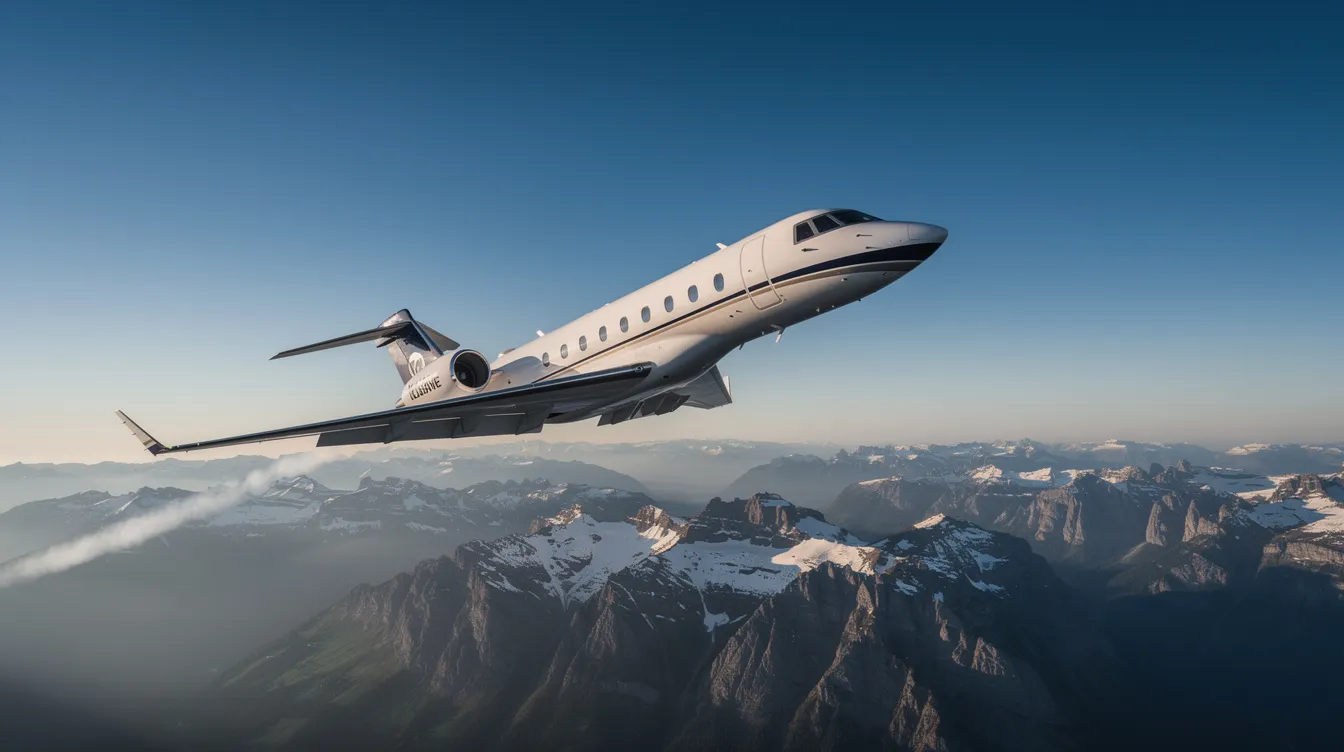
When the United E7W makes sense-and when private jet access is the smarter move
The E7W remains one of the most comfortable ways to fly regional routes commercially. But there are clear scenarios where high-net-worth or corporate travelers step up to private aviation, sometimes via midrange options like a 50-hour jet card program that locks in predictable access.
Commercial Use Cases
Consider these trip examples:
A Monday morning New York–Toronto day trip: commercial requires arriving 90+ minutes early at EWR, clearing security, boarding, deplaning, and customs. A BlackJet light jet departs from a private terminal in 15 minutes, and frequent flyers often compare the best jet cards for maximizing flexibility when deciding how to structure that kind of recurring trip.
A West Coast shuttle like Burbank–San Francisco: the E7W service is solid, but a private flight can visit Santa Rosa (closer to Napa) or San Jose with zero connection risk.
A hub-bypass routing like Denver–Santa Rosa where no direct commercial flight exists, eliminating a layover entirely.
Private Jet Advantages
The key commercial pain points on E7W and similar regional jets: tight connection windows, delays tied to congested airspace at SFO or EWR, limited late-night frequencies, and the cumulative time cost of security lines, boarding, and deplaning.
Key Pain Points on E7W
Door-to-door, private jet travel can save 2–4 hours per leg versus regional commercial flights. For some low-congestion routes, commercial first class on the E7W remains sensible. But for mission-critical or privacy-sensitive trips, a practical cost comparison of chartering a private jet shows why Jet Card access becomes a strategic tool-not a luxury splurge.
From United E7W to BlackJet: evaluating Jet Cards, sustainability, and technology
Many BlackJet members started as top-tier commercial frequent flyers on aircraft like the United E7W, then graduated to Jet Cards once their time, privacy, and scheduling needs outgrew even first class on a regional jet, often beginning with a 25-hour jet card as a test of private access.
Jet Card Basics
A Jet Card works in concrete terms: prepaid hours (25-hour or 50-hour programs), fixed hourly rates across aircraft categories, no ownership responsibilities, and guaranteed availability, with jet card membership pricing that makes costs more predictable than ad hoc charter.
Booking and Flexibility
BlackJet's digital booking platform offers free basic search access, then lets members review routes, aircraft types, and cabin layouts-light, midsize, super-midsize, large cabin-and confirm flights in minutes, compared to hunting through commercial schedules and seat maps or figuring out how to buy a seat on a private jet with multiple providers.
Sustainability Considerations
On sustainability: while regional jets like the E175 are relatively fuel-efficient within commercial fleets, BlackJet arranges carbon-neutral private flights through high-quality offsets at no extra cost to the traveler-a commitment that goes further than what any commercial airline currently offers per individual passenger, even when you opt for the cheapest private aircraft and budget-friendly options in the market.
Who Should Consider Jet Cards
For travelers who know the United E7W intimately-who have boarded it dozens of times, who understand every row and every comment about legroom-and who feel their time is worth more than yet another regional connection, the path forward is clear. Explore how a BlackJet 25+ Hour Jet Card can replace multiple commercial segments each month with seamless, private, carbon-neutral flights.
Conclusion: Elevate Your Travel Beyond the United E7W
The United E7W Embraer 175 sets a high bar for regional commercial aviation with its thoughtful cabin design, efficient performance, and enhanced passenger amenities. Yet for discerning travelers who prioritize privacy, flexibility, and time savings, understanding the private jet price list and access models shows how private jet access through BlackJet offers an awesome alternative. With proprietary safety certifications, seamless digital booking, and a commitment to carbon-neutral flights, BlackJet transforms how high-net-worth and corporate travelers approach short- and medium-haul journeys.
Whether you are weighing the specifications of the E7W against private jet options or seeking a more personalized, stress-free experience, comparing jet card cost per hour can clarify why the choice to upgrade to a Jet Card program unlocks new possibilities. Say goodbye to the constraints of commercial schedules, limited catering, and crowded cabins. Instead, click into a world of bespoke travel where every detail—from aircraft selection to in-flight service—is tailored to your needs.
Discover how BlackJet can reshape your travel and join a community that values time, safety, and sustainability at every altitude.


 Sign up with google
 Sign up with Apple