Introduction: Why Aircraft Types Matter for the Private Traveler
Knowing the difference between aircraft types is more than an aviation enthusiast's hobby — it's a strategic advantage. Whether you're evaluating a transatlantic flight on commercial airlines or booking a direct charter to a regional airport, the aircraft you fly on shapes your entire experience: cabin comfort, total travel time, airport access, and arrival readiness.
Consider the contrast. A commercial first-class seat on a Boeing 737 or Airbus A330 subjects you to fixed schedules, crowded terminals, and connections. A private flight on a super-midsize or large-cabin jet gets you door-to-door in a fraction of the time, departing from thousands of smaller airports that airliners never touch. For frequent, high-net-worth travelers, understanding these categories isn't optional — it's how you make every hour count.
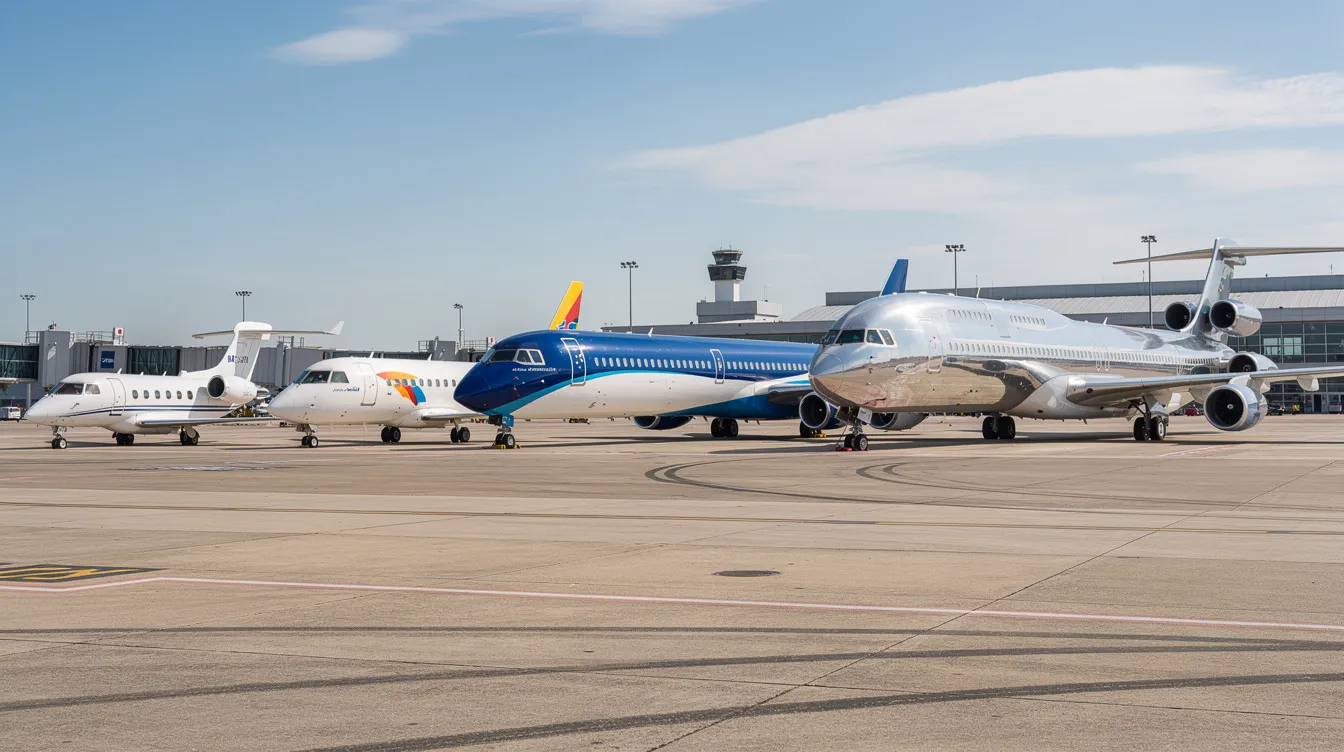
This article walks through the major aircraft types with concrete examples and suggested pictures for each — from narrow-body workhorses and wide-body long-haulers to business jets and special-purpose planes. You'll learn to visually distinguish Boeing jets from the USA and Airbus aircraft from Europe by their nose shape, winglets, and engines.
At the core, airplanes generate lift via forward airspeed over stationary wings — but the design choices built around that principle vary enormously. BlackJet's Jet Card model lets members choose from multiple aircraft categories on demand, matching the right aircraft to each mission rather than locking you into a single type.
Main Aircraft Categories at a Glance (With Visual Guide)
The Federal Aviation Administration classifies aircraft into seven primary categories, while ICAO uses code letters A through F based on size (a Boeing 737 belongs to code C, for instance). For travelers, six practical groupings matter most: These are often organized by intended usage, such as passenger, cargo, military, or private travel.
Category | Flagship Examples | Typical Role |
|---|
Narrow-body airliner | Boeing 737, Airbus A320 | Short/medium-haul commercial |
Wide-body airliner | Airbus A380, Boeing 787 | Long-haul, high-capacity routes |
Regional jet | Embraer E175, CRJ900 | Hub feeder, secondary cities |
Turboprop | ATR 72, Dash 8 | Short routes, small airports |
Business jet | Gulfstream G650, Challenger 350 | Private charter, corporate transport |
Special-mission aircraft | Military fighters, cargo freighters | Defense, freight, experimental |
BlackJet clients most frequently access light, midsize, super-midsize, and large-cabin business jets — the categories explored in depth below, which align closely with the main private jet sizes used in business aviation.
Commercial Narrow-Body Airliners: Single-Aisle Workhorses
Narrow-body airliners are single-aisle planes, with seats arranged along one cabin line, that typically seat two to six passengers abreast and carry 120 to 230 travelers on short and medium-haul routes. They are the most common types of aircraft in the skies and the backbone of domestic air travel worldwide.
Boeing 737 Family
The Boeing 737 took its first flight in April 1967 and entered service with Lufthansa in early 1968. The Boeing 737 Next Generation was introduced in 1965 as a design program that evolved into one of aviation's best-selling families. The current 737 MAX family includes Max 7, Max 8, Max 9, and Max 10 — each featuring high-bypass LEAP-1B engines and split scimitar winglets that improve fuel efficiency by roughly 14% over predecessors.
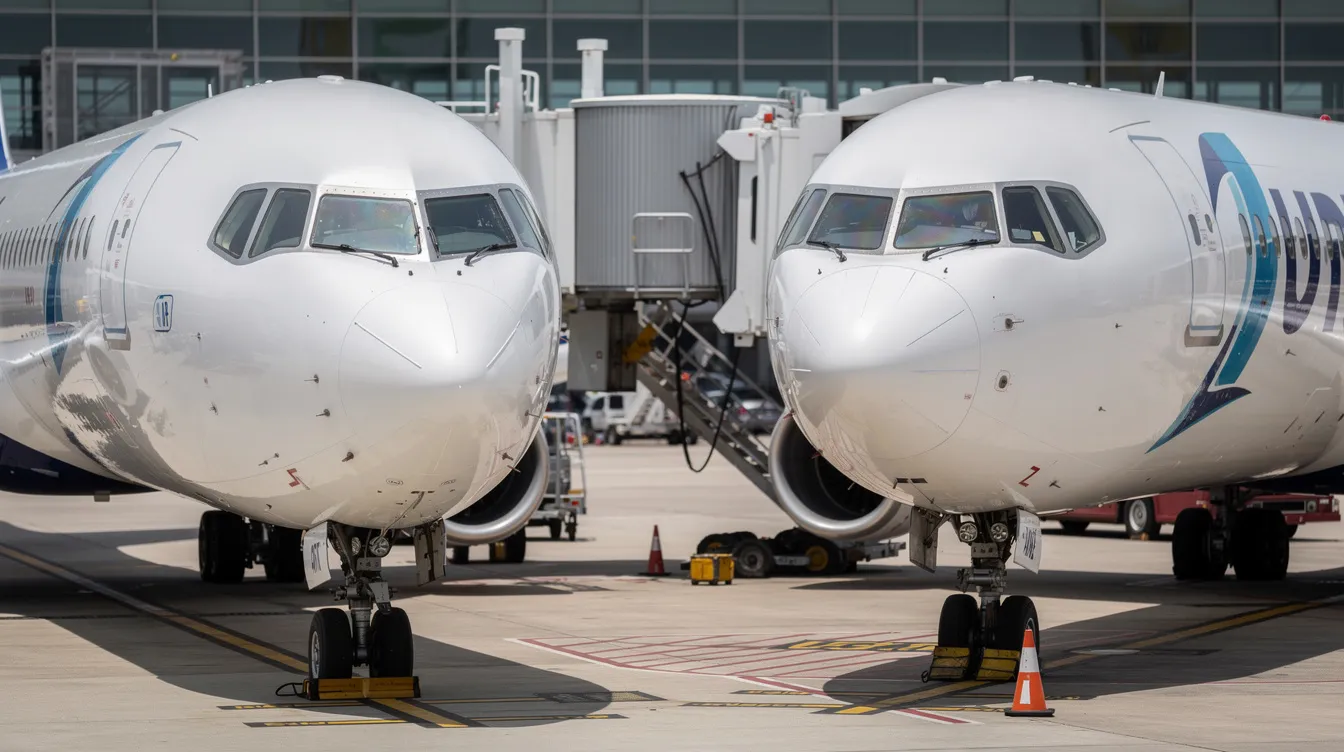
Boeing aircraft have a sharper, pointed nose design, which is one of the fastest ways to distinguish them on the ground or in a photo.
Airbus A320 Family
The Airbus A320 family includes four models: A318, A319, A320, and A321. The A320 can transport up to 180 passengers in a typical single-class layout. The neo variants, introduced in the mid-2010s, use Pratt & Whitney PW1100G or CFM LEAP-1A engines paired with distinctive "sharklet" wingtips.
Airbus aircraft typically feature a rounder, bulbous nose design — a clear visual contrast to Boeing's sharper profile when comparing cockpit close-ups. The cockpit windows differ too: Airbus uses straighter, more angular frames while Boeing historically used curved "eyebrow" windows.
For BlackJet members, the comparison is stark: boarding a narrow-body airliner at a major hub means arriving two hours early, navigating security, and sharing the cabin with 180 passengers. A light or midsize private jet carries 5 to 10 people, departs on your schedule, and accesses smaller airports closer to your destination.
Commercial Wide-Body Airliners: Long-Haul and High Capacity
Wide-body airliners accommodate seven to ten passengers abreast across two aisles, typically seating 250 or more. They serve transcontinental and intercontinental routes where range and capacity matter most.
Airbus Wide-Bodies
The Airbus A330 was introduced in the early 1990s and remains a versatile medium-to-long-haul workhorse utilized by airlines worldwide. The Airbus A350 entered service with Qatar Airways, its launch customer, in January 2015, featuring a fuselage built from roughly 53% composite materials — a leap in fuel efficiency and passenger comfort. The Airbus A380, the world's largest passenger aircraft, seats 500+ in typical configurations and serves routes like London–Dubai, where Emirates operates dozens of weekly flights.
Boeing Wide-Bodies
The Boeing 767 made its first flight in September 1981, opening the era of efficient twin-engine, twin-aisle transport. The Boeing 777 followed with its first flight in June 1994, serving high-demand routes like New York–Tokyo. The Boeing 787 Dreamliner took its first flight in December 2009, and All Nippon Airways became its launch customer, with composite construction and lower cabin altitude (around 6,000 feet) helping reduce passenger fatigue on long flights.
For discerning travelers, these aircraft offer excellent commercial first-class products — but they remain tied to fixed schedules and major airports. BlackJet's large-cabin and ultra-long-range business jets cover similar distances with fully flat beds, private interiors, and departure from thousands of additional airports, getting the job done for travelers who prioritize privacy and schedule control.
Regional Jets and Turboprops: Connecting Secondary Cities
Regional jets are usually designed to seat fewer than 100 passengers, feeding traffic into major hubs and serving shorter routes that larger planes cannot economically cover.
The Embraer E-Jet family (E170, E175, E190, E195) seats 70 to 130 passengers in comfortable 2-2 configurations. The Bombardier CRJ series (CRJ700, CRJ900, CRJ1000) fills a similar role across North American and European networks.
Turboprop aircraft are powered by turbine engines driving propellers. Models like the ATR 42 and ATR 72 — ATR planes typically carry between 40 and 70 passengers — excel on short runways and island routes, and pilots operating aircraft such as the ATR 72 or Dash 8 need aircraft-specific training for these regional platforms. The De Havilland Dash 8 (Q400) serves similar missions with strong short-field performance.
The trade-off: turboprops are slower and noisier than jets, but far more economical per seat on flights under 500 nautical miles.
Sample scenario: An executive needs to reach a remote manufacturing site accessible only via a 4,500-foot runway. The commercial option involves two connections and six hours of travel. A BlackJet charter on a light jet or turboprop flies direct in 90 minutes, with the ability to use that same short runway. The time savings alone justify the cost for anyone whose hours carry real value.
Iconic Flagship Airliners: Airbus A380, Boeing 747, and More
Some aircraft types define eras of flying. These giants shaped what long-distance air travel looks like today.
Airbus A380
Airbus A380 development began in the late 1990s, producing the world's first full-length double-deck airliner. With a capacity exceeding 500 passengers in standard three-class layouts (and up to 853 in maximum density), the A380 remains the largest commercial aircraft ever built. Its sheer scale — visible in any airport gate photo — is unmistakable.
Boeing 747
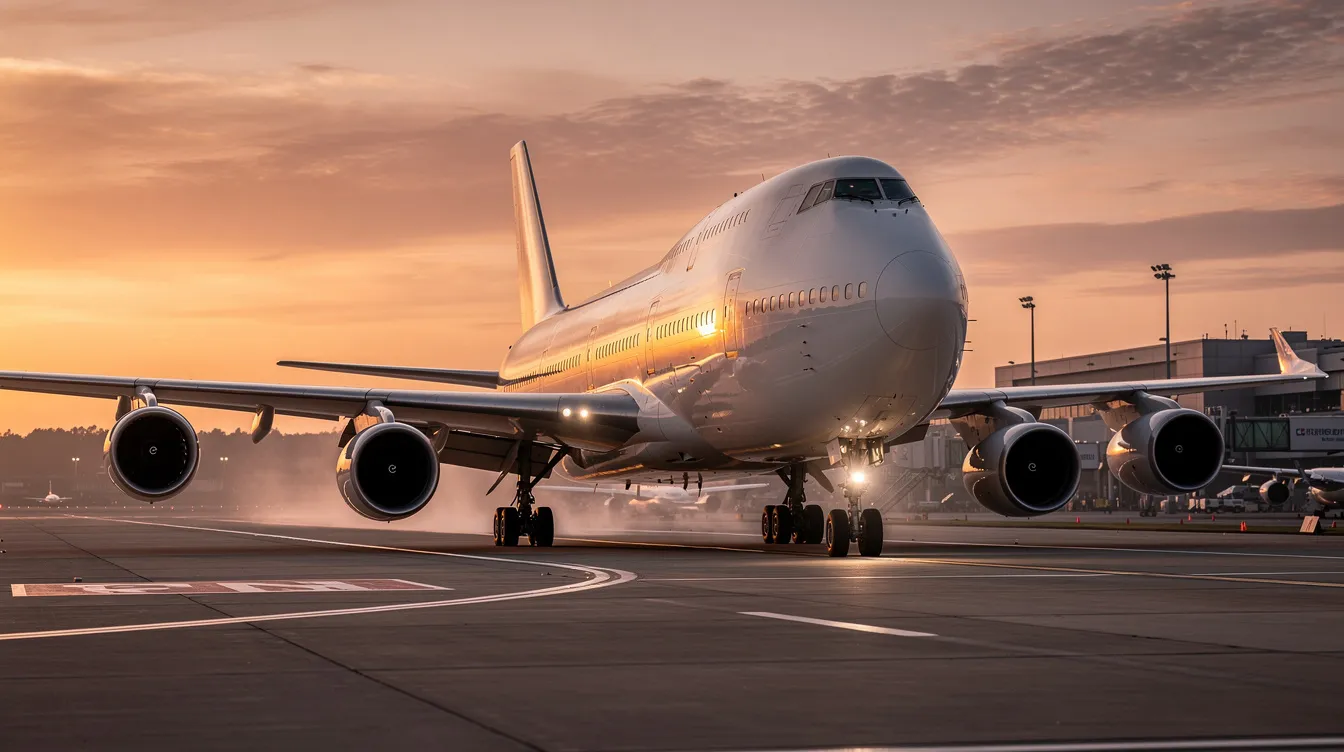
The Boeing 747 first flew on February 9, 1969, and entered commercial service with Pan Am in January 1970. With a length of 76.3 meters and its iconic upper-deck hump, the 747 earned the title "Queen of the Skies" and opened long-haul air travel to thousands of passengers who had never flown internationally. Variants evolved over five decades, from the original 747-100 through the 747-8, the final variant now serving primarily as a freighter.
Other notable long-haul models include the four-engine Airbus A340 and the twin-engine Boeing 777 — each with visually distinct wing and engine configurations worth studying in side-profile photos.
For high-net-worth travelers, first-class suites on these flagships offer luxury — but they cannot match the privacy and schedule control of a large-cabin private jet. A Gulfstream G650ER or Bombardier Global 7500 covers intercontinental range with 10 to 16 passengers in a fully private cabin.
Business Jets by Cabin Class: From Light Jets to Ultra-Long-Range
Business jets are high-performance aircraft optimized for corporate transport, and they represent the core of what BlackJet members access through the Jet Card program and broader BlackJet private aviation services. Here's how the aircraft categories break down:
Category | Models | Range | Passengers | Hourly Cost |
|---|
Light | Citation CJ4, Phenom 300 | 1,500–2,500 nm | 5–9 | $2,500–$3,800 |
Midsize | Hawker 800XP, Citation Latitude | 2,000–3,000 nm | 7–10 | $3,500–$5,000 |
Super-midsize | Challenger 350, Citation Longitude | 2,800–4,200 nm | 8–12 | $4,500–$7,000 |
Large cabin | Gulfstream G550, Falcon 900 | 3,500–6,000 nm | 10–16 | $5,500–$9,500 |
Ultra-long-range | Gulfstream G650/700, Global 7500 | 6,000–7,500+ nm | 10–19 | $7,000–$20,000+ |
A BlackJet member flying to Miami for a weekend selects a light jet. The same member heading to London for a board meeting books an ultra-long-range cabin with lie-flat seating and a private galley. The Jet Card model eliminates the need to own or commit to a single aircraft type - you match the jet to the mission. For a deeper look at membership economics, review our guide to jet card cost and value alongside our types of private jets guide.
BlackJet ensures every flight across all these jet categories is carbon-neutral — at no extra cost to the member.
Private Turboprops and Very Light Jets: Smart Choices for Short Hops
Not every trip demands a midsize cabin. For flights under two hours and access to short runways, turboprops and very light jets deliver exceptional value.
The Pilatus PC-12 and Beechcraft King Air 250 offer club seating for six to nine passengers, spacious baggage capacity, and the ability to operate from runways as short as 2,500 feet. Hourly costs range from approximately $1,100 to $2,900 — a fraction of larger jet categories.
Very light jets like the Embraer Phenom 100 and Cessna Citation Mustang carry four to six passengers at jet speeds, with ranges around 1,200 to 2,000 nautical miles. They bring jet performance to airports that commercial airlines and larger business jets cannot reach and are among the most affordable private jet options for shorter trips.
The operational advantage is direct routing. Instead of driving two hours from a commercial airport to your final destination, you land 15 minutes away. BlackJet Jet Card members can access these categories for regional hops — check private plane rates for current cost breakdowns and our overview of the private jet price list for broader cost comparisons.
Special-Purpose Aircraft: Cargo, Military, and Experimental Types
Not all aircraft carry passengers. The aviation world includes a broad spectrum of specialized platforms.
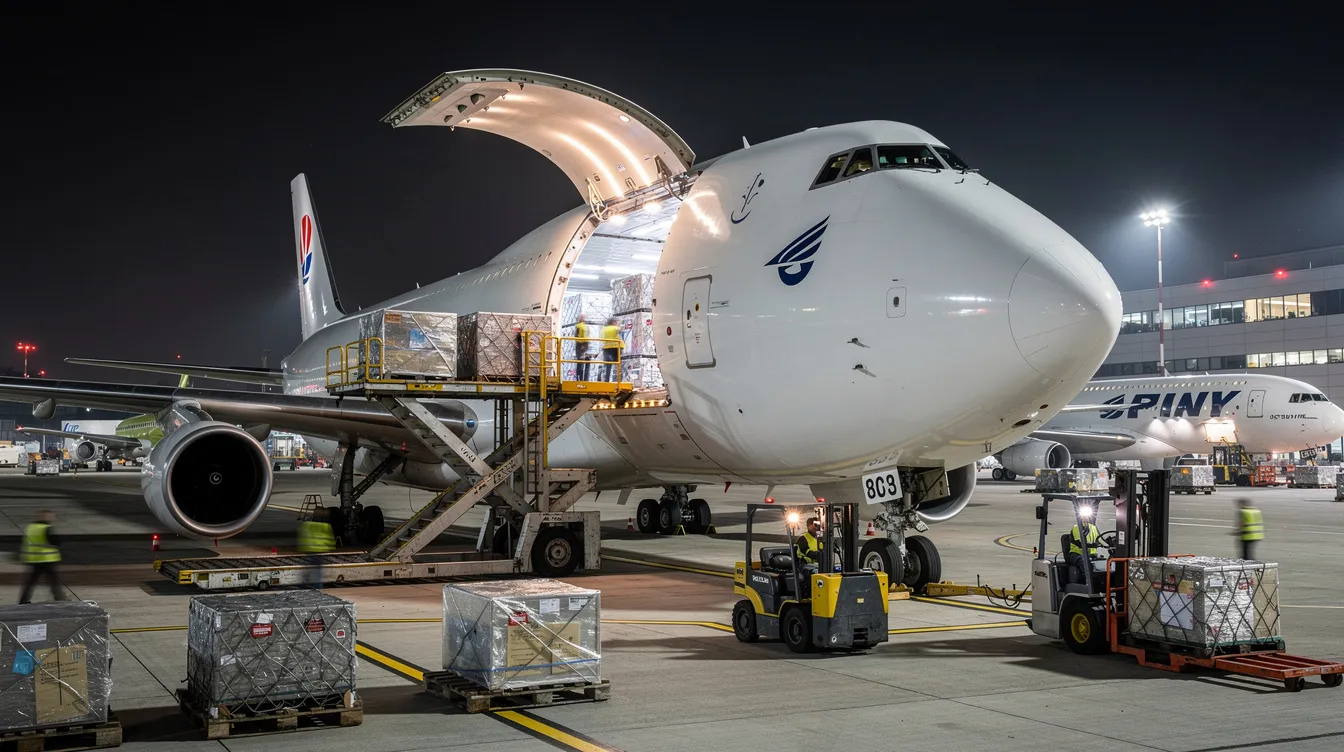
Cargo aircraft are built explicitly for transporting freight. The Boeing 747-8F, Boeing 777F, and Airbus A330-200F haul palletized cargo across global supply chains — visible in photos showing nose-loading doors and cavernous, seatless fuselages.
Military aircraft are designed for combat, reconnaissance, or transport purposes. Fighters like the F-16 and F-35, strategic bombers, and tanker aircraft differ dramatically in design from civilian models — prioritizing speed, stealth, and mission equipment over passenger comfort.
Beyond these, general aviation encompasses non-scheduled civilian flying — from training aircraft to personal planes. The category also includes seaplanes designed to take off from and land on water, agricultural airplanes specialized for crop management and treatments, aerobatic airplanes designed for performing precise flight maneuvers, ultralight airplanes that are lightweight and often used for recreational flying, helicopters that can take off and land vertically, hover, and reach remote areas for rescue, medical, or utility work, and even gliders that rely on air currents for flight without an ongoing engine power source.
Experimental and prototype aircraft - including electric regional demonstrators and blended-wing concepts - push the boundaries of what's possible. While BlackJet does not operate cargo or military aircraft, advances proven in these platforms (composite materials, avionics, safety systems) regularly filter into the business jets our members fly, including many of the best private jets in the world.
Sustainability and New Technologies in Modern Aircraft
Modern Airbus and Boeing jets like the A350 and 787 use composite fuselages and high-bypass engines to cut fuel burn by 20–25% compared to predecessors. These gains matter — fuel efficiency improvements directly reduce emissions per passenger mile.
The industry is also advancing sustainable aviation fuels (SAF), hybrid-electric regional demonstrators, and lighter cabin materials. SAF can reduce lifecycle carbon emissions by up to 80%, though supply remains limited.
In private aviation, carbon offset programs bridge the gap. BlackJet guarantees carbon-neutral flights for all members by investing in verified offset projects — reforestation, renewable energy, and methane capture — at no additional cost, even on ultra-long-range private jets covering intercontinental sectors.
Case example: A BlackJet client flying New York to London on a large-cabin jet generates approximately 25 tons of CO₂. BlackJet's offset program neutralizes this through verified environmental projects, making the journey net-zero. Real-time digital booking tools further optimize routing to minimize both flight time and emissions.
How Aircraft Types Affect Comfort, Safety, and Experience
Aircraft type directly shapes your ride quality. Modern wide-bodies like the A350 and 787 maintain lower cabin altitudes (around 6,000 feet versus 8,000+ on older aircraft), reducing fatigue and dehydration on long flights. Business jets achieve similar or better pressurization.
Larger aircraft generally handle turbulence with less perceived motion — relevant for nervous flyers selecting between a light jet and a super-midsize for the same route.
Safety certification matters across all categories. Commercial airliners operate under FAA Part 121; private charter falls under Part 135. BlackJet works exclusively with operators meeting the highest safety ratings, including third-party audits through programs like Wyvern and ARGUS. Travelers comparing leading providers such as NetJets jet card pricing can also learn more about BlackJet's certification standards and how they compare in our private jet safety overview.
Practical Guide: Choosing the Right Aircraft Type for Your Trip
Aircraft selection is a strategic decision. The right choice balances distance, passenger count, luggage volume, work requirements, and airport access.
Decision framework:
Trip distance - Does the aircraft have nonstop range?
Passengers and luggage - More people and bags demand a larger cabin.
Airport access - Smaller airports require shorter-runway-capable aircraft.
Mission type - Business meeting (need Wi-Fi, workspace) vs. leisure (comfort, sleep).
Scenario examples: Frequent flyers who see themselves in these scenarios may benefit from exploring the best jet cards for regular travelers to lock in predictable access and pricing.
Los Angeles to Las Vegas weekend (235 nm): Very light jet or turboprop - 45 minutes, small airport access, cost-effective.
New York to Miami business trip (1,100 nm): Light or midsize jet - 2.5 hours nonstop, comfortable workspace for four to six travelers.
New York to London board meeting (3,450 nm): Large-cabin or ultra-long-range jet - 7 hours nonstop, lie-flat beds, full galley, private conference space, similar to the best private jets for 15 passengers used for executive teams.
Multi-city European roadshow (London–Paris–Milan–Zurich): Super-midsize jet - range flexibility, rapid turnarounds at smaller international airports, with configurations comparable to the best private jets for 20 passengers when teams travel together.
BlackJet's Jet Card programs simplify this entirely. Members select from available aircraft categories on demand through a digital platform, with 24/7 support matching the optimal jet to each trip; if you're comparing models, our guide to jet card pricing structures explains how costs are typically built.
FAQ: Common Questions About Aircraft Types and Private Jet Access
What is the difference between narrow-body and wide-body aircraft? Narrow-body airliners have a single aisle and seat two to six passengers abreast. Wide-body airliners feature two aisles and seat seven to ten passengers abreast, designed for longer range and higher capacity. If you're evaluating private options instead of commercial cabins, our overview of 50-hour jet card costs can help you translate these aircraft differences into budgeting terms.
How does an Airbus A380 compare to a large-cabin private jet? The A380 carries 500+ passengers on fixed schedules. A large-cabin jet like the Global 7500 covers comparable distance with 10 to 19 passengers in a fully private cabin — with flexible departure times and access to far more airports; our guide to 16-seat private jet options dives deeper into these large-cabin layouts.
Which aircraft types can land at smaller regional airports? Light jets, very light jets, and turboprops excel at short runways and smaller fields. Larger commercial aircraft require longer runways and full-service terminals. Travelers who don't need the whole aircraft can still buy a seat on a private jet on many of these routes.
How does a Jet Card work across different aircraft categories? BlackJet Jet Card members purchase prepaid flight hours and select from multiple aircraft categories based on each trip's requirements — no ownership, no single-aircraft commitment. If you're comparing providers, it can be useful to understand Flexjet Jet Card costs and structures as a point of reference.
Are all aircraft used by BlackJet carbon-neutral? Yes. BlackJet guarantees carbon-neutral flights across every aircraft category through verified offset programs, included at no additional cost to members, extending even to clients exploring private jets for sale in the UK who want sustainable ownership strategies.
What safety standards apply to private jets versus commercial airlines? Commercial airlines operate under FAA Part 121. Private charter operates under Part 135. BlackJet requires operators to meet top-tier safety ratings with independent third-party audits.
What are the most common types of commercial airliners in the world? The Boeing 737 family and Airbus A320 family dominate global airline fleets, collectively serving hundreds of airlines across every continent, while the largest private jets for charter or sale bring similar intercontinental reach to small groups in bespoke cabins.
Conclusion: Mastering Aircraft Types for Elevated Travel
Understanding the full spectrum of aircraft types—from the commercial giants that serve millions daily to the bespoke private jets that transform business travel—empowers you to optimize every journey. Choosing the right aircraft is a strategic decision that goes beyond size or cost; it hinges on matching your mission, schedule, and personal standards for safety, comfort, and efficiency.
Fortunately, with options ranging from nimble turboprops to ultra-long-range jets, and innovative technology advancing sustainability and safety, today’s travelers have unprecedented control. BlackJet’s Jet Card programs provide seamless access to this diverse fleet, ensuring you fly on the perfect aircraft tailored to each trip’s unique demands.
By mastering these aircraft distinctions, you unlock not just travel convenience but a premier, carbon-neutral experience that respects your time and values. Explore how BlackJet can elevate your next flight and discover the strategic advantage that private jet access offers in today’s dynamic world.
Discover how BlackJet can reshape your travel. Explore our Jet Card programs, compare options ranging from the most expensive private jets to private jets for 50 passengers, and we hope this guide helps you identify the right aircraft type for your next flight.


 Sign up with google
 Sign up with Apple